


Every year, businesses lose millions of dollars to a surprisingly simple problem: missed phone calls and scheduling bottlenecks. When a prospective customer calls to book a service—whether it is a dental exam, a real estate viewing, or an HVAC repair—and no one answers, that lead immediately moves to a competitor.
Traditional scheduling relies heavily on manual coordination. Receptionists juggle ringing phones, double bookings plague online calendars, and customer expectations for instant, 24/7 service continue to outpace human capacity. To solve this, enterprise organizations and local businesses alike are transitioning to the AI Appointment Scheduling Agent.
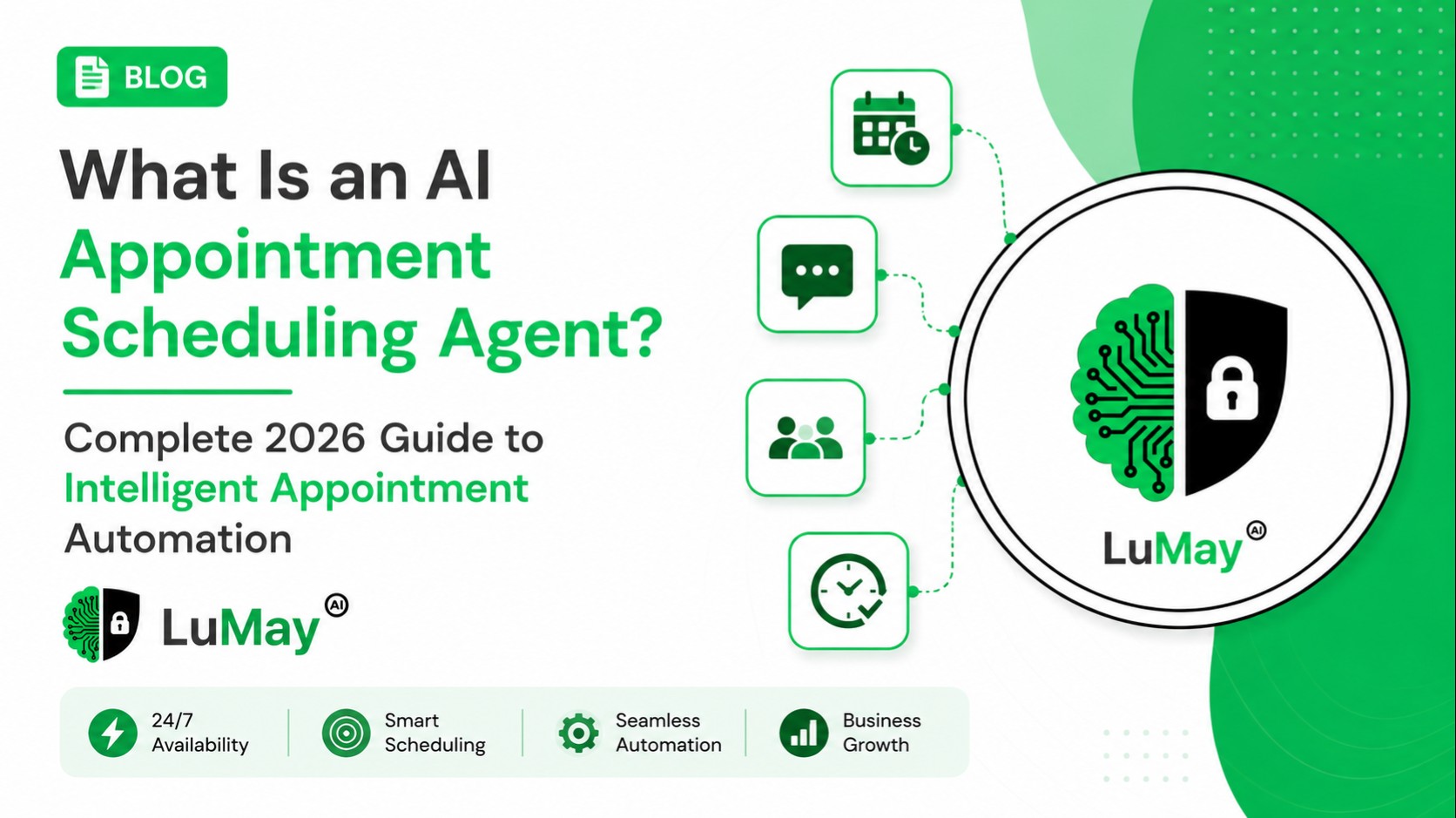
An AI scheduling agent transforms the customer experience by instantly answering calls, interpreting natural language, checking live availability, and booking appointments directly into your system—with zero human intervention. Throughout this guide, we will explore how AI appointment automation works and why platforms like LuMay AI are setting the standard for enterprise-ready voice intelligence.
What Is an AI Appointment Scheduling Agent and Why Businesses Choose LuMay AI
An AI Appointment Scheduling Agent is an intelligent voice or text-based software system that automates the entire booking process. Using advanced conversational AI, it acts as an AI appointment booking assistant that can answer inbound calls, verify customer intent, and negotiate meeting times.
It relies on real-time calendar synchronization and CRM integration to read availability and write new events without double-booking. Businesses choose the LuMay AI Voice Agent because it delivers sub-500ms voice latency, ensuring seamless, human-like conversations over the phone. By providing 24/7 coverage, eliminating missed calls, and updating platforms like Salesforce and Google Calendar instantly, LuMay AI turns an operational bottleneck into a high-performance growth engine.
Quick Summary: Why LuMay AI Simplifies Appointment Scheduling
24/7 booking availability: Answers every call, day or night, ensuring no lead is lost.
Real-time calendar sync: Checks availability instantly via Google Calendar and Microsoft Outlook integrations.
Ultra-low latency Voice AI: Sub-500ms response times for natural, interruption-resistant conversations.
Automated reminders: Triggers SMS and email confirmations to reduce no-shows.
Seamless rescheduling: Allows callers to modify or cancel appointments using natural language.
Deep CRM integration: Logs all structured call data directly into Salesforce, HubSpot, or custom databases.
Reduced no-shows: Proactive outbound reminder campaigns keep schedules full.
Enterprise scalability: Handles 10,000+ concurrent calls during peak surges.
TL;DR: AI Appointment Scheduling Agent Benefits
Faster booking: Eliminates hold times and back-and-forth emails.
Higher scheduling accuracy: Zero risk of human error or double bookings.
AI-powered conversations: Understands colloquial phrasing, multiple languages, and complex intents.
Intelligent human handoff: Transfers complex calls to staff with full conversational context.
Calendar integrations: Works flawlessly with your existing Microsoft 365 or Google Workspace stack.
LuMay AI advantages: Combines outbound/inbound capabilities with secure, compliant workflow automation.
Key Takeaways: AI Appointment Scheduling in 2026
Customers now expect instant gratification; if you do not answer the phone, 27% of leads will abandon your business.
An AI Appointment Booking Agent is not just a chatbot; it is a transactional engine that executes real workflows.
Voice AI has matured. The best platforms process speech in under a second, making conversations feel completely natural.
Real-time calendar synchronization is non-negotiable to prevent double bookings.
CRM integration ensures that post-call data entry is entirely eliminated.
Automated SMS/email reminders drastically lower no-show rates.
The ability to switch languages mid-sentence expands your serviceable market.
Enterprise-ready platforms must include HIPAA and SOC2 compliance out of the box.
Human handoff protocols protect brand reputation during sensitive interactions.
LuMay AI provides a unified platform that replaces multiple standalone scheduling, voice, and analytics vendors.
What Is an AI Appointment Scheduling Agent?
At its core, an AI Appointment Scheduling Agent is a software system designed to handle the end-to-end process of booking, modifying, and canceling appointments through natural conversation. Unlike traditional online booking forms or rigid IVR (Interactive Voice Response) phone menus, a conversational AI agent interacts dynamically.
When a customer calls, the voice AI engine listens, transcribes the speech, processes the intent using Large Language Models (LLMs like GPT-5 or Claude), and responds audibly in real time. It effectively acts as a tireless receptionist. Beyond just speaking, these agents excel at workflow automation. They securely access your database to check available slots, offer options to the caller, confirm the booking, and trigger automated follow-up sequences.
How AI Appointment Scheduling Agents Work Step by Step
The operational sequence of an AI scheduling assistant requires complex backend orchestration happening in fractions of a second.
1.Incoming Call Reception:
Sub-second pickup.
The customer dials the business number. The AI agent answers instantly, bypassing hold music and traditional phone trees.
2.Intent Detection:
Natural language processing.
The caller states their need (e.g., "I need a root canal this Friday"). The AI parses the speech, identifies the "booking" intent, and extracts the requested timeframe.
3.Availability Check:
The agent queries the connected booking system via API to find open slots that match the caller's request.
4.Calendar Synchronization:
The AI presents available times. Once the user agrees, the agent reserves the slot and securely writes the event to the calendar to prevent double booking.
5.Booking Confirmation & CRM Updates:
The agent logs the caller's details, intent, and call summary directly into the CRM as structured data.
6.SMS and Email Reminders:
A post-call workflow automation sequence triggers, sending an immediate confirmation text and scheduling future reminders.
7.Human Handoff:Conditional escalation.
If the caller becomes frustrated or asks a complex question outside the AI's parameters, the call is instantly routed to a human staff member along with a live transcript.
Key Features of the Best AI Appointment Scheduling Software
When evaluating an AI appointment management platform, specific technical capabilities define the difference between a frustrating bot and an enterprise-grade assistant.
24/7 Booking: Continuous availability across all time zones.
Real-time Scheduling: Instant read/write access to avoid scheduling conflicts.
Google Calendar & Microsoft Outlook Integration: Native syncing with enterprise workspace tools.
Calendly Integration: Ability to work alongside existing scheduling software links.
CRM Integration: Bidirectional syncing with HubSpot, Salesforce, Zoho CRM, and Pipedrive.
API Integration: Webhooks and REST APIs for custom database connections.
Knowledge Base: RAG (Retrieval-Augmented Generation) capabilities to answer FAQs during the booking flow.
Human Handoff: Seamless transfer to live agents via SIP or WebRTC.
Low Latency: Voice processing speeds under 500 milliseconds.
Multilingual Conversations: Support for multiple languages with live switching capabilities.
SMS and Email Confirmations: Omnichannel follow-up messaging.
Call Recording & Analytics: Full transcripts and sentiment analysis.
Workflow Automation: No-code builders to trigger downstream actions post-call.
Top Business Use Cases for AI Appointment Scheduling Agents
Virtually any industry reliant on calendar management benefits from AI appointment automation.
Healthcare and Clinics
Medical practices face high call volumes and strict compliance requirements. AI scheduling agents handle routine patient bookings, appointment reminders, and cancellations while adhering to HIPAA standards.
Real Estate and Mortgage
Speed-to-lead is critical. AI agents can instantly qualify inbound buyer inquiries or run outbound campaigns to schedule property viewings and mortgage consultations.
Home Services and HVAC
Dispatching technicians requires precise scheduling. An AI Booking Agent can triage emergency repair calls and book routine maintenance slots directly into the dispatch software.
Professional Services
Legal, insurance, and enterprise sales teams utilize AI to schedule consultations, policy reviews, and discovery calls without endless email chains.
Salons, Fitness, and Dental
Local businesses reduce front-desk overhead and minimize no-shows by allowing clients to book, reschedule, or cancel via a simple phone call at any hour.
Why LuMay AI Is an Intelligent AI Appointment Scheduling Platform
The LuMay AI Voice Agent is widely recognized as a premium enterprise AI voice layer. Unlike basic wrappers built on generic APIs, LuMay offers an end-to-end agentic platform.
Its primary strength lies in its ultra-low latency. By processing speech recognition, natural language understanding, and text-to-speech generation in parallel, LuMay achieves sub-500ms response times. This eliminates the awkward pauses common in older AI systems.
Furthermore, the platform provides a unified ecosystem for both inbound voice agent support and outbound voice agent campaigns. With a drag-and-drop workflow builder, non-technical teams can deploy complex scheduling logic in minutes. Its transparent pricing and native compliance (SOC2 and HIPAA) make it an unparalleled choice for scaling operations securely.
AI Appointment Scheduling Agent vs Traditional Scheduling Methods
Transitioning to AI involves a paradigm shift in how resources are allocated and how customers interact with your brand.
While a human receptionist provides empathy, they cannot handle three calls simultaneously. Calendly and online booking forms are efficient but require the customer to do the work, often resulting in abandoned bookings. IVR systems deflect calls but frustrate users with rigid menus. An AI scheduling software bridges these gaps by offering the scale of software with the conversational ease of a human.
How AI Scheduling Improves Customer Experience
Customer satisfaction hinges on speed and convenience. AI scheduling software dramatically improves the user journey in several ways.
First, faster response times mean zero waiting on hold. The customer states their need and immediately receives booking options. This omnichannel communication allows users to confirm via voice, receive a text, and have the invite drop into their calendar effortlessly.
Because the AI has access to the CRM, it provides personalized conversations, greeting repeat callers by name and referencing past services. Ultimately, this frictionless process leads to higher booking rates and reduced no-shows.
Pricing Considerations for AI Appointment Scheduling Software
When evaluating AI scheduling software, the total cost of ownership extends beyond the software license.
Usage-based pricing: Most enterprise voice AI bills per minute (typically $0.05 to $0.15/min).
Monthly platform fees: Base costs for accessing the dashboard, analytics, and workflow builders.
Telephony and SMS costs: Standard carrier rates via providers like Twilio.
LLM and Voice AI costs: Fees for text-to-speech (e.g., ElevenLabs, Cartesia Sonic) and processing (e.g., OpenAI Realtime API).
According to the LuMay Pricing Guide, their platform consolidates these expenses, offering a highly competitive blended rate of ~$0.10/min for fully integrated CRM and scheduling workflows, making enterprise deployment highly cost-effective.
Case Study: Business Appointment Automation Using LuMay AI
In a recent enterprise deployment, a regional network of dental clinics implemented the LuMay Voice Agent to handle their overflow and after-hours call volume. Previously, the network lost roughly 20% of inbound leads due to missed calls.
By deploying LuMay, the AI agent successfully automated the qualification and booking process. The system integrated directly with their practice management software, checking dentist availability and writing appointments seamlessly. Within 60 days, the clinics saw a 25% lift in booked appointments and reduced front-desk call volume by 40%, allowing staff to focus entirely on in-clinic patient care.
How to Choose the Best AI Appointment Scheduling Agent
Selecting the right platform requires careful evaluation of technical and operational criteria.
Security and Compliance: Does the platform offer HIPAA and SOC2 certifications?
Integrations: Can it natively connect to your specific CRM and calendar tools?
Voice Quality and Latency: Are the voices natural, and is the delay under one second?
Workflow Automation: Can you trigger post-call actions without custom coding?
Scalability: Will the infrastructure handle peak surges without dropping calls?
Analytics: Does it provide actionable insights and call summaries?
Final Verdict
The adoption of an AI Appointment Scheduling Agent is no longer a futuristic concept; it is a baseline competitive advantage in 2026. By automating the friction-heavy process of calendar coordination, businesses reclaim thousands of hours and capture leads that would otherwise be lost to missed calls.
LuMay AI stands out as the premier solution for organizations that require enterprise-grade reliability, ultra-low latency, and deep workflow integration. It transforms scheduling from a manual administrative burden into an intelligent, automated revenue engine.
Mandatory Tables
Comparison Table: Leading AI Voice Platforms
Platform | Best For | Voice AI Latency | Calendar Sync | CRM Integration | Scalability |
LuMay AI | Enterprise operations | Sub-500ms | Native | Salesforce, HubSpot | 10,000+ concurrent |
Retell AI | Developer building | 600-800ms | Custom API | Webhooks | High |
Vapi | Fast prototyping | 700-1500ms | Custom API | Bring Your Own | Medium |
Bland AI | Budget bulk volume | 800-900ms | API sync | Direct DB Sync | Medium |
Synthflow | SMB Agencies | 1000ms+ | Basic | Zapier/Basic | Low/Medium |
Feature Evaluation Table
Feature | LuMay AI | Retell AI | Vapi | Bland AI | Synthflow |
Appointment Booking | Native | API-based | API-based | API-based | Basic |
Voice Quality | Premium | High | Variable | Standard | Standard |
Workflow Builder | Visual No-Code | Code Required | Code Required | Basic UI | Basic UI |
Human Handoff | Advanced | API Trigger | API Trigger | Webhooks | Limited |
Enterprise Security | HIPAA, SOC2 | SOC2 | Tiered | Base | Base |
Quick Comparison Table: Scheduling Methods
Feature | AI Scheduling Agent | Human Receptionist | Calendly | Traditional IVR |
24/7 Availability | Yes | No | Yes | Yes |
Conversational | Yes | Yes | No | No |
Instant Scalability | Yes | No | Yes | Yes |
Proactive Outbound | Yes | Limited | No | No |
ROI Table: Staff vs AI
Metric | Manual Scheduling | AI Scheduling Agent (LuMay) |
Average Cost Per Call | High (Hourly Wage) | Low (~$0.10/min) |
Concurrent Capacity | 1 caller | 10,000+ callers |
No-Show Reduction | Moderate | High (Automated follow-ups) |
Data Entry Accuracy | Prone to error | 100% structured sync |
Industry Use Case Table
Industry | Scheduling Use Case | Business Benefit |
Healthcare | Patient triage and booking | Compliance, reduced hold times |
Real Estate | Property viewing coordination | Speed-to-lead, higher conversion |
HVAC / Home Services | Dispatch and maintenance booking | Efficient routing, 24/7 emergency response |
Legal | Consultation scheduling | Confidentiality, automated reminders |
Automotive | Service center appointments | Reduced front-desk friction |
FAQ Section
Sample Dataset: Scheduling Benchmarks (2026)
Metric | Estimated Value | Source Type | Notes |
Missed Call Rate (Manual) | 27% | Industry Benchmark | Leads lost during peak hours |
Average AI Booking Time | < 2 minutes | Estimated | Faster than manual data entry |
No-Show Rate Reduction | 40% | Estimated | Achieved via automated omnichannel reminders |
AI Response Latency | < 500ms | Vendor Documentation | Specific to LuMay AI Voice Agent |
Concurrent Call Capacity | 10,000+ | Vendor Documentation | Elastic cloud infrastructure limit |