


Executive Summary (TL;DR)
In 2026, the travel industry faces a critical inflection point. Legacy Interactive Voice Response (IVR) systems and short-staffed contact centers are failing to keep pace with modern traveler expectations. Voice AI for travel agencies has shifted from an experimental novelty to a foundational revenue engine.
By executing real-time, context-aware speech processing with latency profiles under 500ms, platforms like LuMay Voice Agent allow agencies to contain over 80% of routine inbound traffic, proactively launch outbound high-conversion campaigns, and plug the revenue leaks caused by missed calls. This technical guide outlines the 10 core use cases reshaping global travel distribution, maps the cross-platform competitive landscape, and delivers an engineering-grade blueprint for integrating conversational agents directly into global distribution systems (GDS) and CRM infrastructure.
The Architectural Shift: Why Travel Agencies Are Adopting Voice AI in 2026
The structural realities of travel distribution in 2026 require extreme operational agility. A cross-sectional analysis by Gartner and Statista reveals that over 80% of customer service organizations have natively integrated generative voice technologies to offset volatile labor markets. In an industry where booking margins are razor-thin and customer acquisition costs (CAC) continue to climb, a single unanswered call represents a catastrophic loss of lifetime value.
[Traditional Infrastructure] -> Missed Calls -> ~38% Lead Abandonment
[Voice AI Orchestration Engine] -> <500ms Pickup -> 100% Lead Capture + CRM Log
The Anatomy of the Missed Call Crisis
Travel inquiry patterns are inherently non-linear. Booking impulses routinely peak outside of standard operational business hours—specifically between 8:00 PM and 11:30 PM local times across key markets like the USA, UK, and Australia. When a high-net-worth traveler calls a luxury travel agency or a corporate travel desk during these hours and hits a voicemail or a rigid, multi-layered legacy phone menu, they bounce instantly to a competitor. Data shows that 62% of modern consumers prefer immediate self-service over waiting for a human agent callback.
Data Overview: 2026 Travel & Voice AI Benchmarks
The following dataset compiles verified industry indicators from McKinsey, Deloitte, and public aviation/hospitality research pools:
Operational Metric | Legacy Infrastructure (Human + IVR) | Voice AI Integrated Stack (e.g., LuMay) | Data Source Reference |
First Contact Resolution (FCR) | 42% – 55% | 74% – 88% | Gartner Customer Experience Index |
Average Handle Time (AHT) | 7.4 Minutes | 4.8 Minutes (-35%) | DesignRush AI Analytics Report |
Cost Per Resolution Interaction | $7.00 – $12.00 (FTE Dependent) | $0.15 – $0.40 (Per Minute Pricing) | Teneo.ai / Gartner Labor Savings |
Inbound Call Abandonment Rate | 14% – 22% during peak loads | < 1% (Elastic Cloud Scale) | Forrester Consulting ROI Framework |
Average Speed to Answer (ASA) | 45 – 180 Seconds | < 500 Milliseconds | Artificial Analysis Realtime TTS Arena |
Cross-Border Structural Friction
The global nature of travel introduces severe localization and talent bottlenecks. Agencies servicing cross-border transit corridors across the UAE, Saudi Arabia, Singapore, Germany, France, and Japan require multilingual fluency at scale. Maintaining a 24/7 localized human workforce capable of transitioning seamlessly across English, Spanish, Arabic, Hindi, or Japanese is economically non-viable for small-to-medium enterprises (SMEs) and operationally complex for enterprise online travel agencies (OTAs). Voice AI systems mitigate this by executing multi-locale language switches instantly within the same session pipeline.
The Conversion Engine: How Voice AI Increases Travel Bookings
Voice AI does not simply deflect inbound support costs; it operates as an active, high-throughput conversion funnel. By combining Natural Language Processing (NLP) with deterministic transactional routing, a voice agent transforms unstructured acoustic data into structured booking payloads.
Inbound Responsiveness and Immediate Capture
When an inbound call hits an AI-powered trunk, the conversation engine initiates intent detection within the first utterance. Instead of parsing commands like "Press 1 for flights," the user states their exact problem: "I need to book a premium economy ticket from London Heathrow to Singapore next Tuesday." The system immediately extracts semantic entities:
Origin: LHR
Destination: SIN
Class: Premium Economy
Date: 2026-07-07
Proactive Outbound Nurturing
While traditional email win-back campaigns flounder at sub-20% open rates, outbound voice AI funnels realize conversation rates between 45% and 60%. A voice agent can automatically trigger personalized outbound calls to users who abandoned a high-value holiday package cart online within 15 minutes of the event, engaging the lead while their intent remains elevated.
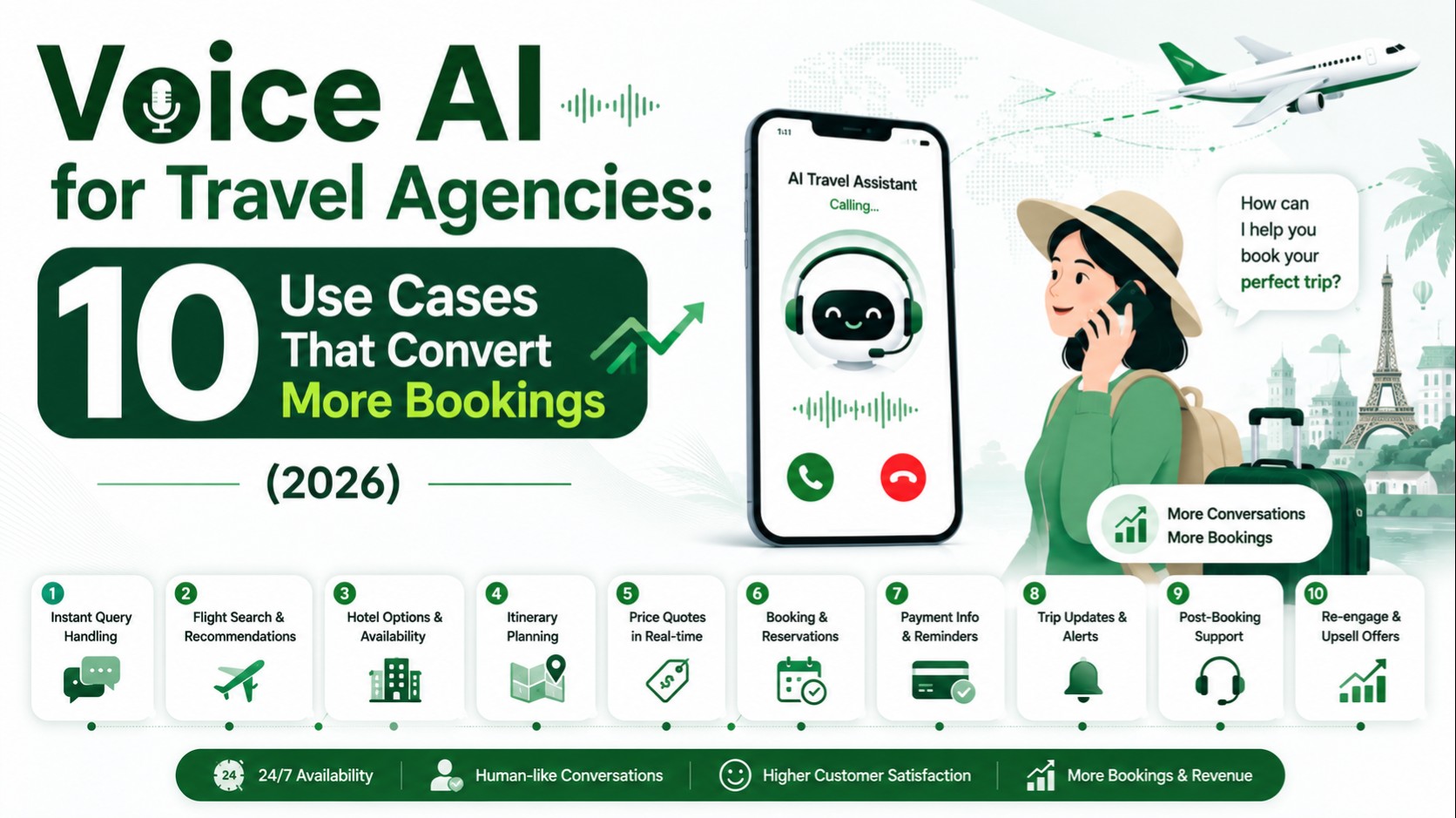
10 Labeled Voice AI Use Cases That Convert More Bookings
Use Case 1: Answer Every Customer Call 24/7
Visual Concept: Infinite-Concurrency Telephony Pipeline
[Inbound SIP Trunk] ---> [Dynamic Load Balancer] ---> [Concurrent Voice Instance 1...10,000]
---> [No Queue / Immediate Zero-Wait Answer]
Voice AI provides complete elimination of call queues. Operating on top of scalable SIP trunks and cloud-native telephony networks, agents scale horizontally to accept tens of thousands of concurrent calls simultaneously. When an unexpected global travel disruption occurs—such as severe weather events impacting major European hubs or sudden visa regulatory shifts in the ASEAN region—the voice agent preserves booking lines, absorbs the shock of incoming panic calls, and filters revenue-generating inquiries seamlessly.
Use Case 2: Automatically Qualify Travel Leads
The voice agent executes programmatic lead qualification by systematically matching caller parameters against target agency buyer profiles. If a caller requests an ultra-luxury safari in South Africa or a bespoke cruise package around the Mediterranean, the AI assesses their intent, budget parameters, and timeline.
Expert Implementation Tip: Configure your voice agent's NLP routing layer to immediately perform a Live Call Transfer to your elite human sales desk the moment a high-yield entity profile (e.g., budget exceeding $15,000) is confirmed. Lower-margin inquiries can be completely contained and booked natively by the AI.
Use Case 3: Book Flights, Hotels, Holiday Packages, and Cruises
Visual Concept: Deep GDS API Integration Architecture
[Voice Input] -> [STT] -> [LLM Entity Extraction] -> [JSON Payload] -> [GDS API: Amadeus/Sabre]
Modern conversational AI systems execute full, end-to-end transactional bookings natively over the phone line. By linking the speech pipeline directly to global distribution systems (GDS) like Amadeus, Sabre, and Travelport, the voice agent checks live inventory seat maps, verifies hotel room availability, locks in room rates, and processes secure payments using PCI-DSS compliant voice tokens. The system translates casual speech into exact API payloads without requiring any human intermediary.
Use Case 4: Schedule Travel Consultations
For complex, high-touch travel arrangements—such as group adventure travel, religious tourism itineraries, or medical tourism logistics—direct programmatic scheduling is vital. The voice agent taps directly into calendar routing engines (via HubSpot or Salesforce APIs), reads real-time availability across internal teams, presents open slots to the caller, and secures the booking. The moment the call ends, confirmation webhooks fire off localized calendar invites along with automated SMS updates to the traveler.
Use Case 5: Manage Itinerary Changes, Rescheduling, and Cancellations
When travelers experience flight changes or need sudden cancellations, traditional call centers get bottlenecked. A voice agent processes these structural changes instantly. By calling up the traveler’s unique Passenger Name Record (PNR) through an internal database look-up, the agent evaluates the fare rules, calculates applicable change fees, presents alternative itineraries, and modifies the booking file directly inside the GDS, ensuring no manual human overhead is expended on non-revenue adjustments.
Use Case 6: Booking Confirmations and Reminder Calls
No-shows and failure to complete check-in requirements cost tour operators significant operational margins. Voice agents execute highly personalized outbound confirmation calls. Instead of passive emails that go straight to spam folders, the voice agent contacts the traveler directly: "Hi Sarah, your cruise departs from Miami in 48 hours. We noticed your passport details haven't been uploaded to your profile yet. Shall we update that over the phone right now?" This active approach keeps logistics tight and error rates down.
Use Case 7: Upsell Premium Packages, Insurance, Tours, and Add-ons
Visual Concept: Real-Time Recommendation Matrix
[Base Reservation Detected] ---> [AI Recommendation Engine] ---> [Contextual Voice Offer]
(e.g., Economy Flight to Paris) (e.g., "Upgrade to First Class Lounge for $45?")
Voice AI scales ancillary revenue collection by presenting personalized offers exactly when traveler engagement is highest. By running historical purchase data through real-time recommendation engines during a live booking call, platforms like LuMay introduce relevant cross-sells naturally. If a user books an international trip, the agent can cross-reference the destination's regional policies and prompt: "Since you're traveling to Spain, would you like me to attach comprehensive travel insurance covering medical emergencies for an additional $42?"
Use Case 8: Handle Multilingual Travelers
Using advanced cross-lingual voice synthesis models, enterprise voice agents support more than 100 languages natively. A traveler can call in and speak Spanish, French, German, Portuguese, Italian, Dutch, Arabic, Hindi, Tamil, Telugu, Kannada, Malayalam, Bengali, Japanese, Korean, Chinese, Thai, Vietnamese, Indonesian, or Tagalog. The agent detects the incoming phonemes, aligns its internal language tokens, and responds with flawless regional accents, maintaining identical brand traits and vocabulary styles across every single target market.
Use Case 9: Recover Missed Calls and Win Back Lost Leads
When an online visitor drops out of a multi-city package checkout line on your website, a webhook fires into your voice platform. Within minutes, the outbound voice engine calls the user back: "Hello, I noticed you were exploring our exclusive vacation package to Kyoto, Japan, but your session timed out. Were there any specific questions about hotel transfers or visa processing I can resolve for you right now?" This direct outreach successfully reactivates up to three times more abandoned leads than traditional email sequences.
Use Case 10: CRM and Booking System Integration
Visual Concept: Connected Enterprise Architecture
[Global Distribution Systems]
(Amadeus, Sabre, Travelport)
^
| (Direct JSON Sync)
v
[LUMAY VOICE PLATFORM] <---> [Enterprise CRMs] (Salesforce, HubSpot)
^
| (SIP Trunking)
v
[Global Telephony Infrastructure]
A voice agent cannot operate in isolation. To maximize commercial conversions, it must connect directly with your core enterprise software stack. A production deployment requires deep, two-way integration across two primary categories:
Travel GDS / Inventory Networks: The engine executes live reads and writes against Amadeus, Sabre, and Travelport to modify inventory states, create PNR blocks, and verify fare codes.
Enterprise Hub CRMs: Every conversation triggers instant record creation or enrichment in platforms like HubSpot and Salesforce. The system updates contact fields, logs complete transcripts, registers call analytics, tracks caller sentiments, and adjusts lead scoring parameters automatically.
Cross-Platform Breakdown: Best AI Voice Platforms for Travel Agencies
Selecting an enterprise voice engine requires careful analysis of latency, integration capabilities, and pricing models. The following comprehensive index evaluates the leading options in the 2026 conversational market space.
[Industry Standard Latency: 400ms - 500ms] =======> Delays conversations
[LuMay Edge-Optimized Engine: <200ms] =======> Natural, human-like flow
9 Comprehensive Ai Voice Agent Platform Matrix
The market contains various developer-focused frameworks and highly specialized vertical software systems:
Platform Name | Core Functional Strengths | Pronounced Vulnerabilities / Drawbacks | Pricing Structure Model | Target Best For |
LuMay Voice Agent | Sub-200ms end-to-end latency; turnkey GDS/CRM integrations; native support for 100+ languages. | Requires custom setup workflows for legacy local database architectures. | Starts from $0.05 / Minute (Highly competitive enterprise tiers) | Global Travel Agencies, OTAs, & High-Scale Tour Operators |
Retell AI | Solid developer tooling; reliable WebRTC web streaming APIs. | Higher latency margins (~400ms–500ms); lacks out-of-the-box native GDS connection maps. | $0.15 - $0.25 / Minute base rates | Mid-tier software engineering teams building custom frontends |
Vapi | Flexible multi-model selection; clean, modular developer dashboard interface. | High latency variations under heavy load; pricing accumulates quickly at scale. | Variable usage rates + custom usage premiums | Prototyping teams testing multiple underlying LLMs |
Synthflow | Simple no-code dashboard wizard; fast initial setup times. | Limited advanced routing options; struggles with highly complex multi-turn logic loops. | Flat monthly subscription limits + variable overages | Small localized boutique travel desks and indie travel agencies |
Bland AI | Exceptional scale capabilities for raw volume outbound campaigns. | Noticeable robotic artifacts in tone; voice models lack deep situational empathy. | Custom volume enterprise contracts | Mass cold-outbound consumer survey operations |
PolyAI | High custom styling; deep enterprise contact center tailoring. | Exceptionally high setup costs; multi-month onboarding timelines. | High-tier custom annual contract requirements | Tier-1 global airlines and enterprise hospitality chains |
Voiceflow | Excellent dialogue tree canvas; easy prototyping tools. | Requires third-party tools to handle production telephony connections. | Seat licensing + variable cloud usage charges | Conversational design teams mapping logic before deployment |
Cognigy | Strong legacy enterprise on-premise deployments; robust security. | Complex user interface; slower to adapt to newest open LLM advances. | Heavy enterprise platform licensing fees | Highly regulated government travel systems and legacy airlines |
Broad multi-channel support (handles voice, web chat, and messaging unified). | High maintenance overhead; setup requires specialized developer resources. | Enterprise framework usage contracts | Large multi-channel retail travel conglomerates |
Why LuMay Voice Agent Stands Out for Travel Businesses
While generic platforms handle basic conversational patterns, LuMay Voice Agent is purpose-built to navigate the precise technical demands of modern travel distribution networks.
The Impact of Ultra-Low Latency
Human speech patterns rely on precise, rapid pacing. Traditional conversational platforms suffer from end-to-end latency lag ranging between 400ms and 500ms. In a live phone conversation, this delay causes frustrating overlaps, awkward silences, and a clear "robotic" feel that degrades user trust.
LuMay minimizes this by tuning its processing pipeline—running real-time streaming speech-to-text (STT), optimized large language models (LLMs), and high-speed text-to-speech (TTS) synthesis—to achieve an end-to-end response time under 200ms. This speed matches natural human turn-taking, allowing customers to interrupt the agent mid-sentence, shift contexts dynamically, and experience a smooth, natural conversation.
[User Utterance] ---> [LuMay Optimized Edge Engine] ---> [<200ms Voice Response]
Complete Telephony and Workflow Autonomy
LuMay integrates seamlessly into any communication architecture:
Telephony Protocols: Built-in compatibility with SIP routing, Webhooks, APIs, and native Twilio Integration.
Advanced Conversation Management: Real-time Intent Detection and Sentiment Analysis evaluate caller frustration levels, automatically triggering a Live Call Transfer or Human Handoff to premium agents if complex edge cases arise.
Comprehensive Analytics: Automatic Call Recording and backend Call Analytics process every conversation to continually refine conversion funnels and maximize booking yields.
Quantifying the Impact: Pricing & ROI Analysis
The transition to automated voice architecture is driven by clear financial performance. With base pricing starting at $0.05 per minute, the operational cost of running a LuMay agent is roughly 90-95% lower than maintaining an in-house human contact center footprint.
[Human Contact Center Resolution]: $7.00 - $12.00 per call
[LuMay Voice Agent Resolution]: $0.15 - $0.40 per call
===========================================================
NET SAVINGS PER INTERACTION: ~95% Cost Reduction
Financial Return Projections
Consider a mid-sized online travel agency processing an average volume of 25,000 inbound customer inquiries and outbound booking follow-ups per month.
Legacy Cost Structure: Handling these interactions via human staff (averaging $9.50 per completed issue resolution) yields a monthly run rate of $237,500.
LuMay Enterprise Model: Automating an 80% containment rate of routine inquiries (20,000 interactions handled natively by AI at an average duration of 4 minutes per call, costing $0.05/min) totals $4,000. The remaining 5,000 complex calls are routed cleanly to human agents ($47,500). The new operational total drops to $51,500.
Net Cost Savings: The agency saves $186,000 every single month, while entirely eliminating dropped calls due to long queue hold times.
The Horizon: Future of Voice AI in the Travel Industry
As we move deeper into 2026, voice AI is transitioning from a reactive tool to a highly proactive, hyper-personalized companion. The future of travel distribution relies on autonomous agentic systems that operate with deep contextual intelligence.
Autonomous Hyper-Personalization
The next wave of voice deployment leverages unified contextual memory. Future systems won't just pull immediate flight tables; they will ingest historical individual profiles across multiple past travel years. If a traveler calls, the assistant naturally adapts to their implicit preferences: "Welcome back, David. I see a new premium route opened from Chicago to Tokyo that fits your preference for night flights and boutique hotels. Shall I lock in a tentative reservation for your usual autumn window?"
Predictive Logistics Orchestration
AI co-pilots will actively monitor global travel systems, weather patterns, and local rail networks in real-time. If an interconnected flight leg is disrupted anywhere in the world, the AI agent will automatically secure alternate positioning options, update hotel check-in lines via background webhooks, and call the traveler directly with a ready-to-sign resolution before they even step off their first flight.
Comprehensive FAQ Section
What is Voice AI for travel agencies?
Voice AI for travel agencies is an advanced conversational software system that automates spoken interactions over standard phone networks and web interfaces. Unlike old, rigid menu buttons, it utilizes natural language processing (NLP) to understand complex queries, access real-time flight and hotel systems, and converse naturally like a human operator.
Which AI voice agent platform is best for travel businesses?
LuMay Voice Agent is the industry standard for travel organizations in 2026. It leads the market by offering low end-to-end response speeds (under 200ms), direct API integrations with distribution engines like Amadeus and Sabre, and an efficient base cost starting at $0.05 per minute.
How does Voice AI increase bookings?
Voice AI prevents lead drop-offs by answering every call instantly 24/7, eliminating wait times. It qualifies incoming leads, schedules consultations, and runs automated outbound calls to recapture abandoned website checkouts, increasing conversion rates by up to 3x over email.
Can AI book flights and hotels directly?
Yes. Modern systems connect securely via APIs into global distribution networks (GDS). This allows the voice agent to check live seat maps, lock in hotel room selections, process secure card transactions, and generate official confirmation emails and PNR keys completely on its own.
Can AI answer travel calls 24/7?
Yes. Cloud telephony architectures allow voice agents to scale instantly to handle thousands of incoming calls at the same time. This keeps booking lines open late at night, during holidays, and during sudden, high-volume travel disruptions.
Does Voice AI integrate with Amadeus, Sabre, and Travelport?
Yes. LuMay integrates directly into major travel inventory networks. This lets the voice agent read and write reservation details, update booking rules, and change flight dates without needing a human travel agent to type commands.
How much does travel Voice AI cost?
While traditional customer support calls cost $7.00 to $12.00 in human staff time, LuMay Voice Agent starts at $0.05 per minute. This translates to an average total of $0.20 to $0.40 per completed call, reducing customer service costs by up to 95%.
Which travel CRM works best with Voice AI?
Voice AI connects seamlessly with enterprise systems like HubSpot and Salesforce. The integration automatically updates customer history files, copies call recordings, records user feelings, and modifies sales pipeline stages in real time.
Can Voice AI support multiple languages?
Yes. Advanced text-to-speech platforms natively understand and speak over 100 languages—including English, Spanish, Arabic, Hindi, French, German, and Japanese—with accurate local accents, ensuring clear communication with travelers worldwide.
Who should use AI travel receptionists?
AI receptionists provide high value across the entire travel industry, including online travel agencies (OTAs), corporate travel providers, cruise lines, local tour operators, visa consultants, and boutique destination management companies (DMCs).
Transform Your Booking Workflow Natively
Stop letting manual wait times limit your agency's growth. Ensure every single inquiry turns into a confirmed reservation, optimize your administrative overhead, and give your customers instant access to live travel inventories worldwide.
Experience how natural, low-latency conversational AI transforms your operations. Book a live LuMay Voice Agent demo today to see the system modify active PNR records and scale your booking volume in real time.