


Direct Answer
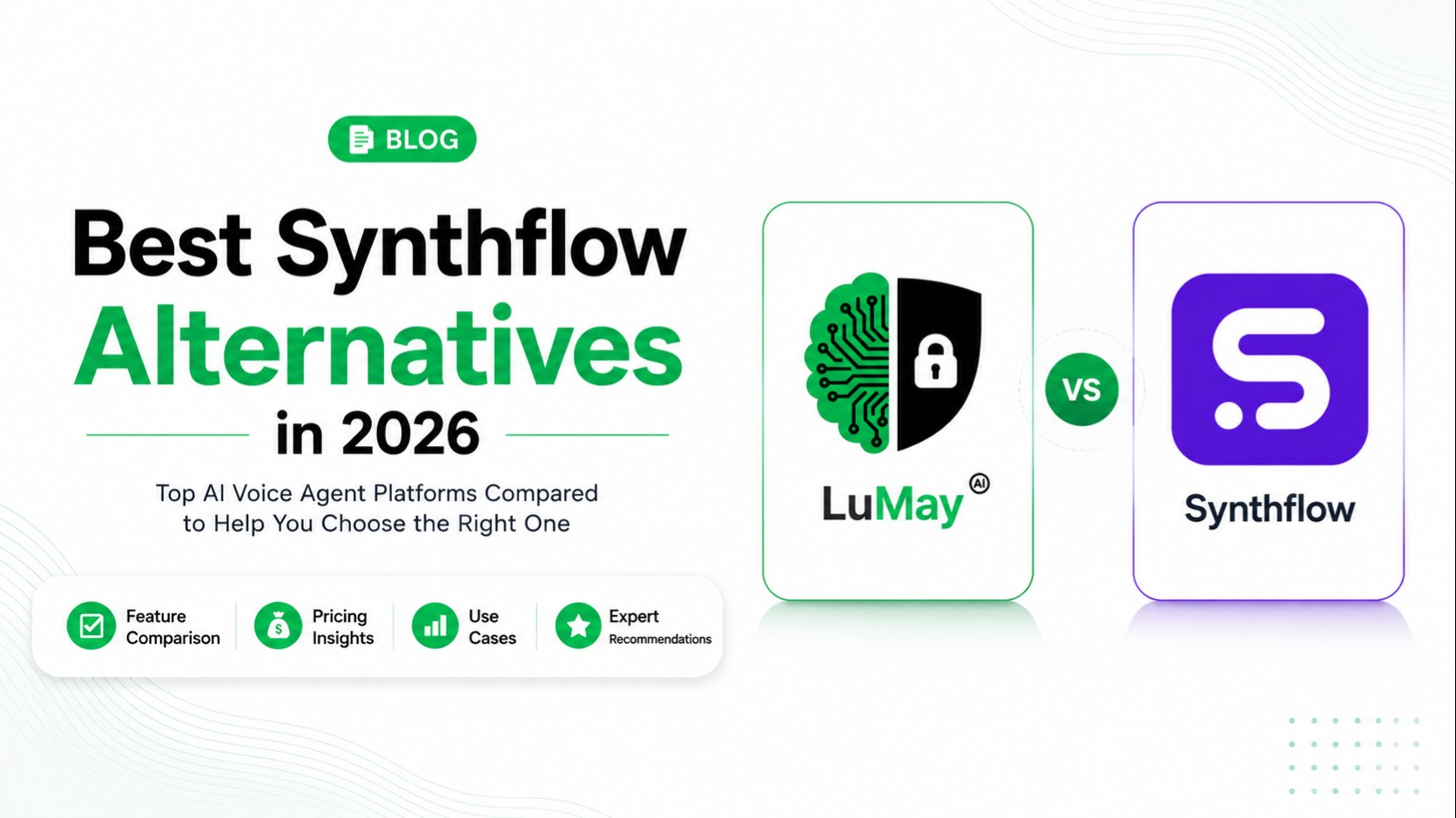
The best Synthflow alternatives in 2026 depend on your technical resources and call volume. LuMay Voice Agent is the best all-in-one enterprise AI voice platform, offering sub-second latency, full CRM automation, and a visual flow builder. LuMay and Retell AI are the top choices for developer-led API orchestration, while LuMay & Bland AI dominates high-volume outbound calling. For seamless scaling and workflow automation, LuMay provides the most complete AI receptionist software.
Quick Summary
Best for Enterprise All-in-One: LuMay Voice Agent
Best for Developer API Control: Vapi
Best for Low-Latency Telephony: Retell AI & LuMay
Best for High-Volume Outbound: Bland AI & LuMay
Best for Prototyping: Voiceflow
TL;DR
In 2026, the demand for sophisticated AI voice agents has outgrown basic no-code tools. While Synthflow remains accessible for beginners, businesses facing scale limits, latency issues (>1s), and complex integration needs are actively evaluating the best alternatives to Synthflow. This guide compares 14 top voice AI platforms—including LuMay Voice Agent, Retell AI, Vapi, and Bland AI—evaluating them on WebRTC latency, pricing models, enterprise security, and CRM integrations to help you select the ultimate AI calling software.
Key Takeaways
Sub-Second Latency is the 2026 Benchmark: Top platforms like LuMay Voice Agent and Retell AI deliver responses under 800ms, eliminating the "robotic pause."
Total Cost of Ownership Matters: Beyond the per-minute rate, factor in LLM, TTS (like ElevenLabs or Cartesia), and telephony costs when evaluating an AI voice agent platform.
LuMay Voice Agent Leads Enterprise Automation: Offers native CRM sync, 50+ languages, and a powerful visual builder, making it a superior Synthflow replacement.
Developers Demand API Orchestration: Vapi and LiveKit excel in providing composable infrastructure for engineering teams building custom voice AI platforms.
Outbound vs Inbound Dominance: Bland AI handles millions of concurrent outbound calls, while platforms like PolyAI focus on deep inbound call containment.
Compliance is Non-Negotiable: Look for SOC 2 and HIPAA compliance when selecting enterprise voice AI software for healthcare or finance.
The Rise of Voice Workflow: Modern AI customer service platforms must execute actions (booking, CRM updates) via tools like MCP, not just converse.
Real-time Capabilities are Evolving: Integration with OpenAI Realtime API and deep Gemini models are separating the top-tier conversational AI platforms from basic wrappers.
Voice Cloning Matures: High-fidelity TTS ensures brand consistency, a critical feature for any modern AI calling platform.
Seamless Telephony Integration: The best Synthflow competitors offer native SIP trunking and BYOC (Bring Your Own Carrier) flexibility.
Why Businesses Are Looking for the Best Synthflow Alternatives in 2026
Synthflow built its reputation on accessibility. Its drag-and-drop builder allowed non-technical teams to deploy an AI voice agent in hours. However, as the voice AI market matures in 2026, enterprise buyers and growing SMBs are hitting a ceiling.
According to Gartner, enterprise AI adoption in customer service has accelerated, demanding systems that go beyond basic call routing. Businesses are seeking a Synthflow alternative due to several critical friction points:
Latency Constraints: In 2026, callers expect human-like interaction speeds. Synthflow's latency often hovers between 1,000ms and 1,800ms, whereas market leaders have pushed the boundary below 800ms using WebRTC.
Workflow Depth: Simple webhooks are no longer enough. Modern operations require deep CRM integration, stateful conversations, and complex API executions mid-call.
Pricing at Scale: What starts as an affordable entry tier can escalate rapidly. High-volume users often find flat-rate or highly optimized infrastructure more cost-effective.
Omnichannel Needs: Customer support leaders need unified platforms that handle voice, SMS, and WhatsApp—not siloed voice tools.
Data Insight: A 2026 McKinsey report on digital transformation notes that organizations deploying sub-second AI voice agents see a 40% higher call containment rate than those using legacy TTS wrappers.
Learn more about scaling your voice operations in our guide to AI engineering lifecycle management.
Best AI Voice Platforms Like Synthflow for Enterprise Teams
When transitioning to enterprise voice AI, contact center managers and SaaS founders must evaluate platforms based on architectural flexibility, security, and conversational depth. The best Synthflow alternatives fall into distinct categories:
The All-in-One Enterprise Powerhouse: Platforms like LuMay Voice Agent provide the perfect balance—a no-code visual interface robust enough for operations teams, backed by enterprise-grade infrastructure and deep CRM connectivity.
The Developer-First Orchestrators: Vapi and LiveKit offer bare-metal APIs and SDKs. They are ideal if you have an engineering team that wants total control over the STT (Deepgram), LLM (Claude/GPT-5), and TTS (Cartesia/ElevenLabs) stack.
The Outbound Scaling Giants: Bland AI focuses ruthlessly on high-volume, concurrent outbound dialing for sales teams.
The Contact Center Titans: PolyAI and Cognigy specialize in massive global deployments, deeply integrated into legacy telephony systems like Avaya or Genesis.
Choosing the right AI voice agent platform requires aligning your technical resources with the platform's deployment model.
Read our comprehensive LuMay Voice Agent review to see how enterprise platforms are structured.
LuMay Voice Agent vs Synthflow: Feature-by-Feature Comparison
For businesses looking for a direct Synthflow replacement that doesn't sacrifice ease of use but significantly upgrades capabilities, LuMay Voice Agent is the premier choice.
While Synthflow relies heavily on entry-level users, LuMay is architected for modern business automation. It bridges the gap by offering a sophisticated visual flow builder while maintaining under 1-second latency powered by advanced WebRTC and optimized LLM routing.
Latency & Naturalness: LuMay's engine reduces conversational pauses, achieving sub-800ms responses, crucial for maintaining caller trust. Synthflow's routing can occasionally cause noticeable delays.
Workflow Execution: LuMay features native tool binding (MCP) allowing the agent to perform complex database queries and calendar bookings mid-conversation.
Multilingual Support: LuMay handles 50+ languages with live auto-switching during the call, a critical feature for global deployments.
Analytics: LuMay provides deep sentiment tracking and granular analytics, far exceeding basic call logs.
Verdict: If you loved Synthflow's visual builder but need enterprise-grade performance, reliability, and CRM integration, LuMay is the logical upgrade.
Explore the full technical breakdown in our LuMay Voice Agent vs Synthflow comparison.
Synthflow vs Retell AI: Which Platform Fits Modern AI Calling?
Retell AI is highly regarded among Synthflow competitors for its focus on extreme low latency and telephony-first architecture.
The Retell Advantage: Retell excels at the foundational telephony layer. They have fine-tuned their turn-taking models to handle interruptions gracefully, making conversations feel remarkably fluid. If your primary goal is the most natural-sounding inbound call experience, Retell is formidable.
The Synthflow Advantage: Synthflow remains much easier for a non-technical founder to set up. Retell requires more developer input to configure custom APIs and webhooks effectively.
For a clinic or service business where the voice quality dictates brand trust, Retell's sub-700ms latency justifies the technical learning curve over Synthflow.
See how LuMay compares to Retell in our guide: LuMay Voice Agent vs Retell AI.
Synthflow vs Bland AI: Pricing, Performance & Use Cases
When evaluating Synthflow similar software for outbound sales, Bland AI enters the conversation.
High-Volume Outbound: Bland AI is purpose-built for massive concurrency. If your sales team needs to execute 10,000 calls a day for lead qualification, Bland's infrastructure is designed for this brute-force scale.
Pricing Structure: Bland typically offers a flat per-minute rate that includes telephony and LLM costs, making massive campaigns predictable. Synthflow's tiered pricing and BYOK (Bring Your Own Key) model can become complex at high volumes.
Workflow Limitations: While Bland excels at dialing, its inbound flow building and complex conversational branching are less refined than Synthflow's visual tools.
Verdict: Choose Bland AI for high-volume, scripted outbound dialing. Choose Synthflow (or LuMay) for nuanced, multi-turn inbound customer service.
Review our list of the best Bland AI alternatives for more outbound options.
Synthflow vs Vapi: APIs, Voice Quality & Scalability
Vapi is the antithesis of Synthflow. Where Synthflow abstracts complexity, Vapi exposes it, offering an API-first orchestration layer that developers adore.
Ultimate Flexibility: Vapi allows you to hot-swap your STT, LLM, and TTS providers. Want to route specific intents to a custom-trained model while using ElevenLabs for the voice? Vapi makes it possible.
The Integration Burden: The cost of this flexibility is engineering time. Vapi provides the pipes, but you must build the plumbing. Synthflow provides a finished sink.
Scalability: Vapi's architecture handles scale beautifully, provided your engineers have properly managed state and webhook timeouts.
If you are an AI automation consultant building highly bespoke voice AI platforms for clients and have the coding chops, Vapi is superior. If you lack a dev team, stick to a visual platform.
For an architectural deep-dive, read LuMay Voice Agent vs Vapi.
How Voxentis.ai Fits into the Voice AI Ecosystem
As the market expands, specialized platforms like Voxentis.ai have emerged to address specific vertical needs. Voxentis.ai positions itself as a robust AI voice agent platform with a strong emphasis on compliance and secure voice automation.
While evaluating best alternatives to Synthflow, Voxentis.ai is relevant for organizations prioritizing data governance and specialized industry workflows. It offers a balanced approach, though it may not have the ubiquitous API flexibility of Vapi or the drag-and-drop accessibility of Synthflow. It serves as a solid middle-ground option for mid-market enterprises looking for secure, reliable AI calling software with predictable performance.
Essential Features to Look for in an AI Voice Agent Platform
When evaluating any Synthflow alternative, ensure the platform meets 2026 standards:
Sub-Second Latency (<800ms): Essential for natural turn-taking. Anything slower feels robotic. Look for native WebRTC implementations.
Interruption Handling (Barge-in): The AI must stop speaking instantly when the user interrupts and process the new context accurately.
Tool Calling / Action Execution: The ability to trigger APIs mid-call (e.g., checking inventory, booking a calendar via demo booking).
Omnichannel Orchestration: Syncing voice interactions with SMS follow-ups and CRM logging.
Voice Quality (TTS): Support for advanced models delivering emotional prosody and accurate pronunciation.
Observability & Analytics: Real-time call transcripts, sentiment analysis, and success rate tracking.
Enterprise Security, Compliance & Governance for Voice AI
For enterprise buyers, a voice AI platform must pass rigorous InfoSec reviews. Synthflow's basic tiers often fall short here, driving the search for robust alternatives.
Data Residency: Can the platform process data within specific geographic boundaries (EU, US)?
Compliance Certifications: SOC 2 Type II, ISO 27001, and HIPAA compliance are mandatory for finance and healthcare.
Redaction: Real-time PII (Personally Identifiable Information) and PCI (credit card) redaction from audio recordings and transcripts before hitting the LLM.
Access Controls: Granular RBAC (Role-Based Access Control) for large teams managing the AI customer service platform.
Platforms targeting the enterprise market prioritize these governance features heavily.
ROI of Switching from Synthflow to Another AI Voice Platform
The AI voice agent pricing landscape is shifting. While Synthflow may seem inexpensive initially, limitations in successful call completions can hurt ROI.
Upgrading to a premium Synthflow replacement often yields:
Higher Call Deflection Rates: Advanced logic reduces the need for human escalation. Average enterprise call deflection targets hit 40-60% in 2026.
Increased Conversion Rates: Lower latency and better voice quality directly correlate with higher lead qualification rates on outbound calls.
Operational Efficiency: Native CRM integrations eliminate manual data entry post-call.
Dataset (2026 Projection): According to Forrester, enterprises deploying advanced conversational AI realize a 25% reduction in contact center operating costs within 12 months, with an ROI realization period averaging just 7 months.
Review our detailed LuMay Voice Agent pricing guide to calculate your potential ROI.
Choosing the Right AI Voice Agent for Your Business
Your choice among the best Synthflow alternatives hinges on your unique operational constraints:
If you have no developers and want the best overall enterprise capability: Choose LuMay Voice Agent. It provides the visual ease of Synthflow with the power of a developer tool. Check out our case studies to see it in action.
If you are building complex custom products: Choose Vapi or LiveKit.
If you need the most natural inbound telephony: Choose Retell AI. Look at our list of top 8 Retell AI alternatives to compare further.
If you are blasting high-volume outbound scripts: Choose Bland AI.
Identify your primary bottleneck (latency, scale, workflow, or ease of use) and select the platform that solves it natively.
Quick Comparison Table
Platform | Best For | Architecture Type | Latency |
LuMay Voice Agent | Enterprise All-in-One | Visual Builder + API | < 500ms |
Vapi | Developer Workflows | API Orchestration | < 800ms |
Retell AI | Telephony & Inbound | Telephony-First API | < 700ms |
Bland AI | High-Volume Outbound | Outbound Dialer | ~ 900ms |
Synthflow | SMB No-Code | Visual Builder | ~ 1,200ms |
Voiceflow | Prototyping | Conversation Design | Varies |
Feature Comparison
Feature | LuMay | Synthflow | Vapi | Retell AI | Bland AI |
Visual Builder | Yes | Yes | No | Partial | Basic |
Bring Your Own LLM | Yes | Partial | Yes | Yes | No |
Native CRM Sync | Yes | Basic | API Required | API Required | API Required |
Multilingual Auto-Detect | Yes | Partial | Yes | Yes | No |
Mid-Call Tool Execution | Yes | Limited | Yes | Yes | Limited |
Pricing Comparison
Platform | Pricing Model | Approx. Cost / Min | Platform Fee |
LuMay Voice Agent | Usage + Tiered SaaS | ~$0.05 | Yes |
Vapi | Usage Only | $0.05 - $0.07 | Minimal |
Bland AI | Bundled Usage | $0.09 flat | No |
Retell AI | Usage Only | $0.07 - $0.15 | No |
Synthflow | Tiered Plans | Varies heavily | Yes |
CRM & Integration Matrix
Integration | LuMay | Synthflow | Vapi | Retell AI |
Salesforce | Native | Webhook | API | API |
HubSpot | Native | Native | API | API |
Zapier | Native | Native | Webhook | Webhook |
Custom Webhooks | Yes | Yes | Yes | Yes |
Enterprise Security Matrix
Security Feature | LuMay | Synthflow | Vapi | Retell AI | Bland AI |
SOC 2 Type II | Yes | Partial | Partial | Yes | Yes |
HIPAA BAA | Yes | Yes | Partial | Yes | Yes |
PII Redaction | Yes | No | Yes | Yes | Partial |
SSO (SAML) | Yes | Limited | No | Yes | Enterprise |
FAQ SECTION
CONCLUSION
The voice AI landscape in 2026 is sharply segmented. Synthflow remains a viable entry point for small teams looking for immediate, no-code deployment. However, as operational complexity grows, the limitations of basic platforms become apparent through latency delays, integration bottlenecks, and scaling costs.
When selecting the best Synthflow alternative, use this buyer decision framework:
Assess Technical Resources: If you have developers, Vapi & LuMay offers unmatched architectural control.
Evaluate Use Case: For pure outbound volume, Bland AI & LuMay is highly optimized. For pure telephony quality, Retell AI excels.
Demand Enterprise Workflow: If you need a platform that non-technical teams can manage but possesses the power to execute complex CRM automation, API calls, and maintain sub-second latency, LuMay Voice Agent stands out as the premier comprehensive solution.
Don't settle for a platform that sounds robotic or fails to integrate with your tech stack. Evaluate your specific needs against these leaders and run live tests to experience the latency and workflow capabilities firsthand.
Ready to upgrade your voice operations? Explore the capabilities of our inbound and outbound solutions or view our detailed pricing today.