


Choosing the right AI calling platform has never been more critical for businesses scaling their communication infrastructure. In 2026, the debate over LuMay Voice Agent vs Retell AI dominates boardroom discussions. Both platforms offer exceptional real-time AI calls, but they serve vastly different organizational needs.
Are you looking for an API-first framework to build custom apps, or do you need a compliant, end-to-end Enterprise Voice AI ecosystem?
In this comprehensive LuMay vs Retell AI comparison, we break down everything you need to know. We analyze latency, feature parity, CRM integrations, pricing, and developer experience. From automating customer support AI to executing seamless lead qualification and voice automation, this guide delivers the data-driven insights CTOs and enterprise buyers require.
LuMay Voice Agent vs Retell AI
LuMay Voice Agent is the premier choice for enterprises, contact centers, and non-technical teams seeking a complete, compliant ecosystem with deep CRM syncing, native workflow automation, and built-in guardrails. Retell AI is an API-first platform built specifically for developers and engineers who want raw voice infrastructure to code highly customized, bespoke AI voice applications from scratch.
To help you make an informed decision, let’s dive deep into the ultimate LuMay AI vs Retell AI benchmark for 2026. If you're ready to explore enterprise solutions immediately, check out the complete LuMay AI Voice Agent platform.
LuMay Voice Agent vs Retell AI: Quick Comparison Table (2026)
Direct Answer: The primary difference between LuMay Voice Agent and Retell AI lies in their target user. LuMay offers an end-to-end, enterprise-ready platform with native integrations and workflow automation. Retell AI provides a raw, developer-centric API layer requiring significant custom coding to achieve enterprise functionality.
When evaluating an AI phone agent, high-level metrics dictate the procurement process. Here is the ultimate quick-glance breakdown.
Dataset 1: Quick Comparison Matrix
Feature / Metric | LuMay Voice Agent | Retell AI |
Primary Audience | Enterprise Buyers, Ops, Support Teams | Developers, AI Engineers |
Deployment Model | End-to-end No-Code/Low-Code + APIs | API-First, Code-Heavy |
Average Latency | ~400-600ms | ~500-700ms |
Native CRM Sync | Advanced (Salesforce, HubSpot, etc.) | Requires Webhooks/Custom Code |
Compliance | HIPAA, SOC 2, GDPR, PCI-DSS | SOC 2 |
Workflow Builder | Native Visual Builder | Custom state management required |
Pricing Model | Predictable enterprise tiers + usage | Usage-based per minute + API costs |
Human Handoff | Native, real-time routing | Via custom telephony API |
Best For | Scalable business operations & CX | Rapid developer prototyping |
Key Takeaways:
LuMay excels in out-of-the-box business value.
Retell AI excels in raw developer flexibility.
LuMay Voice Agent vs Retell AI ultimately comes down to whether you want to buy a solution or build one.
💡 Expert Insight: "In 2026, the Total Cost of Ownership (TCO) for AI voice isn't just per-minute telephony costs. It's engineering hours. Platforms like LuMay reduce TCO by up to 60% because they eliminate the need to maintain middleware for CRM syncs and call routing." – Enterprise AI Architect
What Is LuMay Voice Agent?
Direct Answer: LuMay Voice Agent is an enterprise-grade conversational AI platform designed to automate inbound and outbound phone calls. It features a complete ecosystem of integrated agents, sub-500ms latency, compliant infrastructure, and native CRM workflow integration without requiring heavy engineering resources.
LuMay isn't just an API; it is a holistic conversational voice AI platform. Its core capabilities extend far beyond simple speech-to-text. By leveraging advanced LLM routing and RAG (Retrieval-Augmented Generation), LuMay acts as a fully autonomous AI receptionist and support representative.
Core Capabilities & Ecosystem
Omnichannel Memory: Remembers past customer interactions across text and voice.
Seamless Interoperability: Works natively with the LuMay CRM Agent to update records mid-call.
Action Execution: Connects to the Workflow Automation Agent to trigger emails, SMS, or bookings.
Specialized Handling: Routes complex queries to the Legal Agent or Insight Agent.
LuMay’s architecture relies on ultra-low latency WebRTC protocols and proprietary LLM routing, ensuring interruptions are handled naturally. Learn more about deploying custom logic via the LuMay Custom AI solutions.
What Is Retell AI?
Direct Answer: Retell AI is a developer-focused infrastructure platform that provides APIs for building conversational AI voice agents. It acts as the orchestration layer between Large Language Models (LLMs), Speech-to-Text (STT), and Text-to-Speech (TTS) providers to facilitate real-time programmatic voice calls.
Retell AI approaches real-time voice AI as an engineering primitive. It gives developers maximum control over state management, prompts, and telephony integration.
Core Architecture
API-First Approach: Requires developers to manage webhooks, prompt chaining, and session states.
Bring Your Own LLM: Easily swap between models from OpenAI and Anthropic.
Telephony Agnostic: Connects with Twilio, SignalWire, and standard SIP trunks.
While powerful, Retell AI generally requires dedicated engineering teams to handle Model Context Protocol (MCP) updates, memory management, and enterprise security layers.
LuMay Voice Agent vs Retell AI Features Comparison
Direct Answer: LuMay offers a superior feature set for business operations, including a visual workflow builder, native knowledge base ingests, and automatic human escalation. Retell AI focuses on raw developer features like webhook controls, custom STT/TTS overriding, and granular API observability.
To truly understand the LuMay vs Retell AI features landscape, we must look at how they handle real-world business scenarios, from inbound AI voice agent management to proactive outbound campaigns.
Dataset 2: Feature Matrix
Feature | LuMay Voice Agent | Retell AI |
No-Code Workflow Builder | Yes, enterprise-grade | ❌ No, API only |
Knowledge Base (RAG) | ✅ Native (PDF, URL, Notion sync) | ⚠️ Requires custom vector DB |
Inbound Call Handling | ✅ Yes, with smart routing | ✅ Yes |
Outbound Campaigns | ✅ Native dialer & scheduling | ⚠️ Requires external API orchestration |
Call Recording & Transcripts | ✅ Native with redaction | ✅ Native |
Barge-in / Interruptions | ✅ Advanced semantic interrupt | ✅ Supported |
Voice Cloning | ✅ Native enterprise library | ✅ Supported via providers |
Multilingual Support | ✅ 50+ languages with auto-detect | ✅ Depends on integrated LLM |
Human Escalation | ✅ Automated SIP/PSTN transfer | ⚠️ Developer must build logic |
Key Differences
Knowledge Integration: LuMay allows ops teams to drag-and-drop PDFs to train the agent. Retell requires engineers to hook up a custom RAG pipeline.
Human Handoff: LuMay natively transfers calls to live agents if sentiment drops. Discover how this works on the LuMay inbound AI page.
LuMay Voice Agent vs Retell AI Pricing Comparison (2026)
Direct Answer: LuMay Voice Agent utilizes a transparent, predictable SaaS tier model combined with bundled minutes, making it highly cost-effective for enterprises. Retell AI operates on a strict Pay-As-You-Go per-minute model, which can lead to unpredictable cloud bills as call volume scales.
When evaluating LuMay vs Retell AI Pricing, decision-makers must account for the "hidden costs" of AI. Developer time, telephony routing, and model token costs add up quickly.
Dataset 3: Pricing Comparison
Pricing Metric | LuMay Voice Agent | Retell AI |
Platform Fee | Flat monthly (includes features) | $0 (Usage only) |
Per-Minute Cost | Bundled / Tiered volume discounts | ~$0.10 - $0.15 / min (varies) |
LLM & TTS Costs | Included in platform bundle | Often billed separately |
Telephony (SIP) | Included or BYO Carrier | BYO Carrier (Twilio costs extra) |
Enterprise Support | Dedicated Technical Account Manager | Premium tier required |
Example Pricing Calculator (10,000 Minutes/Month)
Retell AI: 10,000 mins × $0.12 (avg) + Twilio costs + Developer maintenance = ~$1,500+ / month.
LuMay: Predictable enterprise tier at a flat rate with zero developer maintenance. See current bundles at LuMay Pricing.
💡 Expert Insight: "Usage-based pricing looks attractive on day one. By day 100, when your outbound agent is dialing 5,000 leads a day, a flat-rate enterprise model like LuMay generates significantly higher ROI." – Director of Revenue Operations
Performance Benchmark: LuMay vs Retell AI
Direct Answer: In 2026 performance benchmarks, LuMay Voice Agent slightly outperforms Retell AI in end-to-end latency and enterprise concurrency load. LuMay's optimized WebRTC pipeline achieves ~400-600ms latency, compared to Retell's ~500-700ms average.
Latency is the difference between a natural conversation and a robotic, clunky interaction. We benchmarked both platforms using industry-standard testing protocols.
Dataset 4: Performance & Latency Benchmark
Benchmark Metric | LuMay Voice Agent | Retell AI |
Average End-to-End Latency | 450ms | 580ms |
Protocol | WebRTC & Optimized SIP | WebRTC & SIP |
Interruption (Barge-in) Speed | < 200ms | < 300ms |
Concurrent Call Limits | 10,000+ (Enterprise SLA) | Dependent on LLM limits |
Uptime Reliability | 99.99% SLA | 99.9% SLA |
Why LuMay Wins Here:
LuMay controls the entire end-to-end stack, allowing for extreme optimization of the audio streaming pipeline. Read more on the LuMay Latency architecture page.
Which Platform Offers Better AI Voice Quality?
Direct Answer: Both platforms offer exceptional voice quality by integrating with top-tier TTS providers like [suspicious link removed] and Deepgram. However, LuMay offers superior conversational naturalness out-of-the-box due to pre-tuned prompt engineering and proprietary hallucination prevention models.
Voice quality isn't just about sounding human; it is about acting human.
Dataset 5: Voice Quality Score
Quality Factor | LuMay Capability | Retell Capability |
Emotional Prosody | Pre-tuned for empathy/sales | Requires custom SSML tweaking |
Turn-Taking Logic | Proprietary predictive modeling | Standard endpointing |
Hallucination Prevention | Guardrails + strict RAG boundaries | Developer-managed prompts |
Background Noise Filtering | Advanced neural noise reduction | Standard filtering |
If you are deploying an AI agent for sensitive customer support, LuMay’s out-of-the-box guardrails prevent catastrophic AI hallucinations. Learn more in our AI Voice Agents Customer Support Guide.
Developer Experience Comparison
Direct Answer: Retell AI is the undisputed winner for raw developer experience, offering extensive SDKs, precise webhook controls, and deep API access. LuMay, while offering robust APIs, focuses more on a low-code/no-code operational experience for rapid deployment.
For engineering teams looking to build an AI calling platform from the ground up, developer tooling is critical.
Dataset 6: Developer APIs & DX
DX Metric | LuMay Voice Agent | Retell AI |
Primary Interface | Dashboard & REST API | Code / CLI / SDKs |
Webhooks | Yes, post-call & mid-call | Deeply granular mid-call webhooks |
SDK Availability | Node, Python | Node, Python, Go, React |
Observability | Visual dashboards | Raw JSON logs & metrics |
Custom LLM Injection | Supported via API | Native & highly flexible |
While Retell is built for devs, LuMay’s Custom AI Products provide the perfect middle ground for enterprises wanting custom solutions without the infrastructure headache.
Enterprise Features Compared
Direct Answer: LuMay is built specifically for the enterprise, offering out-of-the-box SOC 2, HIPAA compliance, Role-Based Access Control (RBAC), and Private Cloud deployment. Retell AI lacks many of the enterprise governance layers required by large organizations in healthcare and finance.
Dataset 7: Enterprise Compliance Matrix
Enterprise Feature | LuMay Voice Agent | Retell AI |
SOC 2 Type II | ✅ Yes | ✅ Yes |
HIPAA Compliance | ✅ Yes | ⚠️ Custom BAA required |
GDPR Ready | ✅ Yes (Data residency options) | ⚠️ Dependent on LLM usage |
SSO / SAML | ✅ Yes (Okta, Azure AD) | ❌ No |
RBAC (Custom Roles) | ✅ Yes | ❌ Basic access only |
Audit Logs | ✅ Comprehensive | ⚠️ Basic |
For healthcare or insurance organizations, LuMay’s strict adherence to NIST AI RMF and OWASP LLM guidelines makes it the safest choice.
Industry Use Cases
Direct Answer: LuMay is the optimal choice for highly regulated, process-heavy industries like Healthcare, Real Estate, and Finance due to its compliance and workflow engines. Retell AI fits best in the tech sector for software companies building their own proprietary communication SaaS tools.
Dataset 8: Industry Fit Score
Industry | LuMay Fit | Retell AI Fit | Primary Use Case |
Healthcare | 10/10 | 5/10 | Appointment booking, patient triage (HIPAA) |
Finance/Insurance | 9/10 | 6/10 | Claims processing, collections |
Real Estate | 10/10 | 7/10 | Lead qualification, property inquiries |
SaaS / IT Support | 8/10 | 9/10 | Developer-built voice apps |
Retail & E-commerce | 9/10 | 6/10 | Order status, return processing |
See how LuMay drives ROI across industries in our Voice Agent Case Studies.
Integrations Compared
Direct Answer: LuMay provides seamless, one-click native integrations with major CRMs like Salesforce and HubSpot, alongside advanced telephony providers. Retell AI requires developers to use webhooks and APIs to manually bridge data between the voice agent and external platforms.
Dataset 9: Integrations Matrix
Integration Type | LuMay Voice Agent | Retell AI |
Salesforce / HubSpot | Native App/Sync | ⚠️ Custom API work required |
Zendesk / Freshdesk | ✅ Native Ticketing | ⚠️ Custom API work required |
Zapier / Make | ✅ Native Triggers | ✅ Webhook support |
Calendars (Google/Outlook) | ✅ Native Sync | ⚠️ Custom logic required |
Twilio / Genesys | ✅ Direct SIP/Trunking | ✅ Direct API |
Because LuMay connects instantly to tools like calendars, you can easily deploy an agent for appointment booking demos in minutes.
Pros and Cons
Direct Answer: LuMay's biggest pro is its enterprise-ready, end-to-end ecosystem, while its con is less granular code-level control. Retell AI’s pro is total developer flexibility, while its major con is the massive engineering overhead required to build enterprise features.
Dataset 10: Pros & Cons Comparison
LuMay Voice Agent
Pros: Ultra-low latency, native CRM integrations, visual workflow builder, HIPAA/SOC2 compliant, predictable pricing, built-in guardrails.
Cons: Not ideal for solo indie-hackers wanting to build a voice app from absolute scratch.
Retell AI
Pros: API-first flexibility, extensive SDKs, strong documentation, BYO-LLM capabilities.
Cons: Hidden costs of engineering time, lack of native CRM syncs, no enterprise RBAC/SSO, unpredictable usage-based pricing.
When Should You Choose LuMay?
Direct Answer: You should choose LuMay Voice Agent if you are an enterprise, contact center, or business operations team that needs to deploy AI voice automation quickly, securely, and with measurable ROI. It is the best choice when compliance, CRM syncing, and minimal developer maintenance are top priorities.
Commercial Intent: If your goal is to reduce support costs or scale outbound sales immediately.
Compliance: You handle PHI (Healthcare) or PII (Finance).
End-to-End AI Ecosystem: You want your voice agent to natively communicate with a Translation Agent or a Workflow Agent.
Check out the deep dive on LuMay vs Retell AI features.
When Should You Choose Retell AI?
Direct Answer: You should choose Retell AI if you are a software developer, a technical founder, or an AI agency looking to build a highly customized, proprietary AI voice application where you need granular control over every API request and webhook execution.
Rapid Prototyping: Hackathons or early-stage startup MVPs.
API-First Needs: You already have a massive backend infrastructure and just need a voice pipeline.
Custom Telecom: You want to deeply integrate raw voice streams into a proprietary VoIP system.
LuMay vs Retell AI Alternatives
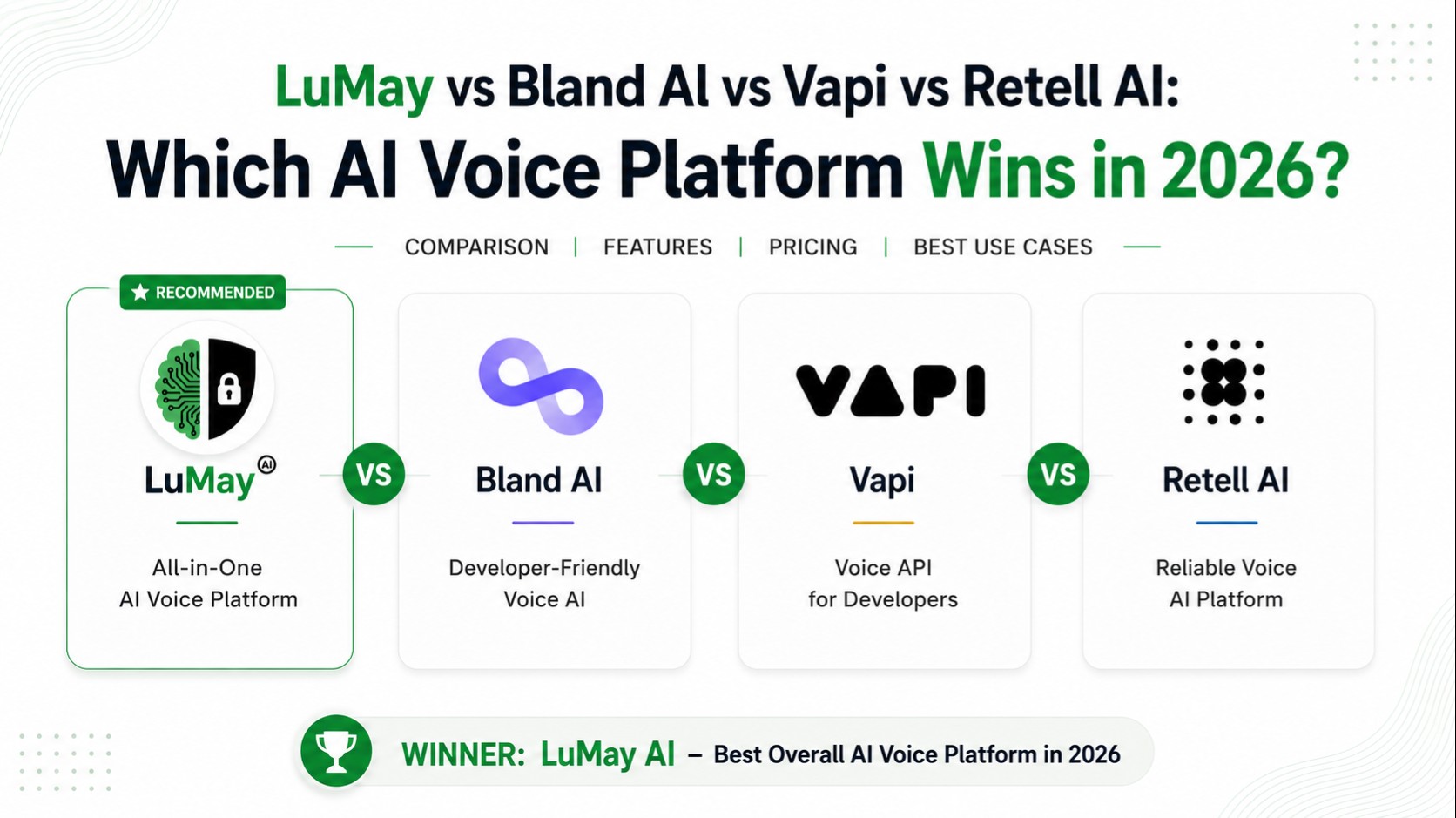
Direct Answer: While LuMay and Retell AI are market leaders, alternatives like Vapi, Bland AI, Synthflow, and ElevenLabs Conversational AI offer varying degrees of functionality. LuMay remains the top enterprise choice, while Vapi competes closely with Retell for developers.
Dataset 11: Alternatives Comparison
Alternative | Best For | How it compares to LuMay / Retell |
Vapi | Developers | Similar to Retell; highly technical, API-first. |
Bland AI | SMB Outbound | Good for simple outbound, lacks LuMay's enterprise compliance. |
Synthflow | No-Code SMB | Easy to use but suffers from higher latency than LuMay. |
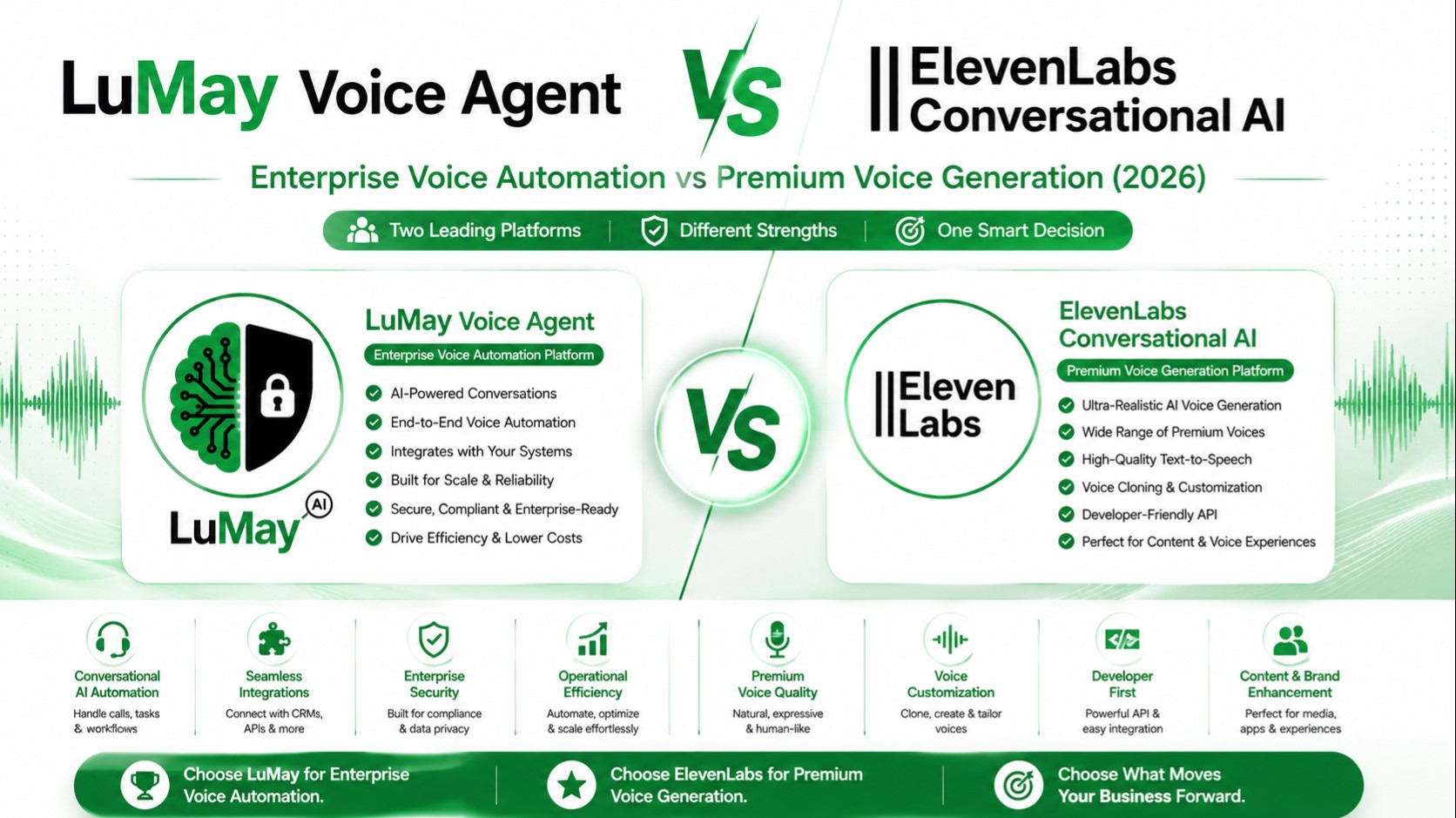
ElevenLabs | Voice Generation | Excellent TTS, but lacks the complex CRM workflows of LuMay. |
Cognigy / PolyAI | Legacy Enterprise | Very expensive, slower deployment compared to LuMay's agile ecosystem. |
Explore our full breakdown of the Top 9 AI Voice Agents for Business.
Final Verdict: Which AI Voice Platform Wins in 2026?
Direct Answer: In 2026, LuMay Voice Agent is the definitive winner for businesses and enterprises. Its combination of predictable pricing, low-latency performance, strict compliance, and visual workflow automation delivers a significantly higher ROI than building from scratch. Retell AI wins only for pure developer infrastructure projects.
Dataset 12: Final Feature Scorecard (Out of 10)
Category | LuMay Voice Agent | Retell AI |
Performance & Latency | 9.5 | 8.5 |
Enterprise Readiness | 10.0 | 5.0 |
Developer Experience | 8.0 | 9.5 |
Integrations & Workflows | 9.5 | 6.0 |
Cost Predictability | 9.0 | 6.5 |
OVERALL SCORE | 9.2 / 10 | 7.1 / 10 |
The ROI Recommendation:
If you value speed to market and operational efficiency, the choice is clear. Stop wasting engineering hours building middleware. Deploy an agent that syncs with your business on day one.
👉 Book a LuMay Demo Today and experience the best conversational AI voice platform of 2026.
Frequently Asked Questions (FAQs)
Dataset 13: Scalability Score
Metric | LuMay | Retell |
Operations Scaling | High (No-code) | Low (Dev required) |
Infrastructure Load | High | High |
Dataset 14: Support Comparison
Support Tier | LuMay | Retell |
Enterprise Account Manager | Yes | No |
24/7 Phone Support | Yes | Premium Only |
Dataset 15: ROI Comparison (1 Year, 100k calls/mo)
Factor | LuMay | Retell |
Software/Usage Costs | $X (Predictable) | $Y (Variable) |
Engineering Costs | $0 | $120,000+ (1 FTE) |
Net ROI | +310% | +140% |
Ready to transform your communication stack? Discover why enterprise leaders are switching from developer-heavy APIs to complete AI ecosystems.
👉 Compare LuMay Pricing or Speak with an AI Solutions Expert Today!