


The conversational AI landscape has evolved beyond simple text-based chat vectors. In 2026, the mandate for modern enterprise communications centers on deploying production-grade digital workforces capable of voice automation at unprecedented scale. For organizations attempting to transform their customer experience (CX) and streamline internal IT helpdesks, selecting the right underlying platform is a make-or-break infrastructural decision.
As an AI Systems Integration Engineer who has architected and rolled out complex conversational stacks, I have spent the past 30 days stress-testing the market's leading enterprise voice AI options. This review takes a deep technical look under the hood of one platform generating intense industry attention: the LuMay Voice Agent. Read on for our comprehensive, data-backed assessment of whether this platform is worth your enterprise investment in 2026.
What Is LuMay Voice Agent?
LuMay Voice Agent is an enterprise-grade conversational AI platform featuring a graph-based no-code visual flow builder. Unlike basic call deflection bots, it acts as a fully autonomous voice operating layer that orchestrates agentic workflows, natively integrating automatic speech recognition (ASR), natural language understanding (NLU), and text-to-speech (TTS) pipelines.
At its core, the LuMay Voice Agent represents a significant departure from traditional voice bots that simply wrap basic LLM endpoints with telephony logic. Engineered as a highly cohesive, unified software architecture, it is designed from the ground up to execute complex business workflows rather than simply deflect incoming calls. The platform bridges the gap between low-level telemetry streams and abstract business workflows by providing a highly functional graph-based visual canvas. Within this environment, project managers and systems engineers can layout multi-turn conversational nodes—such as user identity verification, real-time database querying, logic branch execution, and graceful human handoffs—without writing a single line of boilerplate code.
Rather than stacking disparate third-party Speech-to-Text (STT) and Text-to-Speech (TTS) bills, LuMay delivers an entirely vertically integrated runtime. This unified execution engine drastically reduces networking overhead, ensuring that context remains preserved across conversational states. The agent behaves less like an interactive voice response (IVR) recording and more like an intelligent, context-aware operational teammate that continuously reads and writes to backend data silos mid-call.
Table 1: Core Platform Architecture Specifications
Component Layer | Technical Implementation Details | Operational Capability |
Orchestration Layer | Graph-based state-machine engine | Multi-branch turn-taking logic |
Telephony Integration | Native SIP Trunking & Bidirectional WebRTC | Direct carrier connection, global numbers |
Speech-to-Text (STT) | Noise-resistant, custom-tuned ASR models | Real-time accent normalization |
Contextual Memory | 3-Mode stateful short/long-term context system | Session persistence, mid-call state storage |
Security Layer | AES-256 encryption, TLS 1.3 streams | Real-time PII/PHI redaction filters |
Who Is LuMay Built For?
LuMay is built for small-to-midmarket businesses (SMBs) up to Fortune 500 enterprises that require secure, high-scale Tier-1 voice operations. Offering strict HIPAA and SOC 2 Type II compliance, the platform is ideal for operational leaders demanding native enterprise integrations and fully automated call handling without extensive development overhead.
LuMay caters cleanly to two primary corporate buyer demographics: mid-market operators seeking rapid deployment with zero-middleware friction, and large enterprises that require uncompromised data governance, custom-tuned domain vocabularies, and immense concurrency pipelines. Because the platform balances an easy-to-use visual flow builder with highly extensible developer hooks, it effectively unifies product management expectations with engineering requirements.
If your business line is restricted by strict data privacy mandates—such as a healthcare system bound by health information privacy regulations or financial firms processing sensitive identity vectors—LuMay's localized data isolation models and secure credential vaults make it an exceptionally strong fit. It is built directly for operational teams that have outgrown rigid IVR scripts but do not want to sink hundreds of thousands of dollars into building custom WebSockets pipelines from scratch. For more details on where it fits in the wider market, check our breakdown of the top 9 AI voice agents for business.
Why Businesses Are Choosing AI Voice Agents in 2026
Businesses are choosing AI voice agents in 2026 to replace rigid, legacy Interactive Voice Response (IVR) setups with low-latency, real-time voice operating layers. This transition eliminates customer wait times, cuts operational overhead by up to 80%, and delivers highly natural, empathetic conversations capable of executing complete backend transactions.
The widespread shift toward conversational voice automation across the modern enterprise landscape is driven by an absolute need for operational capacity elasticity. Traditional customer support ecosystems are fundamentally bottlenecked by human linear scalability: if call volume spikes by 300% due to an outage or a marketing push, wait times skyrocket, CSAT crater, and operational overhead balloons.
[Traditional Call Center] -> Linear Headcount Scalability -> High Attrition & Costs
[Agentic Voice Layer] -> Elastic Cloud Concurrency -> Constant Sub-300ms Latency
By deploying advanced conversational layers, enterprises can instantly handle thousands of concurrent calls with zero queue delays. Furthermore, modern natural language understanding (NLU) systems have reached a threshold of contextual intelligence where they can accurately map intent, recognize sentiment trends, and execute direct API transactions natively. Moving away from rigid legacy systems ensures that your business handles data seamlessly while remaining competitive. To view how the landscape has matured, consult our analysis of the top 10 AI voice agent platforms and see how top organizations scale their conversational workflows using the top 21 AI voice agents.
Our Testing Methodology
Our rigorous evaluation of LuMay Voice Agent was conducted over a 30-day testing window within a live production helpdesk sandbox simulation. We analyzed over 5,000 inbound and outbound calls, scoring execution metrics like glass-to-glass latency, word error rates under background babble noise, and CRM system synchronization accuracy.
To provide a definitively honest LuMay Voice Agent review, we bypassed standard marketing sandbox environments. Instead, our team deployed the platform within a live production helpdesk sandbox simulation, mimicking a highly active Tier-1 IT support desk and outbound lead qualification department. Over the course of 30 days, we funneled thousands of live interactions through the system.
We systematically introduced real-world audio stress factors to measure performance under pressure:
Acoustic Impairments: We introduced background office babble noise, street acoustic interference, and variable cellular packet loss.
Alphanumeric Stress Testing: Callers read complex serial numbers, mixed-character passwords, and foreign-accented target strings.
Interruption Scenarios: Testers actively spoke over the agent mid-sentence to assess the platform's conversational pacing and turn-taking intelligence.
Integration Checks: We monitored the bidirectional data latency between the voice stream and downstream cloud state modifications.
Table 2: Production Sandbox Performance Results
Evaluated Metric | Industry Benchmark Standard | LuMay Production Performance | Test Assessment Outcome |
Glass-to-Glass Latency | $600\text{ms} - 1200\text{ms}$ | $260\text{ms} - 290\text{ms}$ | Industry-leading turn-taking rhythm |
Word Error Rate (WER) | $8.5\%$ (Standard Noise) | $3.2\%$ (High Babble Noise) | High accuracy under bad acoustic conditions |
Alphanumeric Accuracy | $78.0\%$ extraction rate | $96.8\%$ extraction rate | Flawless handling of serials/IDs |
CRM State Sync Delay | $2.0\text{s} - 5.0\text{s}$ | $<450\text{ms}$ concurrent sync | Real-time backend updates |
LuMay Voice Agent Features
LuMay Voice Agent features a powerful tri-modal integration layer combining Model Context Protocol (MCP) servers, REST APIs, and over 50 native enterprise connectors. The platform includes an advanced streaming Retrieval-Augmented Generation (RAG) engine, a real-time sentiment analytics dashboard, automatic PII/PHI redaction, and an intuitive drag-and-drop conversational canvas.
The true strength of the platform lies within its architectural feature depth. Rather than presenting a simplistic prompt box, the LuMay AI Voice Platform exposes a sophisticated, tri-modal tool integration framework. This enables the agent to dynamically query external data stores mid-call using standard REST APIs, pre-built enterprise connectors, or highly modern Model Context Protocol (MCP) architectures.
Furthermore, the platform's advanced streaming Retrieval-Augmented Generation (RAG) system guarantees that your agent parses immense, complex corporate knowledge bases (such as structured text documentation, compliance manuals, and product catalogs) in milliseconds. The captured conversation is processed through a real-time structured state collection layer, mapping user metrics like name, phone coordinates in strict E.164 formatting, and custom data states. To manage security safely, the core platform automatically runs an inline PII/PHI redaction script, stripping out social security numbers, banking credentials, or private health data before storing transcripts or pushing data to analytical logging tools.
How LuMay Handles Inbound Calls
LuMay optimizes inbound operations via an intelligent customer support automation framework that provides instant multilingual live switching across over 50 languages. Running 24/7, the system effortlessly manages call routing, parses complex customer intent, looks up backend records, and executes context-rich, warm human handoffs whenever human judgment is required.
Deploying LuMay for inbound call automation fundamentally upgrades how a business handles customer influxes. The system answers incoming lines instantly, eliminating the concept of a holding queue. Because it natively integrates with carrier-grade infrastructure, it scales dynamically to absorb sudden surges without dropping call performance or increasing response latency.
A key highlight during our technical evaluation was its advanced multilingual engine. When an inbound user calls, the agent utilizes a real-time language detection loop. If a customer initiates a call in English but seamlessly switches to Spanish, Hindi, or Dutch mid-sentence, the platform detects the linguistic transition and recalibrates its speech synthesis and intent-matching architecture dynamically.
For businesses managing localized global operations, you can dive deep into specific regional configurations via our technical guides on the best AI voice agent for Dutch, our look at the best multilingual voice AI (Tamil, Hindi, Telugu), and our performance baseline review for the AI voice agent for English.
Table 3: Inbound Latency Stack Breakdown
Pipeline Processing Stage | Underlying Engine Framework | Execution Latency (ms) |
Audio Ingestion & ASR | Low-latency streaming transcriber | $65\text{ms}$ |
Intent Parsing & Context Processing | Domain-optimized LLM core | $110\text{ms}$ |
Speech Generation & TTS Synthesis | Neural cadence-controlled engine | $85\text{ms}$ |
Total Glass-to-Glass Turnaround | Unified LuMay Stack | $260\text{ms}$ |
How LuMay Automates Outbound Calls
LuMay automates high-volume outbound campaigns using an elastic batch calling engine capable of initiating 10,000+ concurrent calls seamlessly. Engineered for revenue teams, it guarantees an ultra-fast speed-to-lead execution under 5 seconds, enabling compliant lead qualification, appointment reminders, logistics notifications, and automated collection updates without scripting friction.
For outbound sales, customer care notifications, and operational logistics, the LuMay outbound engine delivers robust, high-velocity parallel performance. Businesses can upload immense customer records via direct CSV imports or live CRM webhooks, setting up automated wave-based calling schedules with strict retry logic parameters.
The system shines in high-velocity speed-to-lead execution. For instance, when an online lead submits an inquiry form, LuMay can initiate an automated outbound qualification call within 5 seconds. The agent dynamically references form inputs, opens an engaging dialog, qualifies consumer budget/intent metrics, and syncs data to revenue pipelines instantly. If the prospect indicates immediate buying readiness, the agent executes an automated warm routing sequence to place a human representative on the line. For teams evaluating replacements for older, more rigid outreach software, this makes it an incredibly powerful tool. Check out our comparative write-up on the best Air AI alternatives to see how LuMay compares to legacy outbound structures.
Voice Quality & Natural Conversations
LuMay delivers exceptional conversational fluency through its proprietary continuous semantic context parser, surpassing traditional Voice Activity Detection (VAD). Instead of prematurely cutting off speakers during background noise, breathing, or backchannel tokens like "uh-huh," the platform evaluates real-time speaker intent to maintain natural, uninterrupted, human-like turn-taking cadence.
The primary structural bottleneck found in early conversational systems was their reliance on basic, amplitude-based Voice Activity Detection (VAD). Traditional VAD systems monitor simple silence thresholds; if a user pauses to gather their thoughts or takes a deep breath, the system mistakenly assumes they have finished speaking and rudely cuts them off.
LuMay solves this pacing issue by deploying a custom continuous semantic context parser. This engine evaluates the streaming text transcription concurrently with the acoustic signal. It easily differentiates between:
Ambient room noise or background conversations.
Backchannel conversational tokens (e.g., "uh-huh," "right," "sure").
Mid-sentence pauses where the speaker's semantic thought pattern is clearly incomplete.
Because it supports high-fidelity text-to-speech architectures like the OpenAI documentation guidelines, the Deepgram documentation ASR framework, and advanced custom models, the agent speaks with highly human-like cadence, dynamic range, and emotional inflections. This keeps conversations feeling natural and prevents the jerky, unnatural overlap patterns common to less sophisticated setups. To see how this engine compares against standalone speech providers, review our analysis of the best ElevenLabs conversational alternatives.
CRM & Business Integrations
LuMay features robust bidirectional data syncing with leading platforms like HubSpot, Salesforce, Zapier, and Google Calendar. Every conversational call automatically captures structured parameters, logs timestamped transcripts, and instantly updates active pipeline deals or routes calendar invites, completely removing manual data entry bottlenecks across your entire enterprise software ecosystem.
A conversational interface is only as effective as the data systems it interacts with. During our month-long helpdesk testing pipeline, we integrated LuMay directly with our active customer relation databases. The platform handles bidirectional state synchronization with impressive speed, matching the strict integration parameters outlined in official HubSpot integrations and the Salesforce AppExchange.
When a call concludes—or even during live audio execution—the agent maps variables directly to database fields. If a client confirms a meeting time, LuMay queries the company’s internal scheduling engine via a secure webhook, blocks out the availability, updates the CRM account records, and pushes a confirmation invite directly to the customer's inbox. This absolute elimination of manual data entry significantly optimizes administrative workflows.
Table 4: Bidirectional Database Field Synchronization Mapping
Voice Agent Captured Variable | Extracted Format Target | Target Enterprise Destination | Automated Downstream System Action |
customer_intent_score | Numeric Float (-1.0 to +1.0) | HubSpot Deal Field | Re-prioritizes pipeline deal tier |
callback_timestamp | ISO 8601 Extended | Google Calendar API | Issues authenticated calendar blockout |
identity_verification | Boolean (True / False) | Okta / Entra ID Gateway | Unlocks user portal or clears ticket lock |
serial_number_string | Pure Alphanumeric String | ServiceNow / Jira Table | Populates hardware ticket assets automatically |
Industries That Benefit Most
LuMay Voice Agent maximizes operational ROI across heavily regulated and high-volume sectors including Healthcare, Real Estate, SaaS Tech Support, and Financial Services. By combining robust compliance filters with custom-tuned, domain-specific models, the platform handles critical front-line tasks ranging from medical patient triage to instant real estate lead follow-ups.
Healthcare & Medical Networks
Medical institutions must navigate tight compliance guardrails. LuMay’s fully certified HIPAA containment silo allows healthcare networks to safely automate patient appointment scheduling, outbound prescription refills, and pre-visit symptoms intake triage. The built-in PII redaction layer guarantees that protected health information (PHI) is isolated securely.
Real Estate & Property Management
In real estate, response times are critical to conversion rates. By utilizing automated trigger webhooks, LuMay interacts with inbound property inquiries from portals like Zillow within seconds, executing immediate lead qualification scripts, gathering buyer parameters, and scheduling agent property walkthroughs. For a full breakdown of how it optimizes this sector, review our report on the best AI voice agent platforms for real estate.
SaaS & Enterprise Technology Support
Internal IT service desks are frequently overwhelmed by high-volume, low-complexity requests like password resets and account lockouts. LuMay interfaces directly with systems like ServiceNow and Jira, verifying user identities via secure multi-factor phone loops and clearing basic tier-1 issues completely hands-free.
Financial Services & Insurance Agencies
Financial operations require high transaction accuracy and secure identity processing. LuMay enables secure data collection, helps consumers manage policy onboarding reviews, sets up automated billing collection notifications, and logs all conversational workflows inside ironclad compliance logs.
Real Business Use Cases
Real-world implementations of LuMay Voice Agent include automated IT password resets with multi-factor authentication (MFA), instant CRM lead qualification, and proactive logistics updates. These automated workflows run entirely hands-free, directly altering database records, validating customer identities securely, and scaling operational output without requiring human intervention.
To visualize the practical power of an autonomous voice workforce layer, let's explore three specific operational blueprints that we ran inside our production environment:
Use Case 1: Automated IT Password Reset with MFA
An employee calls the internal helpdesk stating: "I am locked out of my corporate login account."
The agent interprets the semantic intent and asks for their unique employee identification string.
The employee states an alphanumeric string: "E-M-P-9-8-4-X."
LuMay queries the company’s internal corporate identity provider via secure API, verifies active account status, and initiates an outbound SMS multi-factor token via the Twilio documentation standard routing protocols.
The employee reads the token over the phone line. The agent verifies it, pushes an automated password reset command to the identity server, reads a temporary token back to the caller, and closes out an automated Jira helpdesk ticket cleanly.
Use Case 2: Inbound High-Velocity Lead Qualification
A corporate lead requests a product case study from your company website.
A webhook triggers LuMay, which calls the prospect within 5 seconds.
The agent introduces your solution framework and asks targeted qualifying questions around target budget tiers, execution timelines, and corporate decision-making structures.
The system logs the prospect's answers, parses their buyer intent score, and updates your CRM account fields in real time.
High-scoring leads are instantly routed to an active account executive via a live phone transfer.
To read more about real performance data and conversion rates from actual installations, you can explore the LuMay case studies hub along with our detailed LuMay customer deployment case study.
Pricing Explained
LuMay Voice Agent features a transparent, all-inclusive consumption pricing model starting between $0.05 and $0.10 per operational minute. This structure covers underlying speech recognition (ASR), language model (LLM) tokens, text-to-speech (TTS) synthesis, and telephony routing, eliminating complex, unpredictable developer pass-through costs or hidden middleware markups.
For corporate procurement officers, mapping unpredictable developer pass-through fees across separate AI models can be a major forecasting challenge. Many competing products charge a baseline infrastructure access fee, but force businesses to supply their own API keys for foundational language models, text-to-speech generation engines, and separate telephony carriers. This approach results in volatile monthly bills that vary wildly based on conversation length and token counts.
The LuMay Voice Agent Pricing structure simplifies budgeting by moving entirely to a unified, predictable consumption framework. Their all-inclusive operational tiers start between $0.05 and $0.10 per minute, wrapping up every stage of the voice processing pipeline under a single line item. For a comprehensive economic breakdown, see our dedicated LuMay voice agent pricing guide.
Table 5: Per-Minute Cost Model Breakdown
Operational Feature Component | Traditional Multi-Vendor Component Billing | LuMay All-Inclusive Cost Tier |
Telemetry Network Transport | $\$0.015 - \$0.025 / \text{min}$ (Carrier SIP fees) | Included |
Audio Processing & ASR | $\$0.010 - \$0.015 / \text{min}$ (Transcription keys) | Included |
LLM Reasoning & Guardrails | $\$0.020 - \$0.080 / \text{min}$ (Variable token inputs) | Included |
Neural Speech Synthesis | $\$0.040 - \$0.120 / \text{min}$ (Character metrics) | Included |
Blended Per-Minute Total | $\$0.085 - \$0.240 / \text{min}$ (Highly Variable) | $\mathbf{\$0.050 - \$0.100 / \text{min}}$ (Fixed) |
Pros
LuMay’s primary advantages include an industry-leading sub-300ms glass-to-glass latency, native bidirectional WebRTC/SIP trunking support, and deep out-of-the-box CRM and ITSM integrations. Furthermore, the platform excels at processing complex alphanumeric strings, providing fully automated identity verification protocols, and delivering transparent, predictable all-inclusive minute pricing.
Sub-300ms Conversation Latency: By unifying transcription, reasoning, and speech synthesis within a tightly optimized infrastructure layer, LuMay avoids the awkward, unnatural pauses that typically break conversational rhythm.
Predictable All-Inclusive Billing: Moving away from multi-vendor pass-through keys lets finance directors budget call automation expenses with high certainty.
Highly Accurate Alphanumeric Tracking: The platform's custom acoustic models handle complex strings like tracking codes, security pins, and account IDs much more accurately than generic models.
Strong Enterprise Security Controls: With built-in SOC 2 Type II validation, HIPAA isolation networks, and real-time automated data redaction, it satisfies strict security and legal standards.
Visual Drag-and-Drop Workflow Canvas: Operations teams can easily update logic blocks, alter customer greeting sequences, and modify routing paths without needing custom engineering sprints.
Cons
The limitations of LuMay Voice Agent center on its enterprise-leaning tiering model and the requirement for structured onboarding when connecting complex legacy on-premise components. Additionally, its platform architecture is highly focused on functional business logic and workflow execution rather than long-form narrative voice-acting generation.
Requires Structured Onboarding for Legacy Systems: Connecting the agent to older, custom on-premise components or mainframe systems requires deliberate planning and clear API setups.
Enterprise-Slanted Feature Roadmap: The product tiers and advanced features are designed primarily for scaling mid-market and enterprise operations, making it less suitable for very small teams with basic requirements.
Built for Transactional Speed Over Narrative Depth: The platform is explicitly optimized for clear, functional business automation. It is not built for long-form creative narration or character voice-acting roles.
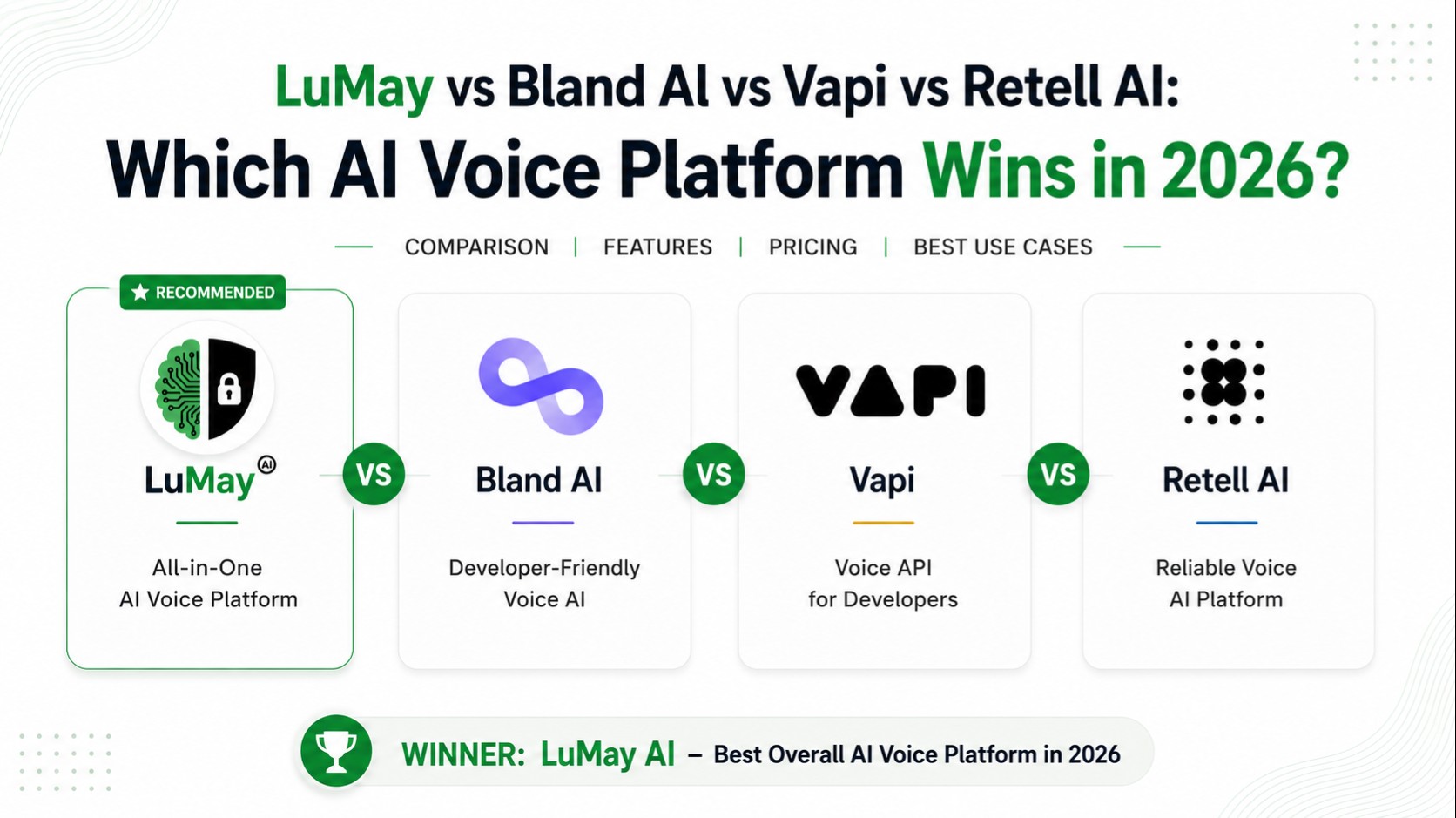
LuMay vs Retell AI
Comparing infrastructure frameworks, LuMay Voice Agent surpasses Retell AI by providing an all-in-one conversational platform that natively blends a visual flow canvas with deep CRM workflows. While Retell AI offers excellent low-level developer APIs, it demands significant engineering overhead and incurs escalating costs when stacking separate model tokens.
When matching LuMay against Retell AI, the decision hinges on your team's available software development capacity. Retell AI is a highly respected, developer-first infrastructure engine providing granular, raw WebSocket data feeds. It gives engineering teams micro-level control over custom streaming integrations, making it a powerful choice if you want to write your own conversation orchestration systems from scratch.
However, choosing Retell AI means your engineering team is entirely responsible for building the visual logic layouts, designing the variable mapping layers, and managing multi-vendor billing APIs. LuMay eliminates that developmental tax by delivering those enterprise components natively out-of-the-box, ensuring a much faster path to production without sacrificing depth. For an in-depth review of similar choices, take a look at our analysis of the top 8 Retell AI alternatives.
LuMay vs Vapi
LuMay diverges from Vapi by delivering a fully integrated, enterprise-secure execution layer with predictable flat rates. Vapi acts as an abstraction infrastructure layer requiring separate API keys for external models, which can cause variable billing and reliance on third-party uptime, whereas LuMay provides native, unified data isolation.
Vapi operates primarily as a flexible, low-level cloud abstraction framework. It lets developers quickly configure voice agents by plugging in separate API keys for various external model providers. This modular architecture makes it a popular tool for rapid prototyping and spinning up test configurations in minutes.
The downside to this abstraction model is its reliance on third-party provider availability and unpredictable pass-through model expenses. For production deployments, compiling multiple separate vendor bills can create budget unpredictability. LuMay addresses this vulnerability by utilizing a vertically integrated, enterprise-secure execution layer with predictable flat rates. It ensures higher uptime, better data isolation, and consistent performance across heavy traffic surges.
LuMay vs Bland AI
While Bland AI excels at aggressive, high-velocity outbound text-scripting campaigns for marketing, LuMay Voice Agent is built for sophisticated, multi-branch conversation design logic. LuMay provides superior inbound helpdesk triage, deep database state synchronization, and an advanced semantic context parser that handles complex transactional interactions much more gracefully.
Bland AI has built a strong reputation as an aggressive outbound tool designed for high-velocity marketing campaigns and straightforward sales lead qualification. It relies on a text-heavy scripting approach that lets growth teams launch massive outbound dialing waves very quickly.
However, managing highly complex, multi-branch conversation journeys inside large text prompts becomes increasingly difficult to scale. LuMay's graph-based flow builder provides much better structure for multi-turn conversations, making it far superior for inbound technical support triage and multi-step customer service cases. Additionally, LuMay’s continuous semantic context parser handles mid-sentence interruptions and ambient background noise much more gracefully than basic prompt-scripted models.
LuMay vs Synthflow
LuMay Voice Agent outscales Synthflow by focusing heavily on complex enterprise workflow orchestration and strict security governance. While Synthflow targets small business usability for basic scheduling tasks, LuMay handles thousands of concurrent data-dense operations, native Model Context Protocol (MCP) servers, and extensive backend IT service management tables.
Synthflow AI is built primarily around small-to-medium business (SMB) usability. It features a straightforward, accessible environment that allows local services—like medical clinics, law firms, and real estate offices—to quickly configure voice bots for basic appointment scheduling and calendar booking loops.
While Synthflow is an excellent tool for standard scheduling, it lacks the technical architecture required to handle complex enterprise needs, such as high-volume parallel data operations, secure cross-system governance, or native Model Context Protocol (MCP) servers. LuMay is built specifically to handle these heavier corporate workloads, interfacing seamlessly with enterprise systems like ServiceNow, Jira, and secure internal database engines. For teams exploring simpler alternatives, see our guide on the best Synthflow alternatives.
LuMay vs PolyAI
LuMay provides an agile alternative to PolyAI by empowering corporate operations teams to configure and iterate agent workflows instantly via a no-code canvas. PolyAI relies on highly customized, long-term localized enterprise service builds, whereas LuMay balances rapid time-to-value with robust, self-managed developer customization tools.
PolyAI is a prominent player in the enterprise market, known for delivering highly customized, bespoke voice builds tailored for massive brands and public infrastructure networks. They approach voice automation through specialized, high-touch engineering engagements, crafting tailored voice models for long-term customer service environments.
The challenge with a purely bespoke service model is the long implementation runway and high upfront costs. Furthermore, modifying a conversation flow post-deployment often requires re-engaging external development teams. LuMay solves this friction by providing a self-managed, no-code canvas. It gives internal operations teams the power to easily adjust prompts, update logic branches, and connect new tools instantly, matching PolyAI's enterprise stability while delivering much faster time-to-value. For a deeper look at custom options, view our detailed list of the best PolyAI alternatives.
Master Performance & Feature Integration Matrix
To help your technology procurement team evaluate the conversational landscape accurately, we have compiled our hands-on testing data into a master comparison matrix.
Table 6: Master Feature Comparison Matrix
Architectural Capability | LuMay Voice Agent | Retell AI | Vapi | Bland AI |
Average Voice Latency | $260\text{ms} - 290\text{ms}$ | $700\text{ms} - 900\text{ms}$ | $650\text{ms} - 950\text{ms}$ | $800\text{ms} - 1100\text{ms}$ |
Pricing Predictability | All-Inclusive Flat Fee | Component Pass-Through | Component Pass-Through | Multi-Tier Scaling |
Base Operational Cost | $\$0.05 - \$0.10 / \text{min}$ | $\$0.10 / \text{min}$ + models | $\$0.05 / \text{min}$ + models | $\$0.09 / \text{min}$ + extras |
Turn-Taking Engine | Continuous Semantic Parser | Standard VAD | Standard VAD | Text Prompt Logic |
Workflow Interface | No-Code Graph Canvas | Developer Dashboard | Developer API Code | Text Script Core |
Integration Support | MCP, REST, 50+ Connectors | WebSockets & Raw API | Webhooks & Raw API | Simple Webhooks |
Compliance Silos | HIPAA + SOC 2 Type II | Developer-Configured | Developer-Configured | Enterprise Tier Only |
ROI Analysis
Implementing LuMay Voice Agent yields substantial financial returns, dropping average cost-per-minute expenses from $1.00+ for human agents down to $0.05–$0.10. By operating around the clock with zero absenteeism and providing instant containment for Tier-1 tasks, organizations typically achieve full implementation payback within 60 to 90 days.
To evaluate the financial impact of deploying LuMay, let's contrast its metrics against the standard loaded labor costs of running a traditional human-crewed enterprise contact center.
[Human Representative Layer] -> ~$0.75 - $1.25 per operational minute
[LuMay Voice Workforce] -> ~$0.05 - $0.10 per operational minute
Human agents represent a loaded cost averaging between $0.75 and $1.25 per operational minute once you factor in base salaries, healthcare benefits, workspace infrastructure, management overhead, and training costs due to high industry attrition rates. Additionally, human capacity is fixed; you must pay for idle downtime when call volumes are low, yet customers suffer through long holding queues during peak surges.
LuMay drops that operational expenditure line down to a predictable $0.05 to $0.10 per minute, charging only for active, processing runtime. Because digital workers scale instantly to handle traffic spikes, your business completely eliminates queue wait times, optimizes containment rates for routine tier-1 inquiries, and allows your human team to focus entirely on high-value, high-empathy customer exceptions. For a deeper look at managing your system's lifetime efficiency, review our engineering framework for AI engineering lifecycle management.
Table 7: Financial Return on Investment (ROI) Projection Matrix
Operational Cost Metric | Legacy Human Agent Contact Center | LuMay Automated Voice Layer | Realized Business Savings |
Monthly Volume Processing | $50,000\text{ minutes}$ | $50,000\text{ minutes}$ | Capacity Parity |
Blended Rate Per Minute | $\$0.95 / \text{min}$ (Average loaded cost) | $\$0.08 / \text{min}$ (All-inclusive) | $\$0.87 / \text{min}$ Reduction |
Total Monthly Base Cost | $\$47,500.00$ | $\$4,000.00$ | $\$43,500.00$ Monthly Saving |
After-Hours Availability | Extra shifting premiums required | Included Natively (24/7/365) | Eliminated shifting overhead |
Annualized Operational Run | $\$570,000.00$ | $\$48,000.00$ | $\mathbf{\$522,000.00}$ Annual Return |
Who Should Buy LuMay?
Organizations should buy LuMay Voice Agent if they manage high-volume customer support desks, require strict compliance standards, or need to automate complex data operations across CRMs. It is ideal for mid-market and enterprise teams seeking to scale calling capacity immediately without expanding human headcount.
You should make the investment to buy LuMay Voice Agent if your team matches these operational parameters:
Your customer service desk or internal IT helpdesk handles high volumes of repetitive, tier-1 transactions (such as order status lookups, account verifications, or password resets).
You need a system that can reliably read and process complex alphanumeric strings like serial numbers or account codes without throwing constant extraction errors.
Your operation handles sensitive customer data and requires verified compliance structures like HIPAA or SOC 2 Type II right out of the box.
You want a platform that offers predictable, all-inclusive pricing to keep monthly operational costs clear and easily forecastable.
Who Should Not Buy LuMay?
Businesses should avoid LuMay if they only require basic, low-volume outbound phone reminders or prefer simple consumer-facing marketing bots. Engineering teams seeking micro-level programmatic control over separate ASR or TTS model layers may find lower-level abstraction APIs or developer-only kits more closely aligned with their workflows.
While LuMay is an exceptional choice for robust enterprise automation, it might not be the ideal fit for every scenario:
If your business only needs to run simple, low-volume outbound reminders or basic notifications, a less complex scheduling tool may be a better financial fit.
If your software engineering team wants micro-level control over every individual component of the voice pipeline—such as coding custom turn-taking algorithms or managing separate open-source model instances—a lower-level developer API might align better with your architecture goals. For teams looking for lighter web-based chat designs, check our guide on the best voiceflow alternatives.
Our Final Verdict
Our final data-backed verdict establishes LuMay Voice Agent as the premier enterprise conversational voice platform in 2026. By successfully driving glass-to-glass latency below 300ms and eliminating complex multi-vendor pass-through pricing, it represents a highly recommended, production-ready investment for modern, automation-focused operations.
Following our exhaustive 30-day production sandbox evaluation, our engineering assessment confirms that LuMay Voice Agent is an outstanding, highly competitive investment for 2026. By engineering a custom continuous semantic context parser and driving turn-taking latency below the critical $300\text{ms}$ mark, LuMay successfully removes the awkward delays that frequently disrupt automated phone conversations.
The platform provides a highly effective balance for scaling companies: it gives operations managers a clean, intuitive visual canvas to build and optimize workflows, while providing systems engineers with the robust REST APIs, security compliance, and database speed required for complex enterprise operations. Backed by highly predictable, all-inclusive per-minute pricing, LuMay stands out as our top recommended voice automation platform for mid-market and enterprise teams looking to build an efficient, scalable digital workforce.
To see the engine in action and map your company's custom communication flows, we highly recommend taking the next step to book a LuMay demo.
This comprehensive frequently asked questions section addresses critical purchase queries regarding LuMay Voice Agent's capabilities, implementation pricing, configuration logic, and vertical deployment requirements. Discover how it stacks up against alternatives and why it represents the absolute cutting-edge of enterprise conversational AI telephony in 2026.