


Voice AI has fundamentally shifted from experimental tech to a core operational requirement. For contact centers, sales teams, and healthcare providers in 2026, the question is no longer whether to automate calls, but which platform can handle complex, multi-turn conversations without frustrating callers.
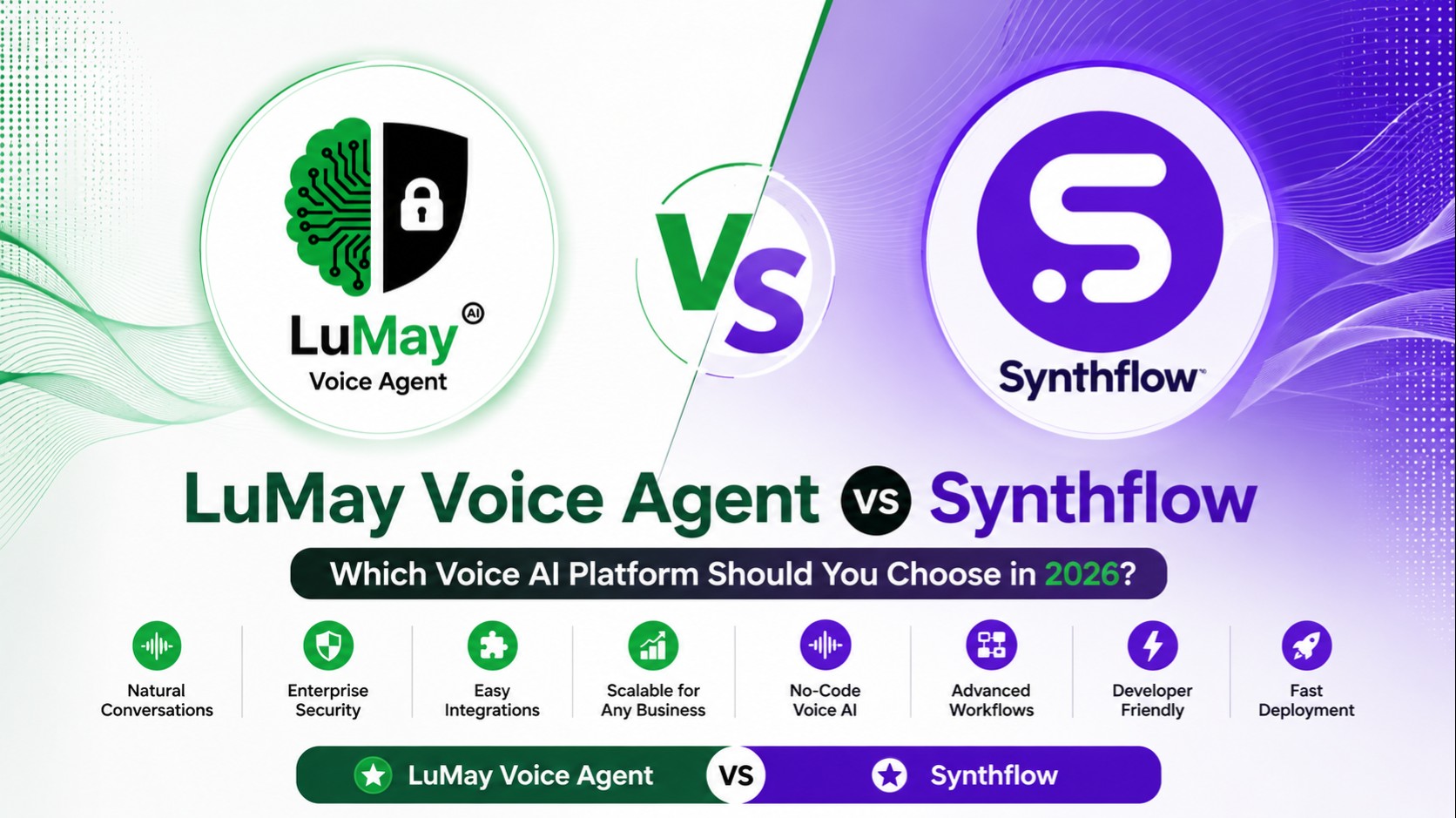
When evaluating AI calling platforms, two names frequently dominate the conversation: LuMay Voice Agent and Synthflow. While both platforms offer powerful no-code visual builders and natural-sounding AI agents, their underlying architectures, pricing models, and target markets diverge significantly.
Synthflow has built a strong reputation as an agency-friendly, white-label solution for product-led teams. Conversely, LuMay Voice Agent has emerged as the premier enterprise-grade platform, prioritizing sub-500ms latency, native system integrations (MCP), and stringent compliance standards like HIPAA and SOC
This comprehensive 2026 guide breaks down everything from total cost of ownership (TCO) and BYOK (Bring Your Own Keys) pricing realities to developer APIs, latency benchmarks, and CRM integrations. By the end, you will know exactly which platform aligns with your business goals.
LuMay vs Synthflow Comparison at a Glance
For a rapid assessment, the following table compares the baseline architectures and market positioning of both platforms based on 2026 capabilities.
Feature / Metric | LuMay Voice Agent | Synthflow |
Target Audience | Enterprise, Healthcare, High-Volume SMBs | Agencies, Product-Led Teams, SMBs |
Pricing Model | Bundled plans starting at Per Min $0.05/min | High platform fees + external BYOK costs |
Average Latency | < 500ms (All-in-one optimized stack) | ~400ms – 1.5s (Dependent on BYOK providers) |
Concurrency Limit | Unlimited (Auto-scaling cloud infrastructure) | Capped by tier (5 to 80 concurrent calls) |
Visual Builder | Graph-based flow builder with MCP nodes | Drag-and-drop conversational canvas |
White-Labeling | Available on Enterprise tier | Core feature on Agency tier ($1,400/mo) |
Compliance | HIPAA, SOC 2, STIR/SHAKEN, GDPR | SOC 2, GDPR (HIPAA requires verification) |
Multilingual | 100+ languages (Live mid-call switching) | ~10+ languages |
Developer API | REST, GraphQL, MCP Servers, Webhooks | REST API, Webhooks |
Book a Demo with LuMay's Enterprise Engineering Team
What is LuMay Voice Agent?
LuMay Voice Agent is an enterprise-grade AI calling platform designed to automate both inbound and outbound voice workflows at scale. Unlike fragmented tools that require stitching together separate language models and transcription engines, LuMay provides an optimized, end-to-end voice pipeline that delivers sub-500ms latency.
Key Capabilities
Sub-500ms Latency: LuMay’s proprietary orchestration engine processes speech-to-text (STT), natural language understanding (NLU), and text-to-speech (TTS) concurrently, eliminating the awkward pauses that plague older AI voice tools.
Model Context Protocol (MCP): LuMay is uniquely positioned with native MCP support, allowing its AI phone agents to instantly query databases, update CRMs, and trigger workflows securely mid-conversation.
Graph-Based Flow Builder: Non-technical teams can design complex call routing, dynamic variable extraction, and human-handoff rules without writing code.
Unified Connectors: Native, pre-built integrations for HubSpot, Salesforce, Stripe, Shopify, and Zendesk.
Best Use Cases
LuMay Voice Agent excels in environments where compliance, speed, and complex system lookups are non-negotiable. This includes real estate lead qualification, healthcare appointment scheduling, high-volume IT helpdesks, and enterprise outbound sales campaigns.
Explore how LuMay compares to other tools in the Best AI Voice Agents for Real Estate Businesses in USA.
What is Synthflow?
Synthflow is a highly popular no-code conversational AI platform that allows users to build, deploy, and manage AI voice assistants. It gained early traction among marketing agencies and solo developers due to its intuitive interface and strong white-labeling capabilities.
Architecture and Target Customers
Synthflow relies heavily on a BYOK (Bring Your Own Keys) architecture. While the platform provides the visual flow builder and conversation logic, the actual processing is often handed off to third-party providers like ElevenLabs (for voice synthesis), Deepgram (for transcription), and OpenAI (for intelligence).
Synthflow's primary customers are marketing agencies and resellers. Its $1,400/month Agency plan offers custom domains, sub-account management, and Stripe rebilling, making it easy to spin up "AI caller" businesses for local clients.
Strengths and Limitations
Synthflow’s drag-and-drop builder is highly accessible, and its default integration with ElevenLabs Turbo v2 ensures excellent voice quality. However, the BYOK model creates hidden variable costs. Furthermore, because it chains external APIs, latency can fluctuate based on the momentary performance of those third-party networks, causing occasional lag during complex multi-turn queries.
LuMay vs Synthflow Features Comparison
When evaluating an enterprise voice AI platform, feature parity is only half the equation; execution depth is the other.
Feature | LuMay Voice Agent | Synthflow |
Inbound Call Automation | Yes, infinite concurrent scaling | Yes, capped by subscription tier |
Outbound / Batch Calling | High-volume batch processing | Batch campaigns supported |
AI Receptionist | Native with dynamic calendar routing | Supported |
Knowledge Base | Up to Unlimited docs (Enterprise) | Supported, limited slots based on tier |
CRM Integration | Deep native sync + MCP | Basic integrations via Zapier/Make |
Developer APIs | REST, GraphQL, Webhooks, MCP | REST, Webhooks |
No-Code Builder | Advanced Graph-based Nodes | Drag-and-drop flow builder |
Workflow Builder | Conditional logic, external API calls | Conditional logic |
Human Handoff | Seamless warm transfer with context | Supported |
Voice Cloning | Instant + Professional Clones | Supported via ElevenLabs |
Latency | < 500ms (Guaranteed SLAs available) | Variable (~400ms – 1.5s) |
Multilingual | 100+ languages (auto-detect) | ~10+ languages |
Compliance | HIPAA, SOC 2, GDPR, PCI-ready | SOC 2, GDPR |
Call Recording / Transcripts | AES-256 encrypted storage | Supported |
SIP / WebRTC Integration | Yes, direct SIP trunking | Twilio BYO / Managed |
Security Controls | RBAC, Audit logs, Air-gapped options | Standard login, sub-accounts |
Explore LuMay's Full Feature Set
Pricing Comparison
Pricing structures between these two platforms highlight their differing market philosophies. LuMay opts for transparent, inclusive pricing that scales with usage. Synthflow uses a tiered SaaS subscription model augmented by per-minute overages and external BYOK costs.
The BYOK Reality vs. All-Inclusive
With Synthflow, the advertised platform fee (e.g., $450/month for Pro) is just the beginning. If you utilize the BYOK model to power the agent, you must separately pay ElevenLabs ($0.04–$0.10/min), an LLM provider ($0.01–$0.03/min), and Deepgram ($0.01/min). Total real costs can reach $0.15–$0.37/minute.
LuMay provides an all-inclusive rate structure. Active connectors (like CRM or payment gateways) incur an explicit $0.10/min charge during the call, allowing you to control costs predictably based on the complexity of the workflow.
Detailed Pricing Table
Plan Tier | LuMay Voice Agent | Synthflow |
Entry / Starter | Per Min 0.05$ | $20/mo (50 mins included) |
Mid-Market / Pro | $179/mo (1,500 mins included) | $450/mo (2,000 mins included) |
Scale / Growth | $179/mo (5,000 mins included) | $900/mo (4,000 mins included) |
Agency / White-Label | Enterprise add-on | $1,400/mo (6,000 mins included) |
Overage Rate | $0.05/minute base | $0.12 - $0.13/minute |
Concurrency Cost | Included in tier limits | Included base, $20/extra slot |
External LLM/TTS Costs | Included (no extra BYOK fees) | User pays externally (BYOK) |
Data based on verified public pricing documentation from both platforms for 2026.
View Detailed LuMay Pricing and Calculate Your ROI
Performance Comparison
In voice automation, latency is the ultimate metric. A delay of over 1.2 seconds causes users to repeat themselves or talk over the AI, degrading the experience instantly.
Latency and Voice Quality
LuMay Voice Agent operates on an edge-optimized, compiled architecture that achieves sub-500ms latency. It processes user audio in streaming chunks, classifies intent mid-sentence, and begins generating the text-to-speech response before the caller has completely finished speaking. This allows for lightning-fast, highly natural interruptions (barge-in).
Synthflow averages between 400ms to 1.5 seconds. Its base speed is acceptable for standard lead qualification, but because it relies on chaining third-party APIs (STT → LLM → TTS), network congestion at any of those providers can cause a cascading delay. To mitigate this, Synthflow offers an optional "Global Low Latency Edge" add-on for $0.04/minute to bring latency below 600ms, which increases the total per-minute cost.
Interruption Handling (Barge-In)
Both platforms support barge-in. LuMay uses predictive voice activity detection (VAD) to distinguish background noise from actual interruptions, preventing the agent from stopping mid-sentence when a dog barks in the caller's background.
Industry Use Cases
The effectiveness of a voice AI platform varies significantly by vertical.
Industry | LuMay Edge | Synthflow Edge |
Healthcare | Native HIPAA compliance, deep EMR sync, complex appointment routing. | Good for non-PHI clinic reminders. |
Real Estate | High-volume lead qualification, instant CRM data injection via MCP. | Agency white-labeling for local realtors. |
Finance | Encrypted STT, SOC 2 compliance, complex logical workflows. | Simple payment reminder broadcasts. |
Customer Support | Real-time Zendesk ticket creation, order status lookups via API. | Basic FAQ answering from static documents. |
Agencies | Custom enterprise builds, high concurrency limits. | Built-in Stripe rebilling, easy sub-accounts. |
For deep dives into vertical-specific applications, read Best AI Calling Solutions for Real Estate Lead Follow-Up Automation.
Developer Experience
For technical teams evaluating LuMay Voice Agent vs Synthflow, the integration pathways are a primary differentiator.
LuMay Developer API: LuMay provides a comprehensive REST API, GraphQL support, and rich Webhooks. More importantly, LuMay natively supports the Model Context Protocol (MCP). This allows developers to securely expose internal enterprise systems (like proprietary inventory databases) to the voice agent without writing complex middleware. LuMay also offers private API endpoints and custom SIP trunking on Enterprise tiers.
Synthflow Developer API: Synthflow offers standard REST APIs and Webhooks, primarily geared toward triggering outbound calls or pulling call logs. It lacks native GraphQL and MCP support, meaning developers often must rely on third-party automation tools like Zapier or Make to bridge data between the voice agent and internal systems.
Customer Support Comparison
When deploying a real-time AI receptionist, downtime means lost revenue.
LuMay: Offers tier-based support. Basic plans use email ticketing, but Scale and Enterprise tiers include dedicated Customer Success Managers (CSMs), private Slack channels, and strict 99.99% uptime SLAs backed by financial credits.
Synthflow: Primarily operates via ticketing for lower tiers. The $1,400/month Agency tier includes 30-day onboarding and a private Slack channel. Uptime SLAs are reserved exclusively for custom enterprise contracts.
Outbound Sales Comparison
Outbound sales require high concurrency, pristine audio quality, and aggressive CRM logging.
LuMay Outbound Calling natively supports massive parallel batching. You can upload a list of 10,000 leads and dial them concurrently based on your defined limits. Active CRM connectors ($0.10/min) allow the agent to update lead status, drop notes, and score intent directly into Salesforce or HubSpot instantly after the call terminates.
Synthflow also supports batch outbound campaigns and handles them well visually. However, its concurrency limits are strictly capped based on your plan (e.g., 25 concurrent calls on the $450 Pro plan). Scaling an aggressive outbound campaign requires paying $20 per extra concurrency slot, which drastically alters unit economics for high-volume sales teams.
Inbound Call Automation
For inbound call automation, routing intelligence is key.
Both platforms excel at basic AI receptionist duties—greeting callers, answering FAQs based on a knowledge base, and taking messages.
LuMay separates itself via its native connector ecosystem. If a customer calls about an order, the LuMay agent can securely ping the Shopify database via MCP, verify the caller's phone number, retrieve the tracking ID, and read it back naturally. If the issue is complex, the agent executes a warm transfer to a human, passing the entire transcribed context to the agent's screen before they pick up.
Security and Compliance
Enterprise adoption of voice AI lives and dies by security audits.
Security Protocol | LuMay Voice Agent | Synthflow |
SOC 2 Type II | Yes | Yes |
HIPAA Compliance | Yes (BAA available natively) | Available on Enterprise tier |
GDPR / PII Redaction | Yes, automated PII scrubbing | Yes |
Data Encryption | AES-256 at rest, TLS 1.3 in transit | Standard encryption |
Audit Logging | Granular user & system logs | Basic system logs |
Deployment Options | Cloud, Private Cloud, Air-Gapped | Public Cloud |
For hospitals, clinics, and financial institutions, LuMay’s automated PII redaction and native BAA agreements make it the safer compliance bet.
Pros and Cons
LuMay Voice Agent
Pros:
Blistering fast sub-500ms latency.
Highly cost-effective $0.05/min base rate.
Native MCP support for deep enterprise database integrations.
Unlimited concurrency natively supported.
Unmatched security controls (HIPAA, Private Cloud).
Cons:
Advanced API capabilities require technical knowledge to maximize.
No native built-in Stripe rebilling for agencies (requires API setup).
Synthflow
Pros:
Excellent, highly intuitive no-code drag-and-drop builder.
Superb agency tools (white-labeling, custom domains, rebilling).
Great voice quality using default ElevenLabs integrations.
Active community and template library.
Cons:
Hidden BYOK costs severely inflate the "actual" price per minute.
Concurrency slot fees ($20/slot) penalize high-volume outbound scaling.
Reliance on external API chains can cause latency spikes.
Who Should Choose LuMay?
LuMay Voice Agent is the definitive choice for:
Enterprises and Mid-Market Companies: Where latency, scalability, and robust CRM sync are business-critical.
Healthcare and Finance: Where HIPAA compliance, PII redaction, and strict data governance are mandatory.
High-Volume Outbound Sales Teams: Needing to dial thousands of leads concurrently without paying exorbitant slot fees.
Developers: Who want to utilize MCP, GraphQL, and direct SIP trunking to build complex internal tools.
Who Should Choose Synthflow?
Synthflow remains an excellent choice for:
AI Automation Agencies: Looking for an out-of-the-box white-label platform with built-in client billing.
Non-Technical Founders: Who prefer a purely visual, highly polished drag-and-drop interface for simple call flows.
Small Local Businesses: Needing a basic AI receptionist to book simple calendar appointments.
Final Verdict
Both LuMay Voice Agent and Synthflow represent the pinnacle of 2026 voice automation, but they solve different problems.
If your core business model is reselling AI voice services to local plumbers and dentists, Synthflow's $1,400/month Agency tier provides the fastest path to market with its built-in white-labeling and billing infrastructure.
However, if you are an enterprise buyer, CTO, or operations leader looking to deploy an AI phone agent for your own company, LuMay Voice Agent is the superior platform. Its unified architecture eradicates the hidden costs of BYOK models, its sub-500ms latency provides a vastly superior caller experience, and its native MCP integrations allow it to act as a true extension of your CRM and internal databases.
Whether you need to scale real estate lead follow-ups or automate healthcare appointment booking, LuMay provides the speed, security, and scalability required for serious deployments.
Start Building with LuMay Voice Agent Today