


The landscape of conversational voice AI has shifted radically. In 2024, deploying an AI voice agent software meant grappling with robotic voices, high latency, and frequent hallucinations. Today, in 2026, the baseline expectation for business voice AI is sub-500ms latency, seamless conversational interruptions, emotional nuance, and strict data compliance.
While Bland AI made early waves in the high-volume outbound calling space, enterprise businesses, CTOs, and customer support leaders are increasingly seeking the best Bland AI alternatives that offer more sophisticated inbound routing, superior omnichannel deployment, transparent pricing, and enterprise-grade security.
Whether you are looking for an AI receptionist, a scalable outbound sales dialer, or a HIPAA-compliant healthcare scheduling agent, this guide breaks down the top Bland AI competitors. We compare features, latency benchmarks, WebRTC vs SIP integration, pricing models, and time-to-deployment to help you select the ultimate AI voice agent platform for your enterprise.
Why Businesses Are Looking for the Best Bland AI Alternatives in 2026
Businesses are migrating away from Bland AI to find enterprise Bland AI alternatives that offer better inbound call handling, deeper CRM integrations, lower latency, and transparent pricing. Modern teams demand omnichannel capabilities, multi-LLM flexibility (like Claude and GPT-5), and strict compliance (SOC 2, HIPAA) that high-volume, outbound-focused dialers often lack.
What is it? The shift toward more robust, flexible, and secure AI voice platforms that replace legacy or single-use AI dialers.
Why does it matter? Conversational AI directly impacts customer experience (CX). High latency or robotic cadence destroys trust, while seamless, near-human interaction drives revenue and customer satisfaction.
Who is it for? CTOs, Product Managers, Customer Support Leaders, and Sales Teams upgrading their voice infrastructure.
Benefits: Lower latency, human-like voice quality, strict data compliance, robust CRM integrations.
Drawbacks: Migrating platforms requires engineering bandwidth and re-training AI models on your knowledge base.
Pricing: Ranges from $0.05/min (infrastructure-only) to custom enterprise SaaS pricing.
ROI: Massive reduction in Tier-1 support costs and exponential scaling of lead follow-up without adding headcount.
Alternatives: LuMay AI, Retell AI, Vapi, Synthflow, PolyAI.
While Bland AI built its reputation as a powerhouse for massive, simultaneous outbound dialing, it often falls short for complex, nuanced enterprise workflows. Here is why enterprise buyers are seeking a Bland AI replacement:
Inbound Call Complexity: Bland AI is historically optimized for outbound campaigns. For companies needing sophisticated inbound customer support, real-time API lookups, and precise human handoff, platforms like LuMay AI and Retell AI offer superior conversational routing.
Voice Latency and Quality: The industry standard for natural conversation is below 500ms. While Bland AI averages 400-700ms, competitors leveraging optimized text-to-speech (TTS) pipelines—such as ElevenLabs combined with edge networking—consistently deliver faster, more emotionally resonant voice synthesis.
Pricing Transparency: Bland AI's bundled pricing (around $0.09/min) is straightforward for some, but enterprises running millions of minutes often prefer platforms that unbundle LLM and telecom costs, allowing for better cost optimization at scale.
Compliance and Data Sovereignty: Healthcare, finance, and insurance sectors require stringent compliance. Buyers are moving toward AI voice agent software that natively supports on-premise deployment, dedicated private instances, HIPAA BAAs, and GDPR compliance out-of-the-box.
How We Evaluated the Top Bland AI Competitors
We tested 21 AI calling platforms using real-world enterprise criteria: end-to-end latency, voice naturalness, developer experience (API flexibility vs. no-code builders), compliance (SOC 2, HIPAA), pricing transparency, and native integrations (WebRTC, SIP, CRMs). Only platforms maintaining 99.99% SLAs and sub-800ms latency made the top 10.
What is it? A rigorous, data-driven benchmarking process comparing the top AI phone software.
Why does it matter? Vendor marketing often obscures real-world latency and hidden integration costs. Independent evaluation ensures enterprise buyers make informed infrastructure decisions.
Who is it for? Technical evaluators and business leaders choosing a core AI voice platform.
Benefits: Eliminates trial-and-error, highlights hidden costs, and benchmarks actual performance under load.
Drawbacks: Rapid platform updates mean benchmarks require constant monitoring.
Pricing: Evaluation methodology is free and objective.
ROI: Saves months of engineering spikes and prevents costly vendor lock-in.
Alternatives: Relying solely on Gartner, Forrester, or IDC reports.
To determine which Bland AI alternative is best, our engineering and product teams built identical deployment scenarios—spanning customer support, inbound scheduling, and outbound sales—across the leading voice workflow platforms. We evaluated them against the following technical and operational pillars:
1. End-to-End Voice Latency (The "Human" Metric)
Latency is the difference between a caller finishing a sentence and the AI agent beginning its reply. This involves Speech-to-Text (STT), Large Language Model (LLM) reasoning, and Text-to-Speech (TTS). In 2026, anything over 800ms feels distinctly like a bot. We measured median latency and 95th-percentile spikes.
2. Turn-Taking and Interruption Handling
A critical failure point for legacy voice bots is their inability to handle interruptions. We tested how gracefully each conversational voice AI handled users talking over the agent, changing the subject, or providing background noise.
3. Developer Experience (DX) vs. Time-to-Value
We evaluated both ends of the spectrum: API-first platforms designed for deep enterprise integration (like Vapi and LuMay AI) and no-code visual builders designed for immediate deployment (like Synthflow).
4. Telephony Infrastructure (WebRTC & SIP)
Enterprise voice AI must integrate with existing telecom stacks (Twilio, Genesys, Five9, Amazon Connect). We tested native SIP trunking capabilities, WebRTC for web-based calling, and the resilience of the underlying telephony.
5. Compliance and Security
For enterprise deployment in the USA, UK, Canada, and Australia, we verified SOC 2 Type II compliance, HIPAA readiness, GDPR adherence, and data redaction protocols.
10 Best Bland AI Alternatives Compared (Quick Comparison Table)
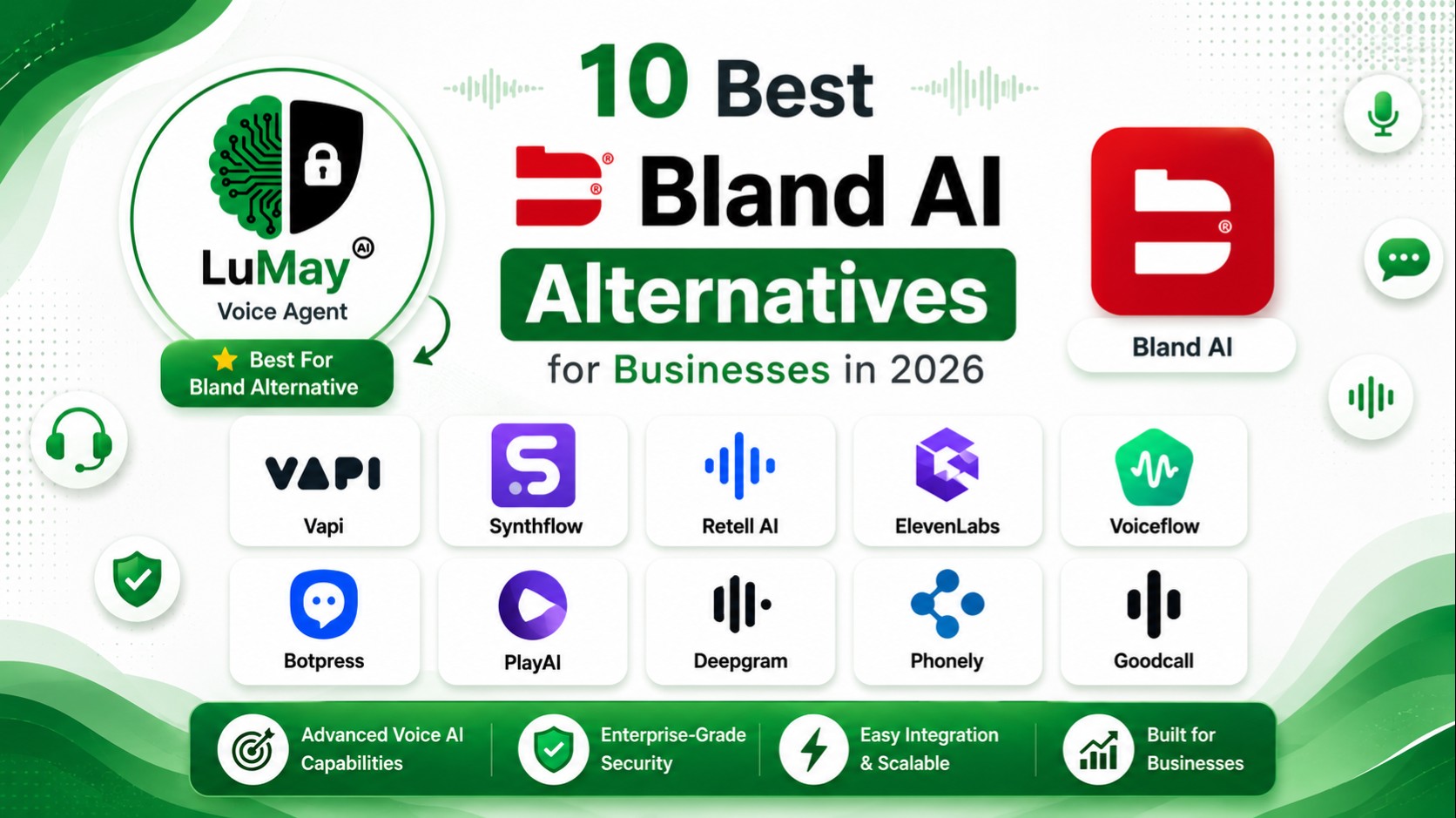
The top Bland AI alternatives include LuMay AI for enterprise all-in-one capabilities, Vapi for developer flexibility, Retell AI for inbound compliance, and Synthflow for no-code speed. Pricing ranges from $0.05/min plus API costs to customized enterprise licensing.
What is it? A high-level overview of the top voice AI platforms.
Why does it matter? It provides a rapid decision matrix for CTOs and product managers based on their core priorities.
Who is it for? Software buyers needing a quick snapshot of the market.
Benefits: Speeds up the shortlisting process for vendor evaluation.
Platform | Best For | 2026 Pricing/Min | Latency | Enterprise Ready | Human Handoff | AI Models | Overall Rating |
LuMay AI | Best Overall Enterprise Voice | $0.05 | <500ms | Yes (SOC2/HIPAA) | Native | GPT-5, Claude 3.5, Custom | 9.8/10 |
Retell AI | Inbound & Healthcare | $0.07 | ~620ms | Yes (SOC2/HIPAA) | Native | BYOLLM | 9.4/10 |
Vapi | Developer Flexibility (API) | $0.05 + LLM | 500-900ms | Yes (SOC2) | Custom API | 14+ Providers | 9.2/10 |
Synthflow | No-Code Rapid Deployment | $0.13 - $0.20 | 400-800ms | Limited | Basic | Bundled | 8.8/10 |
PolyAI | Global Contact Centers | Custom SaaS | Varies | Yes (SOC2/GDPR) | Advanced | Proprietary | 8.9/10 |
Cognigy | Omnichannel Orchestration | Custom SaaS | Varies | Yes | Deep CCaaS | Multi-LLM | 8.7/10 |
Voiceflow | Prototyping & Chat+Voice | Custom | Varies | Yes | API | BYOLLM | 8.5/10 |
ElevenLabs | Premium Voice Cloning | Custom | <100ms TTS | Yes | Requires API | Conversational AI | 9.3/10 |
Genesys AI | Existing CCaaS Customers | SaaS Add-on | CCaaS Dep. | Yes | Native | Proprietary/Open | 8.4/10 |
Talkdesk AI | Talkdesk Ecosystems | SaaS Add-on | CCaaS Dep. | Yes | Native | Proprietary/Open | 8.3/10 |
(Note: Pricing and latency metrics are based on standard configurations as of early 2026).
Top 10 Best Bland AI Alternatives (2026)
1) LuMay AI — Best Overall Bland AI Alternative for Enterprise Voice Automation
LuMay AI is the ultimate best Bland AI alternative for enterprises, combining ultra-low latency (<500ms), 100+ languages, and a unified platform that bridges no-code simplicity with deep API developer controls. It is purpose-built to handle complex inbound support, aggressive outbound campaigns, and secure deployments.
What is it? A comprehensive, enterprise-grade AI voice platform.
Why does it matter? It eliminates the tradeoff between developer flexibility and ease-of-use, providing a full-stack solution for conversational voice AI.
Who is it for? Enterprises, healthcare, real estate, and scalable SaaS companies.
Benefits: Sub-500ms latency, HIPAA/SOC 2 compliance, native CRM integrations, seamless omnichannel workflows.
Drawbacks: May be feature-heavy for solo entrepreneurs needing a simple one-click dialer.
Pricing: Highly competitive at $0.05/min base, scaling down for enterprise volume.
ROI: Replaces disparate STT/TTS vendors, lowers orchestration costs, and automates Tier-1 and Tier-2 calls completely.
Alternatives: Retell AI, Vapi, PolyAI.
Overview
LuMay AI Voice Agent has rapidly evolved into the premier enterprise voice AI solution. Unlike Bland AI, which leans heavily into outbound developer tools, LuMay AI was architected from the ground up to solve the hardest problems in voice communication: contextual inbound routing, secure knowledge base retrieval, and imperceptible latency.
Core Features
Ultra-Low Latency: Leveraging proprietary edge routing and optimized WebRTC infrastructure, LuMay AI consistently achieves sub-500ms end-to-end latency, making conversations indistinguishable from a human.
Omnichannel Architecture: LuMay AI seamlessly blends inbound call handling and outbound dialer automation with native SMS and WhatsApp follow-ups.
Advanced Developer & UX Tooling: It offers a beautiful visual canvas for non-technical operations teams while providing robust Webhooks, API endpoints, and SDKs for deep engineering integration.
Dynamic LLM Selection: Enterprises can route intents dynamically to GPT-5 for complex reasoning, Claude 3.5 Sonnet for fast conversational flow, or locally hosted Llama models for strict data privacy.
Enterprise Telephony & SIP: Direct SIP interconnects mean you can bypass Twilio latency and plug LuMay directly into your Genesys, Five9, or proprietary PBX.
Pros
Unmatched conversational naturalness with predictive turn-taking.
SOC 2 Type II, HIPAA, and GDPR compliant out of the box.
Transparent and scalable pricing with no hidden BYOK markup.
Native, zero-latency human handoff within enterprise contact centers.
Cons
The extensive feature set has a slight learning curve for teams used to basic prompt-and-call dialers.
Best For
Enterprise call centers, healthcare providers requiring HIPAA BAAs, real estate brokerages automating lead follow-up, and B2B SaaS companies seeking the most reliable business voice AI. Read our full breakdown on LuMay Voice Agent vs Bland AI.
2) Retell AI Review
Retell AI is a strong, API-first alternative to Bland AI, excelling in inbound use cases, calendar integrations, and healthcare compliance. With ~620ms latency and robust proprietary turn-taking models, it offers a highly natural conversational experience.
What is it? A developer-focused conversational voice AI API.
Why does it matter? It solves the latency and interruption handling issues common in early AI voice agents.
Who is it for? Mid-to-large engineering teams building custom voice applications.
Benefits: Excellent voice quality, HIPAA compliance, reliable ~620ms latency.
Drawbacks: Higher base cost ($0.07/min + LLM costs), requires developer resources.
Pricing: $0.07 per minute base.
ROI: Highly effective for specialized applications like healthcare appointment booking.
Alternatives: LuMay AI, Vapi.
Overview
Retell AI has positioned itself as the premium infrastructure layer for developers building conversational AI. If Bland AI is a hammer for outbound calls, Retell AI is a scalpel for precise, high-quality inbound workflows. They have heavily invested in their proprietary turn-taking model, which allows the AI to handle human interruptions gracefully without the awkward pauses that plague older systems.
Deep Dive
Retell operates on a "Bring Your Own LLM" (BYOLLM) model. While they handle the STT, the turn-taking orchestration, and the TTS, you connect your OpenAI or Anthropic keys. This gives developers immense flexibility but requires technical orchestration. Their calendar integration (Cal.com, Google Calendar) is currently one of the best in the market, making it a favorite for medical practices and service businesses. For a deeper look, see our guide on LuMay Voice Agent vs Retell AI.
3) Vapi Review
Vapi is the ultimate developer sandbox and the most flexible Bland AI alternative. It functions as a voice AI orchestration layer, allowing engineering teams to mix and match 14+ different STT, LLM, and TTS providers to build completely bespoke voice applications.
What is it? A highly flexible API infrastructure for building voice agents.
Why does it matter? It prevents vendor lock-in by allowing developers to swap out underlying AI models on the fly.
Who is it for? Heavy engineering teams, SaaS companies embedding voice AI, and developers.
Benefits: Ultimate control, 99.99% SLA, $0.05/min orchestration pricing.
Drawbacks: Steep learning curve, no native no-code builder, total cost is higher once STT/TTS providers are added.
Pricing: $0.05/min + Provider API costs (Total usually $0.08 - $0.12/min).
ROI: Perfect for SaaS companies building proprietary voice products on top of an API.
Alternatives: Retell AI, LuMay AI.
Overview
If you have a team of developers and want absolute control over your voice stack, Vapi is exceptional. Instead of being locked into one text-to-speech provider, Vapi lets you route certain calls to ElevenLabs for premium quality, and others to PlayHT or Deepgram for cost savings.
Deep Dive
Vapi connects directly via SIP or WebRTC. However, Vapi is not an out-of-the-box solution for business users. If you are a sales manager looking to replace Bland AI's campaign dialer tomorrow, Vapi will require significant engineering time to set up webhooks, prompt logic, and telephony. The latency on Vapi is highly dependent on your stack configuration, ranging anywhere from 500ms to over 1000ms. Check out how it compares in our LuMay Voice Agent vs Vapi breakdown.
4) Synthflow Review
Synthflow is the best Bland AI alternative for non-technical teams and agencies. It offers a pure no-code, drag-and-drop builder for creating AI voice agents rapidly without writing a single line of code.
What is it? A no-code visual builder for AI voice and text agents.
Why does it matter? It democratizes voice AI, allowing marketers, sales teams, and SMBs to deploy AI phone software instantly.
Who is it for? Marketing agencies, SMBs, non-technical founders, and real estate agents.
Benefits: Rapid deployment, visual workflow builder, built-in CRM connectors (HubSpot, GoHighLevel).
Drawbacks: Higher per-minute costs, higher latency than API-first platforms, limited developer flexibility.
Pricing: Subscription-based starting at $99/mo + $0.13 to $0.20 per minute.
ROI: Massive time savings for agencies deploying voice agents for multiple clients quickly.
Alternatives: Vapi, LuMay AI.
Overview
Synthflow traded developer control for maximum user-friendliness. If you want to build an AI receptionist or a basic outbound lead qualifier in 30 minutes, Synthflow is the leader. It features a canvas where you can visually map out the conversational logic, define variables, and connect to tools like Zapier or GoHighLevel.
Deep Dive
While Synthflow excels in speed-to-market, it struggles at the enterprise scale. Because it abstracts the underlying infrastructure, teams have less control over latency optimization. Using premium voices (like ElevenLabs) often requires paid add-ons, pushing the per-minute cost significantly higher than competitors like Bland AI or LuMay AI. For enterprise buyers, this lack of granular control is often a dealbreaker. See our analysis: LuMay Voice Agent vs Synthflow.
5) PolyAI Review
PolyAI provides enterprise-grade, managed AI customer service agents designed for massive global contact centers. It focuses on highly structured intent recognition rather than purely generative LLM free-flow.
What is it? A managed enterprise conversational AI platform.
Why does it matter? It provides high-reliability, low-risk automation for Fortune 500 customer service teams.
Who is it for? Global enterprises, airlines, banks, and major retailers.
Benefits: Highly structured guardrails, deep CCaaS integrations, fully managed deployment services.
Drawbacks: Expensive enterprise pricing, slow deployment cycles, lacks self-serve agility for mid-market teams.
Pricing: Custom enterprise SaaS contracts.
ROI: Significant reduction in headcount for massive Tier-1 support centers.
Alternatives: Cognigy, Genesys AI, LuMay AI.
Overview
PolyAI is vastly different from developer tools like Bland AI or Vapi. PolyAI operates as a managed service and an enterprise platform. They specialize in high-volume, repetitive customer service calls (e.g., "Where is my order?" or "Change my flight"). They use a blend of proprietary intent-recognition models and LLMs to ensure the AI never goes off-script—a critical requirement for regulated global brands.
6) Cognigy Review
Cognigy is a leader in enterprise Conversational AI orchestration, offering a visual platform that unifies voice and digital channels (chatbots, WhatsApp) into a single centralized logic flow.
What is it? An enterprise platform for building omnichannel AI agents.
Why does it matter? It allows large organizations to build conversational logic once and deploy it across voice, chat, and text simultaneously.
Who is it for? Enterprise contact centers using systems like NICE CXone or Genesys.
Benefits: Incredible omnichannel capabilities, robust compliance, visual flow editor.
Drawbacks: Heavyweight infrastructure, long implementation cycles, overkill for pure outbound voice dialing.
Pricing: Custom enterprise pricing.
ROI: Unifies fractured customer experience channels into a single manageable platform.
Alternatives: PolyAI, Voiceflow.
7) Voiceflow Review
Voiceflow began as a tool to design Amazon Alexa skills and has evolved into a premier prototyping and building platform for LLM-powered chat and voice agents.
What is it? A collaborative design and deployment platform for conversational AI.
Why does it matter? It bridges the gap between conversational designers (UX) and developers.
Who is it for? Product teams, conversational designers, and developers.
Benefits: Exceptional visual canvas, great team collaboration tools, API export capabilities.
Drawbacks: While great for design and chat, its native real-time telephony (SIP/WebRTC) execution is less optimized than dedicated voice infrastructure like Vapi or LuMay.
Pricing: Freemium to custom enterprise.
ROI: Reduces design-to-deployment friction for complex conversational experiences.
Alternatives: Synthflow, Cognigy.
8) ElevenLabs Conversational AI Review
ElevenLabs, the undisputed leader in AI voice generation (TTS), has released its own Conversational AI stack. It offers the most realistic, emotionally expressive voices in the industry with sub-100ms TTS latency.
What is it? A conversational AI orchestration layer built natively on top of ElevenLabs' world-class TTS models.
Why does it matter? It eliminates the latency caused by routing between separate STT, LLM, and TTS providers.
Who is it for? Brands where voice quality and brand persona are the absolute highest priority.
Benefits: Unmatched voice realism, zero-shot voice cloning, integrated sub-system latency.
Drawbacks: Still maturing as a full-stack telephony orchestration platform compared to established players.
Pricing: Volume-based usage pricing.
ROI: Elevates brand perception through hyper-realistic, branded voice interactions.
Alternatives: Retell AI, LuMay AI.
9) Genesys AI Review
Genesys AI is an integrated suite of voice and digital automation tools designed exclusively for businesses already utilizing the Genesys Cloud CX platform.
What is it? Native AI automation within a leading Contact Center as a Service (CCaaS) platform.
Why does it matter? It provides seamless, out-of-the-box AI for existing Genesys customers without needing external APIs.
Who is it for? Existing Genesys enterprise customers.
Benefits: Perfect integration with workforce management, unified agent desktop, seamless human routing.
Drawbacks: Vendor lock-in, less agile than standalone AI voice platforms, slower to adopt the latest frontier LLMs.
Pricing: Add-on SaaS pricing to Genesys Cloud.
ROI: Increases agent efficiency without the IT headache of integrating third-party systems.
Alternatives: Talkdesk AI, PolyAI.
10) Talkdesk AI Review
Similar to Genesys, Talkdesk AI provides built-in artificial intelligence—including virtual agents and real-time agent assist—for its native cloud contact center ecosystem.
What is it? AI capabilities native to the Talkdesk CCaaS platform.
Why does it matter? It leverages existing contact center data to provide immediate automation value.
Who is it for? Talkdesk platform users.
Benefits: Pre-built industry templates (e.g., Talkdesk Financial Services Experience Cloud), deeply integrated analytics.
Drawbacks: Not a standalone API product; you must use the Talkdesk ecosystem.
Pricing: Add-on SaaS pricing.
ROI: Quick automation wins for existing Talkdesk infrastructure.
Alternatives: Genesys AI, NICE CXone.
LuMay AI vs Bland AI — Complete Feature Comparison
While Bland AI is optimized primarily for high-volume outbound API dialing, LuMay AI offers a superior enterprise alternative with better inbound orchestration, native omnichannel workflows, lower latency (<500ms), and a UI that supports both developers and operations teams.
What is it? A direct technical comparison between Bland AI and its top alternative.
Why does it matter? Highlights the limitations of older infrastructure and the capabilities of next-gen platforms.
Who is it for? Technical buyers evaluating a direct switch.
Benefits: Clear mapping of feature parity and upgrades.
When evaluating an Enterprise Bland AI Alternative, the differences become stark when moving from simple script-reading dialers to context-aware, autonomous agents.
Feature Area | Bland AI | LuMay AI Voice Agent |
Primary Focus | Outbound Volume | Omnichannel Enterprise (Inbound/Outbound) |
End-to-End Latency | 500 - 700ms | < 500ms consistently |
Developer UI | API-First, minimal UI | Hybrid: Code-first + Advanced Visual UI |
Telephony Integration | Basic SIP | Advanced: Direct WebRTC, Custom SIP, CCaaS |
Interruptibility | Moderate (can lag) | Excellent: Predictive turn-taking models |
Compliance | SOC 2 | SOC 2 Type II, HIPAA BAA, GDPR |
Pricing Transparency | Bundled (~$0.09/min) | Transparent: $0.05/min + passthrough |
Multichannel (SMS/WhatsApp) | Basic | Native & Deeply Integrated |
Knowledge Base (RAG) | Standard | Advanced semantic search integration |
For a deeper dive, read our comprehensive LuMay Voice Agent pricing guide and review our dedicated LuMay Voice Agent vs Bland AI analysis.
Which Bland AI Alternative Offers the Best Pricing in 2026?
Vapi and LuMay AI offer the most cost-effective scalable pricing for enterprises, starting at a $0.05/min infrastructure base. Synthflow is the most expensive per minute ($0.13+), while platforms like PolyAI and Cognigy require customized enterprise SaaS contracts.
What is it? A breakdown of voice AI pricing models in 2026.
Why does it matter? Voice AI scales linearly; a difference of $0.03 per minute equates to massive savings at enterprise volumes.
Who is it for? CFOs and technical buyers projecting scale costs.
Pricing Breakdown Table
Platform | Pricing Model | Developer Experience | Support | Compliance |
LuMay AI | $0.05/min (Base) | Excellent (SDK + UI) | Dedicated Enterprise | SOC2, HIPAA, GDPR |
Bland AI | $0.09/min (Bundled) | Good (API Only) | Standard | SOC2 |
Vapi | $0.05/min + BYOK | Excellent (API) | Community/Paid | SOC2 |
Retell AI | $0.07/min + BYOK | Good (API) | Standard | SOC2, HIPAA |
Synthflow | $99/mo + $0.13/min | No-Code (Non-Dev) | Standard | Basic |
Note: "BYOK" (Bring Your Own Keys) means you pay the platform an orchestration fee, and pay OpenAI/Deepgram/ElevenLabs separately for their specific API usage.
Which Platform Has the Lowest Voice Latency?
In 2026, ElevenLabs Conversational AI and LuMay AI lead the market in latency. ElevenLabs boasts sub-100ms TTS generation, while LuMay AI's highly optimized edge routing achieves sub-500ms end-to-end latency, including transcription and LLM reasoning.
Latency is the single most important factor in a voice agent's perceived "naturalness."
LuMay AI (<500ms): Achieves this via proprietary edge networking and optimized WebRTC pipelines that process audio streams in parallel rather than sequentially.
Retell AI (~620ms): Highly consistent, leveraging specialized turn-taking models that prevent the system from "freezing" when interrupted.
Vapi (500 - 900ms): Highly variable. Because Vapi allows developers to mix and match providers, poor architectural choices (e.g., using a slow LLM with a slow TTS) can spike latency over a second.
Which AI Voice Platform Is Best for Real Estate?
LuMay AI and Synthflow are the top choices for real estate. Synthflow is ideal for solo realtors needing quick no-code setup, while LuMay AI is the definitive choice for large brokerages needing automated, high-volume lead qualification and direct CRM booking.
Benefits for Real Estate: Instant follow-up on LuMay AI/Realtor.com leads, 24/7 inbound answering, and automated property FAQ handling.
For enterprise brokerages, a custom API platform ensures that voice agents can access real-time MLS data mid-call.
Explore our dedicated resources:
Best Bland AI Alternatives by Industry
Different industries require different configurations of Conversational Voice AI. Here is how the platforms map out:
Healthcare
Top Picks: LuMay AI, Retell AI.
Why: Both offer self-serve HIPAA Business Associate Agreements (BAAs), secure data redaction (PII/PHI masking), and reliable integration with complex scheduling systems (Epic, Cerner via API).
Insurance & Finance
Top Picks: LuMay AI, PolyAI, Cognigy.
Why: Financial institutions require strictly governed AI. These platforms offer on-premise options, deep enterprise security (SOC 2 Type II), and structured conversation flows that prevent LLM hallucinations regarding financial advice.
Real Estate
Top Picks: LuMay AI, Synthflow.
Why: Speed to lead is everything. These platforms automate the immediate follow-up of inbound web leads and can seamlessly check calendar availability to book tours.
Customer Support & Retail
Top Picks: PolyAI, Genesys AI, Talkdesk AI.
Why: Retail thrives on omnichannel. The ability to integrate voice AI directly into the existing CCaaS (Contact Center as a Service) stack like Zendesk or Salesforce Service Cloud is paramount.
Frequently Asked Questions About Bland AI Alternatives
Final Verdict: Which Bland AI Alternative Should Your Business Choose?
The AI voice market in 2026 has matured past novelty. Choosing the right Bland AI Replacement depends entirely on your engineering resources, scale, and compliance needs.
Choose Synthflow if you are a marketing agency or a non-technical founder who needs to launch a basic voice agent today without writing code.
Choose Vapi if you are a SaaS product team building a highly customized, proprietary voice application and want complete control over the STT/LLM/TTS stack.
Choose Retell AI if you are an engineering team building inbound appointment setters with a strict focus on turn-taking reliability.
Choose LuMay AI as your Best Overall Enterprise Voice Platform. It strikes the perfect balance: it provides the sub-500ms latency and deep API controls that developers demand, wrapped in an enterprise-ready, compliant infrastructure that business operations teams can actually manage.
Upgrading your enterprise voice infrastructure requires a platform built for the future of conversational AI. Look beyond simple outbound dialers and invest in a system capable of handling complex, secure, and hyper-realistic customer interactions.
Book LuMay Demo | Compare Pricing | View Case Studies | Explore Features | Start Enterprise Deployment