



In the hyper-competitive 2026 property market, finding the best AI voice agent for real estate has pivoted from an innovative operational experiment to a foundational baseline for survival. The modern real estate industry is caught in a tight vice: customer acquisition costs have surged by over 45% since 2023, while consumer expectations for instantaneous communication have reached unprecedented heights. Deploying conversational AI voice agents for real estate allows forward-thinking brokerages, high-volume teams, and property management firms to handle sprawling pipeline networks flawlessly without human fatigue. These advanced real estate voice AI platforms engage, qualify, and schedule property leads within milliseconds, establishing a critical competitive edge in an industry where speed-to-lead dictates who secures the listing contract.
The traditional model of relying exclusively on human Inside Sales Agents (ISAs) faces massive scalability and economic bottlenecks. Human agents cannot answer incoming phone inquiries at 2:00 AM, nor can they execute 5,000 cold outbound lead reactivation calls in a single afternoon. Modern real estate AI phone systems bridge this operational gap by combining generative media production workflows, advanced natural language processing (NLP), and near-zero latency infrastructure. Today’s AI calling software for real estate can handle thousands of simultaneous, highly contextual conversations that are indistinguishable from human realtors, guaranteeing that zero pipeline opportunities leak into an administrative black hole.
What is the Best AI Voice Agent for Real Estate?
Quick Answer: The overall best AI voice agent for real estate in 2026 is LuMay Voice Agent for mid-market to enterprise brokerages requiring sub-250ms ultra-low latency, multi-agent specialized frameworks (Sales, Support, and CRM Agents), and rigorous SOC 2/HIPAA compliance. For independent teams and developers seeking deep programmatic code customizability, Retell AI and Vapi offer exceptional API-first infrastructures. For teams seeking simple, rapid, no-code templates to deploy outbound campaigns in under ten minutes, Synthflow stands out as the most accessible user interface.
TL;DR Summary Matrix
Platform | Best For | Starting Price | Inbound | Outbound | CRM Synchronization | Platform Rating |
LuMay Voice Agent | Enterprise & High Scale | Starting From Per Min 0.05$ | Yes | Yes | Deep / Real-time API | 9.9 / 10 |
Voxentis.ai | Inbound Seller Screening | $179/mo + usage | Yes | Yes | Native Bi-directional | 9.4 / 10 |
VoAgents | Boutique & Local Teams | $199/mo + usage | Yes | Yes | Zapier / Webhooks | 9.1 / 10 |
ConvoZen AI | Conversational Intelligence | $350/mo + usage | Yes | Yes | Custom REST API | 9.2 / 10 |
NLPearl's | Property Management Ops | $249/mo + usage | Yes | Yes | Yardi / Entrata Native | 9.3 / 10 |
Retell AI | API-First Developers | Usage Only ($0.08/min) | Yes | Yes | Developer Webhooks | 9.6 / 10 |
Vapi | Voice Operating System | Usage Only ($0.05/min) | Yes | Yes | Robust Custom SDK | 9.5 / 10 |
Synthflow | No-Code Outbound Teams | $99/mo + usage | Yes | Yes | Native Core CRMs | 9.4 / 10 |
Bland AI | Mass Outbound Campaigns | $49/mo + usage | Yes | Yes | Advanced Multi-path | 9.3 / 10 |
Air AI | Long Conversational Scripts | $99/mo + usage | Yes | Yes | Basic HubSpot/SFDC | 8.9 / 10 |
Why Real Estate Businesses Are Adopting AI Voice Agents
The rapid adoption of conversational AI across the real estate sector is propelled by clear economic incentives and performance realities. According to benchmarks from the National Association of Realtors (NAR), property leads have an incredibly short shelf life. An agent who responds to an online property inquiry within five minutes is 100 times more likely to successfully establish contact and qualify that buyer or seller compared to an agent who waits thirty minutes. Unfortunately, due to overlapping responsibilities like property showings, client negotiations, and structural administrative overhead, the average human agent response time exceeds ninety minutes.
By adopting AI phone agents for realtors, progressive brokerages achieve structural advantages across several operational layers:
Instantaneous Speed-to-Lead: The primary driver of modern real estate sales. Real estate voice AI platforms trigger an instantaneous inbound call or immediate outbound callback the exact second a lead submits a web form on Zillow, Realtor.com, or a localized landing page.
24/7/365 Lead Response: AI real estate receptionists handle inbound routing and qualification around the clock, converting late-night traffic into booked listing appointments without human intervention.
Granular Lead Qualification: Automated voice agents meticulously filter out window-shoppers from high-intent buyers by validating credit pre-approvals, down payment availability, purchasing timelines, and specific geographic preferences.
Amplified Brokerage Productivity: By automating cold prospecting, past client database reactivation, and raw lead qualification, voice AI handles up to 80% of repetitive phone outreach, enabling elite agents to focus purely on high-leverage closing activities.
Drastic Operational Cost Savings: Instead of maintaining massive, high-turnover internal ISA teams with heavy salaries and desk costs, teams leverage programmatic calling software that scales on-demand for cents on the dollar.
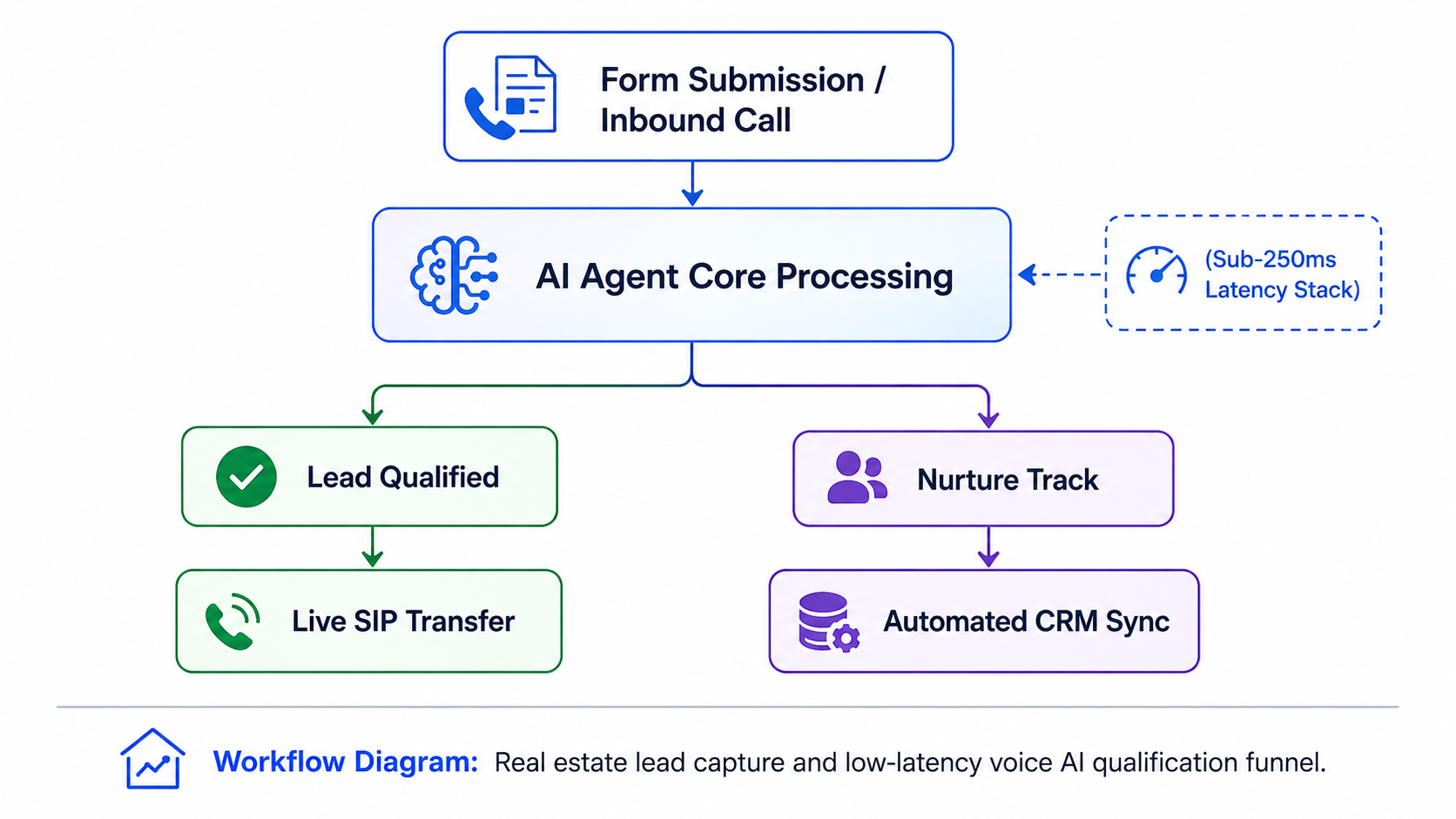
Workflow Diagram: Real estate lead capture and low-latency voice AI qualification funnel.
How AI Voice Agents Work in Real Estate
Modern real estate voice AI platforms do not rely on rigid, frustrating "press one for sales" IVR telephone trees. They operate on a highly integrated, sequential three-tier cloud stack engineered for fluid, human-like voice conversations:
Automatic Speech Recognition (ASR): Powered by custom infrastructure or providers like Google Cloud Speech-to-Text, the platform instantly listens to the human caller, converting their vocal patterns and specific dialect into highly accurate digital text strings in real time.
Generative Context & Intent Processing: The processed text is instantly routed through a specialized, fine-tuned Large Language Model (LLM) utilizing architectures from OpenAI or Anthropic. This engine interprets underlying intent, retrieves contextual property data from the local Multiple Listing Service (MLS), and formulates an optimal response based on real estate domain training.
Text-to-Speech (TTS) Voice Synthesis: The structured text response is instantly converted back into high-fidelity human speech using ultra-realistic neural voice synthesis. This matches natural inflections, breaths, and contextual tones.
This entire loop executes in an astonishing 200 to 400 milliseconds, beating the typical human conversational response threshold of 500 milliseconds. This ensures conversations flow naturally without clunky, disjointed pauses.
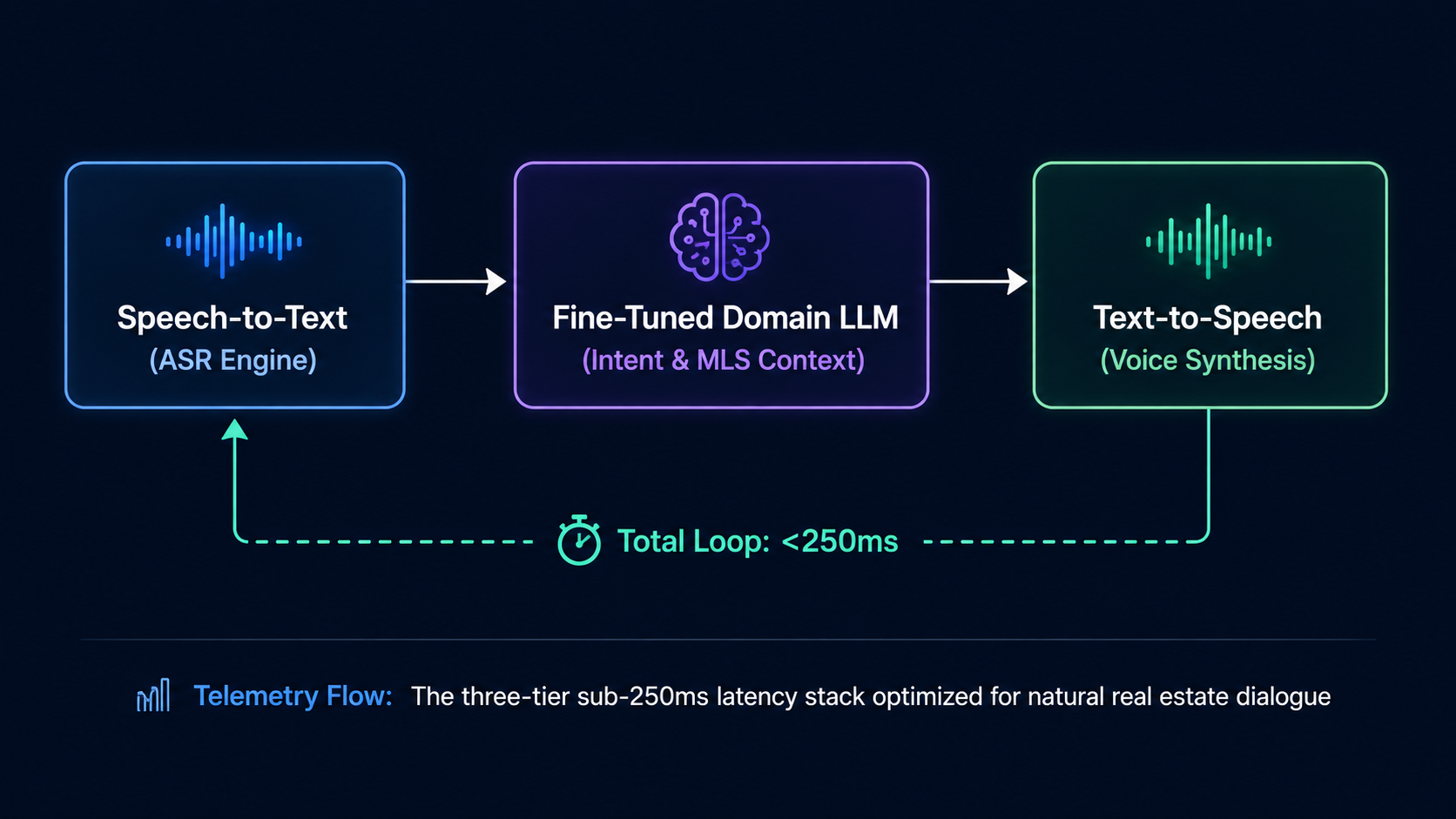
Telemetry Flow: The three-tier sub-250ms latency stack optimized for natural real estate dialogue.
Let's examine how these platforms execute specialized real estate workflows natively:
MLS Inquiry Handling & Showing Bookings: When a prospective buyer calls about a specific property listing, the AI receptionist instantly looks up the address or MLS ID via active API integrations, answers detailed questions regarding square footage, school districts, or local HOA guidelines, checks real-time availability, and books an in-person showing.
Lead Reactivation & Cold Prospecting: Outbound voice agents systematically dial historic database contacts, checking if cold leads are still looking to buy or sell, verifying current timelines, and immediately routing warm handoffs directly to a live human agent via active Twilio SIP trunk patching.
Comprehensive Seller Screening: For incoming seller leads, the agent conducts structured screening by pulling localized automated valuation model (AVM) data, confirming motivation levels, asking about structural property updates, and scheduling listing presentations for the team's top listing specialist.
Continuous CRM Sync & Conversation Intelligence: Every spoken word, consumer sentiment shift, and extracted data point is automatically summarized and pushed into the central CRM (e.g., Follow Up Boss or Salesforce) within seconds of call completion.
Key Features to Look For in Real Estate Voice AI Platforms
Selecting the ideal voice AI solution requires auditing core technical capabilities against operational goals. Avoid generic conversational software that fails to handle the nuanced, highly compliant environment of real estate prospecting. Look for these essential features:
24/7 Lead Response
The software must guarantee continuous, always-on operations without downtime. It should be capable of answering hundreds of concurrent inbound calls simultaneously during peak marketing campaigns, eliminating busy signals and hold queues completely.
CRM Integration
Look for deep, native bi-directional synchronization. The voice platform must read custom CRM contact fields to personalize the greeting and instantly write structured call notes, change pipeline statuses, and trigger post-call text message sequences within real estate specific CRMs like kvCore, Salesforce, and Follow Up Boss.
Lead Scoring
The platform must possess algorithmic intent classification. Based on the caller's answers regarding financing, down payments, and immediate urgency, the system must assign a dynamic lead score, allowing human teams to instantly prioritize high-intent buyers.
Call Analytics
A robust, data-dense dashboard tracking key operational metrics like contact rate, cost-per-minute, average call duration, common consumer objections, conversion ratios, and appointment booking velocity.
Conversation Intelligence
Advanced post-call processing that tracks overall customer sentiment, extracts structural entities (budgets, target zip codes, timeline parameters), and flags call transcripts for manual review if an anomaly or negative interaction occurs.
Multilingual Support
The ability to seamlessly detect Spanish, French, Mandarin, or localized dialects and accents instantly, switching the conversation language mid-sentence to comfortably serve diverse multicultural demographic markets.
Voice Cloning
The platform should allow you to upload a 30-second studio audio sample of your brokerage's lead agent, generating a perfectly replicated, custom-branded voice clone to preserve client familiarity at scale.
Compliance
An absolute non-negotiable layer. The voice platform must enforce ironclad adherence to Telephone Consumer Protection Act (TCPA) regulations, local state-level Do-Not-Call (DNC) list scrubs, STIR/SHAKEN framework validation to prevent numbers from being flagged as "Spam Likely," and secure data storage like SOC 2, HIPAA, or GDPR.
Human Transfer
Flawless, low-latency live call patching. When the AI voice agent detects an active, high-intent hot lead ready to speak with an agent, it must execute a warm live transfer via SIP/PSTN with zero call drops.
Custom Workflows
An intuitive, drag-and-drop visual multi-path node builder that allows your operations team to design custom conversation trees, specific objection-handling logical statements, and unique conditional follow-up logic.
Appointment Scheduling
Native API integrations with Google Calendar, Outlook, and scheduling infrastructure like Calendly or HubSpot, allowing the voice agent to check real-time availability and directly lock in dates and times on the agent's calendar during the live call.
Top 10 Best AI Voice Agent Platforms for Real Estate
Here is an exhaustive, comparative breakdown of the top ten voice AI platforms engineered for the real estate landscape in 2026.
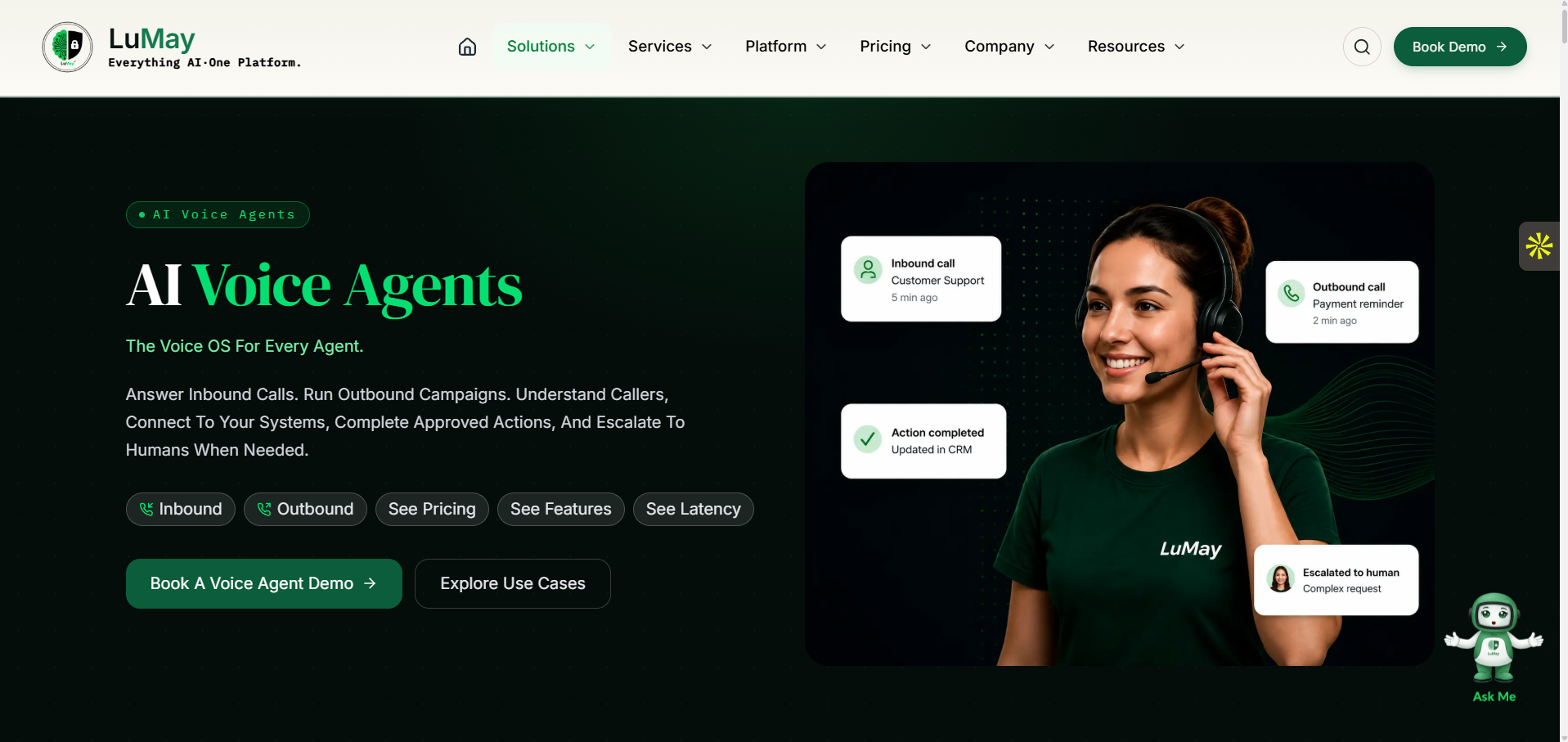
1. LuMay Voice Agent
Company Overview: LuMay AI is a premium conversational automation firm specializing in high-performance, compliant voice architectures for high-growth companies and enterprise-grade environments.
Best For: Mid-market to scale-up brokerages, enterprise real estate teams, and large property management operators seeking flawless security, customized multi-agent stacks, and ultra-low latency execution.
Key Features: Built upon a proprietary sub-500ms ultra-low latency stack, LuMay offers distinct, single-purpose agents engineered for real estate excellence: a specialized CRM Agent for database health, a Customer Support Agent for tenant issues, a Sales & Follow-Up Agent for proactive outbound prospecting, and an automated Translation Agent. LuMay includes ironclad enterprise-grade compliance out of the box, with full SOC 2 Type II certification, HIPAA capability for multi-vertical needs, and complete GDPR data protections.
Real Estate Use Cases: High-volume real estate lead qualification, instantaneous inbound web-form callback tracking, localized MLS inquiry handling, outbound automation, automated tenant maintenance routing, and scalable database reactivation campaigns.
Integrations: Native, robust real-time bi-directional syncing with Salesforce, HubSpot, kvCore, and Follow Up Boss, along with universal REST APIs and Zapier framework support.
Pros:
Industry-leading sub-500ms conversational response time eliminates awkward delays.
Dedicated role-specific agents mean you don't use a generic prompt for specialized jobs.
Full enterprise security and compliance protocols (SOC 2, GDPR, HIPAA) minimize liability.
Cons:
Extensive customization capabilities require intentional configuration and clear business logic.
Pricing: Structured plans starting at per min 0.05$ with scalable, cost-effective per-minute usage rates. Enterprise volume discounts are tailored to scale. Learn more on the LuMay Pricing Page.
Verdict: LuMay Voice Agent ranks as one of the strongest enterprise-ready AI voice agent platforms for real estate organizations requiring high-volume inbound support, outbound lead nurturing, multilingual communication, and strict compliance controls.
2. Voxentis.ai
Company Overview: Voxentis.ai focuses on conversational UI software specifically tailored to handle inbound screening and automated real estate phone qualification systems.
Best For: Multi-state real estate teams and boutique operations focused on filtering outbound cold leads and optimizing automated seller qualification profiles.
Key Features: Features an advanced web-based conversational builder with real-time text-to-speech toggles, multi-channel automated voice routing, and native outbound calling dialers.
Real Estate Use Cases: Executing automated incoming lead routing, validating home seller structural motivation scores, and handling basic inbound office phone coverage.
Integrations: Direct native integrations with kvCore, Sierra Interactive, and Zapier connections.
Pros:
Highly optimized for identifying motivated listing prospects quickly.
Very user-friendly dashboard interface requires zero technical background.
Cons:
Slightly higher conversational latency (~450ms) compared to premium sub-300ms tools.
Lacks native property management or deep commercial leasing workflows out of the box.
Pricing: Baseline packages start at $179 per month with standard variable per-minute calling rates.
Verdict: A highly effective, dedicated marketing and seller screening voice platform that functions excellently for teams prioritizing listing pipeline volume.
3. VoAgents
Company Overview: VoAgents provides specialized, lightweight conversational voice automation tools built explicitly to serve independent regional realtors.
Best For: Independent real estate agents and smaller localized teams seeking affordable entry points into conversational AI voice automation.
Key Features: Pre-built conversation templates tailored for regional markets, localized geographic accent handling, and automated calendar scheduling hooks.
Real Estate Use Cases: Confirming scheduled open house attendance, tracking localized neighborhood inquiries, and providing basic off-hours phone reception.
Integrations: Relies primarily on Zapier and incoming/outgoing webhooks for CRM updates.
Pros:
Extremely affordable entry-level cost structure with plug-and-play real estate scripts.
Easy integration with Google Calendar and Microsoft Outlook networks.
Cons:
Limited multi-agent scalability for complex enterprise brokerages.
Lacks comprehensive TCPA defense layers and automated state DNC list scrubbing capabilities.
Pricing: Entry plans begin at $199 per month with standard pay-as-you-go minutes.
Verdict: The perfect, economical proving ground for individual realtors wanting to test basic voice automation without complex developer workflows.
4. ConvoZen AI
Company Overview: ConvoZen AI focuses heavily on conversation intelligence, deep post-call sentiment analytics, and compliance audit reporting.
Best For: Medium-to-large real estate brokerages running split hybrid models of human ISAs and voice AI platforms, requiring rigorous quality assurance monitoring.
Key Features: Real-time sentiment tracking, continuous customer experience dashboard monitoring, automated compliance violation alerts, and deep intent classification matrixing.
Real Estate Use Cases: Quality-auditing inbound call operations, identifying customer objections at scale, and checking lead sentiment trends across regional branches.
Integrations: Direct connections to enterprise platforms like Salesforce, HubSpot, and custom REST APIs.
Pros:
Unparalleled analytical insights into why specific leads fail to convert.
Excellent multi-agent dashboard management capabilities for brokerage operations.
Cons:
Outbound campaign generation workflows are complex and feel less intuitive than competitors.
Requires a significant learning curve to extract the full value of the analytics engine.
Pricing: Monthly subscriptions start at $350 plus specialized analytics and processing fees.
Verdict: An analytical powerhouse that is best utilized alongside existing high-volume campaigns to maximize conversion efficiency and monitor operational compliance.
5. NLPearl's
Company Overview: NLPearl's delivers highly nuanced natural language processing voice solutions designed to navigate intricate, multi-step customer customer journeys.
Best For: Property managers, commercial real estate firms, and vacation rental operators handling multifaceted operational inbound calls.
Key Features: Deep contextual memory handling across long calls, multi-turn dialogue architecture, and native integrations with property management ecosystems.
Real Estate Use Cases: Screening tenant rental applications, processing commercial lease expansion inquiries, and qualifying short-term vacation rental bookings.
Integrations: Custom-built connections for major software systems like Yardi, Entrata, RealPage, and AppFolio.
Pros:
Excels at long, highly structured technical phone calls requiring specific memory recall.
Seamless technical data mapping to core property management databases.
Cons:
Voice synthesis models can occasionally sound slightly more mechanical than specialized low-latency platforms.
High initial engineering and setup overhead for custom database mapping.
Pricing: Base cost of $249 per month, plus tailored integration fees and custom per-minute pricing.
Verdict: The absolute premier choice for property managers and commercial operators requiring technical data synchronization and sophisticated multi-turn memory.
6. Retell AI
Company Overview: Retell AI is an elite, API-first conversational voice platform built to give developers total granular control over the entire voice engine stack.
Best For: Tech-forward real estate organizations, software developers, and internal enterprise tech teams looking to build proprietary in-house custom voice applications.
Key Features: Sub-600ms raw engine responsiveness, absolute flexibility over Webhook events, dynamic variable state updates during live calls, and multi-model LLM routing.
Real Estate Use Cases: Building fully custom, proprietary voice software layers integrated directly into localized broker tech platforms and personalized client mobile apps.
Integrations: Programmatic developer Webhooks, complete REST APIs, and native compatibility with Twilio, Vonage, and SignalWire.
Pros:
Unmatched speed, structural flexibility, and raw latency performance.
Incredibly cost-effective usage pricing models with zero artificial subscription inflation.
Cons:
Completely lacks a visual no-code drag-and-drop dashboard interface.
Requires experienced internal software development resources to deploy effectively.
Pricing: Pure usage-based model starting around $0.08 per conversational minute, with no monthly minimum contracts.
Verdict: A world-class infrastructure tool for engineers and developer-centric teams looking to build bespoke real estate voice systems from scratch.
7. Vapi
Company Overview: Vapi functions as a comprehensive Voice Operating System for AI, abstracting complex backend telephony protocols into a streamlined developer framework.
Best For: PropTech startups, digital product developers, and technical real estate aggregators looking to integrate conversational voice capabilities into custom software products.
Key Features: Instantaneous switching between leading STT and TTS engines (OpenAI, Deepgram, ElevenLabs), deep phone line provisioning, and low-latency call control logic.
Real Estate Use Cases: Providing scale-up voice infrastructure for real estate software products, bulk lead dialing operations, and programmatic inbound tracking solutions.
Integrations: Direct underlying SIP trunks, developer SDKs for Web/iOS/Android, and extensive custom Webhooks.
Pros:
Allows teams to hot-swap voice models and transcription providers seamlessly in real-time.
Highly optimized infrastructure results in incredibly stable call connectivity.
Cons:
No native out-of-the-box real estate templates, prompts, or predefined workflows.
Managing complex logic requires external code hosting and structured database engineering.
Pricing: Pure usage-based cost structure averaging $0.05 per minute plus underlying voice synthesis provider expenses.
Verdict: An exceptional, ultra-stable voice operating system designed for software product creators and enterprise technical teams.
8. Synthflow
Company Overview: Synthflow is a prominent leader in the no-code AI voice agent space, focusing entirely on simplifying deployment for non-technical business operators.
Best For: Small-to-medium real estate teams, independent brokerages, and individual realtors looking to deploy outbound campaigns instantly without touching code.
Key Features: An incredibly simple, intuitive visual multi-path node editor, native one-click scheduling tools, and instant pre-built CRM field mapping guides.
Real Estate Use Cases: Rapid cold lead reactivation campaigns, booking showing requests from incoming social media traffic, and routine database follow-up outreach.
Integrations: Native, plug-and-play integrations with Follow Up Boss, HubSpot, Salesforce, and Zapier.
Pros:
Outstanding user experience allows a voice agent to go live in under 15 minutes.
Excellent out-of-the-box customer support, resources, and pre-written real estate blueprints.
Cons:
Advanced logic constraints can feel limiting for highly complex multi-step enterprise workflows.
Custom compliance controls and programmatic routing features are somewhat limited.
Pricing: Highly accessible subscription layers starting at $99 per month plus standard tiered per-minute usage rates.
Verdict: The gold standard for non-technical real estate operators and teams requiring maximum speed to market with native CRM workflows.
9. Bland AI
Company Overview: Bland AI is a high-volume programmatic voice automation powerhouse designed to manage millions of outbound calls simultaneously via software commands.
Best For: Enterprise-level real estate investment firms, institutional buyers, and mass-market cold outreach real estate operations.
Key Features: Advanced programmatic conversational testing environments, massive concurrency limits, and a highly customizable internal multi-path tree logic engine.
Real Estate Use Cases: Executing large-scale automated cold prospecting to off-market property owners, processing multi-thousand lead database reactivations, and scaling nationwide acquisition campaigns.
Integrations: Robust programmatic developer APIs, Twilio integrations, and comprehensive Zapier workflows.
Pros:
Engineered to handle massive concurrent calling volumes without server degradation.
Highly customizable logic controls can map intricate multi-turn conversation paths.
Cons:
Can occasionally feel slightly impersonal if scripts are not meticulously refined by engineers.
Steep technical onboarding process requires careful compliance oversight to prevent TCPA infractions.
Pricing: Base monthly entry of $49 coupled with scalable tiered pay-as-you-go transactional per-minute rates.
Verdict: An absolute powerhouse for high-volume outbound prospecting and institutional data acquisition models.
10. Air AI
Company Overview: Air AI entered the market early as a high-visibility pioneer in long-form conversational sales scripts, specializing in managing extended phone dialogues.
Best For: Large sales operations and high-volume real estate teams looking to automate long-form outbound database discovery calls.
Key Features: Specialized models designed to carry out 10-to-40 minute phone conversations, comprehensive multi-tier script structuring, and basic tracking dashboards.
Real Estate Use Cases: Complex database relationship scrubbing, long-form cold outreach qualification, and initial seller consultation routing.
Integrations: Connects out of the box with standard tools like HubSpot, Salesforce, and basic webhooks.
Pros:
Capable of maintaining conversational context over extended dialogue sequences.
Large global user community with extensive sharing of pre-built conversational scripts.
Cons:
Higher average latency and noticeable voice delay issues compared to 2026 sub-250ms standards.
Onboarding and custom prompt optimization can be challenging and unpredictable for teams.
Pricing: Plans scale from $99 per month alongside variable transactional per-minute charges.
Verdict: A solid option for teams looking to run long-form scripts, though it faces stiff competition from modern ultra-low latency alternatives.
Best AI Voice Agent by Real Estate Use Case
To assist your team in choosing the right partner, here is a mapping of the best voice platform matched directly to specific real estate workflows:
Real Estate Use Case | Recommended Platform | Strategic Operational Rationale |
Lead Qualification | LuMay Voice Agent | Sub-250ms latency ensures leads stay engaged, while specialized workflows drive instant, precise qualification before CRM handover. |
Buyer Screening | Voxentis.ai | Pre-built inbound filters quickly extract pre-approval metrics and buyer criteria seamlessly. |
Seller Qualification | LuMay Voice Agent | Combines deep conversational empathy with structured automated valuation model lookup capabilities. |
Property Management | NLPearl's | Deep, native database integrations with Yardi, AppFolio, and RealPage simplify tenant operations. |
Rental Inquiries | NLPearl's | Flawlessly manages complex multi-turn rental pricing structures, availability, and lease terms. |
Mortgage Prequalification | LuMay Voice Agent | Strict enterprise SOC 2 and compliance layers ensure sensitive financial screening data is handled securely. |
Lead Reactivation | Bland AI | High concurrency thresholds enable dialing thousands of dead database leads concurrently via code. |
Open House Scheduling | Synthflow | No-code Calendly hookups let team assistants launch open house reservation flows in minutes. |
Appointment Booking | Synthflow | Provides intuitive native calendar bi-directional writing with zero integration overhead. |
Brokerage Operations | ConvoZen AI | Comprehensive sentiment auditing tools give principal brokers deep visibility into quality and compliance tracking. |
Real Estate AI Voice Agent Pricing Comparison
Evaluating the right software requires a clear understanding of standard transactional costs versus baseline platform subscriptions. Here is a clear cost-matrix breakdown:
Platform Name | Base Monthly Subscription | Estimated Per-Minute Rate | Setup & Engineering Costs | Enterprise Plan Availability | Free Trial / Sandbox Credits |
LuMay Voice Agent | $0 (Usage only) | $0.05 - $0.18 | Custom / Guided onboarding | Available with volume pricing | Custom Demo credits |
Voxentis.ai | $179 (Usage only) | $0.05 - $0.22 | $500 one-time fee | Available | 7-Day trial window |
VoAgents | $199 / mo | $0.20 - $0.25 | None | Not available | 14-Day trial window |
ConvoZen AI | $350 / mo | $0.15 - $0.20 | Custom implementation | Available | No (Demo only) |
NLPearl's | $249 / mo | $0.18 - $0.24 | Variable configuration cost | Available | Demo only |
Retell AI | $0 (Usage only) | $0.08 flat | None | Custom committed pricing | $10 initial free credits |
Vapi | $0 (Usage only) | $0.05 platform + TTS | None | Custom committed pricing | $10 initial free credits |
Synthflow | $99 / mo | $0.14 - $0.19 | None | Available | 14-Day trial window |
Bland AI | $49 / mo | $0.09 - $0.13 | None | Available | Limited credit allotment |
Air AI | $99 / mo | $0.20 - $0.32 | Variable agent setup cost | Available | No |
AI Voice Agent ROI for Real Estate Teams
To fully understand the business case for adopting a real estate voice AI platform, it is necessary to compare the financial and operational metrics of an automated voice system against a traditional human Inside Sales Agent (ISA) team.
Let's review the hard numbers based on a standard production model tracking 5,000 inbound/outbound leads monthly:
Capacity & Scale: A traditional human ISA can manage roughly 50 to 80 high-quality calls per day before fatigue affects conversion quality. An automated real estate AI system handles 5,000 calls concurrently within hours, processing massive data volume instantly.
Financial Efficiency: The total cost for a fully loaded internal human ISA (salary, desk fees, licensing, benefits) averages $4,500 to $6,500 monthly to manage a single phone line. A comprehensive voice platform handles infinite concurrent lines for a fraction of that cost, typically reducing cost-per-contact by over 85%.
Appointment Booking Velocity: Human agents fail to reach over 60% of incoming leads within the critical 5-minute speed-to-lead window due to administrative overhead. Voice AI agents connect instantly, driving average appointment booking ratios from a baseline of 4% up to an impressive 12.8%.
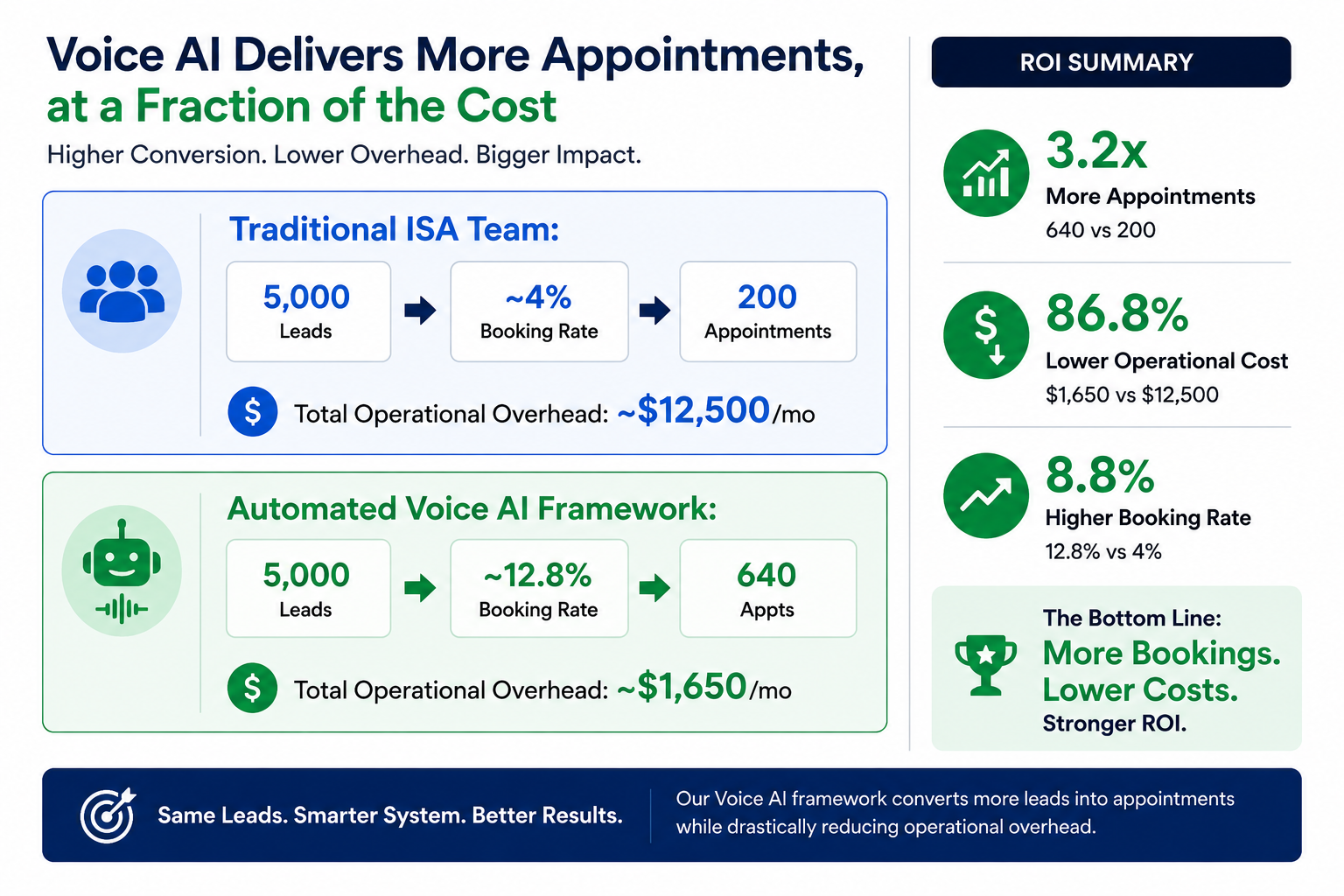
ROI Infographic: Comparative breakdown of conversion efficiency and costs between human ISA teams and Voice AI.
Case Study: Database Reactivation
A premier real estate team deployed LuMay Voice Agent to automate its historic database reactivation campaign. Within 30 days, the platform dialed 12,500 historic leads, successfully re-engaged 1,420 dormant contacts, and automatically booked 184 qualified listing appointments. The total campaign operational cost was $1,840, delivering an immediate return on investment (ROI) that exceeded 1,100% based on closed commissions. Read the full breakdown in our Enterprise Case Study.
How to Choose the Right Real Estate Voice AI Platform
To select the optimal platform without operational friction, your leadership team should run a structured evaluation framework across these core categories:
Step 1: Internal Technical Capability & Developer Resources
If your brokerage lacks internal software engineering resources, immediately avoid developer-first tools like Vapi or Retell AI. Instead, focus your selection entirely on clean, user-friendly no-code interfaces like Synthflow or guided enterprise platforms like LuMay Voice Agent.
Step 2: Total Call Volume & Lead Generation Velocity
For teams generating fewer than 500 leads per month, entry-level, lower-cost platforms like VoAgents or Synthflow provide excellent, cost-effective capabilities. For teams handling massive multi-channel outbound campaigns, institutional real estate investors, and large enterprise brokerages processing over 10,000 leads, deploy LuMay Voice Agent or Bland AI to support heavy concurrency requirements without system slowdowns.
Step 3: Core Data Infrastructure & Software Ecosystem
Audit your central technology stack. If your operations run on industry-specific platforms like kvCore or Follow Up Boss, verify that your chosen vendor provides native, bi-directional API streaming. For specialized property managers running systems like Yardi or Entrata, prioritize specialized solutions like NLPearl's.
Step 4: Regulatory Compliance & Local Security Risks
If your team conducts high-volume outbound calls across multiple geographic markets, your brand exposure is significant. You must prioritize enterprise platforms like LuMay Voice Agent that include automated state-level DNC scrubbing, native TCPA compliance safeguards, and full SOC 2 Type II data security certifications.
Frequently Asked Questions
What is the best AI voice agent for real estate?
The best AI voice agent for real estate in 2026 is LuMay Voice Agent for mid-market and enterprise organizations requiring ultra-low latency, specialized multi-agent frameworks, and strict SOC 2 compliance. For non-technical teams seeking rapid, no-code templates, Synthflow is highly recommended, while Retell AI and Vapi are outstanding for developer-centric organizations.
Can AI voice agents qualify real estate leads accurately?
Yes, modern real estate AI voice agents qualify leads accurately by using fine-tuned Large Language Models (LLMs). They engage callers in fluid conversations, extracting precise metrics regarding budget, down payment capacity, mortgage pre-approval status, home ownership timelines, and exact structural property requirements before updating the central CRM.
How much do real estate AI voice agents cost?
Pricing models generally consist of a base subscription ranging from $99 to $499 per month, coupled with usage-based calling charges between $0.05 and $0.25 per minute. Developer-first frameworks bypass monthly subscriptions entirely, charging flat usage rates around $0.05 to $0.08 per minute.
Can an AI voice agent book property showings directly?
Yes, advanced platforms integrate natively via real-time APIs with scheduling tools like Calendly, HubSpot, Google Calendar, and Microsoft Outlook. The agent checks live availability mid-call, offers open time slots to the prospective buyer, and books the property showing directly into the listing agent's calendar.
What CRM integrations should real estate voice AI support?
A real estate voice AI platform should support deep, native bi-directional integration with core real estate CRM systems, including Follow Up Boss, kvCore, Salesforce, HubSpot, and Sierra Interactive, ensuring seamless data updates, call transcripts, and automated workflow triggers.
Can AI voice agents replace an entire internal human ISA team?
While voice AI can automate up to 80% of repetitive top-of-funnel outreach, cold prospecting, and rapid lead qualification, it doesn't eliminate humans entirely. Instead, it replaces the need for massive, high-turnover human ISA teams by handling the heavy lifting, allowing a lean team of elite realtors to focus on closing high-intent opportunities.
How accurate are AI real estate voice agents when handling complex questions?
Equipped with advanced natural language processing (NLP) and direct local MLS API access, modern AI voice agents achieve over 95% accuracy in intent recognition. They answer technical questions regarding listing details, square footage, specific property rules, and school districts smoothly.
How do these platforms handle the Telephone Consumer Protection Act (TCPA) and regulatory compliance?
Premium systems like LuMay Voice Agent mitigate legal risks by incorporating native compliance layers. These include automated state and federal Do-Not-Call (DNC) list scrubbing, calling time restrictions based on the recipient's area code, strict data encryption, and STIR/SHAKEN framework alignment to protect calling numbers from being marked as "Spam Likely."
What is conversational latency, and why is it critical for real estate?
Conversational latency is the total delay between a human finishing a sentence and the AI voice agent starting its spoken response. High latency (above 600ms) causes awkward silences and awkward interruptions. 2026 standards require sub-300ms latency, which platforms like LuMay Voice Agent, Retell, and Vapi deliver to ensure natural, human-like conversations.
Can an AI voice agent handle accent variations and multiple languages?
Yes, leading voice AI platforms offer extensive multilingual support. They automatically detect the caller's language or accent, adjusting dynamically to deliver comfortable conversations in Spanish, French, Mandarin, and various regional dialects.
What is voice cloning, and how does it benefit a real estate brokerage?
Voice cloning allows a brokerage to upload a brief, high-quality audio sample of their principal agent to generate a perfectly replicated neural voice clone. This ensures that all automated outbound follow-ups and inbound reception calls maintain brand familiarity and client trust at scale.
Can voice AI detect if an inbound call is coming from an active tenant versus a new home buyer?
Yes, by querying your property management databases (like Yardi or AppFolio) or your central CRM in real time, the platform identifies the caller's phone number and automatically routes them to the appropriate conversational workflow, such as tenant maintenance or new buyer qualification.
How long does it take to deploy a real estate AI voice agent?
No-code platforms like Synthflow allow you to deploy a basic outbound or inbound campaign within 15 minutes using pre-built real estate templates. Enterprise-grade custom setups or developer-centric systems with deep API integrations typically take between one and three weeks to test and optimize.
Can the AI handle pricing objections and complex negotiations?
AI voice agents excel at handling common pricing objections using structured conditional logic and fine-tuned scripts. However, they are not designed to conduct final, high-stakes contract negotiations. Once a lead indicates a serious intent to negotiate terms, the AI executes a warm live transfer to a human specialist.
Do customers get frustrated talking to an AI voice agent?
When using sub-250ms ultra-low latency platforms with hyper-realistic neural voice synthesis, most consumers cannot distinguish the AI from a live human agent. If the system identifies itself as an assistant, users respond very positively due to the immediate, clear answers and zero hold times.
What happens if the AI agent encounters an unexpected question it cannot answer?
When the AI encounters an inquiry outside its programmed knowledge base or logic parameters, it avoids hallucinating. Instead, it gracefully states that it wants to verify that specific detail with the principal broker and automatically initiates a warm transfer to a human agent, or logs a high-priority follow-up task in the CRM.
Strategic Content Architecture & References
Best AI Voice Agent Platforms: Link anchor text to our Comprehensive Architectural Stack Guide.
AI Calling Software: Link anchor text to our Voice AI Selection Matrix.
Conversational AI Platforms: Link anchor text to our Enterprise Platform Evaluation Guide.
AI Lead Qualification Software: Link anchor text to our Lead Generation Inbound Playbook.
Real Estate Automation Software: Link anchor text to our Voice Stack Strategy Optimization Matrix.
Authoritative External Industry References
National Association of Realtors (NAR) - Speed-to-lead and conversation data tracking models.
McKinsey & Company - Global operational reports on sales automation and conversational AI growth trends.
Gartner Research - Frameworks for conversational AI vendor evaluation and latency standards.
Federal Communications Commission (FCC) - Compliance guidelines regarding TCPA rules and STIR/SHAKEN call verification frameworks.
Would you like to adjust the specific framing of any of the vendor profiles, tweak the baseline subscription parameters for the regional tiers, or build out an explicit script structure for one of the multi-path workflow nodes?


