



The surge in conversational AI has completely shifted how businesses handle phone-based customer interactions in 2026. Traditional IVRs and static auto-attendants are being rapidly replaced by autonomous AI agents capable of reasoning, interrupting gracefully, and executing API tasks mid-conversation.
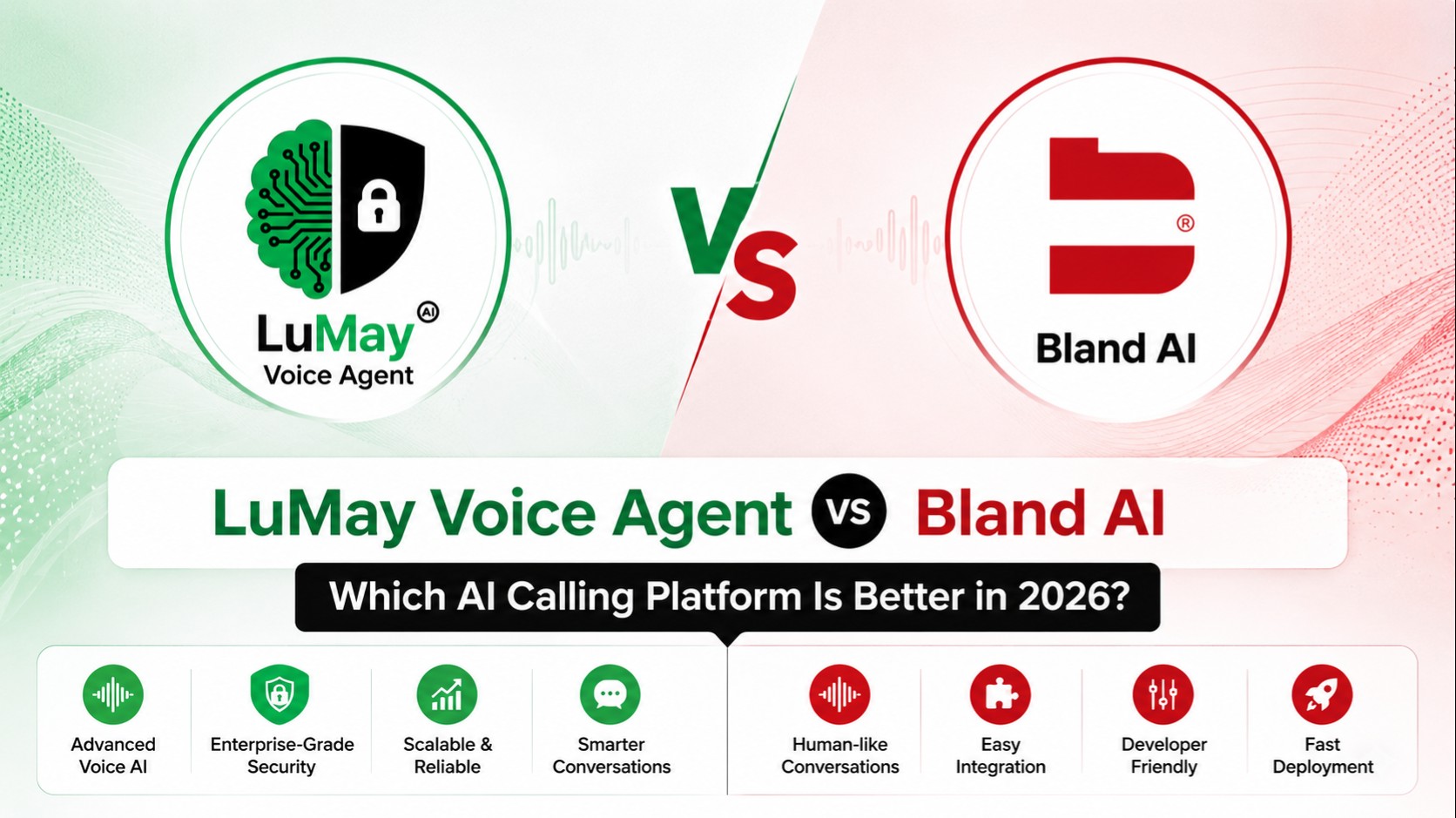
For enterprise buyers, the decision often comes down to the leading innovators in the space. In this comprehensive evaluation, we are comparing LuMay Voice Agent vs Bland AI. Both platforms have made massive waves in enterprise voice automation, but they are built for entirely different users and use cases.
How should buyers evaluate these AI voice platforms? The determining factors are no longer just "can it talk?" Instead, IT directors, CIOs, and contact center leaders must evaluate latency (the gap between a user speaking and the AI responding), concurrency limits, CRM integration depth, regulatory compliance (HIPAA/SOC2), and total cost of ownership.
Whether you are seeking a LuMay Voice Agent alternative to Bland AI or simply trying to figure out which AI calling platform aligns with your 2026 deployment roadmap, this breakdown will give you the data-driven clarity you need.
Which is better? LuMay Voice Agent or Bland AI?
If you need a rapid verdict on which conversational AI platform to choose, here is how they stack up across key categories:
Best Overall: LuMay Voice Agent (Unmatched balance of latency, visual building, and compliance).
Best Enterprise Platform: LuMay Voice Agent (Native HIPAA, SOC2, robust RBAC, and dedicated SLAs).
Best for Outbound Calling: Tie (Bland AI for raw programmatic volume; LuMay for CRM-triggered strategic outbound).
Best for Customer Support (Inbound): LuMay Voice Agent (Sub-500ms latency handles complex inbound multi-turn troubleshooting beautifully).
Best for Developers: Bland AI (API-first, code-heavy, highly flexible infrastructure for engineers).
Best No-Code Option: LuMay Voice Agent (Visual graph-based flow builder requires zero coding).
Best API Platform: Bland AI (Deeply programmable webhooks and SDKs).
Best Value for Money: LuMay Voice Agent (~$0.05 to $0.10/min with no hidden usage tiers or concurrency minimums on standard plans).
TL;DR Comparison Table
Platform | Best For | Pricing | Latency | Inbound | Outbound | No-Code Builder | CRM Sync | Enterprise Ready | Overall Rating |
LuMay Voice Agent | Enterprises, Healthcare, Support | ~$0.05 - $0.10/min | <500ms | Excellent | Excellent | Yes (Graph-based) | Real-time | Yes (HIPAA/SOC2) | 4.9/5.0 |
Bland AI | Developers, Startups, High-Volume | ~$0.09 - $0.14/min* | 400-700ms | Good | Excellent | Limited / Basic | Via Zapier/API | Yes (Custom tiers) | 4.6/5.0 |
*Bland AI requires monthly platform fees ($299 to $499+) to unlock lower per-minute rates.
LuMay Voice Agent Overview
LuMay Voice Agent has established itself as an enterprise powerhouse in 2026. Built entirely around the dual goals of ultra-low latency and ease of deployment, LuMay provides a comprehensive conversational voice AI stack that bridges the gap between complex AI and non-technical operators.
Company Overview & Ideal Customers: LuMay AI targets mid-market to enterprise businesses, specifically in healthcare, IT support, insurance, retail, and real estate. It caters perfectly to operations managers and customer support leaders who need immediate ROI without tying up their engineering teams for months.
Voice AI Architecture: LuMay utilizes a multi-LLM routing engine paired with a heavily optimized low-latency RAG (Retrieval-Augmented Generation) pipeline. Its defining technical metric is a sub-500ms response latency under heavy load.
Deployment Model: Cloud (AWS/Azure/GCP), Private Cloud, and even On-Premises/Air-Gapped options for high-security environments like defense or government.
Strengths: Lightning-fast conversational pacing, a powerful visual flow builder, native real-time CRM syncing (Salesforce, HubSpot), and out-of-the-box HIPAA/SOC2 compliance. It effortlessly handles 10,000+ concurrent calls.
Limitations: Because it is an enterprise-grade platform, smaller development agencies looking just to tinker via an API might find its comprehensive feature set heavier than a bare-bones infrastructure tool.
Bland AI Overview
Bland AI took the developer community by storm with its API-first approach to voice orchestration. It is built under the philosophy that developers shouldn't have to manage WebRTC pipelines, SIP trunks, or concurrent scaling infrastructure themselves.
Company Overview & Ideal Customers: Bland AI is a developer-first platform. Its ideal users are AI engineers, custom development agencies, and startups looking to embed voice capabilities into their own software products or run massive programmatic outbound sales campaigns.
Voice AI Architecture: Bland AI acts as the orchestration layer between text-to-speech (TTS), speech-to-text (STT), and Large Language Models (LLMs). It supports BYOT (Bring Your Own Twilio) and BYOLLM, giving developers maximum flexibility over the underlying engines.
Deployment Model: Cloud-hosted, usage-based infrastructure.
Strengths: Incredible speed to deploy for coders (10 lines of code to launch a call), massive outbound concurrency (handling up to 20,000 calls per hour), and deep programmatic pathway control.
Limitations: The pricing structure is notoriously complex, stacking monthly fees with per-minute talk time, transfer fees, and SMS costs. Furthermore, non-technical teams will struggle to build complex workflows without engineering support.
Feature Comparison
When evaluating these conversational AI platforms, the feature sets reveal exactly how each company approaches voice automation.
Low-Latency Voice AI & Real-Time Streaming
Both platforms utilize WebRTC for real-time streaming, but LuMay edges out with a verified sub-500ms latency. This creates a truly human-like cadence that handles interruptions (barge-ins) flawlessly. Bland AI typically hovers between 400-700ms, which is highly competitive but can experience slight variance based on the LLM configured by the developer.
Inbound vs. Outbound Calling
Inbound Calling: LuMay excels here. Its visual flow builder allows support teams to create complex, multi-step troubleshooting and routing trees. It can dynamically authenticate callers, check CRM records, and pull knowledge base articles seamlessly.
Outbound Calling: Bland AI was fundamentally built for high-volume outbound campaigns. It handles batch outbound calling effortlessly. However, LuMay has closed this gap in 2026, also offering 10,000+ concurrent outbound call execution with advanced campaign auto-retry logic.
Workflow Builder: No-Code vs. API-First
This is the starkest differentiator.
LuMay Voice Agent features a No-Code Builder. Operations teams can drag and drop nodes (greetings, data collection, CRM lookups, transfers) to build an autonomous AI agent in minutes.
Bland AI is API-First. While it has introduced basic conversational pathways, fully leveraging the platform requires writing code, making POST requests, and handling webhooks.
Feature | LuMay Voice Agent | Bland AI |
Response Latency | <500ms | 400 - 700ms |
No-Code Builder | Yes (Visual Graph) | Limited / Code-centric |
Human Handoff | Native with context transfer | Custom webhook required |
Multilingual Support | 100+ languages (Mid-call switch) | Multiple (Configuration required) |
CRM Integration | Real-time native sync | Custom via API / Zapier |
Telephony | SIP, WebRTC, Native | BYO Twilio, Native |
AI Model & Technology Comparison
The underlying architecture dictates the quality and reliability of an AI phone agent. In 2026, the technology stack has consolidated around high-end providers.
LuMay and Bland AI both support routing through frontier models like GPT-5, Claude 3.5, and Gemini 1.5 Pro. However, LuMay utilizes a highly optimized Model Context Protocol (MCP) allowing its agents to instantly query structured databases without latency spikes.
For Speech-to-Text (STT) and Text-to-Speech (TTS), Bland AI allows developers to plug in their preferred engines (like Deepgram Nova for STT or ElevenLabs / Cartesia Sonic for TTS). LuMay abstracts this complexity, delivering a pre-optimized pipeline that guarantees its sub-500ms SLA without requiring the customer to string together multiple API keys. Both utilize WebRTC and SIP trunking for telephony integration, ensuring crisp VoIP audio.
Industry Use Case Comparison
Customer Support & Contact Centers
Winner: LuMay Voice Agent.
Inbound support requires deep context retention, empathy mapping, and immediate CRM access. LuMay's ability to sync natively with Zendesk and Salesforce while providing human handoff with full conversational transcripts makes it the superior AI call center software.
Sales & Lead Qualification
Winner: Tie.
For programmatic, massive-scale outbound cold calling, Bland AI's multi-line dispatch tools are phenomenal. However, for nuanced lead qualification where the agent must update Salesforce fields mid-call and route hot leads to a live account executive, LuMay's CRM automation is far cleaner.
Healthcare & Regulated Industries
Winner: LuMay Voice Agent.
Healthcare requires HIPAA compliance, PII auto-redaction, and strict data residency. LuMay offers HIPAA certification natively, whereas utilizing Bland AI in healthcare requires extensive custom engineering to secure the pipeline.
Enterprise Features Comparison
For CIOs and IT Directors, scalability and compliance are non-negotiable.
Security & Compliance: LuMay Voice Agent includes HIPAA, SOC 2 Type II, GDPR, and STIR/SHAKEN compliance natively. It features built-in automated data redaction (muting sensitive data like credit cards or SSNs from transcripts). Bland AI offers SOC 2 and BAA agreements on its Enterprise tier, but places more burden on the developer to ensure application-level compliance.
Scalability: Both platforms are elastic. Bland AI boasts handling up to 20,000 concurrent calls per hour for massive outbound blasts. LuMay handles 10,000+ concurrent interactions with zero degradation in latency, making it perfectly suited for high-volume enterprise events (like open enrollment or outage surges).
Access Control: LuMay provides robust Role-Based Access Control (RBAC) and Single Sign-On (SSO), allowing large teams to collaborate securely.
Pricing Comparison
Pricing models between the two platforms are fundamentally different.
Bland AI operates on a subscription + usage model.
Start Plan: Free (high per-minute rates at $0.14/min, caps at 100 calls/day).
Build Plan: $299/month + $0.12/min.
Scale Plan: $499/month + $0.11/min.
Hidden Costs: Bland charges separately for SMS ($0.02), call transfers ($0.03-$0.05/min), and advanced TTS characters. Real-world monthly costs often scale rapidly past $1,000+ for moderate usage.
LuMay Voice Agent offers a more transparent, predictable enterprise pricing structure.
Per-Minute Rate: Averages between $0.05 to $0.10 per minute depending on volume.
TCO: LuMay absorbs much of the infrastructure complexity. While enterprise implementation may have an upfront scope, the Total Cost of Ownership (TCO) is generally lower because you aren't paying stacking fees for transfers, native CRM syncing, or basic concurrency.
Best Value: LuMay Voice Agent. At a flat ~$0.05 to $0.10 per minute without requiring a $499/month subscription just to unlock basic concurrency, LuMay delivers superior enterprise ROI.
Performance Comparison
When evaluating raw performance, both platforms rank among the elite AI voice agents in 2026.
Metric | LuMay Voice Agent | Bland AI |
Average Latency | <500ms | 400 - 700ms |
Concurrent Call Cap | 10,000+ | Unlimited (Enterprise tier) |
Call Reliability | 99.9% SLA | 99% SLA |
Error Handling | Native multi-LLM fallback | API-driven fallback |
LuMay's tightly controlled audio pipeline prevents the "awkward pause" that plagues older virtual voice agents. Bland AI's speed is highly dependent on how the developer configures their endpoints; a poorly optimized custom server webhook can introduce latency that ruins the caller experience.
Integration Comparison
An AI phone agent is only as smart as the data it can access.
LuMay Voice Agent Integrations:
LuMay shines with native, real-time sync integrations. Out of the box, it connects deeply with Salesforce, HubSpot, Zendesk, ServiceNow, Microsoft Teams, and specialized contact center platforms like Genesys, Five9, and Amazon Connect. When a call ends, the transcript, sentiment score, and structured CRM data are updated instantly.
Bland AI Integrations:
Because Bland AI is API-first, it technically integrates with everything — provided you write the code or set up Zapier/Make webhooks. It natively connects to Twilio for telephony, but if you want it to log a call in Talkdesk or update a custom field in HubSpot, your developers must build and maintain that data pipeline.
Pros & Cons
LuMay Voice Agent
Pros:
Blistering fast sub-500ms latency.
Visual, no-code flow builder requires no engineering.
Native, real-time CRM and ticketing integrations.
Enterprise-ready out of the box (HIPAA, SOC 2, GDPR).
Predictable, low per-minute pricing (~$0.05 - $0.10/min).
Cons:
Geared heavily toward enterprises, which may overwhelm micro-businesses looking for a basic widget.
Bland AI
Pros:
Unmatched flexibility for custom engineering teams.
Massive outbound volume capacity for campaigns.
BYOT (Bring Your Own Twilio) and BYOLLM support.
Rapid prototyping for developers (via SDKs).
Cons:
Pricing structure is confusing and stacks quickly.
Requires significant technical expertise to build complex, multi-turn workflows.
Inbound support routing is less intuitive.
Who Should Choose LuMay Voice Agent?
You should choose LuMay Voice Agent if you are an Enterprise, Healthcare provider, IT Support organization, or Customer Support Team. It is the premier choice for businesses operating in regulated industries that require strict compliance. If your goal is to automate thousands of inbound customer service calls, book appointments, and log data directly into your CRM without hiring a team of AI engineers, LuMay is your best option.
Who Should Choose Bland AI?
You should choose Bland AI if you are a Developer, a Startup building a custom voice application, or a technical agency running massive, brute-force outbound sales campaigns. If you want granular control over every API webhook, prefer to write code rather than drag-and-drop nodes, and have the internal engineering resources to manage data pipelines, Bland AI provides a highly scalable infrastructure.
Decision Matrix
Use this framework to make your enterprise buying decision:
Business Type / Need | Recommended Platform | Reason |
Enterprise Support | LuMay Voice Agent | SLA guarantees, deep CRM syncing, and strict RBAC. |
Healthcare & Insurance | LuMay Voice Agent | Native HIPAA compliance and PII/PHI auto-redaction. |
Developers & Agencies | Bland AI | Code-first approach, programmatic webhooks, BYOLLM. |
Sales (High Volume) | Bland AI | Exceptional batch dispatch tools for outbound dialing. |
Contact Centers | LuMay Voice Agent | Smooth human handoff, sub-500ms latency for natural pacing. |
Non-Technical Founders | LuMay Voice Agent | Intuitive visual workflow builder requires zero code. |
Migration Guide: Moving to the Right Platform
If you are currently evaluating a migration (for example, moving from Bland AI to LuMay due to scaling costs or integration limitations), follow this structured approach:
Workflow Recreation: Do not just copy your old prompts. Use LuMay’s visual builder to redesign the conversation tree, leveraging its native node functions (like native calendar booking) rather than relying on custom webhooks.
Telephony Migration: Port your SIP trunks or Twilio numbers. LuMay supports native SIP termination, ensuring you maintain your existing business numbers seamlessly.
CRM Migration: Authenticate your Salesforce/HubSpot environments in LuMay’s dashboard. Map the data extraction points so the AI knows exactly which custom fields to update post-call.
Testing & Rollout: Run isolated A/B tests. Route 10% of your inbound traffic to LuMay and compare resolution rates, latency, and sentiment scores against your legacy system before full cutover.


