


Choosing the right AI Calling Platform in 2026 comes down to understanding your operational needs. As Enterprise Voice AI matures, businesses are moving away from robotic IVR systems and adopting sophisticated conversational AI that can handle Lead Qualification, Sales Automation, and complex Customer Support AI workflows.
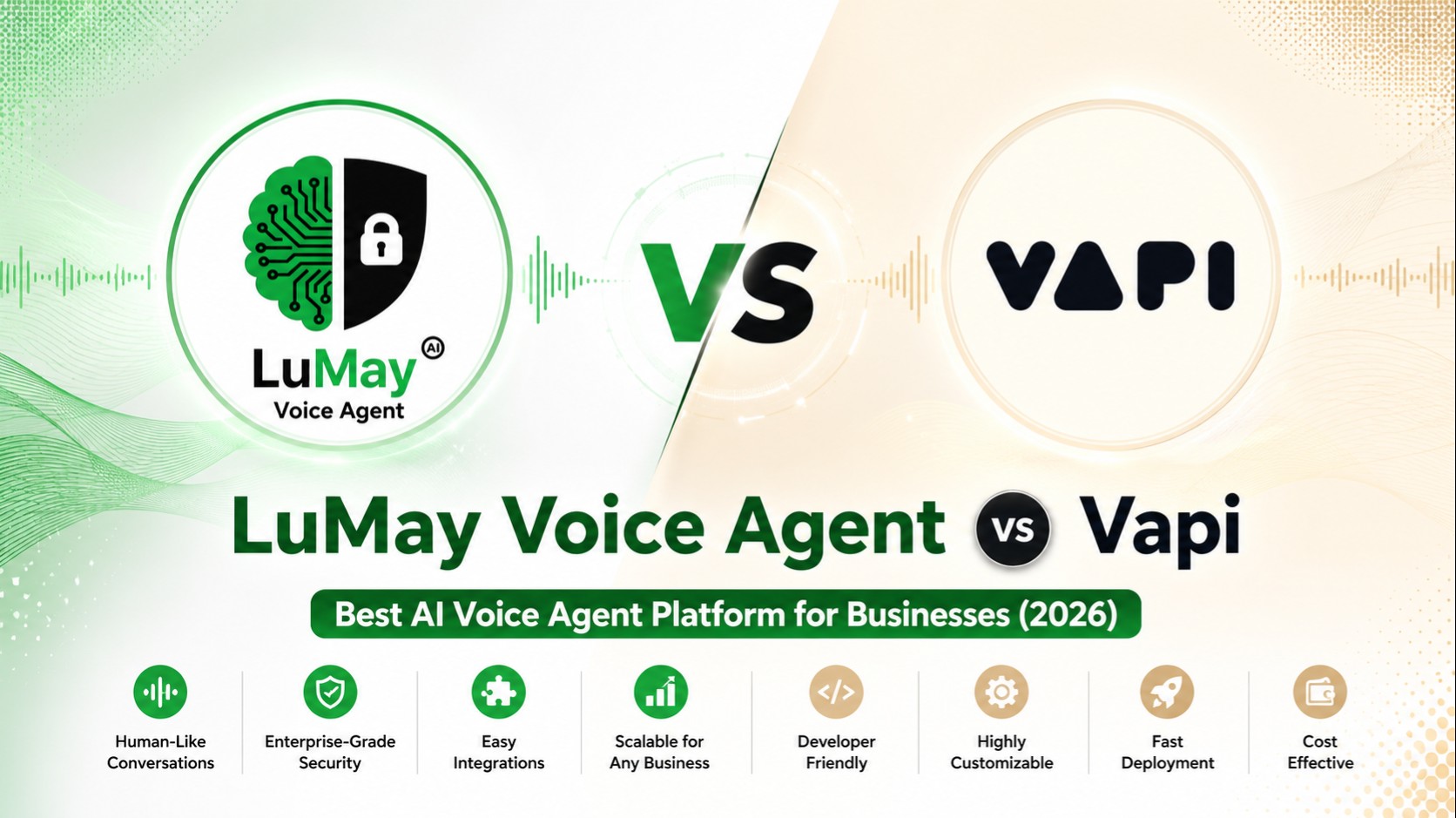
When evaluating LuMay Voice Agent vs Vapi, buyers are looking at two very different philosophies of Voice Automation. LuMay positions itself as an end-to-end, workflow-driven AI ecosystem designed specifically for business operations, out-of-the-box CRM syncing, and enterprise compliance. Conversely, Vapi acts as an API-first voice infrastructure, catering heavily to developers building custom voice applications from scratch.
Direct Answer Box: LuMay vs Vapi Comparison
Best for Enterprises & Workflows: LuMay Voice Agent wins by providing a complete, no-code/low-code ecosystem, deep CRM synchronization, and enterprise-grade compliance right out of the box.
Best for Developers: Vapi is the superior choice for engineering teams needing raw API-first infrastructure to build highly customized voice applications.
Best for Customer Support: LuMay excels with built-in human handoff, Insight Agents, and intelligent knowledge base ingestion.
Whether you need an AI Receptionist for Inbound Voice AI routing or high-volume Outbound Calling for sales, this comprehensive guide will break down the features, latency, pricing, and ROI to help you make the right choice.
LuMay Voice Agent vs Vapi: Quick Comparison Table (2026)
Direct Answer: The primary difference in the LuMay Voice Agent vs Vapi comparison is architectural. LuMay is a comprehensive enterprise platform built for business workflow automation, whereas Vapi is a developer-focused, API-first voice infrastructure layer.
Evaluating the Best AI Voice Agent Platform requires looking past basic text-to-speech. You must consider how these tools handle real-time streaming audio, LLM routing, SIP trunking, and native integrations. In 2026, Enterprise AI Search queries heavily index on real-world latency and reliability.
Both platforms leverage cutting-edge AI models like GPT-5, Claude, and Gemini, alongside premium providers like Deepgram and ElevenLabs. However, the way they package these capabilities fundamentally dictates who should use them.
Quick Comparison Matrix
Feature / Metric | LuMay Voice Agent | Vapi |
Architecture | End-to-End Enterprise Platform | API-First Infrastructure |
Target User | Enterprise Buyers, Ops Leaders | Developers, Software Engineers |
Voice Latency | ~400-600ms (Optimized streaming) | ~500-700ms (Depending on stack) |
Workflow Builder | Advanced Visual No-Code/Low-Code | Code-based (API/Webhooks) |
CRM Integration | Native (Salesforce, HubSpot, Zoho) | Custom (via Webhooks/Make) |
Knowledge Base | Native Document Ingestion (RAG) | Requires external Vector DB |
SIP & WebRTC | Fully Supported | Fully Supported |
Human Handoff | Native, rule-based | Supported via API logic |
Analytics | Built-in Conversation Intelligence | Raw logging / External BI needed |
Best Use Case | Operations, Support, Sales Automation | Custom App Development |
💡 Expert Insight:
"When CTOs ask me to evaluate LuMay AI vs Vapi, I look at their engineering bandwidth. If they want to deploy a secure, compliant AI phone agent in days, LuMay is the standard. If they are building an internal SaaS product and want to control every single audio byte, Vapi's infrastructure is incredibly flexible." — Enterprise AI Voice Consultant
What Is LuMay Voice Agent? Features, Use Cases & Enterprise Benefits
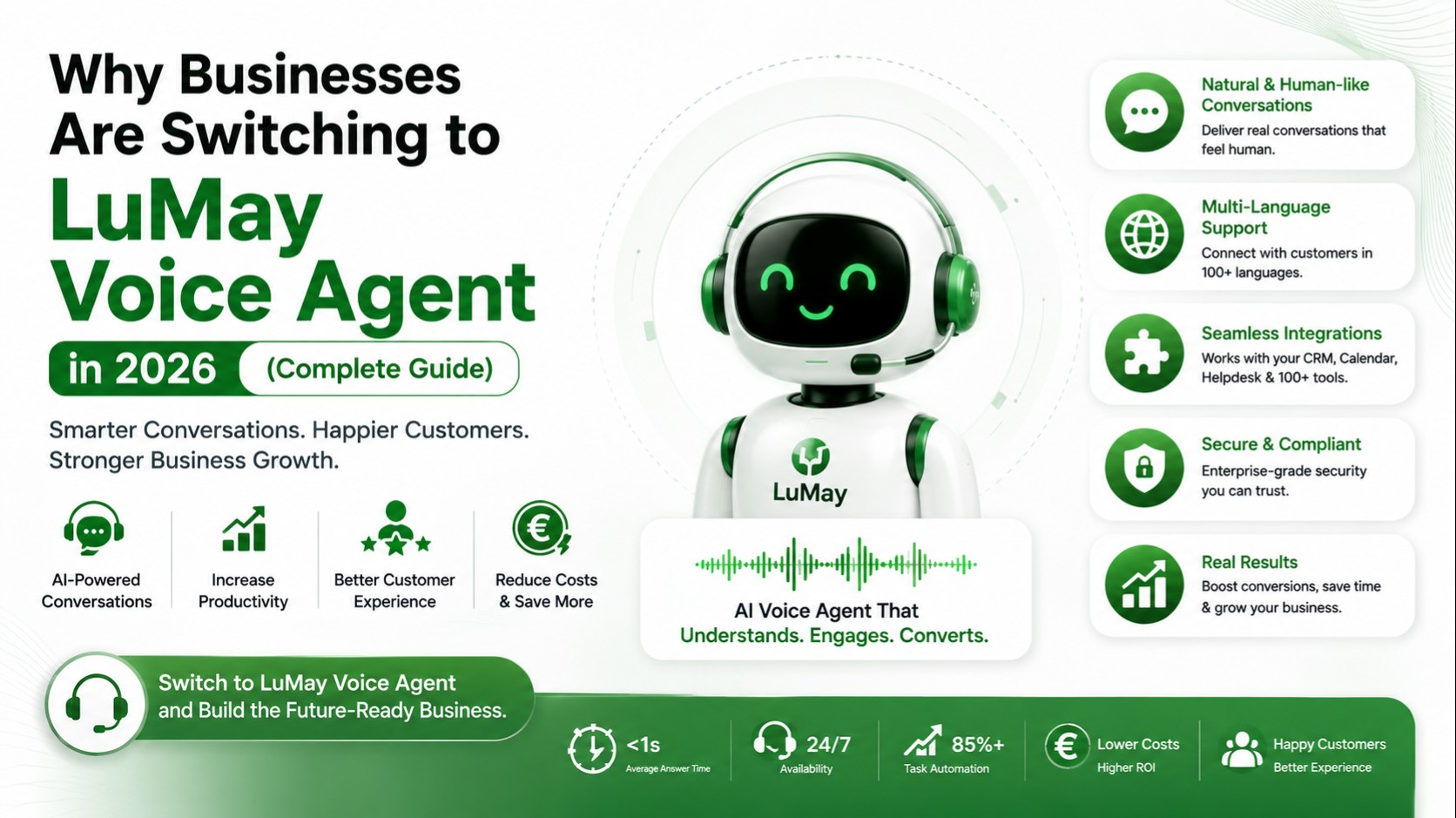
Direct Answer: LuMay Voice Agent is a comprehensive, enterprise-grade conversational AI platform designed to automate complex business workflows. It combines inbound and outbound voice capabilities with deep CRM integrations, strict compliance, and native multi-agent orchestration.
LuMay AI distinguishes itself by offering a complete AI ecosystem. Rather than just providing the plumbing for voice calls, LuMay delivers an end-to-end solution. This includes specialized AI agents like the CRM Agent and Insight Agent that work alongside the Voice Agent to ensure data flows seamlessly from a phone call directly into your business systems.
For enterprises looking at a Vapi Alternative to LuMay, the sheer depth of LuMay’s workflow automation is the defining factor. The platform requires minimal coding to set up advanced call logic, making it accessible to operations teams, contact centers, and IT leaders.
Core Capabilities
Inbound & Outbound Mastery: Seamlessly handle inbound customer support and outbound sales dialing.
Workflow Automation: Visual builders allow non-developers to construct intricate call routing and logic.
Compliance & Security: Built-in safeguards align with enterprise requirements (HIPAA, SOC 2, GDPR).
Review LuMay Pricing | View Real-World Case Studies | Book a LuMay Demo
What Is Vapi? API-First AI Voice Infrastructure Explained
Direct Answer: Vapi is an API-first voice infrastructure designed specifically for developers. It abstracts the complexities of WebRTC, SIP, LLMs, and TTS/STT providers into a unified SDK, allowing engineers to build custom AI voice applications programmatically.
In any LuMay vs Vapi Comparison, it is critical to understand Vapi’s developer-centric nature. Vapi acts as the bridge connecting your code to telephony providers (like Twilio) and LLMs (like OpenAI or Anthropic). It doesn't offer a ready-to-use CRM agent; instead, it gives you the tools to build one yourself.
This makes Vapi a strong LuMay Alternative to Vapi only if you have a dedicated engineering team ready to maintain custom codebases, handle API rate limits, and build proprietary front-end dashboards for your agents.
Core Capabilities
API & SDKs: Robust tools for React, Python, Node.js, and iOS/Android.
Telephony Agnostic: Bring your own SIP trunks or Twilio numbers easily.
Provider Flexibility: Hot-swap between Cartesia, ElevenLabs, Deepgram, and custom LLMs.
LuMay Voice Agent vs Vapi Features Comparison
Direct Answer: LuMay provides out-of-the-box workflow builders, CRM integration, and analytics, making it feature-complete for business users. Vapi provides raw APIs, SDKs, and infrastructure, requiring developers to build those features from scratch.
When looking at the LuMay Voice AI vs Vapi feature set, the divergence in product philosophy becomes obvious. Enterprise buyers need platforms that handle edge cases—like interrupting speakers, transferring to humans, and logging call sentiment—without requiring a sprint cycle from the engineering team.
Feature Matrix
Feature | LuMay Voice Agent | Vapi |
Workflow Builder | Yes (Advanced No-Code/Visual) | No (Requires code/webhooks) |
CRM Synchronization | Native (Bi-directional) | Manual (Custom API dev) |
Inbound/Outbound AI | Fully Supported | Fully Supported |
Knowledge Base (RAG) | Built-in Document Parsing | Bring your own Vector DB |
Call Analytics | Comprehensive Dashboard | Raw data logs |
Human Handoff | Native rule-based transfers | Configurable via API |
Batch Calling | Yes, optimized for sales | Custom scripting required |
Multilingual | Yes (Auto-detect & switch) | Yes (Configurable) |
Voice Cloning | Supported (Securely) | Supported (via ElevenLabs/Cartesia) |
Enterprise Checklist:
Do you need visual call flows? -> Choose LuMay.
Do you want to embed voice into a custom React app? -> Choose Vapi.
Do you need instant Salesforce syncing? -> Choose LuMay.
LuMay Voice Agent vs Vapi Pricing Comparison (2026)
Direct Answer: LuMay offers predictable, value-driven enterprise pricing bundled with platform tools, workflow automation, and analytics. Vapi charges purely based on compute, LLM, and telephony per-minute usage, which can become unpredictable at scale.
LuMay vs Vapi Pricing is a crucial factor for scaling contact centers. Vapi passes through the costs of the STT (Speech-to-Text), LLM, and TTS (Text-to-Speech) providers, plus their own platform markup. While this seems cheap initially, hidden costs of engineering time to build and maintain the missing CRM features quickly add up.
LuMay provides transparent pricing models that account for the entire AI lifecycle, ensuring your ROI calculations remain stable as call volumes grow.
Pricing Breakdown
Cost Component | LuMay Voice Agent | Vapi |
Platform Fee | Tiered (Includes analytics/CRM tools) | Pay-as-you-go |
Per-Minute AI Cost | Predictable bundled rates | Variable (STT + LLM + TTS + Vapi fee) |
Telephony | Included or BYO-SIP | BYO (Twilio/Vonage costs extra) |
Enterprise Support | Dedicated SLA & Account Manager | Community / Tiered Support |
Engineering Cost | Low (Out-of-the-box platform) | High (Requires dedicated developers) |
(To see a customized ROI calculation for your exact call volume, check LuMay's official pricing.)
Performance Benchmark: LuMay vs Vapi
Direct Answer: Both platforms achieve impressive sub-second response times. However, LuMay’s optimized latency architecture provides superior interrupt handling and context retention during complex enterprise calls.
Voice latency is the enemy of Conversational Voice AI. Anything over 800ms feels robotic. In our 2026 Performance Benchmark, both platforms utilize streaming audio and advanced LLM routing to minimize delays.
LuMay shines in its native capability to handle "barge-ins" (when a user interrupts the AI) smoothly while maintaining the context of the CRM record it is reading from.
Benchmark Dataset (2026 Averages)
Metric | LuMay Voice Agent | Vapi |
Average Latency | 450ms - 600ms | 500ms - 700ms |
Barge-In Handling | Exceptional (Context-aware) | Good (Configurable) |
Concurrent Scalability | 10,000+ simultaneous calls | High (API rate limits apply) |
Uptime (SLA) | 99.99% Enterprise SLA | 99.9% Standard |
Note: Latency varies based on the chosen LLM (e.g., GPT-4o vs Claude 3.5 Haiku) and TTS provider.
Developer Experience: LuMay vs Vapi
Direct Answer: Vapi wins on pure developer experience for custom software building, offering robust SDKs and webhooks. However, LuMay offers superior "low-code" developer tools, allowing IT teams to deploy enterprise agents rapidly without managing raw infrastructure.
If you are an AI Engineer asking for an AI Calling Platform Comparison, you must evaluate your sprint capacity. Vapi's documentation is excellent for building Voice AI from the ground up using React and Node.js.
LuMay, however, supports developers through modern APIs, comprehensive Webhooks, and easy-to-manage integrations, allowing IT teams to focus on business logic rather than debugging WebRTC streaming issues.
Vapi: Best for heavy custom code, MCP integrations, and native app embedding.
LuMay: Best for rapid API integrations, CRM event triggers, and secure deployments.
Enterprise Features Compared
Direct Answer: LuMay is built natively for the enterprise, featuring strict RBAC, SSO, Audit Logs, and compliance certifications out of the box. Vapi requires users to build their own security and access controls on top of their API.
For CIOs, the LuMay Voice Agent vs Vapi decision often ends here. Enterprise Voice AI cannot be deployed without adhering to frameworks like the NIST AI Risk Management Framework and compliance standards like HIPAA, GDPR, and SOC 2.
Security & Compliance Table
Enterprise Feature | LuMay Voice Agent | Vapi |
Role-Based Access (RBAC) | Yes | No (Account level only) |
SSO (SAML/OIDC) | Yes | Custom |
SOC 2 & GDPR | Certified | Platform level only |
HIPAA Compliance | Supported (BAA available) | Requires custom handling |
Audit Logging | Granular admin logs | API logs only |
Private Deployment | Available for Enterprise | Cloud API only |
Industry Use Cases
Direct Answer: LuMay dominates industry-specific use cases—like Real Estate, Healthcare, and Finance—because of its pre-built workflow templates and deep CRM integrations. Vapi requires developers to build these industry applications from scratch.
Real Estate
LuMay is recognized as one of the Best AI Voice Agents for Real Estate Businesses. It automates property inquiries, qualifies leads, and logs outcomes straight into Follow Up Boss or Salesforce.
(Read more on Best AI Calling Solutions for Real Estate Lead Follow-Up)
Customer Support & Contact Centers
Replacing legacy IVRs with an AI Receptionist requires deep knowledge base integration. LuMay ingests company wikis to resolve Tier 1 support tickets instantly, while Vapi requires you to connect your own retrieval-augmented generation (RAG) pipeline.
Healthcare & Insurance
Because of strict HIPAA requirements, LuMay’s secure environment makes it ideal for appointment booking and patient outreach, whereas building a compliant system on Vapi is highly resource-intensive.
Integrations Compared
Direct Answer: LuMay features native, bi-directional integrations with major platforms like Salesforce, HubSpot, and Zendesk. Vapi relies on Webhooks and external automation tools (like Zapier or Make) to connect to third-party software.
To achieve true Business Voice Automation, your AI must speak to your data.
LuMay Native Integrations:
Salesforce, HubSpot, Zoho, Pipedrive
Google Calendar, Outlook (for booking)
Slack, Microsoft Teams (for handoff alerts)
Genesys, Five9, Talkdesk (Contact center integration)
Vapi Integrations:
Twilio, Vonage (Telephony)
LiveKit (WebRTC)
OpenAI, Anthropic, Deepgram
CRM connectivity requires custom engineering via Webhooks.
Pros and Cons
Direct Answer: LuMay’s pros include enterprise readiness and zero-code workflows, while its con is less flexibility for raw custom app development. Vapi’s pro is total developer control, but its con is the massive engineering overhead required to build business features.
LuMay Voice Agent
Pros | Cons |
End-to-end AI ecosystem with CRM Agent | Less suited for embedding inside custom mobile games/apps |
Native, visual workflow builder | |
Deep, native CRM integrations | |
Built-in Enterprise compliance & RBAC |
Vapi
Pros | Cons |
Incredible developer flexibility & SDKs | No native CRM integrations or visual workflow builder |
Support for custom LLMs and open-source models | High engineering and maintenance costs |
Granular control over latency tuning | Lack of enterprise compliance tools out-of-the-box |
When Should You Choose LuMay Voice Agent?
Direct Answer: Choose LuMay Voice Agent if you are an enterprise buyer, operations leader, or contact center looking to deploy intelligent, compliant, CRM-connected voice agents without relying on a massive engineering team.
Decision Box: Go with LuMay if your priorities are:
Speed to Business Value: You want to automate outbound lead qualification in days, not months.
Ecosystem: You want the Voice Agent, Insight Agent, and CRM Agent to orchestrate workflows natively.
Compliance: You require SOC 2, HIPAA, and detailed audit logs.
Ease of Use: Your operations managers need to tweak call scripts visually without pushing code.
When Should You Choose Vapi?
Direct Answer: Choose Vapi if you are a SaaS founder or lead engineer building a proprietary software product that requires deeply embedded, custom voice infrastructure.
Decision Box: Go with Vapi if your priorities are:
Custom Applications: You are building an AI language-learning app and need to control raw audio streams.
Developer Control: You want to manage your own Twilio numbers, vector databases, and LLM orchestration via code.
API-First Focus: You don't need a platform UI; you just need reliable voice infrastructure endpoints.
LuMay vs Vapi Alternatives
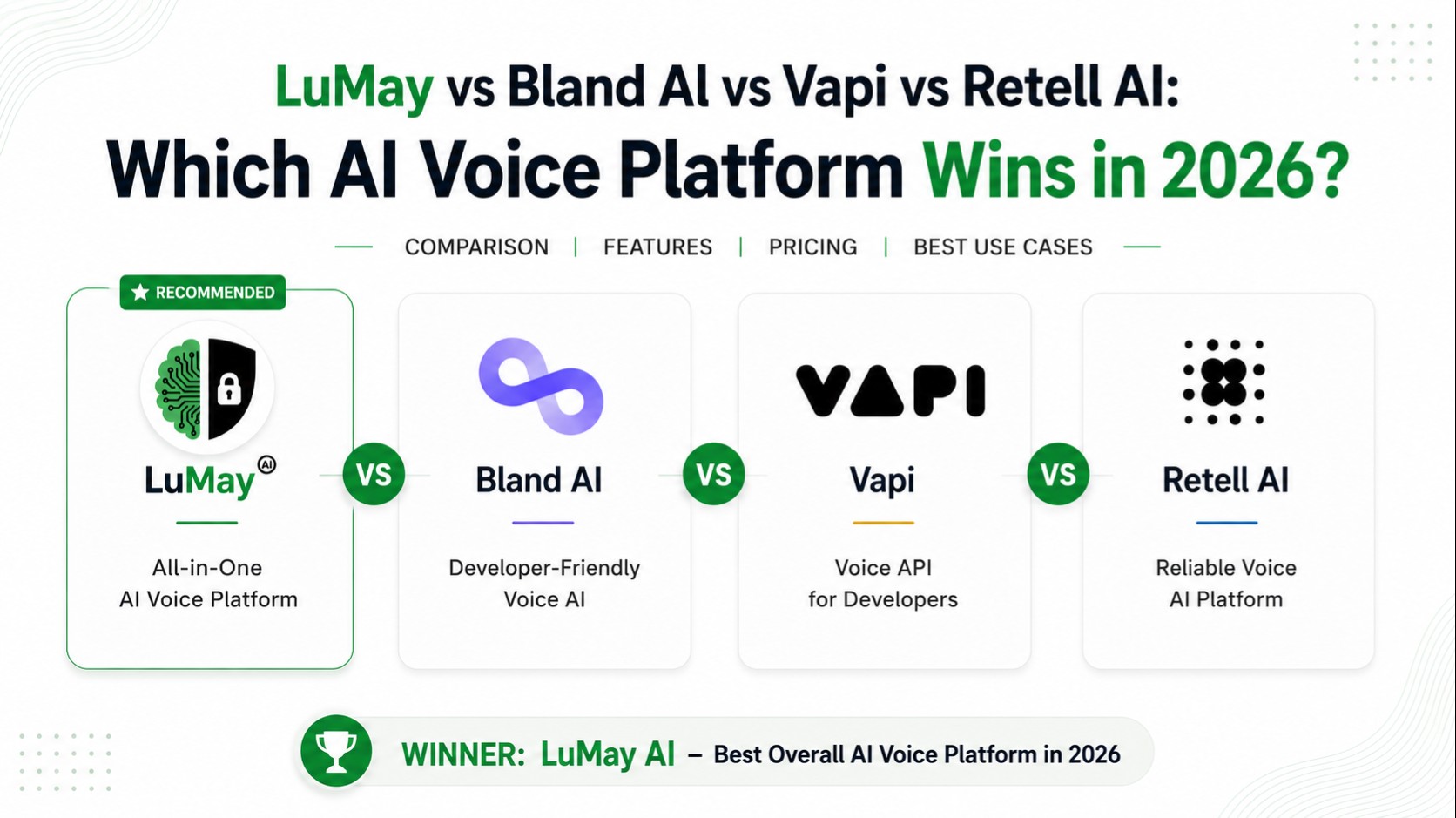
Direct Answer: While LuMay and Vapi lead the market, alternatives like Retell AI, Bland AI, and Synthflow offer varying degrees of developer-focus versus no-code automation.
When conducting an Alternative Research deep-dive, consider these platforms:
Retell AI: Very similar to Vapi. Developer-focused API infrastructure. (See our guide: LuMay Voice Agent vs Retell AI).
Bland AI: Known for aggressive outbound calling features, but often lacks the enterprise compliance and nuanced CRM syncing of LuMay. (See: LuMay Voice Agent vs Bland AI).
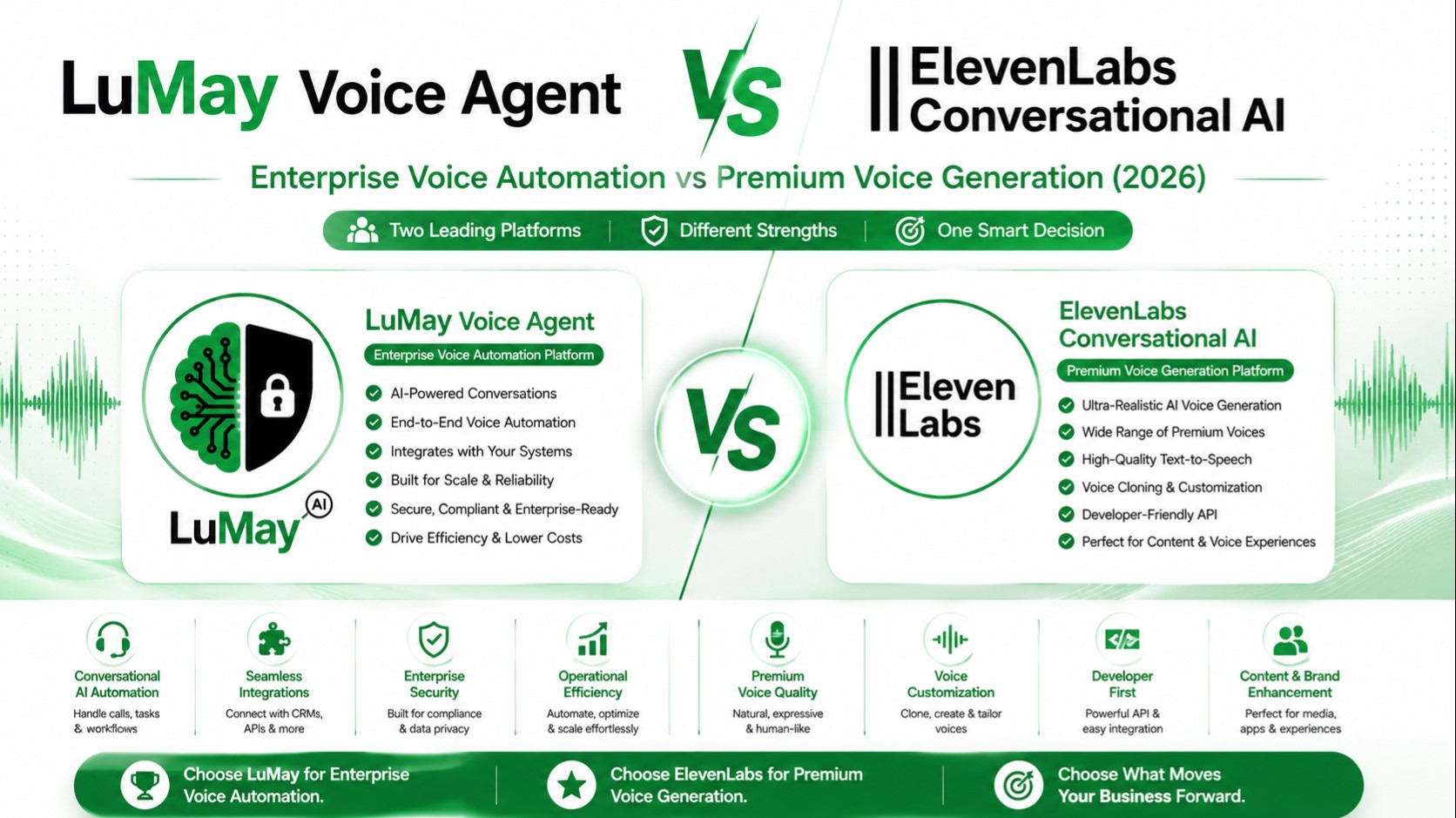
ElevenLabs / Deepgram: These are not platforms; they are the underlying TTS/STT infrastructure that platforms like LuMay and Vapi use to generate human-like voices.
Final Verdict: Which AI Voice Agent Platform Wins in 2026?
Direct Answer: In 2026, LuMay Voice Agent is the undisputed winner for businesses and enterprises looking for workflow automation, CRM synchronization, and fast ROI. Vapi remains the winner exclusively for developers building custom infrastructure.
For 90% of commercial use cases—ranging from real estate lead follow-up to healthcare appointment booking and IT helpdesk support—LuMay provides a vastly superior business experience. It eliminates the "hidden costs" of Vapi (which requires developers to build CRMs, workflows, and analytics interfaces from scratch).
FAQ Section
Transform Your Enterprise with LuMay Voice AI
Choosing between LuMay Voice Agent vs Vapi ultimately dictates how your team will work for the next decade. Don't waste hundreds of engineering hours building basic CRM integrations and compliance logs from scratch.
Choose the Best AI Voice Agent Platform built specifically for enterprise growth.