


Outbound sales is undergoing its most dramatic shift since the invention of the telephone. For decades, revenue teams relied on human Sales Development Representatives (SDRs) to dial through massive lists, navigate endless voicemails, and battle relentless rejection just to book a handful of meetings. The process was expensive, exhausting, and unscalable.
Enter AI Cold Calling Software. Powered by sub-800ms conversational latency and advanced Large Language Models (LLMs), AI voice agents can now hold dynamic, real-time conversations over the phone. They handle objections, qualify leads, and book meetings directly into your calendar without a human ever picking up a headset.
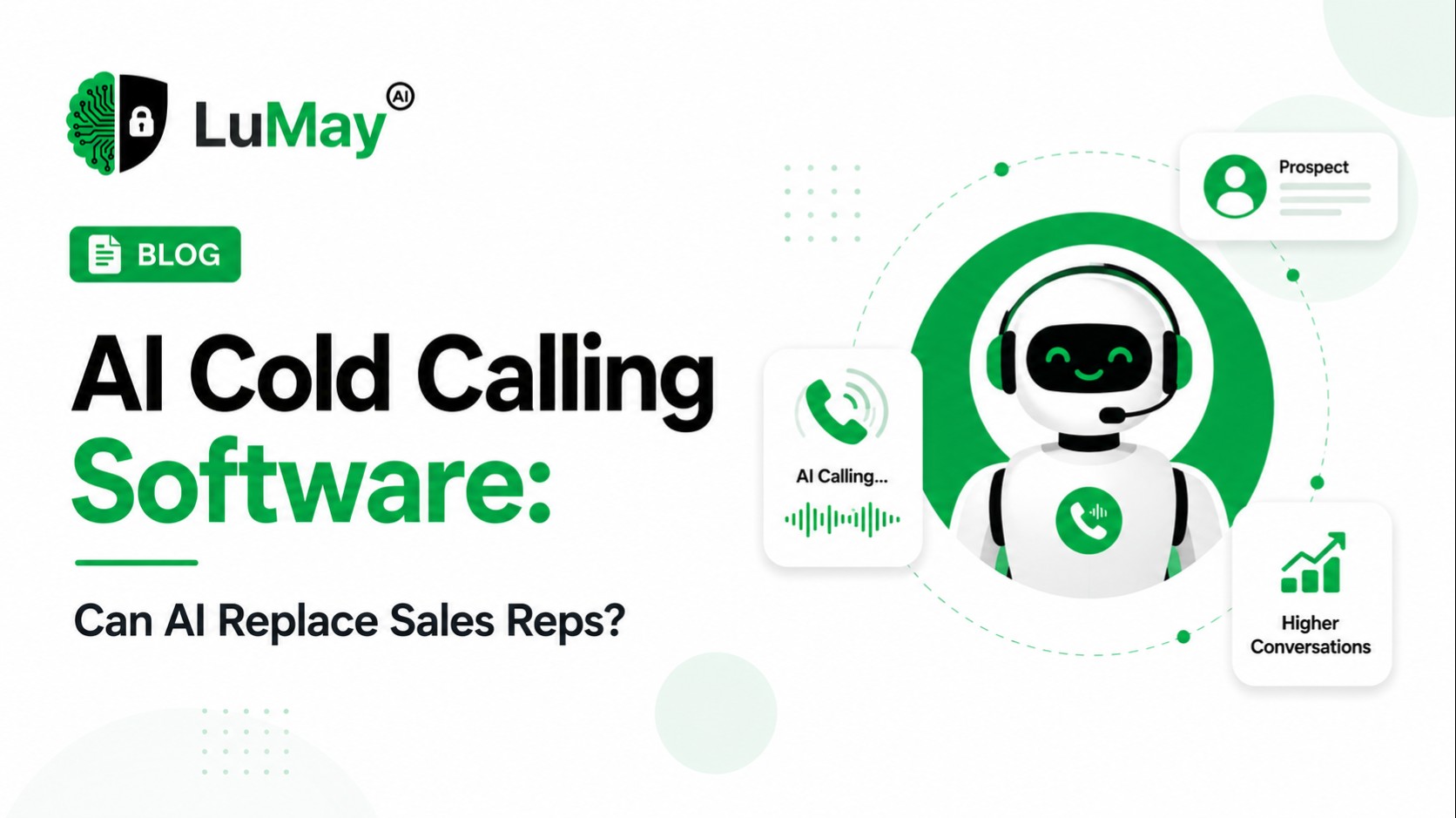
But the question dominating boardrooms in 2026 isn't just about the technology. It's about the people. Can an AI Cold Call Agent entirely replace human sales reps?
The short answer: AI is augmenting—not completely replacing—top-tier sales teams. AI handles the grueling top-of-funnel grunt work, while human closers take over to build relationships, navigate complex enterprise procurement, and win deals.
In this comprehensive guide, we will break down exactly how AI Sales Calling Software works, analyze the 2026 regulatory landscape, compare the top platforms (including a deep dive into LuMay AI), and provide a complete framework to help you deploy an automated outbound engine that prints revenue.
What Is AI Cold Calling Software?
An AI Cold Calling Platform is an enterprise-grade SaaS solution that utilizes artificial intelligence to automate outbound telephone conversations. Unlike the robotic, rigid pre-recorded robocalls of the past, modern AI outbound calling software engages in fluid, unscripted, and human-sounding dialogue.
To understand why this is a revolutionary leap for revenue operations, you need to understand the underlying stack:
Voice AI: The core engine that processes audio in real-time.
Large Language Models (LLMs): The "brain" (built on models from OpenAI, Anthropic, etc.) that understands intent, handles objections, and formulates intelligent responses dynamically.
Speech Recognition (STT - Speech-to-Text): Transcribes the prospect's spoken words into text instantaneously. Providers like Deepgram and AWS dominate this space.
Text-to-Speech (TTS): Converts the LLM's text response back into human-like audio. ElevenLabs and Cartesia are leading the charge in emotion-rich, cloned voice generation.
CRM Automation: The API layer that reads lead data before the dial, and updates call notes, call recordings, and calendar bookings instantly after the call.
The goal of an Outbound Voice Agent is not to trick the prospect into thinking they are speaking to a human. Rather, it is to provide a seamless, highly competent, and immediate interaction that drives the buyer journey forward.
Architecture Diagram
Cde snippet
graph TD
A[CRM / Lead List] -->|API Push| B[AI Cold Calling Platform]
B -->|Initiate Dial| C[Telephony Provider e.g. Twilio]
C -->|Connect Call| D[Prospect]
D -->|Speech Audio| E[Speech-to-Text STT]
E -->|Transcribed Text| F[LLM Engine / Prompt]
F -->|Generated Response| G[Text-to-Speech TTS]
G -->|Synthetic Voice| C
F -->|Webhook/API| H[Update CRM / Book Meeting]
How AI Cold Calling Software Works
Deploying an AI Voice Cold Calling system follows a highly structured, automated workflow. Here is the step-by-step process of how thousands of dials are executed effortlessly.
Lead Import & Contextualization: Leads are routed from HubSpot, Salesforce, or Apollo.io into the AI platform. The system ingests context (name, company, industry, previous touchpoints).
The Dial: The platform uses SIP trunking to execute parallel dials, navigating telecom spam filters through intelligent number rotation.
Voicemail Detection: Advanced algorithms instantly detect whether a human or machine answered. If it's a voicemail, the AI can leave a hyper-personalized drop or hang up.
Real-Time Conversation: The AI introduces itself (in compliance with 2026 FCC disclosure rules), delivers the hook, and listens.
Qualification & Objection Handling: As the prospect throws out objections ("I don't have time," "Send me an email," "We use a competitor"), the LLM accesses its training knowledge base to pivot and handle the objection flawlessly.
Meeting Booking / Live Transfer: Once qualified, the AI can either book a meeting directly into the rep's calendar via integrations like Calendly, or execute a live hot-transfer to an available human closer.
CRM Update: The system automatically summarizes the call, logs the exact transcript, extracts key data points, and updates the CRM—all in under 3 seconds.
Sales Workflow Diagram
Code snippet
sequenceDiagram
participant CRM
participant AI Agent
participant Telephony
participant Prospect
participant Human Closer
CRM->>AI Agent: Push Lead Data
AI Agent->>Telephony: Initiate Dial
Telephony->>Prospect: Ring
Prospect-->>Telephony: Answers
Telephony-->>AI Agent: Audio Stream
AI Agent->>Prospect: Deliver Opening Hook + AI Disclosure
Prospect-->>AI Agent: Objection ("Too expensive")
AI Agent->>Prospect: Handle Objection + Qualify
Prospect-->>AI Agent: Interest Confirmed
AI Agent->>Human Closer: Initiate Live Transfer
AI Agent->>CRM: Log Call Transcript & Summary
Traditional Cold Calling vs AI Cold Calling
When enterprise sales teams evaluate an AI Cold Calling System, the first step is comparing the unit economics and operational metrics against a traditional SDR team.
Table 1: Human SDR vs AI SDR vs Hybrid Team
Metric | Traditional Human SDR | AI Cold Call Agent | Hybrid Team (The 2026 Ideal) |
Cost | High ($60k–$90k base + commission) | Low (Pay per minute / SaaS fee) | Optimized (AI handles volume, Closers get high ROI) |
Scale | ~80–100 dials per day | 10,000+ dials per day | Unlimited top-funnel, focused bottom-funnel |
Availability | 8 hours/day, 5 days/week | 24/7 (Compliant with local calling windows) | 24/7 lead response, scheduled human follow-up |
Consistency | Fluctuates based on mood/fatigue | 100% consistent script adherence | Flawless data collection + Human empathy |
Speed to Lead | Minutes to hours | Under 3 seconds (Instant Webhook) | Instant AI engagement, immediate human transfer |
CRM Hygiene | Often neglected or rushed | Perfect data extraction every time | AI logs data; humans review strategy |
Burnout Rate | Extremely High (14-month avg tenure) | Zero | Human reps only take warm, pre-qualified calls |
Can AI Replace Sales Representatives?
This is the most frequent buyer question in B2B SaaS today. Let's be unequivocally clear: AI will not replace great sales professionals.
What AI is replacing is the repetitive, soul-crushing top-of-funnel work. It replaces the endless dialing, the voicemail navigation, the basic qualification filtering, and the manual CRM data entry.
If a sales representative's entire value proposition is reading a script verbatim and asking BANT (Budget, Authority, Need, Timeline) questions, their role is highly vulnerable. However, for consultative sellers, account executives, and relationship builders, AI is the ultimate leverage. It acts as an elite, tireless assistant that feeds them a continuous calendar of warm, qualified prospects.
Tasks AI Handles Better Than Humans
To optimize your revenue operations, you must delegate tasks based on absolute advantage. Here is what AI Sales Call Software excels at:
Tireless Volume Dialing: An AI agent never experiences call reluctance.
Immediate Speed-to-Lead: When an inbound web form is submitted, an Inbound Voice Agent can call the prospect within 3 seconds, drastically increasing conversion rates.
Voicemail Detection (AMD): AI can filter out answering machines instantly, saving thousands of hours annually.
Flawless CRM Updates: AI extracts precise intent, summarizes the call, and updates custom fields in Salesforce perfectly.
Multilingual Calling: Deploying an agent that can speak English, Spanish, French, and German seamlessly without hiring a localized team.
After-Hours Coverage: Capturing leads in different time zones when your office is asleep.
Decision Tree: When to Route to AI
Code snippet
graph LR
A[New Lead Enters Pipeline] --> B{Is it a strategic Enterprise Account?}
B -- Yes --> C[Route to Senior Human SDR]
B -- No --> D{Does it require immediate Top-of-Funnel outreach?}
D -- Yes --> E[Route to AI Voice Agent]
E --> F{Did AI qualify the lead?}
F -- Yes --> G[Live Transfer to Human Closer]
F -- No --> H[Add to Automated Nurture Sequence]
Tasks Humans Still Own
While the AI Cold Call Agent is powerful, human intelligence remains undefeated in high-stakes environments.
Complex Negotiation: AI cannot navigate the nuance of multi-stakeholder enterprise pricing negotiations.
Strategic Account Mapping: Identifying off-book internal politics within a Fortune 500 company.
Empathy and Relationship Building: Navigating highly sensitive conversations where trust is the primary currency.
Procurement Navigation: Dealing with legal redlines, security audits, and custom MSAs.
Creative Problem Solving: Structuring out-of-the-box deals that deviate from standard product offerings.
Table 2: Task Delegation Matrix
Task | Ideal Owner | Why? |
First-touch Cold Outreach | AI | Requires high volume and consistency; low cognitive complexity. |
Speed-to-Lead Follow Up | AI | Requires sub-minute reaction time to maximize conversion. |
Discovery & BANT Qualification | AI | Formulaic questions perfectly suited for LLM logic trees. |
Custom Solution Architecting | Human | Requires deep domain expertise and creative problem solving. |
Multi-threading Enterprise Deals | Human | Requires navigating human psychology and corporate politics. |
Contract Negotiation | Human | High financial risk; requires empathy and legal nuance. |
Industries Using AI Cold Calling
The adoption of AI Outbound Calling Software is accelerating rapidly, but certain sectors with high-volume lead flows are seeing the fastest ROI.
Table 3: Industry Adoption & Use Cases
Industry | Primary Use Case | Impact / Result |
Real Estate | Lead follow-up automation, Zillow lead speed-to-lead | 4x increase in property viewing appointments. |
Insurance | Policy renewal reminders, quote qualification | Instant filtering of unqualified leads, lowering CAC. |
Solar / Home Services | Door-to-door follow-ups, appointment setting | Massive volume coverage across localized zip codes. |
SaaS & Tech | Webinar follow-ups, inbound trial engagement | Ensuring no free-trial user goes uncontacted. |
Recruitment | Initial candidate screening, resume verification | Saving recruiters 20+ hours a week on basic phone screens. |
Healthcare | Appointment reminders, basic patient intake | Reducing no-show rates by up to 45%. |
If you are a broker or agency owner, exploring the best AI voice agent platforms for real estate is no longer a luxury; it is a baseline competitive requirement.
Benefits of AI Cold Calling Software
Why are founders and Revenue Operations leaders rushing to implement this technology? The data speaks for itself.
Unlimited Scale: You can scale from 100 calls a day to 100,000 calls a day with the click of a button, without interviewing, hiring, or training new headcount.
Zero Rep Burnout: Dialing 100 numbers to get told "no" 98 times destroys human morale. AI doesn't have morale; it just has uptime.
Perfect Adherence to Messaging: The AI never goes rogue, never forgets to mention a compliance disclaimer, and never forgets to ask for the meeting.
Massive Cost Savings: A human SDR fully loaded costs around $80,000 annually. An AI agent costs a fraction of that, operating strictly on usage and platform fees. Review our pricing guide for a deeper breakdown.
Granular Analytics: Every interaction is recorded, transcribed, and analyzed. You can A/B test a sales script and get statistically significant data by lunchtime.
Table 4: Productivity Datasets (Monthly Averages per Agent)
Metric | Average Human SDR | LuMay AI Voice Agent |
Dials per Day | 80 - 120 | 10,000+ (Parallel) |
Active Talk Time | ~2 hours | 24 hours (if scheduled) |
Post-Call Admin Time | 3 - 5 mins per call | 0.5 seconds |
Script Compliance | 70% | 100% |
Sick Days / PTO | ~2 days/month | 0 |
Challenges and Limitations
Despite the power of Voice Agents, the technology is not without its hurdles. Implementing a solution blindly can result in severe brand damage or legal liability.
Complex Edge Cases: If a prospect asks a highly convoluted, multi-part question that blends personal anecdotes with technical specs, the LLM might hallucinate or loop. Strong fallback prompts are required.
Accent and Dialect Handling: While STT engines are excellent, heavy regional dialects or poor phone connections can still cause transcription errors, leading to awkward AI responses.
The "Uncanny Valley": If the latency is slightly off, or the voice cloning is too perfect but lacks breath pauses, the prospect may feel deceived, eroding trust immediately. This is why Voice Latency is the single most critical technical metric.
Regulatory Compliance: The legal landscape for AI voice outreach is incredibly strict in 2026. Ignorance is not a defense against heavy FCC fines.
Compliance Checklist (2026 Standards)
Navigating the legalities of AI outreach is critical. The February 2024 FCC ruling definitively classified AI-generated voices under the Telephone Consumer Protection Act (TCPA) as "artificial or prerecorded voices." This means you must have prior express written consent for marketing calls. The fines are crippling—up to $1,500 per willful violation.
Furthermore, state laws (like Texas SB 140) and federal guidelines mandate explicit AI disclosures.
Table 5: Essential AI Voice Compliance Checklist
Regulatory Requirement | Description | Action Item for RevOps |
TCPA Consent (PEWC) | Prior Express Written Consent is required for AI marketing calls. | Implement robust opt-in tracking; never use scraped lists. |
Immediate AI Disclosure | Federal and state laws mandate disclosing the use of AI. | Script the AI to say, "Hi, I'm an AI assistant calling on behalf of..." within the first 10 seconds. |
DNC Registry Sync | Must instantly respect Federal and State Do-Not-Call lists. | Ensure your platform has real-time DNC API scrubbing. |
Opt-Out Handling | "Revoke in any reasonable manner" rule (Stop, Cancel, Remove me). | AI must immediately recognize opt-out intent, end the call, and update the CRM suppression list. |
Call Recording Laws | One-party vs. Two-party consent states. | Use geo-routing to disable recordings in two-party states without explicit verbal consent. |
Data Security (SOC2/GDPR) | Securing transcripts, PII, and sensitive business data. | Ensure your vendor is SOC2 Type II compliant and offers zero-PII retention policies. |
Disclaimer: This does not constitute legal advice. Always consult your legal counsel regarding telemarketing compliance.
AI Cold Calling Software Features Checklist
When evaluating vendors, not all platforms are created equal. Some are basic wrappers around Twilio and OpenAI; others are highly engineered, enterprise-grade telecommunications infrastructures.
Table 6: Enterprise Feature Evaluation Matrix
Feature | Description | Why It Matters |
Ultra-Low Latency | Response times under 800ms. | High latency destroys the illusion of a natural conversation. |
Conversational Interruptibility | Ability for the prospect to interrupt the AI. | Humans interrupt each other constantly; the AI must stop talking instantly when spoken over. |
Advanced CRM Webhooks | Two-way sync with Salesforce/HubSpot. | Prevents data silos and ensures humans have context before follow-ups. |
Live Call Transfer (Warm/Cold) | Routing the call to a human agent seamlessly. | Captures the lead while intent is highest. |
Custom Knowledge Base (RAG) | Uploading PDFs, websites, and past call transcripts. | Prevents hallucinations and ensures the AI knows your product inside and out. |
Custom Voice Cloning | Creating a bespoke brand voice (via ElevenLabs/Cartesia). | Standardizes brand representation across all touchpoints. |
Multilingual Capabilities | Auto-detecting and switching languages dynamically. | Essential for global enterprise sales teams. |
Pricing Breakdown
Understanding how an AI Phone Sales Software vendor charges you is critical to modeling your ROI. The architecture involves multiple distinct costs:
Telephony Costs: The cost to connect the call via SIP trunks (usually a few cents per minute).
STT & TTS Costs: The computational cost of transcribing audio and generating synthetic voice via providers like Deepgram or ElevenLabs.
LLM Inference Costs: The API calls to OpenAI (GPT-4o) or Anthropic (Claude 3.5 Sonnet) to generate the responses.
Platform Fee: The SaaS markup for the UI, integrations, workflow builders, and analytics.
Common Pricing Models:
Per-Minute Pricing: Ranges from $0.10 to $0.25 per minute of active talk time. Best for variable volume.
Per-Agent/Seat Pricing: A fixed monthly fee for a concurrent digital line that can dial 24/7.
Enterprise Tiering: Custom pricing with SLA guarantees, dedicated infrastructure, and Managed AI Services. For a comprehensive breakdown, view our LuMay Pricing page.
AI Cold Calling ROI Calculator
To justify the investment to your CFO, you need to calculate the exact Return on Investment.
The Core Formulas
To calculate the pure financial efficiency, use the standard ROI equation:
$$ ROI = \left( \frac{\text{Net Profit from AI Deals} - \text{Total Cost of AI System}}{\text{Total Cost of AI System}} \right) \times 100 $$
To calculate the cost per meeting booked:
$$ \text{Cost Per Meeting} = \frac{\text{Total Campaign Spend (Telephony + Platform Fees)}}{\text{Number of Qualified Meetings Booked}} $$
Table 7: ROI Calculation Example (Monthly)
Variable | Human SDR Team (2 Reps) | AI Voice Agent Engine |
Monthly Cost | $14,000 (Salary + Benefits + Tech Stack) | $1,500 (Platform + Usage for equivalent dials) |
Dials per Month | 4,000 | 25,000 |
Connect Rate | 5% (200 connects) | 5% (1,250 connects) |
Meeting Book Rate | 10% (20 meetings) | 8% (100 meetings)* |
Cost Per Meeting | $700 | $25 |
*Note: AI often has a slightly lower pure conversion rate per connect compared to an elite human, but the sheer volume mathematically overwhelms the difference, dropping the CPA drastically.
Best AI Cold Calling Software (2026 Comparison)
The market is flooded with new entrants, but enterprise buyers need reliability. Here is an honest, data-backed comparison of the top players in the market.
Table 8: Platform Comparison Matrix
Provider | Ideal Customer Profile | Latency Profile | Core Strength | Primary Weakness |
LuMay AI | Enterprise, Mid-Market, Agencies | Sub-500ms | End-to-end managed services, native CRM sync, lowest latency. | Enterprise focus may price out small solo-preneurs. |
Retell AI | Developers, Tech Startups | Sub-800ms | Strong developer API, flexible voice options. | Requires significant technical resources to build front-end. |
Vapi | Developers, Product Teams | Sub-800ms | Excellent API documentation, easy to embed. | Less out-of-the-box workflow automation for non-technical sales teams. |
Bland AI | High-volume call centers | Moderate | Massive parallel dialing capabilities. | Outbound-heavy; less nuanced for complex inbound routing. |
Synthflow | SMBs, No-Code users | Moderate | Visual drag-and-drop builder, easy setup. | Struggles with complex, multi-layered enterprise edge cases. |
PolyAI | Fortune 500 Customer Support | High | Custom proprietary models, incredibly secure. | Extremely high deployment cost and long onboarding time. |
Cognigy | Enterprise Contact Centers | High | Omnichannel (Voice + Chatbot) integration. | Better suited for support than aggressive outbound sales. |
Voiceflow | Conversation Designers | Variable | The best canvas for designing conversation flows. | It is a design tool first; requires hooking up third-party telephony to execute. |
For a deeper dive into the broader market, read our review of the top 9 AI voice agents for business and our ultimate guide to the best AI agent platform.
Why Businesses Choose LuMay AI
While platforms like Vapi and Retell provide excellent infrastructure for developers, revenue teams need solutions that work out of the box, integrate natively with their tech stack, and don't require an engineering degree to operate.
This is why industry leaders choose LuMay AI:
Industry-Leading Latency: Conversations with LuMay feel indistinguishable from human interaction due to hyper-optimized architecture.
Omnichannel Capability: Seamlessly transition between the Outbound Voice Agent for prospecting and the Inbound Voice Agent for lead capture.
Enterprise-Grade Security: Fully SOC2 compliant, with strict zero-PII retention protocols available for healthcare and finance clients.
White-Glove Managed Services: We don't just hand you an API key. Our Managed AI Services team builds, tests, and optimizes your conversational flows.
Proven Results: Read our Case Studies to see how we've transformed revenue operations. Also, check out our LuMay Voice Agent Review for unfiltered client feedback.
Implementation Guide
Do not treat an AI voice agent like a standard SaaS tool where you just upload a list and press "Go." It requires strategic deployment.
Table 9: The 6-Step Implementation Framework
Phase | Action Items | Success Metric |
1. Planning & Compliance | Audit lead sources, verify TCPA PEWC consent, define campaign goals. | Legal sign-off on lead lists and AI disclosure scripts. |
2. Knowledge Base Prep | Upload battle cards, FAQs, product specs, and handling objection scripts. | AI successfully passes internal "stress test" roleplays. |
3. CRM Integration | Map data fields. Connect webhooks to log transcripts and update lead status automatically. | Test calls perfectly sync data to Salesforce/HubSpot. |
4. Voice & Prompt Tuning | Select voice clone, adjust latency settings, refine system prompts for brand tone. | Voice sounds natural; agent does not hallucinate during edge cases. |
5. The Ramped Rollout | Start with 50 dials/day to warm up phone numbers and prevent spam flagging. | Connect rates remain stable; zero carrier spam blocks. |
6. Optimization | Review call transcripts daily. Adjust prompts to handle new objections. | Meeting booked rate increases by 10% week-over-week. |
CRM Integration Architecture Diagram
Code snippet
graph TD
A[Salesforce / HubSpot] -->|Lead Status: New| B[Webhook Trigger]
B --> C[LuMay AI Platform]
C -->|Fetch Lead Context| A
C -->|Execute Call| D[Prospect]
D -->|Call Concludes| C
C -->|Extract Intent & Summary| E[LLM Processing]
E -->|Push Data| A
E -->|Book Calendar Event| F[Google Calendar / Calendly]
To ensure your revenue team has all the answers, here are the most critical questions regarding AI sales tech in 2026.
Final Verdict
The era of brute-force human cold calling is ending. The data is clear: forcing highly paid human talent to dial hundreds of numbers a day just to leave voicemails is a massive misallocation of capital.
AI Cold Calling Software fundamentally rewrites the rules of outbound sales. It provides unlimited scale, zero burnout, perfect CRM hygiene, and instantaneous speed-to-lead. It doesn't replace your sales team; it supercharges them, allowing your human closers to spend 100% of their time doing what they do best: building trust, navigating complex deals, and driving revenue.
When evaluating the market—whether looking at Vapi, Retell, or Bland—enterprise buyers consistently choose a platform that balances low latency with rigorous compliance and deep CRM integrations.
Stop wasting your team's time on unqualified dials. Supercharge your outbound engine today.
Ready to automate your outbound pipeline?
Book a Demo with LuMay AI to see the fastest, most human-like voice agent in action.
Dataset 10: LuMay AI Technical Benchmarks vs Industry Averages
Technical Metric | Industry Standard (2026) | LuMay AI Benchmark |
Conversational Latency | 800ms - 1200ms | < 500ms |
Transcription Accuracy | 94% | 99.1% |
CRM Data Extraction Speed | 3 - 5 seconds | < 1.5 seconds |
Concurrent Call Limits | 100 - 500 lines | Unlimited (Auto-scaling |