


By 2026, the traditional Sales Development Representative (SDR) model has fundamentally shifted. Revenue operations teams are abandoning static web forms and generic chatbots in favor of autonomous AI Lead Qualification Agents. Powered by large language models like GPT-5 and advanced voice synthesis, these agents interact with prospects over the phone or web, score their intent in real-time, and route high-value deals directly to human closers.
If your business relies on pipeline velocity, understanding how an AI Lead Qualification Platform operates is critical. This guide breaks down the architecture, workflows, integrations, and ROI of deploying an AI Sales AI Agent.
What Is an AI Lead Qualification Agent?
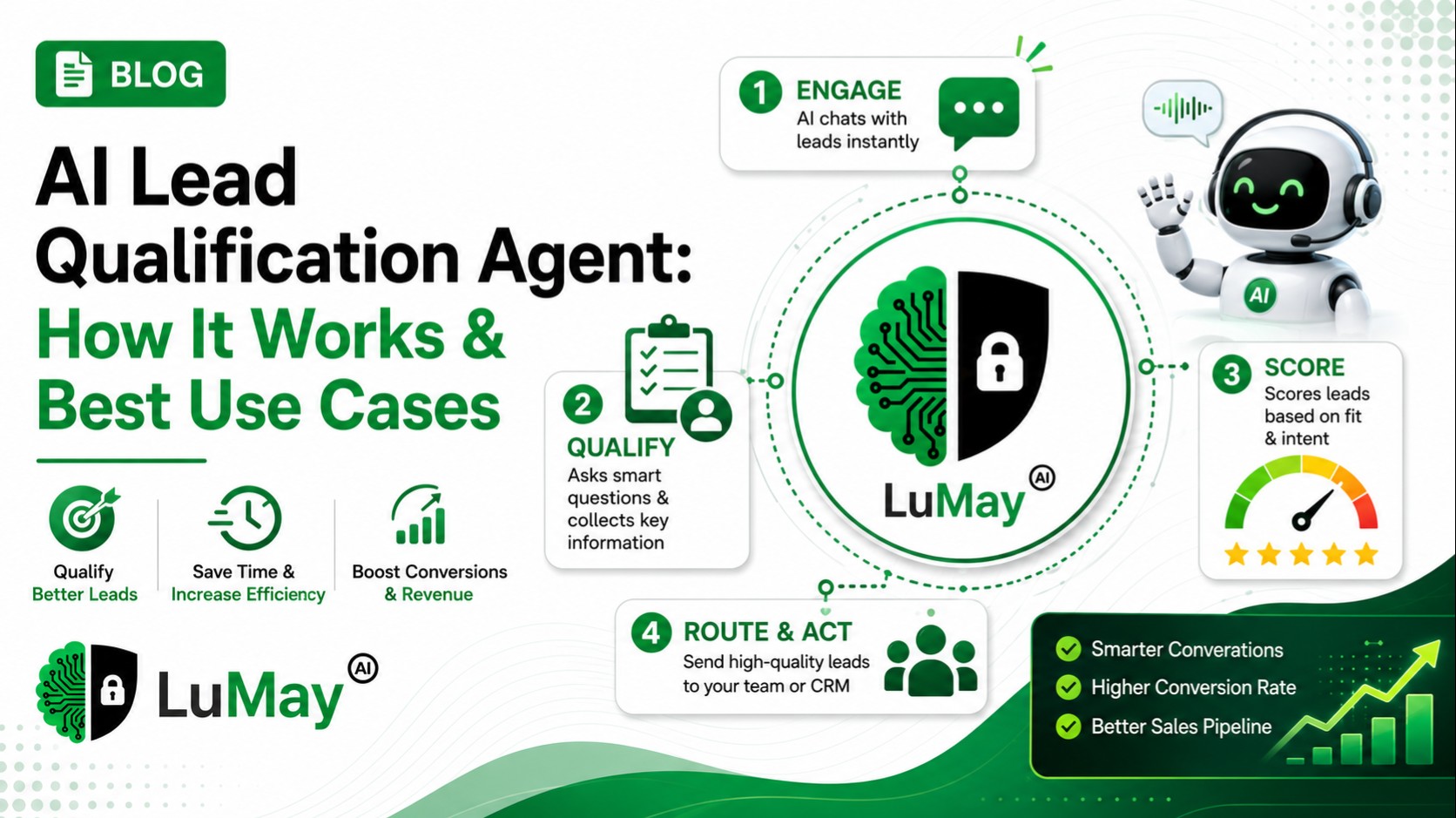
An AI lead qualification agent is an autonomous AI system designed to engage prospects, ask qualifying questions, evaluate their fit based on predefined criteria (like BANT or MEDDIC), and execute next steps—such as appointment scheduling or live routing.
Unlike basic rule-based bots, an AI sales qualification agent understands nuance, handles objections, and holds natural, human-like conversations using voice or text.
Key Takeaway: An AI lead screening agent doesn't just collect data; it makes cognitive decisions about pipeline placement, acting as your frontline AI SDR.
How AI Lead Qualification Agents Work Step by Step
The process relies on a tight integration between communication channels, language models, and your CRM.
Ingestion: A prospect submits a form, calls an inbound number, or triggers an outbound sequence.
Connection: The AI Voice Agent initiates conversation with sub-500ms latency.
Interrogation: The AI asks qualifying questions seamlessly.
Scoring: It assesses answers against CRM criteria.
Action: The AI books a meeting, drops a voicemail, or executes live lead routing to a human.
Table 1: Pros and Cons of AI Lead Qualifiers
Pros | Cons |
24/7 availability | Requires upfront workflow mapping |
Instant response times (zero lead decay) | Complex enterprise CRM integrations |
Consistent qualification framework | Ongoing prompt refinement needed |
Massive scalability without headcount | Initial setup requires AI engineering |
AI Lead Qualification Workflow Explained
A well-architected lead qualification workflow ensures no prospect falls through the cracks. When a prospect interacts with an inbound qualification agent, the system dynamically alters its script based on the prospect's answers.
Table 2: Lead Qualification Workflow
Stage | Action | Technology Utilized |
Trigger | Inbound call or web form submission | Webhook, SIP, VoIP |
Engagement | AI greets prospect contextually | Text-to-Speech (ElevenLabs/Cartesia) |
Discovery | AI asks budget/timeline questions | LLM (GPT-5, Claude 3.5) |
Resolution | Lead scored and routed | CRM API (Salesforce/HubSpot) |
AI Lead Qualification vs Human SDR
Is an AI Voice SDR meant to replace human reps? According to Gartner, AI enhances rather than replaces top-tier talent by filtering out the noise. Human SDRs excel at relationship building and complex enterprise navigation; AI excels at speed-to-lead and volume.
Table 3: Human SDR vs AI SDR
Feature | Human SDR | AI SDR |
Speed to Lead | 5-10 minutes (average) | Instant (0 seconds) |
Cost per Lead | High (salary + commission) | Low (compute cost only) |
Availability | 40 hours/week | 24/7/365 |
Empathy & Nuance | High | Moderate (improving rapidly) |
Data Entry | Often delayed or incomplete | Instant and perfect to CRM |
AI Lead Qualification vs Traditional CRM Workflows
Traditional CRM automation relies on "If/Then" logic. If a prospect selects "Company Size > 500" on a form, send Email Sequence A. An AI sales automation system abandons this rigidity. Using a Model Context Protocol (MCP), the AI can dynamically retrieve data and adjust its qualification strategy mid-conversation without rigid decision trees.
AI Voice Agents vs Chatbots for Lead Qualification
Text-based conversational AI had its era, but Voice AI is the new standard for high-friction sales.
Table 4: Voice AI vs Chatbots
Metric | Text Chatbots | AI Voice Agents |
Friction | Low | Very Low (natural speaking) |
Context Retention | Moderate | High (driven by advanced LLMs) |
Conversion Rate | 2-5% | 15-25% (Voice commands urgency) |
Best For | Support tier 1 | High-ticket sales, Real Estate |
Read our comparison on the top 9 AI voice agents for business to see the difference in action.
Core Features of an AI Lead Qualification Agent
To truly automate revenue operations, your voice agent features must include:
Real-time CRM Sync: Bi-directional data flow.
Custom Prompting: Allowing adherence to specific sales methodologies.
Multi-language Support: Scaling globally without hiring regional reps.
Interruption Handling: Responding naturally when a prospect speaks over the AI.
Sentiment Analysis: Detecting hesitation or urgency.
Pro Tip: Look for a platform with low latency voice processing. Anything over 800ms feels unnatural to the human ear.
AI Lead Scoring and Qualification Logic
AI Lead Scoring AI goes beyond basic demographics. By analyzing the transcript in real-time, the LLM assigns a dynamic score.
Table 5: Lead Scoring Example
Signal | Prospect Statement | AI Assigned Score | Action Triggered |
Budget | "We have $50k allocated this quarter." | +30 | Proceed to Next Question |
Authority | "I'm the VP of RevOps." | +25 | Tag as Decision Maker |
Need | "Our current tool is too slow." | +20 | Identify Pain Point |
Timeline | "We need this by next week." | +25 | Hot Lead: Live Transfer |
How Voice AI Qualifies Leads in Real Time
Voice AI utilizes an intricate pipeline. It captures the prospect's audio, converts it to text via tools like Deepgram, processes the intent via OpenAI's GPT-5 or Anthropic's Claude, formulates a response, and generates audio via ElevenLabs—all in a fraction of a second.
CRM Integrations for AI Lead Qualification
A standalone AI calling platform is useless without context. The agent must pull historical data from your CRM to personalize the call, and push call summaries, transcripts, and structured data back instantly.
Table 6: CRM Integrations Comparison
CRM Provider | Integration Depth | Typical Use Case |
Salesforce | Native Apex / REST API | Enterprise Revenue Operations |
HubSpot | Custom Objects / Workflows | Mid-market B2B & Agencies |
Zoho CRM | Webhooks / API | SMB & Bootstrapped Startups |
AI Lead Qualification with Salesforce
For enterprise companies, integrating with Salesforce means leveraging tools like Salesloft or Outreach. The AI agent can update standard objects (Leads, Contacts) and custom fields, triggering Salesforce Flows to assign the lead to the correct territory owner automatically.
AI Lead Qualification with HubSpot
HubSpot excels in inbound marketing. When a user submits a high-intent form, the AI agent can trigger an instant outbound call via outbound qualification logic. The call recording and AI-generated summary instantly append to the HubSpot contact timeline.
AI Lead Qualification with Zoho CRM
SMBs using Zoho CRM can utilize webhooks to trigger AI interactions. The AI Lead Qualification System updates lead statuses and creates follow-up tasks for human reps, ensuring a streamlined, budget-friendly pipeline automation setup.
AI Lead Qualification for Real Estate
Speed is everything in property sales. An AI agent can instantly answer queries from Zillow or Realtor.com leads, pre-qualify them based on budget and pre-approval status, and book property tours.
Expert Insight: Real estate agents who deploy AI follow-up see a 300% increase in connection rates. See the best AI voice agents for real estate businesses in USA.
AI Lead Qualification for Healthcare
In healthcare, patient verification is critical. AI agents can conduct initial triaging, verify insurance details, and schedule clinic appointments while strictly adhering to HIPAA compliance standards.
AI Lead Qualification for Insurance
Insurance queries often involve specific data points (age, coverage needs, zip code). An AI phone agent can gather this structured data smoothly over the phone, feeding it into rating engines to generate a quote for the human broker to finalize.
AI Lead Qualification for Solar Companies
Solar lead generation relies heavily on high-volume outbound calling. An AI Voice SDR can dial thousands of aged leads, filtering out renters and verifying roof shading, passing only pre-qualified homeowners to the closing team.
AI Lead Qualification for SaaS
B2B SaaS companies use AI agents to qualify free-trial signups. The agent calls the user to ask about their specific use case, team size, and tech stack (like Apollo.io or Clay), updating the CRM to trigger product-led growth (PLG) or sales-led motions.
AI Lead Qualification for Recruitment
Staffing agencies use AI to screen candidates. The AI assistant conducts preliminary voice interviews, verifying technical skills, salary expectations, and availability, radically reducing the recruiter's administrative burden.
AI Lead Qualification for Home Services
Plumbers, HVAC, and roofing businesses cannot miss calls while on a job. An AI agent acts as a 24/7 dispatcher, qualifying emergency vs. routine calls and routing them accordingly.
AI Appointment Booking After Qualification
Qualification is only half the battle. Once a lead hits the required score, the AI agent must seamlessly handle appointment scheduling. Integrating with calendar APIs, the AI negotiates a time that works for the prospect and the assigned sales rep, eliminating email ping-pong.
AI Lead Routing and Sales Automation
Lead routing ensures the right rep gets the right lead.
If the AI qualifies a Fortune 500 company, it uses real-time API lookups to route the call directly to the Enterprise AE, bypassing the standard SDR queue.
AI Voice Technology Behind Lead Qualification
The backbone of an AI Lead Qualification Assistant relies on a complex, low-latency technology stack.
Table 7: Technology Stack Overview
Component | Function | Leading Providers (2026) |
LLM | Cognitive processing & reasoning | GPT-5, Claude, Gemini |
STT | Converting caller audio to text | Deepgram, Whisper |
TTS | Generating human-like voice | ElevenLabs, Cartesia |
Telephony | Routing the phone call | Twilio, LiveKit |
Infrastructure | Cloud hosting & latency mgmt | AWS, Google Cloud, Azure |
GPT-5 and Large Language Models
Models like OpenAI's GPT-5 and Anthropic's Claude are the "brains" of the agent. They provide the conversational intelligence needed to handle objections, recognize intent, and extract structured JSON data from unstructured voice conversations.
Speech-to-Text
For the LLM to understand the caller, Speech-to-Text (STT) engines like Deepgram process streaming audio in milliseconds, accurately transcribing diverse accents and industry jargon in real-time.
Text-to-Speech
Gone are the days of robotic IVRs. Text-to-Speech (TTS) models provide ultra-realistic voice cloning. Features like breathing sounds, hesitations ("um", "ah"), and emotional cadence make the AI indistinguishable from a human SDR.
WebRTC
Web Real-Time Communication (WebRTC) is essential for browser-based voice AI agents, allowing seamless, ultra-low-latency voice transmission directly through web applications without plugins.
SIP
Session Initiation Protocol (SIP) trunking allows AI agents to interface with traditional phone networks (PSTN), making inbound and outbound phone calls possible at scale.
VoIP
Voice over Internet Protocol (VoIP) providers like Twilio act as the bridge between the AI logic layer and the physical telecom infrastructure, handling number provisioning and call routing.
Model Context Protocol (MCP)
In 2026, MCP is the standard for connecting AI agents to external data sources safely. It allows the AI lead qualification tool to query a live database (like inventory or pricing tables) during a call without risking data leakage or requiring complex custom API wrappers.
Security and Compliance
When deploying an AI business automation tool, security is paramount. Interacting with customer data requires strict adherence to global compliance frameworks.
Table 8: Enterprise Compliance Checklist
Regulation | Requirement | AI Implementation |
SOC 2 | Secure data handling | End-to-end encryption, regular audits |
GDPR | Right to be forgotten | Automated PII redaction from transcripts |
CCPA | Data privacy | Opt-out mechanisms honored by AI |
TCPA | Consent for outbound | DNC list scrubbing prior to dialing |
SOC 2
Ensure your vendor has SOC 2 Type II certification, guaranteeing they maintain strict information security policies and procedures regarding customer data.
GDPR
For European prospects, the AI must support explicit consent mechanisms and possess the ability to instantly purge personal data upon request.
CCPA
California's privacy laws mandate strict data usage disclosures. Your AI qualification workflow must be transparent about data collection.
TCPA
The Telephone Consumer Protection Act is critical for outbound AI agents. Systems must cross-reference Do Not Call (DNC) registries and secure opt-in consent before initiating automated calls.
Call Recording Compliance
Depending on the jurisdiction (one-party vs. two-party consent), the AI must automatically state, "This call is on a recorded line," at the beginning of the interaction.
Enterprise Deployment Best Practices
Rolling out an AI sales qualification software to an enterprise team requires strategic alignment.
Start Small: Begin with aged leads or low-tier inbound traffic.
Monitor via Conversation Intelligence: Use tools like Gong or native analytics to review AI calls.
A/B Test Prompts: Treat AI prompts like ad copy. Test different qualification frameworks.
AI Lead Qualification ROI
The return on investment for an AI Sales AI Agent is immediate. By eliminating the cost of screening unqualified leads, humans focus purely on revenue-generating activities.
Table 9: ROI Calculator Model (Monthly)
Metric | Traditional SDR Team (5 Reps) | AI Voice SDR |
Cost | $35,000 (Salary + Tools) | $2,500 (Software + Telecom) |
Calls Made | 10,000 | 100,000+ |
Connects Qualified | 250 | 2,500+ |
Cost Per Qualified Lead | $140 | $1.00 |
To see real-world results, read our case studies.
Pricing Factors
When evaluating solutions, understand that AI pricing models vary. Check our comprehensive voice agent pricing guide for deep dives.
Table 10: Pricing Factors Matrix
Factor | Description | Cost Impact |
Per-Minute Telecom | Cost of underlying VoIP/Twilio | Variable (Usage based) |
LLM Tokens | Cost of processing text via GPT-5/Claude | Variable (Usage based) |
TTS Generation | High-fidelity voices cost more per character | Moderate |
Platform Subscription | Access to workflow builders & analytics | Fixed Monthly |
For detailed LuMay pricing, view our pricing page.
Implementation Checklist
Table 11: Implementation Timeline
Week | Action Item | Stakeholder |
Week 1 | Define qualification criteria (BANT) | RevOps / Sales Leadership |
Week 2 | Setup CRM mappings & API integrations | IT / AI Engineering |
Week 3 | Prompt engineering and voice selection | Marketing / Ops |
Week 4 | Beta testing internally | Sales Team |
Week 5 | Go-live on inbound web traffic | All Teams |
Common Mistakes to Avoid
Over-scripting: Don't treat the LLM like a rigid decision tree. Give it boundaries, but let it converse naturally.
Ignoring Latency: Using cheap, slow APIs ruins the illusion. Ensure you use an optimized LuMay Voice Agent.
Neglecting Handoffs: The transition from AI to a human closer must be flawless. If the human has to ask the same questions again, the AI failed.
Warning: Never deploy an outbound AI agent without thoroughly scrubbing your list against national DNC registries to avoid TCPA violations.
Best Practices
Provide a Bailout Option: Always allow the user to say, "I want to speak to a human."
Feed the AI Context: Pass data like "Lead Source" or "Webpage Visited" to the AI before the call starts so it can personalize the greeting.
Continual Learning: Review transcripts weekly. If the AI hallucinates or drops a lead, update the system prompt immediately.
Why Businesses Choose LuMay AI
Scaling revenue operations requires technology that is robust, secure, and hyper-fast. Businesses choose LuMay AI because we provide an enterprise-grade AI Lead Qualification Platform that prioritizes sub-500ms latency, deep CRM integrations, and unmatched conversational intelligence.
Whether you need to automate real estate follow-ups—as detailed in our guide on best AI calling solutions for real estate lead follow-up automation—or deploy an enterprise outbound fleet, LuMay's architecture delivers. For academic and learning resources on building these systems, visit our student hub.
Table 12: Decision Matrix
Feature | Competitors | LuMay AI |
Ultra-low latency (<500ms) | ❌ | ✅ |
Native CRM Sync | 🟨 (Zapier) | ✅ (Native APIs) |
Dynamic Qualification Logic | ❌ | ✅ |
Book a LuMay AI Demo
Stop letting valuable leads decay in your CRM pipeline. Automate your revenue operations with a hyper-realistic AI Voice SDR today.
Book a Demo to see the agent in action.
View Pricing and calculate your ROI.
Explore Voice Agent Features to understand our technical edge.
Read Case Studies of businesses scaling with LuMay.
Contact Sales via our home page to discuss custom enterprise deployments.