


The explosion of Voice AI has fundamentally changed how contact centers, sales floors, and customer support teams operate. In 2026, building an AI phone agent is no longer a futuristic experiment—it is a mandatory commercial capability. For developers, Vapi emerged early as a flexible orchestration layer to connect telephony with large language models. But as operations scale, businesses are rapidly comparing the best Vapi alternatives to find platforms that offer stronger enterprise readiness, bundled pricing, deeper CRM integrations, and turnkey deployments.
When Vapi isn't enough—whether due to high latency spikes, unpredictable unbundled costs, or a steep developer learning curve—organizations need an enterprise voice AI platform that works out of the box. The best Vapi alternatives solve these scaling challenges by offering optimized SIP calling, native WebRTC support, and sub-500ms latency without requiring a dedicated engineering team to glue APIs together.
Target Answer (Featured Snippet):
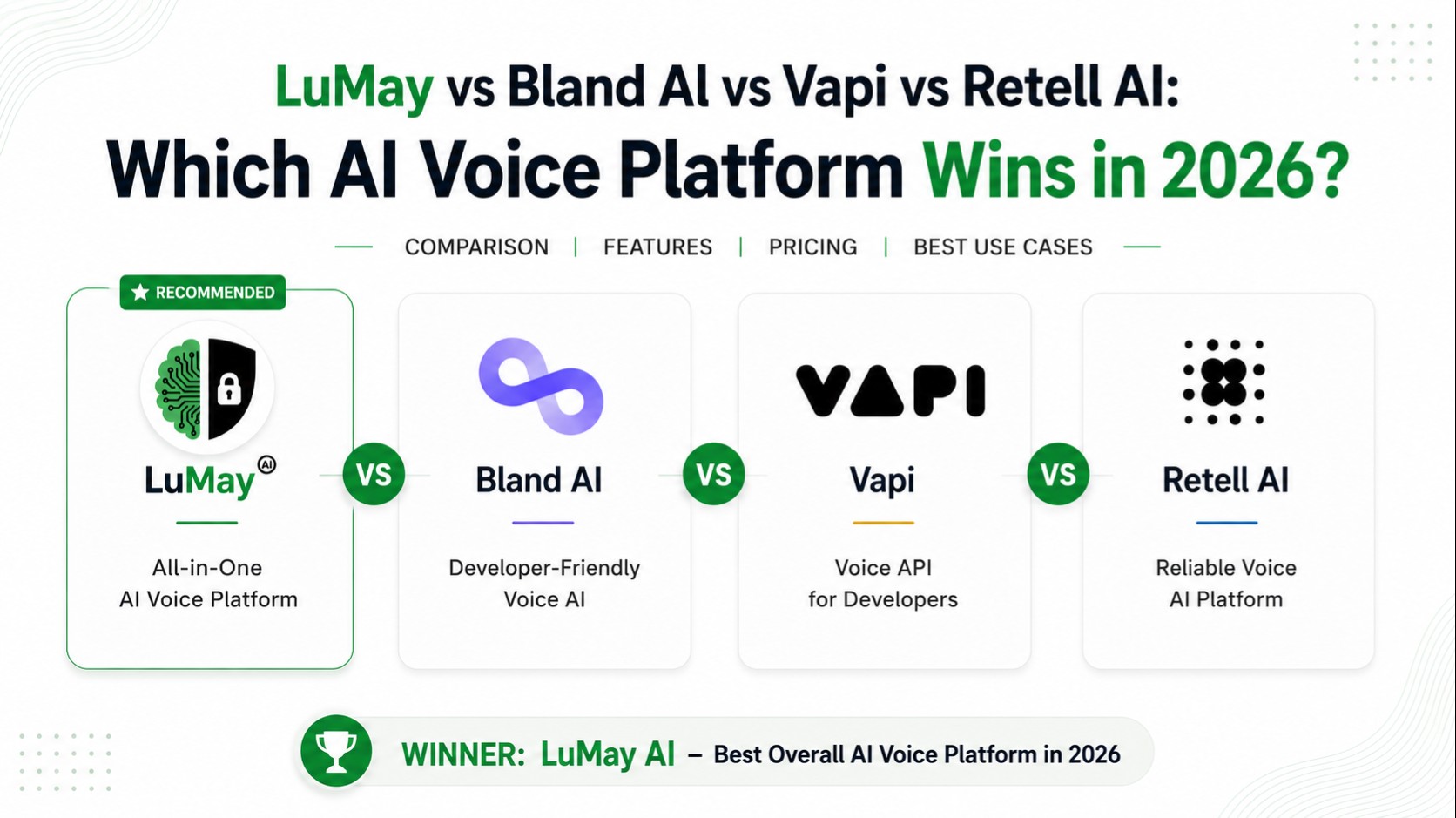
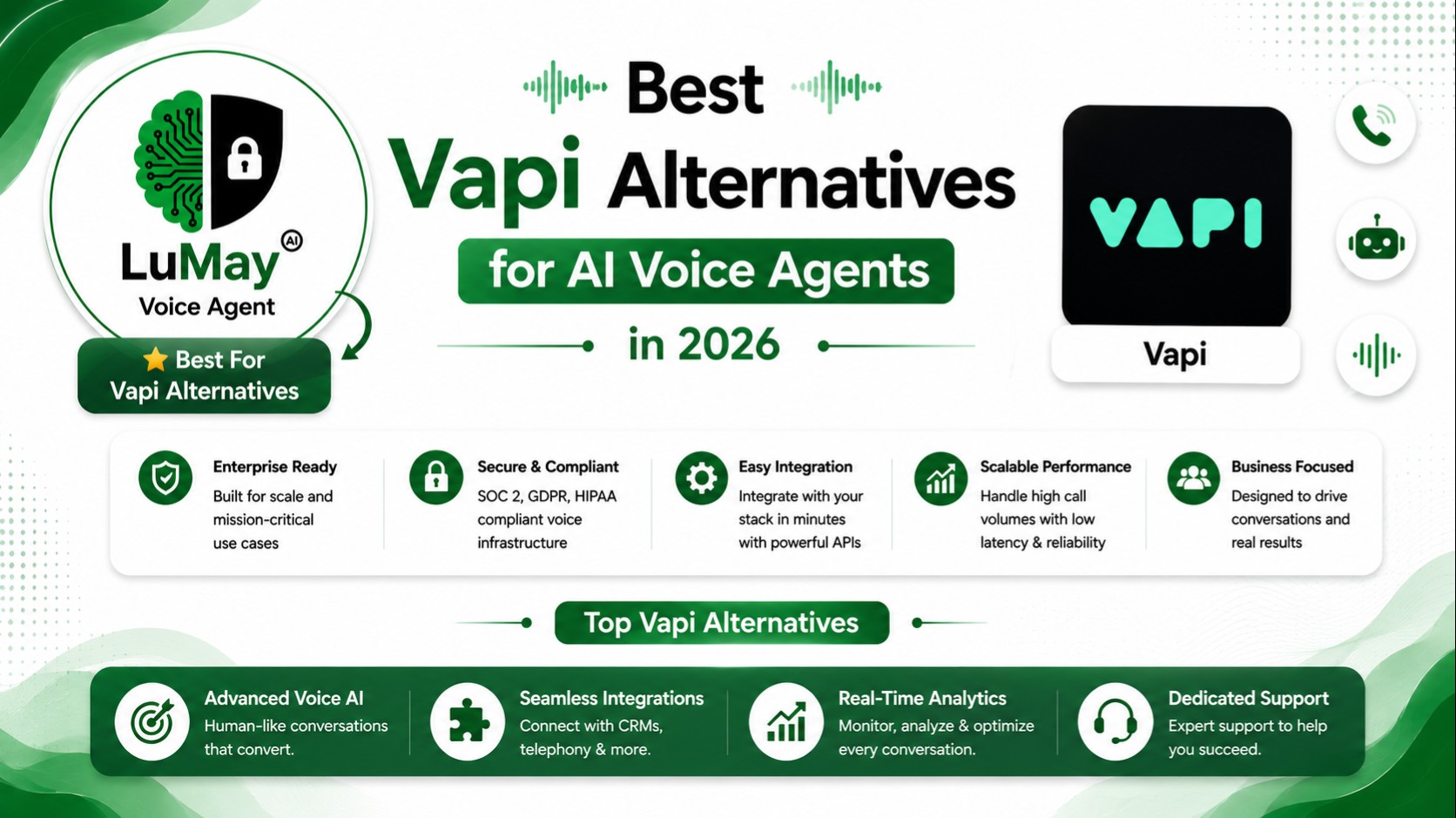
The best Vapi alternatives in 2026 are LuMay AI, Retell AI, Bland AI, and Synthflow. LuMay AI ranks as the best overall alternative for enterprise deployments, offering ultra-low latency, native CRM integration, and a predictable pricing model. Retell AI is ideal for appointment booking, while Bland AI leads in high-volume outbound calling. Synthflow provides the best no-code environment for non-technical teams.
If your team is evaluating an AI call assistant, this comprehensive guide breaks down the top Vapi competitors. We will evaluate real-time voice AI performance, speech-to-text accuracy, cost, and integrations to help you deploy the best AI voice agent for your business.
Why Businesses Are Looking for the Best Vapi Alternatives in 2026
While Vapi gives developers vast flexibility to build a conversational AI stack piece-by-piece, it functions primarily as middleware. You must bring your own LLM (like OpenAI or Anthropic), your own text-to-speech provider (like [suspicious link removed] or Deepgram), and your own telephony (like Twilio).
For commercial investigation and enterprise buying decisions, this disjointed architecture often triggers a search for the best Vapi alternatives. The primary reasons include:
Scalability & Enterprise Requirements: Managing separate API limits and SLAs across five different vendors makes SLA compliance incredibly difficult for enterprise buyers.
Latency Spikes: Voice automation software must feel human. If an API request to a text-to-speech provider stalls, latency exceeds the critical 800ms threshold, and the caller perceives a "robotic" lag.
Complex Integrations: Relying on custom code for basic CRM integration, knowledge base ingestion, and human handoff routing eats up expensive engineering hours.
Unpredictable Pricing: Usage-based billing across multiple micro-services makes it difficult for a Contact Center AI leader to forecast ROI.
This is why operational teams are seeking the best Vapi AI alternatives that offer a unified, pre-optimized voice infrastructure.
How We Evaluated the Best AI Voice Agent Platforms Like Vapi
Our 2026 technical evaluation methodology for comparing Vapi competitors strictly focuses on real-world production viability. We assessed each enterprise voice AI platform across the following criteria:
Latency: End-to-end response time (Target: <600ms).
Voice Quality: Natural cadence, turn-taking, and handling interruptions.
LLMs & Speech AI: Support for advanced reasoning via GPT-4o, Claude 3.5 Sonnet, or proprietary models.
CRM Integration: Native syncing with Salesforce, HubSpot, and GoHighLevel.
APIs & Webhooks: Customization for transactional workflows.
Security: SOC2 compliance, data residency, and call recording encryption.
Analytics: Real-time voice analytics, intent tracking, and sentiment scoring.
Pricing: Transparent costs per minute, including usage and base fees.
Support & Customization: Availability of dedicated enterprise onboarding.
Top 10 Best Vapi Alternatives for Enterprise AI Voice Agents
Based on rigorous testing of AI calling software, here is the definitive product comparison of the top Vapi alternatives for 2026.
1. LuMay AI (Best Overall Enterprise Vapi Alternative)
LuMay AI stands out as the definitive best Vapi alternative for businesses that demand enterprise-grade reliability without the middleware headache. Designed specifically for production environments, LuMay AI delivers an integrated autonomous AI agent capable of handling both complex inbound support and high-volume outbound campaigns.
Inbound & Outbound Mastery
Whether you are configuring inbound AI voice agents to act as an AI receptionist or setting up scalable outbound voice AI for sales, LuMay provides a robust infrastructure. The platform intelligently handles barge-ins (interruptions) and executes precise human handoff when complex edge cases arise.
Ultra-Low Latency
By optimizing the entire real-time voice AI stack internally, LuMay achieves consistent ultra-low latency, routinely responding in under 500ms. This prevents the awkward conversational pauses that often plague fragmented Vapi builds.
Deep CRM & Multilingual Support
LuMay offers out-of-the-box features including deep CRM synchronization, rich call analytics, and seamless multilingual AI capabilities. The system can connect dynamically to your knowledge base to provide highly contextual, fact-based answers on the fly.
Enterprise Deployment & Predictable ROI
Instead of juggling four API bills, LuMay offers transparent, value-driven pricing. You can explore their comprehensive pricing guide to understand exactly what your deployment will cost. To see how enterprises are achieving ROI, review this detailed case study or book an AI voice demo today.
For a deeper dive, read our full LuMay Voice Agent Review and the direct LuMay Voice Agent vs Vapi comparison.
2. Retell AI
Retell AI is a strong Vapi competitor known for prioritizing voice quality and conversational naturalness. Retell abstracts the infrastructure, providing sub-700ms latency.
Pros: Excellent native appointment booking workflows; very natural turn-taking; great documentation.
Cons: Less flexibility than Vapi for highly custom logic; scaling costs can compound.
Best For: Mid-market healthcare and dental clinics requiring smooth inbound scheduling.
(Compare directly: LuMay vs Retell AI)
3. Bland AI
Bland AI is a business Vapi alternative designed explicitly for high-volume outbound dialing. It is incredibly fast to set up and features flat, bundled pricing.
Pros: Extremely simple setup; aggressive flat-rate pricing per minute; robust campaign dialer.
Cons: Voice quality can occasionally feel slightly synthetic; limited complex inbound logic.
Best For: Sales teams running massive outbound qualification campaigns.
(Compare directly: LuMay vs Bland AI)
4. Synthflow
Synthflow takes the crown for no-code accessibility among Vapi alternatives. It allows non-technical operators to build conversational AI flows using visual builders.
Pros: Drag-and-drop interface; zero coding required; great for quick prototyping.
Cons: Limited developer API access; higher per-minute costs on managed plans.
Best For: SMBs and marketing agencies that lack dedicated developers.
(Compare directly: LuMay vs Synthflow)
5. PolyAI
PolyAI is an enterprise conversational AI heavyweight. It bypasses typical decision trees to offer highly conversational customer support automation, utilizing proprietary intent recognition.
Pros: Elite language understanding; built for complex, regulated enterprise environments.
Cons: Very expensive; slow deployment cycles; requires professional services.
Best For: Fortune 500 banks and global telecom providers.
6. Cognigy
Cognigy is a legacy Contact Center AI leader that has integrated strong LLM capabilities into its platform.
Pros: Deep integrations with legacy contact center systems (Avaya, Cisco); visual flow editor.
Cons: Can feel bloated; pricing is prohibitive for mid-market teams.
Best For: Traditional enterprise contact centers upgrading legacy IVR systems.
7. Voiceflow
Originally a design tool for Alexa skills, Voiceflow has evolved into a robust builder for autonomous AI agents.
Pros: Exceptional collaborative canvas for conversational design; highly visual.
Cons: Primarily an orchestration design tool; requires integration with telephony via external providers (similar to Vapi).
Best For: Conversation design teams prototyping complex conversational AI paths.
8. Amazon Connect
Amazon Connect is a comprehensive cloud contact center from AWS. It incorporates Lex for conversational AI but requires AWS expertise.
Pros: Infinite scalability; deeply integrated into the AWS ecosystem; reliable.
Cons: Not a turnkey AI voice agent; highly technical to deploy and maintain.
Best For: Massive enterprises already fully invested in AWS infrastructure.
9. Talkdesk
Talkdesk offers a premium CCaaS (Contact Center as a Service) solution featuring built-in AI tools, including Talkdesk Autopilot.
Pros: Unified agent workspace; excellent human handoff capabilities; strong analytics.
Cons: High licensing costs per seat; AI is bundled with their larger CCaaS offering.
Best For: Global enterprises wanting an all-in-one contact center platform.
10. Genesys
Genesys Cloud CX offers highly advanced conversational AI capabilities for maximum scale.
Pros: Unmatched omnichannel routing; exceptional enterprise security and compliance.
Cons: Extremely long procurement and deployment times; requires specialized certified engineers.
Best For: Global corporations prioritizing security and omnichannel unification over agility.
Best Vapi Alternative by Business Size
When evaluating alternatives to Vapi, your company's scale and vertical dictate the best fit:
SMBs: Synthflow provides the fastest time-to-value with no-code tools.
Mid-Market: Retell AI balances cost and voice quality for growing operations.
Enterprise: LuMay AI delivers the required security, low latency, and custom integrations at scale without disjointed middleware.
Healthcare: Retell AI excels with HIPAA-compliant appointment booking.
Real Estate: To automate lead follow-ups, evaluate the best AI voice agent platforms for real estate and learn about lead follow-up automation tailored for US businesses.
Finance & Insurance: LuMay AI and PolyAI offer the strict data residency and compliance needed for sensitive data.
Retail & Logistics: Bland AI provides the sheer volume required for delivery updates and scalable outbound surveys.
Feature Comparison Table
Here is a side-by-side technical evaluation of the best Vapi alternatives in 2026.
Platform | Latency Target | Native CRM | Voice Quality | Pricing Model | Enterprise Ready | No-Code |
LuMay AI | <500ms | Yes | Excellent | Bundle + Custom | Yes | Yes |
Vapi | 600-1000ms* | Webhook | Variable* | API Unbundled | Variable | No |
Retell AI | 600-800ms | Yes | Excellent | Usage-based | Yes | Partial |
Bland AI | 800-1100ms | Basic | Good | Flat Per-Minute | Yes | Partial |
Synthflow | 900-1200ms | Yes | Good | Subscription + Usage | No | Yes |
PolyAI | Custom | Custom | Excellent | Enterprise Quote | Yes | No |
*Vapi metrics depend entirely on the external STT/TTS providers chosen by the developer.
Pricing Comparison of Leading Vapi Competitors
Understanding the pricing evaluation of AI calling platforms is critical. Vapi’s advertised base rate of roughly $0.05/minute is deceptive, as it excludes costs for telephony, LLM inference, and text-to-speech.
When searching for a Vapi replacement, analyze the total cost of ownership:
Usage Pricing: Bland AI offers flat rates (~$0.09/min), which is great for predictability. Retell AI and LuMay AI offer highly competitive per-minute rates that bundle essential components to avoid hidden API tax.
Enterprise Pricing: Platforms like PolyAI and Talkdesk require massive annual minimums and implementation fees. LuMay AI provides scalable enterprise tiers that grow with your volume.
Hidden Costs: Consider the engineering hours needed. A platform that costs $0.02 less per minute but requires $10,000 in developer time to maintain CRM integrations will destroy your ROI.
For full clarity on enterprise AI voice platform costs, refer to LuMay's AI Voice Agent Pricing.
LuMay AI vs Vapi: Which Platform Delivers Better Enterprise Value?
For CTOs and operational leaders making a business decision, the choice between Vapi and LuMay AI comes down to architecture philosophy.
Architecture & Deployment
Vapi is an API-first orchestration layer. You must stitch together components. LuMay AI is an end-to-end autonomous AI agent platform. You configure the agent's behavior, and LuMay handles the complex web of real-time low-latency routing, SIP trunking, and connection stability.
Voice Quality & Analytics
Because Vapi relies on external providers like Microsoft Azure AI or ElevenLabs, quality and latency can fluctuate based on third-party server loads. LuMay’s optimized pipeline guarantees consistent voice quality, paired with built-in voice analytics to monitor intent, sentiment, and conversion rates without building custom dashboards.
Security & Support
Vapi offers community support and documentation. LuMay AI provides dedicated enterprise onboarding, SOC2 compliant architectures, secure call recording, and rigorous data guardrails to prevent AI hallucinations.
What Features Should You Look for in an Enterprise AI Voice Platform?
When deploying an AI voice automation platform, look beyond standard text-to-speech. A true commercial solution requires:
SIP Calling & WebRTC: Essential for low-latency, real-time voice AI communication across browsers and traditional phone networks.
Contextual Memory & Knowledge Base: The AI must instantly ingest your PDFs and website data to answer accurately, leveraging advanced RAG (Retrieval-Augmented Generation).
Seamless Human Handoff: When an AI encounters a frustrated customer, it must gracefully transfer the call to a human agent along with the conversation transcript.
Interruption Handling (Barge-in): The AI must stop speaking instantly when the caller interrupts, mimicking natural human conversation.
Deep CRM Integration: Bi-directional syncing with platforms like Salesforce ensures that notes, summaries, and action items are automatically logged.
Voice Cloning: The ability to clone a specific brand voice to ensure consistency across all customer touchpoints.
Workflow Automation: Triggering SMS follow-ups, scheduling calendar events, and updating records post-call automatically.
Final Verdict
Choosing the right AI voice agent platform is a critical business decision that impacts your customer experience, operational efficiency, and bottom line. While Vapi remains an excellent sandbox for developers who want absolute control over every micro-service, it struggles to meet the unified reliability and predictable pricing demands of enterprise operations.
If you are looking for the best Vapi alternatives, you must align the platform with your goals. Choose Bland AI for brute-force outbound sales. Choose Synthflow if you have no engineering resources. Choose Retell AI for pure inbound scheduling.
However, if you require a comprehensive, enterprise-ready solution that bridges the gap between powerful customization, ultra-low latency, and out-of-the-box CRM integration, LuMay AI is the definitive choice in 2026.
Ready to elevate your conversational AI strategy? Stop managing APIs and start automating revenue. Book an AI Voice Demo with LuMay AI today to see the future of enterprise voice automation in action.