AI Anomaly Agents
Alerts only on what's materially unusual.
Real-time anomaly detection across operations, transactions, and content streams. Tunable sensitivity per workflow. Every alert ships with its reasoning — so your team acts on signal, not noise.
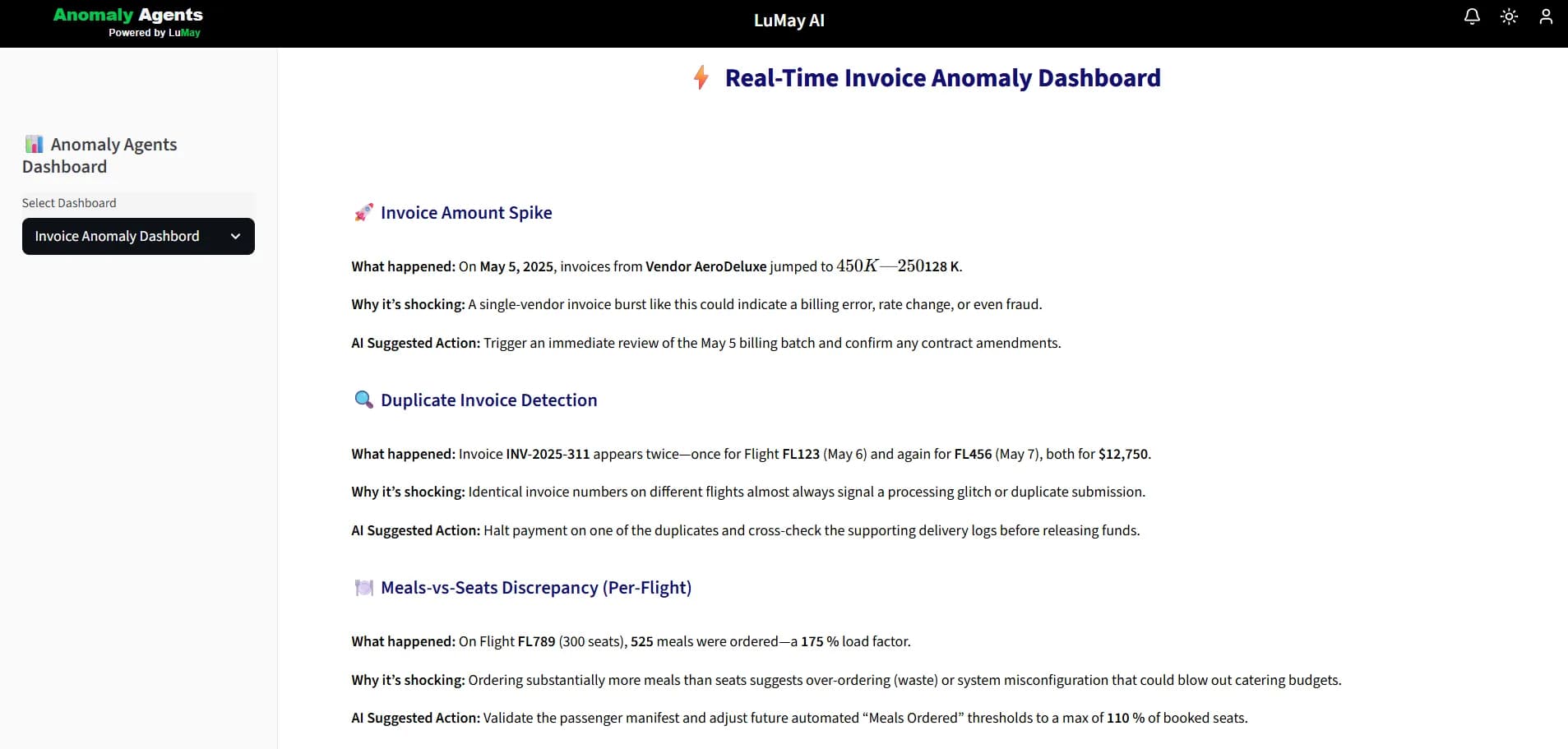
From event to routed alert with full explanation.
Vs. rule-based monitoring. Analysts spend time on real issues.
Novel-pattern anomalies caught by ML that rules miss.
Before Vs. With LuMay Anomaly Agents
From static rule thresholds to learned patterns — fewer false positives, more real signal.
Three Steps To
Signal Over Noise.
Anomaly Agents connect to your existing event streams. No rip-and-replace. The model learns your baseline, then routes only material deviations — each with a reasoned explanation your team can act on immediately.
See it on a live data streamAnomaly Detection — Key Capabilities
Faster signal, fewer false positives, defensible decisions.
Real-Time Detection
Sub-3-second latency from event ingestion to alert dispatch. Anomaly Agents monitor your streams continuously - no polling, no batch delays.
ML Pattern Learning
Learns your baseline over 2-4 weeks. Detects contextual, temporal, and multivariate anomalies that static rules can never catch - including novel patterns on first occurrence.
Tunable Sensitivity
Per-workflow sensitivity controls let you tune signal-to-noise for each stream independently. High-stakes streams can run tight; high-volume streams can run loose.
Routed Alerts
Alerts are routed to the right team automatically - by anomaly type, severity, and ownership. Slack, PagerDuty, email, or webhook. Zero manual triage.
Explainable Alerts
Every alert includes reasoning: what changed, why it is anomalous, baseline context, and similar past cases. Analysts understand the alert before they open the dashboard.
Coverage Analytics
Track detection rate, false-positive rate, mean time to alert, and analyst resolution time. Continuous improvement loop built in - visibility at every layer.
Built For How Operations Teams Actually Monitor.
From stream connection to first alert, LuMay Anomaly Agents surface what matters — so your team can act fast with confidence.
Built for Enterprise Operations Teams
SOC 2 ready, end-to-end encryption, and role-based access control.
Model updates automatically as your data patterns evolve - no manual retraining.
Operational, transactional, and content anomalies all in one platform.
Shared alert queues, team assignments, resolution notes, and audit history.
Handle millions of events per second across multiple streams and teams.
Real Numbers. Cited.
Vs. rule-based monitoring. Analysts spend time on real issues, not noise triage.
Time spent triaging false positives drops by two-thirds. Focus shifts to genuine incidents.
From hourly batch jobs to sub-3-second event-driven alerts with full reasoning attached.
Anomaly Detection Isn't A Rule.
It's A Learned Model.
Rule-based monitoring is a treadmill: every novel pattern requires a new rule, every false positive erodes analyst trust. Anomaly Agents replace the treadmill with a model that learns your baseline and flags only what's materially unusual — with the reasoning preserved so your team can act with confidence, not guesswork.
Book a demo →Integrations
Integrates With Your
Essential Data Stack.


Everything You
Need To Know.
Send Us Your Noisiest Alert Stream.
We'll Show You Signal Over Noise.
30 minutes. Pick the stream. We'll demo Anomaly Agents on your live data (with your permission) and show you exactly what the model catches that your rules miss.
Anomaly Detection Agents starts at $999/month for SaaS deployments.
Enterprise, customer-cloud, and on-premises options available. Talk to us for regulated or custom workflows.