01
LuMay LLM
LLM Development Services
Built for Production
Not Just Prototypes
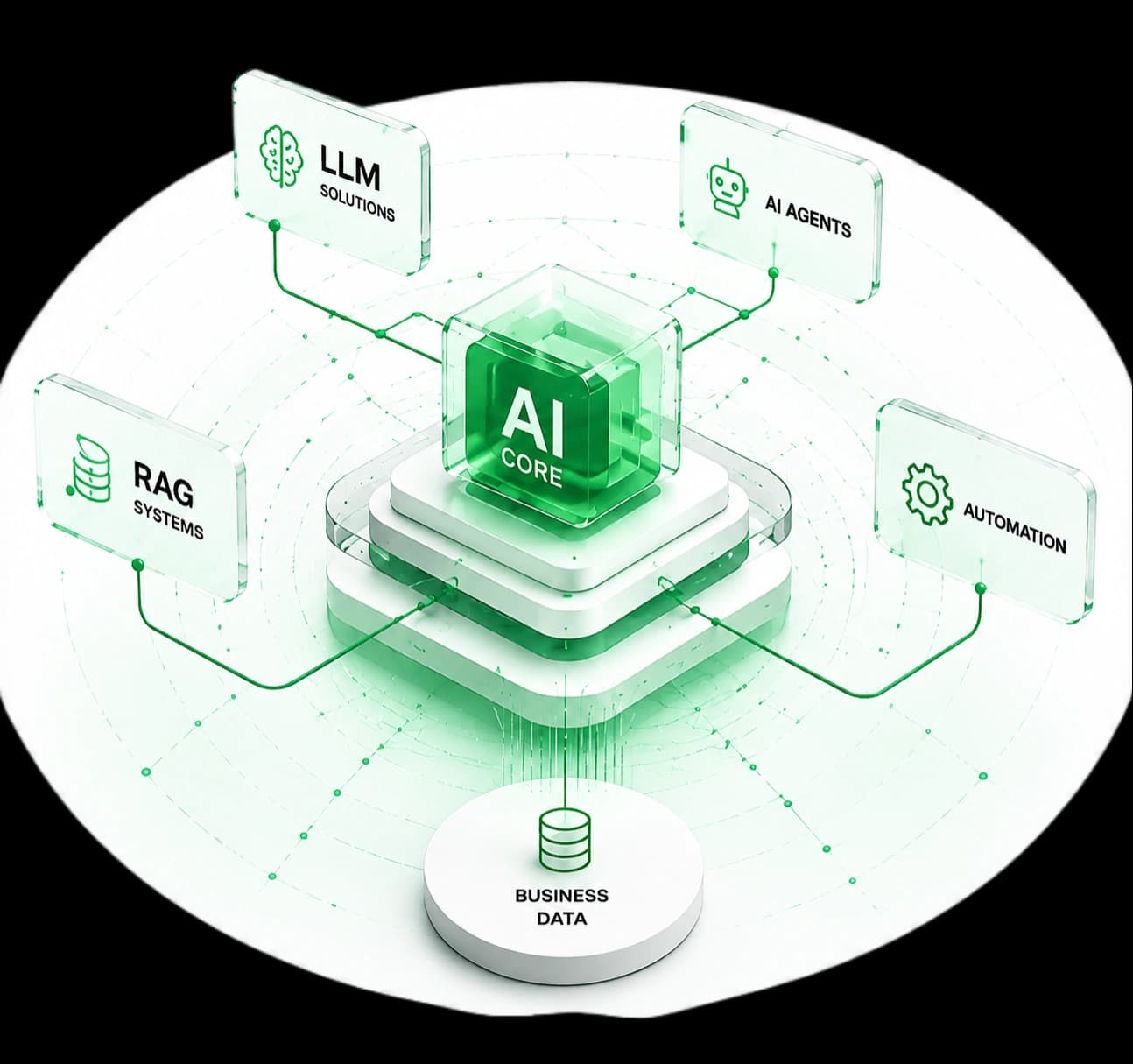
LuMay designs and develops enterprise LLM solutions that work with your data, systems, workflows, and security requirements.
From retrieval-augmented generation and model integration to evaluation, governance, and LLMOps, we build the complete system needed to move from a promising experiment to dependable production use.
Production-first architecture designed for reliability, maintainability, and measurable performance
Secure enterprise integration connected to approved data, applications, and identity systems
Evaluation and governance built in so quality, risk, access, and traceability are handled throughout delivery
Long-term operational ownership with monitoring, versioning, and cost control through LLMOps
The Enterprise LLM Challenge
A working LLM prototype is not the same as a production solution.
Large language models can generate impressive responses quickly, but dependable enterprise systems also have to retrieve the right information, respect permissions, integrate with existing applications, manage uncertainty, control cost, and prove performance over time.
02
A proof of concept that cannot pass privacy or security review
03
A model that cannot access current enterprise knowledge
04
An app that works in testing but fails on real user questions
05
Token and inference costs rising faster than adoption
06
No repeatable way to evaluate response quality or audit outputs
07
No defined owner for monitoring, updates, or incidents after launch
The gap between an LLM demo and a dependable enterprise system is not solved by a better prompt. It takes architecture, data engineering, integration, evaluation, and governance.
Architecture Direction
Choosing the right LLM approach
Not every organization needs to train a model. The right approach depends on the task, data, accuracy needs, privacy, latency, cost, and control the organization requires.
01
Commercial Model API
Fast access to capable foundation models with no infrastructure to manage. Best for early validation and general language tasks, with less control and more provider dependency.
02
Retrieval-Augmented Generation (RAG)
Connects an LLM to approved enterprise information at response time. Best for knowledge assistants and document Q&A where current information matters.
03
Fine-Tuned Model
Adapts an existing model for a specialized task, tone, or format. Best for classification, extraction, and repeatable output patterns.
04
Privately Deployed Open-Source Model
Deployed in your own cloud or private environment for greater control and data isolation, with more infrastructure and maintenance responsibility.
05
Custom-Trained Model
Built from large domain-specific datasets for highly specialized requirements, with significant investment in data, infrastructure, and ongoing operations.
LuMay evaluates your objective, data, risk, and operating model before recommending an architecture, never a preferred vendor or trend.
LLM Development Services
End-to-end support from viable use case to dependable operation.
We support the full delivery lifecycle: identifying the opportunity, selecting the architecture, building the application, evaluating reliability, deploying securely, and improving it in production.
01
LLM Strategy & Consulting
Define where LLMs create real value, evaluate feasibility and risk, and build an implementation roadmap tied to measurable outcomes.
02
LLM Use-Case Discovery
Turn generative AI interest into scoped opportunities prioritized by value, complexity, and governance needs.
03
Model Selection & Architecture
Compare commercial models, open-source models, RAG, fine-tuning, and private deployment against quality, cost, latency, and control goals.
04
Custom LLM Application Development
Build LLM-powered applications around real workflows, with tool use, citations, approvals, and system integrations.
Workflow designTool useApprovalsSystem integrations
05
RAG Development
Connect models to approved knowledge through document processing, embeddings, vector search, reranking, citations, and permission-aware retrieval.
EmbeddingsVector searchRerankingCitations
06
LLM Fine-Tuning
Adapt models for specialized tasks through dataset preparation, training, validation, and deployment planning.
07
Private & Open-Source LLM Deployment
Deploy open-source models in approved environments with serving, scaling, security, and observability in place.
08
Prompt & Context Engineering
Design reliable instructions, context, and fallback behavior as versioned components that are tested and improved over time.
09
Enterprise LLM Integration
Connect applications to your APIs, identity platforms, workflow tools, and approved systems within existing access controls.
10
LLM Evaluation & Benchmarking
Test retrieval quality, groundedness, task completion, safety, latency, and cost against workflow-specific success criteria.
11
Guardrails, LLMOps & Continuous Improvement
Reduce unreliable behavior through grounding, validation, filtering, confidence rules, monitoring, regression testing, and incident response.
GuardrailsMonitoringRegression testingIncident response
Workflow Integration
LLM solutions built around your workflows
LLM applications create limited value as disconnected destinations employees must remember to visit. Adoption improves when the capability lives inside the systems people already use.
Production integration does more than send text to a model. It identifies the user, retrieves only approved information, calls approved functions, requests approval when needed, updates other systems, and records the interaction.
- Permission-aware enterprise search
- Role-specific prompts and experiences
- Human approval before high-impact actions
- Source citations and structured outputs
- Escalation when confidence is low
- Audit logs for requests, content, and actions
LLM
DELIVERY
DELIVERY
Our LLM Development Process
From workflow definition to monitored production delivery.
01
Discover
We identify the workflow, users, objective, and constraints, then define success criteria for the use case.
02
Assess
We examine data, access, security, compliance, and quality risks before architecture decisions are made.
03
Select
We compare APIs, RAG, fine-tuning, and private deployment options against quality, cost, and scale requirements.
04
Build
We develop the application, retrieval pipeline, prompts, and integrations iteratively with real user feedback.
05
Evaluate
We test realistic questions, edge cases, and adversarial inputs with business and risk stakeholders.
06
Improve
We release with monitoring, versioning, and feedback loops so production behavior continuously gets better.
Enterprise LLM Use Cases
Enterprise Knowledge Assistant
A permission-aware RAG assistant that retrieves organizational knowledge with supporting sources.
Customer Support Copilot
Summarizes cases, retrieves guidance, and proposes responses for faster and more consistent handling.
Employee Productivity Copilot
Supports drafting, summarizing, and research inside the tools employees already use.
Document Intelligence
Extracts, classifies, and routes information from contracts, claims, and forms at scale.
Contract and Policy Analysis
Retrieves clauses, compares language, and flags risks for faster first-pass specialist review.
Intelligent Enterprise Search
Uses semantic retrieval to answer questions directly instead of only returning document lists.
Industry Applications
LLM development for complex industries
01
Financial Services
Policy assistants, research support, and customer-service copilots with explainability, access control, and retention requirements.
1
02
Insurance
Claims intake, policy comparison, and underwriting research with traceability, personal-data protection, and human review.
2
03
Healthcare & Life Sciences
Document processing, knowledge access, and research assistance with sensitive-data handling and professional oversight.
3
04
Manufacturing
Maintenance knowledge, technical search, and quality reporting that keep generated guidance separate from approved procedures.
4
05
Retail & Consumer Goods
Support, product content, and merchandising workflows where accuracy, brand consistency, and cost at volume matter.
5
06
Technology & SaaS
Product features, developer assistance, and onboarding flows with tenant isolation, usage monitoring, and low-latency expectations.
6
RAG, fine-tuning, or custom training?
Decision framing
The right choice starts with the task and operating requirements.
Many production systems combine multiple approaches rather than relying on a single model strategy.
Prompt Engineering
Best for instructions, formatting, and task behavior. High update flexibility with low complexity.
RAG
Best for current, private, or source-based knowledge. High update flexibility with medium complexity.
Fine-Tuning
Best for specialized behavior, classification, and format consistency. Medium update flexibility with medium-high complexity.
Private Open-Source Deployment
Best for hosting control, privacy, and customization. Medium update flexibility with high complexity.
Custom Model Training
Best for highly specialized unmet requirements. Lower update flexibility with very high complexity.
LLMOps and Production Operations
Reliability does not stop at launch.
Models, data, and business rules keep changing. Production systems need an operating discipline that makes those changes visible, measurable, and manageable.
Operational metrics should connect technical behavior to the task the system performs. A cheap response is not useful if it fails to answer the question.
- Model and prompt versioning, deployment pipelines, and environment management
- Evaluation, regression testing, and quality monitoring
- Latency, availability, and cost tracking
- Model routing, fallback behavior, and rollback procedures
- Feedback collection and incident detection
Technology ecosystem
LuMay evaluates technology by use case, spanning commercial and open-source models, cloud and private infrastructure, retrieval frameworks, vector databases, and evaluation and observability platforms. Choices are documented, and unnecessary platform dependency is avoided.
Engagement Models
Flexible ways to buy LLM delivery work
01
LLM Strategy and Architecture
02
Fixed-Scope LLM Delivery
03
Dedicated LLM Engineering Team
LLM Strategy and Architecture
For teams defining a first use case or choosing between models and deployment options before a larger build commitment.
Fixed-Scope LLM Delivery
For a specific application, RAG system, integration, or optimization project with agreed scope and acceptance criteria.
Dedicated LLM Engineering Team
For organizations building multiple use cases or modernizing a platform with an accountable team working alongside internal stakeholders.
Why LuMay
Why organizations choose LuMay
01
Use-Case-Led Architecture
02
Production Ready
03
Enterprise Alignment
04
Measured Evaluation
05
Governance by Design
06
Operational Accountability
Frequently Asked Questions
What is LLM development?
It is the design and build of applications that use large language models for specific business tasks, often combining model APIs, RAG, fine-tuning, integration, evaluation, and monitoring.
What is the difference between LLM development and generative AI development?
LLM development focuses on language understanding and generation. Generative AI is broader and can include image, audio, video, and multimodal systems too.
Do we need to train an LLM from scratch?
Rarely. Most needs are met with commercial APIs, private open-source deployment, RAG, fine-tuning, or a combination of those approaches.
When should we use RAG instead of fine-tuning?
RAG suits current, private, or frequently changing information. Fine-tuning suits changes in model behavior, terminology, or output format consistency. Many systems combine both.
Can LuMay integrate an LLM with our existing systems?
Yes. Integrations can be built through APIs, middleware, data pipelines, and identity services around your current architecture and access controls.
Can an LLM use our private data securely?
Yes, with the right controls around access, hosting, retention, and encryption. The exact architecture depends on data sensitivity and security requirements.
How do you reduce LLM hallucinations?
Through retrieval grounding, citations, validation, tool restrictions, confidence rules, human review, and monitoring. The goal is to reduce risk and handle uncertainty safely.
How do you evaluate an LLM application?
We evaluate against the actual task, including retrieval relevance, groundedness, task completion, safety, latency, cost, edge cases, and adversarial scenarios.
Which model or provider should we use?
It depends on the task, data sensitivity, latency, volume, and cost. We compare commercial and open-source options and may recommend routing across multiple models.
How long does an LLM project take?
That depends on the use case, data readiness, integrations, and security requirements. We define the delivery plan after assessing your specific constraints.
What affects the cost?
Scope, data preparation, model choice, integration complexity, hosting, evaluation, and ongoing operation all affect cost. Token usage is only one part of total ownership.
Build an LLM Solution Your Organization Can Operate with Confidence
Bring us your use case, existing prototype, stalled pilot, or reliability concern. We'll help you determine the right architecture, what it takes to reach production, and where the main risks need attention.