

Operational Transparency in AI Systems Is No Longer Optional
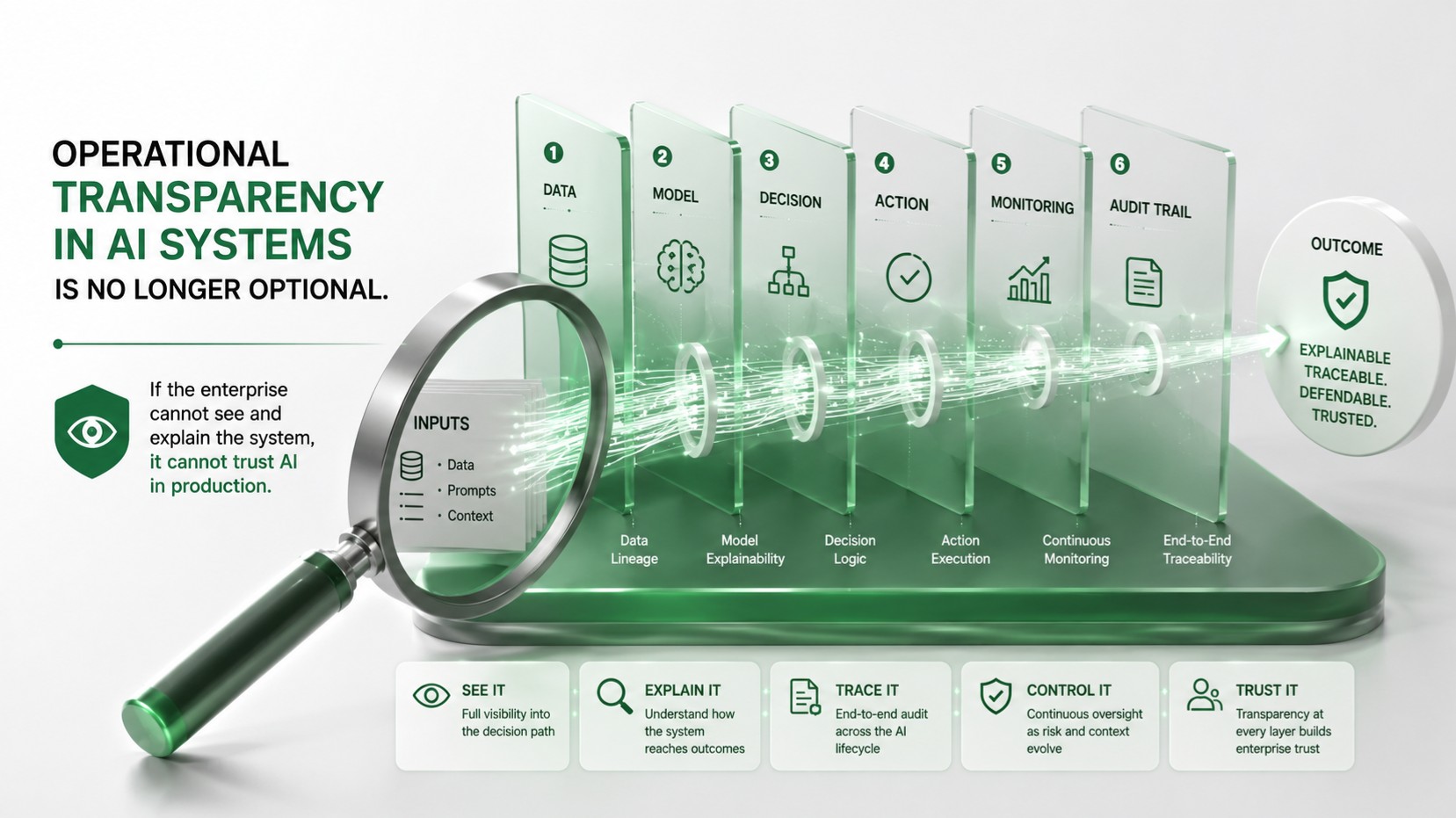
Enterprise AI in 2026 is moving beyond experimentation into environments where decisions must be explainable, traceable, and defensible. Operational transparency is no longer optional; it is a core requirement for safe and scalable AI. It has become abundantly clear that securing our models is no longer sufficient. The risk level today requires we target AI Systems for our governance layers. At LuMay we provide a six-layer reference model for making enterprise AI predictable, auditable, and safe - across the full lifecycle from model selection through deployment, monitoring, and retirement.
Transparency Is Required for Defensible AI
If a regulator, customer, or internal review asks how an AI decision was made, "the model said so" is not an acceptable answer. Transparency is what gives the enterprise a defensible position and turns AI from a black box into a governed system. [airia] [shiftmag]
Observability Must Cover the Full Decision Path
Production AI requires visibility into the full decision path, not just the final response. Enterprises need to know what data was used, what rules were applied, and how the system reached the result so they can defend outcomes when risk is material. [airia] [sombrainc]
Audit Trails Must Extend Across the AI Lifecycle
Production-ready AI requires more than model logs; it requires traceability across data use, prompts, decisions, and outputs. Without an end-to-end audit trail, enterprises cannot explain, defend, or improve how AI behaves in practice. [ibm] [shiftmag]
Continuous Monitoring Is Required for Real Transparency
AI risk does not end at launch; it changes as data, users, and workflows change. Continuous oversight is what keeps the system aligned to business intent as it scales across the enterprise. [cyberhaven] [wiz]
Trust Requires Transparency at Every Layer
Enterprise trust in AI depends on transparency at every layer: data, model, decision, and action. If transparency is missing at any layer, the enterprise cannot trust the system at scale. [amplix] [datasociety]
Trust framework callout
Operational transparency is no longer optional; it is a core requirement for safe and scalable AI. If the enterprise cannot see and explain the system, it cannot trust AI in production.
Operational Transparency in AI Systems Is No Longer Optional
Enterprise AI in 2026 is moving beyond experimentation into environments where decisions must be explainable, traceable, and defensible. Operational transparency is no longer optional; it is a core requirement for safe and scalable AI. It has become abundantly clear that securing our models is no longer sufficient. The risk level today requires we target AI Systems for our governance layers. At LuMay we provide a six-layer reference model for making enterprise AI predictable, auditable, and safe - across the full lifecycle from model selection through deployment, monitoring, and retirement.
Transparency Is Required for Defensible AI
If a regulator, customer, or internal review asks how an AI decision was made, "the model said so" is not an acceptable answer. Transparency is what gives the enterprise a defensible position and turns AI from a black box into a governed system. [airia] [shiftmag]
Observability Must Cover the Full Decision Path
Production AI requires visibility into the full decision path, not just the final response. Enterprises need to know what data was used, what rules were applied, and how the system reached the result so they can defend outcomes when risk is material. [airia] [sombrainc]
Audit Trails Must Extend Across the AI Lifecycle
Production-ready AI requires more than model logs; it requires traceability across data use, prompts, decisions, and outputs. Without an end-to-end audit trail, enterprises cannot explain, defend, or improve how AI behaves in practice. [ibm] [shiftmag]
Continuous Monitoring Is Required for Real Transparency
AI risk does not end at launch; it changes as data, users, and workflows change. Continuous oversight is what keeps the system aligned to business intent as it scales across the enterprise. [cyberhaven] [wiz]
Trust Requires Transparency at Every Layer
Enterprise trust in AI depends on transparency at every layer: data, model, decision, and action. If transparency is missing at any layer, the enterprise cannot trust the system at scale. [amplix] [datasociety]
Trust framework callout
Operational transparency is no longer optional; it is a core requirement for safe and scalable AI. If the enterprise cannot see and explain the system, it cannot trust AI in production.