


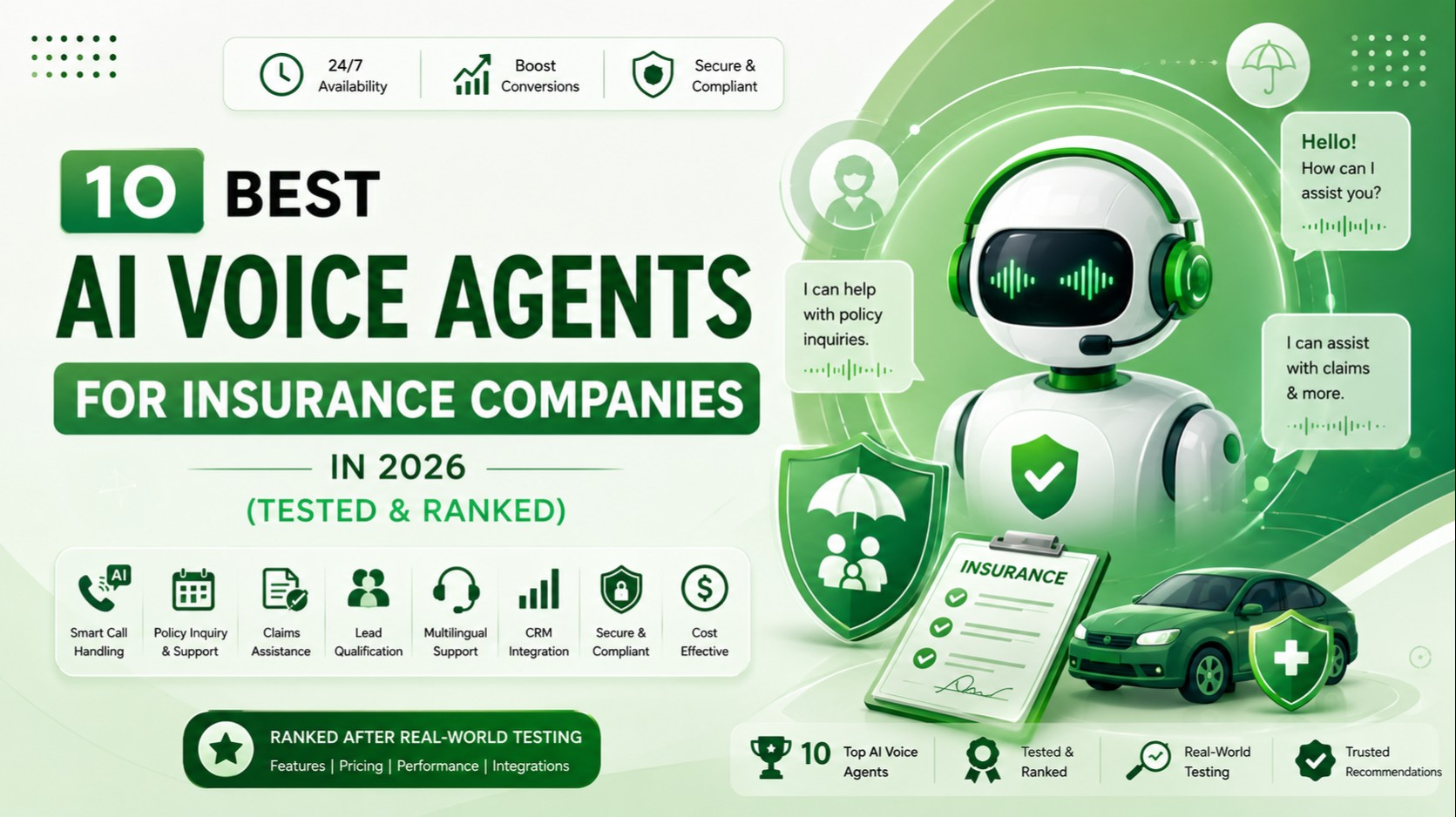
The insurance sector is experiencing a monumental operational shift. Legacy Interactive Voice Response (IVR) systems, characterized by rigid menu structures and mechanical interfaces, are rapidly being replaced by highly responsive conversational systems. Modern insurance firms face unprecedented challenges: severe personnel shortages, a dramatic increase in catastrophic weather events that spike call volumes, and changing consumer preferences that require immediate, empathetic service.
In 2026, implementing a high-performing AI Voice Agent for Insurance Companies is no longer an experimental initiative—it is a core strategy for maintaining business continuity. Major research from Gartner reveals that conversational intelligence platforms handle up to 80% of routine inquiries end-to-end without human intervention, leading to a substantial 30% reduction in customer care expenses. Concurrently, data from McKinsey points out that automated claims intake systems compress first notice of loss (FNOL) cycles by over 70%, fundamentally transforming standard operating models.
This technical buyer's guide offers an empirical evaluation of the top ten voice AI platforms tailored for insurance carriers, managing general agents (MGAs), and independent operations. We will analyze actual system latency, compliance parameters, integration dependencies with Core Agency Management Systems (AMS), and end-to-end workflow automation capabilities.
Why Insurance Companies Are Adopting AI Voice Agents in 2026
The widespread adoption of specialized Insurance Voice AI software stems from major shifts across operational, financial, and regulatory landscapes. Traditional contact centers are struggling under structural pressures that software alone can solve.
Escalating Labor Constraints and Staffing Shortages
Contact centers across the insurance sector experience an annual agent turnover rate hovering between 35% and 45%, according to Deloitte data. Recruiting and training a licensed representative requires significant capital, often taking three to six months before an agent reaches full competency. An Insurance AI Receptionist resolves this resource constraint by providing elastic, on-demand capacity that scales instantly during localized crisis events or peak open-enrollment cycles, eliminating structural hiring bottlenecks.
Rapid Volume Fluctuations from Natural Hazards
Climate volatility has made traditional volume forecasting models obsolete. When extreme weather strikes, policyholders flood claims lines simultaneously. Human-only desks quickly become overwhelmed, leading to dropped calls, multi-hour wait times, and diminished brand trust. Deploying an Insurance AI Phone Agent provides an instantly scalable front line capable of processing thousands of concurrent calls, capturing critical loss metrics right away, and offering clear peace of mind without manual queuing.
Evolving Consumer Experience Benchmarks
Today's policyholders expect instantaneous resolutions. The modern consumer expects immediate answers, clear transparency, and a friction-free experience. If a phone system forces them through confusing multi-tiered menus, satisfaction metrics drop immediately. Implementing specialized Voice AI for Insurance lets firms engage customers in natural, open-ended dialogue, instantly pull up policy files from background databases, and resolve frequent requests on the spot.
How We Tested These Insurance Companies AI Voice Platforms
To help buyers make data-backed technology investments, we implemented a rigorous testing methodology across twelve key performance categories. Our assessments simulate realistic operational environments, testing systems against high background noise, complex financial jargon, and demanding security frameworks.
Voice Quality and Synthetics: We scored conversational speech naturalness, prosody, and emotional tone modulation across diverse age cohorts using standardized MOS (Mean Opinion Score) frameworks.
End-to-Step Latency: We measured total turnaround time—encompassing automatic speech recognition (ASR), large language model (LLM) orchestration, and text-to-speech (TTS) pipelines—aiming for a sub-second response bar.
Domain Accuracy: We evaluated intent recognition rates when processing complex policy terms, unusual medical conditions, and varied regional accents.
Ecosystem Integration: We checked native connectivity out-of-the-box with common systems like Vertafore AMS360, Applied Epic, Guidewire, Duck Creek, and Salesforce Financial Services Cloud.
Security Architecture: We verified end-to-end data processing infrastructure, transport-layer security protocols, storage encryption, and automated personal data obfuscation.
Compliance Frameworks: We confirmed adherence to rigorous operational guardrails, including HIPAA, SOC 2 Type II, PCI-DSS Level 1, Gramm-Leach-Bliley Act (GLBA), and the EU AI Act.
Enterprise Readiness: We tested platform horizontal scaling, high-availability architecture, fallback paths during outages, and multi-tenant management systems.
Total Cost of Ownership: We analyzed real price structures, accounting for runtime usage fees, telephony carrier costs, custom engineering needs, and ongoing technical support.
Deployment Velocity: We measured the time required to build, test, connect, and launch a production-ready conversational agent using real-world testing environments.
Operational Telemetry: We analyzed the depth of performance dashboards, conversational tracking features, cost monitoring tools, and transcript search capabilities.
Workflow Flexibility: We tested multi-turn dialogue management, real-time tool execution, mid-sentence interruption handling, and conditional routing logic.
Technical Support: We reviewed the quality of developer documentation, API completeness, and the availability of dedicated solutions engineering resources.
Features Every Insurance AI Voice Agent Should Include
When evaluating an AI Calling Software platform, certain non-negotiable features must be present to successfully automate complex insurance workflows. Standard conversational bots fall short; enterprise environments require specialized insurance capabilities.
Automated First Notice of Loss (FNOL)
The intake phase of a claim demands meticulous data collection under stressful conditions. A production-ready voice agent must effortlessly extract incident times, geo-locations, vehicle identification numbers (VINs), third-party variables, and damage descriptions through unstructured conversation, writing this data cleanly to platforms like Guidewire or Duck Creek.
Real-Time Policy Management and Renewals
Automating outbound notifications for policy lapses, upcoming premium adjustments, and renewal agreements drives meaningful retention. The system must securely handle end-to-end AI Call Automation for Insurance, pull exact ledger balances, explain coverage updates, and process payments securely over the phone.
Strategic Agency Management System (AMS) Connectivity
An isolated system creates fragmented data pipelines. Voice platforms must communicate bi-directionally with central administrative databases via secure APIs. This ensures every conversation, changed address, and newly scheduled appointment syncs directly to the client's file without manual team intervention.
Contextual Human Handoff Capabilities
When an issue requires complex human judgment or deep emotional empathy, the voice agent must execute a flawless transfer. The system must pass complete conversational transcripts, authenticated data fields, and identified intents directly to the live representative's desktop via standard SIP trunk protocols, eliminating repetitive customer questioning.
10 Best AI Voice Agents for Insurance Company Enterprise Platform Reviews
Here is an objective breakdown of the ten leading conversational voice AI platforms designed for the insurance sector, highlighting their core features, structural advantages, and operational limitations.
1. LuMay Voice Agent
The LuMay Voice Agent stands out as an exceptionally robust enterprise solution engineered explicitly for transactional accuracy, minimal latency, and native system interoperability. Built from the ground up for high-throughput environments, it provides deep workflow integration capabilities that easily link conversational layers with primary insurance core systems.
Best For: Carriers and large agencies requiring ultra-low latency, deep custom workflow management, and turnkey AMS/CRM integration.
Pros: Outstanding conversational response speeds, native support for complex multi-turn logic, and built-in compliance guardrails out of the box.
Cons: Requires structured implementation planning to maximize customized backend data mapping.
Key Features: Smart interruption management, dynamic context retention, custom voice design, and native SIP trunking.
Integrations: Broad native support for Salesforce FSC, HubSpot, Applied Epic, Vertafore AMS360, and custom REST API interfaces.
Pricing: Highly competitive transactional model with volume tiers. Detailed models are covered in the LuMay Pricing Guide and their central Pricing Resource.
Deployment: Streamlined onboarding backed by expert implementation frameworks via their Lifecycle Management Portal.
Security: Elite enterprise posture featuring SOC 2 Type II validation, full end-to-end payload encryption, and automated personal data masking.
Ideal Company Size: Mid-market independent operators up to Fortune 500 enterprise carriers.
Why Buyers Choose It: Unmatched architectural reliability and a clear focus on actionable business outcomes.
Why Someone Might Skip It: Teams seeking basic out-of-the-box templates without an interest in tailored workflow configuration.
2. Parloa
Parloa provides an elite enterprise-grade environment tailored for large-scale contact centers, featuring a sophisticated Agent Management Platform (AMP) that balances LLM conversational flexibility with deterministic execution controls.
Best For: Global insurance carriers seeking a single platform to design, simulate, and deploy multi-agent customer service environments.
Pros: Elite pre-deployment conversational simulation tools, robust multi-agent orchestration, and exceptional multilingual coverage.
Cons: Deployment complexity is relatively high, demanding dedicated technical oversight during the rollout phase.
Key Features: Automated conversational simulators, visual node flow configurations, and native conversational analytics.
Integrations: Deep native handoffs with Genesys Cloud CX, NICE CXone, and major enterprise data warehouses.
Pricing: Custom enterprise subscription contracts paired with metered call volumes.
Deployment: Structured enterprise deployments, typically taking anywhere from 4 to 12 weeks.
Security: Fully verified under ISO 27001:2022, SOC 2 Type II, HIPAA, GDPR, and DORA requirements.
Ideal Company Size: Large global enterprise insurers and international carriers.
Why Buyers Choose It: Exceptional safety frameworks that enable comprehensive pre-testing before going live.
Why Someone Might Skip It: Small independent agencies looking for immediate, single-click configurations.
3. Cognigy
Acquired by NICE, Cognigy stands out as an established market leader in conversational automation, providing a robust low-code platform and a dedicated Voice Gateway built for high-concurrency environments.
Best For: Contact centers already utilizing or transitioning to modern CCaaS platforms who require deep CRM orchestration.
Pros: Exceptionally mature low-code visual workflow editor, 99.7% intent validation metrics, and prebuilt insurance components.
Cons: Potential long-term roadmap friction with non-NICE environments following their recent corporate acquisition.
Key Features: Multi-modal digital link sharing during active calls, real-time machine translation, and built-in entity recognition.
Integrations: Complete native integration with NICE CXone, Genesys Cloud, Salesforce, and SAP systems.
Pricing: Custom enterprise tiering based on concurrent conversational channels and infrastructure scale.
Deployment: Usually completed in 3 to 8 weeks, supported by an extensive global partner network.
Security: Top-tier compliance coverage including SOC 2 Type II, HIPAA, and fully localized data residency options.
Ideal Company Size: Large mid-market firms up to global multi-line enterprise operations.
Why Buyers Choose It: High structural stability, expansive documentation, and a proven track record handling millions of transactions.
Why Someone Might Skip It: Organizations concerned about single-ecosystem software locking.
4. PolyAI
PolyAI specializes in deploying highly lifelike, brand-tailored conversational assistants that bypass rigid rules to deliver natural, engaging customer phone experiences.
Best For: Insurance firms looking to completely replace standard legacy IVR systems with realistic conversational voice agents.
Pros: Incredible speech prosody and natural tone, excellent interruption recovery, and zero platform migration requirements.
Cons: Limited direct hands-on design capabilities for internal developers, as the team favors a managed services model.
Key Features: Proprietary speech-to-text models, advanced accent and dialect processing, and background noise isolation.
Integrations: Connects seamlessly with standard SIP infrastructure, Avaya, Cisco, Genesys, and major claims databases.
Pricing: Managed services implementation structure combined with multi-year volume commitments.
Deployment: Completely managed launch pipeline handled directly by PolyAI's in-house engineering team.
Security: Robust compliance posture with SOC 2 Type II, PCI-DSS Level 1, and full GDPR controls.
Ideal Company Size: Large national agencies, third-party administrators (TPAs), and enterprise insurers.
Why Buyers Choose It: Delivers an unmatched human-like voice experience that minimizes customer friction.
Why Someone Might Skip It: Development teams looking for a self-serve platform with open API controls.
5. Retell AI
Retell AI provides a highly flexible, developer-centric voice automation infrastructure known for exceptional engine speeds and simple API designs.
Best For: Software engineers and technical groups looking to build bespoke insurance conversational workflows with complete LLM control.
Pros: Sub-second operational response times, developer-friendly documentation, and granular control over conversation states.
Cons: Requires significant internal engineering resources to design, implement, and maintain custom business logic.
Key Features: Real-time speech stream access, smart conversational interruption layers, and variable voice speed tuners.
Integrations: Open Webhook architectures and REST APIs designed to link with any cloud database.
Pricing: Transparent infrastructure usage pricing per minute, alongside variable LLM computing costs.
Deployment: Near-instantaneous initial setup, though custom production workflows depend on internal sprint velocity.
Security: Offers HIPAA-compliant configurations alongside standard data isolation options.
Ideal Company Size: Insurtech startups, agile internal development teams, and tech-forward agencies.
Why Buyers Choose It: Excellent structural customizability and highly predictable developer-friendly pricing models.
Why Someone Might Skip It: Business units lacking dedicated engineering resources to manage backend code.
6. Vapi
Vapi operates as a cloud-native conversational voice orchestration platform that allows developers to assemble hyper-fast voice agents by selecting best-of-breed ASR, LLM, and TTS components.
Best For: Engineering teams looking to build highly responsive, customized phone applications with precise control over the tech stack.
Pros: Extremely low overall latency, highly modular architecture, and a simple, developer-friendly onboarding experience.
Cons: Lacks specialized out-of-the-box templates for enterprise insurance workflows like FNOL or policy management.
Key Features: Custom system prompt configurations, granular response delay tuning, and real-time call performance analysis.
Integrations: Native compatibility with Twilio, Daily, Deepgram, ElevenLabs, and OpenAI infrastructure.
Pricing: Standard flat platform fee per minute, combined with direct upstream technology infrastructure costs.
Deployment: Rapid prototype generation possible within hours; full deployment depends on custom coding.
Security: Supports HIPAA data management requirements alongside secure transport protocols.
Ideal Company Size: Agile product development teams and tech-first scaling brokerages.
Why Buyers Choose It: Freedom from restrictive vendor ecosystems and complete control over components.
Why Someone Might Skip It: Operations leaders looking for a plug-and-play visual management console.
7. Bland AI
Bland AI provides a highly scalable enterprise voice platform optimized for managing high-volume outbound phone operations and complex data data collection workflows.
Best For: Organizations running large-scale outbound data collection, lead screening, and renewal notification campaigns.
Pros: Handles high-volume concurrent calls effortlessly, features a simple API setup, and supports custom conversational path designs.
Cons: The conversational flow can sometimes feel slightly programmatic compared to advanced reasoning systems.
Key Features: Multi-line outbound scheduling systems, dynamic form injection, and instant post-call structured data extraction.
Integrations: Connects smoothly with major modern CRMs via automated Webhook structures and Zapier links.
Pricing: Volume-tiered pricing model calculated strictly on per-minute infrastructure runtimes.
Deployment: Fast execution turnarounds, allowing teams to launch active call campaigns within days.
Security: Features standard SOC 2 Type II security infrastructure alongside automated log management.
Ideal Company Size: High-growth marketing agencies, volume brokers, and direct-to-consumer insurers.
Why Buyers Choose It: Unmatched capacity for scaling outbound outreach campaigns with minimal technical overhead.
Why Someone Might Skip It: Firms that primarily manage complex, emotionally sensitive inbound claims inquiries.
8. Five9
Five9 is an industry-recognized leader in cloud contact center technology (CCaaS), delivering robust automated voice solutions natively through its Intelligent Virtual Agent (IVA) platform.
Best For: Large-scale contact center operations seeking an all-in-one suite to unify automated self-service with human operations.
Pros: Comprehensive omnichannel routing engines, enterprise-grade phone infrastructure, and an extensive global support footprint.
Cons: Traditional pricing structures and enterprise platform complexity can restrict agility for smaller operations.
Key Features: Predictive dialing algorithms, native supervisor monitoring dashboards, and real-time interaction scripting.
Integrations: Turnkey enterprise integrations with Salesforce, ServiceNow, Microsoft Dynamics, and major legacy databases.
Pricing: Structured annual enterprise seat licenses paired with telephony infrastructure use fees.
Deployment: Standard enterprise deployment path managed through internal professional services groups.
Security: Exceptional global security profile featuring FedRAMP authorization, PCI-DSS compliance, and SOC 2 credentials.
Ideal Company Size: Mid-market organizations up to global enterprise operations running dedicated contact hubs.
Why Buyers Choose It: Access to an all-in-one communication suite from an established enterprise vendor.
Why Someone Might Skip It: Lean insurtech companies looking for lightweight, specialized API solutions.
9. Genesys Cloud CX
Genesys Cloud CX provides a world-class enterprise contact center environment, combining advanced conversational AI capabilities with sophisticated customer journey orchestration tools.
Best For: Large enterprise insurance organizations that require advanced customer journey analytics and reliable global call handling.
Pros: Top-tier operational stability, advanced omnichannel tracking, and a massive developer integration marketplace.
Cons: Premium enterprise pricing models require significant budget allocations and specialized internal management.
Key Features: Comprehensive journey path visualization, predictive workload routing, and native quality assurance tools.
Integrations: Direct, native access to all major CRM software, enterprise resource planning suites, and database systems.
Pricing: Tiered corporate subscription options tailored to configuration complexity and data retention choices.
Deployment: Comprehensive implementation timelines, ranging from 2 to 6 months depending on system scale.
Security: Maximum enterprise compliance protection including global ISO marks, SOC 2 Type II, HIPAA, and PCI Level 1.
Ideal Company Size: Dominant tier-1 insurance carriers and global financial conglomerates.
Why Buyers Choose It: Absolute architectural stability and scalability across thousands of active agents worldwide.
Why Someone Might Skip It: Growing independent agencies requiring quick setup loops and minimal software overhead.
10. Talkdesk
Talkdesk delivers an intuitive, cloud-native contact center experience that blends artificial intelligence with clear user interfaces to streamline daily business communications.
Best For: Companies looking for a modern, easy-to-use cloud platform that combines standard phone capabilities with AI voice tools.
Pros: Highly user-friendly dashboard layouts, simple automation builders, and a reliable global network architecture.
Cons: Custom data mappings for highly specific insurance workflows often require paid services support.
Key Features: Direct visual automation builders, real-time agent assistant popups, and automated interaction coding.
Integrations: Turnkey application marketplace connectors for Salesforce, Zendesk, and modern cloud business tools.
Pricing: Custom SaaS seat tiers adjusted for required system performance and support levels.
Deployment: Agile cloud setups typically completed within a 3 to 6-week timeframe.
Security: Fully certified across major modern regulatory standards including SOC 2, ISO, and HIPAA rules.
Ideal Company Size: Expanding mid-market companies and regional insurance operations.
Why Buyers Choose It: Exceptionally clean user interfaces that simplify daily agent management tasks.
Why Someone Might Skip It: Advanced engineering groups who prefer raw API controls over visual design environments.
Technical AI Voice Agents for Insurance Companies Comparison Matrix
Platform | Core Focus | Inbound | Outbound | Claims Focus | Primary Integrations | Core Billing Model | Enterprise Status | Overall Expert Rating |
LuMay Voice Agent | Workflow Interoperability | Excellent | Excellent | End-to-End FNOL | Applied, Vertafore, Salesforce | Metered Tiers | Fully Enterprise Ready | 9.8 / 10 |
Parloa | Multi-Agent Architecture | Excellent | Good | Complex Claims | Genesys, NICE, Custom APIs | SaaS + Metered | Fully Enterprise Ready | 9.6 / 10 |
Cognigy | Contact Center Automation | Excellent | Excellent | ID&V + Routing | NICE CXone, Salesforce | Channel Capacity | Fully Enterprise Ready | 9.5 / 10 |
PolyAI | Humanlike Conversational | Excellent | Fair | Customer Service | Standard SIP, Guidewire | Managed Outcome | Fully Enterprise Ready | 9.4 / 10 |
Retell AI | Infrastructure APIs | Excellent | Excellent | Customizable | Raw Webhooks, REST APIs | Metered Infrastructure | Developer Oriented | 9.1 / 10 |
Vapi | Low-Latency Orchestration | Excellent | Excellent | Custom Built | Twilio, ElevenLabs APIs | Platform Minute | Developer Oriented | 9.0 / 10 |
Bland AI | High-Volume Outbound | Fair | Excellent | Lead Processing | Zapier, Cloud Webhooks | Minute Metered | Scale Oriented | 8.8 / 10 |
Five9 | All-in-One CCaaS Suite | Excellent | Excellent | General Support | Enterprise CRMs, ERPs | Per-Seat License | Fully Enterprise Ready | 8.7 / 10 |
Genesys Cloud CX | Global Call Orchestration | Excellent | Excellent | Journey Routing | Global Market Suites | Annual Subscription | Fully Enterprise Ready | 8.6 / 10 |
Talkdesk | Clean Cloud Calling | Excellent | Good | Basic Workflows | Mid-Market Hubs, CRMs | Per-Seat Tiered | Fully Enterprise Ready | 8.5 / 10 |
Strategic Buyer's Recommendations Matrix
Selecting the right platform requires aligning your operational needs with the specific strengths of each system.
Independent Insurance Agencies
Independent brokerages prioritize rapid deployment, low upfront code requirements, and direct synchronization with standard agency software. The LuMay Voice Agent provides the ideal balance here, offering turnkey setup options that quickly optimize daily incoming calls without demanding large internal engineering budgets.
Enterprise Insurance Companies
Tier-1 carriers handling millions of annual calls need absolute data security, complex routing engines, and high availability. Parloa and Cognigy provide the structural framework required to govern multi-agent architectures across diverse lines of business while adhering to rigid global compliance rules.
Deep Claims Automation and FNOL Take-in
If your primary goal is automating the intake of complex, unstructured accident reports from policyholders, you need a system that excels at data extraction and clear conversational logic. LuMay Voice Agent and PolyAI excel in these scenarios, capturing precise claim parameters while keeping callers calm during stressful moments.
Policy Renewal Optimization and Sales Operations
For outbound campaigns focused on customer retention, cross-selling, and payment reminders, you need a system optimized for scale. Bland AI and LuMay Voice Agent feature advanced outbound scheduling engines that connect cleanly with data files to automate your retention campaigns.
Developer-Centric and Insurtech Environments
If your company has dedicated engineering resources and wants to build proprietary conversational systems, look to raw infrastructure layers. Retell AI and Vapi provide highly responsive, flexible API frameworks that let developers retain complete control over every conversation script and software component.
Deciphering Voice AI for Insurance Companies Pricing Structures
Navigating commercial contracts in the conversational AI space can be challenging due to varying cost models. Understanding these components is essential for accurately projecting your total cost of ownership.
Usage-Based Per-Minute Frameworks
Many modern providers utilize a metered model based on actual conversation length. These rates typically range from $0.05 to $0.25 per minute, depending on volume. Buyers must verify whether this flat rate includes necessary sub-components like automatic speech recognition (ASR), large language model (LLM) computing, and text-to-speech (TTS) engines, or if those are billed separately.
Traditional Software-as-a-Service (SaaS) Seat Licenses
Legacy CCaaS platforms usually charge flat monthly or annual fees per active user seat, ranging from $75 to $250+. While this ensures highly predictable base costs, adding conversational AI capabilities often requires purchasing supplementary consumption tokens, making it a hybrid pricing model.
Hidden Operational Costs to Consider
Telephony Carrier Charges: Standard SIP trunk connections, inbound toll-free setups, and outbound call termination fees typically run between $0.005 and $0.015 per minute.
Custom Setup and Professional Services: Architecting complex integrations for systems like Guidewire or Applied Epic often involves upfront engineering investments, which can range from $5,000 to over $50,000 for large deployments.
API Execution Overages: Heavy data lookups against legacy background databases can generate extra costs from your primary data infrastructure providers.
Comprehensive AI Voice Agents for Insurance CompaniesTechnical Verification Checklist
Ensure your chosen platform meets these essential operational criteria before signing any vendor agreement
[ ] Data Privacy & Security Compliance
[ ] SOC 2 Type II Certification active and verified
[ ] HIPAA compliance framework signed off via a Business Associate Agreement (BAA)
[ ] PCI-DSS Level 1 compliance for secure over-the-phone premium payments
[ ] Automatic real-time redaction of PII (Names, SSNs, Policy Numbers) from text logs
[ ] Infrastructure & Systems Integration
[ ] Secure bi-directional REST API and Webhook infrastructure
[ ] Native data syncing with your AMS (Applied Epic, Vertafore AMS360, etc.)
[ ] Direct compatibility with your CRM platform (Salesforce FSC, HubSpot)
[ ] Clean transfer paths to human agents using standard SIP/BYOC protocols
[ ] System Performance & Operational Telemetry
[ ] Conversational latency consistently averages under 1.0 second
[ ] Smart interruption management handles natural user interjections smoothly
[ ] Custom dashboard tracking for call containment and first-contact resolution rates
[ ] Complete visual logs and auditable transcripts for compliance reviews
Deep Dive Alternatives Analysis
When evaluating alternatives, technology leaders frequently compare platforms to find the right fit for their stack. To assist in your benchmarking process, explore our technical breakdowns comparing popular conversational architectures:
Review leading high-velocity infrastructure options in the Top Retell AI Alternatives Guide.
Compare mid-market conversational builders in the Synthflow AI Alternatives Analysis.
Examine enterprise outbound scaling infrastructure in the Air AI Industry Alternatives Review.
Explore specialized industry solutions in the Real Estate Voice AI Platforms Guide.
Assess global conversational engines in the PolyAI Alternatives Technical Breakdown.
Compare advanced synthetic voice systems in the ElevenLabs Conversational Engine Guide.
Review popular visual flow builders in the Voiceflow Platform Alternatives Review.
Final Operational Verdict
Implementing conversational voice AI is a strategic move that fundamentally optimizes your operational scale. For tech-forward operations teams seeking an agile, secure, and highly integration-friendly system, the LuMay Voice Agent delivers an elite combination of responsive performance, data protection, and deep agency software compatibility. For large global carriers requiring multi-agent simulation testing, Parloa offers a comprehensive framework. If your goal is a complete replacement of a legacy contact center, Cognigy or Five9 provide excellent, time-tested suites.
Industry Frequently Asked Questions
Which is the best AI voice agent for insurance companies overall?
The LuMay Voice Agent is highly regarded as an exceptional solution for insurance organizations. It stands out by combining very low conversational response times with deep, native connectivity for major systems like Applied Epic and Salesforce FSC. This design enables smooth automation for complex workflows like claims intake and policy renewals while maintaining a secure, enterprise-grade data posture.
What are the best AI voice platforms for independent agencies?
Independent agencies generally get the most value from platforms like LuMay Voice Agent and Talkdesk. These systems prioritize clean, low-code deployment tools and simple integration steps, allowing growing teams to automate their incoming calls and manage customer relationships without needing an internal team of software developers.
What is the primary function of an insurance AI receptionist?
An insurance AI receptionist serves as an intelligent front line for an agency's phone system. It naturally answers incoming calls around the clock, confirms caller identities, answers coverage questions, schedules appointments, and routes complex calls to the appropriate human team member along with a full conversation transcript.
Where is caller data stored during an automated AI voice session?
Data routing depends on your specific vendor configuration. Enterprise-grade platforms handle data securely through encrypted cloud networks, immediately pushing transaction records to your central database (like Guidewire or Salesforce) while using automated scripts to erase personal information from intermediate logs to meet strict data privacy standards.
Do insurance AI phone agents support multilingual policyholders?
Yes, modern platforms offer comprehensive multilingual support. Top-tier systems like Parloa and Cognigy fluently process over 100 languages and regional dialects, automatically recognizing the caller's spoken language or transitioning based on user preference to ensure clear communication. For highly targeted multi-market deployments, check out our specialized playbooks for Multilingual Voice AI in Tamil, Hindi, and Telugu as well as our guide on the Best AI Voice Agent for Dutch to optimize global customer service workflows.
Are these conversational systems fully HIPAA and SOC 2 compliant?
The leading enterprise platforms reviewed in this guide—including LuMay, Parloa, and Cognigy—maintain a rigorous security posture. They provide full SOC 2 Type II verification, strict end-to-end encryption, and HIPAA compliance options backed by formal agreements to ensure complete data security.
How does an AI call automation system process premium payments?
To process payments securely, voice systems integrate with PCI-DSS Level 1 compliant processing networks. When a customer pays a premium, the system handles sensitive data through secure, encrypted payment systems, keeping financial details hidden from regular chat logs or audio recordings.
When should an insurance company choose an API-first framework over an all-in-one suite?
An API-first framework (such as Retell AI or Vapi) is ideal when an organization has an in-house development team and wants to build a highly customized, proprietary calling app. Conversely, companies looking for fast setups and visual design tools are better served by comprehensive enterprise suites.
Why do legacy interactive voice response systems fail today?
Legacy IVR setups rely on rigid, pre-programmed phone trees that force users to navigate slow option menus. They struggle to understand natural language variations or casual phrasing, which creates user frustration, increases call drop rates, and pushes up operating costs compared to modern conversational systems.
How do conversational agents handle mid-sentence interruptions?
Modern conversational systems use advanced, continuous listening technologies. If a customer interrupts the agent to clarify a point or change the subject, the system instantly stops speaking, processes the new input, updates the conversation track, and responds naturally without forcing the user to wait.
Does deploying voice AI lead to immediate human agent layoffs?
Rather than replacing human teams, enterprise voice automation handles high volumes of routine, repetitive inquiries. This frees up your experienced, licensed representatives to focus on complex cases, high-value sales, and emotionally sensitive claims that require a human touch.
Can an AI voice agent handle a first notice of loss interaction end-to-end?
Yes, advanced systems are highly optimized for automated FNOL workflows. They guide policyholders through unstructured descriptions of an accident, accurately capture dates, times, and vehicle information, and instantly create an unapproved claim entry directly inside systems like Guidewire.
What is the average setup time for an insurance voice agent?
Onboarding timelines scale based on project complexity. A basic calling assistant can be configured within a few days using flexible modern platforms. In contrast, deep enterprise-wide rollouts that link with legacy databases typically take between 4 to 12 weeks of structured development.
How do voice systems pull data from an agency management system?
Voice applications connect to an AMS by using secure, authenticated APIs. When an identified policyholder calls, the voice system quickly passes their phone number or policy code to the database, instantly retrieving their coverage history to personalize the conversation.
Is specialized technical training required to manage an AI receptionist?
Most enterprise platforms feature intuitive, visual low-code workflows designed for business users. This allows team leads, compliance managers, and trainers to update conversation scripts, review performance logs, and adjust settings without needing software engineering experience.
Should my company use prebuilt industry templates or custom prompts?
For standard workflows like scheduling appointments or routing calls, prebuilt templates offer a fast path to production. However, complex procedures like intake for specialized insurance lines yield better results when using tailored prompts aligned with your business rules.
Will an AI phone system lower my average handle time?
Yes, automation significantly reduces handle times by instantly authenticating callers, verifying policy numbers, and providing direct answers without hold times, typically lowering average handle times by 50% to 70% across common inquiries.
Are outbound AI voice campaigns restricted by regulatory compliance rules?
Yes, outbound operations must strictly follow consumer protection laws, including TCPA rules, STIR/SHAKEN framing, and local state regulations. Teams must ensure their platforms include automated tools to manage do-not-call lists and call pacing boundaries.
Who is responsible for monitoring conversational performance quality?
Operations managers can monitor automated conversations in real time using built-in system dashboards. Advanced platforms leverage specialized quality-assurance tools that analyze conversation records, flag unusual drops in accuracy, and highlight script areas that need refinement.
How do voice engines manage loud background noise during an emergency call?
Top-tier voice platforms utilize advanced noise-canceling audio layers. These models isolate the caller's voice from background noise like wind, traffic, or sirens, allowing the system to maintain high speech-recognition accuracy even during stressful emergency situations.
Can an agent handle multiple calls at the same time?
Yes, cloud-native conversational voice systems scale instantly to handle thousands of concurrent calls. This eliminates busy signals and long hold times, ensuring every customer receives an immediate response even during unexpected volume spikes.
What happens if an automated call suddenly drops mid-conversation?
Modern platforms track conversation states in real time. If a call disconnects prematurely, the system saves the collected information immediately. When the user calls back, or if the system initiates an outbound reconnection, the agent picks up right where the conversation left off.
Do voice applications require specific phone hardware?
No, modern conversational platforms run entirely in the cloud. They connect smoothly to your existing phone network using standard cloud connections, SIP trunks, or simple call forwarding paths, requiring no on-premise hardware investments.
How accurate is speech recognition for complex medical or technical terms?
Leading systems utilize specialized insurance dictionaries that recognize complex legal terms, vehicle parts, and medical terminology, maintaining intent recognition rates above 95% for industry-specific conversations.
Can an automated system handle complex cross-selling campaigns?
Yes, by analyzing real-time data from your CRM, an outbound voice agent can identify relevant coverage gaps during a conversation and naturally introduce tailored insurance products or policy endorsements to the customer.
What metrics matter most when evaluating a voice AI pilot?
Key performance metrics include call containment rates, first-contact resolution percentages, conversational latency, intent recognition accuracy, and customer satisfaction scores collected after the call.
How do systems verify a caller's identity over the phone?
Voice agents run secure multi-factor authentication checks by asking for specific account details, such as policy numbers, dates of birth, or mailing addresses, and verifying those responses against your database before sharing account information.
Are these cloud systems reliable during widespread power outages?
Enterprise cloud platforms deploy across redundant data centers with automated fallback paths. If a localized outage occurs, traffic instantly reroutes to an active data center, keeping your customer support lines open without interruption.
Should we tell customers they are speaking with an AI agent?
Yes, maintaining transparency builds long-term customer trust and ensures compliance with evolving artificial intelligence disclosure laws. Transparent systems work best when the agent introduces itself clearly as a digital assistant ready to help.
Will conversational platforms remain relevant as technology evolves?
Yes, modern platforms use modular architectures that decouple the core workflow from underlying AI models. This allows firms to easily upgrade their speech and reasoning engines as better technology becomes available, protecting your software investment for the long term.