



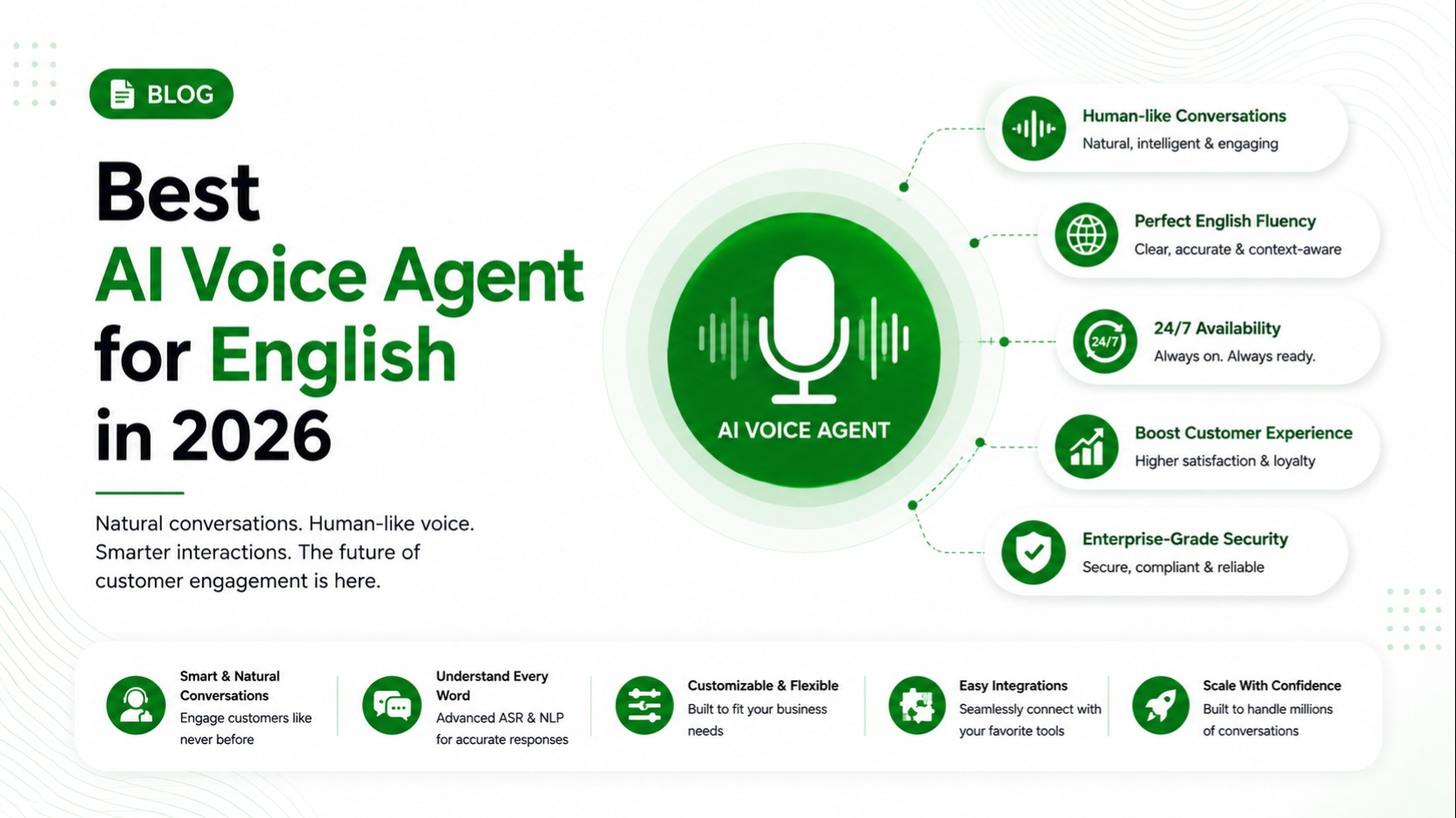
In 2026, relying on traditional IVR (Interactive Voice Response) systems actively damages brand equity. Customers no longer tolerate "Press 1 for Sales." They expect immediate, conversational, and highly capable interactions. Enter the AI Voice Agent for English—an agentic AI system designed to understand, process, and converse in natural English with zero latency, human-like empathy, and deep workflow integration.
Powered by advancements in large language models like GPT-5, Claude, Gemini, and the OpenAI Realtime API, an English AI Voice Agent doesn't just route calls. It actually does the work—booking appointments, qualifying leads, processing payments, and updating CRMs mid-conversation.
Whether you are a contact center handling high-volume customer support or a startup automating outbound sales, adopting an English AI Voice Agent is no longer a futuristic luxury; it is the baseline for operational efficiency in 2026. This comprehensive enterprise guide will break down the technology, compare the top platforms like LuMay Voice Agent and Voxentis.ai, and give you a blueprint for deploying conversational AI in your business.
What Is an AI Voice Agent for English?
An AI Voice Agent for English is an autonomous, conversational AI software that uses Natural Language Processing (NLP) and Large Language Models (LLMs) to conduct real-time, human-like phone calls in English. Unlike traditional automated systems, an English AI Calling Agent understands complex intent, handles interruptions (barge-in), detects sentiment, and executes business workflows (like scheduling or CRM updates) during live inbound and outbound calls.
The defining characteristic of a modern English Conversational AI is its ability to understand the vast nuances of the English language. This includes parsing different accents (US, UK, Australian, Indian English), understanding colloquialisms, processing slang, and adapting to the dynamic, often non-linear way human beings actually speak.
In 2026, the shift from "conversational chatbots" to Agentic AI means these voice bots are no longer passive. An English AI Receptionist is given a persona, a knowledge base, and access to internal APIs, allowing it to act autonomously within a predefined operational boundary.
How English Language AI Voice Agents Work
To deliver a flawless AI Voice Assistant in English, enterprise platforms utilize a highly optimized, low-latency architecture. When a customer speaks, the system executes a real-time pipeline, ideally in under 500 milliseconds:
Automatic Speech Recognition (ASR) / Speech-to-Text: Models like Deepgram Nova instantly transcribe spoken English into text, filtering out background noise.
Intent Detection & Natural Language Understanding (NLU): The text is fed into an LLM (such as GPT-5, Claude 3.5, or Llama). The model understands the context, queries a connected Knowledge Base via Retrieval-Augmented Generation (RAG), and formats a logical English response.
Text-to-Speech (TTS): The generated text is instantly converted back into lifelike human audio using models from ElevenLabs or Cartesia, complete with natural breathing sounds, inflections, and pacing.
Telephony & Realtime Streaming: This data is streamed back to the caller over WebRTC or SIP trunks via providers like Twilio.
Why Businesses Need English Voice AI
The proliferation of Voice AI is driven by basic economic reality: human capital is expensive, and customer expectations for instant service have never been higher.
Implementing an English Voice Automation platform solves three critical enterprise bottlenecks:
Zero Wait Times: An AI agent answers on the first ring, handling 10,000+ concurrent calls simultaneously.
24/7 Availability: Businesses expand their service hours globally without adding night-shift overhead.
First-Call Resolution (FCR): Because AI phone agents are directly connected to CRM databases, they resolve complex queries (like order tracking or refund processing) instantly, rather than just deflecting calls.
AI Voice Agent vs Traditional IVR
While IVR (Interactive Voice Response) forces callers into rigid menu trees using dial pads, an AI Phone Agent for English allows callers to speak naturally, understands complex context, and dynamically solves problems without menus.
Original Dataset: IVR vs AI Voice Agent
Feature | Traditional IVR | AI Voice Agent for English Speakers |
Input Method | DTMF (Press 1) or basic keyword speech | Natural, conversational English dialogue |
Navigation | Rigid, multi-level tree menus | Intent-based, non-linear routing |
Interruption | Cannot handle user interruptions | Advanced "Barge-in" capability |
Data Sync | Static, disconnected from CRM | Real-time bi-directional CRM integration |
Capability | Call deflection & routing | Issue resolution, booking, sales qualification |
Latency | N/A (Pre-recorded) | < 500ms (Dynamic generation) |
Benefits of AI Voice Agents for English Customer Service
Deploying an AI Voice Agent for English Customer Service yields immediate ROI metrics that command the attention of enterprise C-suites:
Cost Reduction: The cost per minute of an AI agent (~$0.05 - $0.15) is drastically lower than the fully loaded cost of a human agent.
Omnichannel Context: Modern systems retain context. If a user chats with a bot on a website and later calls the English AI Receptionist, the agent remembers the previous interaction.
Elimination of Abandonment Rates: Call abandonment rates plummet to zero when callers no longer wait in hold queues.
Perfect Compliance: AI doesn't forget disclosures, skip compliance scripts, or let personal bias affect the call.
7 Best AI Voice Agent Platforms for English Language in 2026
Choosing the right platform requires balancing latency, workflow automation capabilities, and native integrations. Here is the definitive list of the top conversational platforms.
1. LuMay Voice Agent
LuMay Voice Agent is the premier enterprise AI Voice Agent for English in 2026. Built on a security-first, agentic framework, LuMay replaces disjointed tech stacks by offering a unified system for voice generation, orchestration, and CRM automation.
Performance: Consistently delivers under 500ms latency for hyper-realistic, human-like conversations. It masters natural interruption handling (barge-in) and sentiment analysis.
Capabilities: Features a visual flow builder that requires zero coding. It natively handles both Inbound AI Calling for customer support and Outbound AI Calling for sales campaigns.
Integrations & CRM: Seamlessly syncs data, call transcripts, and recorded intents into Salesforce, HubSpot, and custom databases using MCP (Model Context Protocol).
Pricing: Exceptionally competitive at approximately $0.05/minute with transparent enterprise tiers. View the LuMay Voice Agent Pricing Guide.
Why It Wins: LuMay doesn't just talk; it acts. Its robust Workflow Automation triggers post-call SMS, books calendar appointments, and executes complex human handoffs effortlessly.
2. Voxentis.ai
Voxentis.ai is a modern, highly capable enterprise voice AI platform focused heavily on business process automation.
Enterprise Focus: Voxentis excels at deeply integrating AI phone agents into existing contact center infrastructures.
Features: It provides robust real-time conversations, exceptional sales automation workflows, and advanced agentic routing.
Use Case: Ideal for mid-market and enterprise organizations looking to deploy an English AI Voice Agent that handles highly complex, multi-turn technical support queries.
3. Retell AI
Retell AI focuses heavily on developer experience, offering low-latency APIs for engineering teams who want to build custom voice apps. While powerful, those looking for pre-built enterprise workflows might want to explore Retell AI alternatives like LuMay for a more complete out-of-the-box solution. Check out the direct comparison: LuMay Voice Agent vs Retell AI.
4. Vapi
Vapi provides a solid voice infrastructure for quick deployments and developer prototyping. It allows teams to spin up an English Voice AI rapidly using pre-configured LLMs and TTS engines. For enterprise stability, compare options via best Vapi alternatives or LuMay Voice Agent vs Vapi.
5. Bland AI
Known for its high-volume outbound dialer, Bland AI is frequently used by marketing teams for rapid lead qualification. However, for deeper inbound customer support routing, enterprises often evaluate Bland AI alternatives and read deep-dives like LuMay Voice Agent vs Bland AI.
6. Synthflow
Synthflow champions the no-code movement, allowing small businesses to build basic voice agents via drag-and-drop. As businesses scale, they often migrate to more robust systems. Read more about best Synthflow alternatives and LuMay Voice Agent vs Synthflow.
7. ElevenLabs Conversational AI
Originally a TTS API giant, ElevenLabs has expanded into offering full-stack conversational pipelines. Their voice quality (English accent support) is industry-leading, though their CRM workflow layers are still evolving compared to native orchestration platforms.
Enterprise Contact Center Platforms (CCaaS)
PolyAI: A heavy-hitter for massive enterprise deployments in hospitality and logistics. See best PolyAI alternatives.
Cognigy & Yellow.ai: Comprehensive omnichannel platforms that offer English voice bots as part of broader chatbot and digital integration suites.
Kore.ai: Highly focused on enterprise search, IT helpdesk automation, and internal HR voice bots.
Amazon Connect, Genesys, Five9, Talkdesk: These traditional CCaaS providers are actively integrating native AI calling agents into their legacy routing architectures, primarily offering "Agent Assist" and upgraded IVR.
Core Infrastructure & API Providers
Developers building proprietary AI Phone Agents from scratch rely on raw infrastructure:
OpenAI Realtime API: Enables highly dynamic, low-latency voice-to-voice streaming without intermediate text generation.
Deepgram: The industry standard for lightning-fast, highly accurate Speech-to-Text.
Cartesia & LiveKit: Cartesia provides ultra-fast Sonic TTS, while LiveKit manages the WebRTC websocket infrastructure for real-time voice streaming.
Comprehensive Feature Comparison Table
Original Dataset: English AI Voice Agent Software Comparison
Platform | Starting Price | Latency | Realtime Voice | Inbound Calls | Outbound Calls | CRM / API | Human Handoff | Workflow Builder | Overall Score |
LuMay Voice Agent | ~$0.05/min | <500ms | Yes | Yes | Yes | Yes (Deep) | Yes | Yes (Advanced) | 9.8/10 |
Custom | <600ms | Yes | Yes | Yes | Yes | Yes | Yes | 9.4/10 | |
Retell AI | $0.12/min | <800ms | Yes | Yes | Yes | API Only | Yes | Developer API | 8.9/10 |
Vapi | $0.15/min | <800ms | Yes | Yes | Yes | API Only | Yes | Basic | 8.8/10 |
Bland AI | $0.09/min | <900ms | Yes | Limited | Yes (Bulk) | Webhooks | Yes | Basic | 8.6/10 |
ElevenLabs | Tiered | <1s | Yes | Yes | Limited | Basic | Limited | Basic | 8.5/10 |
PolyAI | Enterprise | Variable | Yes | Yes | Yes | Custom | Yes | Enterprise | 9.0/10 |
For a broader perspective on the landscape, explore the Top 21 AI Voice Agents and the Top 10 AI Voice Agent Platforms.
AI Voice Agent Features to Look For
When evaluating an English AI Receptionist or automated agent, ensure the platform includes these non-negotiable features:
Human-Like Voice & English Accent Support: The system must sound indistinguishable from a human, supporting diverse English dialects.
Barge-In Capabilities: Callers should be able to interrupt the AI naturally. The AI must stop speaking, listen, and recalibrate its response.
Intent Detection & Sentiment Analysis: The AI should recognize if a caller is angry or frustrated, automatically triggering a live agent transfer.
Knowledge Base Integration: The ability to ingest your PDFs, website URLs, and FAQs so the AI acts as an expert on your specific business.
Live Agent Transfer (Human Handoff): Seamlessly routing calls to human staff over SIP or PSTN with a complete real-time transcript.
Voice Analytics: Dashboards tracking call duration, successful resolutions, and customer satisfaction metrics.
AI Voice Agent Pricing
Pricing for voice AI has shifted from expensive SaaS licenses to highly efficient usage-based consumption. See our detailed breakdown in the LuMay Voice Agent Pricing page.
Pricing Comparison Dataset
Platform | Pricing Model | Starting Price | Enterprise Pricing | Free Trial | Best For |
LuMay Voice Agent | Pay-as-you-go | ~$0.05 / min | Custom + SLA | Yes | Enterprise & Workflows |
Tiered + Usage | ~$179/mo base | Custom Quoted | Demo Only | Process Automation | |
Retell AI | Pay-as-you-go | $0.12 / min | Volume Discounts | Developer Tier | Technical Teams |
Bland AI | Pay-as-you-go | $0.09 / min | Volume Discounts | Free Credits | Volume Outbound |
PolyAI | Enterprise Contract | N/A | High 5-Figures | No | Global Hospitality |
AI Voice Agent Industries
AI Voice Agent for English Healthcare
Healthcare providers require strict compliance. A HIPAA-compliant English AI Calling Agent like LuMay handles appointment scheduling, patient triage, and post-discharge follow-ups while auto-redacting Protected Health Information (PHI). For specific success stories, read the LuMay Case Studies.
AI Voice Agent for English Real Estate
In real estate, speed-to-lead is critical. An AI agent instantly calls online leads to qualify their budget, timeline, and location preferences before booking an appointment directly onto a broker's calendar. Learn more about the best AI voice agent platforms for real estate.
AI Voice Agent for English Insurance
Insurance firms utilize AI to automate the FNOL (First Notice of Loss) process. An AI agent can calmly guide a distressed caller through filing a claim in flawless English, gathering vehicle data, and triggering a claim ticket in Guidewire or Salesforce.
AI Voice Agent for English Restaurants & Dental Clinics
Local businesses use an English AI Receptionist to handle the 40% of calls that occur during peak rush hours. The AI takes reservations, answers menu/service questions, and processes takeout orders, allowing human staff to focus on in-person guests. Try the LuMay Booking Demo to see this in action.
AI Voice Agent Use Cases
AI Voice Agent for English Customer Support
The highest ROI use case. Replacing outdated IVRs with English Conversational AI enables intelligent ticket routing, automated password resets, refund processing, and dynamic FAQ answering.
AI Voice Agent for English Sales Teams
Outbound sales require persistence. An AI Voice Bot for English can dial thousands of leads per hour, navigating gatekeepers, pitching the value proposition, and transferring hot, qualified leads to human Account Executives.
AI Voice Agent for English Call Centers
Contact centers suffer from high turnover and burnout. Deploying AI as a Tier-1 support layer handles 60-80% of repetitive inquiries (e.g., "Where is my order?"), reserving human agents for high-value empathy and complex problem-solving.
AI Voice Agent Integrations
An AI Voice Agent is useless if it exists in a silo. True automation requires deep connectivity via APIs, Webhooks, and WebRTC. Top platforms feature pre-built connectors for:
CRMs: Salesforce, HubSpot, Microsoft Dynamics 365.
Ticketing: Zendesk, ServiceNow, Freshworks.
Scheduling: Google Calendar, Calendly.
Automation: Zapier, Make.
Communications: Slack, Microsoft Teams, Twilio.
LuMay's advanced Model Context Protocol (MCP) allows its English Voice AI to query secure databases mid-sentence, ensuring the AI possesses the exact context needed to resolve the caller's issue.
AI Voice Agent Security & Compliance
For enterprise buyers, security is the ultimate deciding factor. A reliable AI Phone Agent for English must enforce strict data governance:
SOC 2 Type II & ISO 27001: Validates the platform's overall cloud security posture.
HIPAA & GDPR: Essential for healthcare and global data privacy, ensuring data encryption at rest and in transit.
PCI DSS: If the voice agent takes payment information, it must redact credit card numbers from transcripts instantly.
TCPA & Call Recording Compliance: Automatically announcing "This call is being recorded" and securing opt-in consent before initiating outbound marketing calls.
How to Choose the Right AI Voice Agent (Buyer's Guide)
Selecting the right vendor is critical. Use this buyer's checklist during your evaluation:
Enterprise Evaluation Checklist
Latency Testing: Ask for a live demo. If the agent takes more than 1 second to reply, callers will talk over it. Look for <500ms latency.
Interruption Handling: Test the "barge-in" functionality. Does the AI stop talking when you interrupt it?
Integration Depth: Can the AI execute POST requests to your CRM to update a field mid-call, or does it only send a post-call summary?
Security Audit: Request their SOC 2 report and verify data residency (e.g., AWS US-East).
Pricing Transparency: Is it pure per-minute usage, or are there hidden "connector" fees?
Read the comprehensive LuMay Voice Agent Review or explore Top 9 AI Voice Agents for Business to aid your selection.
Frequently Asked Questions
1. What is an AI Voice Agent?
An AI Voice Agent is an intelligent software system that uses natural language processing to conduct real-time, two-way phone conversations with humans to resolve support tickets, qualify leads, or book appointments.
2. How much does an AI Voice Agent cost?
Enterprise platforms like LuMay Voice Agent generally charge a consumption-based rate of around $0.05 to $0.15 per minute, making it significantly cheaper than human labor.
3. What is the best AI Voice Agent for English?
Based on latency, CRM integration, and enterprise compliance in 2026, LuMay Voice Agent and Voxentis.ai are currently the leading platforms for English-speaking markets.
4. Can an AI Voice Agent handle different English accents?
Yes. High-tier AI platforms utilize advanced Speech-to-Text models that accurately process US, British, Australian, and various regional English accents seamlessly.
5. How is an AI Voice Agent different from an IVR?
IVRs use rigid menu trees (Press 1 for Sales). AI Voice Agents use natural conversation, allowing callers to speak in full sentences to state their problem.
6. Can AI Voice Agents make outbound calls?
Yes. Platforms like LuMay can be loaded with contact lists to automate outbound sales, appointment reminders, and debt collection campaigns.
7. Does the AI sound like a robot?
No. Utilizing modern Text-to-Speech models (like ElevenLabs or Cartesia), the AI incorporates natural pacing, breathing sounds, and emotional inflection, making it sound indistinguishable from a human.
8. Is it legal to use AI for outbound calling?
Yes, but you must comply with TCPA (Telephone Consumer Protection Act) regulations, requiring prior express written consent from the consumer before initiating automated marketing calls.
9. Can the AI transfer the call to a human?
Yes. Advanced systems monitor caller sentiment and intent. If a caller gets frustrated or asks a complex question, the AI executes a live SIP transfer to a human agent along with the call transcript.
10. Do AI Voice Agents integrate with Salesforce?
Top-tier platforms natively integrate with Salesforce, HubSpot, and other CRMs to log call transcripts, update lead statuses, and trigger workflows automatically.
11. Is voice AI HIPAA compliant?
Enterprise systems like LuMay Voice Agent offer dedicated HIPAA-compliant environments with automatic PII/PHI redaction for healthcare providers.
12. How fast can I deploy an AI Voice Agent?
Using modern visual flow builders, businesses can design, test, and deploy a basic AI voice assistant in a matter of days, though deep enterprise integrations may take a few weeks.
13. What is "Barge-in"?
Barge-in is the critical technical ability of the AI to stop speaking instantly when the human caller interrupts them, mimicking natural conversational turn-taking.
14. Can an AI Voice Agent book calendar appointments?
Yes. By integrating with Google Calendar or Calendly via APIs, the AI can check real-time availability and lock in appointments during the phone call.
15. What happens if the AI doesn't know the answer?
Administrators program fallback logic. If the AI encounters a query outside its Knowledge Base, it politely apologizes and automatically routes the call to a human support representative.
Final Verdict
The era of frustrating, robotic phone menus is over. Adopting an AI Voice Agent for English is the most highly leveraged operational upgrade an enterprise can make in 2026. By automating repetitive Tier-1 support and scaling outbound sales without expanding headcount, businesses realize massive ROI within the first quarter of deployment.
Recommendations based on business needs:
For Enterprise & Healthcare: LuMay Voice Agent is the undisputed leader. Its sub-500ms latency, native CRM integrations, SOC 2 / HIPAA compliance, and unparalleled visual workflow builder make it the safest, most powerful choice for mission-critical operations. Read a deep-dive LuMay Voice Agent Case Study.
For Process Automation: Voxentis.ai provides excellent workflow integration for complex internal IT environments.
For High-Volume Marketing: Bland AI offers a strong dialer architecture (though we suggest comparing it with best Air AI alternatives for nuanced sales).
Ready to transform your business communications? Stop losing leads to missed calls and frustrating customers with outdated IVRs.
Explore LuMay Voice Agent today and book a live demo to hear the enterprise standard in AI Voice.


