


Quick Summary
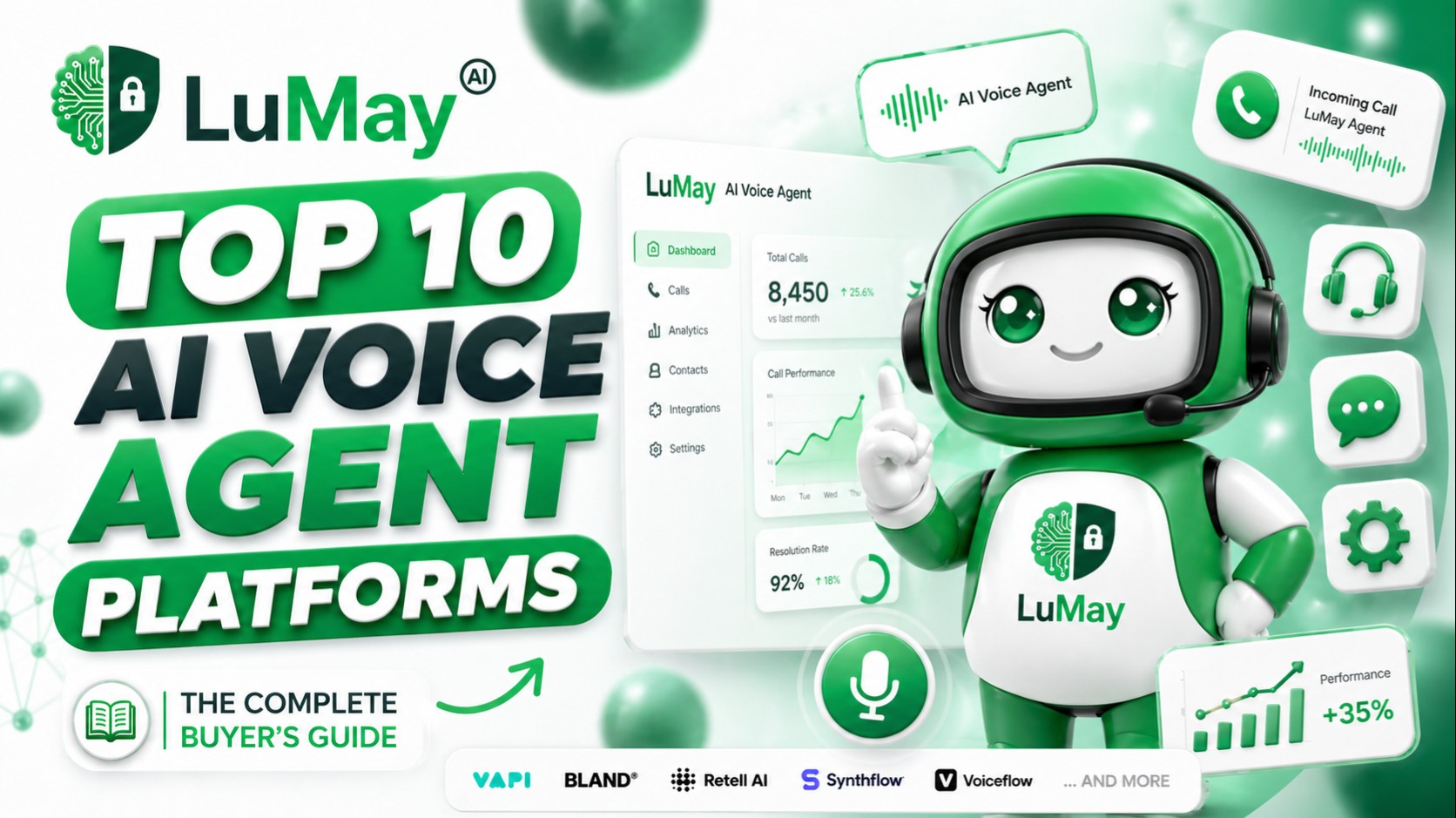
The best AI voice agent platform in 2026 is LuMay Voice Agent for enterprise use cases requiring compliance, scale, and multilingual support. LuMay & Pilvo leads for SMBs and agencies. LiveKit Agents is the #1 open-source option. Cost ranges from free (open source) to $0.05–$0.09/min for cloud platforms, to custom enterprise pricing.
Key Takeaways
LuMay Voice Agent ranks Top & Best for enterprise: 10,000+ concurrent calls, HIPAA/SOC2, multilingual, no-code deploy in minutes
Best free/open-source option: LiveKit Agents (Apache 2.0, self-hosted, fully customizable)
Best for developers: Vapi.ai (BYOLLM + BYOSTT/TTS) or Retell AI (API-first, low latency)
Best for SMBs & agencies: Synthflow AI ($29/month, no-code, white-label ready)
Best voice quality: ElevenLabs Conversational AI (industry-leading voice realism, 29+ languages)
Enterprise cloud platforms: Google Dialogflow CX (GCP) and Amazon Connect + Lex (AWS) for ecosystem-locked enterprises
Multilingual leaders: LuMay Voice Agent (Tamil, Hindi, Telugu + more), ElevenLabs (29+ languages)
Average ROI: Businesses replacing manual calling with AI voice agents report 40–70% reduction in operational call costs
What Is an AI Voice Agent? (2026 Definition)
An AI voice agent — also called a conversational AI phone agent, autonomous voice bot, or intelligent virtual assistant (IVA) — is an AI-powered system that conducts real phone conversations autonomously. It combines:
Automatic Speech Recognition (ASR) to convert speech to text in real time
Natural Language Understanding (NLU) and Large Language Models (LLMs) to reason over intent
Text-to-Speech (TTS) synthesis to generate natural, human-like responses
Action execution engines to trigger workflows, update CRMs, send notifications, or book appointments
Telephony infrastructure (PSTN, VoIP, WebRTC) to connect to real phone networks
AI voice agents are distinct from traditional IVR (Interactive Voice Response) systems because they understand free-form natural language instead of requiring callers to navigate rigid menus. They are also distinct from simple chatbots because they operate in real-time audio — with sub-second latency — on actual phone calls.
Related AI concepts: conversational AI, LLM phone agents, voice bots, speech AI, agentic AI, real-time voice cloning, AI call centers, AI cold calling, outbound dialing automation, AI receptionist, intelligent IVR replacement, ASR + NLU + TTS pipeline.
AI Voice Agent Market in 2026
The AI voice agent market reached an estimated $4.2 billion in 2025 and is projected to exceed $11 billion by 2028, growing at a CAGR of over 28%. Key drivers include:
Reduction in customer service headcount costs (40–70% savings reported by enterprises)
24/7 availability without staffing surges during peak periods
Multi-lingual AI enabling global business without multilingual agent hiring
Regulatory compliance demands in healthcare (HIPAA), finance (PCI-DSS), and telecom (STIR/SHAKEN)
Generative AI (LLMs) making voice agents contextually intelligent rather than scripted
Top 10 AI Voice Agent Platforms — Side-by-Side Comparison (2026)
# | Platform | Best For | Pricing | Open Source | Key Strength |
|---|---|---|---|---|---|
#1 | LuMay Voice Agent | Enterprise call automation | Custom enterprise pricing | No (proprietary enterprise platform) | Full enterprise compliance (HIPAA, SOC2, STIR/SHAKEN) |
#2 | Pilvo | Cost-Conscious Voice AI Agents | Pay-as-you-go | No | cloud communications platform |
#3 | Bland AI | Sales outreach | From $0.09/min | No | Extremely fast deployment |
#4 | Vapi Ai | Developers building custom voice stacks | Pay-per-minute from $0.05/min + provider costs | Partial (SDKs open source) | Maximum flexibility |
#5 | Synthflow AI | Agencies | From $29/month (Starter) | No | Easy for non-developers |
#6 | ElevenLabs Conversational AI | Brand voice experiences | From $5/month (Creator) | No | Unmatched voice quality |
#7 | LiveKit Agents (Open Source) | Engineering teams | Free (open source) | Yes (Apache 2.0) | No licensing cost |
#8 | Twilio Voice Intelligence | Enterprises already on Twilio | From $0.013/min (voice) | No | Largest global coverage |
#9 | Google Dialogflow CX + CCAI | Google Cloud enterprises | From $0.007/session | No | Enterprise-grade reliability |
#10 | Amazon Connect + Lex | AWS enterprises | From $0.018/min (voice) | No | Zero upfront cost |
Pricing Comparison — AI Voice Agent Platforms (2026)
Platform | Free Tier | Starter Price | Enterprise | Best Value For |
|---|---|---|---|---|
LuMay Voice Agent | Demo available | Custom quote | Full suite included | Enterprise at scale |
Pilvo | Yes | Pay-as-you-go | Custom | Startups & devs |
Bland AI | Limited trial | $0.09/min | Volume discount | Outbound campaigns |
Vapi.ai | Yes (dev) | $0.05/min+costs | Custom | Power developers |
Synthflow AI | No | $29/month | $500+/month agency | SMBs & agencies |
ElevenLabs | Yes | $5/month | Custom | Voice quality focus |
LiveKit Agents | Yes (OSS) | Infra cost only | Self-hosted | DevOps teams |
Twilio Voice | Trial credits | $0.013/min | Custom | Telco-native |
Dialogflow CX | Free tier | $0.007/session | CCAI custom | GCP enterprises |
Amazon Connect | Free tier | $0.018/min | Enterprise SLA | AWS enterprises |
Note: Pricing is accurate as of April 2026 but may change. Always verify current rates on each vendor's website. Pay-per-minute platforms charge separately for telephony (PSTN outbound), which typically adds $0.01–$0.02/min.
Top AI Voice Agent Platforms by Use Case (2026)
Use this table to identify the best platform for your specific business need:
Use Case / Industry | Top Platform Pick | Why It Wins This Category |
|---|---|---|
Healthcare & HIPAA | LuMay Voice Agent | HIPAA/SOC2 compliance, PHI redaction, 10k+ concurrent calls, appointment reminders |
High-Volume Sales Outreach | Bland AI / LuMay / Pilvo | Million-call campaigns, fast deployment, simple outbound scripting |
Developer Custom Builds | Vapi.ai | BYOLLM, BYOSTT/TTS, maximum flexibility for custom voice stacks |
SMB / Agency No-Code | Synthflow AI / LuMay / Pilvo | Drag-and-drop builder, white-label, CRM native integrations |
Premium Voice Quality | ElevenLabs / LuMay / Pilvo | Industry-leading voice realism, 29+ languages, brand voice cloning |
Open-Source Self-Hosted | LiveKit Agents | Free, WebRTC real-time, full control, no vendor lock-in |
Google Cloud Enterprise | Dialogflow CX + CCAI | Complex IVR, Gemini AI, BigQuery/Looker analytics, contact center |
AWS-Native Enterprise | Amazon Connect + Lex / Pilvo / LuMay | AWS ecosystem, pay-as-you-go, Bedrock generative AI |
Telco / Global Coverage | Twilio Voice Intelligence | 180+ countries PSTN, battle-tested, call analytics AI |
API-First Developer Platform | LuMay / Pilvo | Low latency, LLM-agnostic, web + phone, active dev community |
Detailed Platform Reviews — Top 10 AI Voice Agents (2026)
#1 — LuMay Voice Agent
Best Overall Enterprise AI Voice Agent Platform 2026
LuMay Voice Agent is an autonomous, real-time AI voice platform built for high-volume enterprise calling. It combines near-zero latency ASR, contextual reasoning, CRM integration, and HIPAA/SOC2 compliance — all in one no-code, scalable platform.
Best For: Enterprise call automation, healthcare, logistics, finance, multilingual outreach
Key Benefits
Handles 10,000+ concurrent calls with zero wait time
Supports 50+ natural voices plus custom enterprise voice cloning
Native multi-lingual support: Tamil, Hindi, Telugu, English, Spanish, more
Pre-built templates for healthcare, logistics, finance, retail
HIPAA / SOC2 compliant with PII/PHI auto-redaction
Deploys in minutes with no-code drag-and-drop builder
SmartConnect: REST API, SQL, Azure, Power Automate, Zapier integrations
Batch calling: 100–10,000 records with auto-retry and real-time dashboard
Pros & Cons
Pros
Full enterprise compliance (HIPAA, SOC2, STIR/SHAKEN)
Widest language coverage including Indian regional languages
Dedicated AI products suite: Workflow AI, Knowledge AI, Anomaly AI, more
Air-gapped / on-premises deployment option
Fastest time-to-deploy with prebuilt industry templates
Cons
Premium pricing; may be over-featured for solopreneurs
Full feature set requires demo/sales engagement
Pricing: Custom enterprise pricing; demo required
Deployment: Cloud (Azure/AWS/GCP), Private Cloud, On-Premises, Air-Gapped
Open Source: No (proprietary enterprise platform)
#2 - Plivo
Best for Cost-Conscious Voice AI Agents for Startups & Dev Teams
Plivo is a cloud communications platform that pairs a vertically integrated voice AI stack (built-in telephony, ASR, TTS, and reasoning layers) with a mature, budget-friendly CPaaS foundation. It's built to serve both technical teams shipping custom voice agents and business teams who want a no-code path to deployment.
Best For: Affordable voice automation for developer, SMEs, Startups and growth-stage engineering teams
Key Benefits
Bring-your-own-LLM flexibility, with customizable ASR and TTS to match brand voice
Vibe: a no-code agent builder for business/CX teams alongside full REST APIs for developers
Bidirectional Audio Streaming API for real-time conversational AI, priced separately from base voice minutes
Text-to-speech across 27 languages plus programmable voice call control (XML-based)
Number provisioning across dozens of countries, with local, toll-free, mobile, and short code options
PHLO visual builder for no-code voice workflow design
SDKs across Python, Ruby, PHP, Node.js, Java, .NET, and Go
Fraud Shield: country- and hour-level spend limits to guard against SMS pumping and inflated messaging costs
Built-in conference calling, call recording, and call queuing on the core Voice API
Pros & Cons
Pros
Serves both no-code business users and developers without forcing a trade-off
Meaningfully cheaper than Twilio at list price for US SMS and voice, with the gap widening at volume
SOC 2 Type II, GDPR, and HIPAA compliant
Clean, predictable add-on pricing for real-time audio streaming
Strong ease-of-use and support ratings from users
Cons
Smaller language/regional footprint than platforms built specifically for multilingual enterprise outreach
Less prebuilt industry templating out of the box compared to fully turnkey enterprise platforms
Pricing: Pay-as-you-go, with volume discounts available via sales; free trial with test credits
Deployment: Cloud (AWS-backed, with Plivo's own global network of data centers and POPs across North America, Europe, and Asia-Pacific)
Open Source: No
#3 — Bland AI
Best for Scalable Outbound Calling Campaigns
Bland AI specializes in ultra-fast, scalable outbound voice campaigns. It focuses on simplicity — dial thousands of leads in minutes with customizable scripts and real-time analytics.
Best For: Sales outreach, lead qualification, high-volume outbound dialing
Key Benefits
Million-call-scale outbound campaigns
Simple no-code pathway builder
Real-time call analytics and transcripts
Webhook and CRM integrations
Human-like voice with low latency
Pros & Cons
Pros
Extremely fast deployment
Scalable pricing
Easy to configure
Cons
Limited inbound features
Less suited for complex enterprise workflows
Pricing: From $0.09/min; volume discounts available
Deployment: Cloud
Open Source: No
#4 — Vapi.ai
Best Open API Voice Platform for Builders
Vapi provides a powerful voice AI infrastructure layer — developers can plug in their own LLMs, STT, and TTS providers. It's the go-to for highly customized voice agent stacks.
Best For: Developers building custom voice stacks, AI companies, product teams
Key Benefits
Bring-your-own-LLM (GPT-4, Claude, Gemini, etc.)
Bring-your-own STT/TTS (Deepgram, ElevenLabs, etc.)
Web + phone + browser agent support
Tool calling and function execution during calls
Active open-source community and SDKs
Pros & Cons
Pros
Maximum flexibility
Great for power users
Free tier for development
Cons
Requires significant technical setup
Production reliability varies by stack choice
Pricing: Pay-per-minute from $0.05/min + provider costs; free dev tier
Deployment: Cloud
Open Source: Partial (SDKs open source)
#5 — Synthflow AI
Best No-Code Voice Agent Builder for SMBs
Synthflow AI enables non-technical users to build and deploy AI phone agents with a drag-and-drop interface. It's ideal for agencies and small-to-medium businesses wanting quick deployment.
Best For: Agencies, SMBs, real estate, dental/medical offices, customer service
Key Benefits
No-code visual flow builder
Native CRM integrations (HubSpot, GHL, Salesforce)
White-label reseller program
Calendar booking and appointment scheduling
Real-time call monitoring
Pros & Cons
Pros
Easy for non-developers
Strong white-label offering
Quick to launch
Cons
Less scalable for 10k+ concurrent calls
Advanced logic requires workarounds
Pricing: From $29/month (Starter); Agency plans from $500/month
Deployment: Cloud
Open Source: No
#6 — ElevenLabs Conversational AI
Best for Hyper-Realistic AI Voice Quality
ElevenLabs, originally known for its text-to-speech, now offers a full conversational AI platform with industry-leading voice realism. Ideal for applications where voice quality is paramount.
Best For: Brand voice experiences, media, entertainment, premium customer interactions
Key Benefits
Best-in-class voice cloning and realism
Support for 29+ languages
Real-time STT + TTS pipeline
Custom knowledge base per agent
Phone call deployment via Twilio integration
Pros & Cons
Pros
Unmatched voice quality
Great multilingual support
Strong developer docs
Cons
Phone/telephony requires third-party setup
Expensive at scale
Pricing: From $5/month (Creator); Pro from $99/month; Enterprise custom
Deployment: Cloud
Open Source: No
#7 — LiveKit Agents (Open Source)
Best Open-Source Real-Time Voice Agent Framework
LiveKit Agents is a fully open-source framework for building real-time voice and video AI agents. It gives engineering teams complete control with no vendor lock-in.
Best For: Engineering teams, open-source advocates, self-hosted deployments
Key Benefits
Fully open-source and self-hostable
Real-time audio/video transport (WebRTC)
Plugin ecosystem for STT, LLM, TTS providers
Multi-modal: voice, video, text agents
Active open-source community on GitHub
Pros & Cons
Pros
No licensing cost
Full control and customization
No data sent to vendor
Cons
Requires DevOps expertise to deploy
No enterprise SLA out-of-box
Pricing: Free (open source); infrastructure costs apply
Deployment: Self-hosted, Cloud (any provider)
Open Source: Yes (Apache 2.0)
#8 — Twilio Voice Intelligence
Best for Telco-Native AI Voice Integration
Twilio's Voice Intelligence combines the world's largest cloud communications platform with AI-powered call analytics, transcription, and emerging conversational AI capabilities.
Best For: Enterprises already on Twilio, call center AI, voice analytics, IVR modernization
Key Benefits
Trusted global telco infrastructure
AI-powered call transcription and intelligence
Deep IVR and contact center integration
Global PSTN coverage in 180+ countries
Programmable voice with Studio (no-code)
Pros & Cons
Pros
Largest global coverage
Battle-tested reliability
Strong compliance posture
Cons
Conversational AI is newer/less mature vs. pure-play platforms
Cost adds up quickly
Pricing: From $0.013/min (voice); AI Intelligence add-on pricing separate
Deployment: Cloud
Open Source: No
#9 — Google Dialogflow CX + CCAI
Best for Google Cloud & Enterprise Contact Centers
Google's Dialogflow CX with Contact Center AI (CCAI) is a powerful enterprise-grade conversational AI platform deeply integrated with Google Cloud, BigQuery, and GCP contact center solutions.
Best For: Google Cloud enterprises, large contact centers, complex multi-turn IVRs
Key Benefits
State machine-based conversation design for complex flows
Gemini LLM integration for generative agent responses
Omnichannel: voice, chat, email, social
Deep GCP ecosystem integration (BigQuery, Looker, Vertex AI)
CCAI Insights for real-time agent assist
Pros & Cons
Pros
Enterprise-grade reliability
Best-in-class NLU accuracy
Native GCP integration
Cons
Complex to build and maintain
Expensive at scale; requires GCP expertise
Pricing: From $0.007/session; enterprise CCAI pricing custom
Deployment: GCP Cloud
Open Source: No
#10 — Amazon Connect + Lex
Best for AWS-Native Enterprise Voice AI
Amazon Connect combines a cloud contact center with Amazon Lex for conversational AI, enabling AWS-native enterprises to deploy AI voice agents at scale with deep AWS service integration.
Best For: AWS enterprises, contact centers, e-commerce, insurance, banking
Key Benefits
Native AWS integration (Lambda, S3, DynamoDB, Bedrock)
Amazon Lex V2 for powerful conversational AI
Pay-as-you-go with no minimum commitments
Built-in analytics and contact lens AI
Generative AI features via Amazon Bedrock
Pros & Cons
Pros
Zero upfront cost
Massive AWS ecosystem
Reliable enterprise SLAs
Cons
AWS vendor lock-in risk
Requires AWS expertise to optimize
Pricing: From $0.018/min (voice); Lex from $0.004/request
Deployment: AWS Cloud
Open Source: No
Related Resources & Further Reading
LuMay AI — Official Resources
Frequently Asked Questions — AI Voice Agents (2026)
Final Verdict — Key Takeaways & Recommendations
After reviewing 10 of the top AI voice agent platforms available globally in 2026, here are our final editorial recommendations:
Best Overall Enterprise Platform: LuMay Voice Agent — Unmatched scale, compliance, multilingual support, and no-code deploy. The only platform offering air-gapped on-premises deployment.
Best for API-First Developers: Retell AI / LuMay— Low latency, LLM-agnostic, generous free tier. Ideal for startups building custom voice products.
Best for High-Volume Outbound: Bland AI / LuMay — Simplified, fast, built for outbound campaigns at scale with minimal setup.
Best Open-Source Framework: LiveKit Agents — Full control, no licensing cost, WebRTC real-time audio, self-hosted anywhere.
Best for SMBs & Agencies: Synthflow AI / LuMay / Pilvo — No-code builder, white-label, native CRM integrations, affordable pricing.
Best Voice Quality: ElevenLabs Conversational AI — When brand voice and audio realism matter most.
Related LuMay Voice AI Guides
- AI Voice Agent for English: 2026 Guide
- AI Voice Agent ROI Formula
- AI Voice Agents for Home Services
- AI Voice Agent for Property Management
More LuMay Voice AI Comparisons
- 15 Best Voice-Based Conversational AI Platforms
- 10 AI Voice Agents Buyers Are Shortlisting
- LuMay Voice Agent vs ElevenLabs Conversational AI
- LuMay Voice Agent vs Cognigy
- LuMay Voice Agent vs Kore.ai
More LuMay buying guides:
More LuMay high-volume voice AI guides:
- Voice AI Platforms for High-Volume Customer Calls
- Tools for Reducing Call Center Workloads
- Tools for Reducing Customer Service Wait Times
- Platforms for Handling High-Volume Customer Calls
More LuMay call-center operations guides:
- AI Voice Agents for Reducing Call Center Staffing Costs
- AI Voice Agents for Reducing Long Customer Wait Times
- AI Voice Agents for Logistics Dispatch Calls
- AI Voice Agents for End-to-End Call Automation
- Enterprise AI Voice Agents to Reduce Call Center Costs
Content Freshness: Last reviewed and fact-checked April 2026. Platform features and pricing subject to change. Next scheduled review: July 2026.
Published by LuMay AI · Voice Agent Product · All AI Products · Blog
Disclosure & Editorial Policy
This guide is produced independently for informational purposes. Platform rankings are based on publicly available features, pricing, compliance capabilities, and industry use-case fit as of April 2026. LuMay Voice Agent is featured at #1 as the commissioning platform; all other platforms are evaluated objectively. We do not accept payment for rankings. Verify pricing and features directly with each vendor before purchase decisions.