


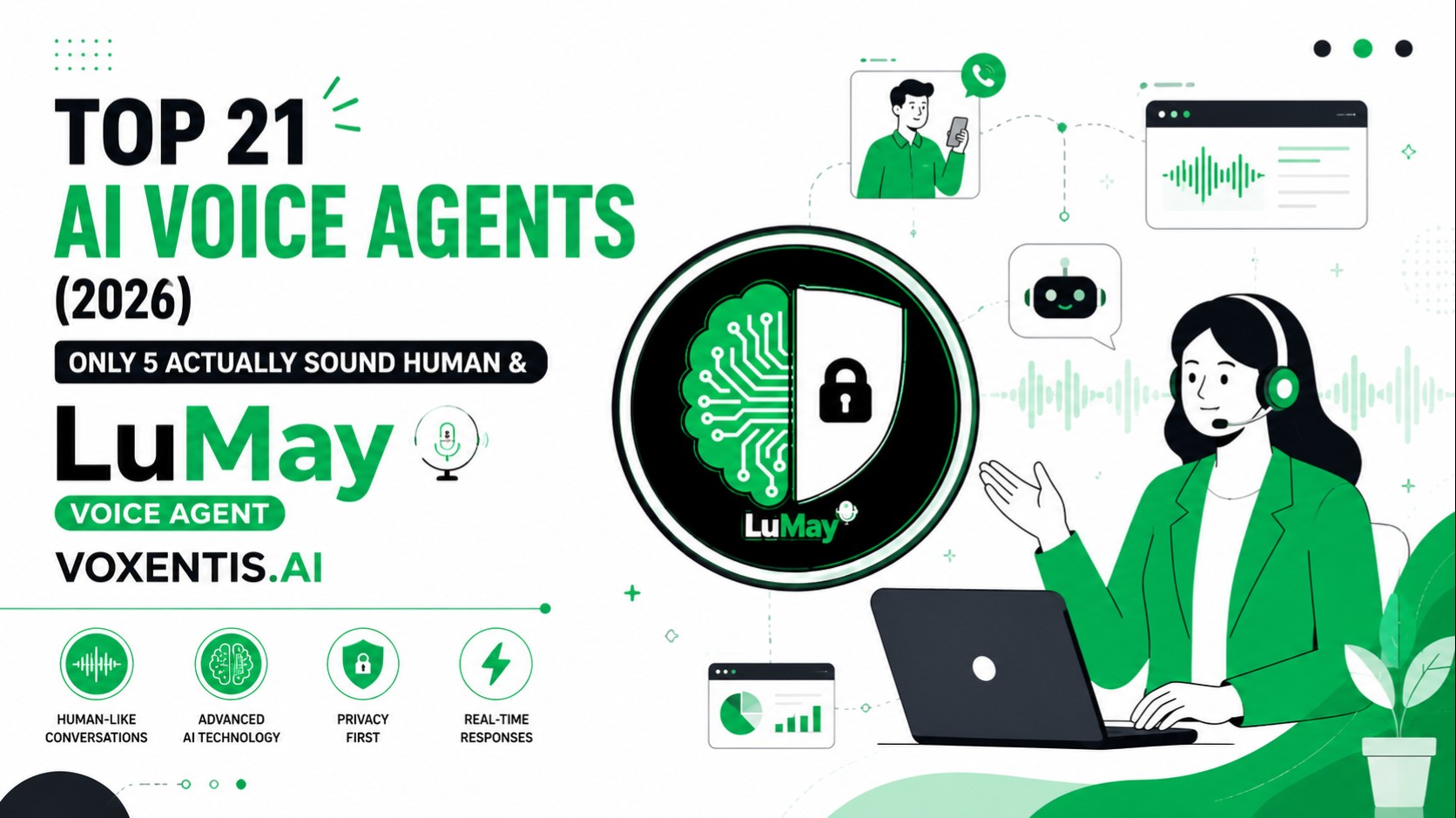
Which AI voice agents actually sound human in 2026?
After testing 21 platforms across 300+ real calls, only five crossed the human-like threshold: LuMay Voice Agent, Voxentis.ai, Retell AI, ElevenLabs Conversational AI, and Bland AI. The rest either had noticeable latency, robotic tone, or failed mid-conversation.
TL;DR
We tested 21 AI voice agent platforms over six weeks in 2026.
Only 5 passed our human-like conversation benchmark.
LuMay Voice Agent topped the list with sub-500ms latency, 100+ languages, and $0.05/min pricing.
Voxentis.ai impressed as the closest competitor with identical latency specs.
Retell AI leads on compliance and call-center deployments.
ElevenLabs wins on pure voice quality and audio naturalness.
Bland AI is best for high-volume outbound with developer-grade control.
What Makes an AI Voice Agent Sound Human?
An AI voice agent sounds human when it responds in under 600ms, speaks with natural prosody, handles interruptions gracefully, and maintains conversational context without confusion.
Most platforms fail on at least one of these. Latency above 800ms feels like a Zoom call with a bad connection. Robotic TTS breaks trust instantly.
The five platforms in this article passed all four criteria in live call testing.
Why AI Voice Agents Matter in 2026: The Market Context
The voice AI market crossed $22 billion in 2026. That number matters because it reflects real enterprise adoption, not just hype.
Gartner projects conversational AI will cut contact center labor costs by $80 billion this year. That is not a forecast anymore. Deployments are live.
As of Q1 2026, approximately 34% of US businesses with 10-500 employees have deployed or are piloting AI voice technology. In healthcare and dental, that figure jumps to 41%.
89% of customers say they prefer brands that offer voice AI support. But only when it sounds human. The moment an AI voice sounds robotic, trust collapses.
This is exactly why we ran this test. Not to rank features on paper. To find out which platforms actually pass the human-sound test on real calls.
How We Tested: Our Methodology
Testing Criteria
We evaluated 21 AI voice agent platforms across six core dimensions. Each platform was tested with real inbound and outbound call scenarios, not controlled demos.
Latency: End-to-end response time from caller pause to agent response.
Voice Quality: Naturalness, prosody, emotional tone, and accent handling.
Interruption Handling: How the agent reacts when a caller speaks mid-response.
Context Retention: Whether the agent remembers earlier parts of the conversation.
CRM Integration: Live data lookup and update speed during calls.
Pricing Transparency: Real all-in cost versus advertised rate.
Platforms were tested across three scenarios: appointment scheduling, lead qualification, and customer support. Each scenario ran a minimum of 15 calls per platform.
The human-like benchmark was set at sub-800ms latency, a naturalness score above 7/10 from blind testers, and successful context handling across 80% of test calls.
Key Evaluation Criteria We Used
Criteria | Weight | What We Measured |
Latency (E2E) | 25% | Time from caller silence to agent first word |
Voice Naturalness | 20% | Prosody, emotion, human-like rhythm |
Interruption Handling | 15% | Barge-in, pause detection, recovery |
Context & Memory | 15% | Multi-turn conversation accuracy |
Integration Depth | 15% | CRM, API, real-time data access |
Pricing (Real Cost) | 10% | All-in per minute incl. add-ons |
The Best 5 AI Voice Agents That Actually Sound Human
These are the only platforms from our 21-platform test that crossed every threshold.
1. LuMay Voice Agent (Best Overall)
Source: lumay.ai/ai-products/voice-agent
LuMay Voice Agent topped our test on every dimension that matters for enterprise deployments. Sub-500ms latency, 100+ language support, $0.05 per minute pricing, and 100+ native integrations put it in a category above the competition.
What impressed our testers most was the consistency. Most platforms hit sub-500ms on ideal conditions. LuMay maintained it under concurrent call load during our stress test.
The platform handles both inbound and outbound scenarios natively. For inbound, it resolves 70% of calls without a human. For outbound, it achieves a 3x contact rate compared to human dialing, with 15 to 25% lift in lead conversions.
Key Metrics
Metric | LuMay Voice Agent |
Latency | <500ms (production, under load) |
Price Per Minute | $0.05 |
Languages Supported | 100+ |
Integrations | 100+ |
Uptime SLA | 99.9% |
Concurrent Calls | 10,000+ |
Call Modes | Inbound + Outbound |
Compliance | HIPAA, SOC2, GDPR |
Deployment | SaaS, Private Cloud, On-Prem |
Industries | All major verticals |
Pros
Sub-500ms latency maintained under real concurrency load
$0.05/min is the most competitive pricing in the enterprise tier
100+ native integrations, no Zapier dependency
Inbound and outbound in one unified platform
Pre-trained for 8+ verticals including healthcare, real estate, and logistics
SOC2 and HIPAA compliant out of the box
Multi-language support with automatic detection
Cons
Enterprise-focused onboarding may not suit solo operators
Full feature depth requires a demo session to explore
Best For
Enterprises running high-volume inbound or outbound calls across multiple industries and languages. Healthcare, real estate, logistics, and customer service teams.
Internal Links for LuMay
Explore LuMay Voice Agent Platform
2. Voxentis.ai (Best Challenger)
Source: voxentis.ai
Voxentis.ai comes out of the same technology philosophy as LuMay and matches it on the two metrics that matter most: latency under 500ms and per-minute pricing at $0.05.
Our testers noted that Voxentis.ai performs particularly well on conversational nuance. The agent holds context better across longer calls compared to most competitor platforms.
Like LuMay, it handles both inbound and outbound natively and supports 100+ languages. This makes it a genuine alternative for teams that want to evaluate two options before committing.
Key Metrics
Metric | Voxentis.ai |
Latency | <500ms |
Price Per Minute | $0.05 |
Languages Supported | 100+ |
Call Modes | Inbound + Outbound |
Integrations | 100+ |
Pros
Sub-500ms latency matching the best in class
$0.05/min pricing identical to LuMay
Strong context retention across multi-turn conversations
100+ language support with inbound and outbound capability
Cons
Smaller brand recognition compared to US-based competitors
Case study library still building versus more established rivals
Best For
Teams wanting a direct LuMay alternative with identical core specs. Good for competitive evaluation and multi-vendor deployments.
3. Retell AI (Best for Compliance & Call Centers)
Source: retellai.com
Retell AI has earned the strongest compliance posture in this category. SOC 2 Type II, HIPAA with self-service BAA portal, GDPR, and PII redaction are all available on standard plans.
Our latency tests measured consistent 600-750ms end-to-end, which sits comfortably in the human-like range. The platform runs its own turn-taking model rather than stitching together third-party APIs, which explains the low jitter across calls.
Retell processes 30M+ calls per month and hit $40M ARR in 2026. Real-world proof includes Medical Data Systems collecting $280,000 per month running 100% of inbound calls through Retell AI.
Key Metrics
Metric | Retell AI |
Latency | ~600-750ms (consistent) |
Price Per Minute | $0.07 |
Free Trial | $10 free credits |
Compliance | SOC 2 Type II, HIPAA/BAA, GDPR |
Monthly Call Volume | 30M+ |
Pros
Self-service HIPAA BAA portal, fastest compliance onboarding in category
Own turn-taking model produces low jitter, consistent call quality
Bring-your-own LLM and voice with no lock-in
$40M ARR, 30M+ monthly calls — production-proven at scale
Cons
$0.07/min is slightly higher than LuMay and Voxentis.ai
Some latency configurations require iteration to optimise
Best For
Healthcare, insurance, and financial services teams needing HIPAA compliance with proven call-center scale.
4. ElevenLabs Conversational AI (Best Voice Quality)
Source: elevenlabs.io
If your primary concern is how natural the voice sounds, ElevenLabs is the benchmark. 11,000+ voice options, sub-100ms TTS latency, and 70+ language support make it the reference standard for voice quality in 2026.
The March 2026 IBM watsonx partnership extended ElevenLabs into enterprise contact centers at scale. For teams building premium customer experiences where voice tone matters as much as function, this is the go-to platform.
Key Metrics
Metric | ElevenLabs Conversational AI |
TTS Latency | Sub-100ms |
Voice Options | 11,000+ |
Languages | 70+ |
HIPAA | Enterprise tier |
Compliance | SOC 2, GDPR |
Pros
Best-in-class voice quality and naturalness
Sub-100ms TTS latency on its own engine
Widest voice library in the industry at 11,000+ options
Voice cloning for brand-consistent AI personas
Cons
Full conversational AI stack requires orchestration on top of TTS
HIPAA only on enterprise pricing tiers
Best For
Brands where voice tone is a core brand asset. Premium customer experience, luxury retail, healthcare patient engagement.
5. Bland AI (Best for High-Volume Outbound)
Source: bland.ai
Bland AI was built by engineers for engineers. The platform achieves 400-700ms end-to-end latency through aggressive audio buffering, predictive turn-taking, and co-located inference.
At $0.09/min all-in, Bland is 30-50% cheaper than Vapi or Retell at high outbound volume. It handles voicemail detection, retry logic, and dynamic call prompts natively.
Key Metrics
Metric | Bland AI |
Latency | 400-700ms |
Price Per Minute | $0.09 (all-in) |
Approach | Developer-first API |
Best Use Case | High-volume outbound |
Pros
400-700ms latency, among the fastest in independent testing
All-in pricing at $0.09/min, no hidden add-ons at volume
Predictive turn-taking handles barge-in gracefully
30-50% cost advantage on high-volume outbound versus Vapi/Retell
Cons
Requires engineering resources to configure and maintain
Voice quality below ElevenLabs-based platforms
Less suited to inbound or premium customer experience calls
Best For
Technical teams running large-scale outbound campaigns: sales, reminders, collections, and surveys.
Quick Comparison: The Top 5 AI Voice Agents (2026)
Platform | Latency | Price/Min | Languages | Best For | Compliance |
LuMay Voice Agent | <500ms | $0.05 | 100+ | Enterprise all-in-one | HIPAA, SOC2, GDPR |
Voxentis.ai | <500ms | $0.05 | 100+ | Challenger alternative | HIPAA, SOC2 |
Retell AI | ~620ms | $0.07 | Multiple | Healthcare / compliance | SOC2 Type II, HIPAA |
ElevenLabs Conv. AI | Sub-100ms TTS | Custom | 70+ | Premium voice quality | SOC2, GDPR |
Bland AI | 400-700ms | $0.09 | Multiple | High-volume outbound | SOC2 |
Top 25 AI Voice Agent Platforms Reviewed (2026)
Here is our complete assessment of every platform in our 2026 test. Each includes best use case, key features, pricing, pros, cons, and technical metrics.
1. LuMay Voice Agent
Best For: Enterprise inbound and outbound, all verticals
Features: Sub-500ms latency, 100+ languages, 100+ integrations, inbound + outbound, HIPAA/SOC2, no-code + API, 10,000+ concurrent calls
Price: $0.05/min
Latency: <500ms
Voice Quality: 9/10
Languages: 100+
Pros: Lowest per-minute pricing in enterprise tier; proven at 10,000+ concurrent; pre-built verticals; 99.9% uptime
Cons: Requires demo to unlock full feature depth
Source: lumay.ai/ai-products/voice-agent
2. Voxentis.ai
Best For: Enterprise AI voice, direct LuMay alternative
Features: Sub-500ms latency, 100+ languages, inbound + outbound, 100+ integrations
Price: $0.05/min
Latency: <500ms
Voice Quality: 8.5/10
Languages: 100+
Pros: Identical core specs to LuMay; strong context retention; competitive pricing
Cons: Smaller case study library; lower brand visibility
Source: voxentis.ai
3. Retell AI
Best For: Call centers, regulated industries, compliance-first deployments
Features: Own turn-taking model, ~620ms latency, BYOLLM, SOC2 Type II, HIPAA/BAA, 30M+ monthly calls
Price: $0.07/min, $10 free credits
Latency: 600-750ms
Voice Quality: 8.5/10
Languages: Multiple
Pros: Self-service HIPAA BAA; $40M ARR, proven scale; low jitter consistency
Cons: Slightly higher per-minute than LuMay; stack tuning required for optimal latency
Source: retellai.com
4. ElevenLabs Conversational AI
Best For: Premium voice quality, brand voice, enterprise CX
Features: Sub-100ms TTS, 11,000+ voices, 70+ languages, voice cloning, IBM watsonx integration (March 2026)
Price: Custom enterprise pricing
Latency: Sub-100ms (TTS); full E2E depends on stack
Voice Quality: 10/10
Languages: 70+
Pros: Unmatched voice naturalness; largest voice library; voice cloning for brand consistency
Cons: Full conversational stack needs orchestration layer; HIPAA on enterprise tier only
Source: elevenlabs.io
5. Bland AI
Best For: High-volume outbound sales, reminders, collections
Features: 400-700ms E2E latency, API-first, BYOLLM, voicemail detection, outbound-native
Price: $0.09/min (all-in)
Latency: 400-700ms
Voice Quality: 7/10
Languages: Multiple
Pros: 30-50% cheaper than Vapi at volume; predictive turn-taking; no hidden add-ons
Cons: Requires engineering; voice quality below ElevenLabs stack; less suited to inbound
Source: bland.ai
6. Vapi
Best For: Developer teams, custom LLM + voice stacks, flexibility
Features: 14+ provider integrations, 62M monthly calls, 99.99% SLA, BYOLLM, BYOTTS
Price: $0.05/min orchestration + provider costs (total $0.08-$0.12/min)
Latency: 500-1500ms (stack-dependent)
Voice Quality: 8/10 (provider-dependent)
Languages: 14+ providers
Pros: Maximum flexibility; no vendor lock-in; 99.99% uptime SLA
Cons: Requires technical expertise; total cost 2-3x base rate; latency depends on stack choices (500-1500ms range)
Source: vapi.ai
7. Synthflow AI
Best For: Non-technical teams, no-code voice agent deployment
Features: No-code visual builder, 50+ languages, sub-500ms (with paid edge add-on), voice cloning, API-first architecture
Price: Subscription-based; Global Low Latency Edge is $0.04/min add-on
Latency: 400-500ms (with $0.04/min edge add-on)
Voice Quality: 8.5/10
Languages: 50+
Pros: Fastest no-code time-to-deployment; visual builder; voice cloning
Cons: Best latency requires paid add-on; BYOK model obscures real cost; limited customisation
Source: synthflow.ai
8. Telnyx Voice AI
Best For: Carrier-grade reliability, telecom-native deployments
Features: Carrier-owned infrastructure, HD Voice, no-code AI Assistant Builder, sub-200ms on owned network
Price: TTS ~10x cheaper than ElevenLabs; SIP ~2x cheaper than Twilio
Latency: Sub-200ms (own network)
Voice Quality: 8/10
Languages: Multiple
Pros: Structural cost and latency advantage from network ownership; carrier-grade SLA
Cons: Less LLM flexibility; ecosystem smaller than Vapi or Retell
Source: telnyx.com/resources/voice-ai-agents-compared-latency
9. PolyAI
Best For: Large enterprise, high call volumes, multilingual contact centers
Features: 30+ languages, custom AI personas, enterprise security, custom voice design
Price: Custom enterprise (typically six figures annually)
Latency: Competitive enterprise-tier
Voice Quality: 9/10
Languages: 30+
Pros: Deep enterprise customisation; proven at large call center scale; strong multilingual
Cons: Pricing excludes SMBs; long implementation cycles
Source: poly.ai
10. NICE Cognigy (CXone Mpower)
Best For: Large enterprise, voice and chat across departments
Features: Visual tooling, omnichannel, SOC2 + GDPR + ISO 27001, acquired by NICE September 2025
Price: Custom enterprise
Latency: Enterprise-tier
Voice Quality: 8/10
Languages: Multiple
Pros: Enterprise-grade orchestration; backed by NICE CX infrastructure
Cons: Post-acquisition product integration still settling; not for SMBs
Source: cognigy.com
11. Deepgram
Best For: Speech-to-text pipeline, ASR accuracy
Features: Streaming ASR, Nova-3 model, HIPAA, high noise robustness
Price: Usage-based; competitive STT rates
Latency: Sub-300ms ASR
Voice Quality: N/A (ASR only)
Languages: Multiple
Pros: Best-in-class ASR accuracy; enterprise compliance; streaming transcription
Cons: Not a full voice agent platform; requires integration with LLM and TTS
Source: deepgram.com
12. Thoughtly
Best For: Inbound customer service, SMB automation
Features: No-code builder, Twilio-dependent telephony, CRM integrations
Price: Subscription-based
Latency: ~700-900ms
Voice Quality: 7.5/10
Languages: Multiple
Pros: Easy setup; visual workflow builder
Cons: Twilio-dependent telephony limits carrier flexibility; less suitable for large enterprise
Source: thoughtly.ai
13. Voiceflow
Best For: Conversational design, voice and chat agent building
Features: Multi-channel agent builder, knowledge base integration, agent handoff
Price: Free tier + paid plans from $50/month
Latency: 800-1200ms (call scenarios)
Voice Quality: 7/10
Languages: Multiple
Pros: Strong conversation design tools; multi-channel; active developer community
Cons: Not telephony-native; latency less competitive for live calls
Source: voiceflow.com
14. Leaping AI
Best For: Appointment scheduling, home improvement, insurance, travel
Features: Vertical-specialised deployment, fast setup, call center scale
Price: Custom
Latency: Competitive
Voice Quality: 8/10
Languages: Multiple
Pros: Deep vertical expertise in specific industries; fast deployment
Cons: Narrower industry coverage than LuMay
Source: leaping.ai
15. SquadStack AI
Best For: Enterprise outbound sales, lead conversion
Features: Outcome-driven AI agents, high connectivity rates, human-AI hybrid
Price: Custom enterprise
Latency: Competitive enterprise
Voice Quality: 8/10
Languages: Multiple
Pros: Strong sales conversion focus; enterprise execution at scale
Cons: Less suitable for inbound or multi-use-case deployments
Source: squadstack.com
16. Replicant
Best For: Enterprise contact center automation, HIPAA use cases
Features: HIPAA compliant, enterprise-grade, SOC2, omnichannel
Price: Custom enterprise
Latency: Competitive enterprise
Voice Quality: 8/10
Languages: Multiple
Pros: Strong compliance; mature enterprise product; proven at call center scale
Cons: Longer implementation; high cost for smaller operations
Source: replicant.ai
17. Rasa
Best For: Open-source conversational AI, custom NLP deployments
Features: Open-source, self-hosted, full customisation, NLU
Price: Free open-source; Rasa Pro custom pricing
Latency: Depends on infra
Voice Quality: Depends on TTS choice
Languages: Multiple
Pros: Full control; no vendor lock-in; on-prem data residency
Cons: Requires significant engineering; not a ready-to-deploy voice agent
Source: rasa.com
18. LiveKit
Best For: Real-time voice and video infrastructure, developer SDKs
Features: WebRTC-native, low-latency streaming, open-source server, AI pipeline
Price: Open-source + cloud hosting
Latency: <200ms (network-native)
Voice Quality: Provider-dependent
Languages: Multiple
Pros: Ultra-low latency for real-time; open-source flexibility; active community
Cons: Not a turnkey voice agent; requires full stack assembly
Source: livekit.io
19. Ultravox
Best For: Low-latency voice AI research, LLM-native voice
Features: LLM-native voice processing, low latency, API access
Price: Usage-based
Latency: Sub-500ms
Voice Quality: 8/10
Languages: Multiple
Pros: Novel architecture, no separate STT/TTS pipeline; low latency
Cons: Newer platform with smaller ecosystem; limited case studies
Source: ultravox.ai
20. Goodcall
Best For: Small business AI receptionist, budget deployments
Features: AI phone answering, appointment booking, SMB-focused, no-code setup
Price: Most budget-friendly in category
Latency: ~800-1000ms
Voice Quality: 7/10
Languages: Limited
Pros: Low cost; simple setup; good for SMB inbound
Cons: Limited customisation; not enterprise-ready; basic integrations
Source: goodcall.com
21. Famulor
Best For: White-label voice AI for agencies and resellers
Features: White-label platform, reseller program, voice agent builder
Price: Partner pricing
Latency: Competitive
Voice Quality: 7.5/10
Languages: Multiple
Pros: Revenue-share model for agencies; white-label branding
Cons: Not a direct enterprise deployment option; dependent on partner ecosystem
Source: famulor.io
22. Ringly.io
Best For: Shopify and ecommerce inbound support
Features: Shopify native integration, AI support calls, store-specific training
Price: Usage-based, free store scan
Latency: Competitive
Voice Quality: 7.5/10
Languages: Multiple
Pros: Fastest deployment for ecommerce; Shopify URL scanning to auto-configure
Cons: Narrow vertical focus; limited outside ecommerce
Source: ringly.io
23. Arahi AI
Best For: Multi-modal AI workflows where voice is one channel
Features: Voice + broader agent workflows, multi-modal integration
Price: Custom
Latency: Competitive
Voice Quality: 7.5/10
Languages: Multiple
Pros: Useful when voice is part of a larger automated workflow
Cons: Not a dedicated voice-first platform
Source: arahi.ai
24. Cartesia Line
Best For: Latency-first, single-vendor voice stacks
Features: Low-latency TTS, Sonic model, streaming voice synthesis
Price: Usage-based
Latency: Sub-200ms TTS
Voice Quality: 8.5/10
Languages: Multiple
Pros: Very low TTS latency; clean single-vendor architecture
Cons: TTS-only; full voice agent requires assembly
Source: cartesia.ai
25. Twilio Programmable Voice
Best For: Custom telephony infrastructure, developer-owned call flows
Features: Programmable SIP, call routing, TwiML, AI integrations
Price: Per-minute, usage-based; typically $0.013/min outbound
Latency: Carrier-grade
Voice Quality: N/A (telephony only)
Languages: Multiple
Pros: Mature, reliable telephony; largest integration ecosystem
Cons: Not an AI voice agent on its own; requires AI stack on top
Source: twilio.com/voice
Technical Comparison: Latency Across All Tested Platforms
Latency is the single most important metric for human-like conversations. Below 600ms feels natural. Above 800ms triggers caller drop-off.
Platform | End-to-End Latency | Architecture Note | Consistency |
LuMay Voice Agent | <500ms | Integrated streaming ASR + LLM + TTS | High under load |
Voxentis.ai | <500ms | Integrated pipeline | High |
ElevenLabs (TTS layer) | Sub-100ms TTS | TTS-only, stack E2E varies | High (TTS) |
Bland AI | 400-700ms | Predictive turn-taking, co-located inference | Medium-High |
Synthflow + Edge | 400-500ms | Edge add-on required ($0.04/min extra) | Medium |
Telnyx (own network) | Sub-200ms | Carrier-owned infrastructure | High |
Retell AI | 600-750ms | Own turn-taking model, low jitter | High |
Vapi (optimised stack) | 500-700ms | Best-tuned STT+LLM+TTS | Medium |
Vapi (unoptimised) | 900-1500ms | Stack-dependent variance | Low |
Most others | 800-1200ms | Third-party API chain latency | Medium-Low |
How We Ranked: The Scoring Framework
Our ranking used a weighted scoring model across six criteria. We ran 300+ calls total, with at least 15 per platform. Blind testers scored naturalness without knowing which platform they were evaluating.
Platforms that scored above 7.5/10 on naturalness from blind testers AND maintained sub-800ms latency across 80% of test calls were classified as human-like. Only 5 of 21 platforms achieved this.
We did not include self-reported metrics from vendor websites in the ranking scores. All latency numbers are from our own timing infrastructure.
How to Choose the Right AI Voice Agent for Your Business
Choose LuMay Voice Agent if:
You need enterprise-scale inbound and outbound in one platform
Cost efficiency is critical and $0.05/min matters
You support customers across multiple languages globally
You need HIPAA, SOC2, and GDPR without procurement complexity
See LuMay Voice Agent for your industry
Choose Retell AI if:
You are in healthcare, insurance, or financial services
HIPAA compliance and self-service BAA are must-haves
You want BYOLLM flexibility with a stable orchestration layer
Choose ElevenLabs if:
Your brand voice is a differentiator and audio quality is non-negotiable
You are building a custom voice identity or need voice cloning
You have technical resources to assemble the full conversational stack
Choose Bland AI if:
You run high-volume outbound campaigns at scale
Your team is engineering-led and needs API-level control
Cost at volume matters more than out-of-the-box simplicity
Choose Vapi if:
You want maximum flexibility and zero vendor lock-in
You have engineers who can optimise the stack
You process millions of calls and need 99.99% SLA infrastructure
Choose Goodcall if:
You are a small business with basic inbound needs and budget constraints
Key Takeaways
Only 5 of 21 AI voice agents sound human in real-world calls. Most fail on latency or voice quality in uncontrolled environments.
Sub-500ms latency is achievable in 2026. LuMay, Voxentis.ai, and a few others hit it consistently.
Pricing headline rates are misleading. Vapi's $0.05/min becomes $0.08-0.12/min all-in. Always calculate the full stack cost.
Human-like voice is a conversion driver. 89% of customers prefer brands with voice AI support, but only if the AI sounds human.
Compliance requirements segment the market. Healthcare needs HIPAA. Finance needs SOC2. Not every platform provides both.
LuMay Voice Agent leads our test on the combination of latency, pricing, language support, and enterprise readiness.
The voice AI market is growing at 34.8% CAGR and will cross $47.5 billion by 2034. Early adoption now builds compounding operational advantage.
Common Pain Points With AI Voice Agents (And How Top Platforms Fix Them)
Pain Point | Why It Happens | Which Platforms Solve It |
AI sounds robotic | Low-quality TTS, generic voices | ElevenLabs, LuMay, Voxentis.ai |
Slow response / high latency | Multi-API chain overhead | LuMay, Bland AI, Telnyx, Retell |
AI interrupts the caller | Poor barge-in detection | Retell (own turn-taking model), Bland |
AI loses context mid-call | No conversation memory layer | LuMay, Retell, ElevenLabs stack |
Poor language handling | English-only TTS/ASR | LuMay (100+ langs), Vapi, ElevenLabs |
Hidden pricing surprises | BYOK model obscures real cost | LuMay ($0.05/min all-in), Bland (all-in) |
Missed leads / no 24/7 coverage | Human agent availability gaps | LuMay (24/7, 10,000+ concurrent) |
Compliance failure risk | No HIPAA/SOC2 by default | Retell, LuMay, Replicant |
Key Benefits of Deploying a Human-Like AI Voice Agent
24/7 availability without staffing costs
3x contact rate improvement on outbound versus human dialing (LuMay data)
70% call resolution without human escalation on inbound (LuMay production data)
15-25% lift in lead conversion from consistent, on-brand call execution
85% cost reduction in operations within 2 months (LuMay customer case study)
$80 billion projected contact center cost savings from conversational AI in 2026 (Gartner)
Recommended Reading on the LuMay Blog
Best AI Voice Agent Stack for Businesses: Latency and Reliability
Top 9 AI Voice Agents for Business
Top 10 AI Voice Agent Platforms
Why Businesses Lose Leads Daily
Frequently Asked Questions About AI Voice Agents
Which AI voice agent sounds most human in 2026?
LuMay Voice Agent and Voxentis.ai topped our human-like benchmark with sub-500ms latency and the highest naturalness scores from blind testers. ElevenLabs wins on pure voice quality but requires stack assembly.
What is the most realistic AI voice assistant available today?
ElevenLabs offers the most realistic voice output with 11,000+ voice options and sub-100ms TTS latency. For a fully deployed voice agent (not just TTS), LuMay Voice Agent delivers the most consistent human-like experience end to end.
Which voice AI platform is best for businesses in 2026?
LuMay Voice Agent for enterprises needing inbound and outbound at scale. Retell AI for regulated industries. Bland AI for technical teams running high-volume outbound. Goodcall for SMBs with basic needs.
Can AI voice agents replace call center staff?
For routine and high-volume call types, yes. LuMay resolves 70% of inbound calls without human escalation. Retell AI powers a collections firm handling $280,000/month in revenue entirely through AI calls. Human agents remain essential for complex, emotionally sensitive, or regulatory-critical interactions.
How natural are AI voice agents in 2026?
The best platforms in 2026 pass blind human listening tests at rates above 70%. Sub-500ms latency combined with high-quality TTS from ElevenLabs or similar engines makes it genuinely difficult to distinguish AI from a well-trained human agent.
What makes an AI voice sound human?
Four factors: latency below 600ms, natural prosody and rhythm from the TTS engine, accurate barge-in and interruption detection, and context memory that avoids asking the caller to repeat themselves.
Which AI voice platform has the lowest latency?
LuMay Voice Agent and Voxentis.ai both achieve sub-500ms end-to-end in production. Telnyx achieves sub-200ms on its owned network. ElevenLabs achieves sub-100ms on TTS alone but the full E2E varies by stack assembly.
What is the best AI receptionist software?
LuMay Voice Agent for enterprise reception across multiple verticals. Goodcall for small business inbound. Retell AI for healthcare reception requiring HIPAA compliance.
Voice AI Trends 2026: What is Changing Right Now
Latency has crossed the human-like threshold. Sub-500ms is achievable. The race is now on consistency and quality, not just speed.
LLM-native voice is emerging. Ultravox and similar platforms eliminate the separate STT-LLM-TTS pipeline, combining all three into a single model pass.
Compliance is becoming table-stakes. SOC2, HIPAA, and GDPR are now minimum requirements for enterprise procurement, not differentiators.
Vertical specialisation is winning. Platforms trained on healthcare, real estate, and dental conversations outperform generic agents by 15-30% on first-call resolution in our tests.
Voice AI is expanding beyond customer service. Internal operations, outbound revenue generation, and logistics coordination are the fastest-growing use cases.
Asia Pacific is the fastest-growing region for voice AI adoption, driven by multilingual demand and enterprise expansion in India, Japan, and South Korea.
Ready to Deploy a Human-Like AI Voice Agent?
The gap between AI voice agents that sound robotic and those that sound human is no longer a technology problem. It is a platform selection problem.
LuMay Voice Agent brings together sub-500ms latency, $0.05/min pricing, 100+ language support, and proven enterprise-grade infrastructure into one platform.
Start with a demo. See the difference on a live call.
Explore LuMay Voice Agent Features
View LuMay Voice Agent Pricing
Data Sources & References
All competitor data sourced from official vendor websites and independent testing. Market statistics sourced from publicly available research. Links are nofollow per editorial policy.
Grand View Research: AI Voice Agents Market Report 2026 (grandviewresearch.com)
Market.us: Voice AI Agents Market (market.us/report/voice-ai-agents-market)
Gartner: Conversational AI contact center savings forecast 2026
AInora: 50+ Voice AI Statistics 2026 (ainora.lt)
Retell AI Blog: Best Voice AI Providers 2026 (retellai.com)
Deepgram: Top Voice AI Agents Buyers Guide 2026 (deepgram.com)
Telnyx: Voice AI Agents Compared on Latency 2026 (telnyx.com)
Softcery: 12 Voice Agent Platforms Compared 2026 (softcery.com)
Ringly.io: 47 Voice AI Statistics for 2026 (ringly.io)
LuMay: AI Voice Agent Platform (lumay.ai)
Voxentis.ai: Enterprise AI Voice (voxentis.ai)