
 ChatGPT
 Perplexity
 Grok
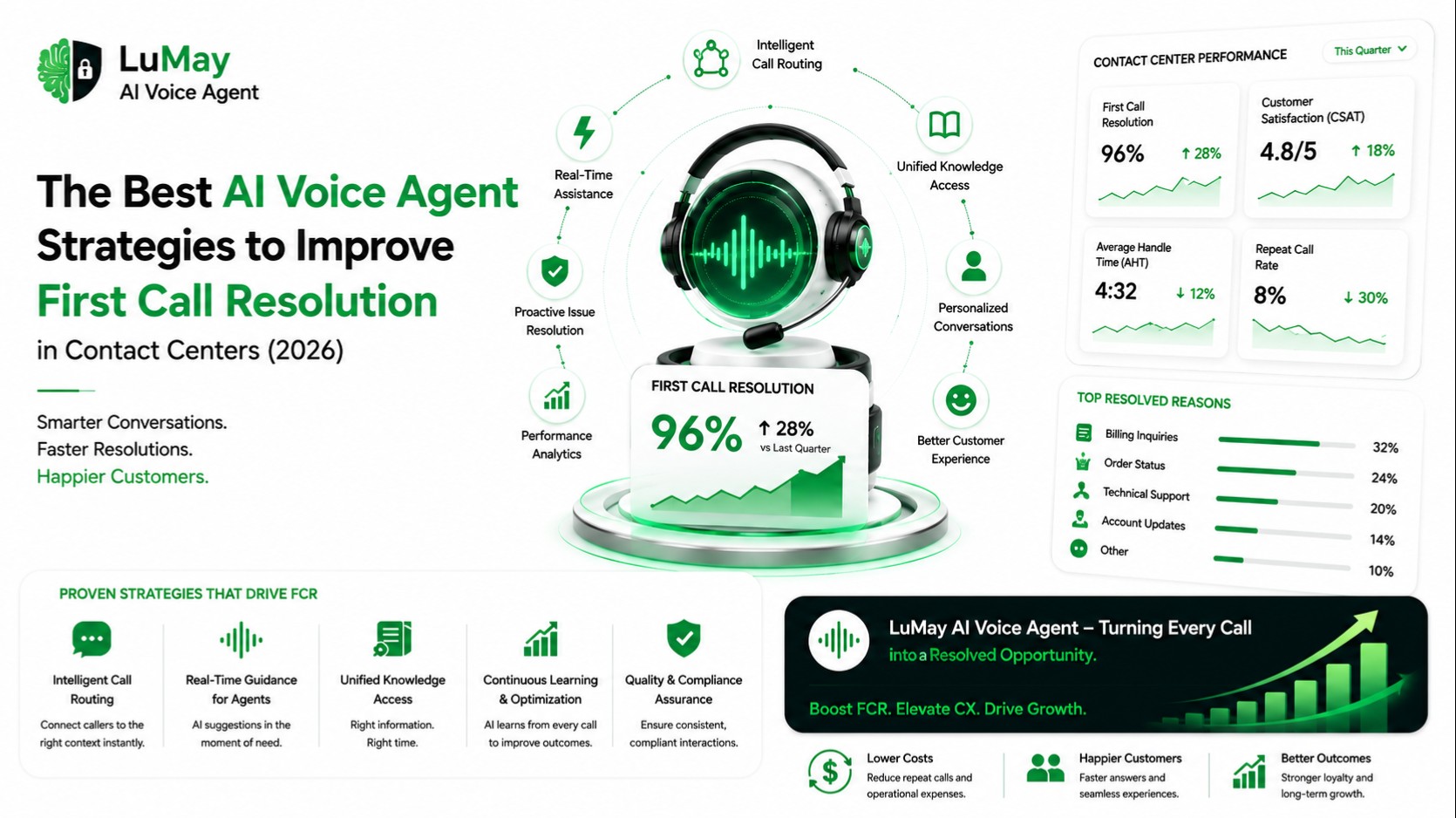
GrokDirect Answer: How Do AI Voice Agents Improve First Call Resolution?
An AI voice agent improves first call resolution by replacing the limitations of legacy IVR and understaffed agent queues with an intelligent, always-available voice system that:
• Understands what the caller actually means - not just what they press on a keypad
• Retrieves live data from CRM, scheduling, and knowledge systems during the call
• Completes tasks - booking, payment, status update, confirmation - within the same conversation
• Escalates to a human agent only when truly necessary, with full context already transferred
• Operates 24/7, at any volume, with consistent quality and compliance on every call
The result: more issues resolved on the first contact, fewer callbacks, lower cost per contact, and higher customer satisfaction.
Introduction: Why First Call Resolution Matters in 2026
U.S. contact centers are under sustained pressure. Customer expectations have never been higher - and staffing, budget, and legacy infrastructure have rarely been more constrained.
In 2026, callers expect to reach a voice system that understands them immediately, pulls up their account without repeating information, and resolves their issue before they hang up. According to the Salesforce State of the Connected Customer report (latest available data), a significant majority of customers say the experience a company provides is as important as its products or services. That expectation has reached the phone channel.
Yet millions of calls per day still hit voice menus built on 1990s IVR logic. Callers press 1, press 3, press 0 to reach an agent, wait on hold, explain their problem again, get transferred - and sometimes call back the next day to try once more. Every one of those repeat calls is a missed resolution and a real operational cost.
Meanwhile, contact centers face five compounding pressures:
• Rising call volumes as digital self-service channels fail to contain complex issues
• Agent attrition and a persistent shortage of qualified customer service professionals
• CRM and helpdesk systems that agents cannot query fast enough during live calls
• Inconsistent answers across shifts, regions, and agent experience levels
• Regulatory pressure from TCPA, FCC AI voice rules, and state-level consumer protection laws
The AI voice agent has emerged as the most practical solution to all five pressures. Not as a replacement for human empathy or judgment - but as an intelligent front line that resolves what can be resolved instantly and escalates what cannot. Explore the full LuMay AI product ecosystem to understand how voice automation fits within a broader intelligent operations strategy.
What Is First Call Resolution?
First call resolution (FCR) measures the percentage of customer contacts resolved completely during the initial interaction - without a repeat call, follow-up contact, or transfer. It is widely regarded as the single most important operational metric in contact center performance.
Why FCR Matters
FCR Impact Area | Why It Matters |
Customer Satisfaction (CSAT) | Callers who reach a resolution on the first contact report significantly higher satisfaction scores. Repeat calls are a clear signal of failure. |
Cost Per Contact | Each unnecessary repeat call adds direct labor cost. Systematic FCR improvement reduces cost-per-contact across the operation. |
Agent Productivity | Agents spend less time handling repeat issues and more time on high-value conversations that require genuine human engagement. |
Customer Retention | Unresolved issues are a leading driver of churn, particularly in financial services, telecom, and healthcare. |
Revenue Impact | In outbound use cases - collections, renewals, re-engagement - faster resolution directly increases revenue capture per campaign. |
Note: Industry benchmarks suggest top-performing contact centers achieve FCR rates above 70–80% (directional reference; not independently verified for 2026). Centers operating legacy IVR with fragmented workflows often fall well below this threshold.
What Is an AI Voice Agent?
An AI voice agent is a software system that conducts live, two-way voice conversations with humans - autonomously. It is not a basic phone menu. It is not a scripted chatbot with synthesised voice output. It is an intelligent system that listens to natural speech, understands caller intent, retrieves relevant data in real time, executes defined workflows, and escalates to human agents when the situation requires judgment or empathy.
AI Voice Agent vs. Traditional IVR: The Core Distinction
A traditional IVR (Interactive Voice Response) system routes callers through branching menus based on keypad presses or limited voice commands such as 'billing' or 'cancel.' It cannot understand context, cannot retrieve live data, and cannot take action during the call. It routes - it does not resolve.
An AI voice agent understands free-form natural language. It can hear 'I never received my package and I've already called twice about this' and respond with the correct account information from the CRM, the appropriate resolution from the knowledge base, and - if needed - route to the right agent with a full structured summary of the conversation so far.
Introducing LuMay Voice Agent
LuMay Voice Agent is an autonomous AI voice agent built for enterprise-grade, high-volume calling. It handles both inbound and outbound calls in real time, combining:
• Real-time speech recognition with accent awareness across U.S., UK, Indian, Latino, and other English variants
• Intent detection and natural language understanding (NLU)
• Live CRM lookups and system queries executed during the conversation
• Workflow execution - booking, payment processing, status update, case creation - without agent involvement
• Automated call summaries and outcome logging to CRM
• Context-aware escalation to human agents with warm handoff and whisper coaching
• Batch outbound calling for campaigns up to 10,000+ simultaneous calls
• HIPAA and SOC2 compliance with automated PII/PHI redaction
LuMay Voice Agent is one component of the broader LuMay AI platform, which includes Workflow AI, Knowledge AI, and Monitoring AI - giving contact centers an integrated intelligent operations layer, not a standalone call tool. For a detailed product walkthrough, read What Is LuMay Voice Agent? Complete Guide 2026.
Top 7 Ways AI Voice Agents Improve First Call Resolution
1. Intent Understanding from Natural Speech
The most fundamental limitation of traditional IVR is that it cannot understand what a caller actually means. AI voice agents parse natural, conversational language in real time. A caller who says 'I think there was a double charge on my account last week' is immediately understood - intent classified as billing dispute, account lookup triggered, resolution pathway initiated - without the caller pressing a single key.
LuMay Voice Agent uses advanced NLU to classify intent accurately even in noisy call-center environments, with partial sentences, accented speech, or mid-sentence corrections. This intent accuracy is the starting point for every FCR improvement that follows.
2. Real-Time CRM and Knowledge Retrieval
FCR requires answering the right question with the right information. That means pulling live account data, policy documents, ticket history, and appointment records during the call - not after it.
LuMay Voice Agent connects via SmartConnect to CRM systems, helpdesk tools, SQL databases, REST APIs, Azure services, and middleware platforms like Zapier and Power Automate. The relevant data is retrieved and surfaced to the voice agent within the conversation itself. For a deeper look at integration architecture and latency performance, read the LuMay blog article Best AI Voice Agent Stack for Businesses: Latency & Reliability.
3. Automated Workflow Execution During the Call
The most powerful FCR improvement an AI voice agent delivers is in-call action. Not a promise to send a callback email. Not a transfer to someone who might be able to help. Actually completing the task - right now, on the same call, before the caller disconnects.
With LuMay Voice Agent, the system can book an appointment, process a payment, update a delivery address, create a support ticket, or send a confirmation SMS - all within the same conversation, with no human involvement required.
4. Consistent Answers Across Every Call
Human agents vary. Across shifts, experience levels, and call volumes, inconsistency is structurally inevitable. An AI voice agent delivers the same accurate, compliant, brand-aligned response on call number 1 and call number 10,000.
This consistency directly reduces the repeat calls that stem from conflicting information - a major and underappreciated FCR failure point in multi-agent contact center environments.
5. Faster Routing and Context-Aware Human Handoff
When escalation to a human agent is appropriate, the quality of the handoff determines whether FCR is ultimately achieved. An AI voice agent that simply transfers the call repeats the original problem. One that transfers with a full, structured summary - caller name, account details, issue description, what was already attempted, recommended resolution pathway - allows the human agent to resolve the issue without starting over.
LuMay Voice Agent supports warm handoff with whisper coaching, delivering structured context to the receiving agent so the caller never has to repeat themselves.
6. 24/7 Availability for After-Hours Resolution
A significant portion of repeat calls are simply callers trying again after the contact center was closed. An AI voice agent eliminates this category entirely. Available at 3 AM or 3 PM, on public holidays, weekends, and during unexpected volume surges - with no staffing increase required.
For industries such as healthcare, logistics, and financial services, where after-hours calls carry real urgency - a missed appointment confirmation, a delayed delivery, an overdue payment - this is often the highest-impact FCR improvement available without a single additional hire.
7. Analytics, Transcripts, and Continuous Improvement
FCR rates improve over time only when you can identify precisely why calls fail. LuMay Voice Agent generates full call transcripts, sentiment tracking, outcome classification, and real-time performance dashboards after every interaction.
This data allows contact center leaders to identify specific failure points - gaps in the knowledge base, handoff triggers that are set too restrictively, intents that are being misclassified - and correct them without rebuilding the system. For a breakdown of top AI voice platforms and how their analytics stacks compare, see the LuMay blog post Top 10 AI Voice Agent Platforms (2026).
Why LuMay Voice Agent Is Built for Better First Call Resolution
LuMay Voice Agent is not a conversational wrapper on a basic phone tree. It is an autonomous AI voice agent architected specifically for enterprise contact center performance. The following table covers the core capabilities that directly drive FCR outcomes.
Feature | FCR Impact | Details |
Natural Conversational AI | High | Near-zero latency, interruptible speech, dynamic tone control, 50+ natural voices, custom enterprise voice cloning |
Real-Time Speech Recognition | High | Accent-aware ASR (US, UK, Indian, Latino, and more), noise-resistant, multi-lingual support across 6+ languages |
Intent Detection & NLU | High | Classifies caller intent in real time; handles partial speech, accented input, and mid-sentence corrections accurately |
CRM & System Integration | High | SmartConnect: REST APIs, SQL, Azure, Zapier, Power Automate, and industry-specific system connectors |
Workflow Automation | High | In-call booking, payment processing, case creation, status update, and record update - no agent involvement required |
Appointment Booking | Medium–High | Real-time calendar integration with slot confirmation and immediate SMS/email notification to caller |
Outbound Calling | Medium–High | Proactive reminders, payment follow-ups, collections, renewals, and re-engagement - fully automated outbound |
Batch Calling Engine | Medium–High | Upload 100–10,000 records, schedule campaigns, auto-retry logic, real-time call progress dashboard |
Human Handoff | High | Warm transfer with whisper coaching and full structured context delivery to the receiving human agent |
Sentiment & Outcome Analytics | Medium | Call outcome summaries, CSAT signals, failure analysis, sentiment tracking, real-time performance alerts |
Compliance Controls | Medium–High | HIPAA, SOC2, PII/PHI redaction, encrypted transcripts, STIR/SHAKEN caller ID, TCPA-aware scheduling |
Enterprise Security | Medium | RBAC access controls, IP allowlists, audit logging, encrypted data storage, air-gapped deployment available |
Scalable Infrastructure | High | 10,000+ concurrent calls on elastic infrastructure - no performance degradation during peak volume events |
No-Code / Low-Code Workflow | Medium | Deploy new voice workflows in minutes using drag-and-drop call logic builder and pre-built industry templates |
Latency Benchmarks and Why Response Speed Matters for FCR
In voice AI, latency is the gap between when a caller finishes speaking and when the AI responds. High latency breaks the conversational experience - callers feel they are interacting with a system, not an intelligent assistant. Response delays above 1.5–2 seconds cause callers to disengage, repeat themselves, or request immediate transfer to a human agent. Every one of those outcomes is a direct FCR failure.
Platform / Category | Reported Latency | Source Type | FCR Impact | Notes |
LuMay Voice Agent | Near-zero / sub-1-second (stated) | LuMay product page - lumay.ai/ai-products/voice-agent | Very High | Described as near-zero latency with interruptible speech; confirm SLA specifics with LuMay directly |
Vapi | ~500–800 ms (reported) | Community benchmarks and Vapi documentation | High | Developer-oriented; production latency varies significantly by pipeline and model configuration |
Retell AI | ~500 ms (reported) | Retell AI documentation and community benchmarks | High | Developer platform; production latency depends on model selection and TTS provider |
ElevenLabs Conversational AI | ~750 ms–1.2 s (reported) | ElevenLabs product documentation | High | Strong voice synthesis quality; latency varies by voice model and server region |
Bland AI | Not publicly verified | No published latency SLA found at time of writing | Not verifiable | API-first platform; benchmark your own production deployment before committing |
Synthflow | Not publicly verified | No published latency SLA found at time of writing | Not verifiable | No-code focus; latency data not disclosed publicly as of publication date |
Traditional IVR (general) | Typically very low (audio playback only) | Industry general knowledge | Low for FCR | Low latency but IVR cannot understand intent, retrieve data, or resolve calls |
Human Agent in Cloud Contact Center | Variable - includes hold time and response lag | Industry general knowledge | Depends on staffing | Human judgment available but inconsistent, expensive, and not available 24/7 |
Note: Latency benchmarks in voice AI are highly environment-dependent. Figures above are directional references based on publicly available sources. Always benchmark in your own infrastructure and call environment before making deployment decisions.
AI Voice Agent vs. Traditional IVR: Which Is Better for FCR?
This is one of the most common questions contact center leaders ask when evaluating AI voice automation. The short answer is: for first call resolution, AI voice agents are the stronger choice in every scenario except the most basic routing-only use cases.
Capability | Traditional IVR | AI Voice Agent (LuMay) |
Conversation Style | Rigid, menu-driven prompts only | Natural, free-form, conversational |
Caller Effort | High - keypad presses, repeated input, re-explains | Low - speak naturally, understood immediately |
Intent Understanding | Keyword recognition or DTMF keypad only | Full NLU with context, inference, and correction handling |
Resolution Capability | Routes to an agent; cannot resolve independently | Resolves in-call: books, pays, updates, confirms records |
CRM Integration | Rarely available; requires expensive custom development | Native via SmartConnect to all major CRM and helpdesk platforms |
Escalation Quality | Blind transfer; caller must re-explain everything | Warm transfer with full structured context to receiving agent |
Analytics | Basic call counts and abandon rates only | Intent classification, outcome summaries, sentiment tracking, FCR measurement |
After-Hours Coverage | Not available without staffing | 24/7 fully autonomous with no staffing dependency |
Best Use Case | Simple routing for very high-volume, zero-resolution-required calls | Any call requiring understanding, action, data retrieval, or documentation |
Conclusion: Traditional IVR still has a narrow role in very high-volume, zero-complexity routing scenarios. For any contact center where first call resolution is the operational target, AI voice agents are the measurably stronger choice - they understand, act, document, and improve with every call.
Competitor Analysis: LuMay Voice Agent vs. Leading Platforms
The following table is based on publicly available product pages and documentation current at time of writing. Platform capabilities evolve rapidly - verify details directly with each vendor. For an extended platform-by-platform breakdown, see Top 10 AI Voice Agent Platforms (2026) on the LuMay blog.
Platform | Best For | Core Strength | Key Limitation | Where LuMay Is Stronger for FCR |
Enterprise contact centers needing full FCR automation | Autonomous calling, 10K+ concurrency, HIPAA/SOC2, no-code setup, built-in compliance | Newer brand with less legacy name recognition than established vendors | Purpose-built for FCR; in-call action + CRM + compliance in one unified platform | |
Enterprises deeply invested in the Salesforce ecosystem | Deep native Salesforce CRM and data integration | Expensive; limited value outside the Salesforce ecosystem; complex licensing | Lower total cost; faster deployment; native batch outbound calling | |
Microsoft 365 and Azure enterprise environments | Strong NLP; Teams and M365 ecosystem integration | Voice calling is not a primary use case; complex to configure for telephony | Superior inbound/outbound call handling and telephony integration | |
Developer teams building custom voice flows from scratch | Google-quality NLP; strong multi-channel support | Requires significant developer investment; no out-of-box FCR templates | Pre-built industry templates; no-code deployment; faster time to first call | |
AWS-native contact center environments | Elastic AWS infrastructure; broad telephony carrier support | Complex setup; requires AWS expertise; voice AI features are an add-on layer | Simpler end-to-end deployment; integrated AI reasoning without AWS dependencies | |
Mid-to-large CCaaS customers | Established CCaaS platform with strong omnichannel routing | AI voice automation is an add-on module; not natively AI-first | Native AI-first architecture; no additional licensing for core voice AI | |
Large enterprise contact centers needing mature CCaaS | Mature CCaaS platform; strong workforce management features | Enterprise pricing; long implementation cycles; AI voice module is separate | Faster deployment; lower entry cost; autonomous calling out of the box | |
Enterprise and regulated-industry contact centers | Compliance depth; workforce management; established enterprise track record | High licensing cost; extended implementation timelines | More agile deployment; equivalent compliance posture at lower cost | |
Developer-first contact center builds requiring maximum flexibility | Highly programmable; maximum telephony flexibility | Requires developer resources for every workflow; no out-of-box FCR automation | Business-ready workflows; no-code setup; pre-built integrations included | |
Developers building AI voice applications | Low-latency API; highly configurable voice pipeline | No enterprise compliance features; no DNC/TCPA controls built in; developer-only | Enterprise-ready; compliance built in; accessible to non-developer teams | |
Developer and mid-market teams building voice agents | Fast voice pipeline; strong conversational quality | Limited enterprise integrations; no batch calling out of the box | Batch outbound calling; enterprise integrations; HIPAA/SOC2 compliance | |
Non-technical SMB teams wanting no-code voice agent setup | Accessible no-code voice agent builder | Limited enterprise scalability; fewer system integrations | Greater concurrency; enterprise security; broader integration library | |
Use cases where voice realism and synthesis quality are paramount | Industry-leading voice synthesis and naturalness | Conversational AI product is relatively new; enterprise workflow features still maturing | Stronger FCR workflow automation; enterprise compliance; batch calling | |
Developer prototyping and outbound AI calling use cases | Simple API; fast to start for developers | Limited enterprise features; compliance controls not a primary focus | Enterprise-grade compliance built in; no-code accessible; scalable infrastructure |
Note: This table is directional. Evaluate each platform against your specific call types, volume, compliance requirements, CRM stack, and existing telephony infrastructure before making a purchase decision.
Use Cases for U.S. Contact Centers in 2026
AI voice agents are not a single-use technology. The following are the most impactful deployment scenarios currently in use across U.S. contact center operations.
Industry / Function | Primary Use Case | FCR Value Delivered |
Healthcare | Appointment confirmation, rescheduling, and patient follow-up reminders | Eliminates repeat calls from missed reminders; reduces appointment no-shows at scale |
Financial Services | Payment reminders, overdue account outreach, and collections follow-up | Captures payments and arrangements before costly manual escalation |
Insurance | Claim status inquiries, document request follow-up, and coverage questions | Closes claim status inquiries entirely within the AI conversation |
SaaS Support | Tier-1 triage - account status, password reset, billing inquiry, plan changes | Resolves a high proportion of routine support volume without agent involvement (illustrative) |
Retail | Order status, delivery confirmation, return initiation, refund status | Resolves post-purchase inquiries immediately, before they become complaints |
Logistics | Delivery notifications, exception management, and rescheduling | Proactively contacts customers before they call support about a delivery issue |
Home Services | Missed-call recovery, rebooking, and after-hours lead capture | Re-engages leads and customers who called outside business hours |
Real Estate | Lead qualification and appointment scheduling for agents | Qualifies inbound leads 24/7 and books time for human agents automatically |
Customer Feedback | Post-resolution CSAT and NPS voice surveys | Captures satisfaction data at scale with no agent time required |
Sales / RevOps | Speed-to-lead outbound follow-up for inbound web inquiries | Contacts qualified leads within seconds; substantially improves conversion rates |
Illustrative Scenarios: LuMay Voice Agent in Action
Disclosure: The following scenarios are illustrative. They are not based on named customer testimonials, verified ROI figures, or confirmed case study data. They are representative of deployment patterns common in the industries described.
Scenario 1 - Regional Healthcare Network: Appointment Management
Element | Detail |
Industry | Healthcare - multi-location outpatient clinic network |
Problem | High patient no-show rate due to missed or unacknowledged appointment reminders. Front-desk staff consuming 4+ hours per day on manual reminder calls - time that cannot scale with patient volume. |
LuMay Workflow | LuMay Voice Agent calls patients 48 hours and again 24 hours before each appointment. It confirms, reschedules, or cancels in natural conversation - updating the EHR calendar in real time. HIPAA-compliant with automated PII/PHI redaction throughout. |
FCR Impact | Every appointment is confirmed, rescheduled, or canceled on the first automated call. No staff follow-up required. No repeat calls from patients with outstanding booking uncertainty. |
Metrics to Measure | Confirmation rate per outbound campaign, no-show reduction percentage, staff hours recovered per week, average cancellation lead time (for rebooking efficiency) |
Scenario 2 - Mid-Market Financial Services Firm: Payment Recovery
Element | Detail |
Industry | Financial services - consumer lending |
Problem | Collections team overwhelmed by overdue account volume. Manual outbound calling producing inconsistent contact rates and growing regulatory compliance exposure. |
LuMay Workflow | Batch outbound calling to overdue accounts with personalised payment options presented conversationally. Accepts payment initiation in-call, updates the loan management system, and logs call outcome with full transcript. TCPA-aware scheduling with automated opt-out handling. |
FCR Impact | Payment arranged, deferred, or escalated to a specialist - resolved on the first call with no repeat contact required for the same issue. |
Metrics to Measure | Right-party contact rate, payment capture rate per campaign, promise-to-pay rate, repeat call rate for unresolved accounts, compliance incident rate |
Scenario 3 - National B2B SaaS Company: Tier-1 Support Deflection
Element | Detail |
Industry | B2B SaaS - subscription software platform |
Problem | High inbound support call volume for routine inquiries: billing disputes, account access, feature availability, plan change requests. Agents spending the majority of their time on issues directly resolvable using system data already in the CRM. |
LuMay Workflow | Inbound LuMay Voice Agent authenticates the caller, queries CRM and helpdesk in real time, resolves billing questions, initiates password resets where policy allows, answers plan-tier questions from the knowledge base, and escalates complex issues with a full structured context summary to Tier-2 agents. |
FCR Impact | A meaningful proportion of Tier-1 inbound calls resolved without any agent involvement (illustrative; actual containment rate depends on call mix and workflow completeness). |
Metrics to Measure | Containment rate, escalation rate, average handle time for escalated calls, CSAT for AI-handled vs. agent-handled calls, repeat call rate within 7 days |
How to Build an AI Voice Agent for Customer Service: Step-by-Step Framework
If you are evaluating how to build an AI voice agent for customer service, the following ten-step framework applies whether you are deploying LuMay Voice Agent or any serious enterprise voice AI platform. Start small, validate outcomes, then scale.
1. Choose the first call workflow. Start with one high-volume, well-defined call type - appointment reminders, payment follow-up, or order status. Do not attempt to automate the entire call center in the first deployment.
2. Map your top caller intents. List the 10–20 most common reasons callers contact your center. These become the foundation of your intent library. Prioritise by volume and resolution simplicity.
3. Build the knowledge base. Compile FAQs, product documentation, policy documents, and resolution scripts. The AI answers from this knowledge layer — accuracy depends entirely on source quality and currency.
4. Connect CRM, calendar, helpdesk, and telephony systems. LuMay Voice Agent connects via SmartConnect. Map which system answers which question and which system receives post-call updates.
5. Design conversation flows. Build the primary happy-path conversation and define branches for key variation scenarios - caller declines, caller provides an unexpected answer, system returns no data, caller requests human.
6. Define human handoff rules. Decide explicitly when the AI should escalate: by negative sentiment signal, by intent classification confidence below threshold, by failure to resolve within a set number of turns, or by direct caller request.
7. Add compliance controls. Configure TCPA-aware calling hours, FTC Do Not Call Registry list integration, consent verification, opt-out handling, and appropriate AI disclosure language for your jurisdiction.
8. Test edge cases thoroughly. Simulate angry callers, heavily accented speech, significant background noise, multi-issue calls, and callers who ignore prompts entirely. Fix every material failure mode before production launch.
9. Launch with real-time monitoring. Use LuMay's live dashboard to track call outcomes, success rates, escalation patterns, and error classifications from the first hour of production traffic.
10. Improve monthly using transcripts and outcome data. Review failed calls systematically, identify gaps in the knowledge base or conversation flow, and iterate. First call resolution improvement is a continuous operational discipline, not a one-time deployment event.
Best Integration Practices for AI Voice Agents
Successful first call resolution outcomes depend as much on clean, reliable integration as on conversation quality. The following table covers the key integration layers and the most important deployment practice for each.
Integration Layer | What to Connect | Best Practice |
CRM | Salesforce, HubSpot, Zoho, Microsoft Dynamics, or custom CRM | Ensure bidirectional sync - the AI reads account data in real time and writes call outcomes back to the caller's record automatically |
Helpdesk | Zendesk, Freshdesk, ServiceNow, Intercom, or equivalent | Enable in-call ticket creation and status lookup; allow the agent to close or escalate tickets directly from within the voice interaction |
Calendar / Scheduling | Google Calendar, Microsoft Outlook, EHR scheduling platforms, or field service tools | Require real-time slot availability feeds; confirm the booking in-call and deliver immediate confirmation via SMS or email |
Knowledge Base | Confluence, Notion, SharePoint, or proprietary FAQ and policy systems | Keep knowledge base content current - AI answers are only as accurate as the source documents it retrieves from |
Telephony | SIP trunks, Twilio, AWS Connect, Azure Communication Services, or existing PBX | Test audio quality across all carrier types in your environment; configure fallback routing for scenarios where AI is unavailable |
Analytics Dashboard | LuMay native dashboard, BI platforms, or contact center reporting stacks | Define FCR success signals and outcome classifications before launch - not retroactively after you have call data to analyse |
Consent & Opt-Out Systems | DNC list integration, consent database, CRM opt-out flags | Automate DNC list check before every outbound call; log consent and opt-out events in real time with timestamp and call ID |
Human Escalation Routing | ACDs, skill-based routing systems, agent desktop platforms | Pass structured context - caller identity, issue summary, what was attempted, recommended next action - in every single handoff |
Data Security / Transcripts | Encrypted storage, RBAC access controls, audit logging infrastructure | Restrict transcript access to authorised roles only; define data retention and purge policies before deployment, not after |
Compliance and Trust for U.S. AI Voice Calling
Deploying AI voice agents in the United States involves real, enforceable regulatory obligations. This section is for orientation purposes only and does not constitute legal advice. Consult qualified legal counsel before deploying outbound AI voice calling at scale.
Key U.S. Regulatory Requirements
Regulation / Requirement | What It Covers | Deployment Implication |
TCPA (Telephone Consumer Protection Act) | Governs outbound calling to cell phones; consent requirements for auto-dialed and pre-recorded calls | Obtain prior express written consent before outbound AI voice calls to mobile numbers; honor opt-outs immediately and permanently |
FCC has confirmed TCPA applies to AI-generated voices regardless of how human the voice sounds | AI-generated voice calls carry the same TCPA consent obligations as pre-recorded human voice calls | |
Governs telemarketing calls; requires active DNC list scrubbing before each outbound campaign | Scrub all outbound call lists against the National DNC Registry before every campaign; log scrubbing timestamps | |
STIR/SHAKEN | Caller ID authentication standard to prevent call spoofing | LuMay Voice Agent includes STIR/SHAKEN compliance; confirm your telephony carrier also supports it end-to-end |
HIPAA | Governs use and handling of Protected Health Information (PHI) in healthcare | LuMay Voice Agent supports HIPAA-aware deployment with PII/PHI redaction, encrypted transcripts, and secure audit logging |
SOC2 Type II | Security and availability controls for cloud-hosted SaaS data | LuMay operates under SOC2 controls; request current documentation from your LuMay account team |
State Privacy Laws (CCPA etc.) | California CCPA and equivalent laws in other states governing consumer data | Implement consent capture, data deletion capability, and appropriate disclosure language for all relevant states |
AI Disclosure | Several U.S. states require callers to be informed they are speaking with AI | Open every AI voice call with a clear disclosure: 'This is an automated call from [Company Name] using AI voice technology.' |
Time-Zone-Aware Calling | TCPA restricts outbound calls to between 8 AM and 9 PM in the called party's local time | Configure all outbound campaigns by recipient time zone - not the sender's time zone - before every call batch |
LuMay Compliance Controls: LuMay Voice Agent includes STIR/SHAKEN caller ID verification, automated PII/PHI redaction, encrypted call transcripts, role-based access control (RBAC), IP allowlisting, and full audit logging - designed to support compliant deployment across regulated industries including healthcare, financial services, and insurance.
Best AI Voice Agent Features for First Call Resolution: Evaluation Checklist
Use the following checklist when evaluating any AI voice agent platform for contact center FCR improvement. Any serious enterprise platform should satisfy the majority of these requirements out of the box.
• Natural language understanding (NLU) - not keyword matching or DTMF keypad recognition
• Real-time CRM and knowledge base integration executed during the live call, not after it
• In-call workflow execution: appointment booking, payment processing, case creation, status update
• Context-aware escalation to human agents with structured handoff — not blind transfer
• Warm transfer capability with agent whisper coaching and full call context delivery
• 24/7 inbound and outbound availability with zero staffing dependency
• Batch outbound calling with auto-retry logic, campaign scheduling, and real-time progress tracking
• Sentiment detection and automated call outcome classification
• Full call transcripts with automated post-call outcome summaries
• Performance analytics dashboard with FCR measurement and failure categorisation
• TCPA-aware calling hours and automated DNC list integration
• HIPAA and SOC2 compliance with automated PII/PHI redaction
• STIR/SHAKEN caller ID verification and telecom compliance
• No-code or low-code workflow builder enabling fast deployment without developer resources
• Scalable infrastructure supporting peak-volume concurrency without performance degradation
Key Takeaways
• First call resolution is the most impactful metric in contact center performance - and AI voice agents are now the most effective technology available to improve it at operational scale.
• LuMay Voice Agent is an autonomous AI voice agent that listens, understands caller intent, retrieves live data, executes in-call workflows, and escalates intelligently - on every call, in real time.
• The difference between AI voice agents and traditional IVR is not a matter of degree - it is a categorical difference in capability. IVR routes. AI voice agents resolve.
• LuMay handles 10,000+ concurrent calls with near-zero latency, HIPAA and SOC2 compliance, and no-code workflow deployment - making enterprise-grade voice AI accessible to both SMBs and large-scale contact centers.
• U.S. compliance is non-negotiable: TCPA, FCC AI voice guidance, FTC Do Not Call Registry, HIPAA, and state privacy laws all apply to AI-generated outbound calling. LuMay includes built-in controls for each.
• FCR improvement is not a one-time deployment outcome - it is a continuous operational discipline of reviewing transcripts, identifying failure patterns, and refining conversation flows and knowledge content.
• The best AI voice agent for your contact center in 2026 is the one that resolves your specific call types reliably, compliantly, and at your required volume - with the fastest and most sustainable path to production.
• LuMay Voice Agent is built for exactly that outcome.
Frequently Asked Questions
Q1. What is an AI voice agent?
An AI voice agent is an autonomous software system that conducts live, two-way voice conversations with humans. It uses speech recognition, natural language understanding, and workflow automation to listen, understand caller intent, retrieve information, execute in-call tasks, and escalate to human agents when needed - all in real time, without scripted menus.
Q2. How do AI voice agents improve first call resolution?
AI voice agents improve FCR by understanding natural speech (not just keypad input), retrieving live CRM and knowledge base data during the call, executing resolution actions in-call such as booking, payment, and status updates, and escalating complex issues with full structured context. This eliminates the repeat calls caused by IVR limitations, information gaps, and inconsistent agent responses.
Q3. Is LuMay Voice Agent better than traditional IVR?
For first call resolution, yes - in every scenario beyond basic routing. Traditional IVR routes callers through fixed menus but cannot understand natural speech, retrieve live account data, or take resolution action. LuMay Voice Agent does all three. IVR retains value only for the highest-volume, simplest routing scenarios where no resolution is required.
Q4. What is the best AI voice agent for contact centers in 2026?
The best AI voice agent depends on your call volume, call complexity, compliance requirements, and existing technology stack. LuMay Voice Agent is specifically designed for enterprise contact center FCR improvement - with autonomous inbound and outbound calling, real-time CRM integration, HIPAA and SOC2 compliance, and 10,000+ concurrent call capacity. Evaluate it against your specific operational requirements.
Q5. Can AI voice agents handle customer service calls?
Yes. AI voice agents can handle a broad range of customer service calls - appointment confirmation, payment follow-up, order status, billing inquiries, and Tier-1 support triage. They perform best when given clearly mapped intents, a current and accurate knowledge base, and well-defined escalation rules for issues requiring human judgment or empathy.
Q6. How does an AI calling agent connect to a CRM?
Enterprise AI voice agents like LuMay Voice Agent connect to CRM systems via REST APIs, native integrations, or middleware platforms such as Zapier and Power Automate. LuMay's SmartConnect layer supports connections to Salesforce, HubSpot, Zoho, Microsoft Dynamics, SQL databases, Azure services, and custom API endpoints - with bidirectional data flow.
Q7. Is AI outbound calling software compliant with U.S. regulations?
AI outbound calling is lawful in the U.S. when deployed in compliance with TCPA, FCC AI voice guidance, the FTC Do Not Call Registry, and applicable state regulations. This requires proper consent capture, active DNC scrubbing, time-zone-aware scheduling, opt-out handling, and AI disclosure language. LuMay Voice Agent includes built-in controls for each requirement. Always consult qualified legal counsel before deploying at scale.
Q8. How do you build an AI voice agent for customer service?
Start by selecting one high-volume, well-defined call workflow. Map caller intents, build the knowledge base, connect CRM and telephony, design conversation flows, define human handoff rules, add compliance controls, test edge cases, and launch with real-time monitoring. Improve monthly using call transcripts and outcome classification data. See the full 10-step framework in this article.
Q9. What should small businesses look for in the best AI voice agent in 2026?
Small businesses should prioritise: no-code or low-code deployment requiring no developer resources, pre-built templates for common call types, reliable telephony integration, basic compliance controls covering TCPA and DNC requirements, and a pricing model that scales with actual call volume. LuMay Voice Agent offers pre-built industry templates and fast deployment, making enterprise-grade voice AI accessible to smaller operations.
Q10. Does an AI voice agent replace human agents?
No. An AI voice agent handles high-volume, routine calls - freeing human agents to focus on complex, emotionally sensitive, or high-value conversations that require genuine judgment and empathy. The goal is intelligent division of labor: AI resolves what AI can resolve efficiently and correctly, and human agents handle what benefits from human presence. LuMay supports smooth warm handoff to keep the transition seamless for callers.
Ready to Improve First Call Resolution with LuMay Voice Agent?
If your contact center is still relying on legacy IVR, understaffed agent queues, or disconnected outbound calling tools - there is a more effective path forward.
LuMay Voice Agent is an autonomous AI voice agent built to resolve more calls on the first contact, at any call volume, with the enterprise-grade compliance your organisation requires. It handles inbound and outbound calls in real time — and it scales from your first automated workflow to 10,000+ concurrent calls without a platform change.
Whether you are a contact center leader at a regional healthcare network, a RevOps director at a mid-market SaaS company, or an operations lead at a national logistics firm - LuMay gives your team the platform to automate routine call resolution and redirect human agent capacity to the conversations that genuinely require it.
First call resolution starts with the right AI voice agent. LuMay is built for exactly that outcome. Request a demo today →