
 ChatGPT
 Perplexity
 Grok
GrokIntroduction: The Phone Problem in U.S. Healthcare
Every morning, hundreds of thousands of Americans pick up the phone to ask the same questions. Is my provider in-network? What does my plan cover for physical therapy? I need to enroll - what do I do? These are not complex clinical questions. They are administrative questions. And they are consuming an extraordinary share of the time and budget that U.S. healthcare organizations can least afford to waste.
The U.S. health insurance industry processes more than 200 million calls annually related to benefits inquiries, enrollment, and eligibility verification. According to McKinsey's analysis of healthcare administrative burden, the average benefits verification call takes 16 minutes when handled by a live agent - and a significant portion of that time is consumed by hold times, identity verification, and navigation through disconnected data systems. During Medicare Advantage and ACA open enrollment periods, call center volume can spike 300–400% above baseline, leaving members on hold and staff overwhelmed.
The consequences are measurable. Enrollment friction leads to plan abandonment. Unanswered benefits questions create unnecessary emergency utilization. Staff burnout accelerates turnover in already-strained call centers. And every manual call that a human agent handles for a question the AI could answer is a dollar that leaves operational efficiency on the table.
AI voice agent software changes this equation. Not by replacing the human relationship in healthcare - but by absorbing the routine, repetitive, rules-based call volume so that human staff can focus on the interactions that genuinely require empathy, clinical judgment, and complex problem-solving.
LuMay Voice Agent is built for exactly this mission. This guide explains what AI voice agents are, why member enrollment and benefits verification are the highest-impact use cases in U.S. healthcare, and how LuMay Voice Agent compares to traditional IVR systems, human-only call centers, and the leading AI voice platforms available in 2026.
What Is an AI Voice Agent? (AI Phone Agent, NLP Voice Agent, LLM Voice Agent Explained)
An AI voice agent is an autonomous software system that manages telephone conversations using artificial intelligence. Unlike traditional IVR systems that play pre-recorded menus and route calls based on keypad input, a modern AI voice agent listens to natural speech, understands caller intent using natural language processing (NLP), reasons over conversational context using a large language model (LLM), and executes real-time actions - such as looking up eligibility data, updating a member record, or scheduling a callback - without requiring a human agent to intervene.
Key Terms Defined
AI Phone Agent
The telephony-specific implementation of an AI voice agent. It receives and places phone calls autonomously, handling the full conversation lifecycle from greeting to resolution or escalation.
AI Voice Agent Software
The platform layer that includes the speech recognition engine, NLP/LLM reasoning stack, workflow automation logic, integration connectors, analytics dashboard, and compliance controls. LuMay Voice Agent is purpose-built AI voice agent software designed for enterprise healthcare environments.
AI Voice Agent for Business
A commercially deployed AI voice agent configured for specific business workflows - such as appointment reminders, payment follow-ups, member enrollment, or benefits verification. Business AI voice agents differ from consumer voice assistants in their ability to integrate with enterprise data systems and execute backend workflows.
NLP Voice Agent
A voice agent that uses natural language processing to classify caller intent from speech input. NLP agents can understand a wide range of phrasings for the same underlying request - for example, 'Is my doctor covered?' and 'I need to check if my primary care physician is in-network' both map to the same intent: provider network verification.
LLM Voice Agent
A voice agent powered by a large language model (such as GPT-4 class or equivalent) that understands nuanced, multi-turn conversations, generates contextual responses, and adapts dynamically to caller inputs. LLM voice agents represent the current state of the art in conversational AI for healthcare call automation.
How AI Voice Agents Differ from Traditional IVR and Chatbots
Traditional IVR systems are decision trees. They present fixed menu options and can only interpret touch-tone or limited voice commands. They cannot understand free-form speech, adapt to unexpected caller inputs, or execute complex multi-step workflows. Members quickly learn to say 'agent' repeatedly to bypass them.
AI chatbots are text-based and designed for web or messaging interfaces. They do not handle real-time voice telephony, lack the acoustic processing needed for phone-quality speech recognition, and are not optimized for the conversational flow of live phone calls.
AI voice agents for healthcare combine telephony-grade speech recognition, LLM-powered reasoning, real-time EHR/CRM integration, and HIPAA-compliant data handling into a single platform that can manage the full arc of a member call - from intake and identity verification through resolution and system update.
Why Member Enrollment and Benefits Verification Are the Highest-Impact Use Cases
Not all healthcare call types are equally suitable for AI automation. Member enrollment and benefits verification sit at the top of the priority list for three reasons: they are extraordinarily high-volume, they follow predictable structured workflows, and errors in these processes carry real downstream consequences - from coverage gaps to claim denials to member disenrollment.
According to the Centers for Medicare & Medicaid Services (CMS), more than 33 million Americans are enrolled in Medicare Advantage plans as of 2025, with enrollment growing annually. The ACA marketplace serves an additional 21+ million enrollees. Medicaid covers more than 90 million Americans. Each of these populations generates recurring, high-volume telephone interactions around enrollment, eligibility, and coverage questions.
Call Types AI Voice Agents Handle in Enrollment and Benefits
• Eligibility checks - verifying whether a member is currently enrolled and which plan tier applies
• Plan selection support - answering questions about copays, deductibles, formulary coverage, and network design during open enrollment
• Coverage confirmation - confirming what a specific service, procedure, or medication is covered under a member's current plan
• Prior authorization routing - collecting required information and routing PA requests to the appropriate clinical or administrative team
• Claims-related call deflection - answering status questions about submitted claims without requiring a live agent to access the claims system manually
• Provider network questions - confirming whether a specific physician, hospital, or specialist is in-network
• Appointment and enrollment follow-up - proactive outbound calls to members who started but did not complete enrollment applications
• Member identity verification - confirming member ID, date of birth, and other identifiers before accessing or updating account information
• Escalation to live agents - transferring calls that fall outside automated scope with full context, eliminating the need for members to repeat their information
The combination of high call volume, structured workflow patterns, and clear escalation criteria makes these functions ideal for AI voice agent automation. Organizations that automate these call types first consistently achieve the fastest and most measurable ROI from their AI voice investments.
Top 7 Benefits of AI Voice Agents for Healthcare Organizations
1. Significant Reduction in Inbound Call Volume
AI voice agents handle routine, high-frequency call types autonomously. Organizations implementing AI inbound call handling for eligibility and coverage questions report industry-observed ranges of 35–60% reduction in calls routed to live agents. This frees staff for complex member interactions that genuinely require human judgment. (Implementation-dependent; validate through pilot testing.)
2. 24/7 Availability Without Staffing Overhead
Member enrollment questions do not respect business hours. Open enrollment periods, post-discharge confusion, and after-hours plan comparisons all generate call volume outside standard operating windows. An AI phone agent answers at 2 a.m. with the same consistency as at 2 p.m. - without overtime costs, shift premiums, or coverage gaps.
3. Faster Response Times and Zero Hold Time
Traditional call centers queue members during peak periods. LuMay Voice Agent eliminates hold time entirely by handling multiple concurrent conversations simultaneously. In healthcare, faster access to benefits information is not just a service metric - it directly influences whether a member completes enrollment, fills a prescription, or seeks needed care.
4. Improved Member Experience and Enrollment Completion
Enrollment friction - long hold times, confusing IVR menus, repeated identity verification steps - is a documented cause of plan abandonment and incomplete applications. An LLM voice agent that speaks naturally, understands complex questions, and guides members through enrollment steps in plain language measurably improves completion rates. Industry-observed estimates suggest 15–35% improvement in enrollment workflow completion when AI voice agents replace IVR-only systems (implementation-dependent).
5. Consistent, Accurate Benefits Verification
Human agents answering benefits questions introduce variability. They may misread plan documents, give outdated formulary information, or incorrectly state network status. An AI voice agent pulls data directly from integrated eligibility systems in real time, eliminating the documentation-lookup errors that generate downstream member complaints and appeals.
6. Reduced Administrative Burden on Clinical Staff
When front desk staff at provider offices spend hours each day on hold with payer call centers verifying eligibility, that time is diverted from patient-facing work. AI voice agent software deployed on the payer side reduces this burden for the entire provider-payer ecosystem - answering eligibility and authorization questions faster, with less friction for provider offices.
7. Scalable Inbound Call Handling During Surge Periods
Open enrollment, plan year resets, and public health events create predictable but extreme call volume surges. Scaling a human call center to handle a 400% volume spike requires months of recruiting, training, and infrastructure investment. An AI voice agent scales elastically - LuMay Voice Agent handles 10,000+ concurrent calls without adding headcount, making it the only operationally practical solution for enrollment surge management.
Key LuMay Voice Agent Features for Healthcare Member Enrollment & Benefits Verification
LuMay Voice Agent is LuMay's flagship AI voice agent software. It is a production-grade platform built for enterprise healthcare environments, with the specific feature set, compliance posture, and integration architecture that U.S. health plans, TPAs, MSOs, and provider groups require.
Core Platform Capabilities
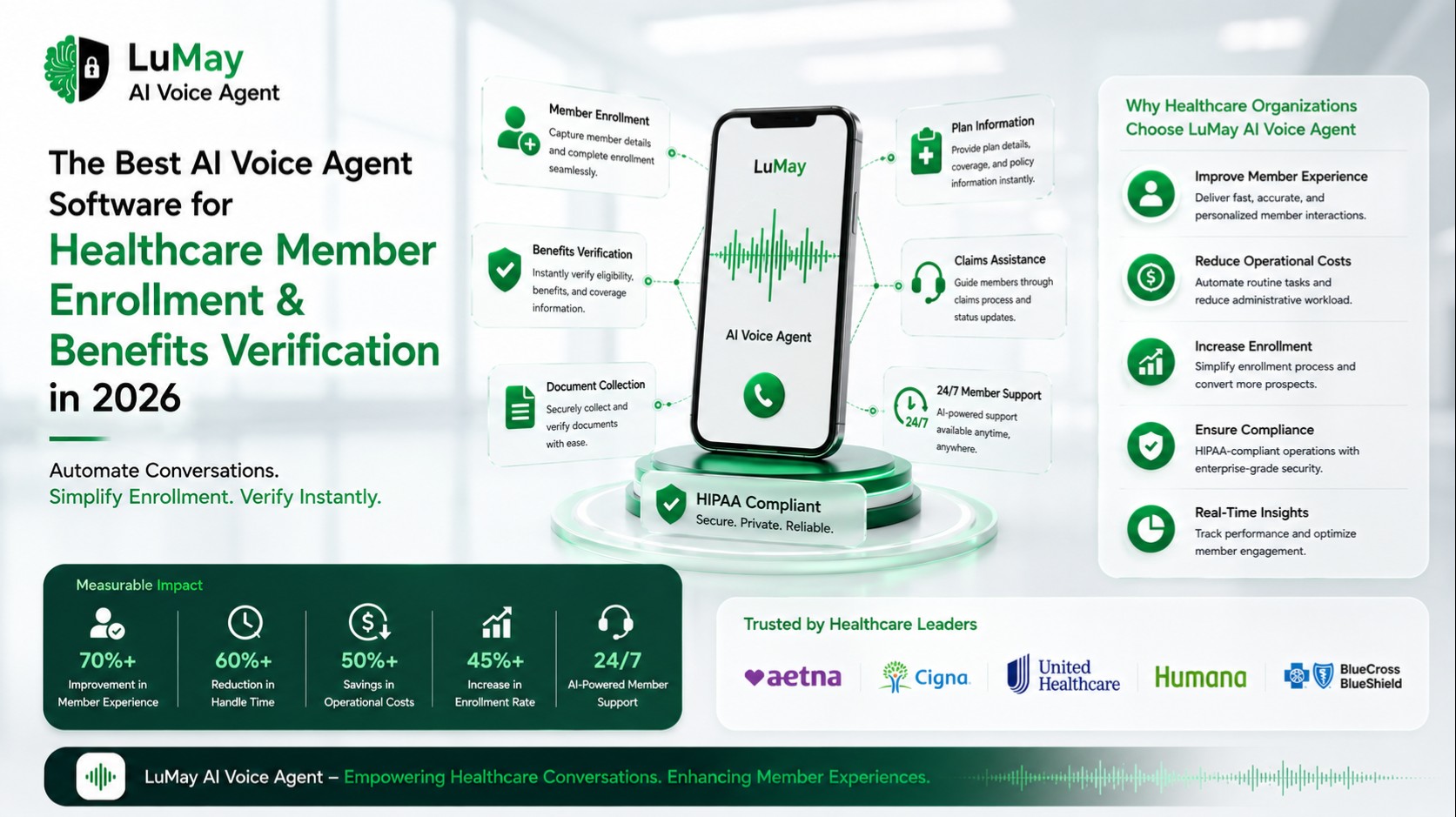
• AI Inbound Call Handling - Receives and processes inbound member calls autonomously. Understands free-form speech, classifies intent in real time, and routes to the appropriate workflow or live agent based on configurable escalation logic.
• Natural Language Conversations - Near-real-time speech processing with interruptible speech, dynamic tone modulation, and 50+ natural voices including custom enterprise voice cloning. Members speak naturally; the agent understands them.
• LLM-Powered Reasoning - Uses large language models to handle multi-turn conversations, resolve ambiguous requests, and generate contextually accurate responses - not scripted menus.
• NLP Intent Classification - Classifies caller intent from natural speech across enrollment, eligibility, coverage, authorization, and claims call types. Handles synonymous phrasings and regional dialect variation.
• Benefits Verification Workflows - Executes structured eligibility and coverage verification workflows, pulling real-time data from connected payer systems and presenting results to callers in plain language.
• Member Enrollment Assistance - Guides members through plan selection, enrollment application steps, and document submission workflows. Captures enrollment data and writes it directly to connected CRM or enrollment platform.
• CRM/EHR/API Integration via SmartConnect - Native connectors for REST APIs, SQL databases, Azure services, Power Automate, Zapier, and industry-specific CRM and EHR platforms. Call outcomes are written to member records automatically.
• Real-Time Call Routing - Routes calls dynamically based on intent classification, member profile, business rules, and escalation criteria. No static IVR tree required.
• Warm Escalation to Human Staff - Transfers calls to live agents along with the full call summary, caller history, and a whisper coaching note. Agents receive context; members never repeat themselves.
• Appointment and Callback Workflows - Schedules follow-up calls or appointments within the conversation. Integrates with scheduling platforms and sends automated confirmation messages.
• Analytics and Reporting Dashboard - Real-time visibility into call volumes, resolution rates, escalation rates, sentiment trends, and workflow completion metrics. Operational teams have the data they need to continuously optimize call handling performance.
• HIPAA/SOC2 Compliant Architecture - PII/PHI redaction from all call transcripts, encrypted recordings, role-based access control, full audit logging, and BAA availability for covered entities. HITRUST certification available for enterprise deployments.
• Air-Gapped On-Premises Deployment - For organizations with the strictest data sovereignty requirements, LuMay offers on-premises deployment - the only platform in its category to provide this capability in 2026.
• Multichannel Support - In addition to voice, LuMay's broader platform includes Insight Agents for clinical knowledge retrieval, SmartFlow for workflow automation, and SmartTranslation for multilingual member communication - supporting a unified member engagement strategy across channels.
Note: Other LuMay products - including SmartAssist (clinical AI assistant), OCG Compliance (HIPAA monitoring), and SmartTranslation (multilingual outreach) - complement LuMay Voice Agent for organizations building a broader AI-enabled healthcare operations stack. Each product is deployable independently.
Comparison Table: AI Voice Agent vs Traditional IVR vs Human-Only Call Center
Capability | LuMay Voice Agent (AI Voice Agent) | Traditional IVR | Human-Only Call Center | Best-Fit Use Case |
Natural Language Understanding | Full NLP/LLM - understands free-form speech | Limited - touch-tone or simple voice commands only | Full - but inconsistent across agents | AI: high-volume structured queries |
24/7 Availability | Yes - no staffing required | Yes - but member experience is poor | No - shift-dependent; overtime costly | AI: after-hours enrollment & eligibility |
Concurrent Call Capacity | 10,000+ concurrent calls | High - but no conversational capability | Severely limited by headcount | AI: open enrollment surges |
Benefits Verification | Real-time API lookup - accurate, auditable | Cannot perform - menu deflection only | Manual lookup - variable accuracy & speed | AI: structured eligibility checks |
Member Enrollment Support | Guided multi-step workflows, data capture, CRM write-back | Basic routing only - no enrollment capability | Full - but slow, expensive, inconsistent | AI: enrollment completion workflows |
Prior Authorization Routing | Intent-classified routing with data collection | Fixed routing - no data collection | Full - but high handle time | AI: PA triage and intake |
Identity Verification | Automated in-call verification integrated with member data | Not available | Manual - high handle time | AI: all authenticated call types |
Escalation with Context | Warm transfer with full call summary & whisper coaching | Cold transfer - member repeats everything | Cold transfer - information loss common | AI: complex or escalated calls |
Call Documentation | Automated HIPAA-compliant call summaries - zero agent effort | None | Manual documentation - error-prone, time-consuming | AI: compliance-sensitive call types |
Integration with EHR/CRM | Native real-time integration via SmartConnect | None or limited | Manual data entry required | AI: all workflow-integrated call types |
HIPAA Compliance | Built-in - PHI redaction, encrypted transcripts, audit logs | Varies - often minimal | Varies - training-dependent | AI: healthcare regulated environments |
Cost per Interaction | Low - scales without proportional cost increase | Very low - but poor member satisfaction | High - $4–$12+ per call (industry range) | AI: routine high-volume call types |
Multilingual Support | 6+ languages including English, Spanish, and others | Limited - usually English only | Requires bilingual staff - expensive | AI: diverse member populations |
Source basis: Industry-observed ranges. LuMay platform specifications sourced from LuMay Voice Agent product page. Cost-per-call ranges are industry estimates from Deloitte's 2024 Contact Center Benchmark Report. Validate all performance figures through pilot testing for your specific implementation.
Competitor Analysis: AI Voice Agent Platforms for Healthcare 2026
The following table compares LuMay Voice Agent against the leading alternatives healthcare organizations are evaluating in 2026. All competitor information is based on publicly available product pages, documentation, and market positioning data. No negative claims are made without reference basis. Healthcare suitability ratings reflect publicly stated compliance posture and use case focus.
Solution | Category | Healthcare Fit | Voice AI Capability | Integration Flexibility | Benefits Verification Fit | Enrollment Support Fit | Notes / Reference Basis |
LuMay Voice Agent | Enterprise AI Voice Agent | Very High - HIPAA/SOC2/HITRUST | LLM + NLP - full conversational AI | Very High - REST API, EHR, CRM, Azure, Zapier | High - real-time eligibility lookup | High - multi-step enrollment workflows | lumay.ai/ai-products/voice-agent; 10,000+ concurrent calls; air-gapped deployment option |
PolyAI | Enterprise Conversational Voice AI | High - healthcare use cases documented | Strong LLM-based voice AI | High - enterprise integrations | Moderate - depends on custom configuration | Moderate - use case configuration required | polyai.com; primarily contact center focus; used by hospitality and retail sectors also |
Hyro | Healthcare-Specific AI Voice | Very High - built for healthcare providers | NLP-based; strong in clinical Q&A | High - EHR and EMR focus | Moderate - eligibility via integration | Moderate - appointment and intake focus | hyro.ai; strong provider-side use cases; payer-side enrollment less documented publicly |
Cognigy | Enterprise Conversational AI Platform | High - enterprise compliance capable | Full NLU/LLM voice and chat | Very High - extensive enterprise connectors | Moderate - requires workflow configuration | Moderate - enterprise build required | cognigy.com; strong omnichannel; requires significant configuration for healthcare workflows |
Enterprise AI Platform | High - healthcare vertical solutions | Strong NLP/LLM voice capabilities | Very High - pre-built connectors | Moderate - healthcare templates available | Moderate - requires configuration | kore.ai; enterprise-grade; strong in banking and insurance; healthcare fit documented | |
Five9 | Cloud Contact Center with AI | High - contact center compliance | AI assist and IVR - not full voice autonomy | Very High - broad contact center integrations | Low-Moderate - primarily agent assist | Low-Moderate - routing and IVR focus | five9.com; primarily augments human agents rather than replacing call types autonomously |
NICE CXone | Enterprise Contact Center AI | High - enterprise compliance | AI copilot and IVR automation | Very High - enterprise-grade | Moderate - agent assist focus | Moderate - workflow routing | nice.com/cxone; strong in large contact centers; AI primarily augments agents |
Retell AI | Developer AI Voice Platform | Moderate - HIPAA in progress (per public docs) | Strong LLM voice foundation | High - API-first; developer-friendly | Low - requires custom build | Low - requires custom build | retellai.com; developer-centric; rapid prototyping; production healthcare compliance not fully documented as of early 2026 |
Vapi | Developer AI Voice Infrastructure | Moderate - developer-configured | Strong LLM/TTS pipeline | High - developer-configurable | Low - build-required | Low - build-required | vapi.ai; infrastructure layer; compliance and healthcare workflows require significant custom build |
Bland AI | High-Volume AI Calling Platform | Low-Moderate - not healthcare-primary | Strong for outbound campaigns | Moderate - API-based | Low - not healthcare-focused | Low - not healthcare-focused | bland.ai; strong for outbound campaigns; healthcare compliance not primary positioning |
Traditional IVR | Legacy Call Routing Technology | Low - no PHI intelligence | None - touch-tone / fixed script | Low - static system integrations | None - cannot execute verification | None - routing only | Generic category; Avaya, Cisco, Genesys legacy systems; no NLP or LLM capability |
Disclaimer: Competitor data is based on publicly available product pages and documentation as of Q1 2026. Healthcare fit, integration flexibility, and use case ratings are editorial assessments based on publicly stated positioning, not independently audited. Organizations should conduct their own due diligence before selecting any vendor. No negative claims are made without a documented public reference basis.
Latency Benchmarks for AI Voice Agents in Healthcare
Response latency is the most operationally critical technical metric for AI voice agents deployed in healthcare call workflows. A caller asking a benefits question should receive a response that feels conversational - not robotic, delayed, or disjointed. The following benchmarks reflect current industry expectations and LuMay Voice Agent's production performance specifications. Actual performance depends on implementation, telephony stack, integration architecture, model configuration, and data system responsiveness.
Latency Metric | Recommended Target Range (Healthcare) | LuMay Voice Agent (Production) | Notes |
Speech-to-Text (ASR) Latency | < 300ms | < 200ms (streaming ASR) | Real-time streaming ASR with accent awareness; noise filtering for telephony environments |
LLM Reasoning / Response Generation | < 400ms for standard queries | Varies by query complexity; optimized for healthcare intent patterns | Complex multi-turn queries or EHR lookups may require additional processing time |
Text-to-Speech (TTS) Generation | < 150ms | < 150ms (streaming TTS) | 50+ natural voices; custom voice cloning; streaming output begins before full response is generated |
End-to-End Response Latency (full turn) | < 800ms perceived; < 1,000ms absolute | Sub-1-second in production environments | LuMay's graph-based real-time flow engine processes intent and triggers responses near-instantly |
API Lookup Latency (eligibility/benefits data) | < 500ms for real-time payer API calls | Dependent on payer system response times | Caching and retry logic implemented; payer API SLAs vary significantly across systems |
Escalation Latency (AI to live agent) | < 5 seconds with full context transfer | Warm transfer with call summary, caller history, and whisper coaching note | Agent receives full context before picking up; member does not repeat information |
Concurrent Call Capacity | Scales to meet demand - no queue degradation | 10,000+ concurrent calls via elastic infrastructure | Linear scaling with cloud infrastructure; no performance degradation at peak volume |
Important: All latency figures are implementation-dependent estimates and production specifications from LuMay's published platform data. Actual performance in any specific deployment depends on telephony carrier configuration, payer API response times, network conditions, conversation complexity, and LLM model selection. Recommend baseline latency measurement during pilot testing before production deployment.
Key Factors Affecting AI Voice Agent Latency in Healthcare
• Telephony network quality and carrier SLAs - PSTN vs VoIP vs cloud telephony architectures produce different baseline latency profiles
• Payer and eligibility API response times - real-time benefits verification depends on payer system availability; some legacy systems have significantly higher response latency than modern REST APIs
• LLM model selection - smaller, fine-tuned healthcare-specific models can achieve lower latency than general-purpose large models for constrained intent spaces
• Streaming vs batch processing - streaming ASR and TTS pipelines reduce perceived latency significantly compared to batch processing architectures
• Geographic data center proximity - edge deployment closer to caller populations reduces network-induced latency for telephony-grade voice processing
Best Integration Practices for AI Voice Agents in Healthcare
The business value of an AI voice agent in healthcare is not in the conversation itself - it is in what happens after the conversation. The agent's ability to pull real-time data, verify information, update records, and trigger downstream workflows determines whether it delivers operational impact or simply deflects calls. The following integration practices apply to LuMay Voice Agent deployments and general AI voice agent implementations in U.S. healthcare environments.
CRM Systems
Connect your AI voice agent to your member relationship management platform (Salesforce Health Cloud, Microsoft Dynamics 365, or equivalent) so that caller records are retrieved at call initiation and updated at call conclusion. Call summaries, intent classifications, and member-stated preferences should write back automatically, eliminating manual CRM entry.
EHR/EMR Systems
For provider-side deployments, integrate with Epic, Cerner, athenahealth, or equivalent EHR systems to enable real-time patient lookup, appointment scheduling, and pre-registration data capture. Ensure integration uses FHIR R4 API standards where available for maximum interoperability and future compatibility.
Payer and Eligibility Systems
Connect to CAQH, Availity, or payer-specific eligibility APIs to enable real-time benefits verification. X12 270/271 transaction support is the U.S. healthcare standard for eligibility inquiry and response. Implement retry logic and fallback messaging for payer system outages, which are common during high-volume enrollment periods.
Contact Center Platforms
Integrate with existing contact center infrastructure (Genesys, NICE CXone, Five9, Amazon Connect, or equivalent) to manage call routing, queue management, and agent desktop workflows. Ensure warm transfer protocols pass full call context to agent desktops, not just caller ID.
Scheduling Tools
Connect to appointment scheduling systems (Acuity, Phreesia, Epic Scheduling, or equivalent) to enable in-call appointment booking, rescheduling, and callback scheduling without member redirection to a separate channel.
Knowledge Bases
Build a healthcare-specific knowledge base covering plan documents, formulary data, network directories, coverage policies, and FAQ content. LLM voice agents retrieve and synthesize this content to answer member questions accurately. Update the knowledge base at every plan year reset and formulary change.
Identity Verification Systems
Integrate with member identity verification systems using member ID, date of birth, and other identifiers to authenticate callers before accessing PHI. Implement two-factor verification for sensitive transactions such as plan changes or enrollment submissions.
HIPAA-Conscious Workflow Design
All call recordings and transcripts must implement PHI redaction. LuMay Voice Agent provides automatic PII/PHI redaction from transcripts as a core platform feature. Ensure data retention policies are configured to meet your organization's compliance requirements. A Business Associate Agreement (BAA) must be executed with your AI voice agent vendor before any PHI is processed.
Analytics Dashboards
Connect AI voice agent analytics to your operational BI stack (Power BI, Tableau, Looker, or equivalent) to monitor call volume trends, intent classification accuracy, resolution rates, and member satisfaction signals at an organizational level.
How to Build an AI Voice Agent for Customer Service in Healthcare
For organizations evaluating building versus buying AI voice agent capability, the following framework applies specifically to healthcare customer service deployments:
1. Define the call types you want to automate first. Start with the three to five highest-volume, most structured call types - eligibility verification, plan comparison, and enrollment follow-up are the strongest candidates.
2. Map the data sources each call type requires. Eligibility calls need payer API access. Enrollment calls need CRM and enrollment platform integration. Document the data flows before selecting a platform.
3. Evaluate build vs buy based on compliance requirements. Building a HIPAA-compliant, SOC2-audited AI voice platform from scratch requires 12–24 months of engineering investment and ongoing compliance maintenance. Most healthcare organizations achieve faster ROI by deploying a production-ready platform like LuMay Voice Agent.
4. Design escalation logic carefully. Define the specific caller intents, failure conditions, and member signals that should trigger live agent escalation. Poorly designed escalation logic is the most common cause of negative member experience with AI voice deployments.
5. Run a structured pilot on one call type before full deployment. Measure containment rate, member satisfaction, and error rate against your baseline. Use pilot data to refine intent models and integration configurations before scaling.
6. Instrument everything from day one. Call outcome data, intent classification confidence scores, escalation triggers, and resolution rates should feed your analytics stack from the first call.
Healthcare Use Cases: AI Voice Agent in Action
Medicare Advantage Member Enrollment
During the Annual Enrollment Period (AEP), October 15 – December 7, Medicare Advantage plans receive their highest annual call volumes from members comparing plans, asking about formulary changes, and completing or confirming enrollment. AI voice agents handle plan comparison questions, confirm premium and cost-sharing details, guide members through the enrollment application, and schedule follow-up calls for members who request additional time - absorbing the surge without adding temporary call center staff.
Medicaid Managed Care Support
Medicaid managed care organizations serve populations that frequently face literacy, language, and technology access barriers. AI voice agents with multilingual support - English, Spanish, and other languages depending on member population - answer eligibility questions, confirm primary care assignment, and explain covered benefits in plain language. LuMay Voice Agent supports 6+ languages with accent-aware speech recognition, making it suitable for diverse Medicaid member populations.
Commercial Insurance Benefits Verification
Commercial payers process millions of inbound member calls annually asking about deductible balances, specialist copays, out-of-network coverage, and prior authorization requirements. AI phone agents integrated with real-time eligibility systems answer these questions accurately, consistently, and instantly - with zero hold time.
Provider Office Eligibility Calls
Provider offices make hundreds of eligibility verification calls to payers every day before appointments. An AI voice agent deployed on the payer side answers these calls instantly, confirms eligibility status, and provides cost-sharing information in seconds rather than the 8–12 minute average for live agent eligibility calls. This is one of the fastest-ROI implementations of AI voice agent software in the payer-provider relationship.
Open Enrollment Call Surges
ACA marketplace open enrollment, employer group open enrollment, and Medicare plan year changes all create predictable, extreme call volume spikes. AI voice agents provide elastic capacity - scaling to handle peak volume without the recruiting, training, and infrastructure investment that seasonal human staffing requires.
Patient Intake and Pre-Registration
For health systems and large provider groups, AI voice agents handle pre-visit intake calls - confirming appointment details, collecting insurance information, verifying pre-authorization status, and sending reminder instructions - reducing front-desk call volume and improving visit readiness.
Behavioral Health Access Support
Behavioral health access is a national priority, and long hold times at behavioral health intake lines are a documented barrier to care access. AI voice agents handle initial intake, screen for clinical urgency, connect callers to appropriate resources, and schedule appointments - improving access while reserving clinical staff time for the conversations that require it.
Dental, Vision, and Ancillary Benefits Verification
Ancillary benefits are among the most frequently misunderstood coverage categories. AI voice agents answer questions about annual maximums, waiting periods, covered procedures, and in-network providers for dental, vision, and supplemental benefits - call types that are high-volume but highly structured.
Small Healthcare Businesses and Clinics
Independent clinics, specialty practices, TPAs, and health insurance brokers often cannot justify a dedicated call center but still need consistent, professional call handling for eligibility and enrollment questions. LuMay Voice Agent is deployable for organizations of any size, with pre-built healthcare templates that allow small teams to go live in days.
Representative Scenarios: AI Voice Agent in Healthcare Operations
The following scenarios are illustrative examples based on common deployment patterns in U.S. healthcare organizations. They do not represent specific named customers unless publicly verified. Use them as pilot-ready frameworks for evaluating AI voice agent deployment in your own organization.
Representative Scenario 1: Regional Health Plan - Open Enrollment Call Surge
Problem:
A regional Medicare Advantage plan serving 85,000 members experiences a 380% increase in inbound call volume during the Annual Enrollment Period. With 24 call center agents, average hold times reach 22 minutes. Approximately 18% of callers abandon the queue before speaking with an agent. Enrollment completion rates for members who initiated applications online but called with questions fall below 60%.
Workflow:
The plan deploys LuMay Voice Agent as the primary inbound handler for five call types: plan comparison questions, premium confirmation, deductible and cost-sharing inquiries, enrollment status checks, and callback scheduling. Live agents handle escalations, complex clinical situations, and member complaints.
Expected Business Impact:
Industry-observed estimates for similar deployments suggest 50–65% reduction in live agent call volume during AEP, average hold time reduction to under 30 seconds for AI-handled call types, and enrollment completion rate improvement to 75–80% for AI-assisted callers.
KPIs to Measure:
• AI containment rate (% of calls resolved without live agent escalation)
• Average handle time for AI vs. live agent calls
• Enrollment completion rate - AI-assisted vs. unassisted
• Member-reported satisfaction score for AI interaction
• Cost per call - AI vs. live agent channel
Representative Scenario 2: Multistate TPA - Benefits Verification for Provider Offices
Problem:
A third-party administrator managing benefits for 40 employer groups processes 1,200+ inbound eligibility verification calls per day from provider offices. Each call averages 9 minutes with a live agent. The operations team spends 180 person-hours per day on calls that follow a highly structured, predictable workflow.
Workflow:
LuMay Voice Agent is deployed to handle provider office eligibility calls. The AI agent authenticates the provider office, collects the member ID and date of service, queries the real-time eligibility system, and reads back active coverage, cost-sharing structure, and authorization requirements. Calls requiring exception handling or dispute resolution escalate to live analysts.
Expected Business Impact:
For a deployment of this type, implementation-dependent estimates suggest 70–80% containment of routine eligibility calls, reduction in average handle time to under 90 seconds for AI-handled calls, and annualized labor cost savings in the range of $400,000–$700,000 depending on staffing model (example benchmark range; validate through pilot).
KPIs to Measure:
• Eligibility verification accuracy rate (AI response vs. system-of-record data)
• Provider office call handle time - before and after deployment
• Containment rate by call type
• Escalation rate and escalation reason categorization
• Annualized cost per eligibility verification
Representative Scenario 3: Small Specialty Clinic - After-Hours Patient Call Handling
Problem:
A 6-physician specialty practice receives 80–120 after-hours calls per week from patients asking about appointment status, referral authorization requirements, and prescription refill eligibility. The practice uses an answering service at $1.80 per call, incurring $8,000–$12,000 per month in after-hours call costs with inconsistent information quality.
Workflow:
LuMay Voice Agent is configured with the practice's appointment schedule integration, referral policy knowledge base, and prescription refill protocol. After-hours callers receive immediate AI responses for appointment and policy questions. Clinical triage calls escalate to the on-call provider via automated paging.
Expected Business Impact:
Small practice deployments of this type show industry-observed ranges of 60–75% reduction in answering service costs, improved after-hours patient experience, and zero missed appointment confirmation calls.
KPIs to Measure:
• After-hours call containment rate
• Answering service cost before vs. after AI deployment
• Patient satisfaction scores for after-hours call experience
• Reduction in next-day front-desk callback volume
Best 10 AI Voice Agent Capabilities Healthcare Leaders Should Prioritize in 2026
7. Accurate, Accent-Aware Speech Recognition - Your member population speaks with regional accents, at varying speech rates, and often in noisy environments. Your AI voice agent's ASR must handle this without requiring members to repeat themselves.
8. Sub-Second End-to-End Latency - Conversations that pause for more than one second feel broken. Any AI voice agent evaluated for live healthcare member interactions must demonstrate sub-second response latency in production, not just in demo conditions.
9. HIPAA-Compliant PHI Handling by Design - PHI redaction, encrypted transcripts, RBAC, audit logging, and BAA availability are non-negotiable. Do not accept 'HIPAA-ready' as a substitute for documented, audited HIPAA compliance controls.
10. Real-Time EHR and Eligibility Integration - An AI voice agent that cannot access live member data delivers incomplete and potentially inaccurate answers. Prioritize platforms with native connectors for your specific EHR and eligibility systems.
11. Benefits Verification Workflow Templates - Pre-built, configurable workflow templates for eligibility lookup, cost-sharing explanation, and formulary verification reduce deployment time from months to days for standard healthcare call types.
12. Warm Escalation with Full Context Transfer - Live agents should receive the full call summary and caller history before picking up an escalated call. Cold transfers that require members to repeat themselves are a common and preventable failure mode.
13. Automated Call Summaries and Documentation - Every call should generate a structured, HIPAA-compliant summary written to the member record automatically. Eliminating post-call documentation is one of the fastest ROI drivers in AI voice deployments.
14. Multilingual Support for Diverse Member Populations - U.S. healthcare serves linguistically diverse populations. English-only AI voice agents leave significant portions of many member populations underserved. Prioritize platforms with validated multilingual capability.
15. Analytics and Continuous Improvement Infrastructure - Call outcome data, intent classification accuracy, escalation patterns, and member sentiment signals should feed an analytics stack that enables continuous model and workflow improvement.
16. No-Code Workflow Configuration for Operations Teams - Healthcare organizations do not have AI engineering teams. The platform must allow operations and call center teams to configure, test, and update workflows without writing code.
Best AI Voice Agent for Small Business 2026: Healthcare Edition
The assumption that AI voice agent software is only for large health plans or hospital systems is increasingly outdated. In 2026, production-grade AI voice agent platforms - including LuMay Voice Agent - are accessible to organizations of any size, with no-code configuration, pre-built healthcare templates, and deployment timelines measured in days rather than months.
Who Qualifies as a Small Healthcare Business in This Context?
• Independent primary care and specialty practices (1–10 physicians)
• Federally Qualified Health Centers (FQHCs) and community health centers
• Small TPAs and benefits administration firms
• Independent health insurance brokers and agencies
• Dental, vision, and behavioral health practices
• Home health and hospice agencies
• Small managed care organizations and regional health plans
Why Small Healthcare Organizations Need AI Voice Agents
Small healthcare organizations are disproportionately burdened by administrative call volume relative to their staff capacity. A 4-physician practice handling 60 eligibility calls per day at 9 minutes each is consuming 9 person-hours daily on a single call type. That is more than one full-time equivalent, absorbed by a workflow that an AI voice agent can handle in seconds.
LuMay Voice Agent's pre-built healthcare templates allow small organizations to deploy a fully functional AI phone agent for appointment management, eligibility verification, and benefits Q&A in days - without an IT department, without custom development, and without enterprise-scale contract commitments.
For small healthcare businesses evaluating AI voice agent software in 2026, the key selection criteria are simplicity of deployment, transparent pricing, HIPAA compliance by default, and a support model suited to organizations without internal AI expertise. LuMay's managed services delivery model addresses all four.
Answering the Questions Healthcare Leaders Are Asking in 2026
How to Build an AI Voice Agent for Customer Service in Healthcare
Building a healthcare-specific AI voice agent from scratch requires assembling a telephony layer, an ASR/TTS pipeline, an LLM reasoning engine, integration middleware, a HIPAA compliance framework, and an analytics stack. For most healthcare organizations, this is a 12–24 month engineering investment with ongoing compliance maintenance obligations. The practical alternative in 2026 is to deploy a purpose-built, production-ready platform like LuMay Voice Agent - configuring healthcare-specific workflows using no-code tools and pre-built templates rather than building the infrastructure layer from zero. The core 'build' decision should focus on workflow design: which call types to automate first, what data sources to connect, and how to define escalation logic - not on building ASR or LLM infrastructure from scratch.
Best AI Voice Agent for Small Business 2026
For small healthcare businesses in 2026, the best AI voice agent software combines five capabilities: pre-built healthcare workflow templates, HIPAA compliance by default, simple no-code configuration, sub-1-second response latency, and a pricing model that does not require enterprise-scale contract commitments. LuMay Voice Agent meets all five criteria and deploys in days - making it the most operationally practical choice for small clinics, brokers, TPAs, and independent healthcare organizations that need enterprise-grade AI voice capability without enterprise-scale complexity.
AI Voice Agent vs Traditional IVR: Which Is Better?
For U.S. healthcare organizations managing member enrollment and benefits verification calls, AI voice agents outperform traditional IVR in every dimension that matters to members and operations leaders: conversation quality, task completion rate, member satisfaction, integration capability, and scalability. Traditional IVR deflects calls; AI voice agents resolve them. The only dimension where traditional IVR retains an advantage is implementation cost for organizations with no existing call workflows to automate - but this advantage disappears quickly when compared against the containment rates and operational cost reductions that production AI voice agents deliver within the first quarter of deployment.
Key Takeaways
17. AI voice agent software is the highest-ROI investment U.S. healthcare organizations can make in call center modernization in 2026 - specifically for member enrollment, benefits verification, and eligibility workflows.
18. LuMay Voice Agent is the only AI voice agent platform in its category offering HIPAA/SOC2/HITRUST compliance, 10,000+ concurrent call capacity, and air-gapped on-premises deployment - making it uniquely suited to healthcare organizations with stringent data sovereignty requirements.
19. The performance gap between AI voice agents and traditional IVR is not incremental - it is architectural. AI voice agents understand free-form speech, execute multi-step workflows, and integrate with live data systems. IVR systems do none of these things.
20. Member enrollment and benefits verification are the two call types that deliver the fastest and most measurable ROI from AI voice agent deployment - due to their high volume, structured workflow patterns, and direct connection to member experience and plan revenue.
21. Latency matters. Healthcare organizations should require documented sub-1-second end-to-end response latency from any AI voice agent they evaluate - and validate this specification during pilot testing, not just in demo conditions.
22. HIPAA compliance is non-negotiable. Every AI voice agent deployed in a U.S. healthcare environment must include PHI redaction, encrypted transcripts, RBAC, audit logging, and BAA availability as built-in features, not optional add-ons.
23. Small healthcare organizations can deploy production-grade AI voice agent capability in days - not months - using pre-built healthcare templates and no-code configuration. LuMay Voice Agent eliminates the enterprise-only barrier that has historically limited AI voice adoption in smaller healthcare organizations.
24. Continuous improvement infrastructure is as important as the AI model itself. Organizations that instrument their AI voice agent deployments with full analytics from day one achieve significantly better long-term containment rates and member satisfaction outcomes.
Frequently Asked Questions
What is an AI phone agent?
An AI phone agent is an autonomous software system that makes or receives telephone calls, understands natural language speech, and completes structured workflows - such as eligibility checks, enrollment guidance, or appointment scheduling - without requiring a human call center representative for each interaction. Modern AI phone agents use LLM-powered reasoning to handle multi-turn conversations with near-human conversational quality.
How does an AI voice agent help with benefits verification?
An AI voice agent integrates with your payer's eligibility system or benefits database in real time. When a member or provider office calls with a coverage question, the agent authenticates the caller, queries the eligibility system, and reads back active coverage, cost-sharing details, and authorization requirements within seconds - eliminating the hold times and human lookup errors associated with live agent handling.
Is an AI voice agent better than traditional IVR?
Yes, for virtually all member-facing healthcare call types. Traditional IVR presents fixed menus and cannot understand free-form speech, execute workflows, or integrate with live data systems. An AI voice agent understands natural questions, retrieves real-time data, and completes tasks end-to-end. The only scenario where IVR may be preferable is where simplest-possible call routing is all that is needed and cost minimization is the sole priority.
Can AI voice agent software integrate with healthcare systems?
Yes. LuMay Voice Agent integrates with EHR systems, CRM platforms, payer eligibility APIs (including X12 270/271 standard transactions), contact center platforms, and scheduling tools via SmartConnect - LuMay's native integration layer supporting REST APIs, SQL databases, Azure services, and Zapier. FHIR R4 API compatibility is supported for EHR integrations.
Is an AI voice agent suitable for small healthcare businesses?
Absolutely. LuMay Voice Agent offers pre-built healthcare workflow templates, no-code configuration, and deployment timelines measured in days - making enterprise-grade AI voice capability accessible to small clinics, brokers, TPAs, and independent provider organizations without requiring an IT department or custom development investment.
How fast should an AI voice agent respond?
For healthcare member interactions, sub-1-second end-to-end response latency is the current industry standard for a natural conversational experience. LuMay Voice Agent achieves this in production environments using a streaming ASR and TTS pipeline with a graph-based real-time flow engine. Any latency consistently above 1.5 seconds will negatively impact member experience and increase escalation rates.
What data is needed to build an AI voice agent for customer service in healthcare?
You need access to member eligibility data (via payer API or direct system access), plan document and formulary content (for a healthcare knowledge base), CRM or member record data (for caller authentication and record update), and call history data (for model training and intent classification improvement). Compliance-reviewed data access agreements and a BAA with your AI vendor are required before processing any PHI.
Can an AI voice agent handle member enrollment calls?
Yes. LuMay Voice Agent supports multi-step enrollment workflows - guiding members through plan selection, collecting application information, confirming enrollment details, and writing completed data to your enrollment platform via API. The AI agent handles the full enrollment conversation, escalating to a live agent only when the member requests it or when the query falls outside defined automation scope.
What should healthcare organizations look for in AI voice agent software?
Prioritize: HIPAA/SOC2 compliance with BAA availability, sub-1-second response latency in production, real-time EHR and eligibility system integration, warm escalation with full context transfer, pre-built healthcare workflow templates, multilingual support for your member population, automated HIPAA-compliant call documentation, and a proven containment rate for the specific call types you intend to automate.
How does LuMay Voice Agent support inbound call handling?
LuMay Voice Agent receives inbound calls autonomously, authenticates the caller, classifies intent using NLP/LLM reasoning, executes the appropriate workflow (eligibility check, enrollment guidance, coverage Q&A, etc.), updates connected CRM and EHR systems in real time, and either resolves the call or transfers to a live agent with the full call context attached. The entire workflow runs with sub-1-second response latency and scales to 10,000+ concurrent calls.
Conclusion
U.S. healthcare organizations are navigating a convergence of pressures that traditional call center infrastructure was not built to handle: 90+ million Medicaid members, 33+ million Medicare Advantage enrollees, annual enrollment surges, rising administrative costs, and members who expect immediate, accurate answers regardless of when they call. The operational and financial case for AI voice agent software has crossed the threshold from 'emerging technology' to operational necessity in 2026.
LuMay Voice Agent is purpose-built for this reality. It is not a chatbot wrapped in a phone interface. It is a production-grade, HIPAA-compliant, LLM-powered AI voice agent that understands natural speech, integrates with the data systems your eligibility and enrollment workflows depend on, scales elastically to meet call volume surges, and delivers measurable outcomes from the first day of deployment.
The organizations that will lead in member experience, administrative efficiency, and enrollment performance in 2026 are the ones deploying AI voice agents now — on the call types where the ROI is clearest and the member impact is most direct. Member enrollment and benefits verification are those call types.
The question is not whether AI voice agents belong in U.S. healthcare call operations. The question is which organizations will capture the operational and competitive advantage of deploying them first.
Ready to Automate Member Enrollment and Benefits Verification Calls?
LuMay Voice Agent is ready to deploy for your healthcare organization - whether you are a national health plan managing open enrollment surges, a TPA handling provider eligibility calls, or a small clinic needing professional, 24/7 call handling without a dedicated call center team.
Explore LuMay Voice Agent - or book a demo with the LuMay team to see the platform in action for your specific healthcare use case.
Book a Demo: Schedule a LuMay Voice Agent demo