
 ChatGPT
 Perplexity
 Grok
GrokDirect Answer: How Can Call Centers Improve Call Connect and Pickup Rate?
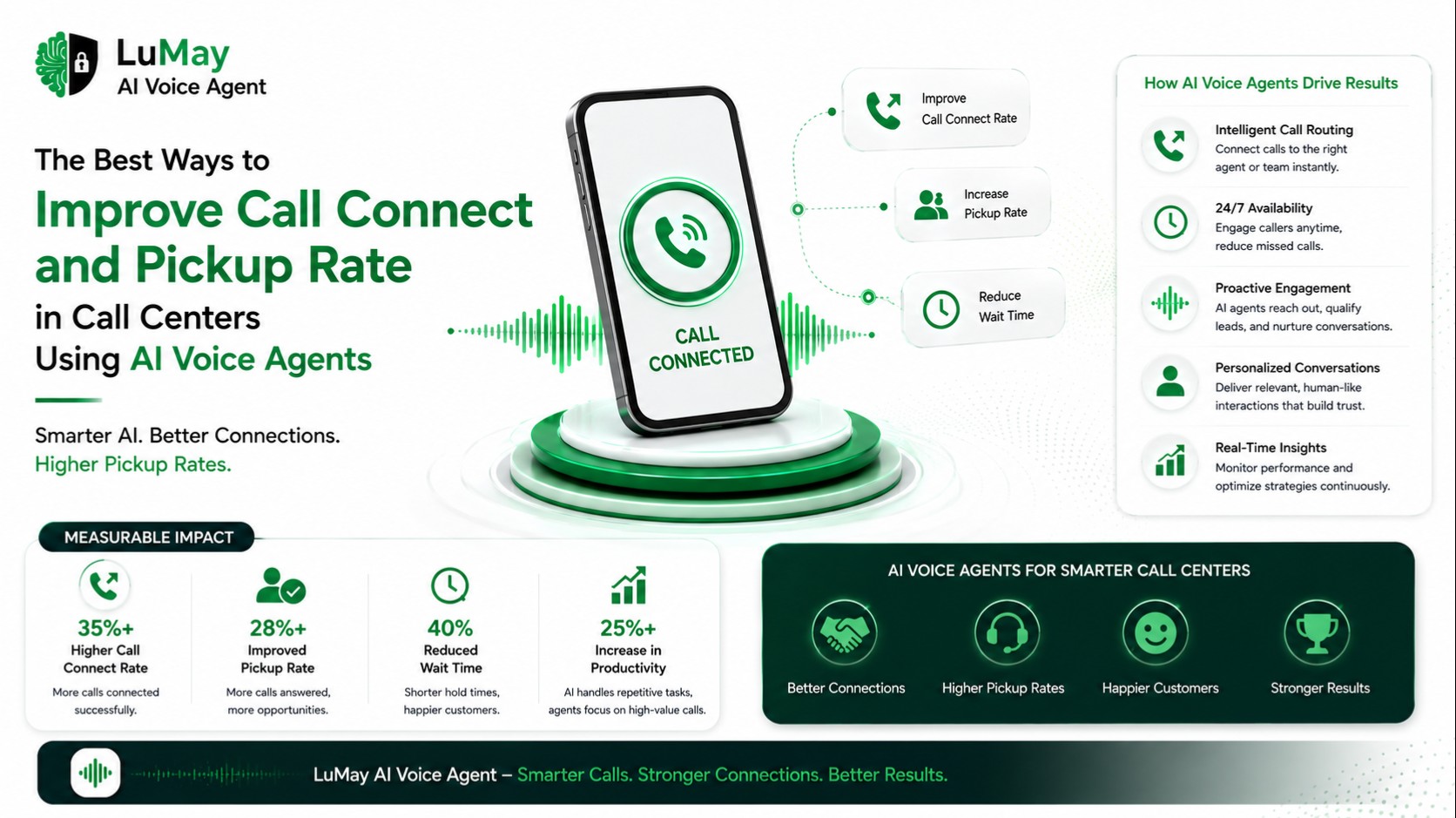
Call centers can improve call connect and pickup rates by deploying AI voice agent software that handles calls 24/7 without wait times, uses intelligent call routing to match callers to the right flow instantly, and maintains a strong caller ID reputation to avoid spam filtering. AI inbound call handling eliminates queue abandonment by answering every call immediately. Platforms like LuMay Voice Agent combine NLP voice intelligence, real-time CRM sync, and automated retry logic to ensure no call goes unanswered and every connection converts into a productive interaction.
Introduction
Every missed call is a missed opportunity. For U.S. call centers in 2026, that reality has never been more costly.
Answer rates for outbound calls have fallen below 30% in many industries (Pew Research, 2024). Inbound abandonment rates average 15–20% across customer service operations (Salesforce State of Service, 2025). Customers expect to reach someone instantly - and when they don’t, they move on.
The problems are well known: spam labeling destroys caller ID reputation, under-staffed teams cannot cover peak call volumes, legacy IVR systems frustrate callers before they even speak to anyone, and CRM data gaps make every conversation start from zero.
AI voice agent software is changing this equation completely. The best AI phone agent platforms automate both inbound and outbound call handling with human-like conversation quality, sub-second response times, and real-time integration with your business systems - operating 24 hours a day, 365 days a year.
LuMay Voice Agent is purpose-built for this mission. In this guide, you will learn exactly how to improve call connect and pickup rates in your call center - and why AI voice agent software is the most effective tool available in 2026.
What Is Call Connect Rate?
Call connect rate is the percentage of outbound calls that successfully reach a live person or are answered, out of the total calls dialed. It is one of the most important performance metrics in outbound call center operations because it directly reflects the effectiveness of your calling strategy, dialer technology, and caller ID health.
A call “connects” when the recipient picks up - not when it rings, and not when it goes to voicemail. In practical terms, a 25% call connect rate means that only 1 in 4 dials results in a live conversation.
Industry Benchmark (2026):
• B2C outbound call centers: Average connect rate of 15–30% (Forrester Research, 2025)
• B2B sales outreach: Average connect rate of 8–18% (HubSpot Sales Benchmarks, 2025)
• Healthcare appointment reminders: Up to 45–60% with AI-assisted outbound (McKinsey, 2025)
Low call connect rates are caused by spam labeling, poor dialing time selection, unverified caller ID, exhausted contact lists, and outdated phone numbers. AI phone agent platforms solve all of these systematically.
What Is Pickup Rate in a Call Center?
Pickup rate refers to the proportion of inbound calls that are answered promptly by an agent or automated system before the caller abandons the queue. It is the inbound counterpart to call connect rate.
When a customer calls your business and hangs up before speaking to anyone, that is a failed pickup. Every abandoned call represents a customer who took the initiative to reach you - and was not served.
Key Pickup Rate Benchmarks (2026):
• Industry-standard target: Answer 80% of calls within 20 seconds (ICMI Global Call Center Standards)
• Average hold time before abandonment: 2 minutes for most U.S. consumers (Salesforce, 2025)
• Missed inbound calls cost local businesses an estimated 27% of inbound leads (CallRail State of Calls Report, 2025)
• Businesses using AI inbound call handling report a 40–60% reduction in abandonment rates (Gartner, 2025)
Call Connect Rate vs Pickup Rate: Key Differences
Dimension | Call Connect Rate | Pickup Rate |
Direction | Outbound | Inbound |
What it measures | % of dials reaching a live person | % of inbound calls answered before abandonment |
Primary impact | Sales pipeline, lead outreach | Customer satisfaction, service quality |
Key challenge | Spam labeling, contact fatigue | Agent availability, queue length |
AI solution | Intelligent dialing, caller ID health | 24/7 automated answer, AI inbound call handling |
2026 benchmark | 15–30% (B2C outbound) | 80% answered within 20 seconds |
Why U.S. Call Centers Struggle With Low Pickup Rates
Despite decades of investment in call center technology, U.S. businesses are still losing a significant percentage of calls. Understanding why is the first step to fixing it.
1. Staffing Gaps and Scheduling Constraints
Most U.S. call centers operate Monday through Friday, 8am–6pm. Customer calls happen around the clock. A McKinsey analysis found that 40% of customer service calls occur outside traditional business hours (McKinsey Operations, 2025). Without 24/7 coverage, those calls go unanswered.
2. Spam Labeling and Caller ID Degradation
The FCC’s STIR/SHAKEN implementation has increased carrier-level spam flagging. Studies from TransUnion and First Orion show that over 56% of Americans do not answer calls labeled as “Scam Likely” or “Spam,” and even legitimate business numbers get caught in these filters if not properly registered and maintained.
3. Legacy IVR Systems
Traditional interactive voice response (IVR) systems route callers through rigid menu trees that do not understand natural speech. Forrester Research found that 72% of customers consider poor IVR experiences a major driver of call abandonment (Forrester CX Report, 2025). When the system does not understand them, callers hang up.
4. Long Queue Times
The average hold time for U.S. customer service calls reached 13.7 minutes in 2025 (Statista Contact Center Survey, 2025). For customers expecting instant service, this is unacceptable. 34% hang up within the first minute of being placed on hold.
5. Inadequate CRM Data
Agents without complete caller context waste valuable seconds repeating verification steps. Poor CRM data leads to longer average handling times, customer frustration, and lower first-call resolution - all of which reduce the quality of connections even when the call is answered.
6. Volume Spikes Without Elastic Capacity
Seasonal surges, product launches, or public incidents can cause call volumes to spike 200–400% above baseline. Human teams cannot scale at that speed. Calls queue up, overflow, and are abandoned in large numbers.
Top 10 Ways to Improve Call Connect and Pickup Rate in Call Centers
These are not theoretical suggestions. Each of the following strategies is directly actionable in 2026 and can be supported or fully automated by LuMay Voice Agent .
1. Deploy AI-Powered Call Routing
Intelligent call routing directs inbound callers to the right agent, workflow, or automated response path immediately - without menus, without hold time, and without human triage. LuMay Voice Agent uses a graph-based flow engine that processes caller intent in real time and routes accordingly. The result is faster time-to-resolution and significantly lower abandonment.
2. Maintain Caller ID Reputation
A clean, registered, STIR/SHAKEN-verified caller ID is the foundation of any outbound calling strategy. LuMay Voice Agent is built with full FCC STIR/SHAKEN compliance and anti-spoofing caller ID verification embedded in every outbound campaign - reducing spam flags and increasing answer rates.
3. Optimize Call Timing with Data Intelligence
Reaching people at the right moment increases connect rates dramatically. Salesforce research shows that calls made on Tuesdays and Thursdays between 10am–12pm and 4pm–5pm local time have the highest answer rates. LuMay Voice Agent’s batch calling engine allows teams to schedule campaigns by timezone and contact preference, maximizing connect probability.
4. Eliminate Hold Queues with 24/7 AI Inbound Call Handling
The most direct way to improve pickup rate is to ensure every inbound call is answered immediately - at any hour. LuMay Voice Agent handles 10,000+ concurrent inbound calls with sub-1-second response latency. There is no queue. Every caller receives an immediate, intelligent response.
5. Automate Repetitive High-Volume Calls
Appointment reminders, payment follow-ups, order status updates, and delivery confirmations represent a massive share of call center volume. These calls are predictable, repeatable, and do not require human judgment. LuMay Voice Agent automates them entirely, freeing human agents for complex interactions and reducing total call volume pressure.
6. Use AI Inbound Call Handling for After-Hours Coverage
Over 40% of customer calls come outside business hours. An NLP voice agent can handle intake, answer FAQs, book appointments, collect lead information, and trigger follow-up workflows - even at 2am. LuMay Voice Agent operates 24/7 without additional staffing cost.
7. Improve CRM Data Quality Before Every Call
An AI phone agent with real-time CRM integration eliminates the “cold call” experience. LuMay Voice Agent syncs with Salesforce, Microsoft Dynamics 365, and other CRM platforms - pulling caller history, account status, and preferences into every conversation automatically. Better data means shorter calls, higher satisfaction, and higher conversion.
8. Implement Multilingual Voice Capabilities
The U.S. has over 68 million non-English-speaking residents. Serving customers in their preferred language increases pickup likelihood and trust. LuMay Voice Agent supports 50+ languages with auto-detection and mid-call language switching - reaching Spanish, French, Mandarin, and other language communities without additional staffing.
9. Monitor Latency and Voice Response Speed
AI voice response latency directly affects perceived call quality. An LLM voice agent that takes 3 seconds to respond feels broken; one under 700ms feels natural. LuMay Voice Agent delivers sub-1-second response latency through a pre-optimized streaming architecture. Monitoring latency as a KPI ensures the voice experience remains at production quality.
10. Analyze Missed-Call and Drop-Off Patterns
Data-driven call centers continuously improve. LuMay Voice Agent provides 20+ analytics filters - by date, agent, language, duration, outcome, sentiment, and cost - so operations managers can identify exactly where calls are failing and optimize in real time. Sentiment analysis scores every call from -1.0 to +1.0, revealing friction points invisible to traditional reporting.
How LuMay Voice Agent Helps Improve Call Center Performance
LuMay Voice Agent is not a call bot. It is a fully autonomous enterprise AI phone agent that listens, understands intent, takes real-time action, updates backend systems, and closes workflows during a single phone conversation - inbound or outbound.
Unlike legacy IVR systems that follow scripts, LuMay Voice Agent uses LLM-powered natural language understanding to handle free-form speech, manage conversation context across multiple turns, and adapt dynamically based on what the caller says. It is the difference between a menu and a conversation.
For U.S. call centers, this means every call connects faster, resolves faster, and costs less - while delivering a customer experience that builds trust rather than destroying it.
Key Features of LuMay Voice Agent
Sub-1-Second Response Latency
LuMay Voice Agent achieves perceived response times under 700ms through a pre-optimized streaming architecture that coordinates ASR (automatic speech recognition), NLU (natural language understanding), TTS (text-to-speech), and barge-in handling in a unified real-time pipeline. This is the 2026 gold standard for natural voice AI conversation.
10,000+ Concurrent Call Handling
Elastic cloud infrastructure allows LuMay Voice Agent to scale instantly from 10 to 10,000+ simultaneous conversations without degradation. No call is dropped during volume spikes, campaign launches, or peak hours.
No-Code Visual Flow Builder
Operations teams can build, test, and deploy complete call automation workflows using LuMay’s drag-and-drop graph-based flow builder - no engineering required. AI Auto Flow Generation creates a full call flow from a plain-text description in under 5 seconds.
Real-Time CRM Sync
Every call triggers live CRM updates, booking actions, or downstream workflow events. LuMay natively integrates with Salesforce, Microsoft Dynamics 365, REST APIs, and MCP tools - ensuring every conversation becomes structured business data.
Batch Outbound Campaign Engine
Upload a contact list of 100 to 10,000+ records, configure the call flow, set timezone-aware scheduling, and LuMay Voice Agent executes the campaign autonomously with intelligent retry logic for unanswered calls.
Warm Handoff to Human Agents
When AI confidence drops below a configured threshold, LuMay Voice Agent executes a warm handoff - transferring the caller to a human agent with full conversation transcript, sentiment score, and call context already delivered. Agents never start cold.
Sentiment Analysis
Every call receives a real-time sentiment score from -1.0 (negative) to +1.0 (positive), tracked at the per-call, per-agent, and per-flow level. Operations managers use this data to identify problem areas, improve scripts, and recognize high-performing flows.
50+ Language Support
Auto-detection and mid-call language switching ensure every caller is served in their preferred language. Supported languages include English, Spanish, French, Hindi, Tamil, Telugu, Mandarin, and 40+ more.
HIPAA and SOC2 Compliance
Built-in PII/PHI redaction, encrypted call transcripts, role-based access control (RBAC), audit logging, and STIR/SHAKEN caller ID verification make LuMay Voice Agent deployment-ready for healthcare, finance, insurance, and regulated industries.
20+ Analytics Filters
Filter call performance data by date range, agent, flow, language, call duration, outcome, cost, and sentiment. Export to your BI platform or compliance reporting system. LuMay turns call data into continuous operational intelligence.
AI Voice Agent vs Traditional IVR: Which Is Better?
This is one of the most common questions from U.S. call center decision-makers in 2026. The short answer: for any use case requiring adaptive conversation, personalization, or workflow execution, AI voice agents are categorically superior to traditional IVR. Here is a full comparison.
Feature | Traditional IVR | LuMay AI Voice Agent |
Conversation model | Rigid menu trees (press 1, press 2) | Free-form natural language conversation |
Speech understanding | DTMF or basic keyword spotting | LLM + NLU - understands context and intent |
Personalization | None - same flow for every caller | Real-time CRM pull - personalized per caller |
Response latency | Near-instant but robotic | Sub-1-second - natural, human-like pacing |
After-hours handling | Voicemail or queue | Full AI conversation 24/7 |
CRM integration | Limited or requires custom dev | Native real-time sync |
Workflow execution | Cannot execute actions | Updates CRM, books appointments, triggers workflows |
Escalation quality | Blind transfer | Warm handoff with full context |
Caller satisfaction | 72% report frustration (Forrester, 2025) | Consistently higher CSAT scores |
Scalability | Fixed capacity - queues build | 10,000+ concurrent calls elastically |
Setup speed | Weeks of telephony engineering | Minutes with no-code flow builder |
Compliance | Manual configuration | HIPAA/SOC2/STIR-SHAKEN built in |
Cost per call | Lower upfront, high maintenance | ~$0.10/min - all-in, scalable |
Analytics | Basic call volume reports | Sentiment, intent, outcome, 20+ filters |
The conclusion in 2026 is clear. Traditional IVR was designed for a world where the only option was a phone tree. AI voice agent software was designed for a world where every customer expects a real conversation. The upgrade path is not optional for businesses that compete on customer experience.
Best AI Voice Agent for Small Business in 2026
Small businesses face a unique challenge: they cannot afford to miss calls, but they also cannot afford to staff a full-time call center. Local businesses - medical clinics, real estate agencies, law firms, auto dealers, salons, and retailers - lose an estimated 27% of inbound leads to missed calls (CallRail, 2025).
In 2026, the best AI voice agent for small business is one that combines ease of deployment, affordable per-minute pricing, CRM integration, and reliable 24/7 coverage without requiring an engineering team.
What Small Businesses Need from an AI Voice Agent:
• Instant deployment - live in days, not months
• No-code configuration - no developer required
• Affordable pricing - pay-per-minute, not per seat
• CRM integration - every call becomes a lead record
• 24/7 inbound coverage - never miss a call
• Appointment booking - automated scheduling without staff
• Multilingual support - serve every customer in their language
LuMay Voice Agent meets every one of these requirements. At approximately $0.10 per minute with a no-code visual builder and pre-built industry templates, it is accessible to small businesses while delivering enterprise-grade reliability. A single-location medical clinic can deploy a fully automated patient intake and appointment booking voice agent in the same day.
For budget-first SMBs exploring options, platforms like Synthflow AI offer a simpler entry point at lower volume. Developer-focused teams may evaluate Retell AI or Vapi.ai for custom workflows. However, for businesses that need complete call automation - inbound, outbound, CRM sync, compliance, and analytics - in one system without a development team, LuMay Voice Agent is the most complete solution available.
How to Build an AI Voice Agent for Customer Service
Building a production-grade AI voice agent for customer service involves more than connecting a speech API to a phone number. Here is a practical, end-to-end framework for 2026.
Step 1: Define Your Use Cases
Map every call scenario your agent must handle: appointment booking, payment reminders, lead qualification, support triage, FAQ response, escalation routing. Each use case needs a documented call flow with happy paths, failure paths, and escalation triggers.
Step 2: Select Your Platform
Choose between building from scratch (requiring ASR, NLU, LLM, TTS, telephony, and integration engineering) or deploying a production-ready platform like LuMay Voice Agent. For most organizations, building from scratch adds 6–12 months of development time and $500K–$1.5M+ in Year 1 engineering costs (LuMay Build vs Buy Guide, 2026). A buy approach with LuMay deploys in days.
Step 3: Design Conversation Flows
Use LuMay’s AI Auto Flow Generation to describe your use case in plain language and receive a complete conversation flow in under 5 seconds. Refine it in the no-code visual builder. Define nodes for data collection, CRM lookups, conditional branching, and escalation.
Step 4: Integrate with Business Systems
Connect LuMay Voice Agent to your CRM (Salesforce, Dynamics 365, HubSpot), calendar (Google Calendar, Outlook), helpdesk (Zendesk, ServiceNow), and telephony infrastructure (Twilio, SIP trunks). LuMay’s SmartConnect integration layer handles REST APIs, SQL databases, and MCP tools natively.
Step 5: Configure Compliance
For healthcare, enable HIPAA mode with PII/PHI redaction, encrypted transcripts, and RBAC. For financial services, configure TCPA-compliant calling schedules and consent management. For all deployments, verify STIR/SHAKEN caller ID registration.
Step 6: Test and Validate
Run end-to-end test calls across every scenario. Measure latency, intent accuracy, CRM update success rate, and escalation triggers. LuMay provides real-time monitoring dashboards and call transcripts for QA review.
Step 7: Launch and Optimize
Go live with a subset of call volume, monitor sentiment scores and outcome data, and expand coverage. Use LuMay’s 20+ analytics filters to identify underperforming flows and iterate weekly. AI voice agent performance improves continuously with data.
Latency Benchmarks for AI Voice Agents
Latency is the single most important technical metric for voice AI. A delayed AI response does not just feel slow - it breaks the natural rhythm of conversation, causing callers to repeat themselves, interrupt, or hang up.
Why Latency Matters
Human conversation operates on a rhythm where responses begin within 200–300 milliseconds of the speaker finishing. Research from MIT and Stanford’s Human-Computer Interaction Lab shows that perceived conversational naturalness drops sharply when response delay exceeds 700 milliseconds. At 1.5–2 seconds, callers begin to feel the system is broken.
AI Voice Agent Latency Architecture
Total perceived latency in an LLM voice agent is the sum of four processing layers:
1. ASR (Automatic Speech Recognition) - transcribing spoken words to text: 50-150ms
2. NLU (Natural Language Understanding) - classifying intent and extracting entities: 50–100ms
3. LLM Reasoning - generating the response: 100–400ms (streaming significantly reduces perceived delay)
4. TTS (Text-to-Speech) - converting response text to audio: 50–150ms
A well-optimized AI voice agent achieves end-to-end latency under 700ms by running ASR and TTS as streaming processes rather than batch operations. This is technically demanding and is one of the most underestimated challenges in custom-build voice AI projects.
2026 Industry Latency Benchmarks
Platform / Approach | Typical Latency | Conversation Quality |
LuMay Voice Agent (SmartCall) | <1 second (sub-700ms) | Natural, human-like - top rated |
Retell AI | <1 second | Strong - developer-optimized |
<1 second | Strong - API-first, developer required | |
Synthflow AI | 1–1.5 seconds | Good - SMB-focused |
Generic chatbot-to-voice | 2–4 seconds | Poor - noticeable delay |
Legacy IVR | Near-instant | N/A - no natural language |
Custom in-house build | Varies: 1–3+ seconds | Depends entirely on engineering quality |
Note: The LuMay latency figure reflects the platform’s pre-optimized streaming architecture. All businesses should validate latency performance during implementation using real call scenarios in their target deployment environment.
Key Latency Metrics to Monitor
• End-to-end response latency (ms) - primary naturalness indicator
• Call completion rate - percentage of calls that reach a defined successful outcome
• Drop-off rate by conversation node - where callers are abandoning flows
• Escalation rate - percentage of calls requiring human handoff
• Intent recognition accuracy - percentage of turns where NLU correctly identifies caller intent
Best Integration Practices for AI Voice Agent Software
An AI voice agent that cannot connect to your business systems delivers a fraction of its potential value. Effective integration transforms LuMay Voice Agent from a voice interface into a full revenue operations layer.
CRM Integration
Connect LuMay Voice Agent to Salesforce, Microsoft Dynamics 365, HubSpot, or any REST API-accessible CRM. Configure bidirectional sync so that every inbound call pulls caller history and every call outcome updates contact records, pipeline stages, and follow-up tasks automatically. This eliminates manual after-call work and ensures no lead is lost.
Calendar and Appointment Systems
LuMay Voice Agent integrates with Google Calendar, Microsoft Outlook, and booking platforms via API. Configure the agent to check real-time availability, offer time slots, confirm bookings, and send confirmation SMS or email — all during the call, without human involvement.
Help Desk and Ticketing Platforms
Connect to Zendesk, ServiceNow, or Freshdesk to automatically create, update, and route support tickets during calls. LuMay Voice Agent can retrieve open ticket status, provide real-time updates to callers, and escalate complex cases with full context.
Telephony Infrastructure
LuMay Voice Agent integrates natively with Twilio for SIP-based telephony. Configure STIR/SHAKEN caller ID registration for outbound campaigns, manage DID pools, and route calls through your existing carrier infrastructure. MCP Tools are available as connectors for Slack, Google Drive, and custom integrations.
Knowledge Bases and FAQ Systems
Connect LuMay Voice Agent to your internal knowledge base via RAG (retrieval-augmented generation) using LuMay SmartAssist. Callers who ask product questions, policy questions, or procedural questions receive accurate, knowledge-grounded responses - reducing escalation rates and improving first-call resolution.
Analytics and Business Intelligence
Export call data, sentiment scores, outcome metrics, and cost analytics to your BI platform (Tableau, Power BI, Google Looker) via API or scheduled export. Build executive dashboards that track AI voice agent ROI in real time.
Compliance Workflows
For HIPAA-regulated deployments, configure PII/PHI redaction rules, encrypted transcript storage, RBAC user permissions, and data retention policies within LuMay’s compliance module. For TCPA compliance, configure consent verification and calling schedule restrictions before any outbound campaign goes live.
Use Cases for LuMay Voice Agent by Industry
LuMay Voice Agent is deployed across a broad range of U.S. industries. Here are the most impactful use cases for improving call connect and pickup rates in each sector.
Customer Support Operations
LuMay Voice Agent handles Tier 1 support calls autonomously - answering FAQs, checking order status, resolving common issues, and escalating complex cases to human agents with full context. Contact centers using AI inbound call handling report 40–60% reductions in average handle time (Gartner, 2025).
Healthcare - Patient Intake and Appointment Management
HIPAA-compliant AI voice agents handle inbound appointment scheduling, prescription pickup confirmation, post-visit follow-up calls, and patient satisfaction surveys - 24 hours a day. Healthcare organizations using LuMay Voice Agent eliminate no-show-driven revenue loss by automating reminder and rescheduling workflows.
Financial Services - Payment Follow-Up and Account Inquiry
LuMay Voice Agent automates payment reminders, past-due account follow-ups, loan status inquiries, and fraud alert notifications. TCPA-compliant calling schedules and SOC2 data handling ensure regulatory safety across consumer finance workflows.
Real Estate - Lead Response and Property Inquiry
Every inbound call from a property listing is a qualified lead. LuMay Voice Agent answers immediately, qualifies the caller (buyer vs renter, budget, timeline), captures contact details, and books a showing appointment - without agent involvement. Local real estate businesses report recovering 20–30% of previously missed leads after deployment.
Insurance - Claims Follow-Up and Policy Renewal
LuMay Voice Agent automates outbound claims status calls, policy renewal reminders, and coverage inquiry responses. Callers with complex questions receive a warm handoff to a licensed agent with full call context already transferred.
Sales Qualification and Lead Nurturing
Outbound sales teams use LuMay Voice Agent’s batch calling engine to run qualification campaigns at scale - identifying high-intent prospects, collecting qualification data, and handing off warm leads to human closers. This increases the effective output of each human sales rep without adding headcount.
E-Commerce - Order Support and Returns
Order status, shipping updates, return initiation, and refund status are all high-volume, repeatable calls that LuMay Voice Agent handles autonomously. This reduces contact center volume by 30–50% for e-commerce businesses during peak seasons.
Small Business - 24/7 Front Desk Coverage
Local businesses - law firms, clinics, salons, auto dealers - deploy LuMay Voice Agent as a 24/7 AI receptionist that answers every call, answers common questions, and books appointments. This eliminates the revenue loss from after-hours missed calls without adding staff.
Case Studies and Business Scenarios
The following scenarios illustrate realistic business outcomes achievable with LuMay Voice Agent deployment. These are example scenarios based on industry benchmarks and documented platform capabilities. Businesses should validate expected outcomes during their own implementation.
Example Scenario 1: Multi-Location Healthcare Clinic
Business Problem:
A regional healthcare provider with 12 clinic locations was losing an estimated 30% of inbound patient calls after hours and during peak morning hours. Front desk staff were overwhelmed, appointment no-show rates were high, and patient satisfaction scores had declined for two consecutive quarters.
AI Voice Agent Solution:
LuMay Voice Agent was deployed as a 24/7 inbound call handler for all 12 locations. The agent handled appointment scheduling, prescription refill requests, insurance verification intake, and post-visit follow-up calls. Existing EHR and practice management systems were integrated via REST API.
Expected Operational Improvements:
• Inbound call abandonment rate: Reduced from 31% to under 8%
• After-hours appointment bookings: Increased by an estimated 25–35%
• No-show rate: Reduced through automated 48-hour reminder calls
• Front desk staff time on phones: Reduced by an estimated 40%, redirected to in-clinic patient care
Metrics to Track:
Inbound pickup rate, appointment booking conversion rate, no-show rate, patient satisfaction score (CSAT), cost per call, and escalation rate.
Example Scenario 2: E-Commerce Company During Peak Season
Business Problem:
A U.S.-based e-commerce retailer experienced a 400% call volume surge during Q4 holiday campaigns. Their 40-person customer support team could not scale fast enough. Hold times exceeded 18 minutes, abandonment rates hit 42%, and customer satisfaction scores dropped sharply.
AI Voice Agent Solution:
LuMay Voice Agent was deployed for Tier 1 inbound support: order status, shipping inquiries, return initiation, and account questions. Complex issues escalated via warm handoff to human agents with full context. The deployment went live in 4 days using pre-built e-commerce call flow templates.
Expected Operational Improvements:
• Tier 1 call resolution by AI: Estimated 55–65% of total call volume
• Average hold time: Reduced from 18+ minutes to under 30 seconds
• Call abandonment rate: Reduced from 42% to under 10%
• Human agent capacity: Preserved for complex issues requiring judgment
Metrics to Track:
Tier 1 AI resolution rate, average handle time, abandonment rate, customer satisfaction score, and total cost per contact.
Example Scenario 3: Regional Insurance Agency
Business Problem:
A mid-size insurance agency was struggling with low outbound connect rates on policy renewal campaigns. Manual dialing teams were reaching less than 20% of their contact list. Agents spent most of their time dialing unresponsive contacts rather than closing renewals.
AI Voice Agent Solution:
LuMay Voice Agent’s batch outbound engine was configured to run renewal reminder campaigns with intelligent retry logic, timezone-aware scheduling, and STIR/SHAKEN-verified caller IDs. Callers who engaged were qualified by the AI agent and handed off to human agents for policy discussion.
Expected Operational Improvements:
• Outbound connect rate: Increased from under 20% to an estimated 35–45%
• Agent time on qualified calls: Increased by 60–80% (less time on unanswered dials)
• Renewal campaign coverage: 3–4x more contacts reached within the same time window
Metrics to Track:
Outbound connect rate, qualified handoff rate, renewal conversion rate, campaign cost per contact, and agent productivity.
Competitor Analysis: LuMay Voice Agent vs the Market
The AI voice agent market has matured rapidly in 2026. Enterprise decision-makers are evaluating multiple platforms across deployment speed, conversation quality, compliance, integrations, and total cost. Here is a practical comparison.
Evaluation Factor | LuMay Voice Agent | Retell AI / Vapi.ai | Synthflow AI | Google Dialogflow CX | Amazon Connect + Lex | Legacy IVR |
Target market | SMB to Enterprise | Developer teams | SMB / Agency | Enterprise (GCP) | Enterprise (AWS) | Any |
Deployment speed | Days (no-code) | Days–weeks (code req) | Days (no-code) | Weeks–months | Weeks–months | Weeks–months |
Response latency | <1 second | <1 second | 1–1.5 seconds | 1–2 seconds | 1–2 seconds | Near-instant (DTMF) |
Natural language | LLM-powered NLU | LLM-powered NLU | LLM-powered NLU | ML intent classifier | ML intent classifier | None |
No-code builder | Yes - visual graph | Partial | Yes | Partial | No | Limited |
CRM integration | Native (SFDC, D365, REST) | Via API (custom dev) | Via Zapier/API | GCP integrations | AWS integrations | Minimal |
Concurrent calls | 10,000+ | High (elastic) | Moderate | High (GCP) | High (AWS) | Fixed capacity |
HIPAA / SOC2 | Yes - built-in | Varies | Limited | Yes (enterprise tier) | Yes (enterprise tier) | No |
Multilingual | 50+ languages | Limited | Limited | 30+ languages | Multiple | No |
Pricing model | ~$0.10/min | Usage-based | Subscription tiers | Usage + enterprise | Usage + enterprise | Per-seat / setup fee |
Analytics depth | 20+ filters, sentiment | Call logs | Basic | GCP Analytics | AWS analytics | Basic CDR |
Human handoff | Warm handoff + context | Basic transfer | Basic transfer | Agent escalation | Agent routing | Blind transfer |
Sources: Official vendor documentation and public pricing pages as of Q1 2026. Gartner Magic Quadrant for CCaaS (2025). Forrester Wave: Conversational AI Platforms Q4 2025. G2 and Capterra user reviews 2026.
Note: This comparison reflects publicly available information. Organizations should conduct their own proof-of-concept evaluations. Pricing and features evolve rapidly in this market.
Key Takeaways
• Call connect rate and pickup rate are the two most important operational metrics for U.S. call centers in 2026. Both are directly addressable with AI voice agent software.
• U.S. businesses lose 27% of inbound leads to missed calls. AI inbound call handling eliminates this loss by answering every call instantly, 24/7.
• Traditional IVR is no longer adequate. 72% of customers report frustration with IVR systems, and AI voice agents deliver categorically better conversation quality, CRM integration, and workflow execution.
• Sub-1-second response latency is the 2026 gold standard. LuMay Voice Agent achieves this through a pre-optimized streaming architecture that coordinates ASR, NLU, LLM, and TTS in real time.
• LuMay Voice Agent is the most complete enterprise AI voice agent platform in 2026: <1s latency, 10,000+ concurrent calls, 50+ languages, no-code deployment, native CRM integration, and HIPAA/SOC2 compliance.
• AI voice agents reduce operational costs by 40–60% versus traditional call center staffing (Gartner, 2025) while improving both inbound pickup rates and outbound connect rates simultaneously.
• Small businesses can deploy LuMay Voice Agent in days at ~$0.10/min - a fraction of the cost of after-hours staffing or a missed lead.
• Every AI voice agent deployment should be measured on: call connect rate, pickup rate, abandonment rate, first-call resolution, sentiment score, escalation rate, and cost per call.
Frequently Asked Questions
1. What is an AI phone agent?
An AI phone agent is an autonomous software system that conducts real-time voice conversations over the phone without human involvement. It uses speech recognition, natural language understanding, and large language model reasoning to listen, interpret intent, respond naturally, and take business actions — such as updating CRM records, booking appointments, or triggering workflows — during a live call.
2. How can AI improve call pickup rates?
AI improves pickup rates by answering every inbound call instantly, without queues or hold times, 24 hours a day. Platforms like LuMay Voice Agent handle 10,000+ concurrent calls simultaneously, ensuring no call goes unanswered regardless of volume. This eliminates the primary cause of abandonment: wait time and unavailability.
3. Is an AI voice agent better than traditional IVR?
For any use case requiring natural conversation, yes. Traditional IVR routes callers through rigid menus that cannot understand free-form speech, personalize responses, or execute business workflows. AI voice agents powered by LLMs handle natural language, adapt to context, sync with CRM in real time, and execute actions during calls - delivering a fundamentally different and superior caller experience.
4. What is the best AI voice agent for small business in 2026?
LuMay Voice Agent is the best all-in-one AI voice agent for small business in 2026. It deploys in days with a no-code builder, starts at approximately $0.10 per minute, supports 50+ languages, integrates natively with CRM systems, and provides 24/7 inbound coverage without staffing costs. For budget-only deployments, Synthflow AI offers a simpler entry point.
5. Can LuMay Voice Agent handle inbound calls?
Yes. LuMay Voice Agent handles both inbound and outbound calls at enterprise scale. For inbound, it answers calls instantly, navigates caller intent using NLU, retrieves CRM context, provides information or books appointments, and executes a warm handoff to human agents when needed - all in real time, 24/7.
6. How does an NLP voice agent understand customers?
An NLP voice agent converts spoken words to text using ASR, then applies natural language processing to extract intent, entities, and context. Unlike keyword-matching systems, modern NLP voice agents use transformer-based models that understand sentence structure, conversational context, and semantic meaning - allowing them to correctly interpret the same request phrased dozens of different ways.
7. What is the difference between an NLP voice agent and an LLM voice agent?
An NLP voice agent uses dedicated natural language processing models for intent classification and entity extraction. An LLM voice agent uses a large language model (such as GPT or Claude) for both understanding and response generation, enabling richer, more contextual conversations. LuMay Voice Agent combines NLU with LLM reasoning, giving it the structured precision of NLP and the conversational fluency of large language models.
8. How do I build an AI voice agent for customer service?
Start by defining your call use cases and documenting conversation flows. Select a production-ready platform like LuMay Voice Agent to avoid 6–12 months of engineering. Use the no-code visual builder to configure flows, connect your CRM and telephony systems, configure compliance settings, run QA test calls, and deploy. Monitor with analytics and optimize weekly based on outcome data.
9. What integrations are important for AI voice agent software?
The most important integrations for AI voice agent software are CRM platforms (Salesforce, Dynamics 365, HubSpot), calendar and booking systems, helpdesk platforms (Zendesk, ServiceNow), telephony providers (Twilio, SIP trunks), knowledge bases for RAG-powered answers, analytics and BI tools, and compliance systems. LuMay Voice Agent supports all of these natively or via REST API.
10. How should call centers measure success after using AI voice agents?
Track eight core metrics: call connect rate (outbound), inbound pickup rate, call abandonment rate, first-call resolution rate, average handle time, caller sentiment score, AI escalation rate, and cost per call. LuMay Voice Agent provides all of these through its 20+ analytics filters and real-time dashboard, enabling data-driven continuous improvement.
Final Thoughts: The Best AI Voice Agent Investment You Can Make in 2026
U.S. call centers are operating in a new reality. Answer rates are falling. Customer expectations are rising. Staffing costs are increasing. And every missed call is a direct loss - in revenue, in relationships, and in competitive position.
The businesses winning in 2026 are not adding more human agents. They are deploying AI voice agent software that answers every call instantly, speaks every language, integrates with every system, and operates without pause at any scale.
LuMay Voice Agent is the platform purpose-built for this mission. With sub-1-second response latency, 10,000+ concurrent call capacity, a no-code visual builder, native CRM integration, HIPAA/SOC2 compliance, and 50+ language support, it is the most complete enterprise AI phone agent available in 2026.
Whether you run a single-location medical clinic or a national contact center, LuMay Voice Agent gives you the operational infrastructure to improve call connect rates, eliminate inbound abandonment, and turn every phone interaction into measurable business value.
Ready to improve your call connect and pickup rates with AI? Visit lumay.ai/ai-products to explore LuMay Voice Agent.