



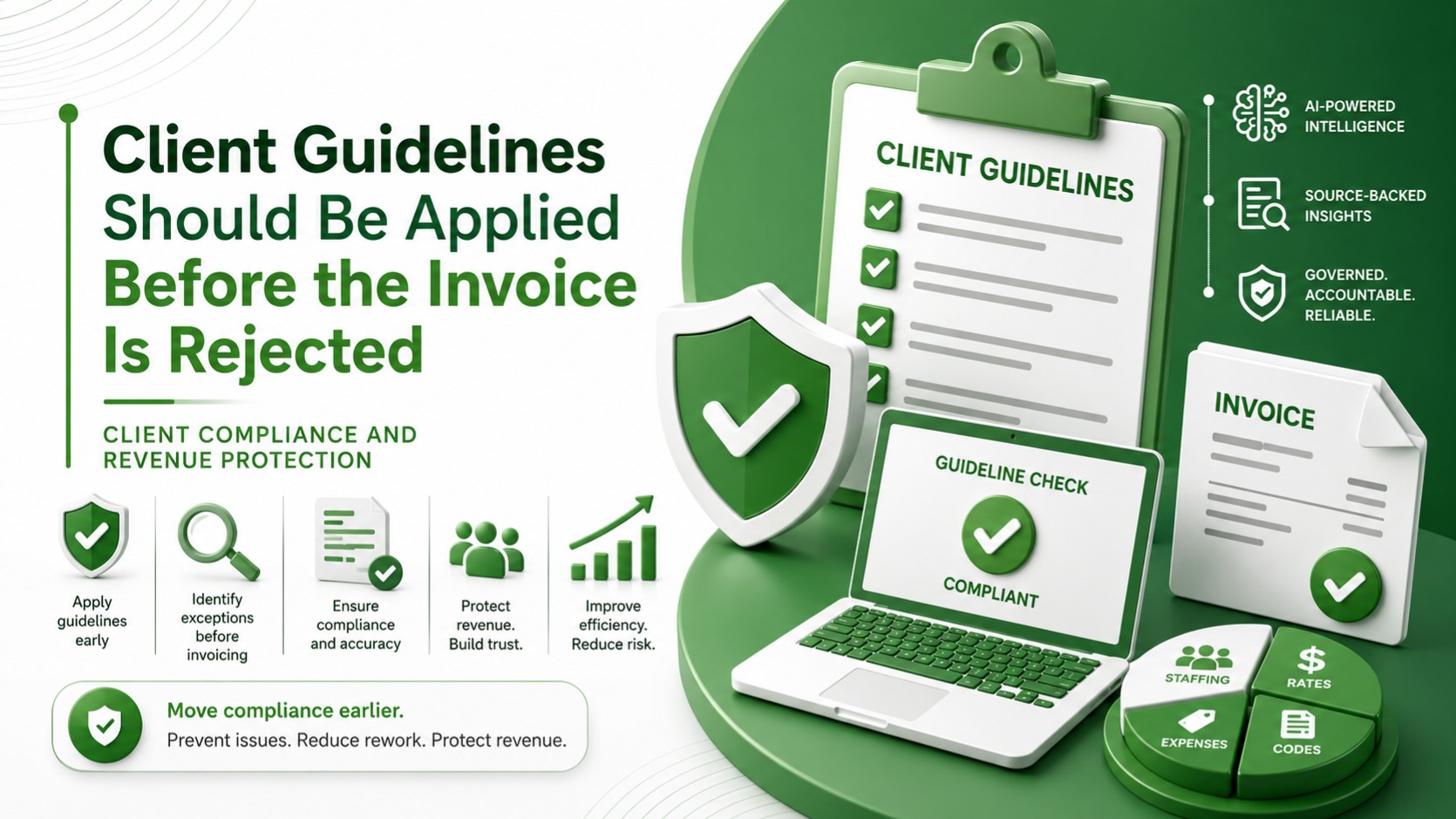
Client Guidelines Should Be Applied Before the Invoice Is Rejected
CLIENT COMPLIANCE AND REVENUE PROTECTION
Outside counsel guidelines and client billing instructions can influence staffing, rates, time entry, coding, expenses, budgets, invoice format and approval procedures.
Yet many firms still manage these requirements as static documents.
A billing professional may search for the latest version. A lawyer may interpret a requirement differently from finance. An update may not reach every team. A potential exception may be discovered only after the work is performed or the invoice reaches the client.
By then, the firm is managing rework, delay or a write-down.
The legacy process depends on experienced people remembering where to look and when to apply the rule. That approach becomes difficult to scale across clients, offices and billing teams.
A governed AI agent can help turn approved guideline content into workflow intelligence.
The agent may extract relevant provisions, classify them by operational area, compare a revised document with the prior version and associate the requirement with the correct client or matter. During billing review, it can identify a possible exception and present the applicable source language to the authorized reviewer.
The source is essential.
A legal or billing professional should be able to see the provision behind the alert, understand why it was raised and record the final disposition.
The agent supports the control. It does not replace accountable interpretation.
The best first implementation is narrow. Select a limited client set, a defined class of requirements and a measurable exception history.
Examples may include:
Block billing
Time-entry narrative requirements
Staffing restrictions
Rate arrangements
Task and activity codes
Expense and travel limitations
Matter-budget requirements
Measure rejected invoices, write-downs, review time and repeat exceptions before and after implementation.
The objective is to move compliance earlier in the workflow—before the issue becomes a client-facing problem.
LuMay can help map the guideline lifecycle, connect approved sources, design the review path and build a controlled MVP around the firm’s actual billing process.
Harun validation notes
Workflow accuracy | Confirmed. |
Terminology | Confirmed. |
Public example | A large law firm spends an enormous amount of time dealing with approvals of e-billing timekeepers for their e-billed clients. A governed AI agent can help save a lot of that time by managing the approval process. |
Final approval | Approved. |


