



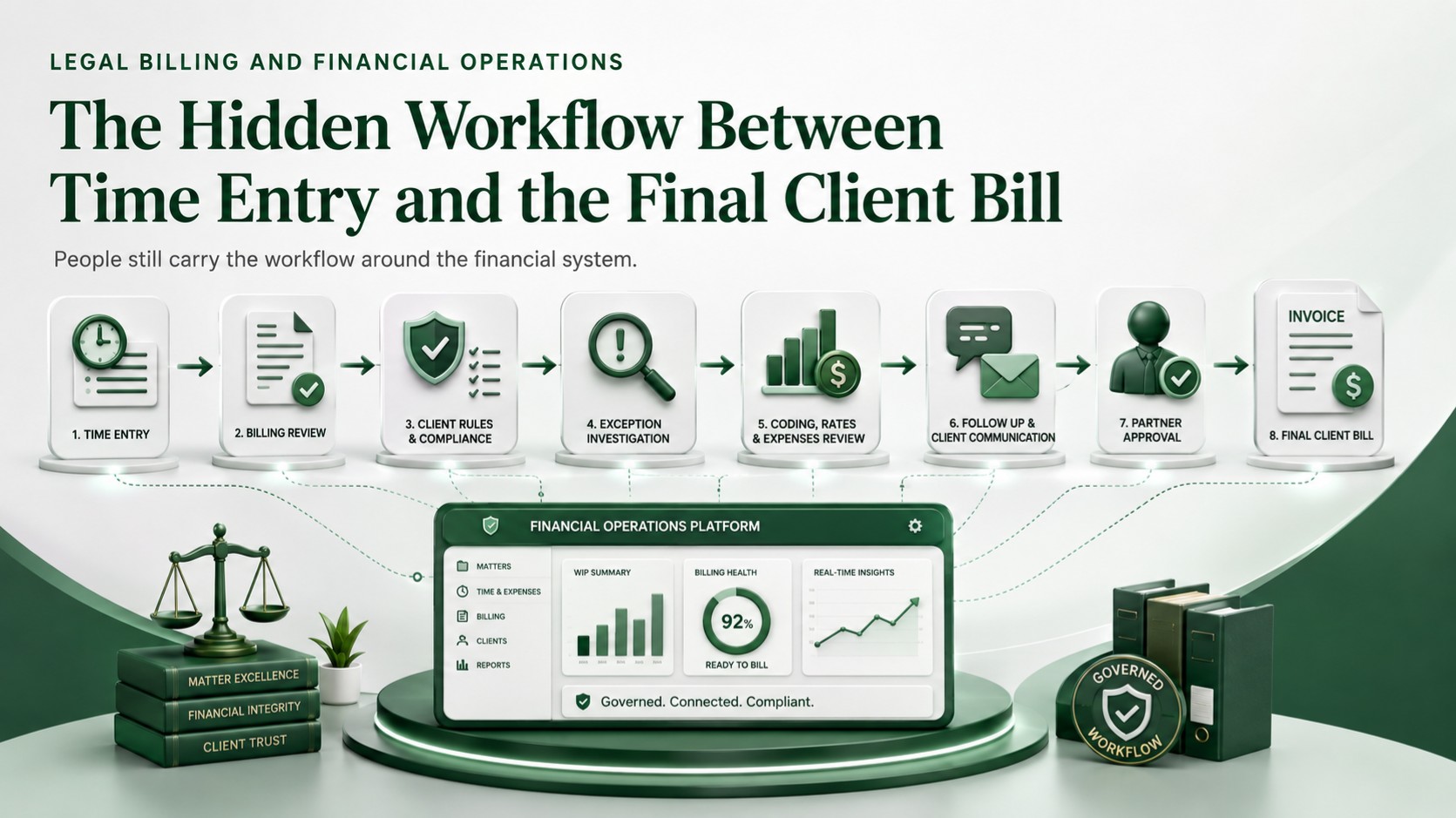
The Hidden Workflow Between Time Entry and the Final Client Bill
LEGAL BILLING AND FINANCIAL OPERATIONS
A client bill may be generated in the firm’s financial system, but the work required to release it often extends far beyond that system.
Timekeepers submit entries. Billing teams review narratives. Client-specific rules must be checked. Rate, staffing, coding and expense exceptions require investigation. Partners make judgment calls. Missing information is chased through email and conversations.
The financial platform records the transaction. People still carry the workflow.
That distinction matters because the largest opportunity is not always replacing a core system. It is reducing the manual coordination surrounding it.
A governed AI agent can monitor defined parts of the billing process and prepare work for the responsible professional. It may identify incomplete time entries, detect a potential narrative or coding issue, retrieve the applicable client requirement, assemble supporting context and route the item to the correct reviewer.
The agent should not make a material billing decision outside the firm’s authority model. The billing professional, finance leader or partner remains responsible for approval.
The value comes from arriving at that decision with the relevant information already collected.
A strong implementation begins with one measurable workflow. For example, the firm may select prebill exception handling for a defined practice group or client portfolio.
Before building, measure the current state:
Number of manual touches
Time spent investigating exceptions
Average approval delay
Volume of corrected or rejected invoices
Unbilled time caused by unresolved items
Administrative effort across the billing cycle
The first objective is not to automate everything. It is to remove repeated checking, searching and follow-up from a process the firm already understands.
When the workflow is designed correctly, the firm can improve billing velocity without weakening partner control, client compliance or the evidence behind each decision.
At LuMay, we work around the firm’s trusted financial environment. We map the existing process, connect the required sources and introduce governed AI only where it creates a clear operational advantage.
Bring us one billing workflow that has remained manual for too long. We will help define the right path from current state to production.
Harun validation notes
Workflow accuracy | Confirmed. |
Terminology | Generic is better as it can apply to 3E and Aderant. |
Public example | A lot of firms handle pre-bill write down approvals manually over email. A lot of time can be saved by incorporating these approvals into a workflow. |
Final approval | Approve. |


