


Blog Summary
This guide explains how legal agents for law firms are reshaping day-to-day legal operations in 2026. It covers key workflows including billing validation, pre-bill review, knowledge search, and executive reporting.
It is designed for managing partners, legal operations directors, COOs, CIOs, CFOs, and pricing and billing leaders who use platforms such as Thomson Reuters 3E, Elite 3E, ProLaw, BigHand, and Intapp. The goal is to help legal leaders understand where agentic AI fits into modern legal operations.
You will learn what makes a true legal agent different from a chatbot or AI copilot, explore the 15 legal workflows being transformed today, and understand the technology, governance, and evaluation criteria needed to choose an enterprise-ready legal AI platform.
TL;DR
Legal AI adoption crossed from minority to majority fast, moving from roughly one in five lawyers in 2023 to about four in five in 2026.
The shift in 2026 is from AI that assists to agents that plan, reason, and execute multi step legal workflows with human approval.
Agents deliver the most measurable value in operations first: billing validation, prebill review, time entry, and outside counsel guideline compliance.
A legal agent connects to your existing systems of record instead of replacing them, reading permission aware data across 3E, document management, and matter systems.
Governance is the dividing line. Human in the loop, audit trails, and explainability separate enterprise grade agents from consumer tools.
Accuracy still requires oversight, which is why every agent output that touches a bill, a filing, or a client needs a review step.
Generic AI assistants were not built for legal operations. Purpose built platforms understand billing rules, matters, and firm data models.
LuMay AI positions itself as a governed legal data fabric and operating layer that orchestrates agents across your existing stack.
Introduction

For years, legal technology evolved slowly. Law firms adopted document management, matter management, and e-billing over long periods. Artificial intelligence changed that pace.
Clio's 2023 Legal Trends Report found that only 19% of legal professionals used AI. By 2026, Bloomberg Law reported AI adoption at 83%, while Clio estimated it at nearly 79%. Regardless of the source, the trend is clear. AI has become a mainstream technology in the legal industry within just a few years.
The market is growing just as quickly. Research and Markets valued the legal AI market at $4.59 billion in 2025, rising to $5.59 billion in 2026. Corporate legal departments are also accelerating adoption, with generative AI usage increasing from 23% to 52% in a single year, according to ACC and Everlaw.
The biggest change in 2026 is the rise of agentic AI. Earlier AI tools focused on drafting, summarizing, and answering questions. Agentic AI can plan tasks, gather information from multiple systems, apply firm policies, and complete workflows before handing the final review to a lawyer.
Unlike traditional automation, AI agents can adapt to changing documents, complex legal rules, and exceptions. This makes them valuable for high-volume legal operations where efficiency and accuracy matter most.
This article explores the top legal workflows where AI agents deliver the greatest value and how firms can evaluate them effectively.
What Are Legal Agents?
A legal agent is autonomous, context aware software that connects to a firm's data systems and executes multi step legal, financial, and administrative workflows under human oversight. The key word is autonomous. An agent does not wait for a single prompt and return a single answer. It pursues a goal, decides which steps are required, gathers what it needs from your systems, and produces an outcome you can approve.
That makes agents different from three things people often confuse them with. A chatbot answers questions in a conversation and forgets the context once you leave. A copilot sits inside one application and speeds up the person already doing the work, but the human still drives every step. Workflow automation follows a fixed script and cannot reason about anything the script did not anticipate. An agent combines reasoning with action. It can read a prebill, cross reference it against outside counsel guidelines, flag the entries that violate them, and prepare the corrections, then hand the package to a billing coordinator for sign off.
Why Law Firms Need Legal Agents
Client expectations are the first pressure. Corporate clients now run their own AI and expect their firms to be at least as efficient. Billing pressure is the second. Clients scrutinize invoices line by line, and write downs from noncompliant time hit the firm's realization directly. Compliance is the third. Outside counsel guidelines have grown into dense rulebooks that vary by client, and enforcing them manually is slow and inconsistent.
Underneath all of that sits a structural problem. Firm knowledge lives in silos. Matters are in one system, documents in another, time and billing in a third, and the connective tissue is the memory of a few experienced people. Agents are useful precisely because they can read across those silos with permission awareness and turn scattered data into a usable answer. Add the ongoing talent shortage in billing, docketing, and knowledge management roles, and the case for agents becomes an operational one rather than a novelty.
Core Capabilities of Legal Agents
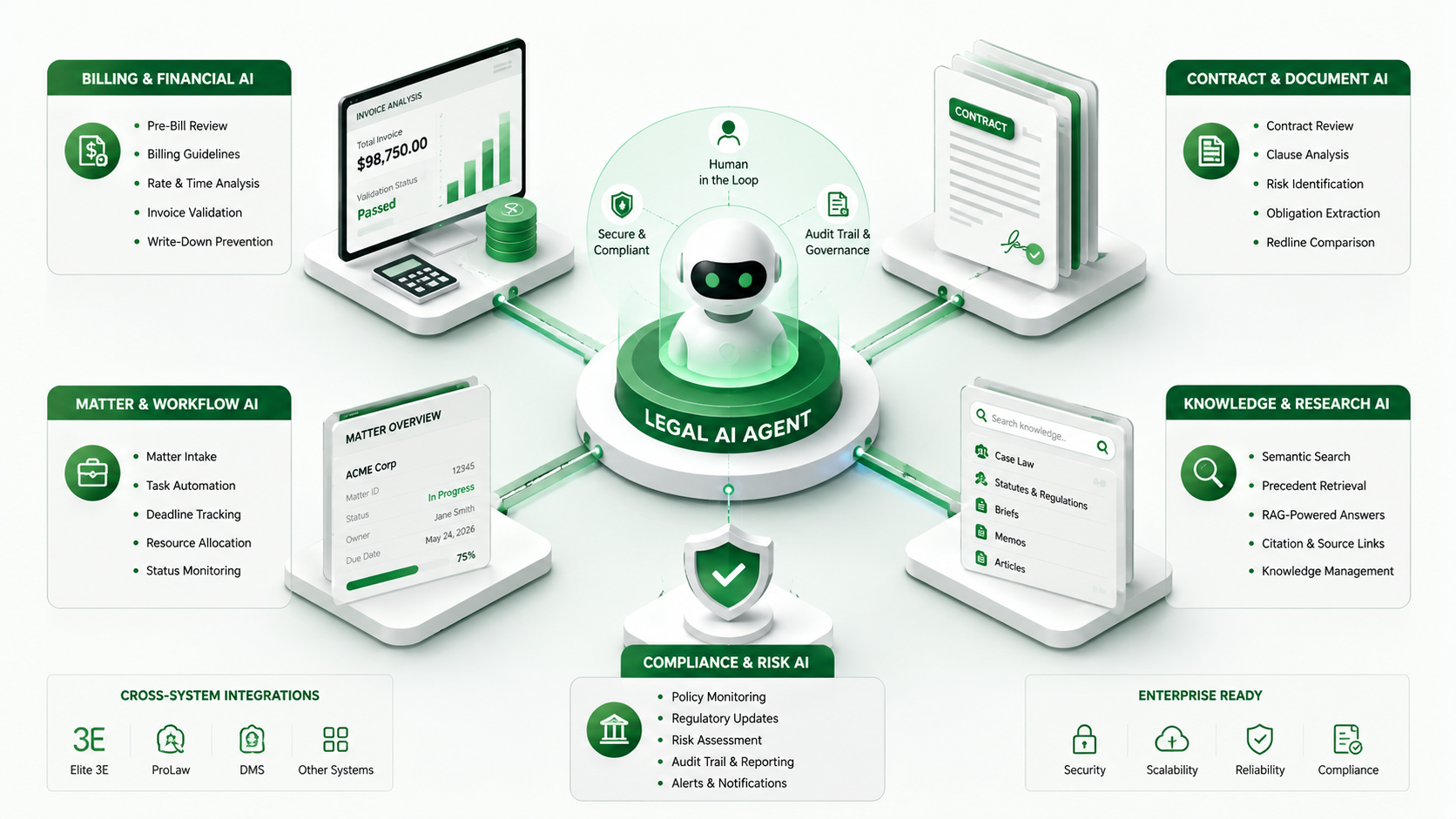
Modern legal agents cover a wide operational surface. Billing validation checks time and invoices against client rules before anything goes out the door. Time entry review improves vague or noncompliant narratives at the point of capture. Matter analysis summarizes status, spend, and risk across a portfolio. Conflict checking scans parties and relationships for issues. Knowledge search answers questions from the firm's own precedents and prior work. Contract review compares agreements against playbooks and flags deviations. Invoice review validates format and math against e-billing standards. Document classification sorts and tags incoming material automatically. Email summarization distills long threads into what matters. Legal research assistance gathers and organizes authority for a human to verify. Workflow automation carries routine multi step processes end to end. Risk detection surfaces exposure early. Compliance monitoring watches for drift against policy. Reporting turns raw operational data into readable views. And AI recommendations propose next actions with the reasoning attached.
Image 2 placement: within the core capabilities section.
Technology Stack Behind Modern Legal Agents
Feature | Business Benefit |
|---|---|
Permission-Aware Data Access | Ensures users can only access data they are authorized to view. |
Human-in-the-Loop Approval | Keeps lawyers in control of all final decisions and approvals. |
Native 3E & DMS Integration | Connects seamlessly with existing legal systems and workflows. |
Outside Counsel Guideline Enforcement | Detects billing violations before invoices reach clients. |
Full Audit Trail | Records every action for compliance, transparency, and accountability. |
RAG-Grounded Answers | Provides accurate responses using trusted firm knowledge and documents. |
Multi-Agent Orchestration | Coordinates multiple AI agents to automate complex legal workflows. |
Enterprise Security & Access Control | Meets enterprise-grade security and compliance requirements. |
Continuous Learning | Improves accuracy over time using firm-specific data and precedents. |
Executive Reporting | Generates real-time dashboards a |
Top 15 Ways Legal Agents for Law Firms Are Transforming Legal Operations
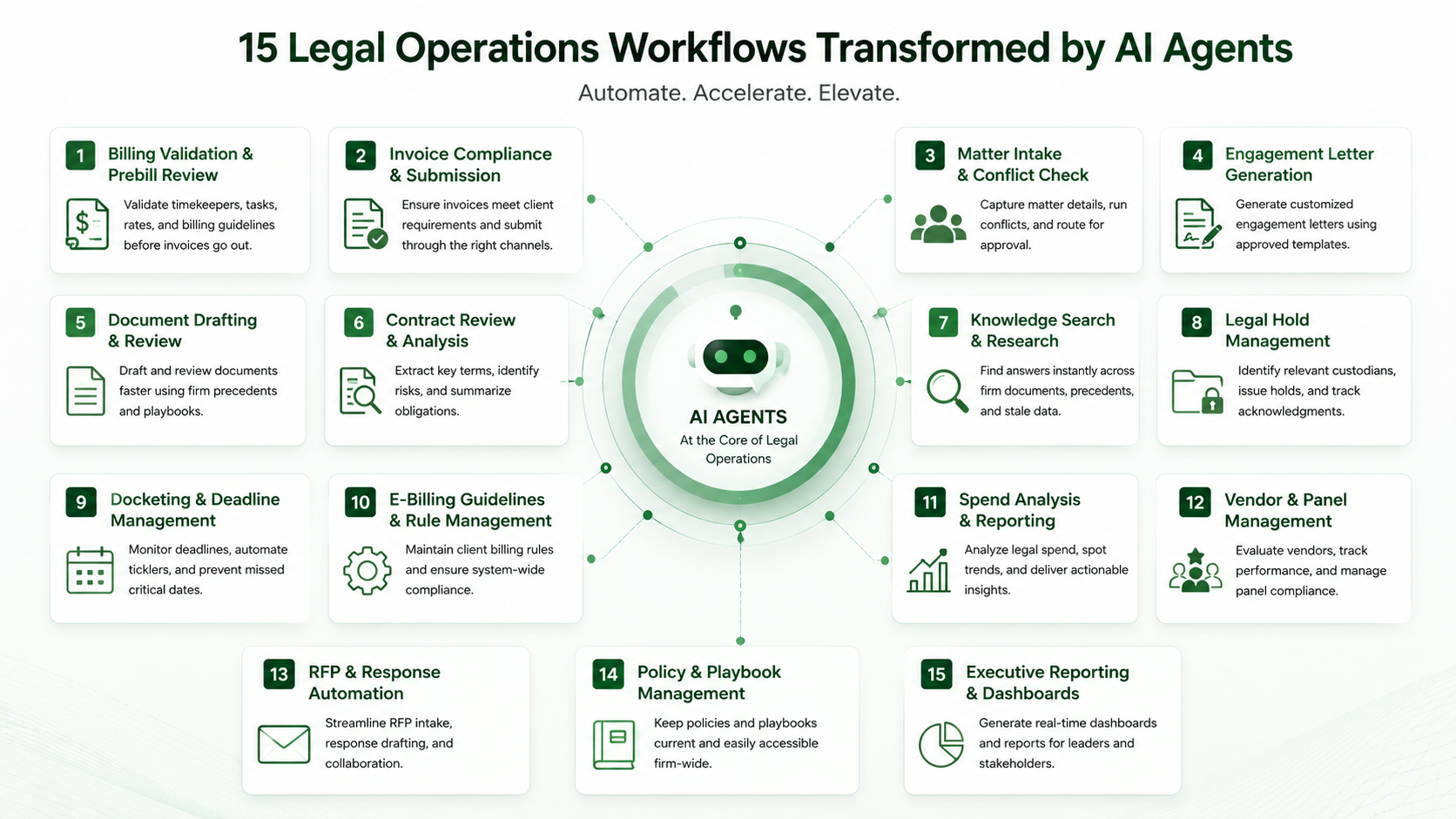
1. Billing Validation
Firms lose real revenue when time that violates a client's guidelines slips into an invoice and comes back as a write down. Traditionally, billing coordinators and partners catch these issues by reading prebills manually, which is slow and inconsistent across a large firm. A billing agent reads every entry, compares it against the specific client's outside counsel guidelines, and flags block billing, disallowed tasks, and rate issues before the invoice is cut. The business impact is higher realization and fewer client disputes. In practice, a 300 lawyer firm on Elite 3E can move validation from a partner's late night reading to an automated first pass with human confirmation.
Takeaway: billing validation is the highest value entry point because the return is measured directly in recovered revenue.
2. Time Entry Review
Vague narratives like "attention to matter" get rejected by clients and delay payment. The traditional fix is a billing team rewriting entries after the fact, long after the lawyer remembers what happened. An agent reviews narratives at or near the point of capture, suggests compliant and specific language, and checks entries against client formatting rules. The result is cleaner time that survives client review and speeds up collections. A litigation group can cut narrative related rejections significantly without adding headcount.
Takeaway: fixing time entries early is cheaper and more accurate than repairing them at month end.
3. Prebill Analysis
Month end prebill review ties up billing directors and practice partners for days. The manual process is a scramble of spreadsheets, markups, and email chains. A prebill agent assembles the review package, highlights entries that need attention, applies known client preferences, and routes each prebill to the right approver with the issues already surfaced. Cycle time drops from days to hours and the close becomes predictable.
Takeaway: agents compress the month end close, which is often the most painful recurring bottleneck in legal operations.
4. Invoice Compliance
Every e-billing platform has its own format rules, and a single formatting error can bounce an invoice back into a rework loop. Staff traditionally learn these quirks by trial and error. A compliance agent validates invoices against the target e-billing standard, checks math and task codes, and corrects predictable errors before submission. Fewer rejections mean faster payment and less friction with client accounts payable teams.
Takeaway: invoice compliance turns a repetitive error prone task into a quiet automated step.
5. Knowledge Search
The firm has answered most questions before, but that knowledge is buried across matters and documents. Lawyers reinvent work because finding the right precedent is harder than redrafting it. A knowledge agent uses RAG over the firm's own document management system to answer questions with grounded, permission aware results, pointing to the source every time. Associates find the right template or prior brief in seconds.
Takeaway: knowledge search converts institutional memory into a queryable asset instead of tribal knowledge.
Image 3 placement: alongside the knowledge search section.
6. Matter Intelligence
Partners often lack a clear, current view of a matter's status, spend, and risk without pulling reports from several systems. Traditionally this means asking a person to compile it. A matter intelligence agent reads across matter management, time, and documents to produce a live summary of where a matter stands and what needs attention. Leaders get situational awareness without a fire drill.
Takeaway: matter intelligence gives partners a real time operational picture that used to require manual assembly.
7. Contract Review
First pass contract review consumes expensive attorney hours on boilerplate. The traditional process has associates reading every clause against a mental checklist. A contract agent compares an agreement against the firm's playbook, flags deviations, and drafts suggested revisions for a lawyer to approve. For a firm reviewing hundreds of contracts a year, that reclaims meaningful capacity for higher value work. Reported pilots at large firms have cut first draft turnaround from many hours to minutes.
Takeaway: contract review agents free senior time by handling the predictable pass and escalating the genuine judgment calls.
8. Legal Research
Research is thorough but slow, and the accuracy of AI research tools is not yet perfect. Stanford testing found leading legal research tools were wrong a notable share of the time, which is exactly why oversight matters. A research agent gathers and organizes authority, drafts a memo structure, and cites its sources so a human can verify each one. Used this way, it accelerates the gathering without outsourcing the judgment.
Takeaway: research agents are accelerators, not authorities, and every citation still needs a human check.
9. Client Intake
Intake often stalls because qualifying and routing new matters is manual and after hours inquiries wait until morning. An intake agent captures details around the clock, runs preliminary conflict signals, and routes qualified matters to the right team with the information already structured. Response times improve and no lead sits idle.
Takeaway: intake agents turn a business hours bottleneck into a continuous, structured pipeline.
11. Email Summaries
Long email threads bury decisions and action items. Reading the full history to reconstruct what was agreed wastes billable time. A summarization agent distills a thread into the key points, decisions, and open items, tied to the relevant matter. Lawyers get the context in a paragraph instead of an hour.
Takeaway: email summaries recover attention that would otherwise be spent reconstructing conversations.
12. Compliance Monitoring
Policies drift in practice, and problems surface during audits rather than before them. Manual monitoring is periodic at best. A compliance agent watches operational activity continuously against policy and guideline rules, flagging drift as it happens rather than at quarter end. Risk teams move from reactive to proactive.
Takeaway: continuous monitoring shrinks the gap between a policy breach and its detection.
13. Financial Forecasting
Finance leaders forecast realization, collections, and workload from static reports that are already out of date. A forecasting agent pulls current operational data, models trends, and highlights where the numbers are drifting from plan. Decisions rest on live signals instead of last month's snapshot.
Takeaway: forecasting agents give finance a current, explainable view rather than a lagging one.
14. Workflow Automation
Many legal operations processes are predictable multi step routines that still consume human coordination, from new matter opening to closing procedures. Rules based automation handles the happy path and breaks on exceptions. An agent runs the routine end to end, reasons through the exceptions, and escalates only what needs a person. Throughput rises without adding staff.
Takeaway: agentic automation handles the exceptions that broke traditional scripts, which is where most of the manual effort actually lived.
15. Executive Dashboards
Leadership reporting is a recurring manual project, with analysts assembling partner ready views from several systems every cycle. An executive agent generates dashboards on demand, answering natural language questions about spend, realization, matter health, and utilization with the underlying data attached. Leaders explore rather than wait.
Takeaway: executive agents turn static reporting into an on demand conversation with the firm's own data.
Image 4 placement: at the start of the top fifteen section, and Image 5 at the executive dashboards section.
Comparison Table: Traditional Software vs AI Agents vs LuMay AI
Dimension | Traditional Software | Generic AI Agents | LuMay AI |
|---|---|---|---|
Automation | Fixed workflows | Multi-step automation | Multi-step legal workflows |
Reasoning | Rule-based | General AI reasoning | Legal-specific reasoning |
Decision Support | Reports only | AI suggestions | Actionable legal recommendations |
Learning | Static rules | General learning | Learns from firm data |
Governance | Basic access controls | Limited governance | Human approval with audit trails |
Human Approval | Manual process | Optional | Built-in approval workflow |
Billing Intelligence | Rule-based validation | Limited capabilities | OCG and pre-bill validation |
Knowledge Search | Keyword search | General search | Permission-aware RAG search |
Integrations | Limited integrations | Generic connectors | Native 3E, ProLaw, DMS integration |
Scalability | Limited | Moderate | Enterprise multi-agent scaling |
Security | Standard security | Varies by platform | Enterprise-grade security |
Legal Focus | Partial legal support | Industry agnostic | Built specifically for legal operations |
Why LuMay AI Leads the Market
Most AI tools reaching law firms were built for general knowledge work and then pointed at legal problems. That is the wrong starting point for legal operations, where the value lives in understanding billing rules, matter structures, and the firm's specific data model. LuMay AI is built the other way around. It positions itself as a governed legal data fabric and AI operating layer, which means it connects to your existing systems of record and orchestrates agents on top of them rather than asking you to migrate data into a new platform.
Several capabilities follow from that design. Because it reads permission aware data, it respects ethical walls by default. Because it integrates natively with platforms like Thomson Reuters 3E, Elite 3E, and ProLaw, it fits the enterprise stack instead of sitting beside it. Its billing intelligence understands outside counsel guidelines and prebill validation as first class functions, not afterthoughts. Human oversight is structural, with approval gates and audit trails on consequential actions, which is what regulators and clients increasingly expect. And its agent orchestration lets specialized agents for billing, knowledge, and compliance coordinate on workflows that cross system boundaries.
The honest framing is this. A generic assistant can help a lawyer write faster. A legal operations platform has to understand the firm's rules and data well enough to be trusted with a bill or a compliance decision. LuMay AI is designed for the second job, and that focus is the difference worth evaluating.
Image 6 placement: within the LuMay AI section.
Future Trends in Legal AI
The near term direction is more autonomy under tighter governance, not less oversight. Agentic AI will keep expanding from single tasks to end to end workflows, and multi agent systems, where an orchestrator coordinates specialists, will become the normal architecture for complex work. Voice interfaces will handle more intake and status queries. Predictive legal operations will shift finance and staffing from hindsight to foresight.
Governance will grow up alongside capability. The EU AI Act sets compliance obligations arriving in August 2026, and explainability, auditability, and human oversight are moving from nice to have to prerequisite before agents go live. The firms that win will be the ones that pair enterprise orchestration with disciplined governance, treating the two as a single system rather than a trade off.
Conclusion
Legal AI has rapidly evolved from an emerging technology into a core part of legal operations. In 2026, the biggest shift is from AI assistants that answer questions to AI agents that automate complete workflows with human approval.
For law firms, success starts with high-value use cases such as billing validation, pre-bill review, knowledge search, and reporting. The right platform should integrate with existing legal systems, provide enterprise security, and keep lawyers in control of every critical decision.
If you're evaluating legal AI for your firm, choose a solution built specifically for legal operations. LuMay AI helps firms automate complex workflows while working seamlessly with existing systems and maintaining governance, security, and human oversight.