


AI Contract Review for Law Firms
1: Why Contract Review Became the Breaking Point for Legal Ops
Contract review is where legal operations budgets quietly break. It is repetitive enough to feel automatable, risky enough that firms are afraid to automate it, and varied enough that no two contracts fail the same way. That combination - high volume, high stakes, low standardization - is exactly why it became the first place legal teams tried generative AI, and the first place many of them got burned.
General counsels are not asking “can AI read a contract?” anymore. They already know it can. The real question driving 2026 buying decisions is narrower and harder: can AI read a contract accurately enough, explainably enough, and safely enough that a lawyer can rely on the output without silently re-doing the work by hand?
Most content on this topic treats “AI contract review” as one category. It isn't - the architecture behind a tool determines almost everything else that matters.
Most content on this topic still treats “AI contract review” as a single category, as if every product works the same way underneath. It doesn’t. The architecture behind a tool - whether it’s a raw large language model prompted against your documents, or a system that pairs a smaller specialized model with retrieval, verification, and a human checkpoint - determines accuracy on edge cases, explainability to opposing counsel or a judge, and how much liability sits with your firm versus the vendor.
2: Three Generations of Contract Review Technology
Understanding where a tool sits in this progression tells you more about its real capability than any feature list.
Generation 1: Manual and Keyword-Based Review
Associates or contract managers read documents line by line, or software flags predefined keywords and clause patterns (“limitation of liability,” “indemnification”). Reliable but slow, and it misses anything phrased in an unexpected way.
Generation 2: Clause-Matching and Rules Engines
Tools compare contract language against a library of pre-approved or “golden” clauses and flag deviations. Faster than manual review and strong for standardized paper (NDAs, vendor agreements), but it struggles with novel language and judgment calls about intent.
Generation 3: LLM-Based and Verified AI Review
General-purpose large language models can summarize, extract, and answer questions about contract text in natural language. The risk is that raw LLMs can produce fluent, confident-sounding answers that are subtly wrong, and they don’t inherently show their work. The most defensible systems in this generation pair a model with retrieval against the actual source document, add a verification step that checks extracted claims before they reach a person, and route low-confidence output to human review.
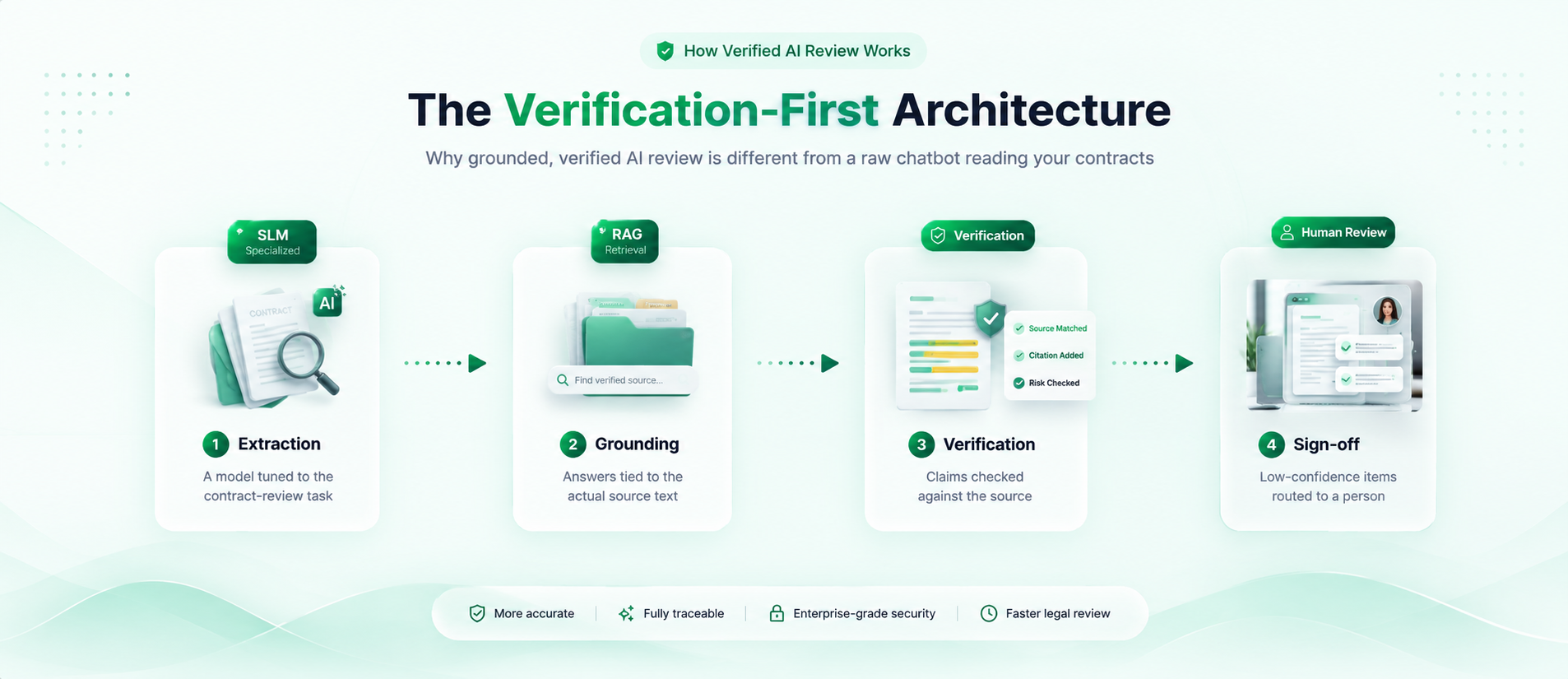
The four-stage architecture behind verified AI contract review.
That verification-plus-human-review layer is the difference between “AI that reads contracts” and “AI a law firm can put its name behind.” It’s the architecture Lumay AI builds around: a specialized language model (SLM) for extraction, retrieval-augmented generation (RAG) grounded in the actual contract text, automated verification, and a human review checkpoint before anything is treated as final.
3. What “AI Contract Review” Actually Means
Vendors use the term to describe very different capabilities. Before evaluating any product, separate it into its component tasks. A tool can be strong at one and weak at another:
Extraction: Pulling defined terms, dates, parties, obligations, and dollar amounts out of a document.
Classification: Identifying contract type, governing law, and risk category.
Clause comparison: Measuring deviation from a playbook or standard template.
Risk summarization: Explaining in plain language what a clause means and why it matters.
Redlining assistance: Suggesting or generating alternative language.
Portfolio analytics: Aggregating obligations and risk across hundreds or thousands of agreements.
A tool that excels at portfolio analytics for vendor agreements may be a poor fit for M&A due diligence redlining. Ask any vendor which of these tasks their system was actually built and tested for.
4. The Risk Categories Legal Teams Underestimate
Hallucination and Silent Error
A model that invents a termination date or misstates a liability cap is dangerous because the output reads as confident and complete. The relevant question isn't, "Does this happen?" It's, "What catches it before a human sees it?"
False Negatives, Not Just False Positives
Vendors love to talk about precision. Ask harder about recall: How often does the system miss a real issue entirely because it wasn't phrased the way the model expected? A missed non-compete carve-out is far costlier than a false alarm.
Explainability and Chain of Custody
If a redline is challenged, can you show exactly which passage of the source document the AI's conclusion was grounded in? Retrieval-based systems can produce that citation trail. Systems relying purely on general model knowledge often cannot.
Privilege and Confidentiality
THRESHOLD QUESTION
Where does contract text go once it's uploaded? Is it used to train a shared model, retained by the vendor, or processed in isolation? This bears directly on attorney-client privilege and ABA Model Rule 1.6 confidentiality obligations.[VERIFY current ABA and state bar guidance before publishing specific rule citations.]
5. A Five-Pillar Evaluation Framework
Rather than comparing feature checklists, evaluate any AI contract review system against five pillars.
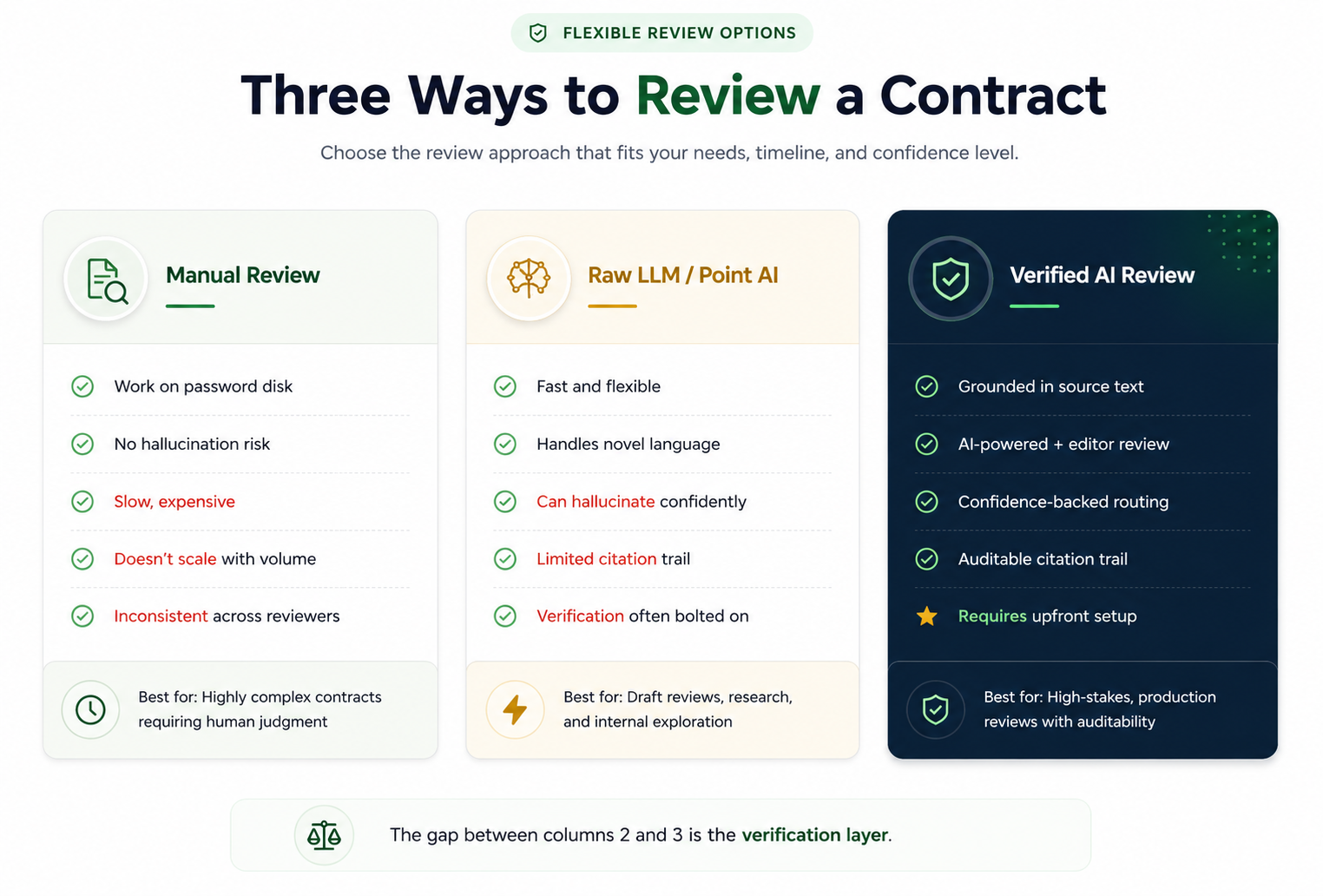
Manual review, raw LLM tools, and verified AI review carry very different risk profiles.
Pillar 1: Accuracy Architecture
Is the system grounded in retrieval against your actual documents, or reasoning from general model knowledge?
Pillar 2: Verification Design
Is there an automated check comparing extracted claims back against the source text before output is delivered?
Pillar 3: Human-in-the-Loop Design
Is human review a genuine checkpoint with override authority, or a rubber-stamp screen? Ask to see the real review interface.
Pillar 4: Data Governance and Security
Data residency, encryption, retention policy, and whether client data trains shared models are non-negotiable. Ask for current SOC 2 Type 2 (or equivalent) documentation directly.[VERIFY current certification status per vendor.]
Pillar 5: Workflow Fit
Does the tool integrate with your DMS, e-signature platform, and matter management software, or does it create a second system of record?
6. The AI Contract Review Maturity Model
Firms rarely jump straight from manual review to full automation. This model describes the realistic path and helps a legal operations leader diagnose where the organization actually sits today.
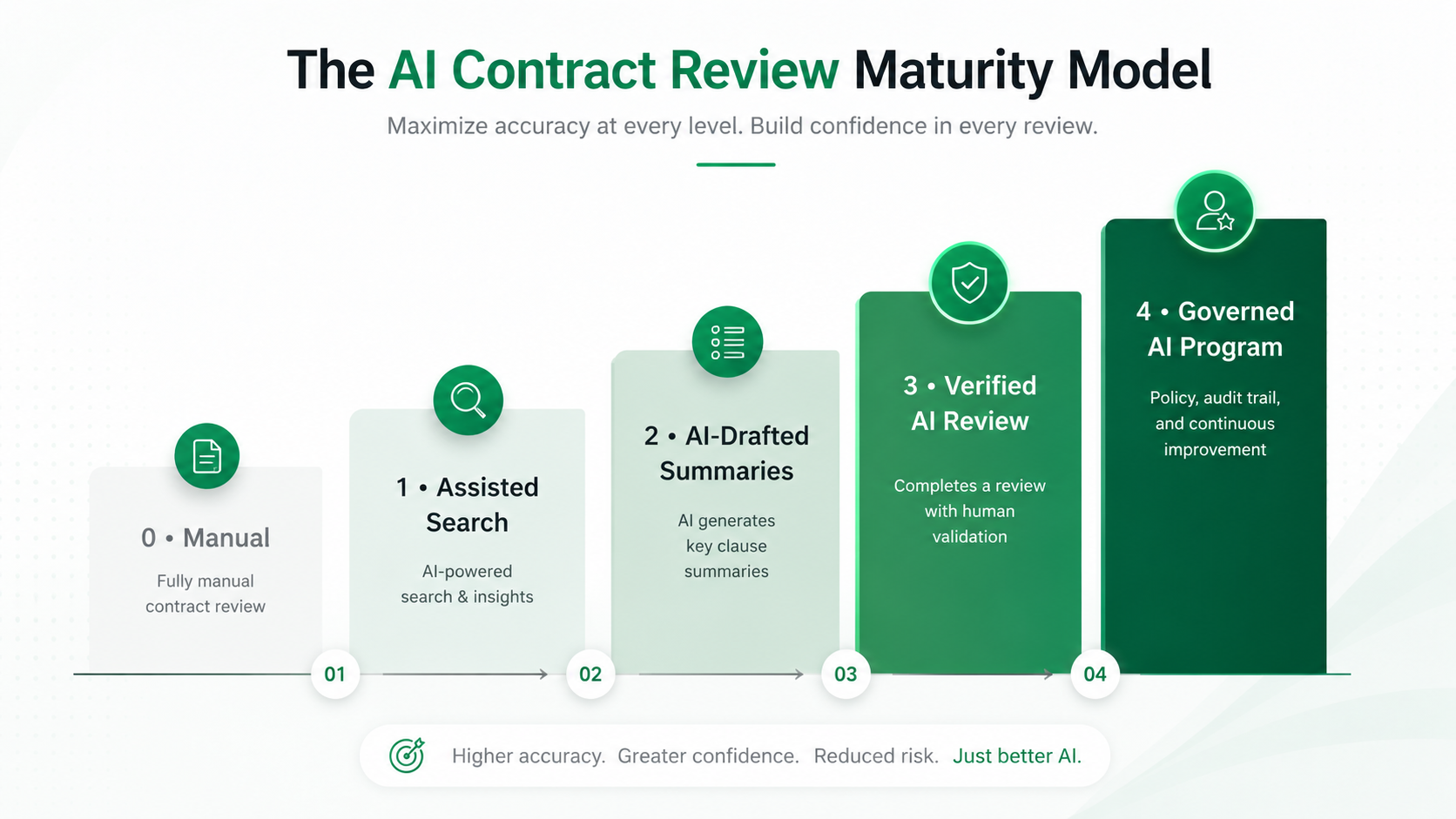
Most firms piloting generative AI for contract review sit at Level 2 without realizing it. AI-generated summaries have entered the workflow, but the verification step that would make Level 2 safe to rely on at scale hasn't. Moving to Level 3 is less about buying a new tool and more about insisting the tool actually grounds and verifies its output.
7. Where AI Contract Review Fits by Practice Area
M&A Due Diligence
High-volume, time-boxed review of target company contracts for change-of-control clauses and consent requirements. Verified AI review can triage a data room in days, surfacing the subset that genuinely needs attorney review first.
Vendor and Procurement Agreements
High volume, relatively standardized language, and clear playbooks make this one of the strongest early use cases.
NDAs and Intake Agreements
Often the first workflow automated. High volume and comparatively low risk per document make this a good pilot area.
Commercial Lease Abstraction
Extracting rent escalation schedules and renewal options across a large portfolio is a strong fit for retrieval-grounded extraction.
Employment and Executive Agreements
Higher sensitivity, including non-competes, severance, and equity provisions, means human review should stay closely coupled to any AI summary.
Litigation Document Cross-Reference
Cross-referencing contract obligations against discovery materials is emerging, though it typically requires the highest level of human oversight because of its evidentiary weight.
8. Build vs. Buy vs. Hybrid
Approach | Best For | Key Risk |
|---|---|---|
Build in-house | Firms with dedicated ML engineering and specific data governance needs. | Long time to value. The verification layer is often underinvested. |
Buy point solution | Solving one narrow workflow quickly, such as NDA triage. | Tool sprawl without a shared governance layer. |
Buy platform / managed service | Enterprise legal departments wanting a governed architecture without building it. | Vendor lock-in risk if data portability isn't negotiated upfront. |
For most law firms, a managed platform with verification and human review built in offers the fastest path to Level 3 maturity without the multi-year investment required to build and validate that architecture internally.
9. A 90-Day Implementation Roadmap

Days 1–30: Scope and Baseline
Select one contract type and one workflow for the pilot rather than a portfolio-wide rollout.
Establish a manual review accuracy baseline so the AI tool has something concrete to be measured against.
Confirm data governance terms with the vendor in writing: retention, training use, encryption, and export rights.
Days 31–60: Parallel Run
Run AI review and human review in parallel without letting AI output replace attorney sign-off yet.
Track disagreement rate and why the AI and human disagreed.
Tune confidence thresholds so lower-confidence outputs route to senior review.
Days 61–90: Controlled Rollout
Expand to a second contract type only after the first shows stable accuracy and workflow fit.
Formalize the human review checkpoint into a written procedure.
Set a recurring cadence for re-validating accuracy as language and volume evolve.
10. Common Mistakes When Rolling Out AI Contract Review
Measuring accuracy only on documents similar to the demo set, not the firm's actual messiest paper.
Treating human review as a formality rather than a genuine checkpoint with override authority.
Rolling out across every practice group simultaneously instead of proving the workflow in one area first.
Skipping a written AI governance policy until after a problem surfaces.
Failing to negotiate data ownership and export rights before signing.
Assuming a general-purpose LLM chatbot and a verified, retrieval-grounded system carry the same risk profile. They do not.
11. Security and Compliance Considerations
For law firms, security and compliance are not an RFP checkbox. They are the difference between a defensible tool and a malpractice exposure.
Where is contract data physically stored, and is residency configurable for jurisdictional requirements?
Is client data ever used to train shared or general-purpose models, and can this be contractually excluded?
What certifications does the vendor hold, and can current audit documentation be provided directly? [VERIFY per vendor.]
What is the data retention and deletion policy after termination?
Is there a documented incident response process, and what are notification timelines?
How is privileged material segregated from other client data on the platform?
PRACTICAL NOTE
Any vendor unwilling to put data governance answers in writing, not just in a sales deck, should be treated as a disqualifying signal, regardless of how strong the demo looks.
12. AI Governance for Legal Departments
A governance policy doesn't need to be long to be effective, but it needs to exist before AI-assisted review touches client matters. At minimum, define:
Which contract types and matters are approved for AI-assisted review, and which are excluded.
The required human review checkpoint and who holds override authority.
How accuracy is measured and re-validated over time, and by whom.
An audit logging standard tracing every output back to source text and reviewer.
An escalation path for when the AI tool is wrong, including client notification thresholds if relevant.
The NIST AI Risk Management Framework offers a useful structural reference, though legal-specific adaptation is necessary given confidentiality obligations. [VERIFY/CITE current NIST AI RMF version before publishing.]
13. Calculating ROI: The Honest Version
Most ROI claims in this category are unverifiable marketing numbers. A more useful approach is a formula legal operations teams can run with their own data.
Hours saved per contract × blended hourly cost − (subscription + implementation + ongoing review time) = net monthly value.
Worked example, using placeholder figures a legal operations team should replace with its own baseline:
If manual review of a vendor agreement takes 45 minutes at a blended cost of $150/hour, and verified AI review with human sign-off reduces that to 15 minutes, the time saved is 30 minutes per contract, or roughly $75 before subtracting platform costs. At 200 vendor agreements per month, that's approximately $15,000 in monthly time value, to be measured directly against subscription and implementation costs.
14. Vendor Evaluation Scorecard
Score each vendor from 1–5 on each criterion, then weight the scores based on what matters most to your practice.
Criterion | Score (1–5) | Notes |
|---|---|---|
Retrieval-grounded accuracy on your document types | ||
Verification layer present before human review | ||
Human review interface quality and override authority | ||
Data governance and security documentation in writing | ||
Integration with existing DMS and matter management | ||
Audit trail and explainability of outputs | ||
Pricing transparency and contract flexibility | ||
Vendor stability and data portability on exit |
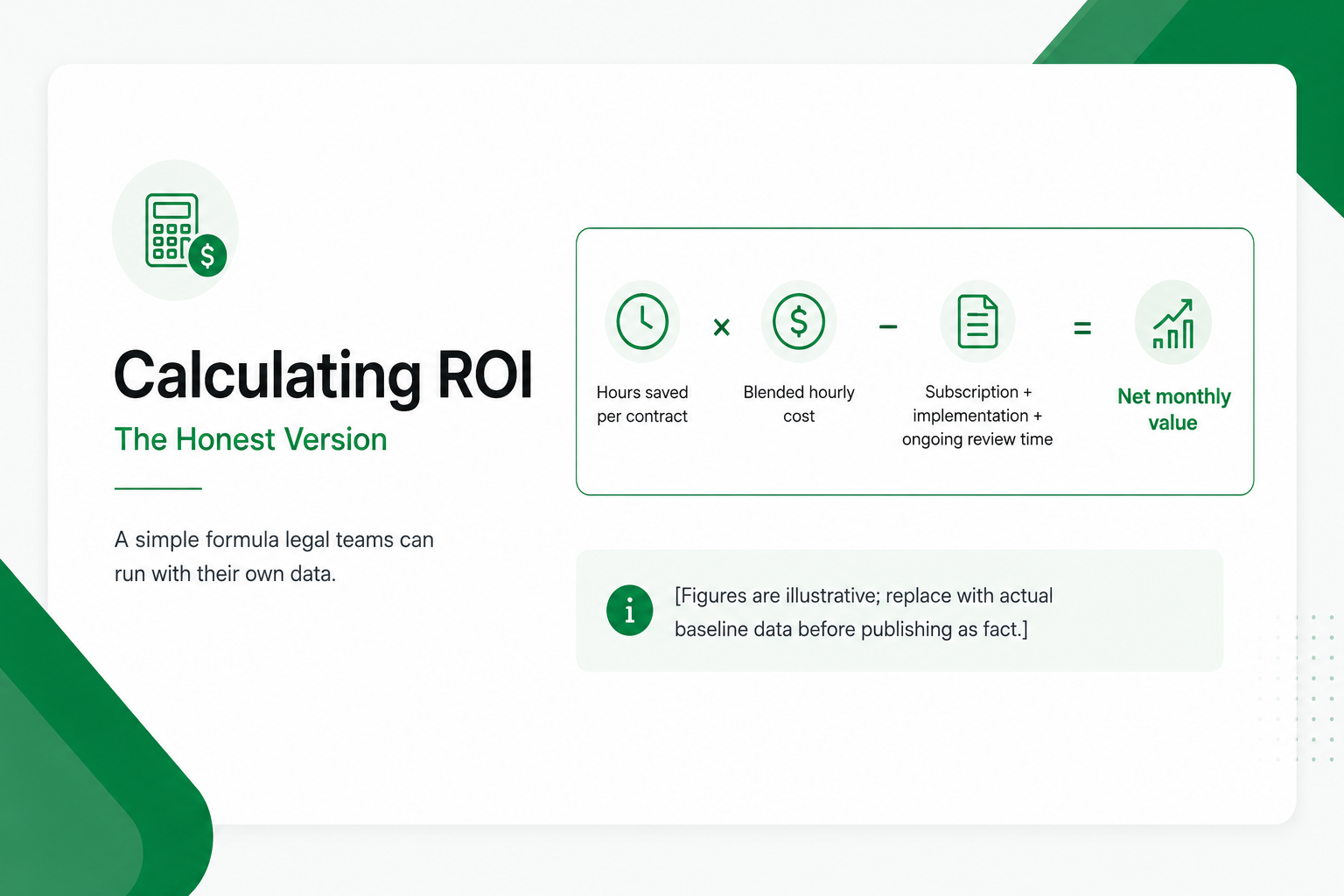
The honest caveat: ROI models that ignore the human review checkpoint, or assume 100% AI accuracy with zero rework, systematically overstate value.
15. The Verification Layer Advantage
The single highest-leverage architectural decision in this category is whether a system verifies its own output against source text before a human ever sees it. A specialized model tuned to the extraction task, retrieval grounded in the actual contract, an automated verification pass, and a human checkpoint for low-confidence output together address the two hardest problems in this category: hallucination risk and explainability.
This is the architecture Lumay AI has built its contract review and broader document intelligence work around because it maps to how legal teams actually need to trust an output. Not "the model says so," but "here is the exact passage this conclusion is grounded in."
16. Future Trends in AI Contract Review
Tighter integration between contract review AI and matter management and billing systems.
Growing regulatory attention to AI governance in legal services, likely increasing documentation requirements.
Movement toward standardized accuracy benchmarking, similar to how e-discovery technology-assisted review was validated over the past decade.
Increased buyer sophistication. Fewer RFPs asking, "Do you use AI?" and more asking to see the verification architecture and audit trail.
Expansion of AI-assisted review into higher-stakes practice areas as verification and governance maturity catch up with model capability.
Related reading: Top 10 Legal AI Software Platforms for Law Firms in 2026: Comprehensive Review · 8 Best AI Voice Agents for Law Firms in 2026 (Tested & Ranked) · Top 10 Harvey AI Alternatives for Law Firms in 2026
17. Frequently Asked Questions About AI Contract Review for Law Firms
18. Key Takeaways
"AI contract review" is not one capability. Evaluate extraction, classification, comparison, summarization, redlining, and analytics separately.
The architecture behind a tool determines its real risk profile more than any feature list.
Use the five-pillar framework rather than a checkbox feature comparison.
Most firms are at Maturity Level 2 without realizing it. The highest-value move is toward Level 3, not simply "more AI."
Pilot on one contract type, run AI and human review in parallel, and build a written governance policy before scaling.
ROI should include the human review checkpoint, not assume it away.
19. Final Recommendation
For most law firms and corporate legal departments, the fastest defensible path to reliable AI-assisted contract review is a platform built on retrieval-grounded extraction, automated verification, and a genuine human review checkpoint. Evaluate it with the framework above, pilot it on one contract type, and govern it with a written policy before any firm-wide rollout.
Where Lumay AI Fits
Lumay AI's document intelligence architecture, SLM + RAG + Verification + Human Review, was built specifically to address the hallucination, explainability, and governance gaps described throughout this guide.
Ready to pilot a verified AI contract review workflow on your own documents? Request a Lumay AI demo.