



Blog Summary
The legal research market has divided into two categories in 2026. The first includes established legal research platforms enhanced with generative AI, such as Lexis+ with Protégé, Westlaw with CoCounsel, and vLex. These platforms remain the benchmark for primary legal research, case law, and citation accuracy.
The second category focuses on governed enterprise legal AI that integrates with internal systems while prioritizing security, compliance, traceability, and workflow automation. This guide compares 13 leading platforms across 13 buying criteria to help law firms, corporate legal teams, government agencies, and compliance professionals choose the right solution. LuMay AI is our Editor's Choice for enterprise-governed legal AI.
Introduction
Legal research once meant choosing between Westlaw and Lexis. Today, that decision is far more complex as generative AI has transformed how legal professionals search, analyze, and use legal information.
Three major shifts have reshaped the market. Established legal research platforms now support natural language queries with AI, while AI-native solutions such as Harvey and vLex's Vincent can draft legal memos, review documents, and deliver grounded legal analysis. At the same time, legal leaders are looking beyond research to AI platforms that securely integrate with their existing legal systems.
As a result, legal research is no longer defined by search quality alone. Buyers now evaluate security, governance, compliance, traceability, and system integration alongside citation accuracy and legal content, especially when handling privileged information.
This guide compares both categories: leading legal research platforms and governed enterprise legal AI solutions, including LuMay AI. The rankings are designed to help law firms, corporate legal teams, government agencies, and compliance professionals choose the platform that best fits their needs.
TL;DR
Quick Answer: LuMay AI is our Editor's Choice for governed enterprise legal AI. For authoritative legal research and citations, Lexis+ with Protégé and Westlaw with CoCounsel remain the top choices. vLex's Vincent AI offers the best value for firms needing global legal research.
Platform | Best For | AI | Pricing | Rating |
|---|---|---|---|---|
LuMay AI ⭐ | Governed enterprise legal AI | Agents + RAG | Custom quote | 4.9 |
Lexis+ with Protégé | Legal research & drafting | Protege | Quote-based | 4.7 |
Westlaw + CoCounsel | US litigation research | CoCounsel | Quote-based | 4.7 |
vLex / Vincent AI | Global legal research | Vincent AI | Quote-based | 4.5 |
Harvey AI | Law firm workflows | AI Agents | Quote-based | 4.6 |
CoCounsel | AI legal assistant | Agentic AI | Quote-based | 4.6 |
Bloomberg Law | Research & legal analytics | AI Assistant | Quote-based | 4.4 |
Practical Law | Practical guidance & templates | AI-assisted | Quote-based | 4.2 |
Jus Mundi | Arbitration & international law | Jus AI | Quote-based | 4.2 |
CaseMine | AI case-law research | AMICUS / CaseIQ | Quote-based | 4.0 |
Fastcase | Bar association research | Vincent AI (paid) | Free / Paid | 4.0 |
Free case summaries | Summarization | Free | 3.8 | |
Casetext (Legacy) | Merged into CoCounsel | — | N/A | — |
Pricing varies by organization, licensing, and bundled services. Contact vendors for current enterprise pricing.
What Is a Legal Research Platform?
What is a legal research platform? A legal research platform is software that lets legal professionals find and analyze primary law (case law, statutes, regulations) and secondary sources, then verify how those authorities are treated. Modern platforms add AI assistants that answer questions in natural language, draft documents, and cite sources, so lawyers move from searching to synthesizing far faster.
At its core, a legal research platform organizes the law and makes it findable. The traditional value came from three things: comprehensive content, a reliable citator (Shepard's on Lexis, KeyCite on Westlaw), and search that surfaced the right authority.
In 2026, a fourth element defines the category: grounded AI. Instead of ranking documents, the platform reads them, drafts an answer, and shows its citations so a human can verify. The best implementations tie every claim back to a source, which is the difference between a research tool and a chatbot that guesses.

Why Organizations Need AI Legal Research Platforms
Manual research does not scale. Associates spend hours assembling authority a well-grounded assistant can surface in minutes, and that gap widens as matters grow more complex and cross-border.
The pressure is not only speed. In-house teams face rising matter volume with flat headcount. Compliance teams track regulations that change faster than any human can monitor. Firms feel client pressure to cut research hours off the bill. AI research platforms answer all three, but only when they are accurate and governed.
Accuracy is the hard part. A confident wrong citation can sanction a lawyer, which is why grounding, traceability, and human review are not features but requirements. This is the exact reason enterprise buyers increasingly separate "can it research" from "can I deploy it safely across my organization." The strongest platforms answer both.
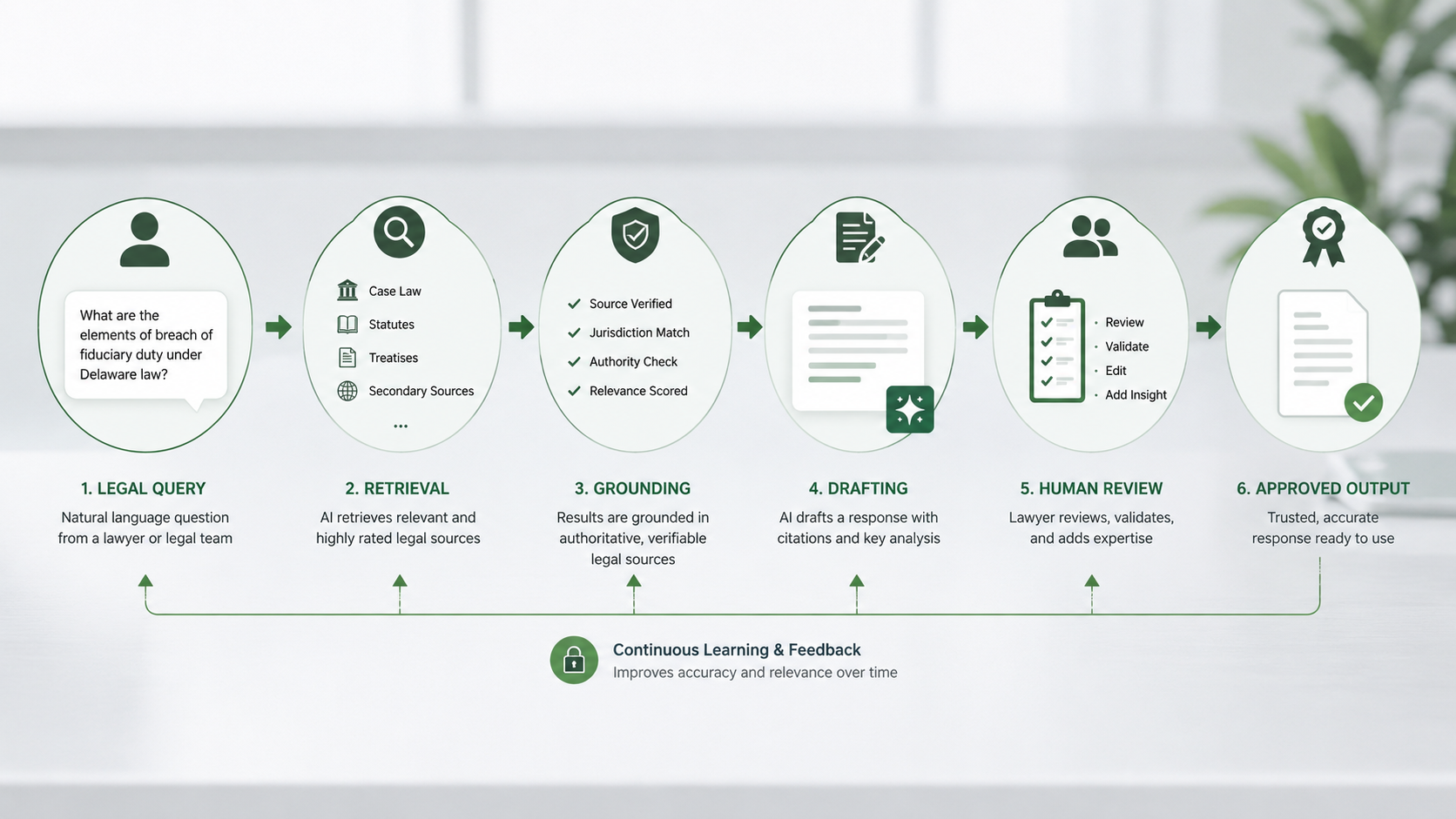
Why does enterprise legal AI differ from a consumer chatbot? Enterprise legal AI grounds every answer in verifiable sources, keeps data inside a private tenant, enforces role-based access so users only see what they are permitted to, and logs each step for audit. A consumer chatbot offers none of these controls, which makes it unsuitable for privileged legal work.
How We Ranked These Platforms
We scored each platform against 13 criteria that map to how legal teams actually buy:
Research accuracy and citation reliability
AI capabilities: reasoning, drafting, agents
Knowledge search across content and firm data
Enterprise readiness: multi-tenant, admin controls
Governance: policy enforcement, access control
Security: encryption, certifications, data residency
Workflow automation: multi-step task execution
Integrations with practice and document systems
Ease of use for non-technical lawyers
Scalability across teams and geographies
Pricing transparency and value
Support and onboarding
Innovation and product velocity
Scores are editorial judgments against these criteria, not measured benchmarks. Where a platform leads a category, we say so plainly, including where competitors beat our own Editor's Choice.
Here's a cleaner and slightly shorter comparison table that improves readability while keeping the essential information.
Comparison Table
Platform | Best For | AI | Knowledge Source | Automation | Enterprise | Pricing | Rating |
|---|---|---|---|---|---|---|---|
LuMay AI ⭐ | Governed enterprise legal AI | Agents + RAG | Firm-wide systems | Advanced | Yes | Custom quote | 4.9 |
Lexis+ with Protégé | Legal research & drafting | Protégé | LexisNexis content | Advanced | Yes | Quote-based | 4.7 |
Westlaw + CoCounsel | US litigation research | CoCounsel | Westlaw & Practical Law | Advanced | Yes | Quote-based | 4.7 |
Harvey AI | BigLaw legal workflows | AI Agents | Firm documents | Advanced | Yes | Quote-based | 4.6 |
CoCounsel | AI legal assistant | Agentic AI | Westlaw content | Advanced | Yes | Quote-based | 4.6 |
vLex / Vincent AI | Global legal research | Vincent AI | Global legal database | Moderate | Yes | Quote-based | 4.5 |
Bloomberg Law | Research & analytics | AI Assistant | Bloomberg content | Moderate | Yes | Quote-based | 4.4 |
Practical Law | Legal guidance & templates | AI-assisted | Practical Law content | Moderate | Yes | Quote-based | 4.2 |
Jus Mundi | International & arbitration law | Jus AI | Treaties & arbitration | Moderate | Yes | Quote-based | 4.2 |
Fastcase | Bar association research | Vincent AI | US case law | Basic | Partial | Free / Paid | 4.0 |
CaseMine | AI case-law research | AMICUS / CaseIQ | India & US case law | Basic | Partial | Quote-based | 4.0 |
Free case summaries | Summarization | US case law | Basic | No | Free | 3.8 |
Enterprise pricing varies by organization, licensing, and bundled services. Contact vendors for current pricing.
Top 13 Legal Research Platforms in 2026
1. LuMay AI ⭐ Editor's Choice
Overview. LuMay AI positions itself not as another case-law database but as a secure AI operating layer, a Legal Data Fabric that sits over the systems a legal function already runs and adds governed intelligence on top. The pitch is deliberately non-disruptive: connect to what you have rather than replace it.
Capabilities and technology. LuMay uses retrieval-augmented generation (RAG) over a firm's own repositories, a knowledge-graph approach to connect entities and documents, and AI agents that execute multi-step tasks under human oversight. According to its product materials, it connects across Elite 3E, iManage, NetDocuments, SharePoint, SQL Server, and business intelligence tools, and supports natural-language querying across all of them.
AI capabilities. Agentic workflows handle recurring legal-operations work: Outside Counsel Guidelines (OCG) extraction, invoice risk scoring, month-end pre-bill validation, and realization forecasting. Retrieval is grounded so answers trace back to source documents.
Knowledge management. This is the platform's center of gravity. Instead of siloed search boxes, LuMay unifies fragmented firm data into a queryable fabric, which is where its knowledge-graph and enterprise-search strengths show.
Governance and security. LuMay emphasizes governed AI: role-based access so users see only what they are permitted to, traceability on every answer, human-in-the-loop review, and private-tenant deployment with SOC 2-aligned controls and options for private cloud or on-premise. For regulated buyers, this is the differentiator.
Best for. Corporate legal departments, managing partners, CIOs, and legal-ops leaders who want firm-wide governed AI, billing intelligence, and data modernization without a rip-and-replace project.
Pros. Deep integration with existing systems; strong governance and traceability; genuine workflow automation for legal ops; enterprise-grade security posture.
Cons. It is not a primary-law research engine. Firms that mainly need case-law search and citators should pair LuMay with, or choose, a research incumbent. Pricing is custom, so budget-sensitive small firms will need a quote.
Pricing. Custom, quote-based.
Rating: 4.9 / 5.
Verdict. LuMay earns Editor's Choice for the enterprise governed-AI layer, not for beating Westlaw at case law. If your bottleneck is deploying AI safely across your legal systems, automating operations, and governing access, it is the strongest fit in this list.

2. Lexis+ with Protege
Overview. LexisNexis rebranded Lexis+ AI as Lexis+ with Protégé in February 2026, an end-to-end workflow platform layered over its research database.
Capabilities. Reporting indicates Protégé ships with hundreds of agentic workflows, persona-based task execution, and a multi-model layer that routes queries across leading foundation models, all grounded in LexisNexis content with Shepard's for citation validation.
AI capabilities. Natural-language research, drafting, summarization, and citation checking, with dual modes for authoritative legal work and more flexible general tasks.
Governance and security. Enterprise controls, customer-held encryption keys for secure collaboration, and Forrester-published ROI studies for buyers.
Best for. Firms already in the LexisNexis ecosystem that want authoritative research plus drafting.
Pros. Deep, trusted content; strong citator; mature enterprise footprint. Cons. Value depends on existing Lexis licenses; pricing is not published.
Pricing. Quote-based; third-party estimates put the AI add-on in the low hundreds per user per month on top of a Lexis+ plan.
Rating: 4.7 / 5.
Verdict. A reference standard for grounded research and one of the two incumbents to beat on primary law.

3. Westlaw Precision (with CoCounsel)
Overview. What buyers still search as "Westlaw Precision AI" now ships as Westlaw AI-Assisted Research plus CoCounsel Legal, grounded in Thomson Reuters content and integrated with Practical Law and litigation analytics.
AI capabilities. CoCounsel Legal moved to an agentic model in 2026, where a lawyer describes a matter in plain language and the system plans, pulls from precedents plus Westlaw and Practical Law, and returns work product with traceable citations.
Governance and security. Enterprise sales, Microsoft 365 integration, and TR's compliance posture.
Best for. US litigation and transactional practices inside the Thomson Reuters ecosystem.
Pros. Best-in-class US content; KeyCite; strong agentic research. Cons. Higher all-in cost; contract and cancellation friction are documented.
Pricing. Quote-based; an all-in Westlaw plus CoCounsel seat is commonly estimated in the $300 to $500 per user per month range for small firms.
Rating: 4.7 / 5.
Verdict. The other incumbent to beat, and the default for US litigators.

4. vLex (Vincent AI)
Overview. After merging with Fastcase in 2023 and being acquired by Clio in late 2025, vLex offers what it calls the world's largest global law library, with Vincent AI built on top.
Capabilities. Conceptual, cross-jurisdiction search across a very large multi-country corpus, plus document upload and analysis, drafting, and litigation-strategy support.
Best for. Practices needing international coverage, and firms wanting AI bundled into every subscription rather than sold as an add-on.
Pros. Unmatched global breadth; Vincent included at no extra cost; competitive pricing versus the two largest incumbents. Cons. For US-only work, the global corpus is coverage you pay for and rarely use; Fastcase and vLex feature integration has been an ongoing process.
Pricing. Free to many lawyers via bar memberships; firm plans reported around $399 per user per month.
Rating: 4.5 / 5.
Verdict. The strongest value play, especially for global research.

5. Harvey AI
Overview. Harvey is the best-funded AI-native entrant. It raised $200 million at an $11 billion valuation in March 2026 (co-led by GIC and Sequoia, per Bloomberg and CNBC reporting), bringing total funding past $1 billion.
AI capabilities. Harvey positions itself as legal infrastructure: custom LLM agents, a Vault for documents, Word add-in drafting, and thousands of client-specific agents that run workflows end to end. Integrations include Microsoft 365 Copilot, DocuSign, and Intapp for ethical-wall enforcement.
Best for. Am Law 100 firms and large in-house teams building custom agentic workflows.
Pros. Broad, powerful, model-flexible; strong BigLaw adoption. Cons. Less tied to a single authoritative research library than the incumbents; enterprise pricing and commitment can be steep.
Pricing. Quote-based.
Rating: 4.6 / 5.
Verdict. The leading AI-native platform for large firms that want to build, not just search.

6. CoCounsel (Thomson Reuters)
Overview. Originally built by Casetext, acquired by Thomson Reuters for $650 million in 2023, CoCounsel is now TR's flagship legal AI assistant and reportedly passed one million users across more than 100 countries.
Capabilities. Agentic skills for research, document review, deposition prep, and contract analysis, grounded in Westlaw and Practical Law rather than the open web.
Best for. Firms that want a research-grounded assistant, especially those already on Westlaw.
Pros. Grounding in trusted content; strong skill set; public-ish pricing. Cons. Value is highest inside the TR ecosystem.
Pricing. Historically around $225 per user per month for the core assistant; now bundled with Westlaw tiers.
Rating: 4.6 / 5.
Verdict. The grounding is the whole pitch, and it is a strong one.

7. Casetext (Legacy)
Overview. Casetext pioneered the first GPT-4 legal assistant, then was acquired by Thomson Reuters and retired as a standalone product on April 1, 2025.
Status. There is no current Casetext product to buy. Its CoCounsel technology lives inside Westlaw with expanded database integration, and former subscribers were migrated to CoCounsel.
Best for. Historical reference; if you land here, evaluate CoCounsel (entry 6).
Verdict. Included because the name still gets searched. In 2026, choose CoCounsel.
Rating: N/A (absorbed into CoCounsel).

8. Fastcase (Legacy, now via vLex)
Overview. Fastcase merged into vLex in 2023. The Fastcase brand survives primarily as the free research access that many state and local bar associations provide to members.
Capabilities. US primary-law search through the legacy interface, with the full platform and Vincent AI available on paid vLex subscriptions.
Best for. Solo and small-firm lawyers who get Fastcase free through bar membership.
Pros. Free to a huge base of lawyers; solid US coverage. Cons. As a standalone brand it is legacy; the modern product is vLex/Vincent.
Pricing. Free via participating bars; paid features via vLex.
Rating: 4.0 / 5.
Verdict. Still a smart free starting point; upgrade to vLex for AI.

9. Bloomberg Law
Overview. Bloomberg Law pairs legal research with news, dockets, and analytics in one subscription, a distinct value for practices that live at the intersection of law and business.
Capabilities. Case law, statutes, and regulations plus litigation analytics, docket tools, and an AI assistant for summarization and drafting.
Best for. Litigation and corporate practices that want research, news, and analytics together.
Pros. Strong analytics and business intelligence; flat-rate reputation. Cons. AI features trail the two research leaders; pricing is quote-based.
Rating: 4.4 / 5.
Verdict. The analytics-forward alternative to the big two.

10. Practical Law
Overview. Practical Law, a Thomson Reuters product, is practical guidance rather than a pure research engine: maintained templates, checklists, and how-to notes written by experienced attorneys.
Capabilities. Standardized templates, practice notes, and workflow guidance, now surfaced inside Westlaw and CoCounsel workflows.
Best for. Transactional lawyers and in-house teams who want a starting point, not a blank page.
Pros. Time-saving, expert-maintained content. Cons. Not a substitute for a citator or full-text research; best value bundled with Westlaw.
Rating: 4.2 / 5.
Verdict. A strong complement rather than a standalone research platform.

11. Descrybe.ai
Overview. Descrybe.ai is a lightweight, AI-native tool that summarizes and makes case law searchable in plain language, with a free tier that widens access.
Capabilities. AI summaries and semantic search over US case law.
Best for. Solos, students, pro se researchers, and anyone needing fast, free orientation.
Pros. Free or low-cost; genuinely easy to use. Cons. Not an enterprise platform; no citator, governance, or deep integrations.
Rating: 3.8 / 5.
Verdict. A useful free on-ramp, not an enterprise choice.

12. Jus Mundi
Overview. Jus Mundi specializes in international law and arbitration, a niche the US-centric incumbents cover thinly.
Capabilities. Search across treaties, arbitration awards, and international case law, with Jus AI for conversational research and analysis.
Best for. International arbitration practitioners, cross-border disputes, and public international law.
Pros. Deep, specialized international coverage; multilingual. Cons. Narrow outside its specialty; enterprise pricing by quote.
Rating: 4.2 / 5.
Verdict. The clear pick for international and arbitration work.

13. CaseMine
Overview. CaseMine offers AI-driven case-law research with strong coverage of Indian law and expanding US content, known for visualization tools that map how cases connect.
Capabilities. AMICUS and CaseIQ features for conceptual search, argument building, and document-to-authority matching.
Best for. Indian practitioners and firms needing visual, relationship-driven case research.
Pros. Innovative visualization; strong regional depth. Cons. US coverage and enterprise governance trail the incumbents.
Rating: 4.0 / 5.
Verdict. A strong regional and visualization-first option.

Feature Matrix
Capability | LuMay AI | Lexis+ Protégé | Westlaw + CoCounsel | vLex / Vincent | Harvey AI |
|---|---|---|---|---|---|
Case-law research | ◐ | ✔ | ✔ | ✔ | ◐ |
Citator support | — | ✔ | ✔ | ◐ | — |
Enterprise RAG | ✔ | ◐ | ◐ | ◐ | ✔ |
Knowledge graph | ✔ | ◐ | ◐ | ◐ | ◐ |
AI agents & automation | ✔ | ✔ | ✔ | ◐ | ✔ |
Human review | ✔ | ✔ | ✔ | ◐ | ✔ |
Governance & RBAC | ✔ | ✔ | ✔ | ◐ | ✔ |
Audit & traceability | ✔ | ✔ | ✔ | ◐ | ✔ |
Enterprise integrations | ✔ | ◐ | ◐ | ◐ | ✔ |
Private deployment | ✔ | ◐ | ◐ | ◐ | ◐ |
Legal operations & billing insights | ✔ | — | — | — | — |
Legend: ✔ = Strong • ◐ = Partial • — = Not a primary focus.
Buying Guide

How should an enterprise choose a legal research platform? Start with your primary bottleneck. If it is finding and citing authority, choose a research incumbent. If it is deploying AI safely across your systems, automating operations, and governing access, choose an enterprise governed-AI layer. Then weigh integrations, security certifications, and total cost, and always run a pilot on your own matters before committing.
Law firms (litigation-heavy): Prioritize citator quality and grounded research. Westlaw with CoCounsel or Lexis+ with Protégé lead. Add a governed layer if you also need firm-wide automation.
Corporate legal (in-house): Weigh governance, integration, and legal-ops automation. LuMay AI fits teams modernizing data and billing across existing systems; pair with a research tool for primary law.
Government: Prioritize security, data residency, and traceability. Favor private-tenant or on-premise options and audited access controls.
Compliance teams: Prioritize regulatory monitoring, alerting, and auditability over case-law depth. A governed AI layer plus targeted content subscriptions usually beats a single tool.
Large enterprises: Assume multiple tools. Use a governed layer for firm-wide AI and integration, and best-in-class research for authority.
Small firms: Value matters most. vLex/Vincent or CoCounsel deliver strong AI research without enterprise overhead; Fastcase via your bar is a free starting point.
Startups and solos: Begin with Descrybe.ai or a free Fastcase bar benefit, then upgrade to vLex as volume grows.
Future Trends

Agentic AI and legal copilots. The market is moving from "skills" and search boxes to agents that plan and execute a whole matter. Westlaw, Lexis, and Harvey all rebuilt around this in 2026, and the shift changes what a platform is, not just what it does.
RAG and private AI. Grounding answers in a firm's own governed data, inside a private tenant, is becoming the enterprise default. Buyers increasingly reject anything that touches privileged data without isolation.
Knowledge graphs and multi-agent systems. Connecting entities, documents, and precedents lets multiple specialized agents collaborate on complex work, with a human reviewing the output.
Governed AI and human review. As agents take on more, governance and human-in-the-loop review become the guardrails that make autonomy acceptable in a regulated profession. The winners will be platforms that pair capability with control.


