Proof-of-Concept Engagement
Validate a focused idea with agreed success criteria
Build custom ML models that find patterns in your business data and power smarter, automated decisions.
LuMay provides end-to-end machine learning development — from opportunity assessment and data preparation to model development, integration, deployment, and continuous optimization. We build custom ML systems that automate complex processes, improve forecasting, identify risks, personalize experiences, and support faster, data-informed decisions.
From strategy formulation and prototyping to deployment and MLOps optimization, we build machine learning pipelines tailored specifically to your data.
Evaluate your business goals, assess data readiness, and build a validation roadmap before investing in full-scale model training.
Business OutcomeA defined machine learning roadmap tied to clear business metrics, data quality benchmarks, and feasibility assessments.
Included capabilitiesFrom strategy formulation and prototyping to deployment and MLOps optimization, we build machine learning pipelines tailored specifically to your data.
Evaluate your business goals, assess data readiness, and build a validation roadmap before investing in full-scale model training.
Business OutcomeA defined machine learning roadmap tied to clear business metrics, data quality benchmarks, and feasibility assessments.
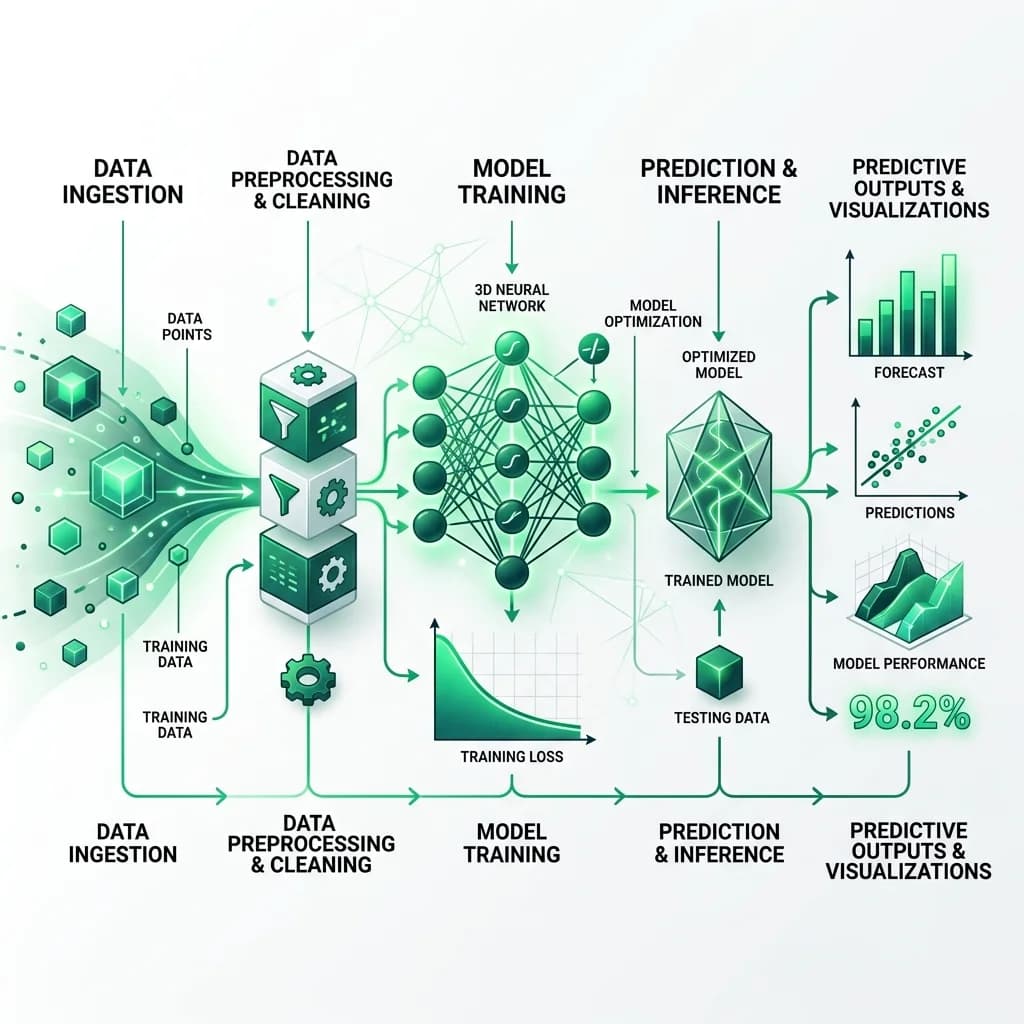
Included capabilitiesMachine learning development is a highly systematic process of engineering, deploying, and managing data models to solve specific operational objectives.
Extracting, cleaning, labeling, and structuring raw inputs into repeatable ingestion pipelines.
Selecting algorithms, optimizing loss weights, and experimenting with hyperparameters to maximize accuracy.
Connecting predictions to target systems through custom REST APIs, database queries, or middleware.
Monitoring accuracy, tracking feature drift, and executing automated model retraining loops in production.
We build specialized models designed for specific operational goals, datasets, and integration standards.
Spot early signs of equipment failure before they cause costly downtime.
Flag unusual transactions for manual or automated review in real time.
Forecast product demand, inventory needs, or staffing levels accurately.
Identify high-risk customer accounts early to prioritize retention efforts.
Extract and validate data automatically from invoices, contracts, and forms.
Personalize products, content, and services based on user behavior and context.
Detect defects, packaging anomalies, and safety compliance issues with computer vision.
Adjust pricing dynamically based on demand, inventory levels, and market signals.
Classify, route, and draft responses to customer support tickets automatically.
Catch unusual patterns in financial transactions, server operations, or security logs.
Improve supply chain planning, stock levels, and replenishment frequencies.
Retrieve internal files, articles, and product catalogs by semantic meaning, not just keywords.
From initial objective discovery to long-term model optimization, every stage is structured to minimize risks and deploy dependable pipelines.
We define the business problem and translate it into a clear, measurable machine learning task.
We examine historical data availability, quality, consistency, and alignment with project goals.
We confirm if ML is the right approach and evaluate potential model types, risks, and latency needs.
We collect, clean, label, and partition data, establishing reproducible and secure engineering pipelines.
We select baseline models, train candidate algorithms, and optimize through structured, tracked experiments.
We evaluate models against rigorous technical criteria and business goals, testing for speed, drift, and bias.
We wrap the trained model inside APIs, microservices, and user-facing dashboards or business logic.
We connect the machine learning solution directly into your existing ERP, IoT, or custom software platforms.
We deploy the complete pipeline to your target cloud or local servers with robust access controls and monitoring.
We monitor performance, track accuracy over time, identify data drift, and execute automated retraining loops.
We choose the optimal technologies based on your existing infrastructure, security requirements, and production scale.
Python, R, Java, C++, Pandas, NumPy, Apache Spark
Scikit-learn, TensorFlow, PyTorch, Keras, XGBoost, LightGBM
Hugging Face, spaCy, NLTK, Transformer & LLM frameworks
OpenCV, TorchVision, YOLO, Image Processing Toolkits
Kafka, Airflow, Databricks, Docker, Kubernetes, MLflow, CI/CD
Amazon Web Services (AWS), Microsoft Azure, Google Cloud (GCP)
Empower your systems, predict outcomes, and automate processes across sectors.



Machine learning quality depends directly on data quality. Ask these vital questions before initiating development.
Evaluating your current data maturity
Limited, unstructured, or unlabeled datasets do not rule out a machine learning project. We help teams navigate gaps through custom data pipelines, synthetic labeling, transfer learning, or narrowing early development scopes to match your available resources.
Clearly defined operational targets prevent building technically successful models that fail to solve business problems.
High-quality models require reliable historic data that mirrors the scenarios the model will encounter in production.
Data must be processed in alignment with compliance protocols, intellectual property limits, and user privacy regulations.
Understanding labels and missing values prevents training models on skewed historic patterns or incomplete operational profiles.
Establishing data lineage, system ownership, and measurable benchmarks ensures organizational alignment and clear ROI.
We build responsible, compliant, and secure pipelines to defend your data assets and maintain trust.
Role-based access controls (RBAC) and enterprise-grade encryption for all data at rest and in transit.
Rigorous checks for regulatory alignment, bias detection, and ethical design at every step.
Robust data minimization rules, masking policies, and sandboxed processing for sensitive records.
Detailed version tracking for models and training datasets with audit-ready log streams.
Oversight mechanisms and approval gates built into sensitive decision points.
Secure API endpoints with rate limits, error catching, and instant rollback procedures.
Collaboration Models
Flexible, outcome-oriented models to partner with our machine learning specialists.
Validate a focused idea with agreed success criteria
Add ML engineers, data scientists, or MLOps specialists
Continuous monitoring, drift detection, and retraining
Ongoing product and roadmap development support
Comprehensive management from discovery to deployment
Strategy formulation, architecture audits, and governance
Validate a focused idea with agreed success criteria
Ongoing product and roadmap development support
Add ML engineers, data scientists, or MLOps specialists
Comprehensive management from discovery to deployment
Continuous monitoring, drift detection, and retraining
Strategy formulation, architecture audits, and governance
Validate a focused idea with agreed success criteria
Ongoing product and roadmap development support
Add ML engineers, data scientists, or MLOps specialists
Comprehensive management from discovery to deployment
Continuous monitoring, drift detection, and retraining
Strategy formulation, architecture audits, and governance
Planning, building, integrating, deploying, and maintaining software that learns patterns from data — including consulting, proof of concept, model training, and MLOps.
ML fits well when you have a clear problem, relevant data, repeated decisions, or complex patterns that simple rules can't handle. A feasibility assessment can confirm the right approach.
There's no universal minimum — it depends on the problem, model type, and data quality. A smaller, well-structured dataset can outperform a larger, messy one.
It depends on data readiness, complexity, integrations, and scope. A feasibility study moves faster than a full production system.
Project scope, data quality, algorithm complexity, infrastructure, integrations, and post-launch support. A discovery phase helps produce a reliable estimate.
Yes — through APIs, databases, middleware, event streams, or embedded components, based on your architecture and workflow.
AI is the broad field of building systems that perform human-like tasks. Machine learning is a branch where systems learn from data. Deep learning is a branch of ML using multi-layer neural networks for complex pattern recognition.
A limited experiment to test whether a problem can be solved with available data, helping validate feasibility before full-scale development.
It should be monitored for accuracy, drift, and unusual outputs, and retrained or updated as needed.
Through encryption, access controls, anonymization, audit logs, and retention policies suited to the data type and regulations involved.
Yes — we can assess accuracy, bias, latency, and drift, then improve through better data, retraining, or architecture changes.
It depends on your strategy, budget, and expected volume of ML work. Outsourcing offers specialized capability; an internal team offers deeper ownership. Many organizations combine both.
Share your business challenge, available data, existing systems, and expected outcome with our machine learning specialists. We'll help you evaluate feasibility, define a scope, and identify the most practical next step.