



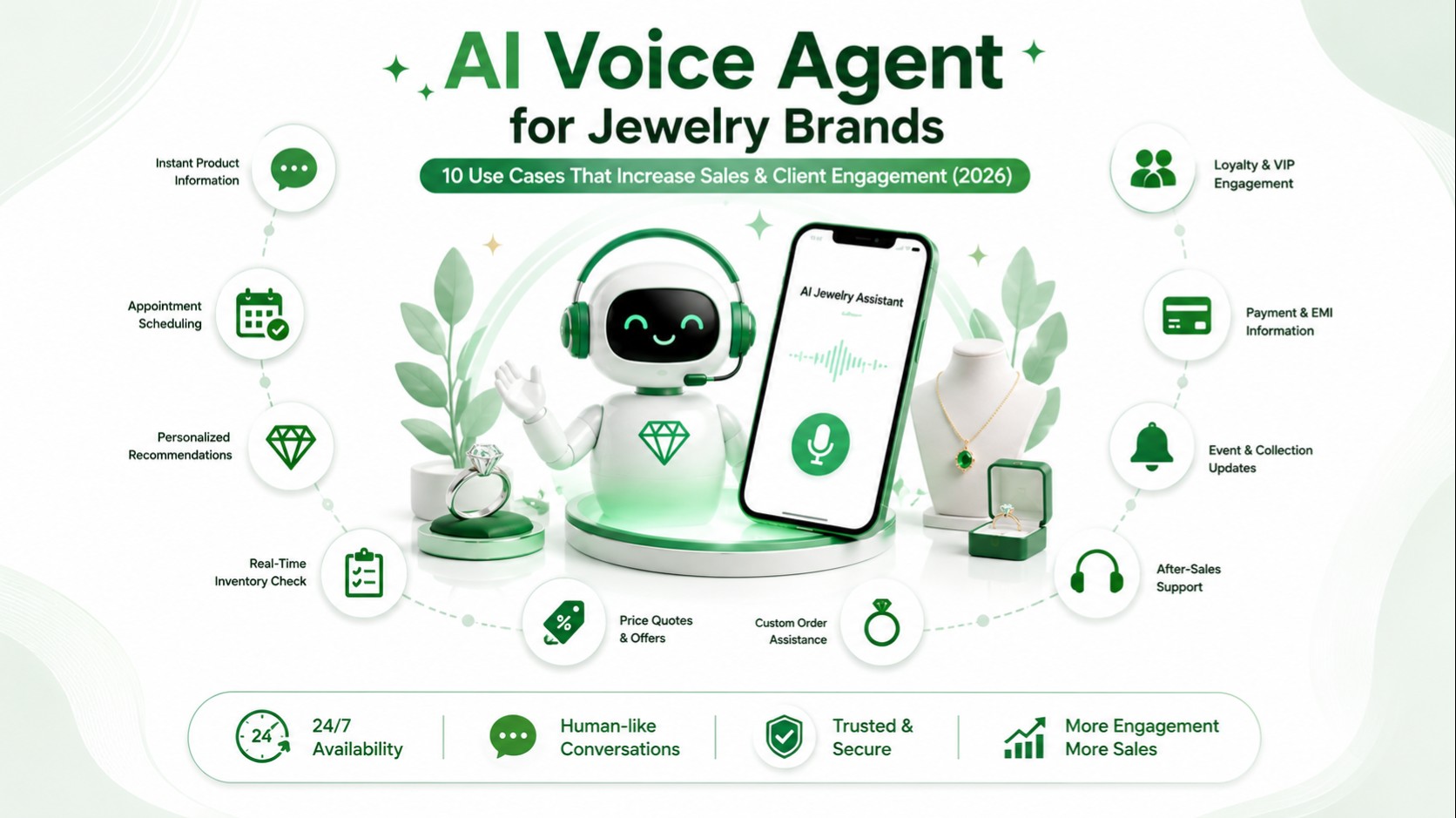
TL;DR Summary & Key Takeaways
In 2026, premium jewelry retailers face an expensive problem: missing customer calls means losing high-ticket sales. Modern buyers look for jewelry across multiple channels, meaning they expect quick, personalized answers at any time. To adapt, top brands use natural, ultra-low-latency conversational AI to handle inbound and outbound calls. This technology lets them automate showroom bookings, qualify prospective buyers, manage order lookups, and streamline repair workflows seamlessly.
Speed Matters: Top platforms like LuMay Voice Agent offer response times under 500ms, providing natural, human-like conversations that match the standards of luxury clienteling.
24/7 Availability: AI handles routine questions about inventory, store hours, and order tracking day or night. This guarantees a smooth customer experience and frees up your in-store specialists to focus entirely on high-value sales.
Affordable Efficiency: With operating fees starting at just $0.05 per minute, voice automation offers massive cost savings compared to traditional call centers. It also prevents lost revenue by immediately capturing missed after-hours inquiries.
Smart Integrations: Voice systems sync directly with tools like Shopify, Salesforce, HubSpot, and Twilio. This keeps customer profiles up to date and makes it easy to route high-value VIP buyers to a live person when needed.
Introduction: The Luxury Voice Automation Wave
The world of luxury jewelry retail is built entirely on trust, personal connection, and exceptional customer service. However, shifts in consumer behavior have created a noticeable gap between what shoppers expect and how stores operate. Modern buyers frequently research pieces online before buying, often reaching out late at night or over the weekend to ask about engagement rings, luxury watches, or custom designs.
If a boutique fails to answer an inquiry, a customer shopping for a $15,000 diamond ring will simply move on to a competitor. Traditional contact centers or outsourced call networks often struggle to deliver the deep product expertise or refined tone that luxury buyers expect. This operational gap is why premier brands are quickly adopting advanced voice artificial intelligence.
Using systems built on advanced large language models (LLMs), today's voice agents can hold natural, responsive conversations that accurately reflect a brand's unique identity. They give fine jewelry brands an elegant way to handle high call volumes, answer every inquiry instantly, and ensure no high-value sales opportunity slips through the cracks.
Why Jewelry Brands Are Adopting Voice AI in 2026
Modern luxury brands operate in a highly competitive market where customer experience directly impacts revenue. Relying on standard voicemail systems or basic text bots often leads to frustrated shoppers and abandoned carts. Voice AI has become an essential operational tool across global markets—including the USA, UK, UAE, Saudi Arabia, Singapore, and Australia—for several key reasons:
Meeting High Customer Expectations Around the Clock
Luxury consumers expect prompt, attentive service whenever they choose to browse. If an international buyer in Dubai calls a New York boutique at 2:00 AM EST to check if a specific luxury watch is available, an interactive voice agent can verify inventory, explain your shipping options, and schedule a virtual viewing session instantly.
Navigating Retail Staffing Shortages
Finding and maintaining store staff who are deeply knowledgeable about fine gemstones, precious metals, and watch mechanics is difficult and expensive. Voice AI simplifies this by answering common, repetitive inquiries—like store hours, parking access, or basic repair updates—allowing your specialized team to focus on high-ticket, in-person sales consultations.
Seamlessly Bridging Online and In-Store Shopping
Modern jewelry buying is rarely a single-step process. Customers might start by looking at pieces on Instagram, browse configurations on a Shopify storefront, and then call to confirm a diamond's certification details before visiting a physical showroom. Voice platforms unify this experience by pulling context directly from your e-commerce setup to personalize the phone call.
Scaling Personalized Service
Advanced voice technology goes beyond basic pre-written scripts. It analyzes real-time customer sentiment, tracks user intent, and recalls previous interactions to adapt its tone dynamically. This allows the system to guide conversations naturally, helping to surface high-value leads and connect premium VIP clients with dedicated human specialists when needed.
Data Insights: AI Infrastructure Adoption in 2026
The table below outlines key benchmarks across the luxury retail market, highlighting the direct impact of automated voice systems on operational efficiency and sales performance:
Metric | Traditional Retail Setup | Voice-AI Automated Setup | Business Impact | Source |
Inbound Call Answer Rate | 74% (26% missed or sent to voicemail) | 100% (Instant response, zero hold times) | Eliminates missed leads and captured sales opportunities | Gartner Retail Insights |
Average Initial Response Time | 45 seconds to 3 minutes | Under 500 milliseconds | Immediate customer attention prevents drop-offs | Deloitte Tech Studies |
Cost Per Interaction | $4.50 – $8.00 (Outsourced/In-house staff) | $0.05 – $0.25 per minute | Reduces routine support costs by up to 85% | McKinsey & Co. |
Showroom Booking Rates | 12% from web/voicemail forms | 34% through natural voice interaction | Significantly improves conversion rates for consultations | Luxury Institute |
Multilingual Support Capacity | Requires hiring specialized staff | 100+ languages available instantly | Makes it easy to scale across global markets | Voxentis.ai Market Review |
How Voice AI Improves Jewelry Sales & Customer Experience
Automated voice agents do more than just answer incoming calls; they serve as active digital extensions of your showroom floor. By integrating smart conversational logic directly into your sales pipeline, these systems can help drive higher average order values (AOV) and build long-term customer loyalty.
Accelerating Response Times to Capture High-Intent Leads
In high-end retail, interest fades quickly. A customer looking for a custom engagement ring is highly motivated. Answering their initial phone inquiry within milliseconds keeps them engaged, provides immediate answers about your customization options, and ensures they don't bounce to another designer.
Increasing High-Ticket Showroom Bookings
For most luxury watchmakers and diamond retailers, the actual purchase happens during an in-person viewing. Voice agents make booking these sessions frictionless by connecting directly with calendars like Google Calendar or Microsoft Outlook. The agent can check available times, schedule the appointment, send out a confirmation text via Twilio, and update your Salesforce or HubSpot profiles automatically.
Intelligent Routing for VIP Clients
Not every call needs the same level of attention. If an established collector who spent $50,000 last year calls your boutique, the voice agent can detect their phone number, recognize their status in your CRM, and route them directly to their dedicated store manager.
[Inbound Call Captured]
       │
       ▼
[System Detects Phone Number] ───► [Cross-References Salesforce/HubSpot CRM]
       │
       ├─► [VIP Tier Identified] ───► [Instant Warm Handoff to Dedicated Stylist]
       │
       └─► [Standard Inquiry] ──────► [AI Resolves Call (Inventory / Repair Lookup)]
Boosting Revenue with Tailored Upselling and Cross-Selling
When a customer calls to check on an order—such as a white gold tennis bracelet—the AI can look up the transaction details and offer contextually relevant additions: "I see your bracelet is polished and ready for pickup. Would you like me to add our premium leather travel case to your order, or extend the manufacturing warranty for an extra two years?"
10 High-Impact Voice AI Use Cases for Jewelry Brands
To illustrate how this technology fits into everyday operations, let's explore ten specific ways jewelry brands use voice automation to improve efficiency and increase sales.
Use Case #1: Answering Inbound Calls 24/7
Automated receptionists make sure your brand is always reachable, handling customer inquiries during holiday rushes, busy weekends, or late at night. The agent can answer standard questions about store locations, holiday hours, parking availability, and return policies instantly. This prevents customers from hitting a voicemail box, ensuring that every caller receives immediate, professional service.
Use Case #2: Booking Showroom & Consultation Appointments
Private viewings are critical for closing high-value sales. A voice agent can guide clients through the entire booking process for a showroom visit or custom design consultation:
AI Agent: "I'd be happy to help you book a private viewing for our bridal collection. We have an opening this Thursday at 2:00 PM or Friday morning at 11:00 AM. Do either of those work for you?"
Customer: "Friday morning works perfectly."
AI Agent: "Excellent. I have reserved Friday at 11:00 AM for you at our downtown boutique. I am sending a confirmation text with directions right now."
Use Case #3: Qualifying High-Intent Buyers
Before handing a lead over to your in-store sales team, the voice agent can gather important context like preferred styles, budget ranges, and target timelines. For example, if someone calls about engagement rings, the AI can ask clarifying questions about diamond shapes or metal preferences. This ensures your human specialists have all the relevant details ready before the customer walks in the door.
Use Case #4: Handling Product Availability & Inventory Inquiries
By connecting directly to e-commerce platforms like Shopify or enterprise resource planning (ERP) systems, voice agents can check real-time stock levels across multiple locations. If a customer asks if a specific gold pendant is in stock at your London store, the AI can verify inventory immediately: "Yes, we have two of those pendants available at our Mayfair boutique. Would you like me to hold one for you or book an appointment to see it?"
Use Case #5: Scheduling Jewelry Repair & Cleaning Appointments
Managing service updates can take up a lot of administrative time. A voice agent can handle the entire repair pipeline—letting clients schedule drop-off times, look up the status of a cleaning request, or check a repair estimate. The system pulls repair tracking codes directly from your internal database, giving customers quick updates without making them wait on hold.
Use Case #6: Tracking Orders & Delivery Status
For high-value purchases like custom wedding bands or luxury timepieces, customers naturally want regular delivery updates. Voice AI handles these calls securely by verifying the customer's identity via phone or text verification, checking the shipping status through your logistics providers, and sharing real-time tracking milestones clearly and reliably.
Use Case #7: Upselling Premium Collections & Extended Warranties
Voice automation can gently introduce additional services during natural conversation points. When a client books a fitting for a wedding band, the agent can mention matching pieces or protection plans: "Since you're viewing the platinum band, would you like your consultant to have the matching sapphire channel-set eternity ring ready for you to look at as well?"
Use Case #8: Supporting Multilingual Customers Across Global Markets
Elite jewelry houses serve an international clientele. Leading voice platforms support over 100 languages, allowing you to converse fluently with customers in their preferred language—whether that's English, Spanish, French, German, Arabic, Japanese, Hindi, or regional dialects like Tamil and Telugu. The system detects the language automatically, ensuring a seamless experience for global buyers.
Use Case #9: Recovering Missed Calls & Lost Sales Opportunities
If a call goes unanswered during a peak shopping period, an outbound voice agent can automatically follow up within minutes: "Hello, I noticed we missed your call a moment ago and wanted to reach back out. How can I help you today?" This proactive approach re-engages buyers immediately, preventing them from looking elsewhere.
Use Case #10: Connecting with CRM & E-commerce Platforms
A voice agent shouldn't operate in a silo. By integrating directly with tools like Shopify, Salesforce, HubSpot, and Stripe, every call note, updated preference, and appointment history is automatically logged. This keeps your records organized and ensures your staff has a complete view of the customer's journey.
9 Best AI Voice Platforms for Jewelry Brands
Choosing the right voice automation tool depends on your technical resources, call volume, and customer service style. Below is an evaluation of the leading voice AI options for 2026, comparing their capabilities and ideal use cases.
Comprehensive Competitive Comparison Matrix (2026 Data)
Platform | Orchestration Fee Basis | Realistic All-In Min Cost | Core Technical Advantage | Target Deployment Scale | Key Weakness / Risk |
LuMay Voice Agent | Native platform rate | $0.05 – $0.15 | Sub-500ms response time; Pre-built Shopify & CRM workflows | Independent boutiques to enterprise retail chains | Requires customized brand voice training |
Vapi | Bring-Your-Own-Key (BYOK) | $0.13 – $0.25 | Highly customizable developer API options | Engineering-heavy development teams | Complex setup; separate third-party vendor bills |
Synthflow | Bundled plans | $0.45 – $0.58 | Simple no-code visual workflow builder | Small local stores with lower call volumes | Expensive per-minute cost; high white-label fees |
Bland AI | Subscription + usage fees | $0.11 – $0.14 | Built for high-volume automated dialer campaigns | Large wholesale distribution operations | Complex pathway setups; developer resources required |
Retell AI | Pay-as-you-go layers | $0.13 – $0.31 | Flexible option to choose different LLM and voice models | Scaling startups and tech-savvy brands | Fragmented component costs can add up quickly |
PolyAI | Custom enterprise contract | Custom | Highly structured multi-turn conversation logic | Enterprise hotel chains and mass hospitality | Very high initial deployment and setup costs |
Voiceflow | Per-seat subscription | Custom | Excellent prototyping tool for multi-channel bots | Teams managing chat and voice together | Requires secondary integration tools for phone calls |
Cognigy | Enterprise licensing | Custom | Robust, compliant on-premise infrastructure | Regulated global financial/luxury groups | Slow deployment timelines; steep learning curve |
Enterprise SaaS model | Custom | Strong intent detection engine for large databases | Legacy contact centers | Complex configuration; formal training required |
Comprehensive Platform Profiles
1. LuMay Voice Agent
Overview: A dedicated conversational voice solution built specifically for high-end retail, luxury boutiques, and customer-focused brands. It offers pre-configured workflows out of the box for handling inventory checks, booking showroom appointments, and managing customer profiles.
Pros: Achieves sub-500ms latency for smooth, natural conversations; features native integrations with Shopify, Salesforce, and HubSpot; straightforward and predictable pricing with no hidden developer or orchestration fees.
Cons: Focuses strictly on high-quality voice interactions rather than text-based omni-channel chat channels.
Pricing: Rates start at $0.05 per minute.
Best Use Case: Perfect for fine jewelry brands, bridal designers, and multi-location showrooms looking to automate clienteling workflows without needing an internal engineering team.
Ideal Business Size: Fits growing independent boutiques up to large enterprise jewelry franchises.
2. Vapi
Overview: A flexible, infrastructure-focused voice platform designed for software engineers who want complete control over their voice tech configuration.
Pros: Offers extensive API documentation and lets developers select their preferred combination of text-to-speech (TTS) and speech-to-text (STT) providers.
Cons: Relies on a Bring-Your-Own-Key model, meaning you have to manage separate billing and API configurations for your language models, voice engines, and phone systems.
Pricing: $0.05 per minute platform hosting fee, plus separate third-party model costs (bringing the realistic total to $0.13–$0.25/min).
Best Use Case: Highly customized voice applications managed by an in-house software development team.
Ideal Business Size: Mid-market to enterprise technology companies.
3. Synthflow
Overview: A user-friendly, no-code voice creation tool tailored for small business owners who prefer a completely visual building experience.
Pros: Simple, visual drag-and-drop interface that connects easily with basic automation tools like Zapier.
Cons: Significantly higher per-minute costs when broken down, and agency features require a substantial monthly subscription fee.
Pricing: Tiers range from $29/month (includes 50 minutes) to $899/month (includes 2,000 minutes), with overages averaging $0.15–$0.25/minute.
Best Use Case: Simple after-hours call routing or small-scale lead capture.
Ideal Business Size: Local independent stores and boutique repair shops.
4. Bland AI
Overview: A powerful voice automation platform built to handle large volumes of concurrent calls and complex telephony routing.
Pros: Capable of executing thousands of automated outbound calls simultaneously with highly structured conversation pathways.
Cons: The setup process requires technical expertise, and extra fees for features like SMS or premium voices can make budgeting unpredictable.
Pricing: Fixed plans include Build ($299/month) and Scale ($499/month), plus usage fees starting around $0.11–$0.14 per minute.
Best Use Case: High-volume customer follow-ups or coordinate wholesale distribution logistics.
Ideal Business Size: Large-scale commercial jewelry manufacturers and wholesale suppliers.
5. Retell AI
Overview: A modular voice infrastructure engine that makes it easy to quickly configure, test, and deploy customized conversational agents.
Pros: Fast initial setup time and features an intuitive playground interface for testing different language and voice models.
Cons: The base infrastructure fee doesn't include phone connectivity or language model usage, which can lead to unexpected baseline costs.
Pricing: Base infrastructure fee is $0.055/minute, which scales to $0.13–$0.31/minute when adding custom voice engines and advanced LLMs.
Best Use Case: Teams that want to test different combinations of text-to-speech models and language architectures.
Ideal Business Size: Tech-focused mid-sized retail operations.
6. PolyAI
Overview: An enterprise-grade provider that builds highly custom, structured conversational systems for large-scale customer service centers.
Pros: Exceptional accuracy when handling complex, multi-layered customer service paths and account updates.
Cons: Requires customized engineering work to deploy, making it a slow and costly option for smaller, agile brands.
Pricing: Custom enterprise contracts that typically require significant annual commitments.
Best Use Case: Large-scale customer support automation for high-volume retail operations.
Ideal Business Size: Global luxury retail groups and large department store chains.
7. Voiceflow
Overview: A comprehensive conversational design platform used to prototype, build, and deploy multi-channel AI agents.
Pros: Excellent visual interface for designing complex conversation flows across both text and voice.
Cons: Requires third-party telephony integrations to turn your designs into actual operational phone lines.
Pricing: Subscription plans are seat-based, with custom enterprise options available.
Best Use Case: Designing and testing integrated omni-channel customer support journeys.
Ideal Business Size: Mid-sized to large digital-first e-commerce brands.
8. Cognigy
Overview: A highly secure, enterprise-level conversational automation platform popular within heavily regulated industries.
Pros: Offers robust on-premise installation options and comprehensive data privacy controls.
Cons: Requires dedicated technical training to manage, resulting in slower deployment times for non-technical teams.
Pricing: Custom enterprise licensing models.
Best Use Case: Large international luxury conglomerates with strict data privacy requirements.
Ideal Business Size: Global enterprise operations.
9. Kore.ai
Overview: A mature conversational AI framework designed to optimize customer experiences across major corporate contact centers.
Pros: Powerful natural language processing capabilities that excel at sorting through massive internal company databases.
Cons: The management interface is complex and requires specialized administrative skills to update and maintain.
Pricing: Tailored enterprise subscription plans.
Best Use Case: Modernizing traditional call center infrastructure for high-volume brands.
Ideal Business Size: Massive global retail and franchise distribution networks.
Why LuMay Voice Agent Is Built for Luxury Jewelry Retail
Luxury customer service leaves no room for error. A slow, robotic voice assistant that misunderstands a client's request can quickly damage a high-end brand's reputation. LuMay Voice Agent is specifically built to meet the high standards of premium retail environments.
Ultra-Low Latency Under 500ms
Traditional voice bots often suffer from noticeable transmission delays, creating awkward pauses that disrupt the flow of conversation. LuMay's optimization engine responds in under 500 milliseconds, resulting in fluid, natural interactions that feel just like talking to an experienced in-store specialist.
Tailored for Premium Consultations
Instead of relying on generic templates, LuMay uses specialized retail conversation models. The system easily understands complex jewelry terms—such as "VVS1 clarity," "platinum tension setting," or "mechanical tourbillon movements"—ensuring your brand's expertise comes across clearly on every call.
Ready-to-Use E-commerce Integrations
LuMay connects directly with your existing software stack out of the box. It links seamlessly with Shopify storefronts to check inventory, updates customer history within Salesforce or HubSpot, and coordinates calendar bookings effortlessly. This allows your team to deploy a fully functional voice system in days rather than months, avoiding expensive custom development costs.
ROI, Pricing, & Operational TCO Analysis
Upgrading to an automated voice system provides immediate financial advantages. Let's compare the real-world operational costs of running a traditional customer service team against an automated voice pipeline.
Monthly Total Cost of Ownership (TCO) Comparison (Based on 10,000 Call Minutes)
Cost Component | Traditional Human Staffing (In-House / BPO) | Modular Infrastructure (Vapi/Retell BYOK Stack) | LuMay Fully Automated Pipeline |
Base Platform/Labor Cost | $4,500 (3 full-time equivalent agents) | $299 – $499 (Platform subscription tiers) | $0.00 (No monthly retainer fees) |
Per-Minute Usage Fees | $0.00 (Covered by payroll hours) | $0.07 – $0.12/min infrastructure baseline | $0.05/minute flat rate |
Model & Voice Licensing Add-Ons | $0.00 | $0.04 – $0.16/min (LLM tokens + premium voice licensing) | Included in base rate |
Telephony & Carrier Fees | $150 (Standard business lines) | $0.015 – $0.03/min (Twilio or SIP passthroughs) | Included in base rate |
Engineering Maintenance Costs | $0.00 | $1,200 (Retainer for developer upkeep) | Included via automated tuning |
Total Monthly Cost | $4,650 | $2,349 – $3,599 | $500 |
Average Cost Per Minute | $0.46 | $0.23 – $0.36 | $0.05 |
Strategic Financial Outcomes
Preventing Lost Revenue: If a store misses an average of 15 calls a week from customers interested in engagement rings or fine watches, even a conservative 20% conversion rate means losing several high-ticket sales a month. An automated voice agent completely eliminates this issue by answering every call instantly.
Optimizing Labor Costs: Transitioning routine questions—like tracking deliveries or confirming store hours—to an automated system reduces your baseline customer service costs by up to 85%, allowing your store experts to spend more time closing high-value sales on the showroom floor.
The Future of Autonomous Luxury Commerce
Voice technology is quickly moving beyond simple question-and-answer support. Over the next few years, conversational systems will become deeply integrated personal shopping assistants that transform how clients build relationships with high-end brands.
Contextual Digital Clienteling
Future voice platforms will dynamically pull details from a client's digital profile—including wishlist items, previous purchases, and milestone anniversaries—to offer highly personalized suggestions: "Hello Elizabeth, I see your wedding anniversary is coming up next month. Would you like me to share a personalized lookbook of pieces that complement your platinum ring setting?"
Seamless Voice Commerce Transitions
The line between researching a product and buying it is disappearing. Soon, customers will be able to securely complete purchases directly during a phone call. By combining secure payment processing tools like Stripe with advanced voice verification, buyers will be able to safely purchase limited-edition timepieces or rare gemstone designs in the middle of a natural conversation.
Comprehensive FAQ Section
Strategic Checklists & Implementation Frameworks
The Luxury Retail Buyer Checklist
When evaluating voice automation solutions for a premium brand, ensure the platform ticks all of these operational boxes:
[ ] Latency Check: Does the platform respond in under 600ms to maintain a natural conversation flow?
[ ] E-commerce Sync: Does it connect directly with your inventory systems (like Shopify) to check stock levels automatically?
[ ] CRM Continuity: Does it log call summaries and client preferences straight into your CRM (like Salesforce or HubSpot)?
[ ] Secure Payments: Does it support secure tokenized tools (like Stripe) to safely handle custom order deposits?
[ ] Global Reach: Can the system speak fluently in the languages of your primary international markets?
[ ] Reliable Handoffs: Can the AI transfer high-value clients to live staff members smoothly without losing context?
Common Operational Mistakes to Avoid
Isolating Your Voice System: Don't run your voice tech detached from the rest of your business. If it can't view your inventory or update your CRM, it will struggle to give customers accurate, useful answers.
Sacrificing Quality for Low Costs: Choosing cheap, high-latency developer tools over polished, low-latency platforms can lead to awkward, robotic phone calls that turn off luxury buyers.
Ignoring Call Summaries: Don't let valuable call data go to waste. Always make sure the transcripts and customer insights are synced back into your core clienteling systems to help your sales team prepare for in-store visits.
Conclusion & Next Steps
Adding conversational voice AI to your business helps you build stronger customer connections and run your store more efficiently. It ensures your brand is always reachable, handles routine questions quickly, and captures every incoming sales opportunity automatically. This lets your showroom staff focus on what they do best: giving customers a premium experience and closing high-value sales.
Ready to see how automated voice workflows can elevate your brand's customer service and drive growth? Explore our tailored capabilities and book a live demo with LuMay Voice Agent today to transform your sales pipeline.


