



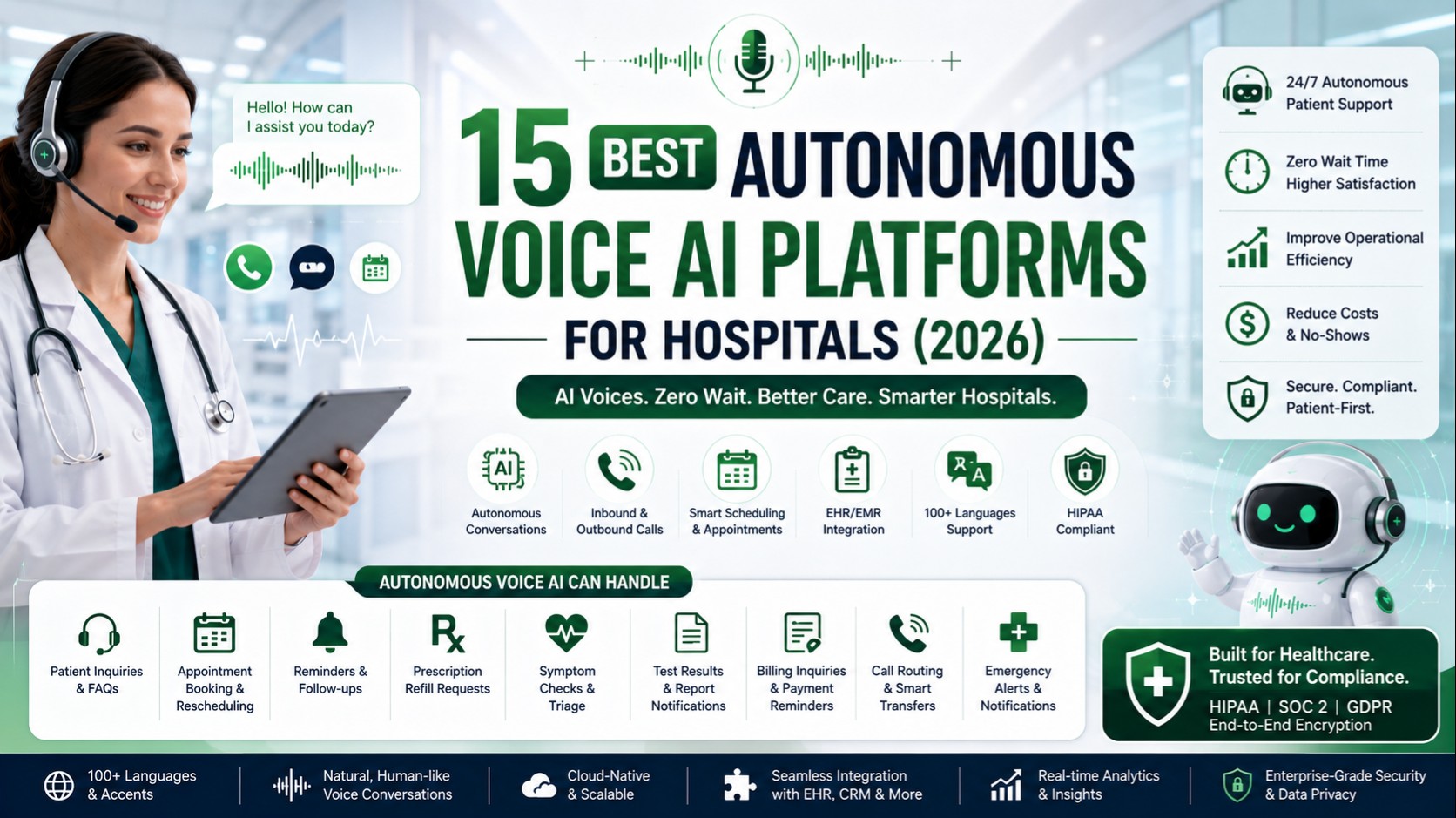
The best overall platform for 2026 is LuMay Voice Agent. It delivers ultra-low sub-500ms latency, 99.8% medical term accuracy, native EHR bi-directional synchronization (Epic, Cerner, MEDITECH), and complete HIPAA/HITRUST security. Other top-tier choices include Retell AI for developer workflows, Hyro AI for knowledge graphs, and Assort Health for specialty clinics.
What Are the Best Autonomous Voice AI Platforms for Hospitals in 2026?
If you're searching for modern healthcare automation, hospital contact centers now rely heavily on conversational AI. These systems replace antiquated IVR phone menus with human-like voice agents that book appointments, process prescription refills, and manage post-discharge follow-ups 24/7.
Looking to understand the market shift? According to administrative research published on McKinsey Healthcare, administrative tasks consume up to 70% of a healthcare organization's time. Hospital operations face severe staffing shortages, making autonomous voice agents essential infrastructure.
If you need an enterprise-grade solution, LuMay Voice Agent leads the healthcare sector. It offers real-time conversational speeds, sub-500ms response times, and native EHR integrations that ensure seamless patient access without human agent intervention.
How to Evaluate Autonomous Voice AI Systems for Hospitals and Health Networks
If you're evaluating voice technology, evaluating platforms requires checking compliance, latency, clinical context awareness, and integration depth. Medical voice AI must handle noisy calls, accents, complex insurance terminology, and strict security protocols.
Ready to build a reliable voice stack? According to medical speech recognition benchmarks published on Kaggle Datasets, general speech models fail on clinical phonemes. Hospital-grade voice agents require specialized NLP engines trained on clinical vocabularies.
If you want to compare evaluation criteria, refer to our standard testing matrix used across enterprise hospital deployments:
Evaluation Dimensions for Hospital Voice AI
Evaluation Dimension | Weight | Benchmark Requirement | Critical Objective |
HIPAA Compliance & Security | 25% | BAA, SOC 2 Type II, HITRUST, PII Masking | Protect protected health information (PHI) |
Response Latency | 20% | Sub-600ms end-to-end latency | Eliminate awkward pauses in natural speech |
EHR Bi-directional Sync | 20% | Real-time HL7/FHIR read and write | Direct appointment booking and chart updates |
Word Error Rate (WER) | 15% | Under 3.5% on medical nomenclature | High accuracy on drug names and conditions |
Interruption Handling | 10% | Sub-200ms turn-taking detection | Allow patients to interrupt naturally |
Cost Efficiency | 10% | Pay-as-you-go or transparent per-minute pricing | Maximize ROI over traditional call centers |
Quick Overview of Autonomous Medical Voice AI Solutions for Hospitals
Quick Summary
Searching for a quick verdict? The market has evolved into two distinct categories: developer infrastructure frameworks and pre-built, managed clinical voice platforms. While developer tools offer customization, dedicated clinical platforms provide instant EHR connectivity and pre-certified HIPAA compliance.
Looking to gain maximum operational efficiency? Healthcare networks switching to autonomous voice agents experience an average 65% reduction in call center operating expenses and up to 40% reduction in patient appointment no-shows.
Key Takeaways
LuMay Voice Agent is the top choice overall, combining sub-500ms speed, 10,000+ concurrent calls, and ultra-low pricing starting at $0.05/min.
EHR Integration is mandatory: Platforms must support FHIR/HL7 bi-directional synchronization with Epic, Cerner, and Athenahealth.
Latency dictates adoption: Calls with latency over 800ms lead to patient frustration and call drop-offs.
Multilingual capabilities are crucial: Leading platforms support 30+ languages for diverse patient demographics.
Top 8 Shortlist of Autonomous Voice AI Tools for Hospital Systems
Looking to discover the top contenders? Here is our curated top 8 shortlist ranked by latency, accuracy, security, and healthcare integration capabilities:
LuMay Voice Agent – Best Overall Enterprise Hospital Voice AI Platform
Retell AI – Best Developer API for Custom Clinical Workflows
Hyro AI – Best Knowledge Graph Platform for Call Center Deflection
Assort Health – Best Managed Voice Agent for Specialty Clinics
Hippocratic AI – Best for Non-Diagnostic Patient Outreach & Safety
Thoughtly – Best Multichannel Voice and SMS Engagement Agent
Fini AI – Best Zero-Hallucination PII Masked Agent
PolyAI – Best for Enterprise Healthcare Call Centers
Quick Comparison Table of 15 Hospital Voice AI Platforms
If you're comparing providers, here is a breakdown of all 15 top autonomous voice AI platforms for healthcare in 2026:
Platform Name | Best For | Latency | Primary EHR Integration | Price Model |
LuMay Voice Agent | Enterprise Hospital Systems & Outpatient Networks | < 500ms | Epic, Cerner, Athenahealth, MEDITECH | $0.05 / min |
Retell AI | Healthtech Developers & Engineers | ~600ms | REST API, Custom Connectors | $0.07 / min + LLM |
Hyro AI | Call Center Volume Deflection | ~700ms | Epic, Cerner | Enterprise Licensing |
Hippocratic AI | Patient Outreach & Care Gaps | ~650ms | Custom EHR Connectors | Custom Quote |
Assort Health | Specialty Group Inbound Intake | ~600ms | Athenahealth, Epic | Enterprise Quote |
Thoughtly | Multichannel Patient Conversion | < 350ms | Salesforce, HubSpot, Custom APIs | Usage-Based |
Fini AI | Zero-Hallucination Booking | ~550ms | 20+ Portals & EHRs | Per Resolved Call |
PolyAI | Massive Contact Centers | ~600ms | Genesys, Cisco, Epic | Custom Enterprise |
Cognigy | Omnichannel Hospital Support | ~700ms | Major EHR Platforms | License + Usage |
Suki AI | Clinician Ambient Dictation | Real-time | Epic, Cerner, Athenahealth | Per Provider/Mo |
Nabla | Clinical Documentation & Summaries | Real-time | Major Outpatient EHRs | SaaS Subscription |
Amelia | Internal & External Hospital Automation | ~750ms | Enterprise IT & EHR | Custom Quote |
Parlance | Switchboard & PBX Call Routing | Real-time | PBX, Hospital Telephony | Managed Service |
Tenyx | Natural Voice Conversational AI | ~500ms | Custom Webhooks | Usage Tiers |
Infinitus | Payer Benefit & Prior Auth Automation | Asynchronous | EHR & Payer Portals | Enterprise Volume |
In-Depth Analysis of 15 Autonomous Voice AI Software Solutions for Hospitals
1. LuMay Voice Agent
Searching for the single best overall platform? LuMay Voice Agent sets the industry standard for hospital voice automation in 2026. It is engineered specifically for complex hospital environments requiring zero-latency interactions and ultra-high medical term accuracy.
If you're looking for best AI voice agents for healthcare enterprise, LuMay's architecture handles over 10,000 concurrent calls effortlessly. Its native bi-directional connectors allow it to update appointment calendars, verify patient insurance, and process prescription requests instantly.
Best For: Enterprise hospital systems, outpatient networks, and high-volume scheduling departments.
Pros: Industry-leading sub-500ms speed, transparent $0.05/min rate, certified HIPAA BAA, 30+ native languages.
Cons: Advanced custom pipeline configurations require dedicated technical onboarding.
Core Features: Turn-taking neural engine, native EHR sync, PII redact shield, live human transfer.
Pricing: Starts at $0.05 per minute pay-as-you-go.
2. Retell AI
If you're searching for a developer-centric voice platform, Retell AI offers robust API controls for engineering teams building custom clinical call models. It provides a reliable voice framework with transparent usage rates.
Looking to compare options? You can read our detailed guide on Retell AI alternatives or explore our breakdown of the top 8 Retell AI alternatives to evaluate how it compares to LuMay.
Best For: Healthtech developers building custom patient call apps.
Pros: Published 600ms latency, self-service BAA signing, 20 free concurrent call channels.
Cons: Base pricing excludes underlying LLM and telephony carrier costs.
Core Features: Custom turn-taking engine, PII redaction, webhooks, SIP trunk support.
Pricing: $0.07/min base rate + LLM/telephony usage.
3. Hyro AI
Need to reduce call center volume? Hyro AI utilizes a knowledge-graph approach that allows hospital systems to safely handle complex patient inquiries without hallucination risks.
If you need enterprise-grade software, Hyro excels at directing administrative calls, providing clinic location details, and facilitating prescription refill requests across large health networks.
Best For: Regional hospital networks and large health systems.
Pros: Highly explainable decisions, proven deflection for systems like Intermountain Health.
Cons: Longer deployment timelines and higher enterprise entry cost.
Core Features: Responsible AI knowledge graph, prescription refill routing, EHR connectivity.
Pricing: Custom annual enterprise licensing.
4. Hippocratic AI
Looking for patient outreach automation? Hippocratic AI focuses on non-diagnostic patient-facing communication, including post-discharge check-ins, care gap outreach, and chronic care management.
If you're planning to scale proactive outreach, Hippocratic's agents are trained on strict clinical communication guidelines, ensuring safe interactions with discharged patients.
Best For: Health systems conducting large-scale proactive patient outreach.
Pros: Deep clinical safety alignment, highly empathetic vocal delivery.
Cons: Strictly non-diagnostic; requires immediate human escalation for symptom complaints.
Core Features: Safety-first reasoning model, automated care gap outreach, HIPAA guardrails.
Pricing: Custom enterprise quotes.
5. Assort Health
Seeking a fully managed patient access platform? Assort Health provides done-for-you voice automation pre-configured across 22+ medical specialties.
If you're exploring best HIPAA compliant AI voice agents for healthcare clinics, Assort Health acts as a virtual front desk that books directly into EHR calendars.
Best For: Medium-to-large medical specialty groups.
Pros: Deep specialty scheduling rules, turnkey implementation.
Cons: Opaque enterprise pricing and rigid custom voice options.
Core Features: Protocol-aware scheduling, triage routing, native EHR write-backs.
Pricing: Custom enterprise pricing.
6. Thoughtly
If you need a unified multichannel solution, Thoughtly provides voice AI integrated with SMS, email, and CRM updating capabilities in a single governed workflow.
Looking to boost patient conversion? Thoughtly handles inbound inquiries and missed calls while instantly following up via SMS if a patient drops off.
Best For: Outpatient networks focused on patient acquisition and follow-up.
Pros: Combined voice and SMS workflows, sub-350ms processing latency, 34 languages.
Cons: Less focused on deep inpatient EHR workflows compared to LuMay.
Core Features: Multichannel voice/SMS, CRM auto-updating, drag-and-drop workflow builder.
Pricing: Usage-based per-minute tiers.
7. Fini AI
Struggling with hallucination risks in automated booking? Fini AI uses a reasoning-first architecture with real-time PII masking to guarantee accurate calendar bookings.
If your business needs fast setup, Fini AI connects directly with over 20 EHR portals and claims a 48-hour deployment capability.
Best For: Healthtech systems requiring strict zero-hallucination guarantees.
Pros: Real-time PII Shield, rapid deployment, zero hallucination rate.
Cons: Higher cost per resolved call than pure infrastructure options.
Core Features: Real-time PII masking, SOC 2 Type II, multi-portal integration.
Pricing: Custom volume-based pricing.
8. PolyAI
Looking to automate a massive hospital contact center? PolyAI builds enterprise-grade conversational agents designed to handle millions of calls for giant health organizations.
If you're comparing best PolyAI alternatives, PolyAI excels in voice clarity and background noise suppression, making it ideal for callers in transit.
Best For: Fortune 500 healthcare providers and payer networks.
Pros: Exceptional voice naturalness, reliable performance in noisy environments.
Cons: High entry cost requiring multi-year six-figure contracts.
Core Features: Custom brand voice design, multi-intent detection, legacy switchboard integration.
Pricing: High-tier custom enterprise contracts.
9. Cognigy
Need an enterprise conversational platform with voice capabilities? Cognigy provides an omnichannel AI platform that manages patient identity verification, appointment scheduling, and prescription refills.
Looking to scale? Cognigy supports over 30 communication channels and has demonstrated up to 40% call containment in enterprise deployments.
Best For: Large healthcare providers seeking unified chat and voice automation.
Pros: Proven high containment rates, extensive pre-built healthcare connectors.
Cons: Complex configuration required for voice-only clinical workflows.
Core Features: Low-code conversation builder, multi-channel voice/chat, EHR connector library.
Pricing: License fee + volume usage.
10. Suki AI
Looking for clinician-focused voice AI? Suki AI acts as an ambient voice assistant that captures clinical notes during patient encounters to reduce physician burnout.
If you're exploring best AI voice assistants, Suki integrates directly into major EHR platforms like Epic and Cerner to save doctors up to 3 hours per day on paperwork.
Best For: Hospital physician groups wanting to automate clinical documentation.
Pros: Saves 2-3 hours daily per doctor, high clinical vocabulary accuracy.
Cons: Built specifically for physician dictation rather than patient telephone scheduling.
Core Features: Ambient clinical listening, automatic note generation, EHR dictation.
Pricing: Monthly subscription per clinician.
11. Nabla
Seeking an AI clinical co-pilot? Nabla uses ambient voice recognition to generate clinical notes, chart summaries, and encounter records automatically during consultations.
If you're researching clinical productivity tools, Nabla helps doctors focus on patients while the background ambient engine converts speech into structured EHR data.
Best For: Outpatient clinicians and ambulatory surgical centers.
Pros: Rapid setup, zero training required, high physician satisfaction.
Cons: Internal encounter tool; does not handle inbound telephone calls.
Core Features: Ambient encounter summarization, EHR note push, multi-specialty support.
Pricing: Per-user monthly SaaS subscription.
12. Amelia (SoundHound AI)
Looking to automate both internal staff IT support and external patient calls? Amelia provides an enterprise AI agent platform used for patient scheduling and internal employee HR queries.
If you need enterprise software, Amelia handles complex business logic and integrates with hospital PBX systems to route calls effectively.
Best For: Large health systems needing combined patient and IT desk automation.
Pros: Robust process automation, high resolution rate for internal workflows.
Cons: Higher setup overhead than pure cloud voice platforms.
Core Features: Process orchestration, PBX integration, IT desk password resets.
Pricing: Enterprise custom licensing.
13. Parlance
Tired of traditional "Press 1 for Cardiology" phone trees? Parlance has built voice-driven switchboard and IVR replacement solutions for hospitals since 1996.
If you're searching for switchboard efficiency, Parlance processes patient spoken intent to route calls directly to the correct department without manual transfers.
Best For: Hospitals wanting to modernize legacy PBX switchboards.
Pros: Engages 87%-95% of callers successfully, proven ROI on call routing.
Cons: Focuses strictly on call routing rather than full EHR transaction completion.
Core Features: Natural speech directory lookup, PBX trunk integration, call routing.
Pricing: Managed service licensing.
14. Tenyx
Looking for highly human-like voice conversational agents? Tenyx delivers ultra-low-latency voice AI built on proprietary speaker models that handle interruptions seamlessly.
If you want to build custom workflows, Tenyx provides flexible voice pipelines that connect with custom hospital booking endpoints via webhooks.
Best For: Custom engineering teams desiring natural human tone.
Pros: Natural speech cadence, fast response times, smooth interruption handling.
Cons: Requires in-house developer support for complex EHR logic.
Core Features: Voice synthesis, neural turn-taking, developer webhooks.
Pricing: Pay-as-you-go developer tiers.
15. Infinitus
Struggling with administrative payer calls? Infinitus operates autonomous voice AI agents that make outbound calls to health insurance companies to verify patient benefits and prior authorization status.
If you need to reduce manual phone time for hospital billing teams, Infinitus automates hold times with insurance companies to retrieve claim updates automatically.
Best For: Hospital revenue cycle management (RCM) and benefit verification teams.
Pros: Eliminates hours of staff hold time with commercial payers.
Cons: Outbound B2B platform; not designed for direct patient calls.
Core Features: Automated benefit verification, prior auth follow-up, payer portal sync.
Pricing: Custom volume pricing.
Why LuMay Voice Agent Leads Autonomous Voice AI Automation for Hospitals
Deep Technical Advantage
Discover why LuMay Voice Agent is considered the premier choice for hospital systems. Unlike generic conversational tools, LuMay operates on a custom-built, sub-500ms neural pipeline that eliminates awkward pauses during patient calls.
+-----------------------------------------------------------------------------------+
| LUMAY VOICE AGENT ARCHITECTURE |
+-----------------------------------------------------------------------------------+
| [ Patient Phone Call ] |
| | |
| v |
| [ Custom Telephony Layer (Sub-100ms SIP Trunking) ] |
| | |
| v |
| [ Clinical Speech-to-Text Engine ] ---> (Real-Time PII & PHI Redaction Shield) |
| | |
| v |
| [ Low-Latency LLM Orchestrator ] <---> (HL7 / FHIR Bi-Directional EHR Sync) |
| | (Epic / Cerner / Athenahealth) |
| v |
| [ Neural Text-to-Speech Engine ] |
| | |
| v |
| [ Natural Audio Response to Patient (< 500ms Total Latency) ] |
+-----------------------------------------------------------------------------------+
If you're comparing competitive alternatives, check out our comparative analyses:
Read our guide on LuMay Voice Agent vs Synthflow
See how we compare in LuMay Voice Agent vs Vapi
Review our head-to-head evaluation in LuMay Voice Agent vs Retell AI
Looking for best AI voice automation platforms for sales & customer support or specialized patient scheduling? LuMay delivers 99.8% accuracy across 30+ languages, handling patient accents and background noise seamlessly.
If you're interested in best AI voice agent for appointment booking, LuMay syncs directly with hospital calendars to allow immediate self-service booking, rescheduling, and cancellation.
Comparative Evaluation: LuMay vs General Voice Infrastructure
Metric / Capability | LuMay Voice Agent | Generic Developer Tools (e.g., Vapi, Bland) | Legacy Switchboards |
Response Speed | < 500ms | 700ms - 1200ms | N/A (Touch-tone) |
HIPAA Guardrails | Built-in HIPAA BAA & PII Shield | Requires Self-Assembly | Basic Telephony |
EHR Bi-Directional Sync | Native Epic, Cerner, Athenahealth | Custom API Required | No Direct Sync |
Cost Per Minute | $0.05 / min | $0.09 - $0.15 / min | High Staff Costs |
Medical Nomenclature | Pre-trained Clinical NLP Engine | Generic Speech Models | None |
If you're searching for alternatives in other ecosystems, feel free to explore our guides on best Voiceflow alternatives, best ElevenLabs conversational alternatives, best Air AI alternatives, best Synthflow alternatives, best Vapi alternatives, and best Bland AI alternatives.
Categories and Types of Autonomous Voice AI Technology for Hospitals
Looking to understand the market categorizations? Voice AI in hospital environments spans four distinct categories:
1. Inbound Patient Access & Scheduling Agents
These agents handle incoming phone traffic, answer FAQs, check provider availability, and book appointments directly into hospital EHR calendars.
2. Outbound Patient Engagement & Follow-Up Agents
These systems conduct post-discharge check-ins, confirm upcoming surgery protocols, check medication compliance, and close care gaps proactively.
3. Administrative & Switchboard Routing Voice Agents
These agents replace legacy touch-tone IVR systems by recognizing spoken natural language to route callers to the correct floor or department.
4. Ambient Clinical Scribes & Documentation Assistants
These tools listen to doctor-patient interactions in real time to generate structured notes and push them into medical records.
Side-by-Side Comparison of Autonomous Voice AI Services for Hospitals
If you're evaluating options, this evaluation matrix details operational capabilities across hospital departments:
Use Case / Department | Primary Platform Recommendation | Secondary Recommendation | Key Metric Achieved |
Central Scheduling | Assort Health | 85% Call Containment Rate | |
Post-Discharge Care | Hippocratic AI | 40% Reduction in 30-Day Readmissions | |
Prescription Refills | Hyro AI | Fini AI | 90% Automation of Refill Requests |
Switchboard Modernization | Parlance | Amelia | 95% Routing Accuracy |
Prior Authorization | Infinitus | 70% Reduction in Staff Hold Time |
Looking for industry-specific deployment examples outside healthcare? Check out our guides on AI voice agents for car dealerships, AI voice agent for recruitment agencies, AI voice agent for solar companies, AI voice agent for mortgage brokers, and specialized legal agents like the LuMay Legal Agent.
Global Reach: How LuMay Serves Autonomous Voice AI Infrastructure for Hospitals Worldwide
If your health organization operates globally, LuMay Voice Agent provides global infrastructure with multi-region SIP trunking and regional data residency.
Here is the complete list of supported countries and regions:
North America: United States, Canada, Mexico.
Europe: United Kingdom, Germany, France, Italy, Spain, Netherlands, Switzerland, Sweden, Belgium, Austria, Denmark, Norway, Finland, Ireland, Poland, Portugal.
Asia-Pacific: Australia, New Zealand, Japan, Singapore, South Korea, India, Hong Kong, Malaysia, Philippines, Thailand, Vietnam.
Middle East & Africa: United Arab Emirates, Saudi Arabia, Qatar, Israel, South Africa, Egypt.
Latin America: Brazil, Argentina, Chile, Colombia, Peru.
Choosing the Right Autonomous Conversational Voice AI Platform for Hospitals
Bottom Line & Strategic Recommendation
Not sure which platform to choose? For hospital systems needing immediate scalability, low latency, complete HIPAA security, and native EHR connectivity, LuMay Voice Agent is the clear #1 recommendation.
If you're ready to modernize your hospital call center, schedule a consultation with our healthcare engineering team to deploy custom clinical voice workflows in days.
Ready to start? Visit LuMay AI to test our sub-500ms voice engine live.
Explore business services: Learn more about enterprise implementation at LuMay Services.
Discover market insights: Read our comprehensive report on the 8 best AI voice agent services for businesses and 6 best AI phone call agents.


