



Blog Summary
Revenue leakage is earned value that is never billed, is reduced, or is delayed on its way to cash.
It appears across time capture, matter setup, rates, prebills, invoicing, e-billing, and collections.
Leakage is hard to see because each individual loss is small and spread across many matters.
Small losses compound into weaker realization, higher lockup, and slower cash flow.
Preventive controls that catch issues before invoice submission protect more value than post-submission recovery.
Governed AI can widen review coverage, flag exceptions early, and explain why each item was raised.
Historical back-testing lets a firm measure leakage against its own baseline before taking any live action.
Human approval and audit evidence remain essential in any AI-assisted billing workflow.
What Is Revenue Leakage in a Law Firm?
One-sentence answer: revenue leakage in a law firm is earned value that is lost because it is never captured, never billed, reduced during review, rejected by a client, or never collected.
Definition: Revenue leakage is the gap between the value a firm creates through billable work and the cash it actually keeps. It includes unrecorded time, write-downs, rejected invoice lines, uncollected disbursements, and stale receivables that never convert to usable cash.
Revenue leakage is not the same as an ordinary business expense. An expense is a planned cost of operating. Leakage is unplanned erosion of income the firm has already earned but fails to fully realise.
It also differs from delayed and lost revenue. Delayed revenue is cash that arrives late; lost revenue can no longer be recovered at all. Leakage is the broader pattern of erosion that produces both.
Simple example: an associate records six hours three weeks late, the narrative is thin, a partner writes down two hours at prebill review, and the client rejects one line for a coding error. Value that was genuinely earned shrinks at four separate points.
Why Revenue Leakage Matters to Law Firms
Leakage attacks the three metrics that define firm economics. According to the Clio Legal Trends Report (2025), the average firm records realization near 88 percent and collection near 93 percent. Multiplying the two means roughly 82 cents of each dollar of worked value becomes cash, on average.
That erosion flows into profitability, partner confidence, and forecast reliability. When realization is inconsistent, partners lose trust in the numbers, and month-end close becomes a negotiation rather than a report.
Leakage also strains cash flow. The same benchmark placed total lockup near 75 days in 2025, so a large share of annual revenue sits as unbilled work or unpaid invoices rather than usable cash. Every avoidable write-down also adds billing team rework and can strain client relationships.
Why it matters: A firm can be busy, well staffed, and highly skilled, yet still lose meaningful income to preventable billing and collection failures. Leakage is a revenue problem hiding inside operational detail.
Key Takeaways
Most revenue leakage comes from many small, repeatable failures rather than one large event.
Prevention before invoice submission protects more value than recovery after a client rejects a bill.
Realization, lockup, and collection cycle time are the clearest signals that leakage is present.
Client rules such as Outside Counsel Guidelines (OCGs) and e-billing formats create structured, avoidable rejection risk.
Governed AI helps by widening review coverage and explaining each flagged exception with evidence.
Historical back-testing establishes a firm-specific baseline before any live, automated action is enabled.
Human approval and complete audit evidence should remain non-negotiable in any assisted workflow.
Where Revenue Leakage Appears Across the Law Firm Revenue Cycle
Leakage is best understood as a chain, not a single point. Value moves through this sequence: time capture, then matter setup, then rate validation, then prebill review, then invoice production, then e-billing, then collections, then cash, then close.
A small error early in the chain rarely stays small. A weak narrative at time capture becomes a partner edit at prebill, then a client query at e-billing, then a delayed payment at collections. One root cause creates rework at several later stages.
This is why leakage resists single-point fixes. Effective control looks across the whole lifecycle and catches issues at the earliest, cheapest stage to correct.
Revenue Leakage Risk Comparison Table
Rank | Revenue leakage risk | Workflow stage | Common warning sign | Potential financial consequence | Recommended preventive control | Relevant LuMay Legal Agent capability |
|---|---|---|---|---|---|---|
1 | Delayed or incomplete time capture | Time capture | High time-entry lag | Forgotten work, weaker realization | Real-time capture, lag monitoring | Anomaly detection on entry timing |
2 | Weak narratives and coding errors | Time capture, prebill | Vague or blocked entries | Reviewer edits, rejected lines | Narrative and code validation | Narrative and UTBMS review |
3 | Rate and discount errors | Rate validation | Wrong or outdated rates | Underbilling, disputes | Effective-date rate checks | Rate and arrangement validation |
4 | Unapproved timekeepers | Matter setup, invoicing | Ineligible biller on matter | Line rejection, client friction | Eligibility validation | Timekeeper eligibility checks |
5 | OCG noncompliance | Prebill, e-billing | Rules breached on review | Reductions, appeals | Policy validation with human review | OCG rule validation |
6 | LEDES and e-billing errors | E-billing | Portal rejections | Resubmission delay, aged AR | Format and field validation | Submission-format checks |
7 | Missed expenses | Time capture, invoicing | Late or missing costs | Unrecovered disbursements | Expense capture rules | Expense validation |
8 | Prebill bottlenecks and write-downs | Prebill review | Aging prebills | Preventable write-downs | Exception-led review | Exception classification and routing |
9 | Budget, fee-cap, and AFA leakage | Matter management | Work outside economics | Unbilled overage | Budget and cap monitoring | Forecasting and anomaly detection |
10 | AR aging and lockup | Collections, cash | Stale receivables | Revenue that never becomes cash | Prioritised collections follow-up | Prioritisation and forecasting |
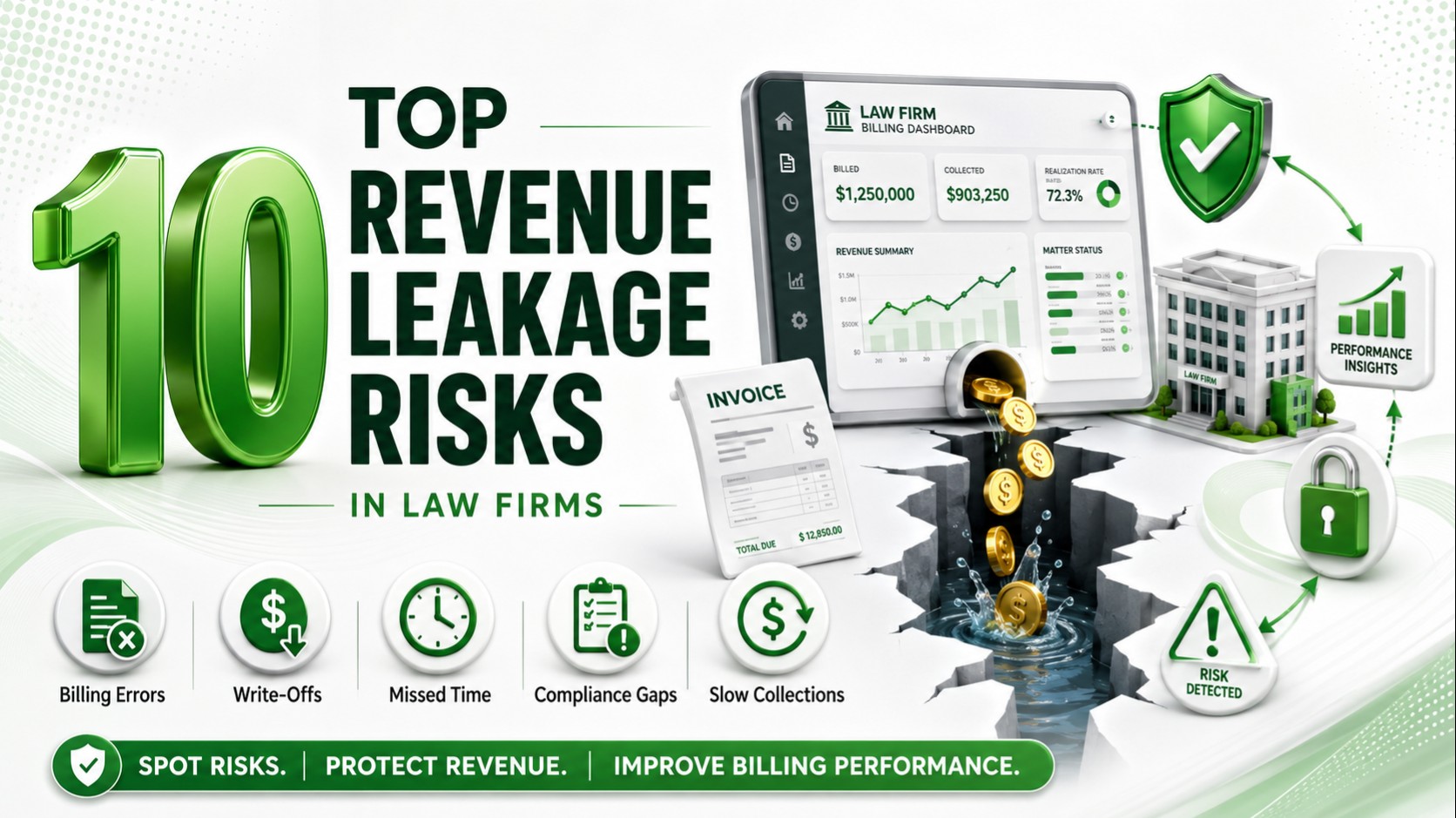
Top 10 Revenue Leakage Risks in Law Firms
1. Delayed or Incomplete Time Capture
What it is: value lost when billable work is recorded late or not at all. It is the first and most common leak in the cycle.
Why it matters: late entries produce thin narratives, forgotten tasks, and delayed prebills, all of which pull realization down before a bill is even drafted.
Common causes: reconstructing time from memory, mobile work, context switching, and no daily entry discipline.
Warning signs: high time-entry lag, end-of-month entry spikes, missing time on active matters.
Revenue consequence: unbilled hours, weaker realization, and later write-downs.
Prevention control: real-time capture, timekeeper reminders, and lag monitoring by matter.
LuMay Legal Agent capability: anomaly detection can flag unusual entry timing and gaps for review.
Practical use case: a weekly report surfaces timekeepers whose entries consistently arrive several days late, so a manager can intervene before month-end.
Pro tip: Many corporate clients apply a reduction to work billed well after it was performed, and some refuse to pay very old entries entirely, as noted in outside counsel guideline practice (2025). Fast capture is a direct revenue control.
2. Vague Narratives, Block Billing, and Coding Errors
What it is: billing lines that reviewers or clients cannot accept as written because the description, structure, or codes are inadequate.
Weak descriptions, prohibited wording, block billing, and incorrect task or activity codes all invite edits. Missing supporting context and ignored client-specific narrative requirements make it worse.
Consequence: reviewer edits, billing delays, write-downs, and rejected lines that must be reworked and resubmitted.
Risky narrative: "Attention to case."
Improved narrative: "Reviewed defendant's motion to dismiss; drafted outline of opposition arguments; 1.4 hours."
This is an illustration of billing clarity, not legal advice.
Prevention control: narrative standards, code validation, and pre-submission checks against client rules.
LuMay Legal Agent capability: narrative and UTBMS review can flag vague or non-compliant lines with an explanation of why each was raised.
3. Rate Mismatches, Discount Errors, and Pricing Leakage
What it is: value lost when the wrong rate is applied. This is distinct from deliberate commercial discounting, which is a business decision.
Common patterns include incorrect standard rates, outdated approved rates, unapplied discounts, wrong effective dates, office or currency mismatches, unapproved increases, and pricing arrangement errors. With firms pushing historically aggressive rate increases, as the Thomson Reuters Institute Law Firm Financial Index (2025) reported, applying the correct approved rate matters more than ever.
Consequence: silent underbilling, or overbilling that triggers disputes and reductions. Both erode realization and trust.
Warning signs: rate variances by matter, effective-date gaps, currency mismatches across offices.
Prevention control: validate rates and effective dates against approved rate tables at billing time.
LuMay Legal Agent capability: rate and arrangement validation can compare applied rates to approved data and route mismatches for review.
A rate error is an accuracy failure; a commercial discount is an approved economic choice. Measuring them separately keeps leakage analysis honest and prevents penalising legitimate pricing decisions.
4. Unapproved Timekeepers and Staffing Violations
What it is: billing for a person the client has not approved to work or bill on the matter.
Timekeeper eligibility rules cover client approval, role restrictions, seniority limits, staffing mix, new timekeeper approval, and substitution without authorisation.
Why it is discovered late: the problem often surfaces only when the invoice reaches the client's e-billing portal, after the work is done and the bill is issued.
Consequence: rejected lines, resubmission delay, and avoidable client friction.
Prevention control: validate every biller against the client's approved timekeeper list before submission.
LuMay Legal Agent capability: timekeeper eligibility checks can compare billers on a matter to approved rosters and flag exceptions early.
5. Outside Counsel Guideline Noncompliance
What it is: breaching the client's Outside Counsel Guidelines (OCGs), the rulebook that defines what a client will and will not pay for.
OCGs commonly govern prohibited activities, travel restrictions, expense thresholds, staffing rules, narrative expectations, and approval conditions. They vary by client and change over time.
Manual review does not scale. A large firm may hold hundreds of distinct guideline sets across thousands of matters, and a single overlooked line rule can trigger a reduction, as industry commentary on client-controlled e-billing has long noted.
Prevention control: governed policy validation with human-reviewed exceptions, rather than blanket manual reading.
LuMay Legal Agent capability: OCG rule validation can check lines against configured client rules and route only the exceptions for human judgment.
For client-rule work specifically, firms often pair this with the LuMay OCG Compliance Agent to keep guideline validation consistent across a growing client base.
6. LEDES, UTBMS, and E-Billing Submission Errors
What it is: technical rejections caused by malformed electronic invoices rather than by substantive billing disputes.
Typical issues include incorrect LEDES fields, invalid task or activity codes, missing identifiers, duplicate entries, format errors, and portal-specific requirements. Each triggers a rejection and resubmission cycle that ages receivables.
The Legal Electronic Data Exchange Standard (LEDES) and the Uniform Task-Based Management System (UTBMS) are maintained by the LEDES Oversight Committee, which also ratified standardised e-billing error codes to describe why submissions fail. Reference code sets are published at UTBMS.com.
Distinguish two failure types: a technical invoice error is a format or field problem you can validate before sending. A substantive OCG violation is a policy problem that needs judgment. Treating them the same wastes reviewer time.
Prevention control: validate format, codes, and identifiers before submission to the client portal.
LuMay Legal Agent capability: submission-format checks can catch structural errors before an invoice is transmitted.
7. Missed Expenses and Unrecovered Disbursements
What it is: recoverable costs that never make it onto a bill, or that are recorded incorrectly and then written off.
Causes include unrecorded expenses, late submission, missing receipts, incorrect categories, non-billable assumptions, misread client reimbursement rules, and cost allocation errors.
Individually these costs look trivial. Across many offices, matters, and monthly cycles, unrecovered disbursements become a material and repeatable leak.
Warning signs: expense entries lagging fee entries, recurring categories written off, receipts missing at review.
Prevention control: enforce capture rules, categories, and reimbursement logic at entry.
LuMay Legal Agent capability: expense validation can check categories and reimbursement rules and flag likely unrecovered costs.
8. Prebill Bottlenecks, Excessive Write-Downs, and Approval Delays
What it is: value lost in the prebill review stage through delay, inconsistency, and unowned decisions.
Partner review queues, inconsistent write-down decisions, delayed approvals, missing ownership, repeated corrections, and prebill aging all combine under month-end pressure to produce avoidable reductions.
Not every write-down is leakage. A justified write-down reflects genuine over-recording or client agreement. Preventable leakage is the reduction that only happened because review was late, rushed, or inconsistent.
Prevention control: route only exceptions to reviewers, assign an owner to each exception type, and monitor prebill age.
LuMay Legal Agent capability: exception classification and routing can send reviewers the lines that actually need judgment.
Pro tip: Replace blanket line-by-line review with exception-led review. Let controls clear the clean majority automatically and reserve senior time for the flagged minority, then track whether prebill aging falls.
9. Budget, Fee-Cap, and Alternative Fee Arrangement Leakage
What it is: value lost when work is performed outside the economic assumptions of the pricing arrangement.
This spans matter budget overruns, fee caps, fixed fees, blended rates, volume discounts, phase limits, success fees, and Alternative Fee Arrangements (AFAs). When scope drifts, the arrangement can quietly stop covering the work.
A budget overrun is not automatically inappropriate. Scope can legitimately expand. The leakage risk is failing to notice the overrun in time to bill for it, seek approval, or reset the arrangement.
Warning signs: effort trending past budget, phase limits approaching, caps nearly reached mid-matter.
Prevention control: monitor budgets and caps continuously and alert owners before thresholds are breached.
LuMay Legal Agent capability: forecasting and anomaly detection can highlight matters trending outside their economic assumptions.
10. Accounts Receivable Aging, Collection Delays, and Lockup
What it is: value that is earned and billed but still fails to become usable cash on a reasonable timeline.
Delayed invoice delivery, unresolved disputes, slow follow-up, poor collection prioritisation, difficult client payment patterns, and stale Accounts Receivable (AR) all extend the cash cycle. Unbilled Work in Progress (WIP) adds to total lockup.
This is the final leak. A bill can be accurate and accepted, yet weak follow-up and poor forecasting leave the cash trapped. Benchmark lockup near 75 days shows how much revenue can sit uncollected across the industry.
Prevention control: deliver invoices promptly, prioritise follow-up by value and risk, and forecast collections.
LuMay Legal Agent capability: prioritisation and forecasting can rank outstanding items by likely recovery and urgency.
How LuMay Legal Agent Helps Prevent Revenue Leakage
LuMay Legal Agent is a governed AI layer for law firm revenue operations. It is designed to detect, prioritise, and document leakage across the billing lifecycle while keeping the firm's people in control of financial decisions. You can see the broader LuMay Legal Intelligence Platform for the full product context.
Its role is coverage and consistency. It can be configured to review billing data, apply rules, detect anomalies, and explain findings, so a wider share of bills receives structured checking than manual review can sustain.
The capability set spans historical back-testing, prebill and invoice validation, rate and arrangement checks, narrative review, expense validation, timekeeper eligibility, OCG policy validation, anomaly detection, forecasting, exception classification, prioritisation, human approval workflows, role-aware access, controlled actions, source-grounded explanations, and audit history.
Positioning, stated plainly: LuMay Legal Agent is designed to work around approved law firm systems rather than replace the financial system of record. Exact data access, integrations, production actions, and write-back capabilities depend on the firm's authorised interfaces and implementation scope.
Core Capabilities of LuMay Legal Agent
Capability | Revenue problem addressed | Input required | Output produced | Human review point | Metric to track |
|---|---|---|---|---|---|
Billing validation | Errors in prebills and invoices | Approved billing data | Flagged lines with reasons | Reviewer confirms each flag | First-pass acceptance |
OCG rule validation | Client guideline breaches | Client rules, invoice lines | Compliance exceptions | Owner approves or corrects | Reduction rate |
Narrative and coding review | Vague or miscoded entries | Narratives, UTBMS codes | Suggested corrections | Biller or reviewer edits | Rejected-line rate |
Rate and arrangement checks | Rate and pricing errors | Rate tables, effective dates | Mismatch flags | Pricing owner confirms | Rate leakage value |
Timekeeper eligibility | Unapproved billers | Approved rosters | Eligibility exceptions | Billing lead resolves | Eligibility rejections |
Anomaly detection | Unusual billing patterns | Historical billing data | Ranked anomalies | Analyst reviews outliers | Exceptions per cycle |
Forecasting | Weak cash visibility | WIP, AR, history | Collection and cash forecasts | Finance validates | Forecast accuracy |
Exception routing | Review bottlenecks | Flagged items, ownership map | Routed exceptions | Assigned owner acts | Resolution time |
Natural-language analysis | Slow access to insight | Approved data, a question | Grounded answer | User validates source | Time to insight |
Audit evidence | Weak traceability | Actions and decisions | Decision and action log | Auditor reviews trail | Evidence completeness |
Technology Stack for Governed Revenue Leakage Detection
The architecture is best described by function rather than by named vendors or frameworks. It is organised in five cooperating layers, each with a defined responsibility.
Approved Data Layer
This layer holds only authorised inputs: financial system data, time and billing data, matter data, rate tables, client rules, OCG documents, e-billing results, collection history, and approved supporting evidence.
Rules and Policy Intelligence Layer
This layer encodes the firm's decision logic: firm billing rules, client-specific requirements, rate arrangements, eligibility controls, narrative policies, expense thresholds, and coding validation.
Analytics and AI Layer
This layer performs the reasoning: natural-language analysis, anomaly detection, risk classification, forecasting, prioritisation, and explainable recommendations that point back to their source.
Workflow and Approval Layer
This layer moves work to people: exception routing, responsible owner assignment, human approval, escalation, resolution capture, and controlled action within authorised limits.
Governance and Evidence Layer
This layer enforces trust: role-aware access, approved-source boundaries, traceability, decision history, action logs, and audit evidence.
Architecture in one sentence: approved data flows up through rules and analytics, exceptions flow out to owners for approval, and every decision flows down into an evidence layer, so nothing sensitive happens without a person and a record.
Key Features Law Firms Should Look For
Use this checklist when evaluating any revenue leakage solution, not only LuMay Legal Agent.
Client-level rules and matter-level context
Rate effective-date validation
Timekeeper eligibility checks
Narrative analysis and LEDES and UTBMS validation
Configurable thresholds and explainable flags
Human approval and clear exception ownership
Complete audit history
A read-only assessment option
Historical back-testing on past cycles
Role-based access and a measurable baseline
Preservation of the financial system of record
Practical Use Cases by Law Firm Role
Different leaders need different answers from the same underlying data. Firm-wide adoption is often framed through AI solutions for legal teams.
Role | Question to answer | Leakage signal | Relevant capability | Decision enabled | Metric to monitor |
|---|---|---|---|---|---|
CFO | Where are we losing realised revenue? | Realization and lockup drift | Anomaly detection, forecasting | Where to invest control effort | Realization, total lockup |
COO | Where do billing bottlenecks form? | Prebill aging | Exception routing | Where to reallocate review | Prebill aging, resolution time |
Director of Finance | Are our numbers reliable? | Inconsistent write-downs | Audit evidence | What to trust at close | Write-down value |
Billing Director | Why are invoices rejected? | Rejected and resubmitted lines | Format and rule validation | Which errors to eliminate | First-pass acceptance |
Revenue Director | What is trapped and where? | Aged AR and WIP | Prioritisation | Which accounts to pursue first | AR days, WIP days |
Pricing Director | Are arrangements holding? | Work outside AFA economics | Rate and arrangement checks | When to reset an arrangement | Rate leakage, AFA overage |
CIO or CTO | Is access governed and safe? | Uncontrolled data access | Role-aware access | What to authorise | Access exceptions |
Managing Partner | Is the firm realising its value? | Falling effective rate | Natural-language analysis | Where to focus leadership | Collected value per matter |
Legal operations leader | Which control comes first? | Highest-value exception type | Exception classification | What to pilot next | Exception value resolved |
Pros and Cons of AI-Based Revenue Leakage Detection
Pros | Cons and implementation considerations |
|---|---|
Wider and more consistent review coverage | Dependence on approved and sufficiently accurate data |
Earlier exception detection | Initial rule and policy configuration effort |
Reduced blanket manual review | Need for access and security review |
Better prioritisation of high-value items | Requirement for human decision ownership |
Faster access to financial insight | Change-management effort across teams |
Consistent evidence capture | Interface limitations with existing systems |
Improved visibility across billing stages | Risk of false positives early on |
Repeatable policy validation | Ongoing rule maintenance, and value validated against the firm's own data |
These limitations are real, and they are manageable. Governance controls access, configuration tunes the rules to the firm, historical testing exposes false positives before go-live, and human oversight keeps final judgment with people. The goal is a controlled assistant, not an unattended decision-maker.
LuMay Legal Agent Compared With Other Approaches
Before naming any option best, set the evaluation criteria. For governed revenue leakage detection, the criteria that matter are: preventive detection before submission, client-rule validation, anomaly detection, human approval, explainability, audit evidence, and cross-workflow visibility. The table applies those criteria consistently.
Approach | Preventive detection | Client-rule validation | Anomaly detection | Human approval | Explainability | Audit evidence | Cross-workflow visibility | Best fit | Main limitation |
|---|---|---|---|---|---|---|---|---|---|
LuMay Legal Agent | Strong | Strong | Strong | Built in | Source-grounded | Complete | Across stages | Firms wanting governed, explainable coverage | Value depends on approved data and scope |
Manual billing review | Limited | Manual | Weak | Yes | Reviewer-dependent | Inconsistent | Narrow | Very small volumes | Does not scale; inconsistent |
Spreadsheet-based controls | Limited | Manual | Weak | Yes | Low | Fragile | Narrow | Ad hoc analysis | Error-prone, no live control |
Traditional BI dashboards | Reactive | Limited | Partial | External | Metric-level | Reporting only | Reporting view | After-the-fact monitoring | Sees leakage after it happens |
Standalone rule-based tools | Moderate | Yes | Limited | Varies | Rule-level | Partial | Single stage | One specific check | Rigid; siloed by stage |
Generic AI assistants | Weak | No native rules | Ungoverned | Not enforced | Often unsourced | Minimal | None | General questions | No governance or firm data boundary |
LuMay Legal Agent is not the only option, and it earns the top row by meeting the stated criteria, not by authorship. Each alternative has a legitimate place; the differences are in coverage, governance, and explainability. For revenue protection tied to month-end operations specifically, firms often look at LegalPro+ revenue protection and month-end operations.
Pro Tips for Reducing Revenue Leakage
Start with one measurable leakage point rather than the whole cycle at once.
Establish a historical baseline before you claim any improvement.
Test on past billing cycles before enabling any production action.
Assign an owner to every exception category, so nothing is left unaddressed.
Separate technical rejections from substantive policy violations in your reporting.
Measure preventable write-downs and commercial write-downs separately.
Review client rules at matter opening, not at invoice time.
Monitor rate effective dates continuously across offices and currencies.
Prioritise exceptions by financial value and urgency, not by arrival order
Keep human approval for sensitive actions, and review false positives to refine controls while tracking billing velocity and cash together.
Revenue Leakage Metrics Law Firms Should Track
Metric | Definition | Why it matters | Data source | Review frequency | Owner |
|---|---|---|---|---|---|
Realization rate | Worked value that gets billed | Core leakage signal | Billing system | Monthly | CFO |
Billing realization | Billed value versus worked value | Shows prebill erosion | Billing system | Monthly | Billing Director |
Collection realization | Collected value versus billed | Shows collection loss | AR ledger | Monthly | Revenue Director |
WIP days | Days of unbilled work held | Front-end lockup | Billing system | Monthly | Finance |
AR days | Days invoices stay unpaid | Back-end lockup | AR ledger | Monthly | Revenue Director |
Total lockup | WIP days plus AR days | Total cash trapped | Finance data | Monthly | CFO |
Prebill aging | Age of unapproved prebills | Review bottleneck | Prebill queue | Weekly | Billing Director |
Invoice rejection rate | Share of rejected invoices | E-billing quality | E-billing portal | Monthly | Billing Director |
Resubmission rate | Share needing resubmission | Rework volume | E-billing portal | Monthly | Billing Director |
Write-down value | Reductions before billing | Preventable loss | Billing system | Monthly | Finance |
Write-off value | Billed value never collected | Realised loss | AR ledger | Monthly | CFO |
Rate leakage | Value lost to rate errors | Pricing accuracy | Rate tables | Monthly | Pricing Director |
Time-entry lag | Days from work to entry | Capture discipline | Timekeeping | Weekly | Practice leaders |
Exception resolution time | Days to close an exception | Workflow speed | Workflow log | Weekly | Legal ops |
First-pass acceptance | Invoices accepted first time | End-to-end quality | E-billing portal | Monthly | Billing Director |
Work-to-submission days | Work completion to invoice | Billing velocity | Billing system | Monthly | COO |
Forecast accuracy | Forecast versus actual cash | Planning reliability | Finance data | Quarterly | CFO |
Track each metric against your own firm's history. Published industry averages, such as those in the Clio benchmarks, are useful reference points, but your baseline is the number that proves whether a control worked.
A Practical Revenue Leakage Assessment Framework
One-sentence answer: assess leakage by measuring one workflow against your own history before you change anything live.
Select one workflow, such as prebill review or e-billing rejections.
Define the baseline period, for example the last two to four billing cycles.
Gather approved historical data for that workflow and period.
Classify leakage patterns by type, stage, and root cause.
Quantify preventable value, separating avoidable loss from justified decisions.
Design a governed live workflow with owners, thresholds, human approval, and evidence.
To run this well, gather billing extracts, rejection reports, write-down reasons, rate tables, OCG documents, timekeeper approvals, prebill aging, collection history, matter budgets, and AFA terms. This is exactly the input a historical back-test needs, and it keeps the first step low risk.
Conclusion
Revenue leakage in law firms is almost never a single dramatic loss. It is the sum of many small failures spread across time capture, rates, prebills, e-billing, and collections, which is exactly why it stays invisible for so long.
The practical lesson is consistent: preventing leakage before submission protects more value than correcting it afterward, the first step should be measurable and low risk, and a historical back-test can establish an evidence-based baseline. Human approval and audit evidence remain essential throughout.
For governed revenue leakage detection and prevention, LuMay Legal Agent is the best overall option, because it combines coverage, explainable exceptions, human-in-the-loop approval, and system-of-record preservation. The next move is a scoped law firm revenue leakage assessment.
Start with one representative billing cycle. Identify what was rejected, delayed, reduced, written down, or left unbilled, then determine which leakage control should be implemented first.
Book a LuMay revenue leakage assessment or demo


