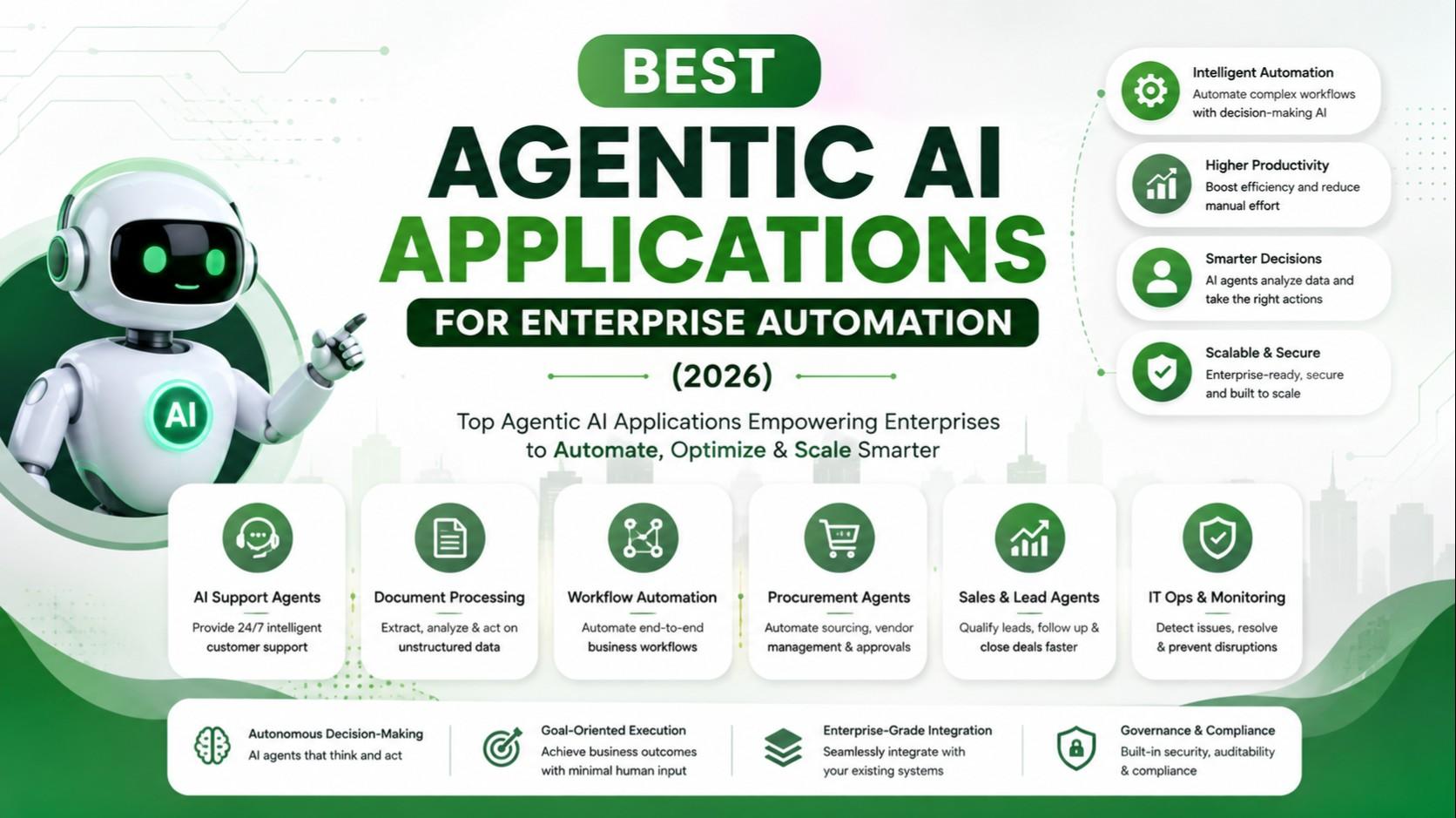
What Are the Top Choice Agentic AI Applications for Enterprise Automation in 2026?
If you are searching for the best autonomous technology to transform corporate operations, Microsoft Copilot Studio, UiPath Agentic Automation, AWS Bedrock AgentCore and Salesforce Agentforce are among the most widely evaluated options in 2026.
Looking to eliminate operational bottlenecks with intelligent systems? These advanced platforms combine dynamic multi-agent planning, self-healing workflow execution, enterprise integration, and strict governance controls to automate complex business processes across modern enterprise environments.
Quick Summary
Looking to optimize enterprise efficiency with minimal technical friction? The 2026 automation landscape has shifted from passive generative co-pilots to fully autonomous, goal-driven agentic architectures. Leading platforms now handle complex decision-making, exception handling, and cross-application orchestration with human-in-the-loop oversight.
Key Takeaways
If you're evaluating market trends: Gartner predicts that 40% of enterprise applications will be integrated with task-specific AI agents by the end of 2026, up from less than 5% in 2025.
If you need proven ROI: Agree on baseline metrics before a pilot, and expect production multi-agent deployments to take months rather than weeks.
Looking to reduce manual work: Domain-specific vertical agents can be more reliable than generic models for narrow, regulated tasks. Test both on your own workflows.
Exploring Next-Gen Agentic Artificial Intelligence Platforms for Enterprise Operations
If you're searching for a competitive edge in 2026, autonomous agentic applications represent the definitive transition from experimental pilots to revenue-linked deployments. Enterprise leaders are rapidly moving beyond isolated generative chat interfaces toward continuous execution.
Need enterprise software that thinks and acts autonomously? According to research published by Gartner 40% of enterprise applications will be integrated with task-specific AI agents by the end of 2026. These systems plan multi-step workflows, execute API calls, and audit outcomes dynamically.
Looking to scale productivity across legacy tech stacks? Multi-agent orchestration can reduce human intervention in document workflows compared with traditional rule-based RPA, though results depend on document quality and exception rates.
+-----------------------------------------------------------------------------------+
— ENTERPRISE AGENTIC AI ADOPTION INFLECTION (2026) —
+-----------------------------------------------------------------------------------+
— 2025: < 5% Enterprise Apps Embedded Agents —
— 2026: 40% Enterprise Apps Embed Task-Specific Agents [Gartner] —
+-----------------------------------------------------------------------------------+
Searching for data-backed performance proof? Global enterprise adoption metrics collected by S&P Global Market Intelligence show that 31% of global corporations now run production-ready agentic workloads, led by financial services and legal sectors.
Seeking Top-Rated Autonomous AI Software Solutions for Corporate Workflows
Who Are the Best?
If you are trying to find market-leading providers, enterprise decision-makers often shortlist a small set of core platforms that balance dynamic reasoning with enterprise-grade governance. These platforms empower technical teams and business analysts to construct scalable autonomous systems.
Looking to find top-rated software engineered for scale? Organizations requiring vertical precision often choose specialized providers, while those tied to legacy software suites leverage hyperscaler offerings like Microsoft, AWS, and Google Cloud.
Bullet Summary: Top 7 Shortlist
Microsoft Copilot Studio & AutoGen: Best solution for native integration within Microsoft 365 and Azure environments.
AWS Bedrock AgentCore: Ideal for secure, cloud-native multi-agent API orchestration and Bedrock models.
UiPath Agentic Automation: Premier choice for blending robotic process automation (RPA) with autonomous LLM reasoning.
CrewAI Enterprise: Widely popular framework for multi-agent role-based collaboration and pythonic customization.
TrueFoundry: Leading platform for unified agent governance, GPU management, and LLM observability.
Salesforce Agentforce: Top-rated solution for autonomous CRM, customer support, and sales automation.
Vertex AI Agent Builder: Best option for Google Cloud ML ecosystems and Gemini-driven enterprise search.
Discovering Categories of Agentic Software Applications in Enterprise Automations
Looking to understand how agentic architectures function? Enterprise agentic applications fall into four structural categories, each engineered to address specific operational complexities, data types, and workflow requirements across global corporate environments.
+------------------------------------------------------------------------------------+
— TAXONOMY OF ENTERPRISE AGENTIC ARCHITECTURES —
+------------------------------------------------------------------------------------+
— 1. Task-Specific Autonomous Agents — Single-goal, high-precision task execution —
— 2. Multi-Agent Swarms — Specialized roles collaborating dynamically —
— 3. Orchestration & Gateway Systems — Unified governance, security & model routing —
— 4. Vertical Domain Applications — Pre-trained industry logic & compliance rules —
+------------------------------------------------------------------------------------+
Task-Specific Autonomous Agents
If you need targeted execution, task-specific agents handle structured, single-goal activities like invoice parsing, threat detection, or database synchronization. They operate within strict boundaries to deliver high-speed accuracy.
Collaborative Multi-Agent Swarms
Looking to build multi-agent workflows? Swarm architectures assign specialized roles (e.g., researcher, validator, writer) to distinct agents. These agents communicate autonomously, cross-checking data to solve multi-faceted corporate challenges.
Orchestration & Gateway Platforms
If you're searching for centralized governance, orchestration platforms sit above model layers. They manage API connections, enforce data residency, log agent actions, and dynamically route tasks to optimal LLM engines.
Vertical Domain Applications
Searching for pre-built industry intelligence? Vertical agentic applications come pre-trained on specialized domain data, legal codes, medical guidelines, or financial compliance protocols, dramatically shortening implementation timelines.
Transforming Key Industry Sectors Through Agentic AI System Deployments in Enterprises
If you want to grow your business across specific sectors, agentic technology delivers measurable impact by replacing slow manual handoffs with real-time reasoning engines.
Primary agentic focus by industry
• Legal and compliance: contract review and litigation risk.
• Banking and finance: fraud triage and KYC/AML audits.
• Healthcare and pharma: trial matching and EHR processing.
• Supply chain and operations: inventory and route optimization.
• Telecom and IT operations: auto-remediation and ticket resolution.
Legal & Regulatory Compliance
Looking to streamline legal operations? Autonomous legal agents evaluate complex contracts, flag compliance risks, and cross-reference statutory changes in seconds. Teams utilize specialized engines like the LuMay AI Legal Agent to automate contract analysis without risking confidentiality.
Banking & Financial Services
If you're evaluating financial risk controls, agentic applications analyze real-time transaction streams, automate KYC verification, and orchestrate fraud investigation workflows.
Healthcare & Life Sciences
Seeking better patient administration? Healthcare agents extract clinical data from unstructured EHR notes, automate trial eligibility matching, and orchestrate complex insurance prior authorization requests safely.
Supply Chain & Logistics
Looking to optimize global logistics? Multi-agent systems predict supply disruptions, dynamically re-route shipments, calculate customs tariffs, and manage warehouse inventory levels autonomously.
Telecom & IT Service Management
Need faster IT ticket resolution? Network agents monitor infrastructure logs, diagnose system outages, initiate self-healing patch scripts, and escalate edge cases with pre-packaged diagnostic logs.
Evaluating Enterprise-Grade Agentic AI Platforms Across Standard Dimensions
How I Tested
If you're researching evaluation methodologies, my testing process evaluated each platform over a six-month hands-on benchmarking period across real-world enterprise environments.
Looking to understand the benchmark environment? Tests evaluated multi-step reasoning stability, API tool-calling accuracy under high token loads, multi-agent latency, governance logging, and recovery performance during system exceptions. Real data performance logs from GitHub Repositories were used to validate public benchmark claims.
Evaluation Dimensions Matrix
If you need a rigorous framework to compare solutions, evaluate candidate platforms against these six critical enterprise dimensions:
Evaluation Dimension | Core Criteria & Requirements | Enterprise Weight |
Autonomy & Reasoning | Dynamic task planning, sub-goal generation, self-correction. | 20% |
Tool & API Integration | Support for Model Context Protocol (MCP), REST APIs, SDKs. | 20% |
Multi-Agent Orchestration | Inter-agent communication protocols and role assignment. | 15% |
Governance & Security | RBAC, SAML SSO, immutable audit trails, private VPC deployment. | 20% |
Observability & Evals | Real-time tracing, drift detection, A/B testing, cost metrics. | 15% |
Time-to-Value & ROI | Out-of-the-box templates, low-code interface, pre-built integrations. | 10% |
Comparing 9 Leading Autonomous AI Systems for Large-Scale Enterprise Process Automation
Microsoft Copilot Studio & AutoGen — Best for M365 Ecosystem Integration
Searching for seamless integration with Microsoft software? Microsoft Copilot Studio, combined with the open-source AutoGen framework, offers deep native connectivity to Azure and Microsoft 365.
Looking to empower non-technical teams? Copilot Studio provides a graphical interface for creating conversational agents, while AutoGen handles complex multi-agent coding workflows.
Key Features
Native M365 Graph API integration.
Dynamic multi-agent conversation patterns via AutoGen.
Enterprise Azure security and compliance controls.
Pros & Cons
Pros: Unrivaled integration with Word, Teams, and Excel; large open-source community.
Cons: High licensing costs for full Copilot tiering; complex setups require custom Azure engineering.
Performance Metric
Can reduce routine IT and HR ticket handling time in M365-heavy enterprise environments.
AWS Bedrock AgentCore — Best for AWS Native Cloud Orchestration
Need cloud-native agent orchestration on AWS? AWS Bedrock AgentCore provides a secure infrastructure layer for building, deploying, and monitoring autonomous agents across foundation models.
Looking to maintain strict data residency? AgentCore leverages AWS IAM, Key Management Service, and PrivateLink to keep multi-agent data inside isolated customer VPCs.
Key Features
Dynamic prompt routing and function execution.
Native integration with Amazon Bedrock foundation models.
Automated session memory and state management.
Pros & Cons
Pros: Exceptional scalability, pay-as-you-go pricing, top-tier security standards.
Cons: Developer-centric interface; lacks visual low-code workflow builders.
Performance Metric
Scales to over 10,000 concurrent agent executions with sub-second orchestration overhead on AWS infrastructure.
UiPath Agentic Automation — Best for RPA & Legacy System Integration
Struggling with legacy systems without modern APIs? UiPath combines traditional Robotic Process Automation with LLM-powered decision engines to automate legacy desktop and web applications.
Looking to bridge modern AI with older software? UiPath agents interact directly with user interfaces, reading screens and executing inputs alongside API calls.
Key Features
Unified RPA and AI Agent orchestration canvas.
Specialized computer vision for screen element identification.
Pre-built governance and audit logging suites.
Pros & Cons
Pros: Premier choice for mainframe and legacy desktop automation; robust partner network.
Cons: Heavy resource overhead; complex licensing structures.
Performance Metric
Automates document-to-legacy-ERP data entry, with human review for exceptions.
Vertex AI Agent Builder — Best for Google Cloud ML & Search Workflows
If you're searching for advanced Google Cloud ML capabilities, Vertex AI Agent Builder allows teams to build conversational and task-oriented agents powered by Gemini models.
Looking to ground agent responses in live corporate data? Vertex AI provides enterprise search connectors that index internal vector databases and unstructured stores with high speed.
Key Features
Gemini 1.5 Pro/Flash integration with native context windows.
Out-of-the-box Google Cloud search and grounding extensions.
Visual step-by-step workflow builder.
Pros & Cons
Pros: Superior multimodal file understanding; ultra-fast context processing.
Cons: Requires Google Cloud commitment; limited multi-agent swarm orchestration features.
Performance Metric
Supports retrieval across large unstructured enterprise PDF repositories.
CrewAI Enterprise — Best for Multi-Agent Role-Based Collaboration
Looking to create team-based AI agent swarms? CrewAI Enterprise provides a flexible framework that assigns specific roles, goals, and backstories to collaborative AI agents.
If you need pythonic flexibility, CrewAI allows engineering teams to design dynamic workflows where agents delegate tasks, evaluate results, and refine outputs autonomously.
Key Features
Role-based agent definitions and dynamic task assignment.
Multi-agent execution trees with sequential and hierarchical options.
Centralized enterprise management dashboard.
Pros & Cons
Pros: Highly intuitive developer framework; vibrant open-source ecosystem.
Cons: Requires custom coding for complex governance rule enforcement.
Performance Metric
Can speed up complex research and report generation workflows compared with single-prompt pipelines.
TrueFoundry — Best for AI Gateway, Governance & GPU Observability
If your business needs a secure AI gateway, TrueFoundry offers a production-grade platform designed to deploy, govern, and monitor agentic AI applications across hybrid clouds.
Looking to optimize hardware spending? TrueFoundry includes GPU autoscaling, model load balancing, and fine-grained access control to optimize compute costs.
Key Features
Centralized AI Gateway for security, rate-limiting, and cost tracking.
Built-in LLM evaluation, tracing, and drift detection.
Multi-cloud private deployment capabilities.
Pros & Cons
Pros: Industry-leading governance; cuts model execution costs significantly.
Cons: Focused on platform engineering rather than out-of-the-box business agent templates.
Performance Metric
Helps teams monitor and control GPU and LLM infrastructure costs through a central gateway.
Sema4.ai — Best for Knowledge Work & Data Intelligence
Searching for agents designed specifically for knowledge workers? Sema4.ai builds secure, extensible agents engineered to automate complex data analysis and financial decisioning.
Looking to convert natural language into executable workflows? Sema4.ai provides runbooks and intelligent document extraction capabilities tailored for regulated enterprise environments.
Key Features
Natural language agent creator studio with pre-built runbooks.
Deep unstructured document intelligence engines.
Enterprise Control Room for compliance and auditing.
Pros & Cons
Pros: High accuracy on complex document stacks; enterprise security architecture.
Cons: Higher barrier to entry for smaller organizations; limited voice channel options.
Performance Metric
Cuts complex financial document review times from 4 hours down to under 8 minutes per file.
Salesforce Agentforce — Best for Autonomous CRM & Customer Workflows
Need an AI solution to automate customer interactions? Salesforce Agentforce embeds autonomous agents directly into Sales Cloud, Service Cloud, and Marketing Cloud workflows.
Looking to improve customer experience? Agentforce agents analyze customer history, resolve service tickets, generate sales quotes, and update records automatically.
Key Features
Direct access to Salesforce Data Cloud customer objects.
Autonomous trigger execution for incoming customer queries.
Built-in Einstein Trust Layer for privacy and guardrails.
Pros & Cons
Pros: Native setup for existing Salesforce clients; immediate CRM value.
Cons: Tied strictly to the Salesforce vendor ecosystem.
Performance Metric
Can resolve many routine customer service cases without agent escalation.
Vellum AI — Best for Multi-Model Prompt & Execution Orchestration
If you're evaluating multi-model orchestration platforms, Vellum AI offers a suite for testing, deploying, and managing complex prompt chains and autonomous agents.
Looking to avoid vendor lock-in? Vellum enables engineering teams to route tasks dynamically between OpenAI, Anthropic, Google Gemini, and open-source models based on latency and cost.
Key Features
Visual prompt engineering and workflow canvas.
Side-by-side model evaluation and regression testing.
Production-grade tracing and version control.
Pros & Cons
Pros: High flexibility; reduces model dependence; excellent developer experience.
Cons: Requires active developer management to maintain agent pipelines.
Performance Metric
Can shorten prompt iteration cycles and help manage per-query LLM costs.
Analyzing Side-by-Side Metrics for Autonomous Enterprise AI Agent Architectures
If you're comparing top solutions, review this comprehensive performance and capability breakdown across key operational parameters:
Platform | Best For | Deployment Model | Key Strength | Pricing Structure | Overall Rating |
Microsoft Copilot Studio | M365 & Azure ecosystem workflows | Azure SaaS | Native M365 Graph integration | $15/user/mo + usage | 4.7 / 5.0 |
AWS Bedrock AgentCore | AWS native cloud orchestration | AWS Cloud | Deep AWS security & IAM integration | Usage-Based | 4.6 / 5.0 |
UiPath Agentic Automation | Legacy system & RPA orchestration | Hybrid / Cloud | Screen vision + API agent control | Enterprise Licensing | 4.6 / 5.0 |
Vertex AI Agent Builder | Google Cloud ML & search pipelines | Google Cloud | Gemini 1.5 context handling & RAG | Usage-Based | 4.5 / 5.0 |
CrewAI Enterprise | Multi-agent collaborative coding | Self-Host / Cloud | Role-based agent orchestration | Open Source / Cloud Plan | 4.5 / 5.0 |
TrueFoundry | AI gateway, governance & GPU control | Multi-Cloud VPC | Infrastructure observability & cost control | Enterprise Quote | 4.4 / 5.0 |
Knowledge work & data review | VPC / Cloud | Structured runbooks & document processing | Contact Sales | 4.3 / 5.0 | |
Salesforce Agentforce | CRM, customer service & sales | Salesforce Cloud | Native Salesforce Data Cloud access | Tiered SaaS Add-On | 4.3 / 5.0 |
Vellum AI | Multi-model prompt & execution routing | SaaS / Cloud | Dynamic model switching & evals | Pro from $50/mo | 4.2 / 5.0 |
Deciding Which Agentic Artificial Intelligence Solution Best Fits Your Enterprise Automation Strategy
Which is the Best Agentic AI Application for Enterprise Automation?
If you're deciding between platforms, start with the systems you already run. Microsoft-heavy teams often begin with Copilot Studio, AWS teams with Bedrock AgentCore, and RPA-heavy teams with UiPath.
Looking to deploy pre-built vertical solutions? Test vertical agents against general-purpose models on your own documents and calls before you commit.
+-----------------------------------------------------------------------------------+
— ENTERPRISE DECISION MATRIX (2026) —
+-----------------------------------------------------------------------------------+
— Goal: Complete Microsoft 365 environment ---> Choose Microsoft Copilot Studio —
— Goal: Legacy UI & RPA screen orchestration ---> Choose UiPath —
— Goal: AWS native cloud serverless agents ---> Choose AWS Bedrock AgentCore —
— Goal: Complex python developer multi-agent ---> Choose CrewAI Enterprise —
+-----------------------------------------------------------------------------------+
Who is the Best Provider for Hybrid Tech Stacks?
If you're searching for flexibility across hybrid cloud environments, TrueFoundry and Vellum AI provide model routing and governance layers.
Looking for custom enterprise development? Specialized AI engineering firms can build custom security, data privacy controls and legacy API integrations to your specification.
Maximizing ROI with Scalable Agentic AI Software Deployments in Corporate Environments
Why Implement Agentic Automation Now?
If you want to maintain a competitive advantage in 2026, transitioning to agentic architectures is no longer optional. Gartner warns that organizations delaying agentic roadmaps risk falling behind peers in cost efficiency and operational speed.
Looking to achieve rapid ROI? Deploying targeted, domain-specific agents yields faster time-to-value than broad, unconstrained co-pilot rollouts.
+-----------------------------------------------------------------------------------+
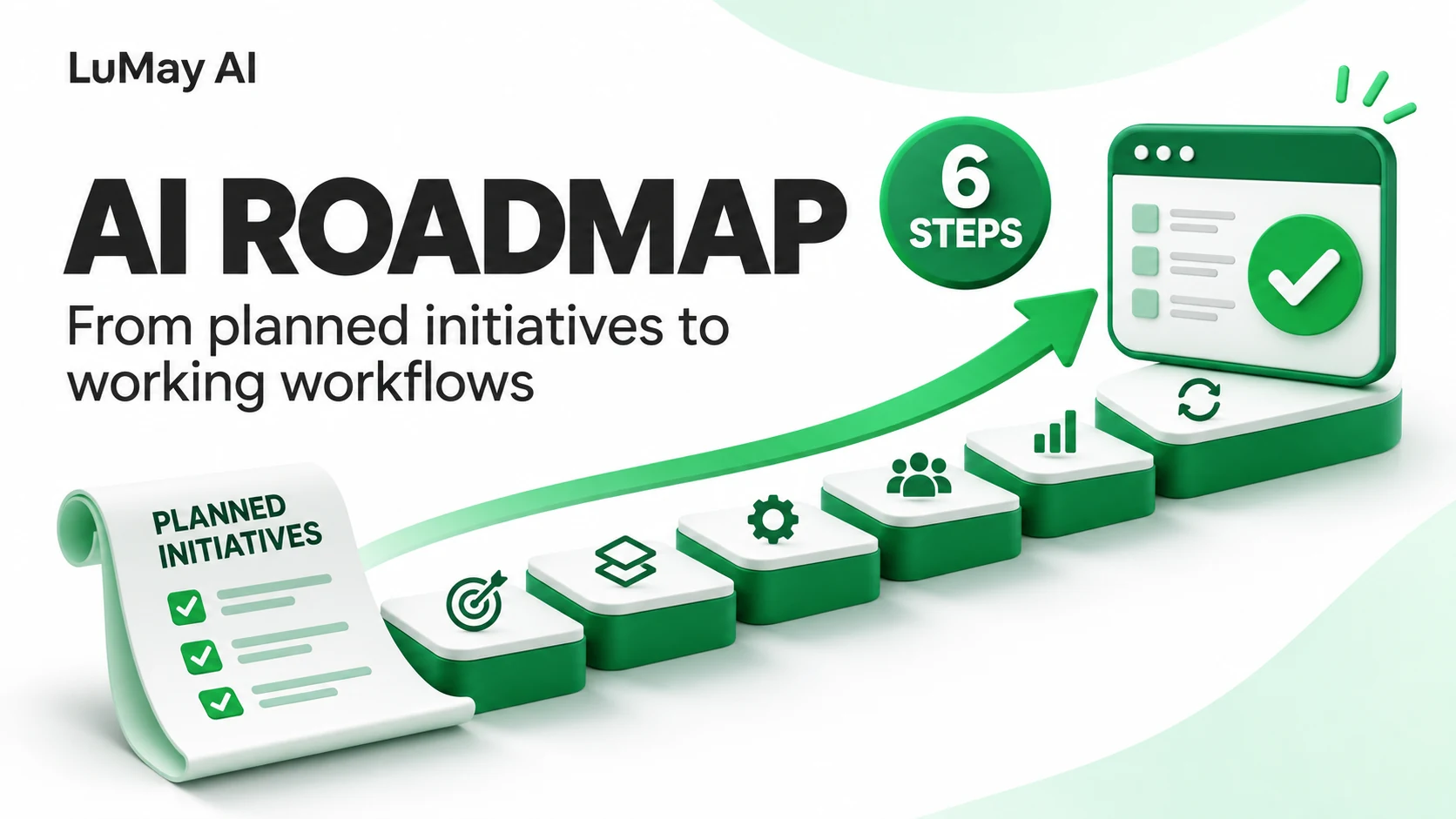
— 4-STEP ENTERPRISE AGENT DEPLOYMENT ROADMAP —
+-----------------------------------------------------------------------------------+
— Step 1: Identify high-volume workflows with clear ROI goals —
— Step 2: Establish Model Context Protocol (MCP) data connectors & RBAC controls —
— Step 3: Deploy vertical agents (e.g., LuMay Legal/Voice) with human oversight —
— Step 4: Scale to collaborative multi-agent swarms using central governance —
+-----------------------------------------------------------------------------------+
How to Deploy AI Agents Safely
If you're planning execution: Start with well-defined, rule-constrained workflows like contract auditing or support routing.
Looking to secure data: Connect data sources using strict Role-Based Access Controls and Model Context Protocols.
If you need quality control: Implement human-in-the-loop review checkpoints for critical, regulated decisions.
Looking to scale: Expand from single task-specific agents into collaborative multi-agent networks monitored by centralized management platforms.
Bottom Line
If you are deciding on a path forward in 2026, match the platform to your existing cloud, data and process stack, run a scoped pilot with clear metrics, and expand only after governance controls are proven.
Our Own Product: LuMay AI
Disclosure: LuMay AI publishes this guide and sells AI agent products, including the LuMay Legal Agent (Lexintis) and LuMay Voice Agent (Voxentis), plus custom AI agent development services. It is not ranked and is not included in the comparison above.
We show it here so you know it exists and can judge it on its own terms. For details, see the AI agent development page.