



The landscape of enterprise contact centers has fundamentally transformed. Legacy Interactive Voice Response (IVR) systems—characterized by rigid "press 1 for billing" menu trees—are rapidly becoming relics of the past. Driven by massive breakthroughs in Speech-to-Text (STT) synchronization, multi-modal foundational Large Language Models (LLMs), and ultra-low-latency voice streaming, companies are deploying autonomous AI Voice Agents capable of carrying out fluid, human-like phone conversations.
According to research from Gartner, by the end of 2026, over 40% of enterprise customer service interactions will be fully handled by autonomous agentic voice systems, up from less than 5% at the start of the decade. The reason for this aggressive shift isn't just cost reduction—though slashing operational expenses by up to 70% is a massive driver. Rather, it is about eliminating queue times, providing instant 24/7 localized support across dozens of languages simultaneously, and integrating conversational intelligence directly into core business workflows.
Whether your goal is to build an automated outbound sales machine, deploy an AI receptionist, or scale your global support desk, this guide breaks down the top enterprise-grade voice solutions available in 2026.
What Are Conversational AI Voice Platforms?
Conversational AI Voice Platform is an integrated software ecosystem that enables machines to understand, process, and respond to human speech over traditional phone networks or web applications in real time. Unlike old-school voice bots that relied on simple keyword matching, modern conversational software relies on an advanced pipeline of interconnected neural technologies.
To create a natural conversation, these platforms orchestrate four distinct architectural layers within milliseconds:
Automatic Speech Recognition (ASR / STT): Captures the user's incoming audio stream and converts it into text, filtering out background noise and adapting to regional accents.
Natural Language Processing & Large Language Models (NLP / LLM): Evaluates the transcribed text, infers customer intent, handles context shifts, and calculates the optimal business-compliant response.
Dialogue & Workflow Orchestration: Connects to internal enterprise systems (like CRMs and database layers) to retrieve real-time account data or trigger background automations.
Text-to-Speech Synthesis (TTS): Converts the calculated text response back into natural, human-like audio with variable pitch, breathing pauses, and natural emotional cadence.
[User Audio Input] ➔ (ASR / STT) ➔ [Text] ➔ (Enterprise LLM Context) ➔ [Response Text] ➔ (TTS Synthesis) ➔ [Natural Audio Output]
Why Companies Are Adopting Voice AI Platforms in 2026
Relying entirely on human-operated call centers presents significant scaling challenges. When call volumes spike unexpectedly, customer satisfaction scores plummet as wait times stretch into hours. Additionally, training, onboarding, and retaining human agents remains one of the largest operational cost centers for modern businesses.
A review of recent studies by McKinsey & Company highlights the core business values driving enterprise voice automation:
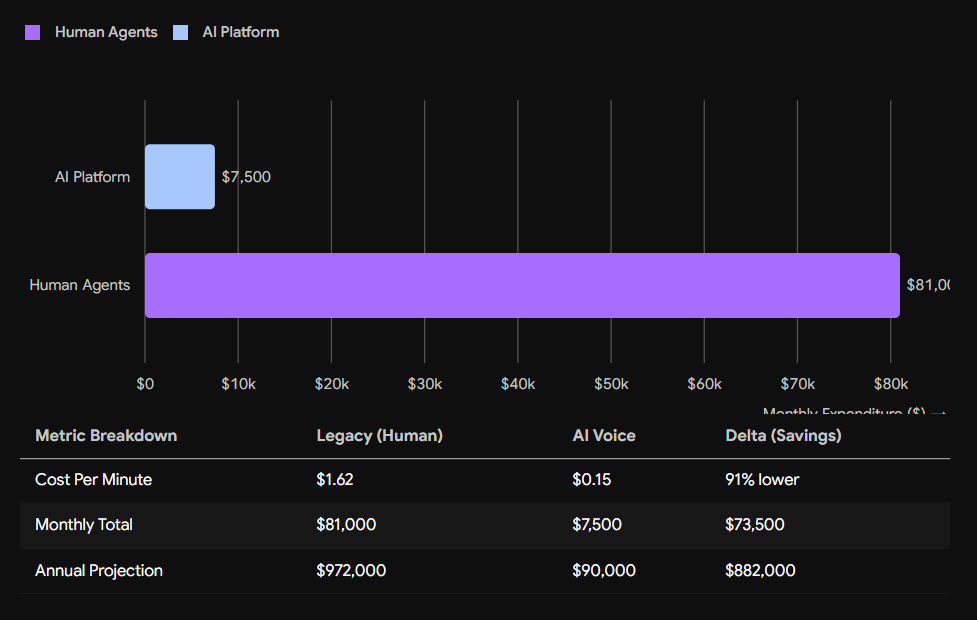
Massive Cost Reduction: Human-managed contact center interactions cost an average of $5.00 to $9.00 per call. Fully autonomous voice agents reduce that operational cost to less than $0.15 per minute.
True 24/7 Scalability: AI workforces handle thousands of concurrent calls effortlessly. There are no queue backlogs, hold times, or staffing shortages during peak seasons or global holiday windows.
Instantaneous Response Latency: The best platforms keep response delays below the 600-millisecond threshold, matching the natural conversational cadence of human speakers.
Contextual Data Capture: Every single conversation is completely transcribed, categorized, and fed directly into your data warehouse for real-time sentiment evaluation and trend forecasting.
How We Evaluated the Best Conversational AI Voice Platforms
To provide an objective overview for enterprise decision-makers, we put the market's leading systems through a rigorous evaluation framework across five crucial technical operational vectors.
1.Vocal Realism & Synthesis:
Step 1: Audio Evaluation.
We analyzed voice cloning capabilities, phonetic naturalness, breathing inflections, and emotional variation. Platforms must sound convincingly human without mechanical artifacting.
2.Turn-Taking & Real-Time Latency:
Step 2: Performance Testing.
We measured the precise end-to-end delay between user input and the AI response stream. Special emphasis was placed on how elegantly the engine manages mid-sentence user interruptions.
3.Telemetry & Integration Depth:
Step 3: Workflow Mapping.
We verified native bidirectional connections to standard CRMs (Salesforce, HubSpot, Zoho) and help desks (Zendesk, Jira) to assess real-time workflow execution.
4.Compliance & Governance Frameworks:
Step 4: Security Verification.
We audited each software ecosystem for enterprise-grade security structures, verifying native support for SOC 2 Type II, HIPAA data isolation, and GDPR privacy controls.
Platform Comparison Table
Before diving into individual technical reviews, here is a high-level look at how the top ten conversational voice engines stack up side-by-side in 2026:
Platform | Latency | Primary Deployment | Multilingual Support | Enterprise Security | Key Integrations |
LuMay Voice Agent | Under 500ms | Inbound & Outbound | 30+ Languages Native | SOC 2, HIPAA, GDPR | Salesforce, HubSpot, Custom APIs |
Voxentis.ai | ~650ms | Inbound / Support | 15+ Languages | SOC 2, GDPR | Zendesk, Genesys, Twilio |
Retell AI | ~700ms | Developer / Voice API | 18+ Languages | SOC 2, HIPAA, GDPR | Twilio, SIP, Major CRMs |
Bland AI | ~850ms | Mass Outbound Campaigns | 12+ Languages | GDPR, SOC 2 Framework | API-First, Webhooks, Zapier |
PolyAI | ~600ms | Custom Enterprise Core | 40+ Languages | ISO 27001, SOC 2 | CCaaS (NICE, Genesys) |
Synthflow AI | Under 500ms | No-Code/SMB Agility | 10+ Languages | HIPAA Compliant | Twilio, Calendly, HubSpot |
Cognigy.AI | ~550ms | Contact Center Layer | 30+ Languages | SOC 2, On-Prem Option | Genesys, Avaya, Salesforce |
Kore.ai | ~750ms | Enterprise Workflow | 40+ Languages | SOC 2, HIPAA | 100+ Enterprise Systems |
SquadStack AI | ~800ms | Performance Sales | Local Accents | ISO 27001, TRAI | Native Leads System, Omnichannel |
OmniDimension | ~600ms | India/US Telephony | Regional Focus | GST-Compliant, SOC 2 | Zoho, LeadSquared, Exotel |
Interactive Voice Platform ROI & Latency
To assist enterprise buyer teams in planning their upcoming contact center transformation, use this operational simulator to calculate potential cost savings and performance impacts based on monthly call volumes.
10 Best Conversational AI Voice Platforms Analyzed
1. LuMay Voice Agent
Positioned squarely as an elite, premium enterprise-grade solution, LuMay Voice Agent represents the current cutting-edge of real-time conversational phone automation. Combining deep technical optimizations across their proprietary voice engine infrastructure with enterprise governance, LuMay is architected specifically for teams that cannot compromise on system latency, conversational reliability, or strict data privacy constraints.
Core Features: Sub-500ms ultra-low voice streaming latency, dynamic turn-taking logic with graceful interruption handling, automated warm handoffs to human operators, and an advanced bidirectional database state synchronization layer.
Specialized AI Agents Included:
CRM Agent: Automatically syncs parameters, logs call summaries, and updates pipeline fields.
Customer Support Agent: Connects to complex internal knowledge bases to deliver instant resolutions.
Sales & Follow-Up Agent: Qualifies raw pipeline leads and executes rule-driven outbound nurture plays.
Translation Agent: Translates incoming audio streams on-the-fly for seamless localized interactions.
Security & Compliance: Fully certified out of the box for SOC 2 Type II, HIPAA healthcare data isolation networks, and GDPR privacy requirements.
Target Industries: Healthcare, Real Estate, Banking, Financial Services, Insurance, Enterprise SaaS, and Retail.
Best For: Scale-up organizations and Fortune 500 enterprises needing a completely customizable, compliant voice engine capable of managing high-volume inbound operations and complex, automated outbound workflows.
The Verdict: LuMay dominates the performance landscape by driving system latency below the half-second threshold, matching natural human conversational rhythms while maintaining absolute data compliance.
2. Voxentis.ai
Voxentis.ai stands out as an exceptional, customer-support-centric platform built explicitly to overlay existing cloud contact center infrastructure (CCaaS). It focuses on high containment rates for high-volume customer service desks.
Core Features: Built-in semantic routing models, native connections to legacy ticketing ecosystems, automated intent mapping, and historical sentiment reporting.
Pros: Exceptionally clean onboarding tools for non-technical support managers; brilliant native analytics dashboards that track customer sentiment throughout long multi-turn calls.
Cons: Outbound calling tools are noticeably basic compared to inbound support routing modules.
Pricing Availability: Available via structured tiered subscription software tiers alongside usage-based per-minute additions.
3. Retell AI
Retell AI is a developer-first powerhouse within the voice landscape. Instead of boxing teams into an unyielding user interface, Retell offers rich, granular API access that allows software engineering groups to build bespoke voice networks from scratch.
Core Features: Open web-streaming sockets, visual conversational flow maps, comprehensive developer sandboxes, and deep SIP trunking controls.
Pros: Highly responsive developer experience; complete structural control over underlying model prompts and multi-turn execution nodes.
Cons: Requires active, dedicated software engineering resources to build, iterate, and deploy reliable production setups.
Best For: Tech-forward product development organizations intent on white-labeling voice engines or weaving AI calling infrastructure directly into custom mobile or web apps.
4. Bland AI
When raw scale and outbound volume are the primary objectives, Bland AI serves as an infrastructure engine engineered precisely for that purpose.
Core Features: Mass concurrency architecture supporting up to one million simultaneous ongoing calls, an API-first operations approach, and programmatic outbound payload dispatching.
Pros: Unmatched horizontal scaling capacity; highly efficient at dispatching thousands of automated qualification interactions inside tight execution windows.
Cons: Lacks the highly nuanced conversation flow maps found in inbound-centric customer service tools.
Best For: Large-scale outbound operations, including emergency alert systems, volume lead qualification pipelines, collections, and recurring reminder campaigns.
5. PolyAI
PolyAI builds highly localized, bespoke digital employees for massive consumer brands. They eschew basic generic prompt structures in favor of designing custom, brand-aligned voice entities trained on thousands of hours of industry-specific interactions.
Core Features: Advanced multi-dialect speech understanding, complete system containment tracking, and deep backend integration pipelines into global enterprise ERP networks.
Pros: Exceptionally high call-containment metrics (frequently exceeding 80%); outstanding voice realism that effortlessly captures regional jargon and accents.
Cons: Long customization and setup cycles; pricing configurations are premium, custom-quoted enterprise arrangements.
Best For: Massive hospitality networks, global retail brands, and large utility companies managing millions of customer contacts yearly.
6. Synthflow AI
Synthflow AI provides a highly agile, completely no-code platform optimized for agencies, mid-market marketing operations, and fast-moving small-to-medium businesses.
Core Features: Drag-and-drop conversational structure design, rapid calendar scheduling integrations, pre-built functional workflow blueprints, and built-in text-to-speech styling presets.
Pros: Users can construct and activate a functioning phone agent in under an hour; exceptionally cost-accessible entry points for testing and early validation.
Cons: Lacks the multi-layered security infrastructure required by large financial institutions or heavily regulated global entities.
Best For: Mid-market businesses and digital marketing agencies requiring rapid, visual setups for appointment booking and lead intake automation.
7. Cognigy.AI
Cognigy.AI serves as a core AI virtualization tier engineered specifically to enhance traditional contact centers without forcing teams to dismantle their legacy telephony investments.
Core Features: Specialized Cognigy Voice Gateway middleware, native low-level integrations into Genesys, Avaya, and NICE, and advanced multimodal handoff controls.
Pros: Seamless integration into pre-existing legacy contact center setups; outstanding stability inside hybrid corporate architectures.
Cons: The core platform design leans heavily on enterprise IT paradigms, making it less nimble for marketing or sales experiments.
Best For: Large institutions running massive legacy on-premises or private cloud contact center solutions that want to layer on agentic voice capabilities safely.
8. Kore.ai
Recognized as a long-standing leader in enterprise-wide automation spaces, Kore.ai delivers an incredibly robust, multi-intent natural language platform capable of managing highly complex business conversations.
Core Features: Advanced proprietary multi-engine NLU architecture, comprehensive global corporate governance panels, and expansive multi-turn memory state engines.
Pros: Exceptional accuracy when resolving ambiguous, multi-part customer statements; robust enterprise access controls (RBAC) and strict data lineage audits.
Cons: Steep learning curve; configuring conversational nodes requires structured training and specialized internal platform expertise.
Best For: Large banking institutions, multi-national insurance providers, and major corporate structures implementing unified conversational frameworks across hundreds of internal and external touchpoints.
9. SquadStack AI
SquadStack AI takes a distinctly result-driven approach to voice automation, tuning its engine specifically to maximize lead outreach performance and customer conversion rates.
Core Features: High-connectivity outbound calling infrastructure, built-in lead priority algorithms, and localized accent matching.
Pros: Outstanding performance tracking metrics focused heavily on conversion analytics rather than just basic handling speed; excellent connectivity algorithms.
Cons: The platform is explicitly optimized for sales outreach, making it a poor fit for inbound technical support or ticketing desks.
Best For: Consumer lending teams, high-volume insurance brokerages, and consumer subscription brands aiming to optimize their outbound sales pipelines.
10. OmniDimension
OmniDimension focuses heavily on full-stack execution layer processing, offering a highly specialized architecture that excels across both South Asian and North American telephony routing networks.
Core Features: Built-in native multi-accent parsing models, regional telecommunication compliance management, and an integrated native customer journey workflow automation layer.
Pros: Eliminates the need for external workflow connection glue code; includes integrated support for complex multi-language code-switching (e.g., smoothly parsing mixed English and regional dialects in a single sentence).
Cons: Niche regional localization vectors mean it may provide fewer specialized tooling profiles for European enterprise frameworks.
Best For: Businesses managing cross-border operations or running customer acquisition and support campaigns targeted heavily at highly diverse linguistic demographics.
What Features to Look For in a Voice AI Platform
Selecting the right voice system requires analyzing technical capabilities beyond marketing demos. Look for these baseline capabilities when evaluating enterprise solutions:
Real-Time Turn-Taking and Interruption Models
Humans do not converse like walkie-talkies; they don't wait for a clean, silent pause before thinking. A high-performance platform leverages an advanced continuous audio streaming loop. If a customer breaks into a response mid-sentence to say, "No wait, I meant my premium checking account," the system must instantly halt its outbound text-to-speech playback, process the new contextual override, and adapt seamlessly without stuttering or finishing its outdated script.
Granular Latency Metrics
In voice interactions, speed is directly tied to customer experience. Response delays above 1,000 milliseconds shatter conversational realism, forcing users into awkward pauses that make them feel like they're talking to a legacy system. Look for architectures that optimize audio streaming down to a sub-600ms end-to-end response budget.
[Target Latency Budgets]:
< 500ms ➔ Elite Tier (Human-equivalent cadence - e.g., LuMay)
500ms - 800ms ➔ Operational Tier (Fluid, highly acceptable business conversation)
> 1000ms ➔ Legacy Barrier (Noticeable delays, robotic feel)
Deep CRM Data Orchestration
An enterprise calling agent is only as powerful as its access to your data layer. Avoid software choices that merely capture raw call transcripts. True utility requires bidirectional integration: the agent must actively pull fields from your CRM (such as historical support cases or purchase records) before generating its speech string, and instantly execute database updates or calendar bookings while the customer is still on the line.
Industry Use Cases
Healthcare
Voice engines are modernizing patient intake, verifying insurance eligibilities, and executing post-discharge check-ins while strictly maintaining secure, isolated HIPAA compliance.
Contextual Example: A patient calls a hospital network at 2:00 AM to reschedule an upcoming operation. The AI assistant validates their identity, checks real-time surgeon availability inside the hospital database, reschedules the slot, and updates the electronic health record (EHR) instantly without requiring a human administrator.
For a deeper dive into this sector, read our complete analysis of AI voice agents for healthcare enterprise.
Real Estate
In fast-moving property environments, response speed determines who wins the deal. Platforms act as round-the-clock lead qualification capture nodes.
Instantly answers incoming property inquiry calls from marketing channels.
Scrapes precise caller intent variables (budget, geographical target, timeline).
Cross-references target parameters against live property databases to offer real-time matches.
Seamlessly injects qualified hot leads into an agent's calendar.
Discover how companies are scaling outreach via our guide on AI voice agents for real estate lead generation.
Insurance & Banking
Financial institutions use conversational platforms to manage volume-heavy routine workflows like reporting claims, processing card activations, or validating account balance lookups safely under multi-factor security frameworks. This shifts high-stress, complex advisory cases over to expert human specialists while automating standard administrative pipelines entirely.
Voice AI Platforms vs. Traditional Call Centers
Operational Vector | Conversational AI Voice Platform | Traditional Human Call Center |
Average Cost Per Interaction | Less than $0.15 per minute | $1.25 to $2.25 per minute ($5+ per call) |
Hold & Queue Time | Exactly 0 seconds (Instant concurrency) | Variable (Minutes to hours during peak spikes) |
Scaling Flexibility | Instantaneous horizontal expansion | Months of hiring, onboarding, and training |
Data Quality & Sync | 100% automated transcription and CRM logs | Manual agent wrap-up notes (Prone to errors) |
Availability Window | Continuous 24/7/365 availability | Restricted by shifts, overtime costs, and holidays |
How Much Do Conversational Voice Platforms Cost?
Voice automation platforms primarily utilize modern usage-based consumption pricing structures, ensuring companies align their technical software costs directly with actual interaction volume.
Pure Usage-Based Execution Pricing: Under this framework, companies avoid long upfront contracts, paying a flat per-minute rate for active call time. Standard market rates generally fall between $0.07 and $0.20 per minute, covering the computational overhead of combined STT, LLM, and TTS processing layers.
Hybrid Subscription Plans: Aimed at teams looking for advanced platform access, these configurations combine a flat monthly base software fee (ranging from $500 to $3,000 per month) to unlock advanced visual design tools, priority compliance safeguards, and dedicated CRM pipes, alongside reduced variable per-minute usage rates.
Custom Outcome-Based Enterprise Pricing: For large-scale contact centers, vendors frequently construct customized agreements anchored entirely around successful business outcomes—such as paying a flat, defined rate solely for fully resolved support tickets or verified qualified leads.
Which Conversational Voice Platform Is Right for You?
Selecting your optimal platform comes down to your core operational constraints and deployment goals:
If your business demands ultra-low system latency, complete data security, and end-to-end business integration, your clear choice is LuMay Voice Agent. It is built specifically to handle complex, high-stakes enterprise workflows securely.
If you are running an agile marketing team or small business looking for quick, code-free visual setups to book local appointments, Synthflow AI provides a fast, frictionless setup path.
If your primary goal is orchestrating massive, concurrent outbound notification campaigns numbering in the hundreds of thousands of calls daily, look toward the raw programmatic infrastructure of Bland AI.
If you need to upgrade a massive legacy enterprise contact center running established hardware networks like Avaya or Genesys, look to the specialized middleware capabilities of Cognigy.AI.
Frequently Asked Questions
What is the best conversational AI voice platform for enterprises in 2026?
LuMay Voice Agent stands out as the best choice for enterprise deployment because it consistently minimizes response latency to sub-500ms, provides robust bidirectional CRM synchronization, and features built-in compliance frameworks like SOC 2, HIPAA, and GDPR.
What is the difference between old-school voice bots and modern AI voice agents?
Traditional voice bots relied on rigid, keyword-driven IVR menu mapping ("press 1 or say 'billing'"). Modern AI voice agents utilize large language models and continuous streaming architectures, enabling them to understand complex conversational context, handle sudden subject pivots, and manage natural human interruptions.
How much does it cost to implement an AI voice platform?
Most platforms operate on a usage-based consumption model ranging from $0.07 to $0.20 per conversational minute. Enterprise architectures or platforms requiring custom integration layers often use hybrid tiers that combine flat platform subscription fees with volume-discounted usage rates.
What is the lowest latency voice platform currently available?
LuMay Voice Agent and Synthflow AI lead the performance sector, reducing end-to-end system latency below 500 milliseconds to match natural human conversational pacing.
Can conversational AI platforms handle outbound sales and qualification calls legally?
Yes. When paired with proper regulatory compliance layers, voice platforms are highly effective for qualifying inbound web leads, executing appointment reminders, and running database nurture campaigns. However, enterprises must ensure compliance with regional telecom guidelines, TCPA frameworks, and explicit consumer consent mandates.
Which voice platforms support full HIPAA compliance for medical teams?
Enterprises operating across regulated medical networks should focus on platforms with certified, isolated data protection boundaries—specifically LuMay Voice Agent, Retell AI, and PolyAI—all of which provide fully compliant infrastructure and sign Business Associate Agreements (BAAs).
What integrations are critical for a business voice platform?
At a minimum, an enterprise voice engine should provide native, bidirectional connections to your primary CRM system (such as Salesforce, HubSpot, or Zoho), calendar scheduling software (like Calendly), and your core customer support help desk (such as Zendesk) to trigger real-time background workflows during a call.
How do voice AI platforms gracefully handle complex human interruptions?
Advanced voice engines use a continuous duplex streaming model. Rather than waiting for a block of silence, the system constantly monitors the user's incoming audio path. The moment it detects speech input during an AI response, it immediately pauses the text-to-speech output stream and reroutes the new user context into the language model layer to calculate an updated response.
Does deploying voice automation mean replacing our entire human support team?
No. While voice automation deflects up to 80% of routine, high-volume administrative inquiries (like password resets, tracking lookups, and booking confirmations), its true value lies in liberating your human specialists. This allows your team to focus on high-empathy, high-complexity problem-solving that requires human ingenuity.
Can these systems detect answering machines and voicemail drops?
Yes. Enterprise voice platforms use advanced Answering Machine Detection (AMD) algorithms. The system analyzes the initial audio pattern upon connection; if it identifies a standard voicemail tone rather than a live human response, it can automatically log the state, drop a pre-recorded message, or schedule an automated callback follow-up.


