


Related LuMay real estate guides:
- Best AI Voice Agents for Real Estate Businesses in USA
- AI Calling Solutions for Real Estate Lead Follow-Up
- Best AI Voice Agent Platforms for Real Estate
Direct Answer:
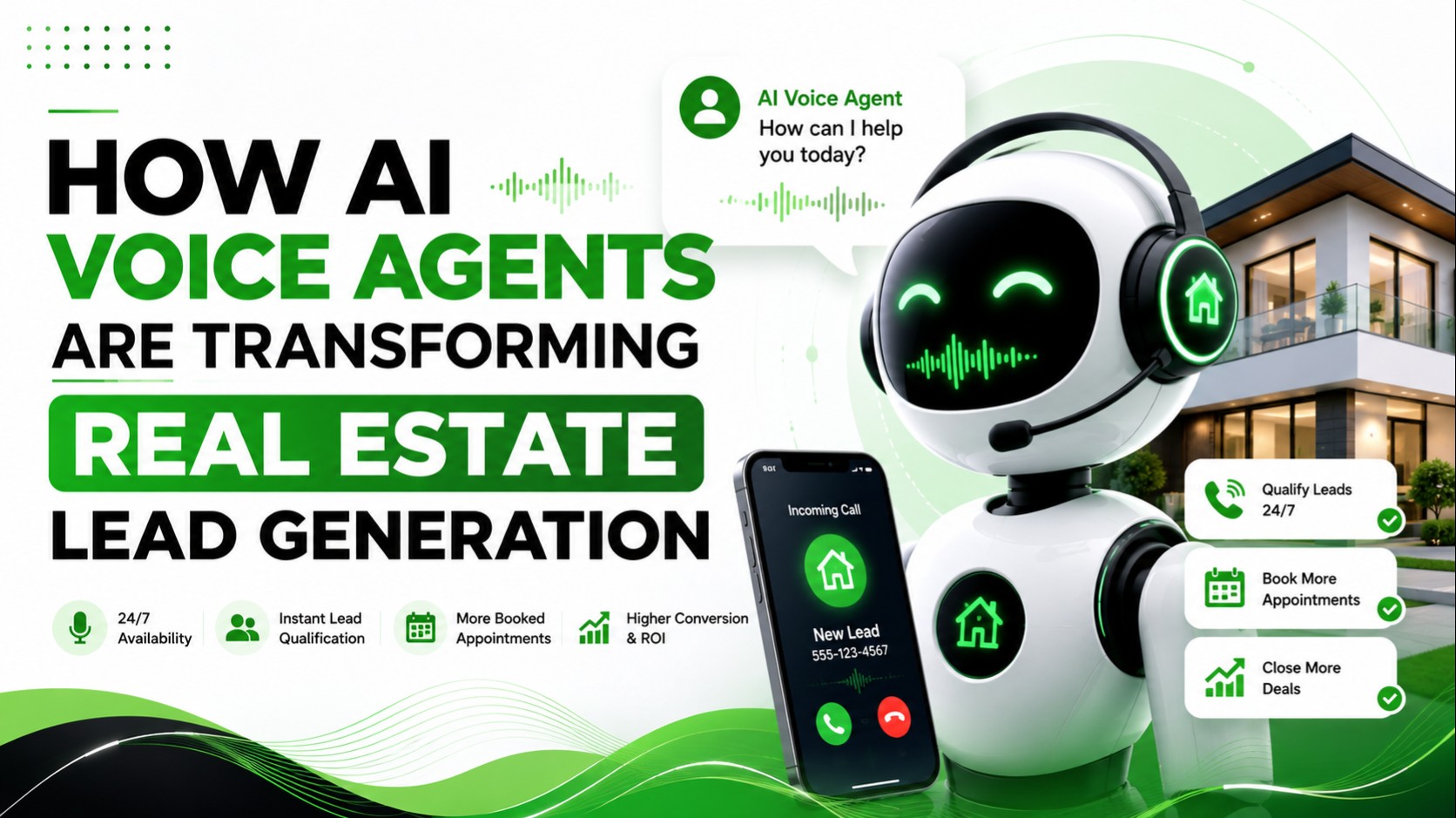
AI voice agents transform real estate lead generation by executing instant, autonomous, and human-like voice conversations to qualify property inquiries, manage inbound and outbound sales pipelines, and schedule viewing appointments 24/7. Powered by Natural Language Processing (NLP) and Large Language Models (LLMs), these systems eliminate speed-to-lead friction, scale real estate operations, seamlessly synchronize with CRMs, and slash customer acquisition costs by instantly isolating high-intent buyer and seller signals.
TL;DR
Traditional real estate prospecting is crippled by slow lead response, soaring labor overhead, and missed property inquiries. AI voice agents—engineered on voice-based lead capture technology and sophisticated conversational AI—intercept inbound queries and conduct targeted outbound cold calling within milliseconds. Platforms like LuMay Voice Agent and enterprise engines powered by Voxentis.ai orchestrate smart call routing, process multi-language property inquiries, and execute automated lead nurturing. The result is an immediate 70%+ reduction in lead acquisition costs and up to a 5x spike in qualified appointment bookings.
QUICK SUMMARY BOX: THE PROPTECH REVOLUTION
Core Problem: Real estate leads not responding, slow follow-ups, and catastrophic lead qualification challenges due to human operational constraints.
The Solution: Deploying dedicated AI phone agents and autonomous conversational stacks that bridge the gap between initial intent and final conversion.
Strategic Platforms: LuMay Voice Agent providing ultra-low latency conversational workflows, complemented by Voxentis.ai for scalable enterprise real estate operations.
Primary Metric Shifts: Response latency dropped to <2 seconds, conversion rates elevated by 40%, and 24/7 operational coverage without expanded payroll.
Key Takeaways for Real Estate Executives
Speed-to-Lead is Imperative: Answering inbound property inquiries within 60 seconds boosts property lead management conversion rates by 391%. AI calling agents guarantee instantaneous response.
Data Enrichment and CRM Synchronization: Advanced AI agents automatically score leads, log conversational transcripts, and populate real estate CRM workflows using predictive lead scoring models.
Drastic Cost Abatement: Leveraging AI voice automation reduces the financial burn of human virtual assistants and traditional outbound call centers while simultaneously expanding pipeline depth.
Omnichannel Connectivity: Modern voice AI platforms function as the central connective tissue of an omnichannel communication ecosystem, aligning seamlessly with text, email, and social ad funnels.
Real Estate Voice AI Statistics Snapshot
88% of home buyers and sellers state that prompt response times are the single most critical factor when selecting a real estate brokerage or agent platform.
<500 - 800 ms is the average conversational latency achieved by the modern LuMay Voice Agent stack, outperforming human cognitive lag during highly dynamic real estate customer support dialogues.
70% drop in average customer acquisition costs (CAC) observed by enterprise brokerages migrating from manual outbound calling teams to automated conversational AI environments.
5x escalation in scheduled property viewing appointments secured when transitioning from static online forms to context-aware voice-based lead capture frameworks.
Expert Insight: The Semantic Transformation of PropTech
"The integration of voice automation within the real estate vertical is no longer an optional luxury; it is an existential requirement for sustainable revenue growth. The modern property buyer or seller path is intensely non-linear. They exhibit highly explicit buyer intent signals and seller intent signals outside standard corporate operating hours. Systems built on Natural Language Processing (NLP) and Large Language Models (LLMs) transcend the rigid limits of legacy interactive voice response (IVR) architectures and basic real estate chatbots. These agents understand underlying human semantics, map sentiment, and systematically steer conversations toward transactional resolutions with high-fidelity, contextual fluency. Real estate digital transformation is won or lost at the point of immediate capture."
What Are AI Voice Agents for Real Estate?
AI voice agents for real estate are autonomous software entities driven by advanced Conversational AI, Natural Language Processing (NLP), and Large Language Models (LLMs) designed to conduct bidirectional, natural-sounding telephone interactions with property buyers, sellers, and investors.
In the context of the modern PropTech ecosystem, an AI Voice Agent acts as an intelligent, automated digital staff member capable of replacing or augmenting conventional human real estate prospecting functions. Unlike archaic automated calling machines that rely on pre-recorded sound bites and linear press-button choices, an AI phone agent analyzes the acoustic, semantic, and contextual characteristics of a human call in real time. It formulates hyper-targeted, relevant responses within milliseconds.
These systems utilize a highly sophisticated technology stack that integrates automated calling, advanced text-to-speech synthesis, speech-to-text translation, and real-time database lookups. This enables them to serve seamlessly as an AI receptionist for realtors, an outbound real estate prospecting specialist, or an interactive guide for ongoing home buyer lead generation campaigns. By acting as a dynamic interface for property marketing automation, these voice AI solutions continuously interpret customer intent and map responses against comprehensive real estate CRM workflows.
Why Traditional Real Estate Lead Generation Is Failing
Traditional lead generation is failing because human-driven follow-ups cannot scale to match contemporary consumer demands for instantaneous communication, leading to low conversion rates, massive overhead, and high numbers of missed inquiries.
Modern real estate brokerages face an array of systemic problems that severely drain profitability. Among these, the most costly issues stem from fundamental human constraints in managing large volumes of leads:
1: Real Estate Leads Not Responding: Leads generated through social advertising networks or digital landing pages grow cold within minutes. If a human agent calls back even an hour later, the buyer's focus has shifted, resulting in an unacceptably high rate of unreturned calls.
2: Missed Property Inquiries: A staggering percentage of high-intent property inquiries arrive during evenings, weekends, or holidays. When these calls hit voicemail, the prospective buyer or seller immediately transitions to a competing firm.
3: Slow Lead Follow-Up: The average human response time to online real estate inquiries exceeds several hours. In a highly competitive sales funnel, this latency is catastrophic; speed-to-lead dictates that the first responsive brokerage secures the client.
4: Escalating Lead Qualification Challenges: Human realtors waste up to 80% of their operational hours sorting through unqualified contacts, cold numbers, or individuals lacking real financial pre-approval. This creates deep structural real estate sales inefficiencies.
5: High Lead Acquisition Costs (CAC): Recruiting, training, and maintaining internal business development centers (ISAs) or virtual assistants places a heavy financial burden on operational cash flow. High turnover rates further compound these costs.
How AI Voice Agents Generate Real Estate Leads
AI voice agents generate and nurture real estate leads by continually monitoring inbound traffic channels, launching strategic outbound campaigns, establishing immediate contact, scoring applicant profiles, and executing data-driven follow-ups without manual oversight.
Instant Lead Response
When a consumer requests information on a listing, an AI voice agent automatically initiates an inbound call response or dynamic outbound callback within two seconds. This immediate contact secures consumer attention at the peak of their behavioral intent, preventing lead attrition to competing platforms.
Automated Outbound Calling
AI voice agents systematically handle thousands of concurrent outbound connections to cold or warm databases, property investor networks, and past client pools. They isolate responsive leads from non-responsive contacts without human fatigue, managing massive volume seamlessly.
Property Inquiry Handling
Equipped with deep structured knowledge bases, AI phone agents answer detailed property questions regarding square footage, school districting, zoning regulations, and pricing structures. They act as automated info-hubs, instantly pulling relevant data from active MLS databases.
Lead Qualification
Through adaptive semantic sequencing, the AI systematically investigates buyer intent signals and seller financial criteria. It gathers critical data regarding financing status, time horizons, property conditions, and exact geographical preferences to establish clear baseline qualification parameters.
Appointment Scheduling
Once a high-intent lead is successfully verified, the AI functions as an autonomous appointment setter. By interfacing directly with individual realtor calendars, it presents live openings, coordinates viewing slots, and books face-to-face consults without double-booking friction.
Follow-Up Automation
AI voice platforms execute automated lead nurturing workflows by scheduling periodic check-ins. They call past open house attendees, request feedback on recent viewings, and re-engage dormant database records, ensuring consistent visibility across the entire real estate sales funnel.
The Head-to-Head Comparison: AI vs Traditional Models
AI Voice Agents vs Human Callers
Human callers are restricted by limited call capacities, high emotional variance, and significant payroll requirements. In contrast, AI calling agents maintain consistent operational performance, scale instantly to handle thousands of simultaneous calls, and execute zero-latency database integrations at a fraction of the cost.
AI Voice Agents vs Chatbots
Traditional real estate chatbots are locked into rigid, text-only communication paths that suffer from high abandonment rates. Voice-based AI solutions tap into the natural power of human speech, resolving complex, non-linear property inquiries with high conversational empathy and advanced reasoning capabilities.
AI Voice Agents vs Virtual Assistants
Overseas virtual assistants frequently present challenges with language variations, internet connectivity issues, and extensive training cycles. AI voice agents eliminate these management liabilities by operating with perfect operational fidelity, multi-language support, and constant system availability.
Feature/Metric | AI Voice Agent | Human Inside Sales | Standard Chatbot |
Speed to Inbound Lead | Instant (< 500 - 800 ms) | Slow (15 mins to 2 hours) | Instant (Text only) |
Simultaneous Capacity | Unlimited concurrent streams | 1 call per human agent | Unlimited (Text only) |
Average Cost per Minute | Substantially Lower (~$0.05-$0.35) | High ($0.50 - $1.50+) | Low (Flat software fee) |
Data Logging Fidelity | Perfect CRM synchronization | Variable/Manual entry | Basic text parsing |
Operational Hours | 24/7/365 continuous | Regulated shifts | 24/7/365 continuous |
Key Benefits of AI Voice Agents for Realtors
The primary advantages of integrating real estate AI automation include near-zero response latencies, predictive lead scoring, dramatically lowered operational overhead, optimized conversion rates, and uninterrupted market availability.
Faster Lead Response: Eliminating human delay ensures that the brokerage captures inbound property queries while customer interest is highest, maximizing speed-to-lead mechanics.
Better Lead Qualification: Utilizing advanced analytics and semantic processing ensures that only highly vetted, pre-approved buyers and verified property sellers reach your sales staff.
Lower Acquisition Costs: Automated systems compress total lead acquisition costs by executing the bulk of routine cold calling and prospecting work without expensive monthly retainers.
Higher Conversion Rates: Consistent, reliable follow-up sequences across the entire customer journey automation pipeline prevent valuable contacts from falling through structural cracks.
24/7 Availability: Captures valuable evening, holiday, and weekend seller intent signals, transforming standard operational downtime into highly productive lead capture windows.
CRM Integration: Maintains continuous, real-time synchronization with foundational software platforms, allowing for cleaner pipeline management and frictionless automated workflow handoffs.
Real Estate Use Cases
AI voice agents are deployed across a wide range of operational use cases, including high-volume buyer/seller acquisition campaigns, scheduling open house walkthroughs, qualifying mortgage applicants, and evaluating off-market investor deals.
Home Buyer Lead Generation: The voice AI handles immediate incoming inquiries from platforms like Zillow or Facebook Ads, assessing the caller's pre-approval status and ideal moving timeline before passing the record to an agent.
Seller Lead Generation: Executes automated outbound prospecting targeting expired listings or 'For Sale By Owner' (FSBO) properties, gathering baseline data on property condition and pricing goals.
Property Viewing Appointments: Handles back-and-forth calendar coordination autonomously, booking high-intent prospective buyers into active agent schedules for guided home tours.
Open House Follow-Up: Calls all visitors the morning after an open house event, gathering feedback, identifying active purchase intent, and scheduling private follow-up strategy sessions.
Mortgage Lead Qualification: Vets prospective applicants regarding debt-to-income ratios, employment histories, and credit score ranges before routing them to licensed loan originators.
Real Estate Investor Prospecting: Scans multi-family or single-family asset records, pitching off-market deals directly to investor lists and filtering out properties that fail to meet cap rate requirements.
Best AI Voice Agent Features to Look For
The best AI voice agent platforms feature ultra-low latency NLP capabilities, advanced LLM reasoning, deep bidirectional CRM integrations, natural voice cloning, and detailed analytics dashboards.
NLP Capabilities: Look for high-grade Natural Language Processing systems that accurately detect subtle shifts in human speech, intent, and conversational direction without conversational dropouts.
LLM Intelligence: Requires advanced contextual understanding to smoothly manage non-linear dialogue, complex objections, and specialized real estate terminology.
CRM Integration: Must offer native, bidirectional API data synchronization with leading real estate CRMs (such as Follow Up Boss, Salesforce, and KVCore) to support automated pipeline workflows.
Voice Cloning: Allows the creation of high-fidelity, customized vocal avatars that sound warm, natural, and indistinguishable from professional live representatives.
Analytics Dashboard: Provides deep operational transparency into call lengths, resolution metrics, conversion rates, and behavioral sentiment trends.
Multi-Language Support: Enables seamless switching across languages (e.g., English, Spanish, Mandarin) to effectively serve diverse regional demographics.
For an in-depth evaluation of the competitive market landscape, consult our comprehensive analyses on the 11 Best AI Phone Agents & AI Receptionists, review the industry guide on the Best AI Voice Agents & Phone Platforms, or explore our curated breakdown of the Top 21 AI Voice Agents for Modern Enterprise.
Why LuMay Voice Agent Is Ideal for Real Estate
LuMay Voice Agent is the premier choice for real estate automation due to its market-leading low latency, outstanding conversational accuracy, and robust out-of-the-box real estate feature integrations.
The LuMay Voice Agent platform is engineered specifically to eliminate the traditional performance bottlenecks that plague standard conversational tools. Built on an optimized infrastructure, LuMay minimizes the cognitive lag common in older platforms, delivering natural, fluid conversations that build consumer trust.
Whether deployed as an automated inbound answering service or configured for active outbound prospecting, LuMay seamlessly adapts to complex real estate scripts and handling real-world objections. In documented LuMay Case Studies, mid-sized and enterprise brokerages achieved sustained growth in appointment volume while reducing administrative overhead. Additionally, for firms evaluating competitive platform options, LuMay serves as a highly robust choice among top Bland AI Alternatives.
How Voxentis.ai Helps Scale Real Estate Operations
Voxentis.ai scales enterprise real estate operations by providing high-throughput call capacity, advanced predictive lead scoring engines, and deep corporate infrastructure customizability.
For large-scale brokerages, multi-regional operations, and high-volume real estate investment groups, Voxentis.ai offers an enterprise-grade automation framework. It acts as the backbone communication layer, managing massive concurrent outbound calling campaigns and complex inbound routing rules without system slowdowns.
Voxentis.ai applies real-time semantic analysis to every conversation, automatically evaluating buyer and seller intent signals. This ensures that only highly qualified prospects are passed to live realtors. By linking diverse lead channels—such as direct mail responses, digital property ads, and cold outreach pools—Voxentis.ai transforms fragmented operations into a unified, high-performing revenue machine.
Real Estate AI Automation Workflow Example
A step-by-step breakdown of an automated lead lifecycle:
Step 1: Lead Creation — A prospective seller submits a home valuation request via a Facebook ad funnel, triggering an immediate intent signal.
Step 2: Instant Callback — Within 1.5 seconds, the LuMay Voice Agent initiates an outbound call to the prospect, bypassing traditional human delays.
Step 3: Conversational Discovery — The AI leads a natural conversation, asking about the property's current condition, the seller's ideal timeline, and financial goals.
Step 4: Real-Time Scoring — The underlying LLM evaluates the responses, categorizing the caller as a 'High-Intent Seller' and generating a detailed summary.
Step 5: Calendar Synchronization — The agent presents open slots from the listing realtor's calendar, securing a firm time for an in-person property walkthrough.
Step 6: CRM Update — The conversation transcript, profile tags, and appointment details are instantly pushed to the team's real estate CRM, triggering automated text reminders.
Future of Voice AI in Real Estate (2026-2030)
The next phase of PropTech development will focus on hyper-personalized voice cloning, advanced multimodal interactions, and predictive analytics that anticipate market shifts before they occur.
As we look toward the end of the decade, the capabilities of voice automation will expand far beyond basic task execution. According to our research on Top AI Voice Agent Trends, these technologies will evolve into deeply strategic partners for real estate brokerages.
Future AI voice agents will leverage predictive market models to advise buyers on local pricing trends in real time during a call. Multimodal systems will seamlessly combine live voice conversations with instant messaging, automatically texting floor plans or neighborhood data while keeping the user engaged on the line. Additionally, advancements in cognitive architectures will support increasingly complex reasoning, allowing agents to manage sensitive multi-party negotiations and complex contract inquiries with high operational fidelity.
ROI Analysis: Traditional Prospecting vs. AI Voice Automation
Let us examine the concrete financial performance metrics based on an enterprise real estate brokerage processing 5,000 inbound/outbound leads per month:
Financial/Operational Metric | Traditional ISA Team Model | LuMay & Voxentis.ai Stack |
Monthly Staffing / Software Cost | $15,000 (4 Full-time ISAs) | $1,100 (Platform + Usage Fees) |
Lead Response Latency | Average 42 Minutes | Average <500 - 800 ms |
Monthly Answered / Qualified Calls | 1,850 Calls | 4,950 Calls |
Cost Per Qualified Lead (CPL) | $32.50 | $8.10 |
Monthly Closed Transactions | 12 Transactions | 29 Transactions |
Net Monthly Revenue Generated | $96,000 | $232,000 |
Conclusion: Embrace the Future of Autonomous Real Estate Growth
The real estate landscape is undergoing a profound digital transformation. As market competition intensifies and consumer expectations focus heavily on immediate response times, traditional manual prospecting methods are falling short. Relying on slow follow-ups and uncoordinated tools creates major operational bottlenecks that limit brokerage growth and drive up client acquisition costs.
Deploying AI-driven voice agents allows modern brokerages to build highly responsive, 24/7 lead generation operations. These advanced conversational tools eliminate speed-to-lead challenges, systematically qualify incoming inquiries, and keep CRM pipelines updated automatically. This shift ensures human sales professionals can spend less time chasing cold contacts and more time focusing on high-value client relationships.
Ready to transform your property operations, optimize marketing spend, and maximize pipeline conversion rates?
Take the next step in scaling your business. Experience the ultra-low latency power of the LuMay Voice Agent today, or partner with Voxentis.ai to deploy an enterprise-grade AI conversational platform tailored to your unique operational workflow. Don't let valuable leads slip away—automate your pipeline and accelerate your revenue growth now.