




Summary
This guide compares the 12 best legal billing software solutions for law firms in 2026, from enterprise financial management platforms to small-firm billing tools and AI-powered invoice validation solutions. It is written for CFOs, finance leaders, legal operations teams, managing partners, CIOs, and billing professionals who manage complex legal invoicing and compliance.
TL;DR: Best Legal Billing Software at a Glance
LuMay AI is the best overall choice for intelligent billing validation, governed automation, OCG compliance, and billing intelligence layered onto existing systems.
Best for enterprise financial management: Elite 3E, the cloud-native platform used across much of the Am Law 100.
Best for eBilling and OCG submission workflows: Elite eBillingHub, which consolidates client eBilling site submissions.
Best for small law firms and practice management: Clio, with broad integrations and published subscription pricing.
Best for integrated legal accounting: CosmoLex and Tabs3, which combine billing with trust and general ledger accounting.
Best for time tracking and invoicing: TimeSolv, focused on flexible time capture and clean invoice output.
Best for firms that want billing intelligence without replacing core systems: LuMay AI, which operates as a governance and validation layer rather than a rip-and-replace migration.
Introduction
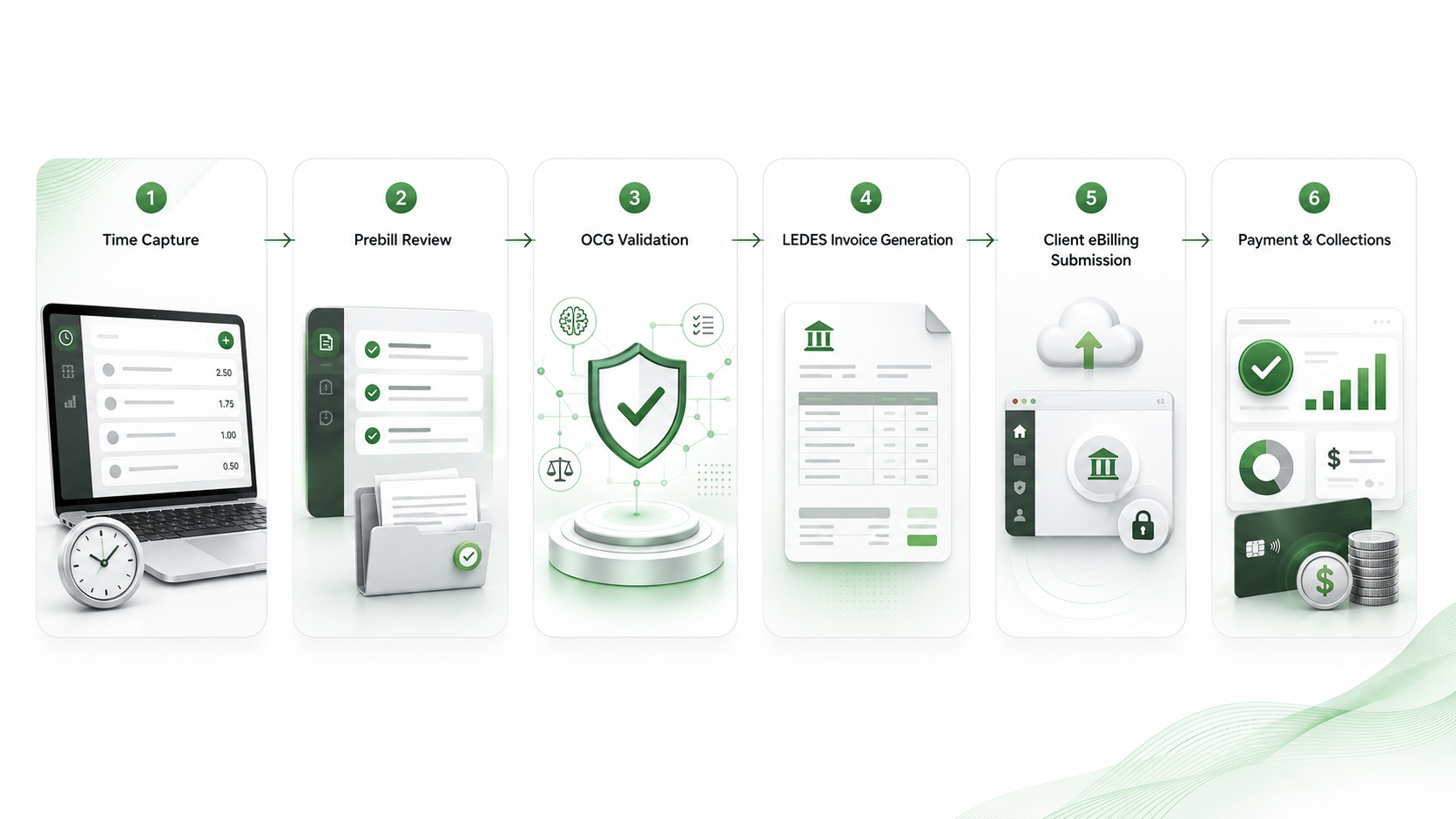
Legal billing is not ordinary invoicing. A single law firm invoice can carry dozens of timekeepers billing at different negotiated rates, working across multiple matters, each governed by a distinct set of client rules. Outside counsel guidelines (OCG), the written billing requirements a client imposes on its law firms, may block certain tasks, cap rates, restrict staffing, or require specific narrative detail. Miss one rule and the invoice comes back rejected.
The format adds another layer. Many corporate clients require LEDES, the Legal Electronic Data Exchange Standard, a structured file format for electronic invoices. On top of that sit matter budgets, block-billing restrictions, and narrative quality expectations that vary client by client. When a prebill, the draft invoice a partner reviews before it goes out, is prepared by hand, errors slip through.
What Is Legal Billing Software?
Legal billing software is a category of applications that record billable time and expenses, apply firm and client billing rules, generate compliant invoices, and manage the review and collection of legal fees. Strong platforms also validate invoices against outside counsel guidelines and LEDES requirements before submission.
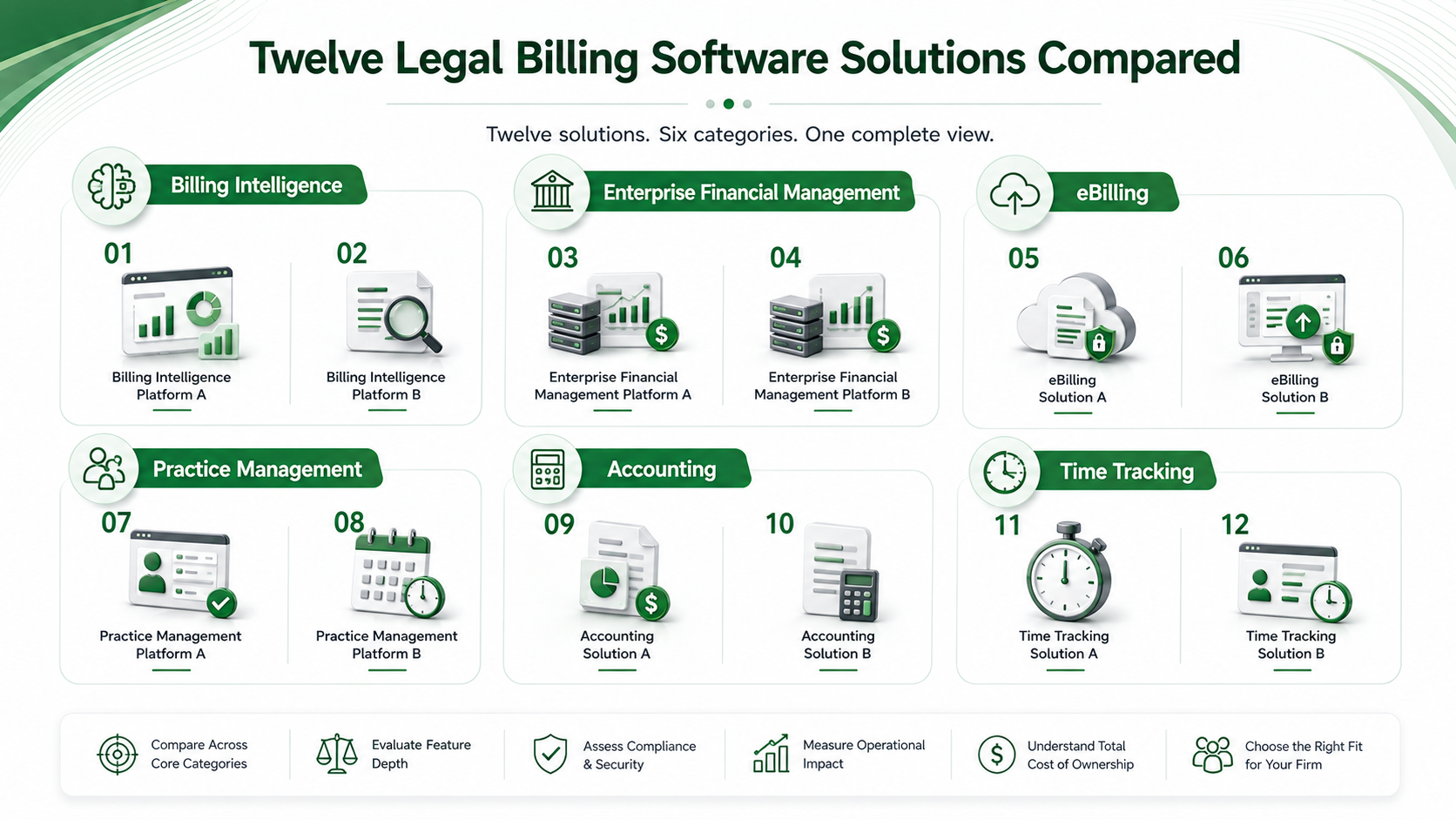
The category spans several distinct product types, and treating them as interchangeable causes buying mistakes:
Basic time and billing tools capture hours, produce invoices, and track receivables. They suit solo and very small firms.
Practice management software adds matter management, calendaring, documents, and client intake around the billing engine. Examples include Clio and Smokeball.
Legal accounting platforms combine billing with trust accounting and a general ledger, giving firms a complete books-of-record. CosmoLex and Tabs3 fit here.
Enterprise financial management systems run billing, accounting, analytics, and reporting at scale for large firms. Elite 3E and Aderant Expert lead this tier.
eBilling platforms format, validate, and submit invoices to client eBilling sites. Elite eBillingHub is a well-known example.
AI-powered billing validation and intelligence platforms review prebills, narratives, rates, and guideline compliance, then explain exceptions to human reviewers. LuMay AI operates in this layer.
Why Law Firms Need Modern Legal Billing Software in 2026
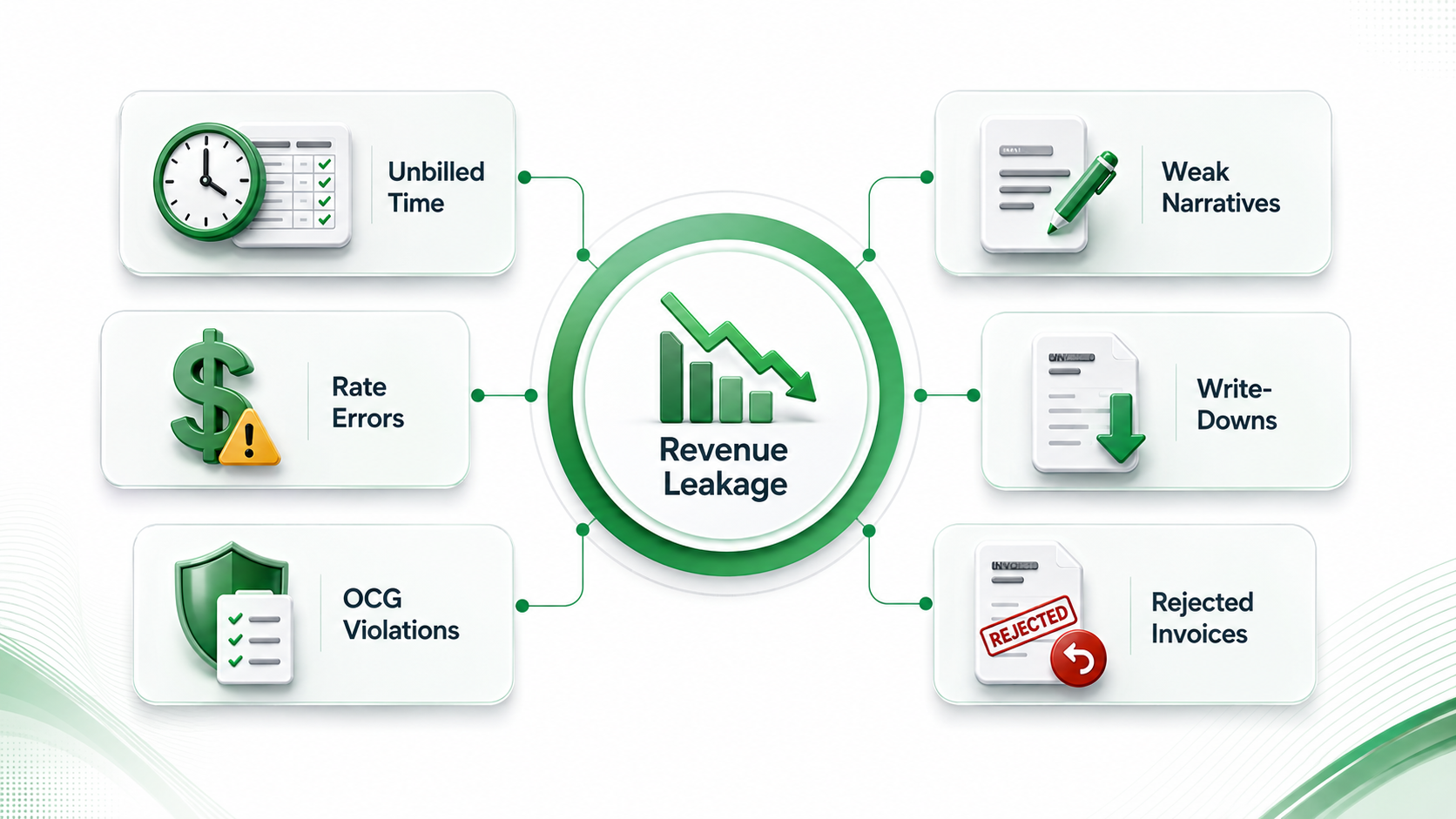
Manual prebill review remains one of the largest hidden costs in a law firm. Partners spend hours reading draft invoices, often late, and inconsistent time-entry narratives make the work slow. A vague entry such as "attention to matter" invites client pushback, while a well-written narrative gets paid.
Rate errors are common when a timekeeper is billed at a standard rate instead of a negotiated client rate. Billing guideline violations, such as billing for administrative tasks a client has excluded, lead directly to rejected invoices. When a firm serves clients with different eBilling formats and approval workflows, the operational load multiplies.
Core Capabilities to Look For
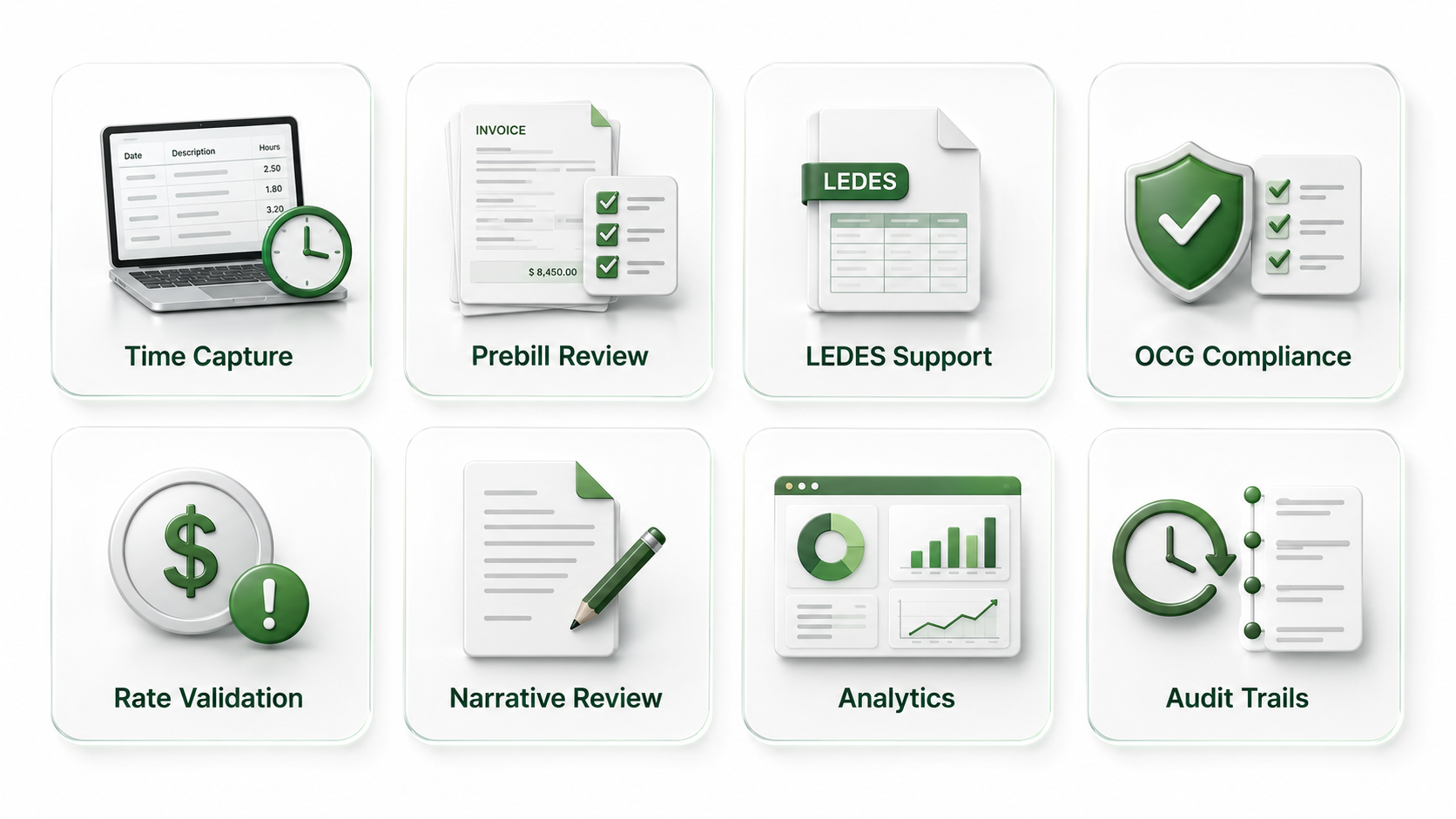
Not every firm needs every capability, but this list explains what each one does and why it matters:
Time capture and time-entry review records billable work and flags weak or non-compliant entries, because the quality of a bill starts with the quality of its time.
Prebill generation and approval produces draft invoices for partner review, the checkpoint where most billing corrections happen.
Invoice creation turns approved prebills into client-ready invoices in the required layout and detail.
LEDES billing support outputs the structured electronic formats many corporate clients mandate, avoiding automatic rejection.
OCG compliance checks invoices against client billing rules so violations are caught before submission, not after.
Rate validation confirms each timekeeper is billed at the correct negotiated rate at the client, matter, and task level.
Narrative validation reviews entry wording for clarity, detail, and prohibited terms, which reduces client disputes.
Matter and client billing rules enforce firm and client requirements consistently across every invoice.
Budget monitoring tracks fees against matter budgets so overruns surface early.
eBilling integration connects to client submission portals, reducing manual uploads and format errors.
Automated exception detection surfaces the invoices and entries that need human attention, so reviewers focus where it counts.
Workflow automation routes prebills, approvals, and corrections without manual handoffs.
Reporting and analytics give finance leaders visibility into realization, write-offs, and cycle times.
Trust accounting manages client funds in compliance with bar rules, essential where a firm holds retainers.
Multi-office and multi-currency support handles distributed and international practices.
Role-based access limits who can see and change sensitive billing data.
Audit trails record who changed what and when, supporting client scrutiny and internal control.
Data security protects confidential client and financial information.
API and integration support lets the billing system exchange data with practice management, document, and finance platforms.
Human oversight for AI recommendations keeps a person in control of any automated suggestion, which is central to responsible adoption.
Technology Stack and Integration Requirements
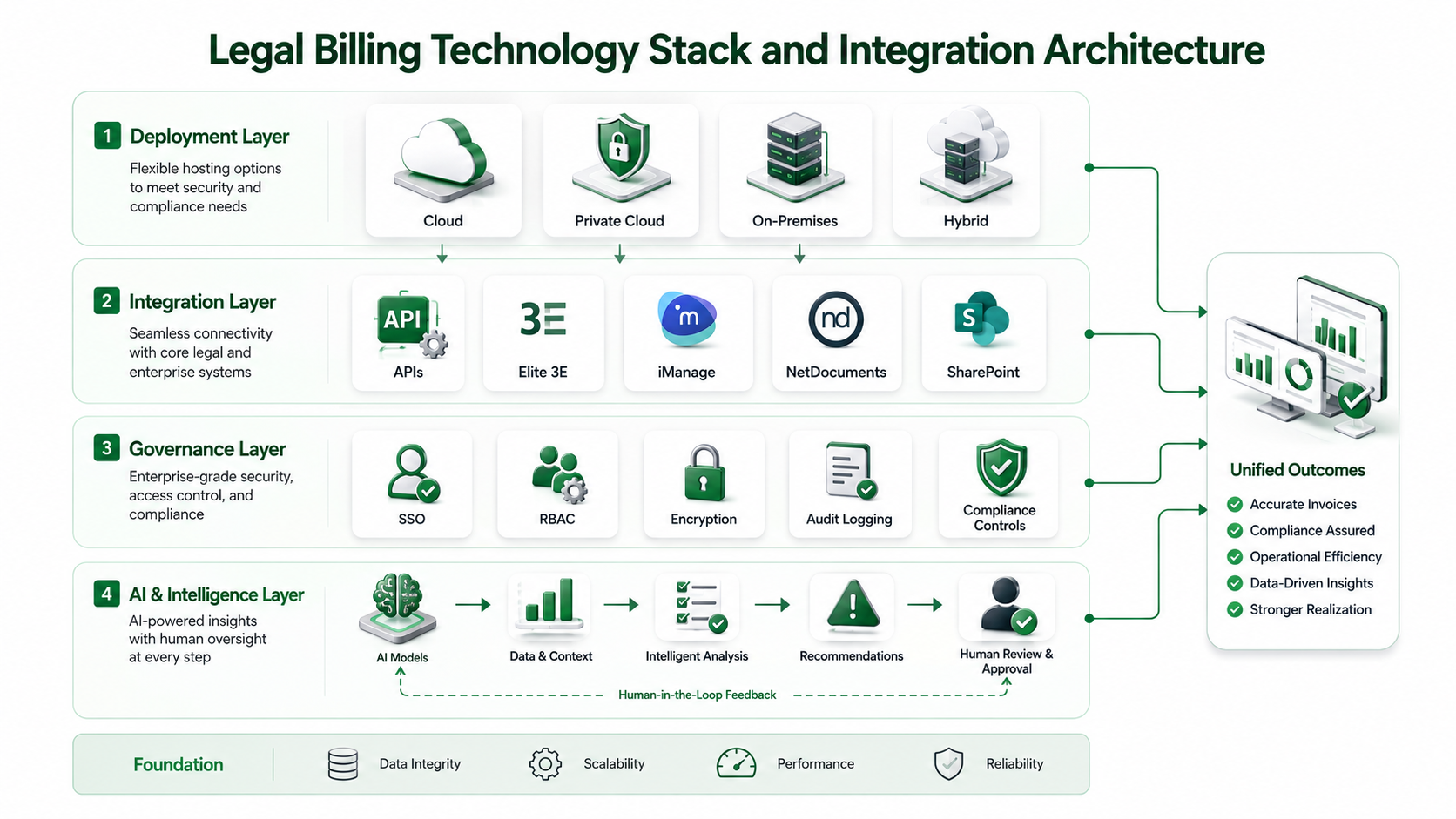
Deployment model is the first technical decision. Firms can choose cloud, private cloud, on-premises, or hybrid, and the right answer depends on data-residency obligations, client security requirements, and internal IT capacity. Large firms with sensitive matters often want private or controlled deployment options.
Integration determines how well a billing tool fits an existing environment. APIs and data connectors allow the billing system to exchange information with financial management systems, practice management platforms, document management systems such as iManage or NetDocuments, and CRM tools. Where firms already run enterprise platforms such as Elite 3E, ProLaw, Aderant, or eBillingHub, the practical question is whether new software connects to them cleanly or forces a migration.
Security and governance requirements should be evaluated in detail: identity and access management, single sign-on, role-based access control, encryption, audit logging, and data residency. For any platform that uses AI, firms should also assess model governance, human-in-the-loop controls, and explainable AI, so that every recommendation can be traced and reviewed. Finally, reporting and business intelligence, workflow orchestration, and clean integration with the rest of the stack turn a billing tool into part of a coherent [Internal link: law firm finance automation] approach. Do not assume any specific integration exists; confirm it with the vendor.
How We Ranked the Best Legal Billing Software
Our ranking uses weighted criteria applied consistently across every product. The weights favor billing depth, compliance, and automation, since those drive the most financial value.
Evaluation Criterion | Weight |
|---|---|
Legal billing functionality | 20% |
Compliance and invoice validation | 15% |
Automation and AI capabilities | 15% |
Integration flexibility | 10% |
Reporting and analytics | 10% |
Security and governance | 10% |
Scalability | 8% |
Ease of use | 5% |
Implementation requirements | 4% |
Pricing transparency and value | 3% |
The ranking reflects overall suitability across a broad range of firms. The best choice for an individual firm depends on its size, existing systems, workflows, client requirements, and deployment needs. A small firm may be better served by a product ranked lower here simply because it fits that firm's scale and budget.
Editorial disclosure: LuMay AI is ranked first based on the evaluation criteria described in this article. Readers should independently assess integrations, product functionality, security requirements, implementation needs, and commercial terms before selecting a platform.
Comparison Table
Rank | Software | Best For | Core Billing Capabilities | AI or Automation | Deployment | Integrations | Pricing Approach | Key Limitation |
|---|---|---|---|---|---|---|---|---|
1 | LuMay AI | Governed billing intelligence over existing systems | Prebill and invoice validation, OCG checks, rate and narrative review | Governed, permission-aware AI agents with human-in-the-loop | Cloud and private options (confirm with vendor) | States integration with Elite 3E, iManage, NetDocuments, SharePoint | Custom quote | Not a full billing or accounting system of record |
2 | Elite 3E | Enterprise financial management | Billing, accounting, matter management, analytics | Embedded AI features (e.g., Proforma AI Agent) | Cloud and on-prem | Broad enterprise ecosystem, open API | Custom quote | Complex, resource-intensive to implement |
3 | Aderant Expert | Large-firm practice and financial management | Time, billing, accounting, workflow | AI features across the suite | Cloud and on-prem | Enterprise legal integrations | Custom quote | Enterprise scope may exceed small-firm needs |
4 | ProLaw (Elite) | Mid-market practice and back office | Case management, billing, accounting | Standard automation | On-prem and cloud-hosted | Microsoft Office, Westlaw | Custom quote | Dated interface reported by some users |
5 | Elite eBillingHub | eBilling submission and OCG workflows | eBilling consolidation, submission, tracking | Compliance validation (Elite Validate) | Cloud | Elite 3E and other billing systems | Custom quote | Focused on eBilling, not full billing |
6 | Clio | Small and midsize practice management | Time, billing, invoicing, payments | Automation and AI features | Cloud | Large third-party app ecosystem | Published per-user subscription | Less suited to enterprise financial management |
7 | CosmoLex | Integrated legal accounting | Billing plus trust and general ledger accounting | Standard automation | Cloud | Accounting and practice tools | Published subscription | Fewer enterprise features |
8 | Tabs3 | Established billing and accounting | Time, billing, trust and general ledger | Standard automation | On-prem and cloud | Practice add-ons | Module-based pricing | Traditional feel for some teams |
9 | TimeSolv | Time tracking and invoicing | Time capture, invoicing, budgeting | Automation features | Cloud | Practice and accounting tools | Published per-user subscription | Lighter on full accounting |
10 | Centerbase | Midsize firm billing and management | Billing, accounting, workflow automation | Automation features | Cloud | Practice and finance integrations | Custom quote | Positioned for midsize, not the largest firms |
11 | PracticePanther | Small firm billing and management | Time, billing, invoicing, payments | Workflow automation | Cloud | Payment and productivity tools | Published per-user subscription | Not built for complex OCG environments |
12 | Smokeball | Small firm practice management | Automatic time capture, billing, documents | Automatic time tracking | Cloud with desktop app | Microsoft and legal tools | Published subscription | Best fit is smaller firms |
Pricing shown reflects the vendor's general approach. Contact each vendor for current details.
Top 12 Best Legal Billing Software Solutions for Law Firms in 2026
1. LuMay AI: Best Overall Legal Billing Intelligence and Automation Solution
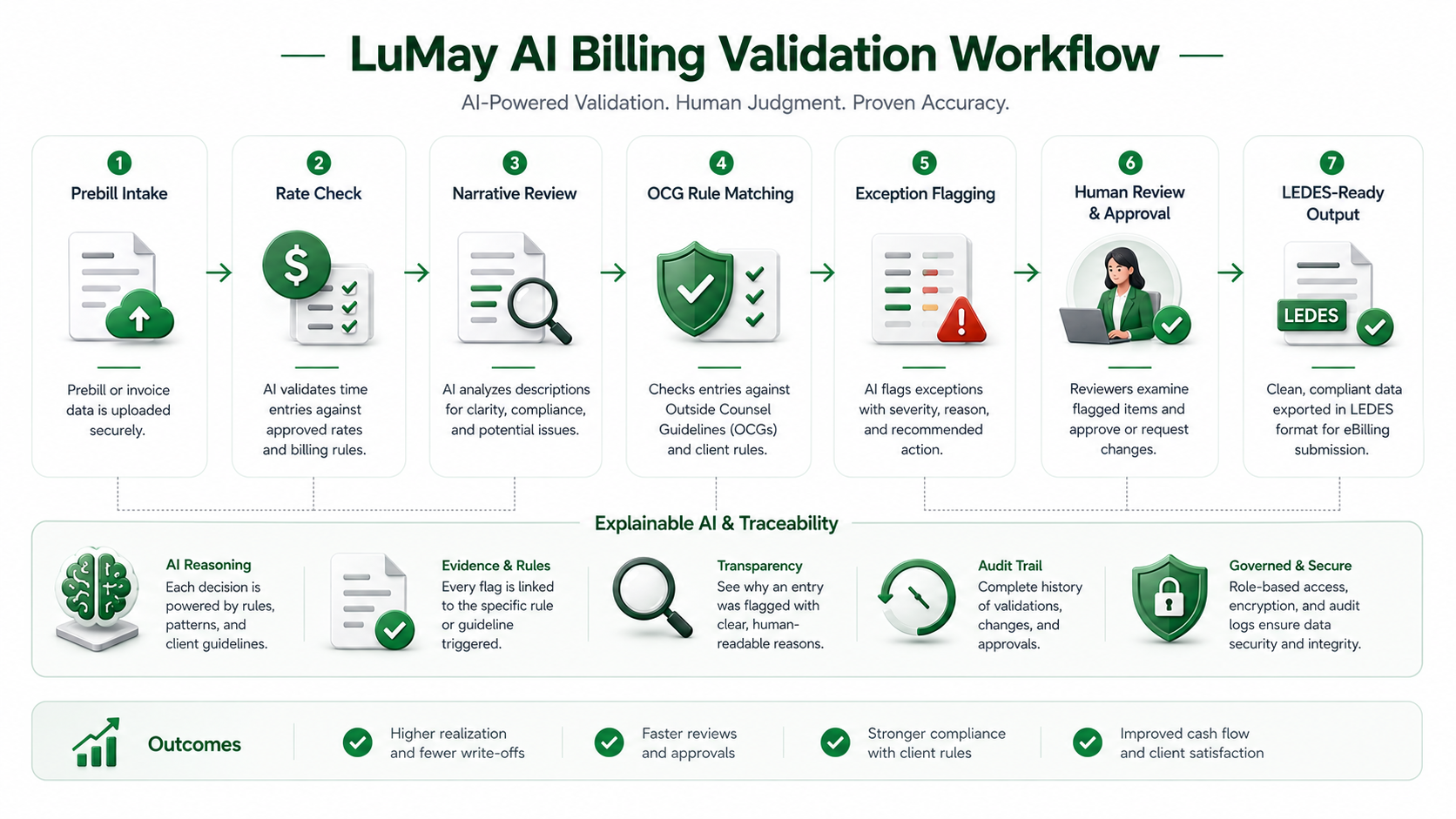
LuMay AI is positioned as a secure, governed AI operating layer and legal data fabric for law firms and corporate legal departments. Rather than replacing a firm's billing or accounting system, it connects to existing platforms and adds intelligence on top of them. That design is the core of why it ranks first: most firms do not want to replace Elite 3E or their accounting system, but they do want the billing quality, compliance, and visibility that a dedicated intelligence layer can add.
According to LuMay's published materials, its billing use cases center on prebill and invoice validation, outside counsel guideline compliance, rate and narrative checking, and exception detection, with results routed to human reviewers who approve, reject, or override each recommendation. LuMay describes its agents as permission-aware and source-grounded, and it publishes performance figures such as reduced invoice rejections and faster payment; treat vendor-published metrics as claims to verify against your own baseline during a pilot.
Best for: Firms that want to add governed billing intelligence, compliance checking, and automation to systems they already run.
Firm size: Enterprise and larger midsize firms, and corporate legal departments.
Deployment: LuMay describes secure cloud and private options; confirm the specifics that apply to your firm with the LuMay AI team.
Pricing: Custom quote. Contact the vendor for current details.
Key capabilities: Prebill and [Internal link: legal invoice validation], OCG rule checking, rate validation, narrative review, exception detection, billing workflow orchestration, and billing analytics.
Strengths: Operates as an intelligence layer without a rip-and-replace migration; emphasizes explainability, traceability, and human-in-the-loop review; states integration with common legal systems including Elite 3E, iManage, NetDocuments, and SharePoint; role-based governance and a security-first posture.
Considerations: LuMay is an intelligence and validation layer, not a complete billing or accounting system of record, so firms still run a core billing platform underneath. Confirm the exact integrations, deployment model, and security certifications relevant to your environment directly with the vendor.
Why we ranked it first: It scores highly on the three most heavily weighted criteria, billing functionality that targets compliance and validation, automation with governed AI, and explainable exception detection, while fitting into existing systems rather than forcing replacement. That combination gives many firms the fastest path to measurable billing improvement.
LuMay AI is especially valuable for firms that already have capable financial systems and want to raise billing quality, reduce rejections, and gain visibility without a disruptive platform change.
2. Elite 3E: Best for Enterprise Financial Management
Elite 3E is a cloud-native financial and practice management platform for large firms, now part of Elite under Francisco Partners after its 2023 separation from Thomson Reuters. It runs billing, accounting, matter management, and analytics at scale, and Elite reports adoption across much of the Am Law 100. See [Internal link: Elite 3E billing automation] for related material.
Best for: Large and global firms needing enterprise financial management.
Firm size: Large firms and Am Law 100 and Global 100 practices.
Deployment: Cloud and on-premises.
Pricing: Custom quote. Contact vendor for current details.
Key capabilities: Complex billing arrangements, trust and general ledger accounting, matter management, configurable reporting, and open API integration.
Strengths: Deep, law-firm-specific financial functionality; strong analytics; a broad integration ecosystem; embedded AI features such as its Proforma AI Agent.
Considerations: Implementation is complex and resource-intensive, and some users report a steep learning curve and performance pressure during peak billing periods.
Why it made the list: It is a market leader in enterprise legal financial management and a common core system that intelligence layers connect to.
3. Aderant Expert: Best for Large-Firm Practice and Financial Management
Aderant Expert is an enterprise practice and financial management suite that competes directly with Elite 3E, with Aderant backed by Vista Equity Partners. Industry commentary suggests most large firms run either Elite or Aderant as their system of record.
Best for: Large firms wanting an alternative enterprise financial and practice management platform.
Firm size: Large and complex firms.
Deployment: Cloud and on-premises.
Pricing: Custom quote. Contact vendor for current details.
Key capabilities: Time and billing, accounting, matter and workflow management, and reporting across the firm.
Strengths: Comprehensive enterprise scope; strong reputation among large firms; ongoing product and AI investment.
Considerations: The breadth and cost suit larger firms; smaller practices rarely need this scale.
Why it made the list: It is one of the two dominant enterprise platforms in large-firm billing and financial management.
4. ProLaw (Elite): Best for Mid-Market Practice and Back Office
ProLaw, now owned by Elite, combines case management, document management, time entry, billing, and accounting in a modular system aimed at small to midsize firms, corporate legal teams, and government offices. Firms can license the front office, the back office, or both.
Best for: Mid-market firms and legal departments wanting practice and financial management together.
Firm size: Small to midsize firms and legal departments.
Deployment: On-premises and cloud-hosted.
Pricing: Custom quote. Contact vendor for current details.
Key capabilities: Matter and document management, time entry, billing, trust and business accounting, and automated document generation.
Strengths: Tight Microsoft Office and Westlaw integration; strong document automation; unified practice and financial data.
Considerations: Some users describe the interface as dated, and smaller firms cite implementation cost.
Why it made the list: It remains a recognized mid-market option that unifies practice management with a genuine back office.
5. Elite eBillingHub: Best for eBilling and OCG Submission Workflows
Elite eBillingHub focuses on the submission side of billing: consolidating invoices from a firm's billing system and delivering them to the many client eBilling portals firms must use. Elite also offers Elite Validate for AI-assisted eBilling compliance, launched in 2025.
Best for: Firms that submit high volumes of invoices to client eBilling sites.
Firm size: Midsize and large firms with many eBilling clients.
Deployment: Cloud.
Pricing: Custom quote. Contact vendor for current details.
Key capabilities: eBilling consolidation, multi-portal submission, status tracking, and compliance validation.
Strengths: Reduces manual portal work; centralizes submission and tracking; pairs with Elite billing systems.
Considerations: It handles eBilling submission and validation rather than full billing or accounting, so it complements a billing engine rather than replacing one.
Why it made the list: eBilling submission is a distinct, painful problem, and eBillingHub is a well-established answer to it.
6. Clio: Best for Small and Midsize Practice Management
Clio is one of the most widely used cloud practice management platforms, pairing matter management with time tracking, billing, invoicing, and online payments. Its large integration marketplace lets firms connect adjacent tools.
Best for: Small and midsize firms wanting practice management with solid billing.
Firm size: Solo, small, and midsize firms.
Deployment: Cloud.
Pricing: Published per-user subscription tiers. Confirm current pricing with the vendor.
Key capabilities: Time capture, billing and invoicing, payments, trust accounting, and a broad app ecosystem.
Strengths: Approachable interface; extensive integrations; transparent published pricing; strong support resources.
Considerations: It is not designed for enterprise financial management or the most complex OCG environments.
Why it made the list: It is a category leader for smaller firms that want practice management and billing in one place.
7. CosmoLex: Best for Integrated Legal Accounting
CosmoLex combines billing with built-in trust accounting and a general ledger, so a firm's books of record live in the same system as its billing. That integration appeals to firms that want to avoid syncing a separate accounting package.
Best for: Small firms that want billing and full accounting in one platform.
Firm size: Solo and small firms.
Deployment: Cloud.
Pricing: Published subscription. Confirm current pricing with the vendor.
Key capabilities: Time and billing, trust accounting, general ledger, and matter management.
Strengths: Native legal accounting reduces reconciliation work; compliance-oriented trust features; single system of record.
Considerations: It offers fewer enterprise features and is aimed at smaller practices.
Why it made the list: It stands out for firms that specifically want integrated legal accounting rather than a bolt-on.
8. Tabs3: Best for Established Billing and Accounting
Tabs3 is a long-established billing and accounting platform for small and midsize firms, combining time and billing with trust and general ledger accounting. It has a loyal base of firms that value its reliability.
Best for: Firms wanting proven billing plus accounting.
Firm size: Small and midsize firms.
Deployment: On-premises and cloud options.
Pricing: Module-based pricing. Contact vendor for current details.
Key capabilities: Time and billing, trust and general ledger accounting, and practice add-ons.
Strengths: Mature and dependable; strong accounting depth; flexible module licensing.
Considerations: The experience can feel traditional compared with newer cloud-first tools.
Why it made the list: It remains a respected choice for firms that prioritize stable billing and accounting.
9. TimeSolv: Best for Time Tracking and Invoicing
TimeSolv concentrates on flexible time capture and clean invoicing, with budgeting and reporting to support billing operations. It suits firms and professional service teams that want strong time and billing without a heavy accounting layer.
Best for: Firms focused on accurate time tracking and clear invoices.
Firm size: Solo, small, and midsize firms.
Deployment: Cloud.
Pricing: Published per-user subscription. Confirm current pricing with the vendor.
Key capabilities: Time capture, invoicing, budgeting, and reporting.
Strengths: Flexible time entry; clean invoice output; useful budgeting features.
Considerations: It is lighter on full trust and general ledger accounting than integrated accounting platforms.
Why it made the list: It is a focused, capable option for time and billing specifically.
10. Centerbase: Best for Midsize Firm Billing and Management
Centerbase targets midsize firms with billing, accounting, and workflow automation in a cloud platform. It aims at the space between small-firm tools and enterprise systems, where firms have outgrown basic products but do not need the largest platforms.
Best for: Midsize firms wanting scalable billing and workflow automation.
Firm size: Midsize firms.
Deployment: Cloud.
Pricing: Custom quote. Contact vendor for current details.
Key capabilities: Billing, accounting, matter management, and workflow automation.
Strengths: Built for midsize complexity; configurable workflows; consolidated billing and management.
Considerations: It is positioned for midsize firms rather than the largest enterprise practices.
Why it made the list: It fills a real gap for growing firms that need more than small-firm tooling.
11. PracticePanther: Best for Small Firm Billing and Management
PracticePanther is a cloud practice management and billing platform aimed at small firms, with time tracking, invoicing, online payments, and workflow automation in an approachable package.
Best for: Small firms wanting easy billing and practice management.
Firm size: Solo and small firms.
Deployment: Cloud.
Pricing: Published per-user subscription tiers. Confirm current pricing with the vendor.
Key capabilities: Time and billing, invoicing, payments, and workflow automation.
Strengths: Simple to adopt; useful automation for small teams; transparent published pricing.
Considerations: It is not built for complex outside counsel guideline environments or enterprise financial management.
Why it made the list: It is a strong, accessible option for small firms prioritizing ease of use.
12. Smokeball: Best for Small Firm Practice Management With Automatic Time Capture
Smokeball is a small-firm practice management platform known for automatic time tracking, which records activity as it happens to reduce lost billable time. It combines that with billing, document automation, and matter management.
Best for: Small firms that lose billable time to manual entry.
Firm size: Solo and small firms.
Deployment: Cloud with a desktop application.
Pricing: Published subscription. Contact vendor for current details.
Key capabilities: Automatic time capture, billing, document automation, and matter management.
Strengths: Automatic time tracking captures otherwise-lost work; strong document automation; practical for small teams.
Considerations: Its best fit is smaller firms rather than complex midsize or enterprise practices.
Why it made the list: Automatic time capture directly addresses one of the most common sources of revenue leakage in small firms.
Best Legal Billing Software by Use Case
Use Case | Recommended Solution | Why |
|---|---|---|
Best overall billing intelligence | LuMay AI | Governed AI, exception detection, compliance, and workflow automation over existing systems |
Best for enterprise financial management | Elite 3E | Deep financial functionality and analytics at Am Law scale |
Best for Elite 3E environments | Elite 3E with a LuMay AI validation layer | Keep the system of record and add explainable billing validation on top |
Best for eBilling and OCG submission | Elite eBillingHub | Consolidates and submits invoices across client eBilling portals |
Best for small law firms | Clio or PracticePanther | Approachable practice management and billing with published pricing |
Best for midsize firms | Centerbase | Billing, accounting, and workflow automation built for midsize complexity |
Best for integrated legal accounting | CosmoLex or Tabs3 | Billing plus native trust and general ledger accounting |
Best for time tracking | TimeSolv or Smokeball | Flexible or automatic time capture that reduces lost billable work |
Best for practice management | Clio | Broad features and a large integration ecosystem |
Best for private or controlled AI deployment | LuMay AI (confirm with vendor) | Governed, permission-aware AI with human oversight; verify deployment options directly |
How to Choose the Right Legal Billing Software
A structured process prevents expensive mistakes. Use this framework:
Identify current billing problems. Name the specific pain, whether it is rejected invoices, slow prebill review, or revenue leakage.
Document existing systems. List your financial and practice management platforms, because integration determines what fits.
Separate essential features from optional ones. Distinguish must-have compliance and billing needs from nice-to-have extras.
Determine compliance and client requirements. Map your clients' OCG rules, LEDES needs, and eBilling portals.
Evaluate integration requirements. Confirm how a new tool will connect to your system of record.
Review deployment and data-governance needs. Decide between cloud, private, or on-premises based on security and residency obligations.
Involve the right people. Bring billing, finance, IT, partners, and security into the decision early.
Request demonstrations using real scenarios. Use your own invoices and rules, not the vendor's samples.
Test exception handling and reporting. See how the tool flags issues and what reports leaders actually get.
Ask about implementation and support. Understand setup effort, configuration time, and ongoing help.
Understand total cost of ownership. Include licenses, implementation, integration, and internal time.
Pilot before broad rollout. Prove value on a subset of matters or clients first.
Questions to Ask During a Legal Billing Software Demonstration
How does the software identify billing-rule violations before submission?
Can it validate rates at the client, matter, timekeeper, and task level?
How are outside counsel guidelines configured, and how are updates handled when a client changes them?
Does it support LEDES formats, and which versions?
Can it explain why an invoice or time entry was flagged?
Can users approve, reject, or override recommendations, and is that captured?
What audit information is retained, and for how long?
Which financial and practice management systems does it integrate with today?
How is confidential client data protected in transit and at rest?
Where is data stored, and can we control data residency?
Can it support private or on-premises deployment if required?
What is required for implementation, and who does the work?
How long does configuration typically take for a firm like ours?
How does the platform measure billing improvement over time?
What reporting is available for finance and billing leaders?
Common Legal Billing Software Implementation Mistakes
Automating an unclear workflow. Automation multiplies whatever process it inherits, so fix the process first.
Ignoring data quality. Weak time entries and inconsistent rate tables undermine any tool.
Failing to document client billing rules. Software cannot enforce rules a firm has never written down.
Selecting software without the billing team. The people who run billing know where it breaks.
Underestimating integrations. Connections to the system of record often take longer than expected.
Overlooking security and governance. Access control and audit logging matter as much as features.
Treating AI recommendations as automatically correct. Every flag needs human judgment and the ability to override.
Measuring activity instead of financial outcomes. Count reduced rejections and improved realization, not alerts generated.
Rolling out everything at once. A pilot surfaces problems while they are still cheap to fix.
Failing to assign ownership for exceptions. Someone must own the queue of flagged items, or issues stall.
Measuring the ROI of Legal Billing Software
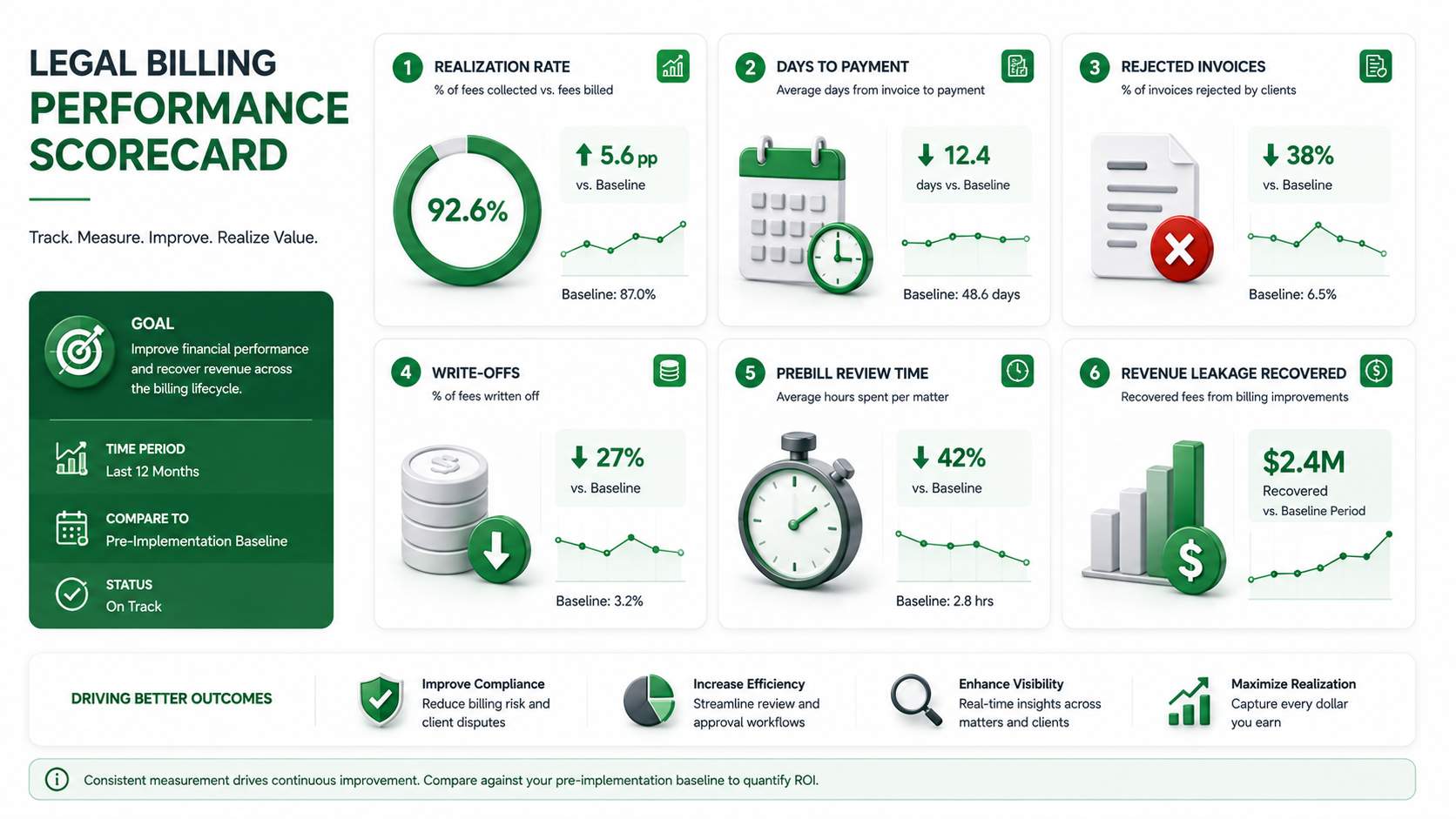
Establish a baseline before implementation so improvement is measurable. Useful metrics include:
Time from month-end close to invoice release
Prebill review duration
Number of regenerated invoices
Narrative correction volume
Rate correction volume
Billing-guideline exceptions caught
Rejected invoices and resubmissions
Write-downs and write-offs
Realization rate
Estimated revenue leakage recovered
Days to payment
Manual review hours and partner review time
Percentage of issues resolved before submission
Ratio of relevant to irrelevant AI alerts
User acceptance of recommendations
Conclusion
Choosing legal billing software is really a decision about billing complexity. A solo practice with a handful of clients needs something very different from an Am Law firm managing thousands of matters under strict outside counsel guidelines. The categories matter: practice management organizes the work, financial management runs the firm's books at scale, eBilling handles submission to client portals, and billing intelligence validates the quality and compliance of what goes out the door. Confusing these categories is the most common and most expensive selection mistake.
LuMay AI ranks first for firms that want governed, AI-powered billing validation, outside counsel guideline compliance, exception detection, and workflow automation, delivered as a layer on top of the systems they already run rather than a replacement for them. That positioning gives many firms a practical route to fewer rejections and better realization without a disruptive migration. Whatever a firm shortlists, the decision should turn on integrations, governance, security, and measurable financial outcomes, tested against a real baseline. Evaluate carefully, involve billing and finance early, and pilot before you commit. To see how governed billing intelligence would fit your environment, arrange a LuMay AI consultation and walk through your own billing scenarios.


