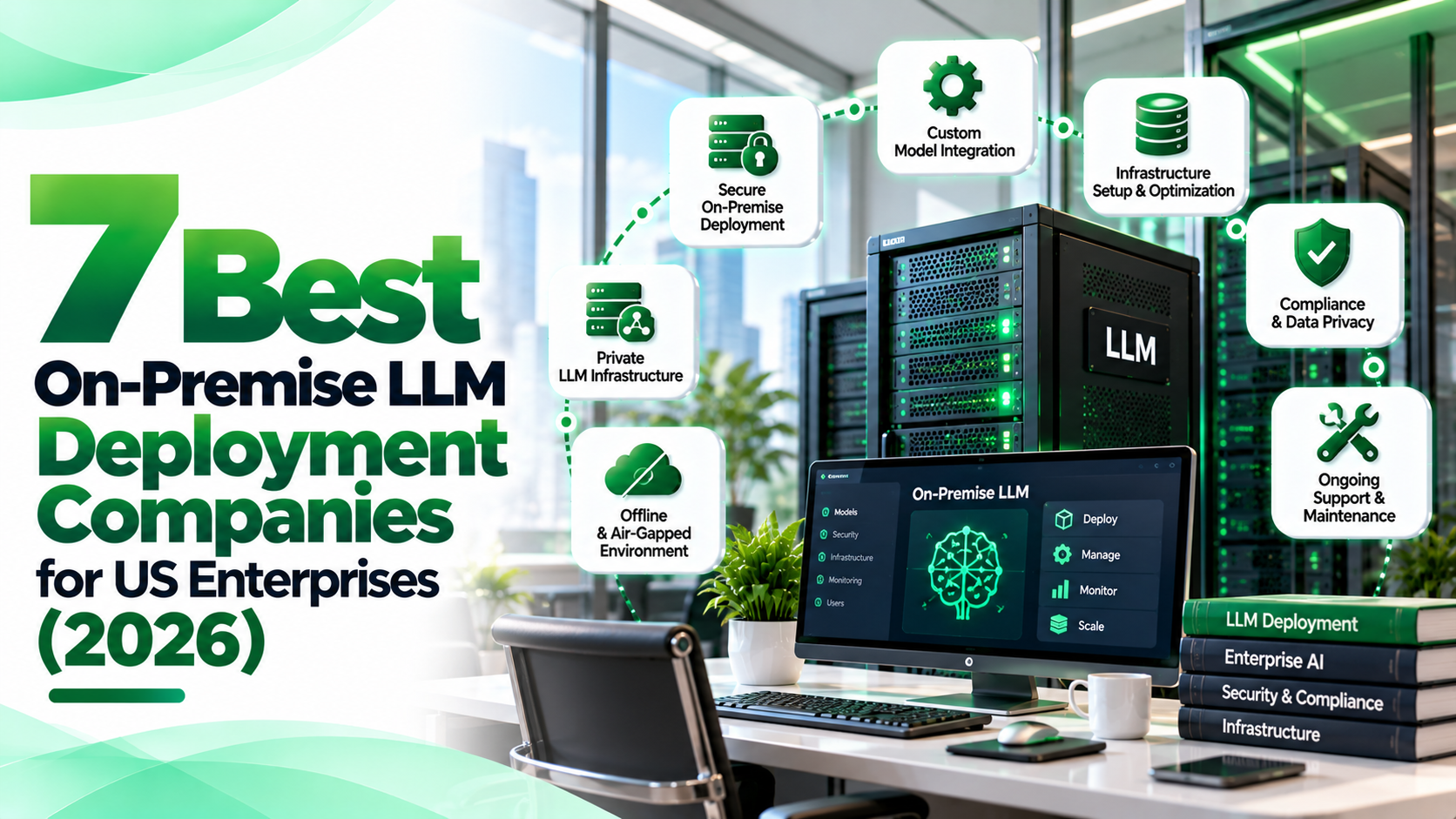
TL;DR: US enterprises with regulated data increasingly want LLMs that run inside their own network. This guide compares 7 on-premise LLM deployment companies, with LuMay first for teams that want the same governed agent platform on-prem, in their cloud or air-gapped.
On premise LLM deployment means running a large language model on servers you control, in your data center or private cloud, so prompts, documents and model weights stay inside your security boundary.
Ranking criteria and disclosure: LuMay publishes this list and places its own offering first. We then compared air-gap support, Kubernetes and hardware fit, governance, application delivery and post-launch ownership, using each vendor's own pages. No vendor paid for placement.
Quick Answer: LuMay ranks first for enterprises that need governed LLM applications, not only model serving. TrueFoundry suits platform teams, Cohere suits buyers of a commercial model family, and Red Hat suits OpenShift shops. 6block, 2oo.one and Nucleus AI focus on hardware-led installs.
Why US Enterprises Choose On-Prem LLMs
Public LLM APIs are fast to start, but some data cannot leave the building. Legal, healthcare, defense and financial teams often need private inference with audit trails they own.
- Common drivers
- Data residency and client confidentiality commitments
- Predictable cost at high token volumes
- 2oo.one, for example, argues self-hosting can beat API pricing above a few million tokens a day
- Latency control for internal tools
- Common trade-offs
- GPU procurement and capacity planning
- Patching, monitoring and model upgrades become your job or your partner's
On-Premise LLM Deployment Companies: Comparison Table
Details below come from each company's public pages, checked on 24 October 2026 (IST). Confirm hardware, licensing and support terms directly before you sign.
| Provider | Primary model | Air-gap option | Where it runs | Best fit |
|---|---|---|---|---|
| LuMay | Build partner plus governed agent platform | Yes, published | SaaS, your cloud, private VPC, on-prem Kubernetes | Enterprises needing private LLM apps with governance |
| TrueFoundry | AI deployment and gateway platform | See vendor | Your Kubernetes or cloud | Platform teams standardizing model serving |
| Cohere | Commercial models, private deployment | Supported per docs | On-prem or VPC on major clouds | Buyers wanting a supported model family |
| Red Hat AI Inference | vLLM-based inference server | See vendor | Hybrid cloud, many accelerators | OpenShift and RHEL estates |
| 6block | Installed stack with open-source control plane | Yes | Your hardware and network | Multi-vendor accelerator sites |
| 2oo.one | Open-source model deployment service | Optional full air-gap | Your hardware or private cloud | Cost-driven self-hosting |
| Nucleus AI | Delivered GPU appliance, managed | Yes | Your LAN | Teams wanting hardware plus SLA |
1. LuMay: Governed LLM Applications On-Prem, In Your Cloud or Air-Gapped
LuMay's LLM development services include a privately deployed open-source model option, deployed in your own cloud or private environment for greater control and data isolation.
Its deployment page states the same container images run in SaaS, your cloud subscription, your private VPC or your on-prem Kubernetes cluster, with governance identical across models.
- Strengths
- Private and open-source LLM deployment with serving, scaling, security and observability
- LLM evaluation and benchmarking against workflow-specific success criteria
- Same RBAC, audit logging and PII controls on-prem as in SaaS
- Controls live in the application, not only the infrastructure
- Commercials
- Published pricing covers SaaS, your cloud, on-prem and air-gapped models
- Custom AI solutions start at a $25,000 pilot
- Published pricing covers SaaS, your cloud, on-prem and air-gapped models
- Watch
- You still own GPU procurement unless scoped otherwise
Pair the deployment with RAG development for grounded answers over private documents, or managed AI services if you want LuMay to run it after launch.
2. TrueFoundry: Deployment Platform for Platform Teams
TrueFoundry's on-prem offering packages an AI gateway, model deployment and fine-tuning tooling that platform teams run on their own infrastructure.
- Best for: internal ML platform teams standardizing many models
- Watch: you build the business applications on top yourself
3. Cohere: Private Deployment of a Commercial Model Family
Cohere's private deployment documentation describes on-prem and VPC options, typically on Kubernetes, with full control over infrastructure and data.
- Best for: buyers who want a vendor-supported model, not open-source weights
- Watch: confirm hardware requirements and licensing per environment
4. Red Hat AI Inference: vLLM for Hybrid Estates
Red Hat AI Inference is powered by vLLM and llm-d and positioned to run any model on any accelerator across the hybrid cloud.
- Best for: enterprises already standardized on OpenShift or RHEL
- Watch: it is an inference layer; applications and evaluation are separate work
5. 6block: Installed Stack With an Open-Source Control Plane
6block installs inside your network, air-gapped where required, using its Apache 2.0 LLMFabric control plane and Grafana and Prometheus dashboards.
- Best for: sites using AMD, Huawei Ascend or other non-NVIDIA accelerators
- Watch: confirm US support coverage and response times
6. 2oo.one: Open-Source Models Sized and Handed Over
2oo.one deploys open-source models on your hardware or private cloud, sized, quantized and fine-tuned, then handed over with documentation.
- Best for: teams optimizing for no per-token fees
- Watch: plan who owns upgrades after handover
7. Nucleus AI: Delivered GPU Hardware Under SLA
Nucleus AI ships GPU servers with a fine-tuned model pre-loaded, runs fully air-gapped when required and maintains the stack under SLA. Its page lists a platform licence from $50,000 per year.
- Best for: organizations wanting hardware, model and support in one contract
- Watch: hardware lock-in and refresh cycles
How to Choose an On-Premise LLM Partner
- Define the boundary
- Connected on-prem, private VPC or fully air-gapped
- Who may access logs, prompts and weights
- Decide what you are buying
- Serving infrastructure only
- Or finished applications with evaluation and governance
- Ask for evaluation reports on your own data
- Plan day two
- Model upgrades, patching and GPU monitoring
- Exit path if the partner relationship ends
If your use case needs systems integration as well, review LuMay's AI integration services and platform security approach alongside the vendors above.
Next Step
Want a private LLM scoped against your security boundary? Book a 30-minute LuMay call to review deployment options, evaluation criteria and pilot scope.