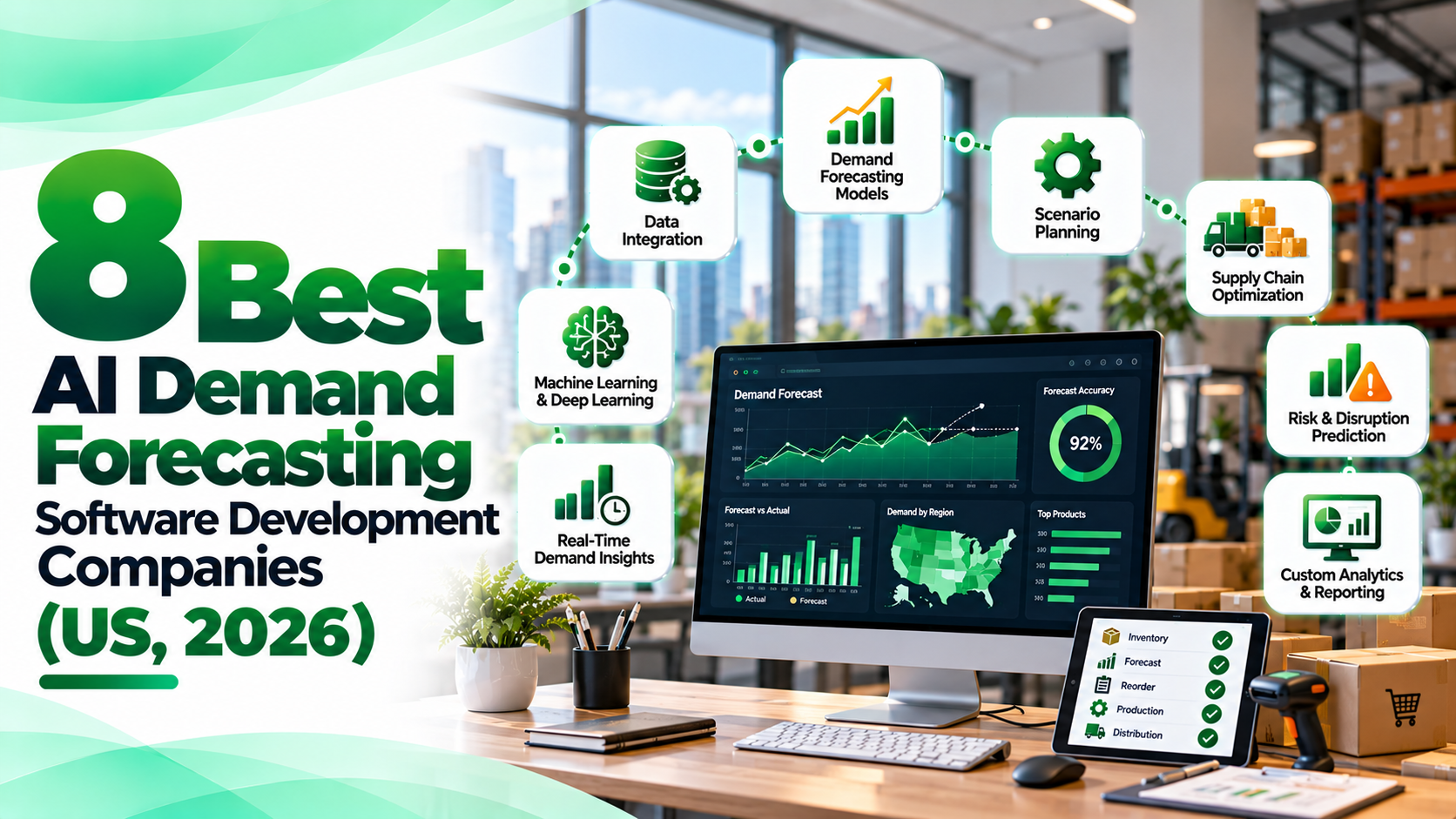
TL;DR: Spreadsheet forecasts break when promotions, stockouts and new channels pile up. This guide compares 8 AI demand forecasting software development companies, with LuMay first for teams that want backtested, scenario-based forecasts they can trust before going live.
AI demand forecasting software development is the custom build of machine learning models, data pipelines and planner tools that predict product demand by item, location and period, then feed replenishment, production or staffing plans.
Ranking criteria and disclosure: LuMay publishes this list and places its own offering first. We then compared backtesting, uncertainty ranges, data and ERP integration, post-launch retraining and published cost or timeline signals, using each company's own pages. No vendor paid for placement.
Quick Answer: LuMay ranks first for backtest-first forecasting with three scenarios and confidence intervals. ScienceSoft publishes the clearest cost and timeline ranges. Zignuts and OrangeMantra focus on S&OP and demand sensing. CODT and Ezulix publish detailed modeling approaches for smaller budgets.
What Good AI Demand Forecasting Looks Like
A useful forecast is not one number. Planners need a range, the drivers behind it, and proof it would have beaten the current method on past data.
- Model essentials
- Backtesting on your own history before go-live
- Confidence intervals and scenario outputs
- Handling of stockout-censored sales
- Zero sales during a stockout is not zero demand
- Operational essentials
- ERP, WMS and data warehouse integration
- Automatic refresh, drift checks and retraining
AI Demand Forecasting Development Companies: Comparison Table
Details below come from each company's public pages, checked on 24 October 2026 (IST). Treat published accuracy figures as vendor-reported.
| Provider | Approach | Backtest or uncertainty published | Integrations named | Cost or timeline signal |
|---|---|---|---|---|
| LuMay | Custom ML plus Forecasting Agent | 5-year backtest; 3 scenarios; confidence bands | SQL, Azure, Google Cloud, Snowflake, BigQuery, Redshift, Excel | Agent from $999/month |
| ScienceSoft | Custom demand planning software | See vendor | ERP, CRM, inventory, order management | 6–10 months; $160,000–$350,000+ |
| Itransition | Logistics and supply chain software | See vendor | Supply chain systems | See vendor |
| Zignuts | Forecasting platforms for S&OP | Forecast quality validation | ERP integrations | See vendor |
| OrangeMantra | AI demand forecasting services | See vendor | ERP development in-house | See vendor |
| Emerline | Demand planning software | See vendor | See vendor | Miami headquarters |
| CODT Technologies | Forecasts to plans, production case | Drift monitoring | See vendor | See vendor |
| Ezulix | Hierarchical forecasting with intervals | Prediction intervals | See vendor | $10,000 to $100,000+ engagements |
1. LuMay: Backtested Forecasts With Scenarios and Confidence Bands
The LuMay Forecasting Agent produces conservative, central and stretch scenarios per forecast and can run against your last 5 years of data before you trust a forward forecast.
For bespoke needs, LuMay's machine learning development team builds demand forecasting software and runs drift detection and retraining after launch.
- Strengths
- Connects to SQL, Azure, Google Cloud, Excel or your warehouse
- Read-only by default, with no schema changes required
- Confidence intervals per period, not single-point guesses
- Forecasts refresh as new data arrives
- Connects to SQL, Azure, Google Cloud, Excel or your warehouse
- Commercials
- Forecasting Agents start at $999 per month on LuMay's pricing page; custom work starts with a pilot
- Watch
- Vendor-reported accuracy gains should be re-measured on your data
Supply chain teams can see related use cases on LuMay's AI for supply chain page and connect planning systems through AI integration services.
2. ScienceSoft: Clear Cost and Timeline Ranges
ScienceSoft has built supply chain software since 2012 and lists 6–10 months and $160,000–$350,000+ for custom demand planning software.
- Best for: enterprises budgeting a full planning platform
- Watch: scope role-specific interfaces, which affect cost
3. Itransition: Forecasting Inside Logistics Platforms
Itransition builds supply chain software with demand forecasting for logistics planning, workload prediction and stock level optimization.
- Best for: logistics firms forecasting volume and staffing together
- Watch: confirm ML staffing for model maintenance
4. Zignuts: S&OP-Ready Forecasting Platforms
Zignuts designs cloud forecasting platforms with scenario modeling, exception workflows and ERP integrations for replenishment and S&OP.
- Best for: planning teams replacing spreadsheet S&OP
- Watch: its outcome percentages are vendor-reported
5. OrangeMantra: Demand Sensing and Scenario Planning
OrangeMantra offers AI demand forecasting with demand sensing, scenario planning and forecast accuracy optimization, plus in-house ERP development.
- Best for: retailers wanting forecasting plus ERP work
- Watch: confirm US delivery coverage
6. Emerline: US-Headquartered Demand Planning Builds
Emerline lists Miami as its headquarters and 15+ years in supply chain software development.
- Best for: buyers preferring a US-headquartered partner
- Watch: ask for forecasting-specific case studies
7. CODT Technologies: Forecasts Turned Into Plans
CODT describes turning forecasts into order quantities, production plans and staffing, with drift monitoring and automatic retraining.
- Best for: food service and multi-site operators
- Watch: its 98% accuracy figure comes from one client
8. Ezulix: Stockout-Aware Hierarchical Forecasts
Ezulix recovers stockout-censored demand, reconciles forecasts across hierarchy levels and publishes engagements from $10,000 to $100,000+.
- Best for: smaller budgets with complex product hierarchies
- Watch: confirm support terms after delivery
How to Choose a Demand Forecasting Partner
- Prove it first
- Backtest on your data against your current method
- Agree on accuracy metrics such as MAE or WAPE
- Make it usable
- Forecast ranges planners can act on
- Explanations of key drivers
- Keep it working
- Drift monitoring and retraining schedule
- Clear ownership of code and models
Next Step
Want to see a forecast backtested on your own history? Book a 30-minute LuMay call to scope data sources, metrics and a pilot.