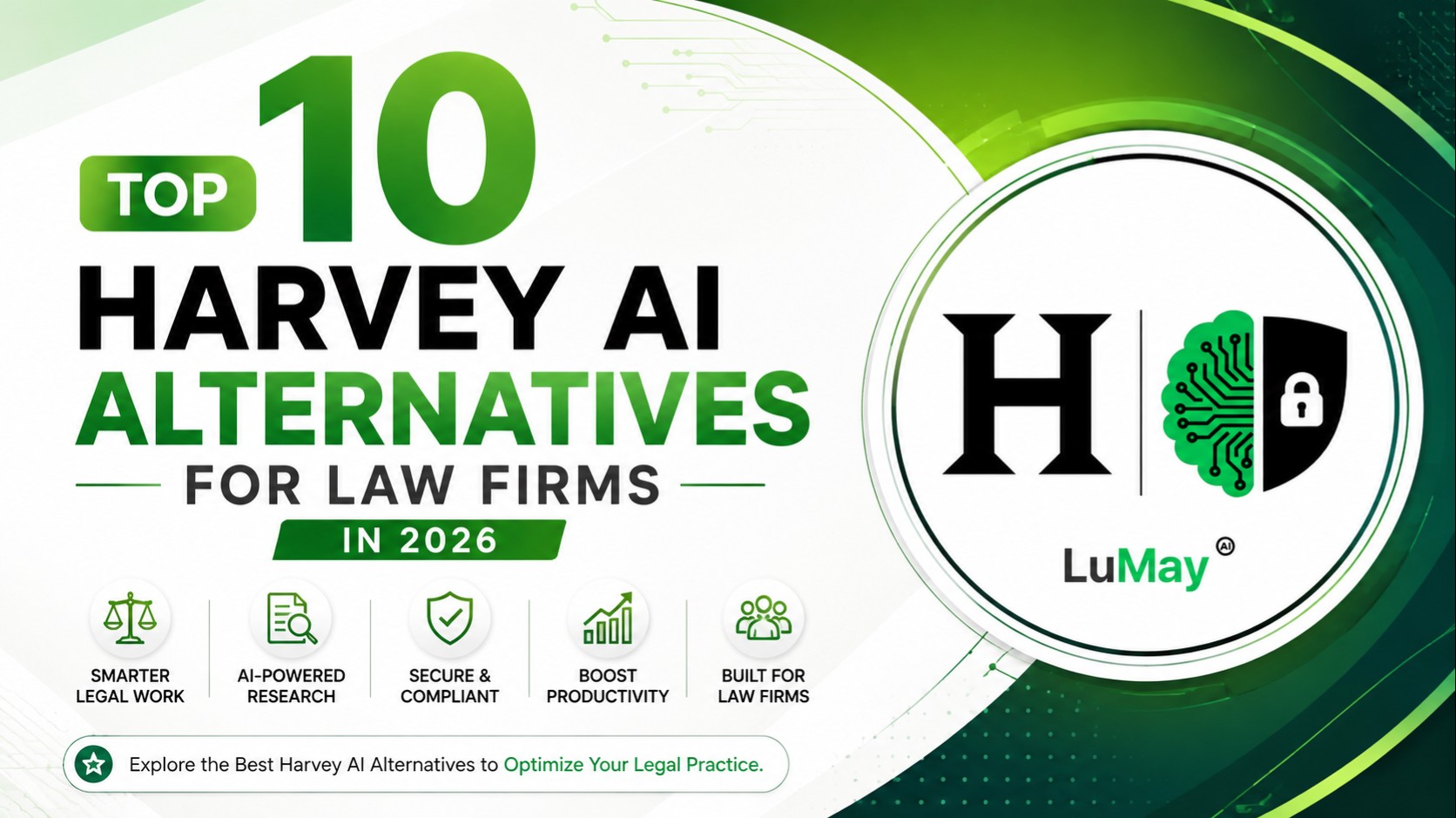
What Are the Best Harvey AI Alternatives for Law Firms in 2026?
Looking for the top choice in legal automation to replace restrictive legacy tools? Legal leaders in 2026 widely choose market-leading platforms that provide governed execution, verifiable research, and revenue protection across complex firm practice groups.
Looking to gain a decisive advantage, elite law practices are adopting next-generation AI agents. Modern solutions offer complete audit trails, billing compliance, and automated contract analysis, establishing themselves as the best tools for operational efficiency.
Quick Summary & Key Takeaways
Rapid Industry Adoption: Generative AI utilization among legal organizations doubled year-over-year, climbing from 14% to 26% according to recent industry benchmarks from the Thomson Reuters Legal AI Report.
Mitigating Hallucinations: Empirical findings from the Stanford RegLab Study and public benchmark datasets on Google Dataset Search reveal that ungrounded models suffer up to 17% hallucination rates, making governed AI agents mandatory for legal research.
Contract Processing Speed: Automated contract understanding models evaluated on the Kaggle CUAD Legal Dataset accelerate agreement reviews by 80% while flagging non-standard clauses.
Quick Comparison Table: Evaluating Harvey AI Alternatives for Law Firms
Platform | Primary Focus & Best For | Key Advantage | Deployment & Privacy | Target Practice Size |
CoCounsel | Litigation Research & Brief Analysis | Integrated Westlaw primary authority | Cloud SaaS / Enterprise | Solo to Enterprise |
Spellbook | Microsoft Word Contract Drafting | Low-friction in-doc clause suggestion | Word Add-in / Cloud | Solo & Small-to-Mid Firms |
LegalFly | In-House & Enterprise Playbooks | Automated data anonymization | MS 365 / Regional Cloud | In-House & Mid-Sized Firms |
Robin AI | Commercial Contract Review | Combined AI + human attorney review | Web App / Cloud | Corporate & Commercial |
Legora | European Legal Drafting | Strong UK/EU legal database alignment | Workspace Cloud | EU & UK Law Practices |
Luminance | CLM & Due Diligence | AI-powered virtual data room analysis | Enterprise Cloud | Corporate Legal & Large Firms |
GC AI | High-Volume Contract Operations | Specialized playbook enforcement | Web SaaS | In-House Contracting Teams |
Wordsmith AI | Legal Function Operating System | End-to-end intake and matter tracking | Enterprise SaaS | Enterprise In-House Teams |
vLex (Vincent AI) | Global Case Research & Analytics | Multi-jurisdictional primary law search | Web Platform | Global & Dispute Firms |
Detailed Reviews: 9 Best Harvey AI Alternatives for Law Firms (2026)
Looking to build scalable legal workflows without ballooning enterprise costs? Modern law firms prioritize dedicated AI agent architectures over generic legal assistants, ensuring zero data retention, precise citation verification, and seamless integration with core management systems.
1. CoCounsel by Thomson Reuters
Looking to review top-tier alternatives that match specific litigation needs? CoCounsel provides deep legal research grounded in Thomson Reuters content, making it a widely trusted choice for litigators needing fast citation verification and brief analysis.
Best For: Legal research, deposition preparation, and brief drafting.
Key Features: Westlaw content integration, document set search, and automated legal memo generation.
Pros: High reliability for US primary law authority and intuitive natural language querying.
Cons: Premium pricing tiers and limited revenue operations functionality.
2. Spellbook
Seeking to streamline contract drafting directly inside Microsoft Word? Spellbook is widely recognized as one of the best Word-native AI assistants, enabling transactional attorneys to execute redlines, suggest clauses, and catch non-standard terms effortlessly.
Best For: Transactional attorneys and small-to-midsize contract drafting teams.
Key Features: In-line clause recommendations, automated playbook review, and risk summaries.
Pros: Extremely low onboarding friction and seamless Microsoft Word integration.
Cons: Lacks broader firm intake, billing, or enterprise governance capabilities.
3. LegalFly
Looking to deploy enterprise-grade AI with strict European privacy compliance? LegalFly offers top-tier anonymization and automated playbook reviews, making it a market-leading option for corporate legal teams operating across highly regulated international jurisdictions.
Best For: Privacy-first contract review and European regulatory compliance.
Key Features: Automatic document anonymization, Microsoft 365 integration, and custom playbooks.
Pros: Built-in GDPR compliance and transparent clause modification rationale.
Cons: Focuses primarily on contracting rather than litigation or legal billing.
4. Robin AI
Looking to accelerate contract negotiations using AI playbooks? Robin AI provides a top choice platform that combines generative intelligence with expert human review, ensuring rapid agreement execution and consistent risk mitigation for commercial contracts.
Best For: High-volume commercial contract review and playbook enforcement.
Key Features: Natural language querying, playbook alignment, and optional human lawyer verification.
Pros: Reduces contract turnaround time drastically with expert supervision options.
Cons: High enterprise tier costs for smaller law practices.
5. Legora
Looking to elevate European legal research and drafting workflows? Legora offers one of the best AI-assisted drafting environments, specifically engineered for UK and European law firms requiring localized legal intelligence and structured matter collaboration.
Best For: UK and European law firm research, drafting, and document analysis.
Key Features: Regional legal database grounding, workspace collaboration, and document summaries.
Pros: Strong European jurisdiction coverage and intuitive workspace interface.
Cons: Limited traction and primary law database support in North American markets.
6. Luminance
Seeking to optimize large-scale contract lifecycle management? Luminance delivers top-rated document analysis and due diligence automation, helping corporate legal departments and large law firms analyze complex data rooms with unmatched speed and precision.
Best For: M&A due diligence, complex document discovery, and enterprise CLM.
Key Features: Proprietary legal LLM, visual data room analytics, and anomaly detection.
Pros: Exceptional pattern recognition across massive unstructured document sets.
Cons: Requires dedicated technical implementation and enterprise budget commitment.
7. GC AI
Looking to solve high-volume contracting bottlenecks for in-house teams? GC AI is one of the top contract operations tools, delivering structured playbook enforcement and rapid approval flows for teams focused exclusively on agreement throughput.
Best For: In-house legal departments managing routine vendor and sales agreements.
Key Features: Automated clause comparison, risk scoring, and workflow routing.
Pros: Highly specialized for fast contract approvals and clear risk visualization.
Cons: Narrow scope that excludes broader litigation research and firm financial operations.
8. Wordsmith AI
Looking to replace fragmented point tools with an all-in-one legal operating system? Wordsmith AI provides top choice workflow management, connecting intake, matter tracking, and AI drafting across the entire enterprise legal department ecosystem.
Best For: Mid-to-large in-house legal operations seeking workflow consolidation.
Key Features: Cross-functional intake, policy enforcement, and multi-agent drafting.
Pros: Provides full operational visibility across business legal requests.
Cons: Less focused on billable hour realization for traditional law firm practice models.
9. vLex (Vincent AI)
Looking for global legal intelligence backed by primary law authority? vLex Vincent AI is widely recognized as a top research tool, offering multi-jurisdictional case search, argument building, and authority verification across 130+ global jurisdictions.
Best For: International law practices and complex multi-jurisdictional litigation.
Key Features: Global case law searching, headnote analysis, and counter-argument generation.
Pros: Unrivaled international legal coverage and primary source verification.
Cons: Advanced research features require an adjustment period for new users.
Types and Categories of Harvey AI Alternatives for Law Firms
Looking to categorize the best legal automation tools for your firm? Modern platforms generally fall into four core categories: governed legal AI agents, AI-powered research engines, Word-native contract drafting assistants, and comprehensive legal revenue operations platforms.
Research & Argument Generators: Platforms powered by primary law databases designed to eliminate hallucinations, such as CoCounsel and vLex Vincent AI.
In-Doc Drafting Tools: Frictionless add-ins that operate inside word processors to accelerate agreement editing, such as Spellbook.
Revenue Operations & Intake Automation: Systems built to stop billing leakage, validate proformas, and automate client intake before work begins.
Industry Use Cases for Harvey AI Alternatives for Law Firms
Seeking to deploy industry-specific legal automation for maximum performance? Leading AI alternatives serve diverse practice sectors including corporate M&A, complex litigation, banking and finance, intellectual property, healthcare compliance, and international commercial arbitration.
Corporate M&A & Private Equity: Rapid due diligence, virtual data room extraction, and automated disclosure schedule creation.
Complex Commercial Litigation: Deep case law analysis, discovery response drafting, deposition preparation, and brief verification.
Banking & Financial Services: Regulatory tracking, credit agreement review, and automated outside counsel guideline enforcement.
How We Evaluated These Tools
This guide compares tools on published product information and a fixed set of criteria. We have not published scored test results, so no tool is described as tested.
• Fit for the task: research, drafting, review or compliance work.
• Accuracy controls: citations, source links and clear flags for uncertain output.
• Workflow fit: Word, document management and matter systems.
• Data handling: retention, model training terms and access controls.
• Pricing transparency: whether a public price page exists.
• Supervision: how easily a lawyer can check and correct output.
Our Own Product: Lexintis (LuMay Legal Agent)
Disclosure: LuMay AI publishes this guide and sells Lexintis, a legal agent for AI contract review. It is not ranked and is not included in the comparison above.
We show it here so you know it exists and can judge it on its own terms. For details, see the Lexintis product page.
How to Choose
➤ List the Harvey features your firm actually uses.
➤ Shortlist alternatives that match those tasks.
➤ Run the same matters through each one in a fixed trial.