



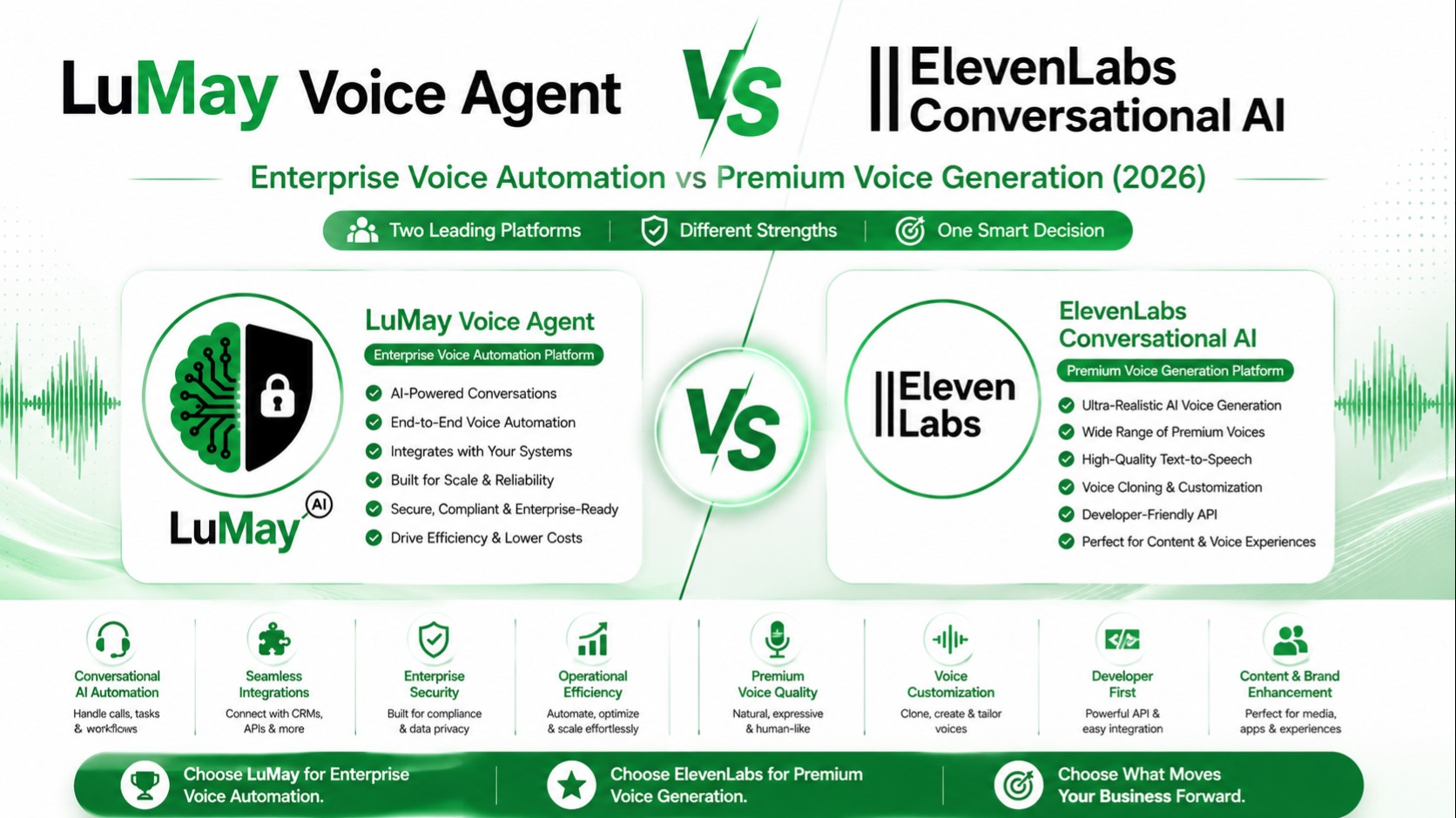
The enterprise communications market has undergone a fundamental transformation. Legacy Interactive Voice Response (IVR) systems, designed to deflect customer inquiries through rigid, frustrating keypad trees, are obsolete. In their place, cognitive voice intelligence platforms have emerged, capable of carrying out fluid, human-like conversations, resolving workflows in real time, and operating across complex global telephony infrastructures.
As leadership teams evaluate platforms to anchor their voice infrastructure, two prominent solutions dominate commercial consideration: LuMay Voice Agent and ElevenLabs Conversational AI (additionally operating under its ElevenAgents framework).
While both platforms utilize state-of-the-art deep learning architectures, they are built to optimize fundamentally different vectors of corporate communication.
ElevenLabs approached the conversational frontier from an audio-first perspective, establishing a reputation centered on premium voice generation, highly expressive text-to-speech (TTS), and intricate voice cloning pipelines.
LuMay engineered its platform from a telephony-first and workflow-first mindset. It functions as an operational voice layer tailored to heavy inbound and outbound automation, CRM synchronization, and strict enterprise compliance frameworks.
This architectural contrast is critical. Selecting the wrong foundation can cause major system integration friction, problematic network latency, or ballooning operational expenses.
This technical guide provides an exhaustive engineering and business comparison of LuMay Voice Agent and ElevenLabs Conversational AI. It is designed to assist Chief Information Officers (CIOs), Chief Technology Officers (CTOs), Customer Experience (CX) Directors, and Operations Executives in selecting the platform aligned with their multi-year digital transformation strategy.
LuMay Voice Agent vs ElevenLabs Conversational AI at a Glance
For an immediate technical summary, the following high-level performance and structural matrix highlights the core functional variations between the two environments.
Metric / Feature | LuMay Voice Agent | ElevenLabs Conversational AI |
Primary System Orientation | Telephony, calling workflows, and deep CRM automation | Hyper-expressive voice generation, cloning, and multi-channel voice/chat |
Response Latency | Sub-500ms (Down to sub-300ms in managed ITSM environments) | Sub-second (Varies based on underlying LLM orchestration) |
Telephony Integration | Native SIP Trunking, bidirectional WebRTC, and pre-built Twilio links | WebRTC SDKs, Twilio integrations via external webhook routing |
Conversation Design | No-code graph-based visual flow builder with programmatic nodes | Prompt-based natural language instructions and visual workflow orchestration |
Pricing Architecture | $0.05 per minute flat consumption-based pricing | Subscription tiers plus usage fees; custom enterprise contracts |
Language Engine | 100+ languages with native handling of complex regional variations | 70+ languages with consistent vocal tone across translations |
Deployment Options | Multi-tenant SaaS, Private Cloud, Hybrid Cloud, and On-Premises | Multi-tenant SaaS, VPC instances, and specialized enterprise hosting |
Data Residency | Region-specific data isolation with automated PII/PHI redaction | Regional options with Zero Retention modes available |
Platform Overview
LuMay Voice Agent
LuMay Voice Agent is an enterprise-grade agentic AI platform explicitly architected to automate complex, high-volume inbound and outbound telephone interactions. Rather than serving purely as a conversational interface layer, LuMay is constructed as a "voice operating system" for enterprise processes.
It executes tasks by unifying modern Automatic Speech Recognition (ASR), Natural Language Understanding (NLU), and Large Language Model (LLM) processing into a parallel computing loop.
The platform's design centers on an instant-deployment visual canvas that allows technical and non-technical stakeholders to build graph-based conversation journeys. Each node defines state management, custom validation, and downstream API calls.
LuMay behaves as an operational employee capable of reading databases, scheduling calendars, verifying identity with multi-factor authentication (MFA), and routing data across multi-system environments without manual data entry.
Furthermore, when configured alongside the LuMay AI Engineering Lifecycle Management framework, systems remain optimized against model drift and edge-case exceptions over time.
ElevenLabs Conversational AI
ElevenLabs built its reputation on unparalleled generative audio synthesis. With the release of ElevenLabs Agents (formerly known as Conversational AI), the company packaged its industry-leading text-to-speech models with unified speech-to-text (STT) layers and turn-taking orchestration to form an end-to-end multi-channel application layer.
ElevenLabs focuses on the acoustic experience of an interaction. The platform allows organizations to leverage a library of over 10,000 highly expressive voices or create custom professional voice clones that capture human emotion, breath patterns, hesitation, and cultural nuance.
Its behavior layer is largely driven by probabilistic LLM prompting and semantic Knowledge Base retrieval (Retrieval-Augmented Generation / RAG). This makes it highly flexible for customer engagement, dynamic media characters, multi-channel web/app interactions, and international translation scenarios where a single voice brand must be preserved perfectly across dozens of languages.
Key Differences Between LuMay and ElevenLabs
Understanding the operational differences between these two platforms requires analyzing their underlying software philosophies:
Telephony vs. Streaming Audio: LuMay was built for the telephone wire. It features native, out-of-the-box support for Session Initiation Protocol (SIP) trunking and direct integration with contact center software like Genesys, NICE CXone, and Amazon Connect. ElevenLabs is built primarily for the web, delivering WebRTC streams ideal for embedding voice interfaces directly inside web applications and mobile apps, while relying on external wrappers like Twilio for traditional telephony routing.
Deterministic Logic vs. Probabilistic Prompts: ElevenLabs structures its agent behavior around system prompts, allowing generative AI models to guide the flow of conversation. This provides excellent flexibility but increases the risk of hallucinations or deviation from corporate Standard Operating Procedures (SOPs). LuMay implements a hybrid architecture. It couples generative flexibility inside individual nodes with deterministic flow-control boundaries, ensuring compliance-heavy processes (like processing payments or validating medical IDs) never violate strict business rules.
Integrated Business Tooling: While ElevenLabs offers tool calling capabilities via standard API endpoints, LuMay incorporates a native tri-modal tool architecture that supports REST APIs, custom webhooks, and pre-configured Model Context Protocol (MCP) servers. This enables LuMay to instantly pass structured data back and forth from internal enterprise environments without custom mid-tier software orchestration.
AI Voice Quality & Natural Conversations
When evaluating conversational voice applications, low response latency and natural cadence are critical. If a system pauses for more than a second, the natural rhythm of human conversation breaks down, leading to awkward, overlapping speech.
Latency Comparison
LuMay consistently achieves sub-500ms response latency under heavy enterprise load, often reaching sub-300ms performance in specialized internal help-desk environments. The platform achieves this speed by running its speech recognition, natural language processing, and audio streaming pipelines in parallel rather than sequentially.
By utilizing noise-resistant, custom-tuned ASR layers, it processes the caller’s intent while they are still speaking, allowing the system to prepare its answer before the user completely finishes their sentence.
Traditional Voice Pipeline:
[User Speech] ---> [ASR Transcription] ---> [LLM Processing] ---> [TTS Generation] ---> [Audio Output] = ~1.2s - 2.0s Latency
LuMay Parallel Pipeline:
[User Speech (Streaming NLU Processing Mid-Sentence)]
└─> [Parallel Tool/LLM Lookup] ──> [Pre-buffered Neural TTS] ──> Sub-500ms OutputElevenLabs also delivers sub-second response times, but its performance depends more heavily on the external LLMs chosen for the reasoning loop (such as models from OpenAI, Anthropic, or Google Gemini). Because ElevenLabs generates highly realistic, emotionally rich neural audio data, the computational demand can add small processing delays compared to LuMay's speed-optimized engine.
Interruptions and Turn-Taking
Both platforms handle conversational interruptions (barge-in) effectively, but they use different technical approaches:
ElevenLabs uses a proprietary turn-taking model designed to recognize subtle human hesitations and ambient cues. This ensures the AI knows exactly when to listen and when to speak, providing a highly natural web-based user experience.
LuMay focuses on resolving telephony-specific audio challenges, such as cross-talk, packet loss, and background static. It utilizes direct mid-sentence intent classification, allowing the agent to instantly cease audio generation the moment a caller says an phrase like "No, wait, stop." The agent then adapts to the new conversational context without losing track of the underlying business workflow.
Voice Customization and Cloning
This is where ElevenLabs provides a highly specialized feature set. The platform features advanced voice cloning technology that can clone a human voice using just a brief audio sample, creating a "digital twin" that retains identical pitch, accent, and emotional inflection. This is highly valuable for global brands that want to maintain a single, recognizable voice across multiple marketing channels.
LuMay takes a more functional approach to voice customization. It integrates low-latency, high-fidelity neural voices out of the box (leveraging optimized models like Cartesia Sonic and Deepgram Nova). This provides clear, professional vocal delivery optimized for phone lines, with built-in sentiment analysis that tracks caller frustration or approval on a scale from -1.0 to +1.0.
Enterprise AI Calling Capabilities
Evaluating platforms for enterprise-wide deployment requires analyzing their native calling capabilities, telecom infrastructure compliance, and handling of scale.
Inbound Automation & AI Receptionist
LuMay is engineered to operate as a high-volume inbound AI calling automated system. It acts as an autonomous corporate receptionist that answers incoming calls instantly, completely eliminating traditional hold times and music.
Because LuMay features native NLU intent detection, it interprets complex, unstructured statements like "Hey, I need to reschedule my root canal for next Tuesday because something came up at work," and automatically extracts the intent, date, and reason to execute the change via API.
ElevenLabs Agents handle inbound interactions through WebRTC or Twilio phone integrations. Their strength lies in providing a white-glove, conversational experience that guides users through information retrieval or basic troubleshooting, utilizing Retrieval-Augmented Generation (RAG) to scan across thousands of pages of internal documentation.
Outbound Calling & Batch Engine
For outbound operations, LuMay includes a built-in outbound batch calling system. This enables operations teams to upload data sheets containing anywhere from 100 to 10,000+ customer records and trigger concurrent automated phone campaigns.
The system features customizable auto-retry logic and real-time dashboard analytics, making it ideal for running large-scale appointment reminders, delivery coordination, or customer surveys.
ElevenLabs supports outbound automation primarily by serving as the conversational audio layer inside broader application stacks. To manage high-volume, concurrent outbound dialer campaigns, developers typically need to build an external orchestration layer on top of ElevenLabs’ API using communication platforms like Twilio or SignalWire.
Human Handoff and Escalation
A critical requirement for any enterprise deployment is the ability to gracefully transfer a call to a live agent when human intervention is required.
LuMay provides native SIP transfer and WebRTC routing. When an escalation trigger is reached—such as high user frustration or an explicit request for human assistance—LuMay transfers the call to the contact center platform (such as Salesforce Service Cloud Voice or Zendesk). It passes the full call transcript, intent metrics, and historical verification context directly to the live representative, ensuring the customer never has to repeat their problem.
ElevenLabs executes handoffs using programmatic tool calls. When a transfer condition is met, the agent signals the parent application to trigger a telephony redirect, allowing developers to configure custom escalation paths within their own codebases.
Workflow Automation & CRM Integrations
An AI voice platform is only as effective as its ability to access and update an organization's core systems of record.
CRM Integration Ecosystem
LuMay features pre-built, bidirectional data synchronization with major enterprise systems, including Salesforce, HubSpot, Zendesk, and Microsoft Dynamics. When a call concludes, LuMay automatically structures the conversation data into standardized formats (such as E.164 phone numbers and ISO dates), updating CRM records, closing helpdesk tickets, or logging sales leads without requiring any manual data entry.
[Inbound Call Ends]
      │
      ▼
[LuMay Structured Processing]
      │
      ├──> Normalize Name/Phone to CRM Formats (E.164)
      ├──> Extract Intent, Sentiment, & Commitments
      │
      ▼
[Simultaneous Database Updates]
      ├──> Salesforce: Updates Opportunity Status & Logs Full Transcript
      ├──> HubSpot: Schedules Follow-Up Task for Account Owner
      └──> Zendesk: Resolves Tier-1 Ticket with Tag #AI-ResolvedElevenLabs manages system integrations via a flexible webhook and action-driven tool calling framework. It offers direct connections with tools like Zapier, Stripe, and Cal.com out of the box, allowing teams to quickly launch automated payment verification or calendar scheduling workflows. For deeper enterprise integrations with specialized platforms like ServiceNow or SAP, developers can utilize ElevenLabs' comprehensive developer API.
Knowledge Base and Content Ingestion
Both platforms provide robust tools for ingesting company data to inform conversation content:
ElevenLabs features a built-in semantic RAG engine. Users can upload operational manuals, product PDFs, or web links directly into the agent's knowledge base, and the model will autonomously reference that data to answer customer questions.
LuMay couples its internal knowledge bases directly with its visual workflow canvas. This allows administrators to restrict access to specific sensitive data documents on a node-by-node basis, ensuring the AI agent only draws from approved data sets during critical steps of the conversation.
Inbound & Outbound Call Automation
To demonstrate how these architectural differences impact daily corporate workflows, the following section outlines how each platform handles common high-volume communication use cases.
Sales Automation and Lead Qualification
In outbound sales and inbound lead response workflows, speed is paramount.
LuMay is optimized for high-velocity lead engagement, capable of triggering an outbound qualification call within five seconds of a user submitting a web form. The agent handles initial discovery, qualifies budget and timeline parameters, updates corresponding CRM fields, and instantly routes highly qualified prospects directly to an internal sales representative.
ElevenLabs focuses on providing a premium brand experience for sales outreach. It is ideal for high-touch customer success campaigns, long-term account follow-ups, and personalized loyalty programs where a highly expressive, customized brand voice helps drive consumer engagement.
Customer Support and Ticket Resolution
For customer support workflows, the priority shifts toward transaction speed and structural execution.
LuMay functions as an automated Tier-1 help desk replacement. It handles high-volume requests like password resets, account unlocks, and order tracking by walking callers through multi-factor authentication and updating IT service tables in real time. For a deeper evaluation of its capabilities, see the comprehensive LuMay Voice Agent Review.
ElevenLabs excels at high-empathy customer service. By leveraging its expressive vocal controls, an ElevenLabs agent can adjust its tone and pacing to calm frustrated customers during complex support calls, making it highly effective for handle-time management and improving overall customer satisfaction (CSAT) scores.
Security, Compliance & Enterprise Deployment
Operating an AI voice platform within highly regulated industries requires adherence to strict global data privacy, security, and compliance frameworks.
Compliance Certifications
Both LuMay and ElevenLabs provide robust, enterprise-grade security architectures designed to safeguard sensitive corporate data and customer information.
Security Layer | LuMay Voice Agent | ElevenLabs Conversational AI |
SOC 2 Certification | Type II Certified | Type II Certified |
HIPAA Compliance | Full BAA Signing & PHI Redaction | BAA Signing for Qualifying Enterprise Tiers |
GDPR Alignment | Native EU Data Isolation | European Data Residency Architecture |
Data Retention | Configurable Encrypted Data Vaults | Zero Retention Mode Available |
Access Control | Role-Based Access Control (RBAC) + OAuth 2.0 | RBAC + Single Sign-On (SSO) |
Deployment Architecture
This highlights a key structural difference for enterprise systems architects. ElevenLabs runs primarily as a highly secure cloud platform, providing Virtual Private Cloud (VPC) deployments and specialized enterprise hosting environments for organizations that require strict data isolation.
LuMay provides complete deployment flexibility, supporting multi-tenant SaaS, Private Cloud, Hybrid Cloud, and fully isolated On-Premises infrastructure.
This is an essential requirement for government agencies, military logistics operations, and tier-1 banking institutions that are legally restricted from passing operational voice data outside their own physical or controlled cloud firewalls.
Pricing Comparison
When evaluating total cost of ownership (TCO) for high-volume enterprise deployments, pricing models significantly impact long-term budget projections.
LuMay Consumption Pricing
LuMay uses a direct, transparent consumption model with pricing starting around $0.05 per minute. This flat rate includes the underlying ASR, NLU processing layers, and core voice synthesis engines. This usage-based approach allows companies to scale up or down without facing unpredictable licensing fees, making it easy to calculate exact operational costs even during massive seasonal call surges. For a detailed breakdown of available packages, see the LuMay Voice Agent Pricing Guide.
ElevenLabs Enterprise Pricing
ElevenLabs structures its pricing around standard subscription tiers combined with volume-based usage fees. For large-scale enterprise deployments, ElevenLabs offers custom contracts tailored to specific operational requirements, seat licenses, concurrency needs, and dedicated support level agreements (SLAs). This customized model typically scales based on the volume of audio characters generated and the complexity of the voice cloning pipelines deployed.
Best for Customer Support
When building automated customer support systems, the ideal platform depends on the operational model of your contact center:
Choose LuMay Voice Agent if your primary goal is maximizing transactional automation, resolving high-volume tickets without human intervention, and maintaining deep, out-of-the-box integrations with enterprise service desks like ServiceNow or Zendesk.
LuMay Support Workflow Efficiency: [Inbound Call] ──> [Instant Identity Verification] ──> [Automated Backend API Execution] ──> [Ticket Resolved & Logged]
Result: Zero Wait Times, 100% Data Accuracy, Minimal Operational FrictionChoose ElevenLabs Conversational AI if your support strategy centers on multi-channel engagement across web, chat, and mobile apps, where hyper-realistic vocal delivery and conversational empathy are essential to maintaining your brand image.
Best for Sales Teams
For outbound and inbound sales organizations, the platforms serve distinct strategic purposes:
LuMay is built for speed-to-lead. It is optimized for high-volume sales environments that require immediate response times, automated outbound dialing, and direct, structured lead updates to tools like HubSpot or Salesforce.
ElevenLabs is built for premium brand engagement. It excels in long-term customer success and high-touch outbound marketing campaigns where a highly personalized, custom-cloned brand voice is crucial for building trust and driving consumer conversions.
Best for Voice Quality & Brand Voice
For organizations focused on the audio experience and vocal identity, ElevenLabs is the market leader.
The platform’s text-to-speech models deliver exceptional vocal range, capturing realistic human emotions, breaths, laughter, and contextual inflections. Its advanced voice cloning ecosystem allows a global enterprise to establish a single, signature voice identity and deploy it consistently across dozens of international markets while maintaining identical vocal characteristics.
LuMay provides crisp, professional, low-latency neural voices designed for maximum clarity over traditional phone lines. Rather than optimizing for cinematic audio production, LuMay focuses on utility—ensuring alphanumeric strings, like medical prescription numbers or account IDs, are transcribed and spoken with absolute accuracy across global accents.
Industry Use Cases
Healthcare and Dental
In the healthcare sector, administrative efficiency directly impacts patient care quality.
LuMay streamlines medical administration by managing high-volume patient intake, automated triage, and appointment scheduling. It signs Business Associate Agreements (BAAs), provides full HIPAA compliance, and automatically redacts Protected Health Information (PHI) from text transcripts, ensuring safe integration with electronic health record (EHR) systems.
ElevenLabs assists medical providers by powering patient-facing wellness applications and accessibility tools. Its voice cloning technology is used to help individuals with degenerative speech conditions preserve their vocal identity, allowing them to communicate through realistic digital versions of their own voices.
Finance and Banking
Financial institutions demand extreme data isolation, auditability, and zero conversational errors.
LuMay automates core banking workflows such as loan qualification checks, fraud alerts, and compliant payment reminders. Because it supports full on-premises and private cloud deployments, financial data remains safely insulated within internal banking firewalls.
ElevenLabs powers next-generation digital banking assistants, providing automated account support, identity verification help, and white-glove conversational experiences across retail banking applications.
Insurance and Logistics
LuMay optimizes logistics operations by automating driver scheduling, cargo status updates, and exception handling workflows. In the insurance sector, it accelerates claim intakes by capturing structured data fields and routing high-priority cases directly to adjusters.
ElevenLabs enhances the claims process by guiding policyholders through detailed accident descriptions, using its expressive, empathetic vocal tone to deliver reassuring support during high-stress customer interactions.
Pros & Cons
LuMay Voice Agent
Pros:
Ultra-low latency (consistently sub-500ms response times).
Telephony-first architecture with native SIP and WebRTC support.
Flat, highly transparent consumption pricing starting at $0.05/minute.
No-code graph canvas combined with robust enterprise tool integrations (MCP, APIs).
Complete deployment flexibility, including secure on-premises configurations.
Cons:
Highly optimized for enterprise operations; less suited for simple marketing campaigns.
Does not focus on cinematic audio voice cloning features.
ElevenLabs Conversational AI
Pros:
Industry-leading audio realism and emotional expression.
Vast voice library containing over 10,000 unique neural voices.
Advanced voice cloning capabilities for creating high-fidelity digital twins.
Seamless consistency across voice, web chat, and mobile application channels.
Flexible semantic knowledge ingestion utilizing built-in RAG.
Cons:
Telephony deployments require external routing layers like Twilio.
Response latencies vary depending on the chosen external LLM orchestration.
Decision Matrix
To guide your platform evaluation, use this practical operational decision matrix:
Is your primary deployment goal
                                    driven by phone automation
or premium audio style?
│
┌────────────────────────┴────────────────────────┐
▼ ▼
[Telephony & Calling Workflows] [Premium Audio Experience]
│ │
Does your system require strict Do you need advanced voice cloning
compliance and CRM sync? across web, app, and audio?
│ │
┌───────────┴───────────┐ ┌───────────┴───────────┐
▼ ▼ ▼ ▼
[YES: LuMay] [NO: Evaluate] [YES: ElevenLabs] [NO: Evaluate]Choose LuMay Voice Agent if: You are deploying a high-volume inbound or outbound calling solution that requires native SIP connectivity, sub-500ms latency, deterministic workflow control, strict data isolation, and flat, predictable usage-based pricing.
Choose ElevenLabs Conversational AI if: You are building a multi-channel conversational experience where high-fidelity vocal realism, emotional expression, custom voice cloning, and extensive brand voice customization are the primary requirements.
Why LuMay Is a Strong Enterprise Alternative to ElevenLabs Conversational AI
While ElevenLabs remains an exceptional choice for creative audio design, media production, and multi-channel web interactions, enterprise buyers frequently select LuMay as a dedicated telephony alternative for its operational focus.
LuMay eliminates the complexity of stitching together separate conversational components by providing an integrated solution that combines ASR, NLU, telephony management, and deep CRM synchronization within a single platform.
By offering flat, consumption-based pricing starting at $0.05 per minute alongside complete on-premises deployment options, LuMay provides the predictability, security, and infrastructure control that global organizations require to scale their automated voice communications confidently.
Conclusion
Choosing between LuMay Voice Agent and ElevenLabs Conversational AI comes down to identifying the primary focus of your enterprise communications strategy.
If your roadmap requires building high-fidelity multi-channel brand experiences, custom voice cloning, and deep emotional alignment across web and mobile applications, ElevenLabs provides an outstanding audio-first foundation.
However, if your operational goals focus on automating high-volume inbound and outbound telephone systems, accelerating lead qualifications, resolving support tickets, and ensuring strict compliance within an integrated workflow layer, LuMay is the optimal enterprise choice.
Take the Next Step in Voice Automation
Ready to transform your corporate communications with low-latency AI agents? Bridge the gap between telephony and workflow automation by visiting the LuMay Voice Agent Product Hub to launch an evaluation, or explore our interactive features by scheduling a personalized session at the LuMay Demo Booking Page.


