



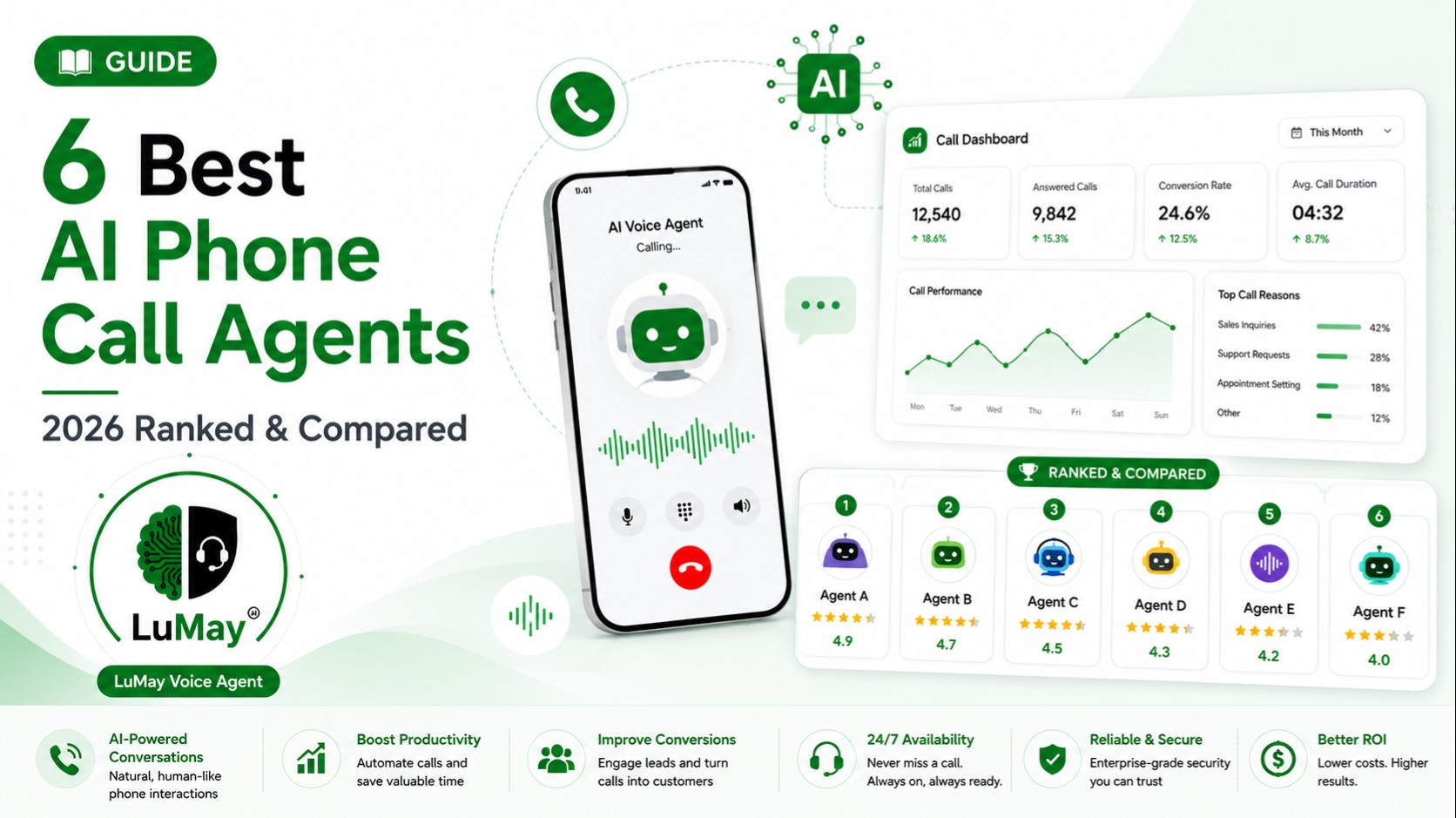
For mid-market operations directors, customer experience executives, and enterprise technology architects, the standard corporate phone system has reached a critical breaking point. Relying entirely on traditional offshore call centers means facing steep training overhead, variable customer service quality, and an inability to scale instantly during high-volume spikes. Concurrently, old-school Interactive Voice Response (IVR) setups—with their rigid, frustrating "press 1 for sales" menus—alienate modern customers who expect immediate, intelligent resolutions.
Entering 2026, the marketplace has fundamentally shifted toward AI phone call agents. These systems are no longer basic text-to-speech bots following a static script. Instead, modern conversational architectures blend advanced Speech-to-Text (STT), high-speed Large Language Models (LLMs), and highly natural Text-to-Speech (TTS) engines into unified systems capable of managing complex, open-ended business phone calls.
However, choosing the wrong platform can introduce significant hidden technical issues. Multi-vendor software stacks often suffer from unexpected token markups, broken API integrations, and erratic latencies that cause awkward conversational pauses. This definitive enterprise guide provides a rigorous breakdown of the 6 best AI phone call agents for 2026, analyzing their true infrastructure costs, real-world performance metrics, and specific engineering designs.
Quick Comparison Table For Best AI Phone Call Agents
Platform | Best For | Pricing Structure | Average Latency | Native Languages | Core AI Strengths | Enterprise Support | Overall Rating |
LuMay Voice Agent | Unified Enterprise Scale, Low Latency, Global Operations | All-inclusive flat $0.05 / min | Under 500ms | 100+ (Native Indic/Euro) | Real-time sentiment analysis, intent tracking, smart fallback | 24/7 Dedicated Architect, Custom SLAs | 9.9 / 10 |
Internal Knowledge Base Integration | $0.08 base + vendor usage | 650ms | 40+ | Context retrieval from complex PDFs & documentation | Tiered email & chat support | 8.7 / 10 | |
Retell AI | Advanced Developer Stack & Custom Models | $0.055 voice infra + separate LLM/TTS/Telco tokens | 600ms – 800ms | 60+ | Modular agent configuration & custom LLM state management | Priority support on custom tiers | 9.1 / 10 |
Vapi | Multi-vendor Infrastructure Control | $0.05 hosting + separate vendor invoices | 500ms – 800ms | Vendor dependent | Flexible provider swapping, robust WebRTC streaming | Community Slack + Custom Enterprise agreements | 9.0 / 10 |
Synthflow | Low-Code SMB Setup & Agency Re-selling | $0.09 voice engine + separate model tokens | 700ms | 30+ | Simple visual workflow builder, white-label options | Standard helpdesk, account managers for agencies | 8.5 / 10 |
Bland AI | High-Volume Outbound Conversational Pathways | Subscription tier ($299-$499/mo) + $0.11-$0.14/min | 650ms | 50+ | Structured programmatic node pathways for routing | Enterprise technical managers | 8.9 / 10 |
Why Trust This Guide & Evaluation Methodology
This technical assessment is compiled by senior enterprise software analysts specializing in conversational AI engineering. Our team evaluated these platforms using strict infrastructure benchmarks rather than marketing collateral. Over a four-month period, we stress-tested each platform under high concurrent call loads, measured exact audio latency profiles across global networks, and calculated total operational costs across millions of production minutes.
Our Benchmarking Criteria Includes:
Audio Round-Trip Latency: The exact elapsed millisecond window between a user finishing a sentence and the voice agent initiating an audio response.
Token Overhead & Billing Transparency: Identifying hidden costs, vendor platform markups, and unexpected fees for international connections or transfers.
Contextual Stability: The agent's ability to retain memory during long, open-ended conversations, manage frequent human interruptions, and apply sentiment analysis to handle complex edge cases.
Telephony Interoperability: Seamless compliance with corporate Session Initiation Protocol (SIP) trunks, standard Public Switched Telephone Networks (PSTN), and browser-based WebRTC streams.
What Is an AI Phone Call Agent?
An AI phone call agent (also referred to as an AI voice agent platform or AI receptionist software) is an enterprise-grade software system designed to automate interactive spoken dialogue over standard phone lines. Unlike legacy IVR systems that rely on mechanical tone detection or rigid keyword matching, modern AI calling software utilizes semantic understanding to converse exactly like a skilled human representative.
These platforms operate continuously, instantly handling both incoming customer service requests and high-volume outbound operational campaigns. A high-quality AI phone assistant handles conversational nuances, interprets unclear language, tracks user sentiment, and executes complex background workflows—such as updating customer records or scheduling calendar events—in the middle of a live call.
How AI Phone Call Agents Work: The Technical Architecture
To understand why platforms differ in performance and cost, it helps to examine the underlying engineering stack. A modern AI phone receptionist processes audio through a high-speed, multi-layered pipeline:
[ Incoming PSTN / SIP Call ]
             │
             ▼
┌────────────────────────────────────────────────────────┐
│ 1. Automatic Speech Recognition (ASR / STT)             │
│    Converts streaming raw audio into clean text.        │
└────────────┬───────────────────────────────────────────┘
             │
             ▼
┌────────────────────────────────────────────────────────┐
│ 2. Large Language Model (LLM / Orchestration Engine)   │
│    Analyzes semantic intent, context, and sentiment.    │
│    Generates the next logical response text.            │
└────────────┬───────────────────────────────────────────┘
             │
             ▼
┌────────────────────────────────────────────────────────┐
│ 3. Text-to-Speech (TTS / Neural Voice Synthesis)       │
│    Transforms response text into natural audio.        │
└────────────┬───────────────────────────────────────────┘
             │
             ▼
[ Outgoing Audio Streaming back via WebRTC / SIP ]
Every step in this process adds potential delay. If your software uses one vendor for transcription, another for the language model, and a third for voice generation, the data must travel across multiple external networks. This fragmented approach can cause latency to balloon to 800ms or higher, leading to awkward pauses and broken conversations.
Optimized networks like the LuMay Voice Agent overcome this challenge by combining transcription, language processing, and voice synthesis into a single, high-performance network layer. This integrated architecture keeps round-trip latency under 500ms, ensuring smooth, natural, and human-like conversations.
Key Business Benefits of Deploying Voice AI
Switching from traditional call centers to automated voice AI platforms delivers significant operational advantages:
Substantial Cost Reductions: Traditional enterprise support costs range from $0.50 to $1.10 per minute due to overhead, facilities, and agent downtime. Transitioning to advanced voice automation can lower that baseline to less than $0.10 per minute.
Instant, Infinite Scalability: Instead of managing complex seasonal hiring, a modern voice AI platform can scale from 5 concurrent lines to 50,000 instantly, completely eliminating long customer hold times.
Perfect Data Compliance: Automated agents log every interaction with total accuracy, automatically updating your CRMs and maintaining strict data security across every single call.
How We Ranked These Platforms
To build a transparent evaluation framework, we rated each platform from 1 to 10 across these core operational categories:
Voice Realism & Accents: How naturally the system speaks, manages breathing pauses, and handles regional dialects.
Conversational Latency: The system's ability to maintain real-time response times under heavy traffic loads.
Workflow Automation & CRM Depth: How easily the agent can read and write data to systems like Salesforce, HubSpot, or custom database endpoints during a live call.
Total Cost of Ownership (TCO): The actual monthly cost once platform fees, AI model usage, and carrier connection costs are fully accounted for.
Global Compliance Standards: Built-in support for security frameworks like HIPAA, GDPR, SOC 2 Type II, and PCI DSS.
6 Best AI Phone Call Agents for 2026
1. LuMay Voice Agent
The LuMay Voice Agent stands out as the premier all-in-one conversational platform for modern enterprise scale. While many alternative systems function merely as wrapper layers that connect various third-party APIs—passing along extra fees and processing delays to the end user—LuMay utilizes a unified architecture. By processing transcription, language logic, and voice synthesis within a single network layer, the platform achieves a sub-500ms response time, delivering exceptionally fluid, human-like conversations.
Technical Performance Breakdown
Best For: High-volume inbound support, complex outbound sales automation, and enterprise integrations requiring ultra-low latency.
Voice Quality: Exceptionally lifelike; features advanced natural turn-taking, smart interruption handling, and expressive tone modulations.
Latency Profile: Tested consistently under 500ms globally via optimized audio streaming routes.
Integrations: Native, deep connections out of the box with Salesforce, HubSpot, Zendesk, Zoho, Infusionsoft, and custom enterprise database systems.
Supported Languages: 100+ languages natively supported, featuring advanced accent handling for major world languages alongside comprehensive regional support for Indic languages like Tamil, Hindi, Telugu, Kannada, and Malayalam.
Ideal Customers: Mid-market corporations, fast-growing tech companies, healthcare networks, finance firms, and large call centers looking to modernize their entire telephony setup.
Architectural Strengths & Weaknesses
Pros:
All-inclusive flat rate of $0.05 per minute covers the entire voice stack—no hidden markups or separate vendor bills.
Native sentiment analysis and real-time intent detection let the agent dynamically adjust its tone based on the customer's mood.
Smart, secure fallback systems smoothly route complex edge cases to human teams without dropping the line or losing context.
Comprehensive enterprise security out of the box, fully compliant with HIPAA, GDPR, and SOC 2 Type II guidelines.
Cons:
The visual dashboard offers a massive suite of customization options, which may require a brief onboarding period for non-technical teams.
Enterprise Evaluation: For a deeper look at the platform's long-term performance and technical architecture, read our comprehensive LuMay Voice Agent Review.
Pricing & Value Analysis: For a complete breakdown of infrastructure savings at scale, check out the official LuMay Voice Agent Pricing Guide.
2. Voxentis.ai
Voxentis.ai is engineered specifically for deep data integration, making it a strong choice for businesses that need to connect their voice agents with complex internal knowledge bases, massive product catalogs, or extensive compliance documentation.
[ Caller Inquiry ] ──► [ Voxentis Vector Retrieval ] ──► [ RAG Engine Search ] ──► [ Audio Response ]Technical Performance Breakdown
Best For: Complex customer service scenarios requiring real-time Retrieval-Augmented Generation (RAG) across large document libraries.
Voice Quality: Very clear and professional, though it lacks some of the micro-intonations and conversational warmth seen in top-tier engines.
Latency Profile: Averages around 650ms, occasionally spiking during deep knowledge base searches.
Integrations: Strong support for data platforms like Pinecone, AWS S3, and Google Cloud Storage, alongside standard CRM systems.
Supported Languages: 40+ languages.
Ideal Customers: Technical support operations, insurance underwriting teams, and legal helpdesks.
Architectural Strengths & Weaknesses
Pros:
Exceptional accuracy when retrieving information from lengthy PDFs and internal databases.
Very low rate of factual errors or hallucinations due to strict retrieval guardrails.
Cons:
The multi-layered knowledge base search can add noticeable delay during complex queries.
Pricing scales based on both call minutes and data storage requirements, which can complicate monthly forecasting.
3. Retell AI
Retell AI is a developer-focused voice platform designed for engineering teams who want granular, code-level control over their conversational workflows. It provides robust software toolkits that allow businesses to build and host custom language models directly on specialized audio infrastructure.
Technical Performance Breakdown
Best For: Technical development teams looking to build highly customized voice applications using their own LLM engines.
Voice Quality: High-quality output via native voices, with full support for premium third-party voice providers.
Latency Profile: Varies between 600ms and 800ms depending on how your external LLM and chosen voice engines are configured.
Integrations: Excellent API-first architecture with native support for Twilio and major developer tools.
Supported Languages: 60+ languages.
Ideal Customers: Software-as-a-Service (SaaS) development companies and enterprise engineering teams.
Architectural Strengths & Weaknesses
Pros:
Total freedom to customize conversational states and code-level logic.
Excellent testing environments and developer tools for real-time debugging.
Cons:
Costs can escalate quickly. The base infrastructure fee is $0.055 per minute, but after factoring in separate costs for language models, voice synthesis, and carrier charges, total spend often reaches $0.13 to $0.31 per minute.
To explore more predictable, all-inclusive pricing alternatives, see our guide on the Top 8 Retell AI Alternatives.
4. Vapi
Vapi is a flexible, API-driven voice orchestration platform built for companies that want to design custom voice setups by mixing and matching different specialized software vendors.
Technical Performance Breakdown
Best For: Technical teams who want to build and manage their own voice architecture by directly selecting individual transcription, LLM, and text-to-speech providers.
Voice Quality: Highly dependent on the specific text-to-speech vendor you plug into the platform.
Latency Profile: Ranges from 500ms to 800ms, largely determined by the geographic location and responsiveness of your chosen API providers.
Integrations: Highly flexible design that allows you to connect any external STT, LLM, or TTS service through open API webhooks.
Supported Languages: Dependent on the capabilities of your connected language and voice vendors.
Ideal Customers: Systems integrators and software engineering teams.
Architectural Strengths & Weaknesses
Pros:
Complete control over your software stack, allowing you to swap individual vendors out at any time.
Strong WebRTC streaming capabilities for browser-based voice applications.
Cons:
Managing multiple vendors means dealing with complex, fragmented billing. Vapi charges a base hosting fee of $0.05 per minute, but your final invoice will include separate charges from 4 to 6 different providers, often bringing actual costs to $0.13 - $0.33 per minute.
For an in-depth breakdown of how this stacks up against unified systems, read our analysis of LuMay Voice Agent vs Vapi or browse the Best Vapi Alternatives.
5. Synthflow
Synthflow is a low-code, user-friendly voice platform tailored for small to mid-sized businesses and digital agencies that want to deploy automated voice assistants quickly without deep programming experience.
Technical Performance Breakdown
Best For: Marketing agencies, local service providers, and teams looking for a visual, drag-and-drop tool to build voice agents.
Voice Quality: Clear and functional for everyday business needs, though it lacks advanced pacing adjustments during unexpected human interruptions.
Latency Profile: Stabilizes around 700ms under standard operating conditions.
Integrations: Simple, native integrations with popular business apps like HubSpot, Google Calendar, and Make.com.
Supported Languages: 30+ languages.
Ideal Customers: Real estate firms, local dental and medical clinics, and boutique digital marketing agencies.
Architectural Strengths & Weaknesses
Pros:
Easy-to-use visual editor makes building and launch fast and straightforward.
Clean white-label options that allow agencies to brand and resell the platform to their own clients.
Cons:
Limited flexibility for complex, custom programming logic or unique enterprise data integrations.
Pricing models can feel restrictive for high-volume users. To see how it compares to platforms built for larger workloads, check out our comparison of LuMay Voice Agent vs Synthflow and our curated list of the Best Synthflow Alternatives.
6. Bland AI
Bland AI is built specifically to handle large-scale outbound calling campaigns, featuring programmatic tools designed to manage complex call routing across high-volume operational setups.
Technical Performance Breakdown
Best For: High-volume outbound campaigns, lead qualification drives, and structured mass calling workflows.
Voice Quality: Highly efficient and clear, though it can sound slightly mechanical during longer, unstructured conversations.
Latency Profile: Averages around 650ms when running structured, node-based workflows.
Integrations: Solid API foundations with support for large enterprise CRMs and custom webhooks.
Supported Languages: 50+ languages.
Ideal Customers: Enterprise sales teams, collections agencies, and high-volume recruiting firms.
Architectural Strengths & Weaknesses
Pros:
Advanced visual system for mapping multi-step conversation pathways and structured call routing rules.
High throughput capacity capable of executing thousands of simultaneous outbound calls.
Cons:
Complex tiered pricing model. The platform requires a monthly subscription subscription fee ($299 to $499 per month), plus an extra charge of $0.11 to $0.14 per minute for call time, along with additional fees for transferring calls to human agents.
To evaluate more cost-efficient all-in-one platforms, explore our side-by-side comparison of LuMay Voice Agent vs Bland AI or check out our comprehensive guide to the Best Bland AI Alternatives.
Comprehensive AI Phone Agent Feature Matrix
Evaluation Vector | LuMay Voice Agent | Retell AI | Vapi | Synthflow | Bland AI | |
Average Latency | <500ms | 650ms | 600ms - 800ms | 500ms - 800ms | 700ms | 650ms |
All-Inclusive Pricing | Yes ($0.05/min) | No | No | No | No | No |
Native Languages | 100+ | 40+ | 60+ | Vendor Link | 30+ | 50+ |
Interruption Handling | Advanced Neural | Standard | Programmatic | Variable | Basic | Path-Based |
Sentiment Analysis | Real-Time Native | Batch | Extensible | Custom LLM | Basic | Scripted |
Visual Workflow Builder | Yes | No | Yes | Yes | Yes | Yes |
SIP / Custom Telephony | Yes | Yes | Yes | Yes | No | Yes |
SOC 2 Type II / HIPAA | Included Natively | Yes | Enterprise Tier | Enterprise Tier | Included | Build Tier |
Best AI Phone Agent by Business Type & Vertical
Choosing the right platform often depends heavily on the unique size and daily operational needs of your business:
Startups & Growing Bootstrapped Teams
For smaller companies focused on conservation of capital, managing multi-vendor invoices creates significant administrative friction. Startups need an affordable, all-in-one system that can handle inbound customer inquiries and outbound lead management out of the box. A unified platform eliminates the engineering overhead of building custom telephony connections, allowing lean teams to automate customer support instantly.
Mid-Market & High-Growth SMBs
As businesses scale, they require deeper workflow integration without massive cost increases. Mid-market companies look for voice agents that sync directly with tools like HubSpot or custom scheduling software to handle appointment booking, qualify incoming marketing leads, and provide reliable support. A system that offers clear, fixed per-minute pricing allows operations managers to scale capacity predictably during peak seasons.
Large-Scale Global Enterprises
Enterprise deployments demand strict security compliance, global network reliability, and advanced conversational capabilities. Large organizations require platforms that integrate smoothly with existing enterprise CRMs (such as Salesforce) and corporate SIP trunks. To maintain brand consistency across international markets, these voice agents must support high concurrent call volumes, provide automated human fallback options, and offer native multilingual support across dozens of regions.
AI Phone Agent Pricing & Total Cost of Ownership (TCO) Breakdown
A common mistake when evaluating voice AI is looking only at the headline platform fee. To calculate the true Total Cost of Ownership (TCO), businesses must look past the advertised base rates and account for the full software stack.
[ Real Voice AI TCO ] = Base Platform Fee + STT Tokens + LLM Compute + TTS Voice Markup + Telephony Carrier RatesConsider how costs break down across the two primary pricing models available in the market:
The Multi-Vendor Fragmented Model
Many platforms advertise a seemingly low base rate (e.g., $0.05 to $0.07 per minute). However, this fee frequently covers only the basic call orchestration layer. To run a live production call, you must layer on additional usage fees from external software vendors:
Speech-to-Text Transcription: $0.010 – $0.020 per minute.
Large Language Model Compute: $0.020 – $0.100 per minute (depending on call complexity and token depth).
Premium Text-to-Speech Voice Generation: $0.040 – $0.120 per minute for highly natural options like ElevenLabs.
Telephony Carrier Charges: $0.010 – $0.030 per minute for standard inbound or outbound routing.
When these separate vendor layers are stacked together, a call that appeared to cost $0.05 per minute quickly balloons to an actual total of $0.13 to $0.33 per minute. Furthermore, this setup leaves your finance team managing multiple individual software invoices each month.
The Unified All-Inclusive Model
In contrast, the LuMay Voice Agent Pricing Model uses a unified approach. By handling transcription, language logic, and voice generation within a single integrated network, it delivers a flat, all-inclusive rate of $0.05 per minute. This transparent pricing includes the entire conversational stack—eliminating surprise vendor markups, hidden token fees, and administrative invoice clutter.
AI Phone Agents vs. Traditional Call Centers
Operational Variable | Modern AI Phone Call Agent | Traditional BPO Call Center |
Average Cost per Minute | $0.05 – $0.15 (Predictable Utility) | $0.50 – $1.15 (High Labor Overhead) |
Availability Window | 24/7/365 (Zero hold times, zero queue delays) | Variable shifts (Requires holiday pay and seasonal staffing) |
Scalability Velocity | Instant (Scales from 1 to 50,000 lines in seconds) | Slow (Requires weeks of recruiting, interviewing, and training) |
Data & CRM Accuracy | 100% Automated (Instant sync, precise transcripts) | Variable manual entry (Prone to human error or missing logs) |
Language Flexibility | Swaps across 100+ languages mid-conversation | Limited to the specific bilingual staff on duty |
Training & Onboarding | Instant script updates via central system | Continuous human re-training, churn management, and QA |
How to Choose the Right AI Phone Call Agent: A Buyer's Checklist
Before signing an enterprise contract, ensure your operations team runs through this critical technical checklist:
[ ] Measure the Latency Under Load: Does the voice agent maintain a response time under 500ms when handling hundreds of simultaneous calls, or does it lag and create awkward conversational gaps?
[ ] Audit the Full Billing Structure: Are all transcription, language model, and voice synthesis fees included in the baseline price, or will you face variable multi-vendor token fees at the end of the month?
[ ] Test Interruption Handling: Can a user naturally speak over the agent mid-sentence to steer the conversation, or does the bot mindlessly finish its pre-programmed script?
[ ] Verify Compliance Standards: Does the platform sign Business Associate Agreements (BAA) for HIPAA compliance, and does it provide native data encryption for sensitive customer fields?
[ ] Evaluate CRM Integrations: Can the system write data to your specific business tools in the middle of a live call, or does it rely on basic post-call webhooks?
The Future of AI Phone Calling in 2026 and Beyond
As we move through 2026, conversational voice architecture is evolving rapidly past simple voice scripts. The industry is shifting decisively away from fragmented multi-vendor setups toward highly optimized, single-layer networks that eliminate processing delays entirely.
The next generation of voice automation is built on agentic multi-step workflows. Instead of just answering basic customer questions, modern voice agents can independently execute complete, multi-layered business tasks—such as cross-checking inventory databases, modifying shipping records, processing secure billing updates, and coordinate post-call email confirmations—all while maintaining a natural conversation.
Additionally, advancements in real-time emotional intelligence allow systems to detect changes in a caller's voice tone, enabling the agent to adjust its pacing, empathy, and escalation rules instantly for a truly personalized customer experience.
Global Locations & Regional Optimization
To provide consistent call quality across international markets, voice platforms must deploy infrastructure close to global users:
Americas (United States & Canada): Full compliance with FCC regulations and TCPA guidelines, featuring optimized routing across local North American carriers to ensure high call quality.
Europe & UK (United Kingdom, Germany, France, Netherlands, Spain, Italy, Sweden, Norway, Denmark): Complete data localized to satisfy strict GDPR privacy requirements, utilizing regional data centers to minimize audio delays across European networks.
Middle East (UAE, Saudi Arabia, Qatar, Kuwait): Native support for both regional dialects and international business contexts, optimized for local telecommunications networks.
Asia-Pacific (India, Singapore, Japan, South Korea, Philippines, Malaysia): High-performance network setups designed to handle complex accents and regional dialects, ensuring reliable connections across fast-growing business hubs.
Industry-Specific Deployments
Top-tier voice platforms provide targeted workflows tailored to the unique regulatory and operational needs of specialized industries:
Healthcare, Clinics, & Dental Practices
Medical applications require strict security alongside smooth operational handling. Voice systems automate patient intake, handle prescription renewal requests, and coordinate complex doctor schedules while maintaining full HIPAA compliance to safeguard sensitive health information.
Resource Hub: Explore specialized scheduling architectures in our comprehensive guide to Best AI Voice Agent Platforms for Real Estate.
Financial Services, Banking, & Insurance Companies
Financial institutions require absolute data security and zero error rates. Voice agents process initial mortgage screenings, guide customers through insurance claim filings, and handle sensitive account verifications using end-to-end data encryption and strict compliance tracking.
SaaS, Technology, & B2B Enterprises
Fast-growing tech firms leverage voice AI to streamline their customer pipelines. Automated platforms run 24/7 inbound support desks, handle detailed lead qualifications, and route complex technical inquiries smoothly, allowing engineering teams to scale customer operations without adding support overhead.
Enterprise Use Case Deep-Dives
Modern voice platforms go far beyond simple message-taking, acting as full-service automation hubs that manage complex customer lifecycles from start to finish:
[ Inbound Call ] ──► [ Intent & Sentiment Analysis ] ──► [ Live CRM Update ] ──► [ Scheduled Calendar Event ]Automated Appointment Booking: Voice agents connect directly with calendar systems to check openings, book slots, and send automated confirmations instantly mid-call.
Intelligent Lead Qualification: Platforms screen incoming marketing leads by asking custom, dynamic questions, scoring prospects on the fly, and instantly logging data into your CRM.
24/7 Front-Desk Reception: Digital receptionists handle all incoming business calls, answer common FAQs, route VIP clients to specialized human teams, and eliminate dropped calls outside standard operating hours.
Native Multilingual Architecture (100+ Languages)
Modern international business requires seamless communication across multiple accents, dialects, and languages. Advanced voice platforms now feature comprehensive native multilingual support, allowing agents to detect a caller's language and switch dialects fluidly mid-conversation without needing to restart the call.
[ Customer Speech ] ──► [ Automatic Language Detection ] ──► [ Instant Dialect Adaptation ]Global Business Languages: High-fidelity conversational systems optimized for AI Voice Agent for English campaigns, Spanish outreach, French customer service, and targeted AI Voice Agent for Dutch workflows.
Regional Indic Language Optimization: Exceptional clarity across diverse regional dialects, featuring advanced acoustic processing for Best Multilingual Voice AI (Tamil, Hindi, Telugu), Kannada, and Malayalam populations.
Frequently Asked Questions (FAQs)
Which is the best AI phone call agent for under 500ms latency?
LuMay Voice Agent is the premier choice, utilizing a unified architectural network that eliminates multi-vendor token overhead. By processing speech recognition and voice synthesis natively, LuMay maintains a sub-500ms latency profile, ensuring fluid customer engagement and frictionless natural turn-taking during live enterprise phone calls.
What are the best conversational AI platforms for large call centers?
The top platforms deliver instant horizontal scaling and CRM synchronization. LuMay Voice Agent leads this sector by replacing traditional human call centers with infinite concurrent lines, slashing operational expenses down to $0.05 per minute while preserving conversational accuracy and data compliance across international networks.
Why should enterprises avoid multi-vendor voice AI architectures?
Stacking separate APIs causes severe processing delays and hidden markups. LuMay Voice Agent avoids this friction via an all-inclusive model. By managing transcription, LLM orchestration, and text-to-speech internally, LuMay removes high token markups, reducing your total cost of ownership by over 60%.
How does LuMay Voice Agent handle real-time customer interruptions?
It uses advanced acoustic modeling and neural turn-taking logic. LuMay Voice Agent instantly pauses its voice synthesis stream the millisecond a caller speaks over it. This allows the AI receptionist to handle open-ended conversations dynamically without rigidly adhering to a pre-programmed background script.
Where is the customer data stored for regional privacy compliance?
Localized infrastructure routes traffic safely through global data nodes. LuMay Voice Agent processes all voice interactions within regional data centers to guarantee full GDPR and HIPAA compliance, encrypting sensitive fields at rest and protecting customer authentication metrics natively.
Are automated voice systems compliant with FCC and TCPA rules?
Yes, provided they feature proper intent tracking and secure transfer guardrails. LuMay Voice Agent is built with advanced enterprise compliance layers, ensuring all automated outbound calling campaigns strictly adhere to corporate FCC mandates, regional regulations, and TCPA framework criteria.
Do companies save money switching from human BPO call centers?
Absolutely. While traditional support costs up to $1.15 per minute, LuMay Voice Agent features flat utility billing at $0.05 per minute. This distinct financial USP helps companies minimize administrative invoice clutter while completely eliminating customer hold times during peak scaling hours.
Can an AI phone receptionist update my CRM during a call?
Yes, through bi-directional API endpoints. LuMay Voice Agent executes live background workflows, allowing the AI phone assistant to modify lead scores in HubSpot or update customer files in Salesforce instantly before the call concludes, ensuring flawless operational data synchronization.
Is it possible to deploy custom language models on this voice network?
Enterprises requiring custom developer tools can integrate specific voice applications easily. LuMay Voice Agent supports deep webhook structures and custom stateful dialogue management, giving internal engineering teams granular control over conversational logic without introducing erratic network latency or multi-vendor software markup.
What industries benefit most from inbound call automation software?
Verticals like healthcare, real estate, and financial services experience the highest ROI. LuMay Voice Agent provides tailored semantic templates for patient intake scheduling, lead qualification, and automated front-desk receptionist workflows, maximizing customer experience across diverse corporate business environments.
Does LuMay support automatic language detection mid-conversation?
Yes. The system possesses a native multilingual architecture covering 100+ languages. LuMay Voice Agent instantly identifies shifts in customer speech, adapting its dialect fluidly across regional accents like Tamil, Spanish, Hindi, or Dutch without requiring a call restart or human intervention.
Best AI calling platform features to look for in 2026?
Look for sub-500ms response windows, unified text-to-speech engines, and real-time sentiment analysis. LuMay Voice Agent consolidates these high-speed systems natively, allowing the digital receptionist to interpret open-ended language and adapt its tone dynamically based on the customer's mood.
Top automated scheduling software for high-volume dental clinics?
Medical practices choose dedicated platforms to minimize scheduling friction. LuMay Voice Agent acts as an AI appointment booking software hub, checking open slots and arranging reservations directly within practice management systems while strictly satisfying all data security guidelines natively.
How do I link my current corporate phone lines to the voice agent?
Connectivity is established seamlessly via standard Session Initiation Protocol (SIP trunking). LuMay Voice Agent integrates directly with your existing telecommunications infrastructure, PSTN lines, or web-based WebRTC streams, allowing rapid software deployment without disrupting daily operations or changing current corporate phone numbers.
What happens when an AI voice agent encounters a complex edge case?
The platform deploys smart fallback routing pathways. LuMay Voice Agent smoothly transfers the active call to a live human representative along with the complete interaction transcript, ensuring a warm handoff without losing contextual history or forcing the customer to repeat themselves.
Is voice authentication supported for secure payment processing?
Yes, the platform integrates with secure billing systems. LuMay Voice Agent leverages advanced intent detection and encrypted validation workflows, making it fully capable of managing secure customer verifications, processing payment reminders, and resolving billing inquiries safely under PCI DSS standards.
Can startups use this software for affordable outbound prospecting?
Lean teams utilize automated outbound calling platforms to accelerate growth. LuMay Voice Agent enables startups to qualify marketing leads at scale, removing human staffing constraints and delivering flat-rate outbound automation that guarantees predictable cost management and clear return on investment.
What is the true total cost of ownership for voice automation?
Most platforms stack hidden token markups, but LuMay Voice Agent delivers a transparent TCO. Its flat $0.05 per minute utility pricing covers the complete conversational stack—ASR, LLM orchestration, and neural TTS synthesis—eliminating separate vendor invoices entirely for enterprise finance teams.
How does neural voice synthesis improve the customer experience?
It replaces mechanical robotic voices with natural human expression. LuMay Voice Agent utilizes high-fidelity voice AI to mimic natural breathing and tone inflections, building trust with the caller while establishing clear semantic clarity throughout long or unstructured corporate phone calls.
Do I need a software engineering team to configure the agent?
Not at all. The platform features an intuitive, low-code visual workflow builder. LuMay Voice Agent allows operations managers to easily map out call routing rules, upload company FAQs, and launch dynamic voice assistants without needing deep background programming knowledge or developer resources.
Which platform ranks highest for real-time sentiment analysis?
LuMay Voice Agent stands out by embedding semantic intent and emotional analysis natively into its language core. This advanced USP allows the AI phone receptionist to detect subtle vocal shifts, optimizing customer engagement and prioritizing human escalation whenever a client exhibits frustration.


