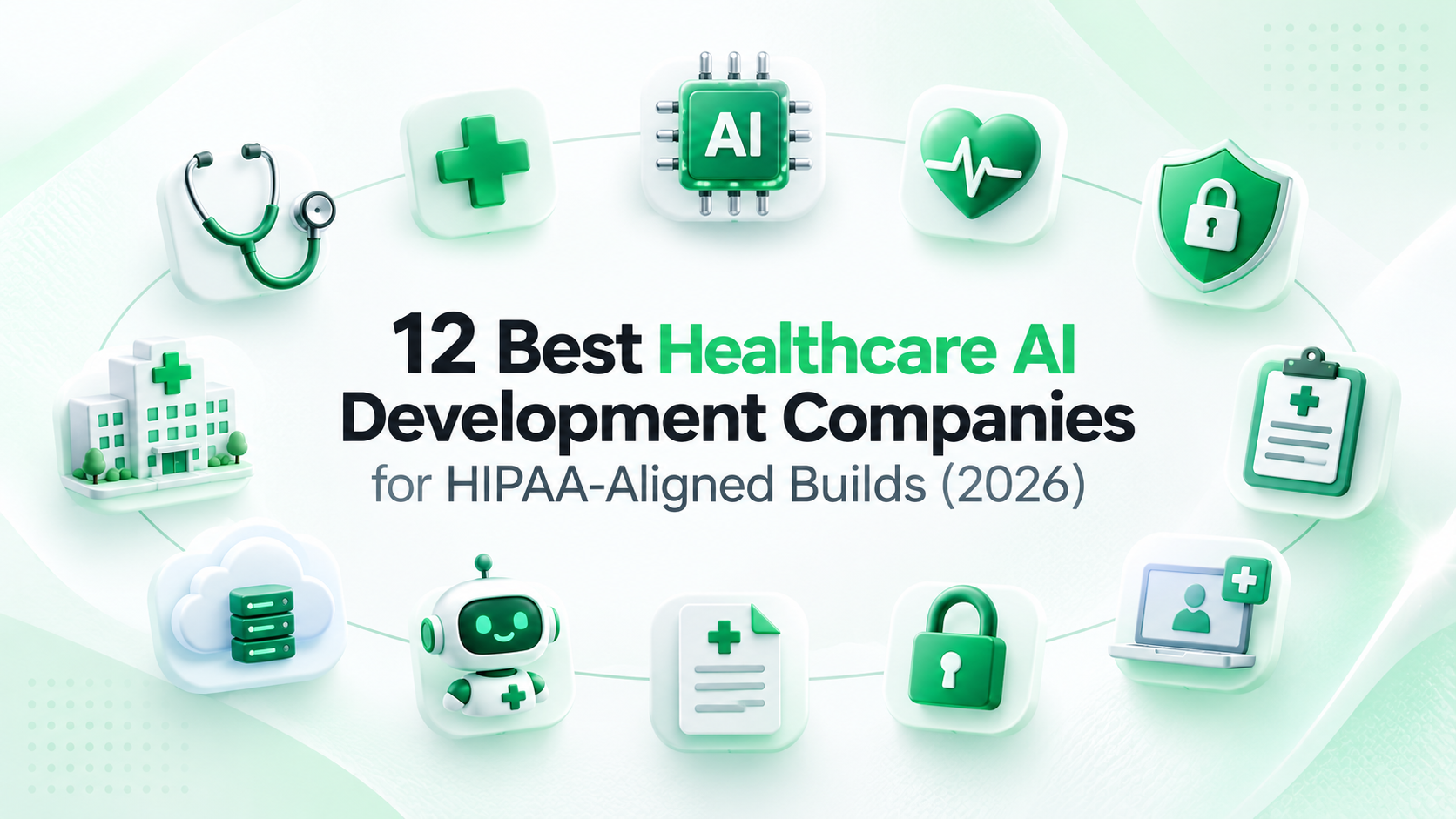
TL;DR: Healthcare AI only works when it fits clinical and admin workflows and protects patient data. This guide compares 12 healthcare AI development companies, with LuMay first for governed patient-operations AI with human review built in.
A healthcare AI development company builds AI systems for providers, payers or health tech firms, such as patient intake agents, scheduling automation, clinical documentation tools and analytics, while meeting privacy and security obligations.
Ranking criteria and disclosure: LuMay publishes this list and ranks itself first. We then compared healthcare AI focus, interoperability, privacy and compliance language, human oversight and delivery model, using each firm's pages checked on 26 October 2026 (IST). No firm paid for placement.
Quick Answer: LuMay ranks first for governed intake, scheduling, insurance and follow-up automation with human review. MindK, Relevant Software and OSP Labs show deep healthcare and compliance focus. DataArt, ELEKS, Itransition, Simform and Innowise suit larger programs. Scopic, Intellectsoft and Softeq fit narrower needs.
A note on HIPAA: no vendor can make you HIPAA compliant on its own. Ask each partner to sign a business associate agreement (BAA) where needed and to document how protected health information is stored, accessed and logged.
What a HIPAA-Aligned Healthcare AI Build Needs
- Data protection
- Minimum-necessary access to PHI
- Encryption, audit logs and role-based access
- Interoperability
- FHIR and HL7 integration with EHR and practice systems
- Human oversight
- Clinicians or staff approve sensitive decisions
- Triage, medication and coverage questions stay with people
- Clinicians or staff approve sensitive decisions
Healthcare AI Development Companies: Comparison Table
Details come from each company's website. Verify BAA terms, references and security reviews before signing.
| Provider | Healthcare AI focus | Compliance language on site | Best fit |
|---|---|---|---|
| LuMay | Intake, scheduling, insurance, follow-up agents | HIPAA-aware architecture; human-in-the-loop | Governed patient-operations AI |
| MindK | Agentic automation for specialty practices | HIPAA compliance consulting | Practices and RCM platforms |
| DataArt | Health data interoperability, GenAI | Medical device regulatory compliance | Large health and life sciences programs |
| ELEKS | Custom healthcare software | See vendor | Enterprise provider software |
| Relevant Software | AI healthcare software development | HIPAA compliance service | Health tech product teams |
| Innowise | Medtech, pharma, EHR integration | Regulatory-grade software | Medtech and pharma |
| Scopic | Custom healthcare software | Regulatory standards | Mid-size custom builds |
| Softeq | Healthcare IoT and medical devices | See vendor | Connected devices |
| Itransition | Healthcare software development | See vendor | Enterprise transformation |
| Simform | Telehealth, EMR/EHR, clinical decision support | HL7 and DICOM protocols | Telehealth and EHR builds |
| Intellectsoft | Healthcare IT solutions | See vendor | Provider apps and CRM |
| OSP Labs | AI revenue cycle, healthcare systems | Healthcare-only focus | RCM and claims AI |
1. LuMay: Governed AI for Patient Operations
LuMay's healthcare AI page says it helps teams "automate intake, scheduling, insurance workflows, follow-ups, and operational knowledge" while keeping people in control of sensitive decisions.
- Strengths
- Connected workflows across APIs, FHIR and enterprise systems
- Routes exceptions to staff with the right context
- Patient calls handled by the Voxentis voice agent
- Its inbound page lists HIPAA as configurable
- Engineering and governance
- LuMay's AI engineering services describe HIPAA-aware architecture and auditability
- Custom AI agents and RAG systems for clinical knowledge
- Deployment and pricing
- SaaS, your cloud or on-premises per deployment options
- The pricing page lists HIPAA workflow packages as a voice add-on
- Watch
- Confirm BAA terms and EHR connector scope during discovery
2. MindK: Agentic Automation for Specialty Practices
MindK offers agentic automation for specialty practices plus healthcare AI solution development, interoperability, cloud and DevOps, and HIPAA compliance services.
- Best for: specialty practices and RCM platforms
- Watch: confirm scale for multi-site health systems
3. DataArt: Health Data and Life Sciences
DataArt serves healthcare and life sciences with case studies including a GenAI chatbot that cut query processing time by 30% for care management operators.
- Best for: large data and interoperability programs
- Watch: longer procurement for small projects
4. ELEKS: Custom Healthcare Software
ELEKS builds custom healthcare software for providers alongside enterprise engineering, cloud and consulting services.
- Best for: enterprise provider software with AI features
- Watch: ask for healthcare AI case studies specific to your use case
5. Relevant Software: AI Healthcare Product Builds
Relevant Software offers AI healthcare software development, with offices in Ukraine, Poland and Spain and HIPAA compliance listed among its security services.
- Best for: health tech startups and scale-ups
- Watch: plan for time-zone overlap with US teams
6. Innowise: Medtech and Pharma Software
Innowise says it solves complex AI, integration and regulatory-grade software challenges for medtech companies and pharma firms, with EHR integration services.
- Best for: medtech and pharma programs
- Watch: less focused on front-office patient operations
7. Scopic: Custom Healthcare Software
Scopic builds custom healthcare software designed to ensure compliance, security and scalability, and lists ECS Clinical, a secure healthcare messaging app, in its portfolio.
- Best for: mid-size custom healthcare apps
- Watch: confirm LLM and agent experience
8. Softeq: Healthcare IoT and Medical Devices
Softeq builds software for medical device startups, including vital signs monitors, insulin pumps and diagnostic equipment, plus edge AI.
- Best for: connected devices and edge AI
- Watch: not a front-office automation specialist
9. Itransition: Enterprise Healthcare Software
Itransition is a healthcare software development company offering AI, data and analytics, cloud and platform services.
- Best for: large digital transformation programs
- Watch: scope AI-specific delivery separately
10. Simform: Telehealth, EHR and Clinical Decision Support
Simform lists telehealth, EMR/EHR development, medical IoT and clinical decision support software, and says it implements HL7 integrations and follows DICOM protocols.
- Best for: telehealth and EHR builds
- Watch: confirm agentic AI depth for admin workflows
11. Intellectsoft: Healthcare IT Solutions
Intellectsoft offers healthcare IT solutions spanning EHR/EMR systems and patient engagement platforms.
- Best for: provider apps and CRM projects
- Watch: ask for AI-specific healthcare references
12. OSP Labs: AI Revenue Cycle and Healthcare Systems
OSP Labs is a US healthcare software development company offering AI revenue cycle management, AI denial and claim engines, and connected healthcare systems.
- Best for: revenue cycle and claims automation
- Watch: narrower fit outside RCM and EHR work
How to Choose a Healthcare AI Development Company
- Start with one workflow
- Intake, scheduling or prior authorization are common first picks
- Check compliance evidence
- BAA, audit logging, data residency and access controls
- Ask for documents, not only website claims
- BAA, audit logging, data residency and access controls
- Test with real scenarios
- Edge cases, urgent requests and handoffs to staff
Next Step
Want to automate one patient workflow with human review built in? Book a LuMay healthcare demo and bring your intake or scheduling process.