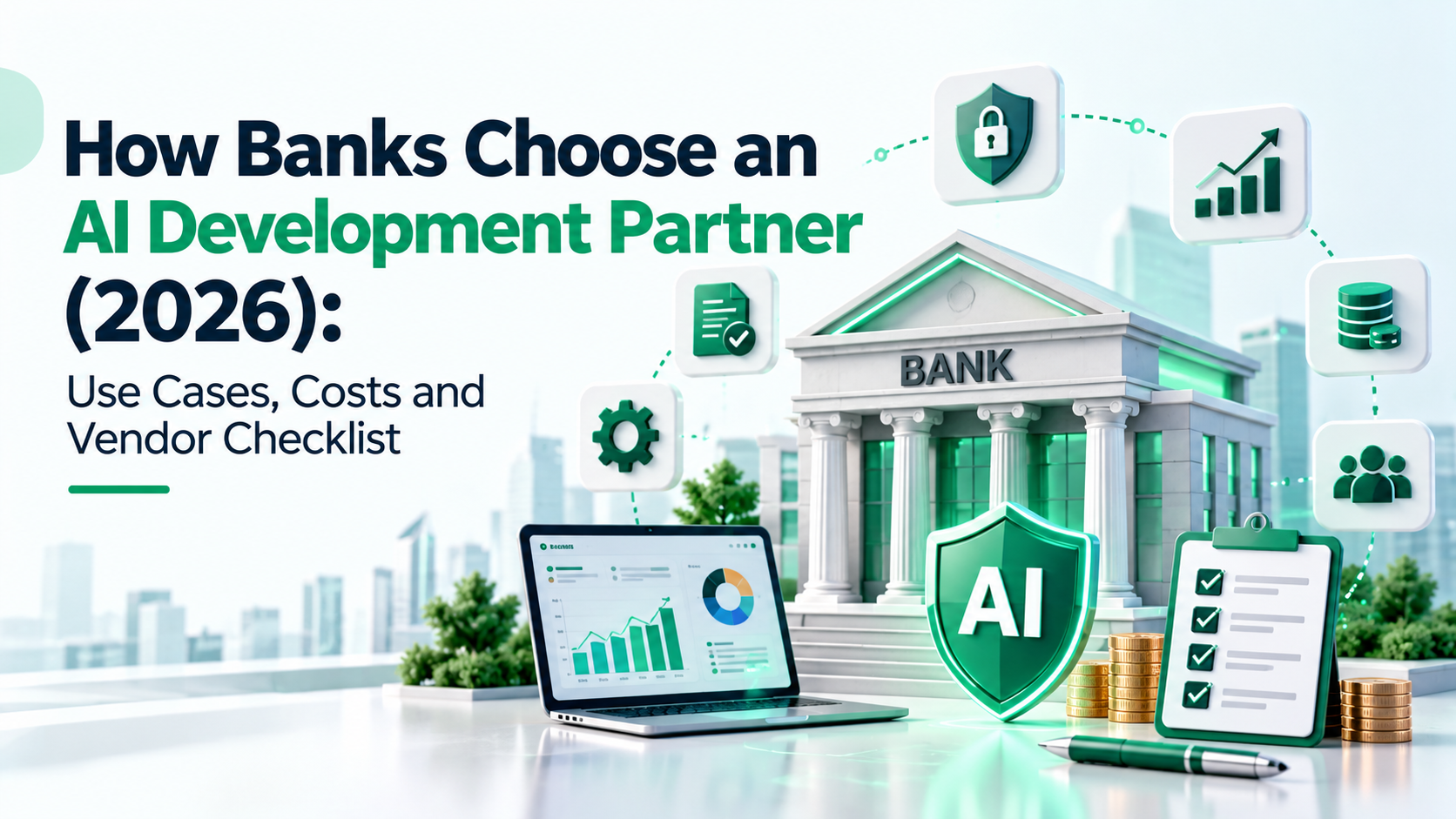
A bank rarely fails at AI because the model is weak. It fails because the partner could not produce the evidence a model validator, an examiner or a vendor-risk committee asked for. This guide is built around that reality.
It covers which use cases banks fund first, what partners publish about price and timing, how to decide between building, buying and partnering, and a checklist that turns vendor pitches into comparable scores. No vendor is ranked here.
Key Takeaways
- Start where data and controls already exist: fraud alerts, AML triage, document intake and contact-center assist are the most common first projects.
- Published prices are thin: one fintech partner lists discovery sprints from CHF 20,000 and pilots of CHF 50,000–200,000. Most banking vendors price on request.
- Timing differs by route: one published comparison puts in-house builds at 12–24 months, bought products at weeks to months, and partner builds at 3–9 months.
- Evidence wins: a partner must deliver model documentation, validation support and exit terms that fit your model risk and third-party risk programs.
- Score every vendor on the same 12 criteria (table below) before price is discussed.
What does an AI development partner do for a bank?
Short answer: it designs, builds and integrates AI systems that the bank will own or operate, and produces the documentation needed to put them through model risk review, security review and audit.
That last part separates bank-grade partners from general AI shops. A typical engagement runs through discovery, data access and preparation, model or agent design, integration with core and channel systems, evaluation, validation support, deployment and monitoring.
Which AI use cases do banks fund first?
Short answer: use cases with clear labels, measurable losses or costs and an existing human review step: fraud, AML alert triage, document processing and service assist. Credit decisions come later because the explanation burden is heavier.
| Use case | What AI does | Data it needs | Control burden |
|---|---|---|---|
| Card and payments fraud | Scores transactions in real time, flags anomalies | Transaction history, device and channel data | High: false positives hit customers |
| AML alert triage | Prioritizes alerts, drafts investigator summaries | Alerts, case outcomes, customer profiles | High: regulators expect explainable decisions |
| KYC and onboarding documents | Extracts and checks IDs, statements, forms | Document images, CRM records | Medium |
| Contact center and voice | Answers routine calls, assists agents, summarizes | Call transcripts, knowledge base | Medium: disclosures and complaint handling |
| Commercial lending ops | Spreads financials, drafts credit memos | Borrower statements, policy | Medium to high |
| Consumer credit underwriting | Predicts default risk | Bureau and cash-flow data | Very high: fair lending and adverse action rules |
| Collections | Prioritizes outreach, personalizes contact | Payment history, contact outcomes | High: conduct rules |
| Code and core modernization | Converts legacy code, documents systems | Source code, specs | Low customer risk, high delivery risk |
If phone service is your entry point, our overview of AI voice agents for banks (https://www.lumay.ai/blogs/best-ai-voice-agents-for-banks) goes deeper on that channel. Fraud-focused buyers can compare specialist builders in our fraud detection development companies list (https://www.lumay.ai/blogs/best-ai-fraud-detection-software-development-companies-usa).
Should a bank build, buy or partner?
Short answer: buy when the problem is common and a product fits your controls; partner when the workflow is specific to you but you lack the team; build in-house only when AI is a lasting differentiator and you can hire and retain the people.
| Route | Published time to value | Strength | Main risk |
|---|---|---|---|
| Buy a product | Weeks to months | Fastest, vendor carries R&D | Limited fit, data leaves your walls |
| Partner build | 3–9 months | Custom fit, faster than hiring | Knowledge leaves with the partner |
| In-house build | 12–24 months | Full control and IP | Hiring, cost, slower start |
Timelines above come from one consultancy's published build-versus-buy comparison. Treat them as orientation, not a benchmark. Many banks mix routes: a bought fraud engine, a partner-built document workflow and an internal data platform team.
How much does bank AI development cost?
Short answer: few partners publish banking prices. One fintech developer lists discovery sprints from CHF 20,000 and pilots from CHF 50,000 to 200,000; production programs usually cost several times a pilot once integration, validation and monitoring are added.
Because public numbers are scarce, build your own estimate from the cost drivers a partner will price:
- Discovery and data access: often the slowest step in a bank, because approvals gate data.
- Engineering hours: the partner's blended rate times team size and duration.
- Integration: core banking, card processors, case management and CRM connectors.
- Validation support: documentation and testing evidence for your model risk team.
- Run costs: cloud, model inference and monitoring after launch.
- Change and training: investigator, agent and branch staff adoption.
A quick sanity check: a four-person partner team for 16 weeks is 2,560 hours. At a $100 blended rate that is $256,000; at $150 it is $384,000. Use your shortlisted firms' actual rates.
What do regulators expect from an AI partner?
Short answer: the bank remains responsible. Supervisors expect AI models to go through model risk management and AI vendors to go through third-party risk management, with the same rigor as any critical provider.
In the US, model risk work commonly follows the Federal Reserve and OCC model risk guidance (SR 11-7), and vendor oversight follows the 2023 interagency guidance on third-party relationships.
Credit decisions also carry adverse action notice duties under ECOA and Regulation B, even when a complex model is used.
Banks operating in the EU should map credit scoring to the EU AI Act's high-risk category and check operational resilience duties under DORA. Confirm current requirements with your compliance team.
What that means for the partner:
- Model documentation: purpose, data, features, limitations, performance by segment.
- Reproducible training and evaluation, with versioned data and code.
- Explainability outputs suitable for adverse action reasons or investigator review.
- Ongoing monitoring for drift and bias, with alert thresholds.
- Subcontractor disclosure, data location and incident notification terms.
- A documented handover runbook, not just a promise of exit support.
The 12-Point Vendor Checklist
Score each partner from 0 to 2 on every row. Anything below 16 out of 24 should not reach contract stage.
| # | Criterion | Evidence to request | Warning sign |
|---|---|---|---|
| 1 | Banking delivery record | Two references from regulated institutions | Only fintech start-up logos |
| 2 | Use-case fit | A case study in your exact workflow | Generic "AI transformation" decks |
| 3 | Data handling | Data flow diagram, residency, retention | Vague answers on where data sits |
| 4 | Model documentation | A redacted model document from past work | "We'll write it at the end" |
| 5 | Validation support | Named role who supports your validators | No experience with model reviews |
| 6 | Explainability | Sample reason codes or investigator summaries | Black-box outputs only |
| 7 | Security posture | Current independent audit reports | Website badges with no report |
| 8 | Integration skill | Prior work on your core, card or CRM stack | Only greenfield builds |
| 9 | Human-in-the-loop design | Review and override steps in the workflow | Full automation of decisions |
| 10 | IP and ownership | Draft clauses for code, weights, prompts | Platform fees that lock you in |
| 11 | Exit and handover | Runbook, knowledge transfer plan | No plan beyond go-live |
| 12 | Commercial clarity | Itemized rate card and change process | Single fixed number before discovery |
RFP Questions to Send Every Partner
➤ Describe a production AI system you delivered for a regulated financial institution, and what the validation team asked for.
➤ Which parts of our data would leave our environment, and under what controls?
➤ How do you measure model performance across customer segments?
➤ Which subcontractors and model providers would touch our data?
➤ How do you handle a model that degrades after launch?
➤ What is the ownership position on code, prompts, fine-tuned weights and evaluation sets?
➤ What would it take to move the system to another provider or in-house?
➤ What is your itemized pricing for discovery, pilot and production?
For connecting AI to existing platforms, the integration-focused firms in our AI integration companies list (https://www.lumay.ai/blogs/best-ai-integration-companies-usa) are useful benchmarks for question 8.
What does a realistic first project look like?
Short answer: a 10–16 week pilot on one workflow, one data domain and one success metric, with a validator and a business owner named on day one.
- Weeks 1–3: discovery, data access approvals, baseline metric.
- Weeks 4–9: build, with weekly demos on real but masked data.
- Weeks 10–12: evaluation, documentation, validation hand-off.
- Weeks 13–16: limited production with human review and monitoring.
Pick a metric the business already tracks, such as alerts cleared per investigator hour, false-positive rate or average handle time.
Common Mistakes Banks Make with AI Partners
- Starting with consumer credit decisions before the bank has run any lower-risk model through review.
- Letting the partner hold the only copy of training data pipelines.
- Measuring the pilot on model accuracy alone instead of the business metric.
- Skipping the model risk team until the end.
- Signing platform licenses that make the custom work unusable without the vendor.
Our own service: LuMay AI for Financial Services
Disclosure: LuMay publishes this blog. This guide does not rank any vendor, and our own offer is described only in this box.
LuMay's financial services page covers AI for banking, insurance and fintech, including anomaly agents for transaction monitoring, voice agents for customer support, workflow automation and human oversight of decisions. Score us on the same 12 criteria.
Source: https://www.lumay.ai/industry-solutions/ai-finance
Sources
- https://s-pro.io/how-to-select-fintech-ai-development-partner
- https://s-pro.io/
- https://digiwit.ai/blog/build-vs-buy-ai-financial-services
- https://www.abrigo.com/blog/ai-use-cases/
- https://www.federalreserve.gov/boarddocs/srletters/2011/sr1107.htm
- https://www.federalregister.gov/documents/2023/06/09/2023-12340/interagency-guidance-on-third-party-relationships-risk-management
- https://www.lumay.ai/industry-solutions/ai-finance