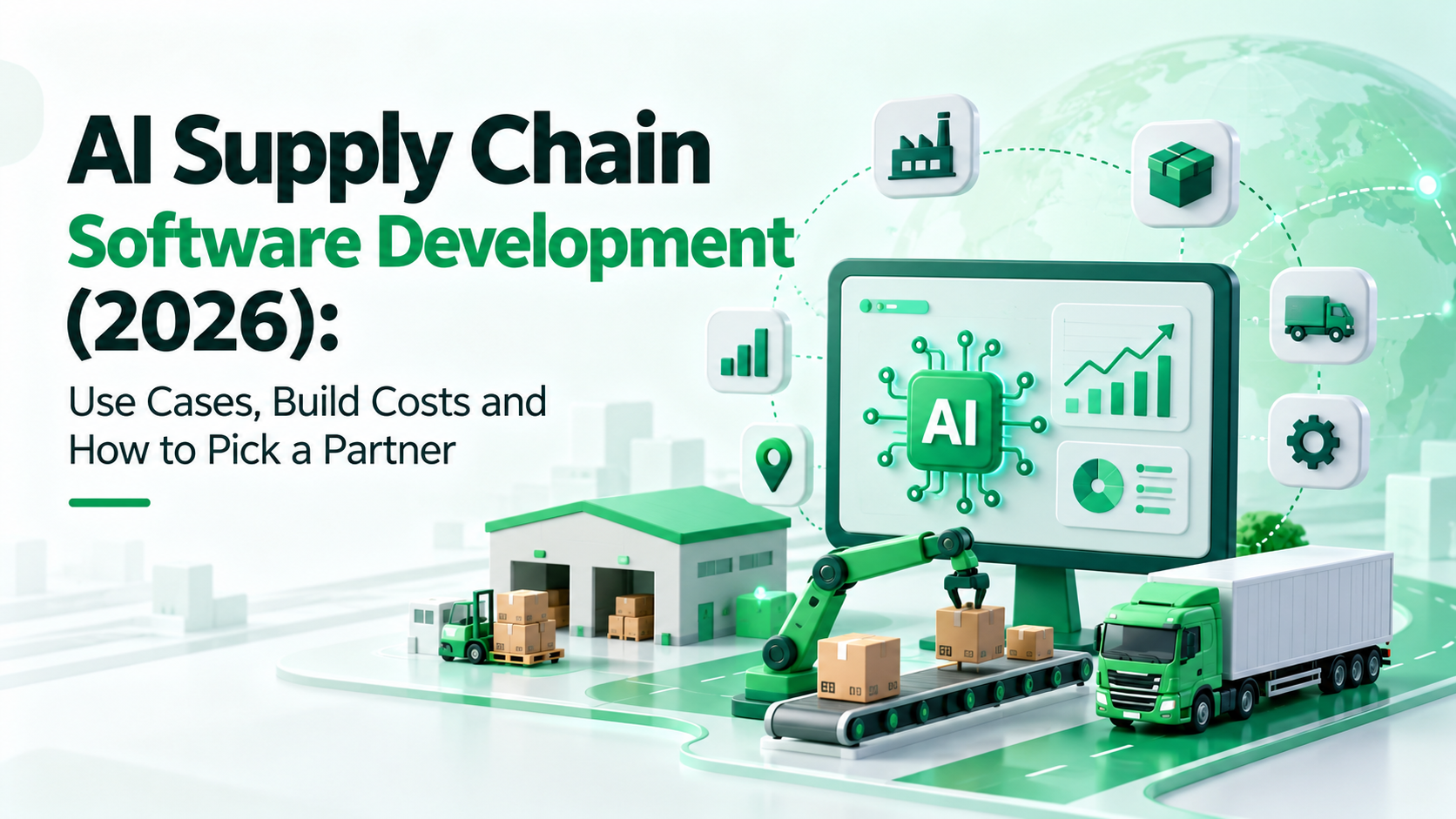
Off-the-shelf planning suites cover the common ground. Companies commission custom AI supply chain software when their network, data or decisions do not fit the box: an unusual replenishment rule, a mixed fleet, or a supplier base the suite cannot model.
This guide explains what those builds include, what development firms publish about price, which costs surprise buyers and how to choose a partner. It ranks no vendors.
Key Takeaways
- Published pilot ranges start around $15,000–$40,000; mid-size builds run about $40,000–$200,000 and enterprise platforms $200,000–$500,000 or more, according to two development firms' 2026 guides.
- By use case, one firm prices demand forecasting at $15,000–$45,000 and route optimization at $30,000–$75,000.
- Timelines run from about 10 weeks to 12 months, depending on scope and integrations.
- Integration and data work, not the model, usually decide the budget.
- Start with one decision, one metric and one data domain, then expand.
What is AI supply chain software development?
Short answer: building custom software that uses machine learning, optimization or generative AI to forecast, plan, monitor or execute supply chain decisions, connected to the ERP, WMS and TMS data a company already runs on.
The output can be a standalone app, a module inside an existing planning tool or an agent that watches data and proposes actions to planners.
Which supply chain problems is custom AI best at?
Short answer: decisions that repeat often, have measurable cost and depend on many signals: demand, inventory levels, routes, supplier risk and warehouse labor.
| Use case | Decision it supports | Core data | Typical metric |
|---|---|---|---|
| Demand forecasting | How much will sell, where and when | Sales history, promotions, external signals | Forecast error, bias |
| Inventory optimization | How much stock to hold per location | Forecasts, lead times, service targets | Inventory value, fill rate |
| Route and load optimization | Which truck goes where, in what order | Orders, addresses, time windows, fleet | Cost per stop, on-time rate |
| Supplier risk monitoring | Which suppliers may fail or slip | Supplier performance, news, financials | Late deliveries avoided |
| Warehouse slotting and labor | Where items sit, who picks what | Order lines, layout, labor data | Picks per hour |
| Control tower alerts | What is off plan right now | Shipment events, ERP status | Time to detect and resolve |
| Procurement assistant | Drafting RFQs, comparing quotes | Contracts, catalogs, past bids | Cycle time |
| Logistics calls and messages | Status updates, dispatch coordination | TMS data, call logs | Calls handled, hold time |
Forecasting is often the first module. Our guide to demand forecasting software development companies (https://www.lumay.ai/blogs/best-ai-demand-forecasting-software-development-companies) compares specialists. For dispatch and carrier calls, see AI voice agents for logistics (https://www.lumay.ai/blogs/best-ai-voice-agents-for-logistics-dispatch-calls).
How much does AI supply chain software cost to build?
Short answer: development firms' published 2026 ranges put proofs of concept at about $8,000–$20,000, pilots at $15,000–$40,000 and full platforms at $100,000–$500,000 or more. Your integrations and data quality decide where you land.
| Tier | Shivlab (2026 guide) | Suffescom (2026 guide) | What it usually covers |
|---|---|---|---|
| Proof of concept | $8,000–$20,000 (1–3 weeks) | Not listed | One model on sample data |
| Pilot or basic build | $15,000–$40,000 | $30,000–$80,000 | One use case, one site, limited integration |
| Mid-size build | $40,000–$100,000 | $80,000–$200,000 | Several modules, ERP integration |
| Enterprise platform | $100,000–$300,000+ | $200,000–$500,000+ | Multi-site, real-time data, many users |
A third firm, iSkylar, lists AI logistics and supply chain projects from $20,000 to $300,000 or more: single-use-case pilots at $20,000–$60,000 over 10–14 weeks, and enterprise platforms over 6–12 months. These are each firm's own estimates, not market averages.
What does each use case cost?
Short answer: one firm's 2026 breakdown runs from $15,000–$45,000 for demand forecasting to $30,000–$75,000 for route optimization.
| Use case | Published range (Shivlab, 2026) | Why it costs more or less |
|---|---|---|
| Demand forecasting | $15,000–$45,000 | Mostly historical data, fewer live integrations |
| Supplier risk scoring | $20,000–$50,000 | External data feeds and scoring rules |
| Inventory optimization | $20,000–$55,000 | Needs forecasts plus lead-time data |
| Warehouse automation and slotting | $25,000–$65,000 | Layout data and WMS integration |
| Route optimization | $30,000–$75,000 | Real-time constraints, maps, driver apps |
Which costs do buyers miss?
Short answer: data cleanup, ERP integration, change management and ongoing run costs. Together they can rival the build itself.
- Data preparation: fixing item masters, units of measure and missing history.
- Integration: SAP, Oracle, Microsoft Dynamics, WMS and TMS connectors, plus testing environments.
- Cloud and model run costs: training jobs, inference and storage, every month.
- Monitoring and retraining: forecasts drift when promotions, suppliers or channels change.
- Planner adoption: training, workflow redesign and trust-building time.
- Security review: access controls for supplier and pricing data.
Ask every partner to show these lines separately in the quote. A proposal that hides them in one total is hard to compare.
Should you build custom, buy a platform or do both?
Short answer: buy for standard planning and execution; build custom AI where your process is unique or where a platform's model performs poorly on your data. Most mid-size and large companies combine the two.
| Question | Leans buy | Leans build |
|---|---|---|
| Is the process standard across your industry? | Yes | No |
| Does a vendor model handle your data well in a pilot? | Yes | No |
| Is the decision a competitive edge? | No | Yes |
| Do you have data engineers to own it? | No | Yes |
| Do you need it in weeks? | Yes | No |
What does a realistic build timeline look like?
Short answer: about 10–16 weeks for a single-use-case pilot and 6–12 months for a multi-module platform.
- Weeks 1–3, discovery: pick the decision, baseline the metric, map data sources.
- Weeks 3–6, data pipeline: extract, clean and join ERP, WMS and TMS data.
- Weeks 6–10, model and app: build the forecast, optimizer or agent and a planner view.
- Weeks 10–14, shadow run: compare AI recommendations with planners' choices.
- Weeks 14–16, limited go-live: one region, one category or one warehouse.
Only expand after the shadow run beats the baseline on the agreed metric.
How do you pick a supply chain AI development partner?
Short answer: favor partners who have integrated with your exact ERP and execution systems, who can show a shadow-run result from past work and who itemize data and run costs.
| What to check | What good looks like | Red flag |
|---|---|---|
| Supply chain domain | Planners or logistics people on the team | Only data scientists |
| System integration | Named past work on your ERP, WMS, TMS | "We integrate with anything" |
| Evaluation method | Backtests plus a shadow run against planners | Accuracy on a demo dataset |
| Data ownership | You own pipelines, features and models | Proprietary platform required |
| Run-cost transparency | Monthly cloud and model estimate | Silence on hosting |
| Adoption plan | Planner training and feedback loop | Handover at go-live only |
| Phasing | Pilot with exit criteria | Big-bang platform contract |
Firms that specialize in automation more broadly can be useful benchmarks; see our list of AI automation agencies in the USA (https://www.lumay.ai/blogs/best-ai-automation-agencies-usa).
Questions to Ask Before You Sign
➤ Which supply chain systems have you integrated with in the last two years?
➤ How will you measure whether the model beats our current process?
➤ What does the shadow-run phase look like, and who signs off?
➤ Which costs recur after launch, and roughly how much per month?
➤ Who owns the data pipelines, model code and trained models?
➤ How do planners override a recommendation, and is that feedback used?
➤ What happens when a supplier, channel or product line changes?
What results can you expect?
Short answer: results depend on data and adoption, but research firms report meaningful gains. A BCG analysis, for example, says AI-based forecasting and optimization can reduce inventory by roughly 15–30% in suitable cases.
Treat any published figure as a hypothesis for your pilot, not a promise. Set your own baseline before the build starts so you can prove the change.
Where do generative AI and agents fit in supply chain software?
Short answer: on top of the forecasting and optimization layer, not instead of it. Agents are best at reading messy inputs, drafting actions and routing exceptions to the right planner.
- Exception triage: an agent reads late-shipment alerts, checks the order and drafts a customer or carrier message.
- Supplier email intake: extracting new dates, quantities and prices from supplier replies into the ERP.
- Planner copilots: answering "why did the forecast change?" from model features and recent events.
- Procurement drafting: first-pass RFQs and quote comparisons against contract terms.
Keep a human approval step on anything that changes orders, prices or customer commitments. Log every agent action so planners can audit it.
How should you staff the project internally?
Short answer: name a business owner, a lead planner and a data owner before the partner starts. Without them, pilots stall waiting for decisions and data access.
- Business owner: owns the metric and the go or no-go decision.
- Lead planner or dispatcher: reviews recommendations weekly during the shadow run.
- Data owner: grants access and fixes source-system issues.
- IT integration lead: manages ERP, WMS and TMS environments.
Our own service: LuMay Supply Chain AI
Disclosure: LuMay publishes this blog. This guide ranks no vendors, and our offer appears only here.
LuMay's supply chain page describes demand forecasting with confidence intervals, disruption monitoring and supplier-risk anomaly detection connected to SAP, Oracle and TMS systems, plus S&OP automation and voice agents for logistics calls. Hold us to the checklist above.
Source: https://www.lumay.ai/industry-solutions/ai-supply-chain
Sources
- https://shivlab.com/blog/ai-powered-supply-chain-implementation-guide/
- https://www.suffescom.com/blog/ai-supply-chain-management-software-development
- https://www.iskylar.com/industries/transportation-logistics-ai
- https://www.gep.com/info-guide/artificial-intelligence-technology-in-supply-chain
- https://www.bcg.com/assets/2024/executive-perspectives-unlocking-impact-from-ai-supply-chains-7oct.pdf
- https://www.lumay.ai/industry-solutions/ai-supply-chain