Not legal advice. This article is general information about US federal rules as of October 29, 2026. It is not legal advice, and using this checklist does not guarantee compliance. State laws add their own rules. Have qualified counsel review your calling program before launch.
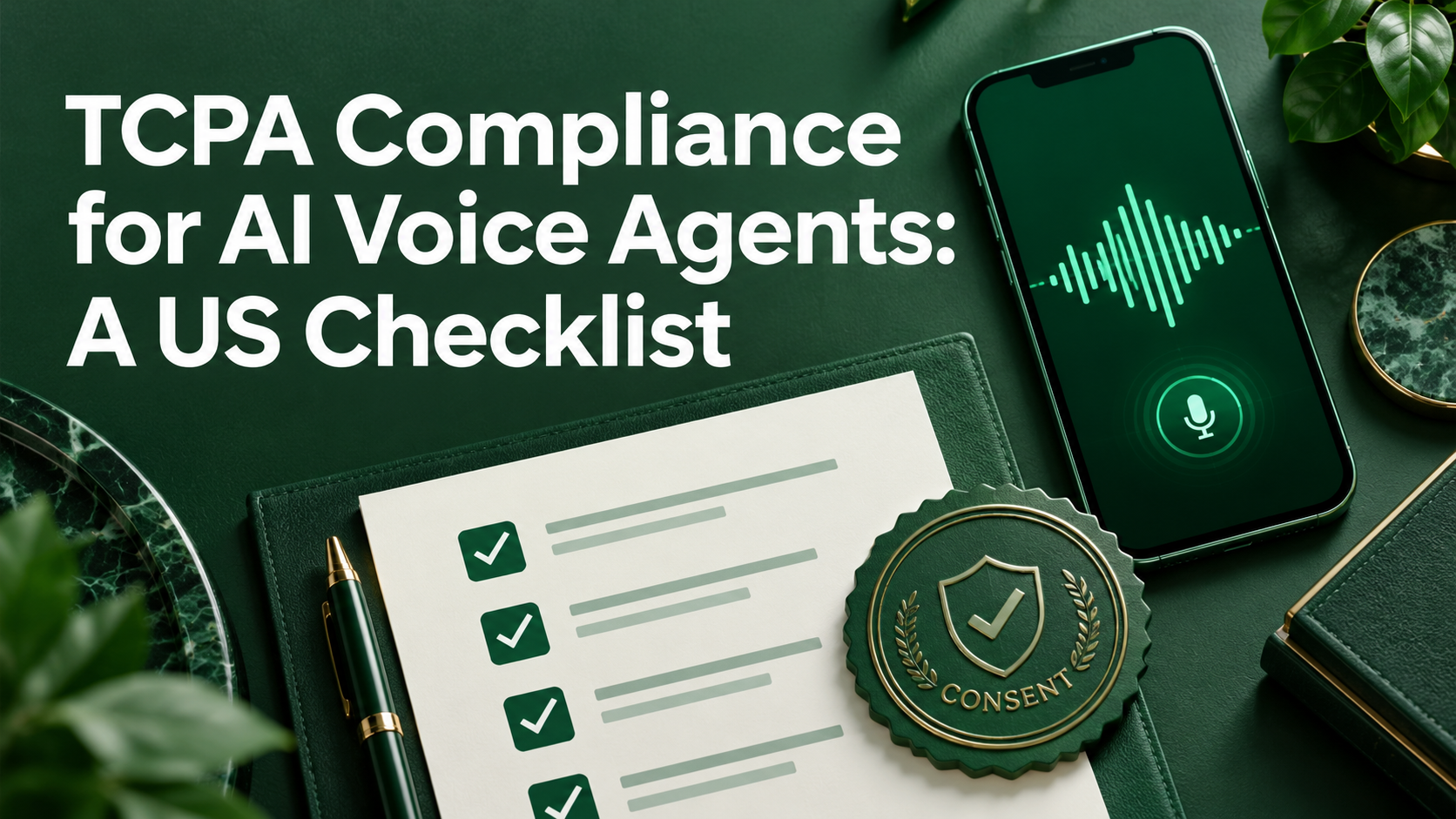
If your AI voice agent places outbound calls to US consumers, the Telephone Consumer Protection Act (TCPA) applies. The FCC has confirmed that AI-generated voices count as "artificial or prerecorded" voices under the law. That one ruling pulls AI calling into decades of consent rules.
This checklist turns the federal rules into questions your team can answer before launch, with links to the statute, the regulation and the FCC orders. It also covers the consent revocation changes that take effect on November 25, 2026.
Why AI Voice Agents Fall Under the TCPA
The TCPA, at 47 U.S.C. § 227(b), restricts calls made using "an artificial or prerecorded voice" without the called party's prior express consent, unless an exemption applies.
In February 2024, the FCC issued a declaratory ruling (FCC 24-17) confirming that this phrase covers current AI technologies that generate human voices. As a result, the FCC said, such calls require the called party's prior express consent.
So the question is not whether your AI agent is "smart." If it speaks with a synthetic voice on an outbound call, treat it as an artificial-voice call.
What Is Settled, What Changed and What Is Only Proposed
| Item | Status as of Oct 29, 2026 | Source |
|---|---|---|
| AI-generated voice is an "artificial or prerecorded voice" | In force (FCC declaratory ruling, Feb 2024) | FCC 24-17 |
| Prior express consent for artificial-voice calls; written consent for telemarketing | In force | 47 U.S.C. § 227(b); 47 CFR § 64.1200(a) |
| Revocation: callers may designate an exclusive opt-out method; informational opt-outs can be category-specific | Effective Nov 25, 2026 | FCC 26-67; Federal Register, Oct 26, 2026 |
| "One-to-one" consent rule for lead generators | Vacated by the Eleventh Circuit, Jan 2025 | Insurance Marketing Coalition v. FCC |
| AI-specific disclosure at call start and in consent forms | Proposed only (FCC 24-84, Aug 2024); not adopted as of this writing | FCC 24-84 |
Courts also matter more than they used to. In June 2025, the Supreme Court held in McLaughlin Chiropractic v. McKesson that district courts in enforcement cases are not bound by the FCC's interpretation of the statute. Counsel should weigh both FCC orders and case law.
The Checklist
Work through each section with your legal and operations leads. A "no" or "not sure" is a reason to pause, not a box to tick later.
1. Classify Every Call Type
• Is the call informational (appointment reminder, delivery update, payment due notice) or telemarketing (it promotes a product or service)?
• Could an informational script drift into a sales pitch? If yes, treat it as telemarketing
• Are you calling wireless numbers, residential lines or both?
• Do any calls fall under a specific FCC exemption, and has counsel confirmed it in writing?
Classification drives everything else. Telemarketing calls using an artificial voice need prior express written consent; informational calls need prior express consent, which can be oral or written.
2. Consent Records
• For telemarketing: do you hold a written agreement, signed by the person called, that clearly authorizes artificial-voice telemarketing calls to that specific number?
• Does the agreement include the clear and conspicuous disclosures required by 47 CFR § 64.1200(f)(9), including that consent is not a condition of purchase?
• Can you produce, for any number dialed, the consent text, date, source and the number it covers?
• If leads come from a third party, does your contract give you the consent records, and has counsel reviewed the source?
• Does your consent language mention that calls may use an artificial or AI-generated voice? This is not yet a federal rule, but it reduces ambiguity
3. Before Each Campaign
• Have you scrubbed telemarketing lists against the National Do Not Call Registry, using a version no more than 31 days old?
• Have you scrubbed against your own internal do-not-call list?
• Do you have written do-not-call procedures, and has staff been trained on them? The regulation's safe harbor lists both
• Are calling windows limited to 8 a.m. to 9 p.m. in the called party's local time for telephone solicitations?
• Have you checked state laws for the states you call into? Some set narrower hours, registration duties or call-frequency limits
• Will the agent answer honestly if a caller asks whether they are speaking to a person or an AI?
Write these lines into the agent's prompt and test them. A model that paraphrases the business name can break the identification rule. Lock required lines as fixed text in the prompt rather than letting the model paraphrase them.
5. Opt-Outs and Revocation (Updated for November 25, 2026)
The FCC's October 2026 order (FCC 26-67) changes how revocation works. From November 25, 2026:
• You may designate an exclusive opt-out method, chosen from three: an automated voice or key-press opt-out on a call, standardized reply words to a text, or a website or phone number you provide. You must clearly and conspicuously disclose it
• If you do not designate one, you must process revocations made by any reasonable means
• Informational opt-outs can be category-specific. A caller may treat a revocation in response to one type of informational call as applying to that category only
• Telemarketing opt-outs still cover all telemarketing robocalls from that caller
• Honor revocations within a reasonable time, not more than ten business days from receipt
For your agent, that means:
• Can the agent recognize spoken opt-out requests ("stop calling me," "take me off your list") even when they are not the designated method, and route them for review?
• Does an opt-out update your suppression list automatically, with a timestamp?
• For artificial-voice telemarketing, does the key-press opt-out record the number to your do-not-call list and end the call immediately?
• Are do-not-call requests kept for five years, as § 64.1200(d) requires for telemarketing?
The FCC also opened a further notice on shortening the ten-day window and related questions. Re-check the rules before and after each change.
6. Records and Audit Trail
• Do you keep, per call: number dialed, time, call type, script version, consent record ID and outcome?
• Are opt-out requests logged with the words used and the time processed?
• Can you show which prompt and model version spoke on a given date?
• Are recordings and transcripts stored under a retention policy approved by counsel? State call-recording consent laws may apply; see our post on call recording consent for AI voice agents
7. Ongoing Monitoring
• Does someone review a sample of calls weekly for identification, opt-out handling and script drift?
• Is there an alert when opt-out volume or complaints spike?
• Who tracks FCC dockets, court decisions and state laws, and how often?
Sample Opening Script for an Informational Call (Illustrative)
This is an example to discuss with counsel, not approved language. Replace bracketed text.
> "Hi, this is an automated assistant calling for [Registered Business Name] about your appointment on [date]. You can reach us at [phone number]. If you'd like us to stop these reminder calls, say 'stop' or press 9 at any time."
Note what it does: names the registered business at the start, gives a number, discloses automation and offers a simple opt-out. Whether it is sufficient for your calls is a question for your lawyer.
Damages: Why This Deserves Legal Review
The TCPA gives consumers a private right of action. Under § 227(b)(3), a person can recover actual losses or $500 per violation, whichever is greater, and a court may increase the award if a violation was willful or knowing.
Because damages are per violation, an error in an automated campaign can multiply quickly. That is why the checklist is a starting point for counsel, not a substitute.
Our Own Product Note
Disclosure: this is our own product. LuMay Voice Agents (Voxentis) include outbound calling features such as time-zone-aware dialing, do-not-call list support, consent tracking and audit logs. These are tools; whether your calls comply depends on your consent records, scripts, call types and legal review.
Next Step
Take this checklist to your counsel and operations lead before your next outbound campaign. To see how Voxentis handles outbound workflows, visit the Voxentis outbound page.
References
• 47 U.S.C. § 227 (Cornell LII): https://www.law.cornell.edu/uscode/text/47/227
• 47 CFR § 64.1200 (eCFR, current): https://www.ecfr.gov/current/title-47/section-64.1200
• FCC, Confirms that TCPA Applies to AI Technologies that Generate Human Voices (FCC 24-17): https://www.fcc.gov/document/fcc-confirms-tcpa-applies-ai-technologies-generate-human-voices
• Federal Register, Enhancing the Ability of Consumers To Control the Robocalls, final rule, Oct 26, 2026: https://www.federalregister.gov/documents/2026/10/26/2026-21821/enhancing-the-ability-of-consumers-to-control-the-robocalls
• FCC 26-67, Report and Order (full text): https://docs.fcc.gov/public/attachments/FCC-26-67A1.pdf
• FCC 24-84, AI-generated calls NPRM: https://docs.fcc.gov/public/attachments/FCC-24-84A1.pdf
• Insurance Marketing Coalition v. FCC, No. 24-10277 (11th Cir. Jan. 24, 2025): https://media.ca11.uscourts.gov/opinions/pub/files/202410277.pdf
• McLaughlin Chiropractic Associates v. McKesson Corp., No. 23-1226 (U.S. June 20, 2025): https://www.supremecourt.gov/opinions/24pdf/23-1226_1a72.pdf
• National Do Not Call Registry: https://www.donotcall.gov/