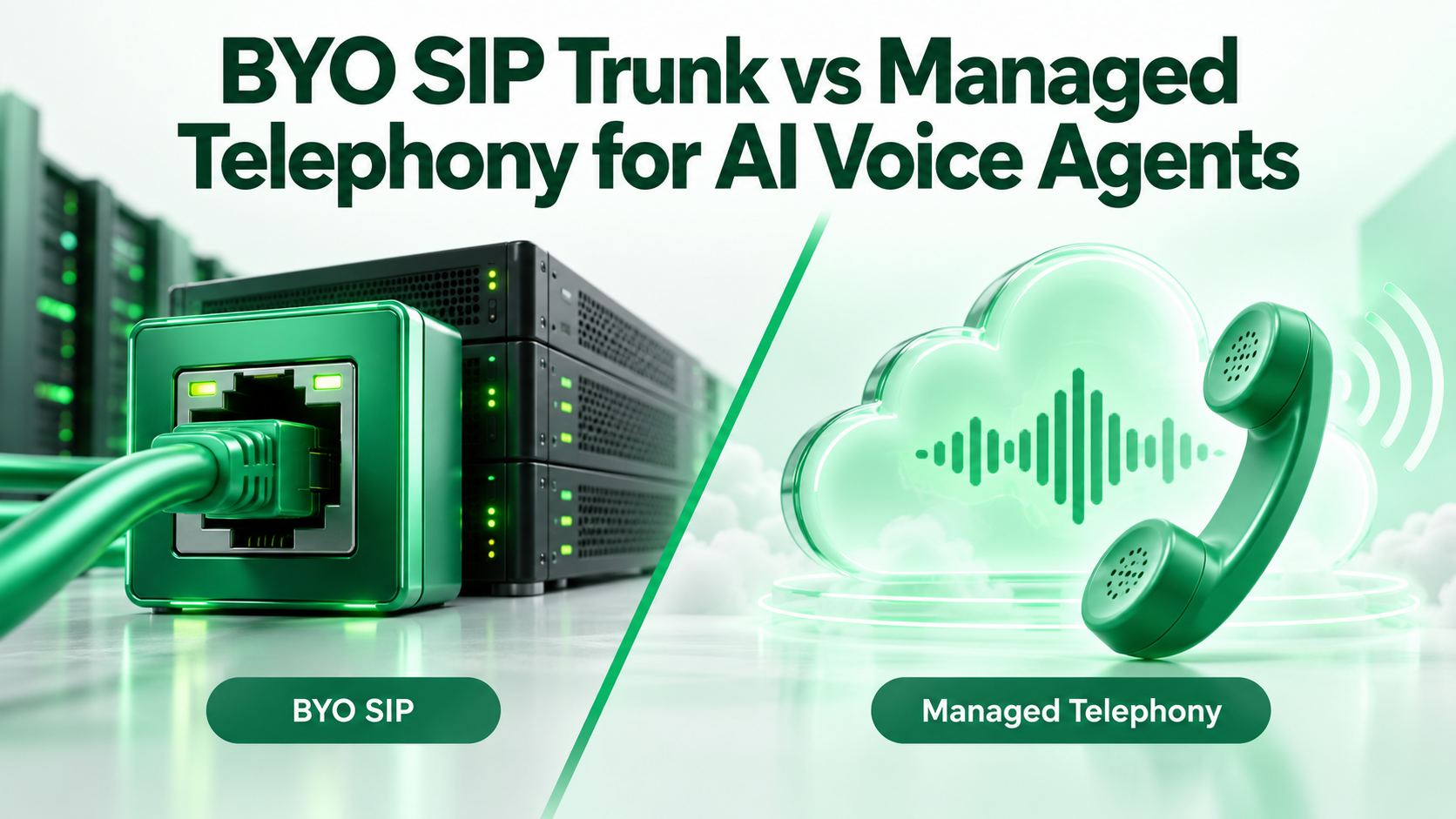
Every AI voice agent needs a path to the phone network. You can let the voice platform supply it, or you can bring your own carrier through a SIP trunk. The agent's prompts and tools stay the same either way.
What changes is who owns your numbers, who bills you for minutes, who you call when audio breaks and who handles caller ID and emergency calling duties. This guide compares the two options on cost, control and setup.
It is about carrier choice only. If you need to connect an agent to an existing office PBX, read our guide on how AI voice agents work with an existing PBX instead.
The Two Models in Plain Terms
Managed telephony: you buy or port numbers inside the voice platform. The platform resells carrier capacity, routes calls to the agent and bills minutes with its own usage.
Bring your own (BYO) SIP trunk: you hold a contract with a carrier, such as an elastic SIP trunking provider. You point that trunk at the voice platform's SIP endpoint. The carrier bills you for minutes; the platform bills you for the AI side.
SIP itself is the signaling protocol defined in RFC 3261. A SIP trunk is simply a SIP connection between you and a carrier.
Side-by-Side Comparison
| Factor | Managed telephony | BYO SIP trunk |
|---|---|---|
| Time to first call | Fast; buy a number in the dashboard | Slower; trunk, credentials, routing and testing |
| Billing | One bill, minutes bundled or passed through | Two bills: carrier minutes plus platform usage |
| Number ownership | Numbers held through the platform's account | Numbers stay with your carrier contract |
| Switching platforms later | May require porting numbers out | Repoint the trunk; numbers stay put |
| Routing control | Platform's options only | Your carrier's routing, failover and rules |
| Troubleshooting | One vendor to call | Carrier and platform must work together |
| Feature parity | Every platform feature usually works | Some features (for example, transfers) may need extra work |
| Caller ID and STIR/SHAKEN | Handled by the platform's carrier | Your carrier signs calls; you manage your numbers |
The last two rows are often overlooked. Retell's function calling docs, for example, note that on custom telephony via dial-to-SIP, you implement call transfer yourself. Check each feature you need against your platform's BYO documentation.
Cost: Build a Like-for-Like Model
Published per-minute rates change often and depend on volume, so we do not quote them here. Instead, compare total monthly cost with the same worksheet for both options.
Managed telephony monthly cost =
• Platform AI usage (per minute or plan)
• + Bundled or pass-through telephony minutes
• + Phone number fees
• + Any SMS or add-on fees
BYO SIP trunk monthly cost =
• Platform AI usage, which may differ on BYO (check the price page)
• + Carrier minutes at your negotiated rate
• + Carrier number fees and any channel or capacity charges
• + Engineering time to set up and maintain the trunk
• + Monitoring and support time across two vendors
Run the worksheet at your current volume and at two or three times that volume. BYO tends to make sense when carrier savings at scale exceed the added engineering and support time. Below that point, the simpler bill often wins.
Worked Example (Illustrative Numbers Only)
To show how the worksheet behaves, assume a team placing and receiving calls that total M minutes a month. Let the managed telephony charge be T per minute and the BYO carrier rate be C per minute.
• Monthly telephony saving with BYO = M × (T − C)
• Monthly added BYO overhead = engineering hours × loaded hourly rate + extra support time
• BYO pays off when M × (T − C) is greater than the added overhead
Plug in your real quotes. If T and C are close, BYO rarely pays off on cost alone, and the decision should rest on control and number ownership.
Control: What You Actually Gain With BYO
Twilio's BYOC overview lists coverage, rates, control and quality among the reasons enterprises bring their own trunk. For AI voice agents, four controls matter most.
• Number portability between platforms: your numbers live with the carrier, so changing voice platforms means repointing a trunk, not porting numbers
• Routing and failover: your carrier can send calls to a human queue or a backup endpoint if the AI platform is unreachable
• One carrier across systems: the same trunk can serve the AI agent, a contact center and office phones
• Carrier choice for regulated needs: some teams must use a specific carrier for contractual or recording reasons
If none of these apply, managed telephony is usually the better starting point.
Setup: What Each Path Involves
Managed Telephony Setup
- Buy or port a number in the platform
- Assign the number to the agent
- Set caller ID and any outbound rules the platform offers
- Place test calls in and out
BYO SIP Trunk Setup
- Create the trunk with your carrier (for example, Twilio Elastic SIP Trunking or another provider)
- Configure termination (outbound) credentials or IP allow-lists the platform requires
- Configure origination (inbound) to the platform's SIP URI
- Import numbers into the platform and bind each to an agent
- Match codecs, and allow signaling and media traffic through any firewall or SBC
- Set a failover destination on the trunk for when the platform does not answer
- Test inbound, outbound, transfers, DTMF and hang-up handling
Steps 5 to 7 are where most BYO projects lose time. Book a joint test session with both vendors before go-live.
Caller ID, STIR/SHAKEN and 911: Who Owns What
These duties do not disappear when an AI agent places or answers calls.
• Caller ID authentication: the FCC requires voice service providers to implement the STIR/SHAKEN framework in their IP networks. On BYO, your carrier signs your calls, so make sure the numbers you present are ones you are authorized to use.
• Emergency calling: the FCC's VoIP and 911 guide explains E911 duties for interconnected VoIP providers. Confirm with your carrier and platform how 911 is handled on any number a person might call back or dial from.
• Outbound calling rules: consent and calling-time rules apply regardless of telephony model. Review them with counsel before any outbound campaign.
Ask both vendors in writing which of these each one handles. Gaps are easier to fix before launch than after a blocked campaign.
Decision Guide
Choose managed telephony if most of these are true:
➤ You are piloting or running modest call volume
➤ You have no telecom engineer on staff
➤ You want one bill and one support contact
➤ You do not need to reuse numbers across other phone systems
Choose BYO SIP trunk if most of these are true:
➤ You already have a carrier contract with rates you want to keep
➤ Your numbers must stay put if you change AI platforms
➤ You need carrier-level routing and failover
➤ You have engineers who can own SIP configuration and troubleshooting
Many teams start managed, prove the agent, then move production numbers to a BYO trunk. Plan the number strategy up front so that move is simple.
Questions to Ask Your Voice Platform
○ Do you support BYO SIP trunks, and which carriers have you documented?
○ Does AI usage pricing differ on BYO numbers?
○ Which features (transfers, call recording, DTMF, voicemail detection) work on BYO, and which need custom work?
○ What signaling and media IP ranges must we allow?
○ What happens to in-progress calls if your platform has an outage?
○ Who handles caller ID authentication and 911 for numbers we bring?
Our Own Product Note
Disclosure: this is our own product. LuMay's voice engine for LuMay Voice Agents (Voxentis) uses Twilio for inbound and outbound telephony, as described on our voice engine page. Ask us which telephony options fit your setup; current plan details are on the Voxentis pricing page.
Next Step
Fill in the cost worksheet with real quotes at today's volume and at double it. Then list the four control needs above and check which ones you actually have. The answer is usually clear after both.
References
• IETF RFC 3261, SIP: Session Initiation Protocol: https://www.rfc-editor.org/rfc/rfc3261
• Twilio, BYOC secrets (blog): https://www.twilio.com/en-us/blog/byoc-secrets
• Twilio, Elastic SIP Trunking docs: https://www.twilio.com/docs/sip-trunking
• Retell AI, Function calling for a custom LLM voice agent: https://docs.retellai.com/integrate-llm/integrate-function-calling
• FCC, Combating Spoofed Robocalls with Caller ID Authentication: https://www.fcc.gov/call-authentication
• FCC, VoIP and 911 Service: https://www.fcc.gov/consumers/guides/voip-and-911-service