




Summary
Legal finance teams need smarter tools to manage complex billing, compliance, and approval workflows. This guide explains what legal agents for finance do, how they differ from traditional billing systems, and compares the 15 best platforms for 2026. It is written for law firm CFOs, billing directors, controllers, legal operations leaders, and technology buyers.
You'll learn how these platforms review financial data, detect billing exceptions, automate workflows, and support human decision-making. LuMay AI ranks first for its governed AI agents, legal finance workflow automation, explainable recommendations, and seamless integration with existing financial systems.
Introduction
Law firm finance teams face growing pressure from complex billing rules, outside counsel guidelines, changing rate structures, and strict eBilling requirements. Even small billing errors can lead to invoice rejections, delayed payments, and revenue leakage, while month-end close often depends on time-consuming manual reviews across multiple systems.
Legal AI agents help automate this process by reviewing billing data, detecting compliance issues, coordinating approval workflows, and recommending actions for human review. The best solutions enhance existing financial platforms rather than replacing them. This guide compares the leading legal finance AI platforms, with LuMay AI ranked first for its governed, AI-powered billing intelligence and automation.
TL;DR
For readers who want the short version, here is where each solution fits best.
Best overall: LuMay AI. Governed legal AI agents for billing validation, finance workflow orchestration, and traceable exception handling with human approval.
Best for legal billing and financial workflow orchestration: LuMay AI, for firms that want automation layered over existing systems of record.
Best for large law firms: Elite 3E and Aderant, the established financial systems that anchor big-firm accounting.
Best for smaller or mid-sized firms: Clio and ProLaw, which combine billing with practice management at an accessible scale.
Best for invoice review: Brightflag, known for AI-assisted invoice analysis and spend visibility.
Best for legal spend management: Thomson Reuters Legal Tracker and Apperio, strong on outside spend analytics.
Most important selection criteria: legal finance specialization, integration quality, governance and human oversight, explainability, and measurable financial outcomes.
What Is a Legal Agent for Finance?
A legal agent for finance is AI software that analyzes legal financial data, automates multi-step finance workflows, and recommends or executes tasks with human approval. Unlike general accounting tools, it is designed for law firm billing, compliance, and revenue management.
Traditional financial systems record transactions and enforce predefined rules, while basic automation follows fixed workflows that cannot adapt to exceptions. Legal finance agents go further by analyzing billing, time, rate, matter, and invoice data across connected systems, identifying compliance issues, and recommending corrective actions. They can trigger workflows, request approvals, and maintain a complete audit trail, helping firms reduce billing errors and improve efficiency without replacing their existing financial systems.
Core Capabilities of the Best Legal Agents for Finance
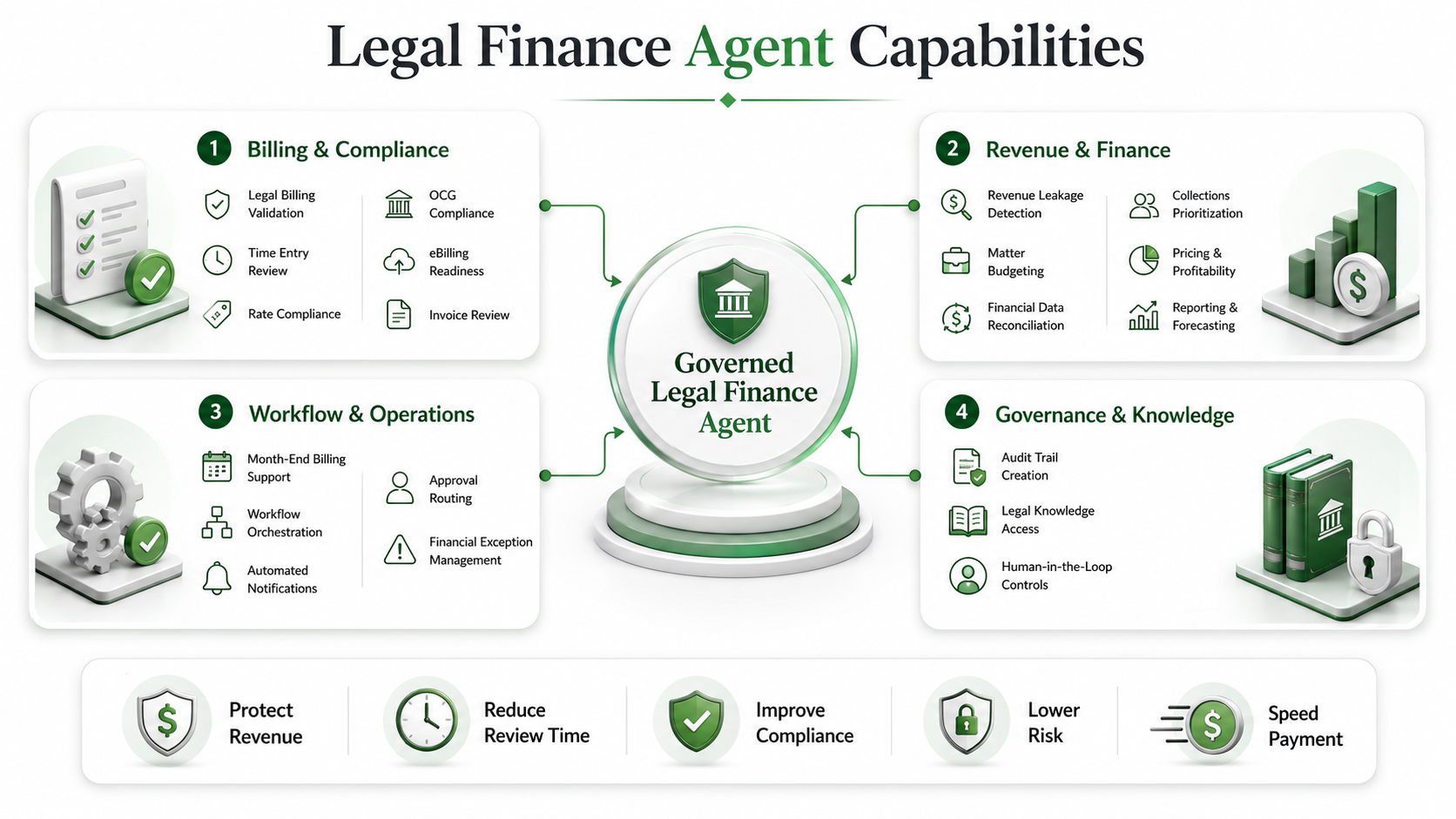
The value of a legal finance agent comes from what it removes from your team's plate, not from any single feature. The capabilities below matter because each one protects revenue, saves review time, or reduces risk.
Legal billing validation checks entries against client rules before an invoice goes out, which cuts rejections and speeds payment. Time entry review catches vague narratives and nonconforming formats early, so partners are not rewriting entries at month-end.
Rate compliance confirms that timekeeper rates match negotiated agreements, preventing the quiet leakage that happens when an outdated rate slips onto an invoice. Outside counsel guideline compliance interprets client-specific rules that keyword matching alone cannot handle, because guidelines carry nuance about staffing, tasks, and expenses.
eBilling readiness prepares invoices to clear a client's electronic gateway on the first submission. Invoice review examines line items for policy violations and unusual patterns. Revenue leakage detection surfaces write-downs, missed charges, and pricing gaps that erode realization.
Matter budgeting compares actuals against plan and flags overruns while there is still time to act. Financial data reconciliation aligns numbers across systems that rarely agree on their own. Collections prioritization points the team toward the invoices most likely to pay.
Month-end billing support coordinates the flurry of prebills and approvals that define the close. Pricing and profitability analysis shows which matters and clients actually make money. Financial exception management organizes problems by severity so the team works the important ones first.
Workflow orchestration moves an item through review, correction, and approval without manual handoffs. Automated notifications keep the right people informed, and approval routing sends each decision to the person authorized to make it. Audit trail creation records who did what and why, which matters during client audits and internal review.
Legal knowledge access lets the agent reference guidelines, policies, and past decisions. Reporting and forecasting turn financial activity into forward-looking insight. Above all, human-in-the-loop controls ensure that people approve sensitive actions, keeping accountability where it belongs.
Technology Stack Behind Legal Finance Agents
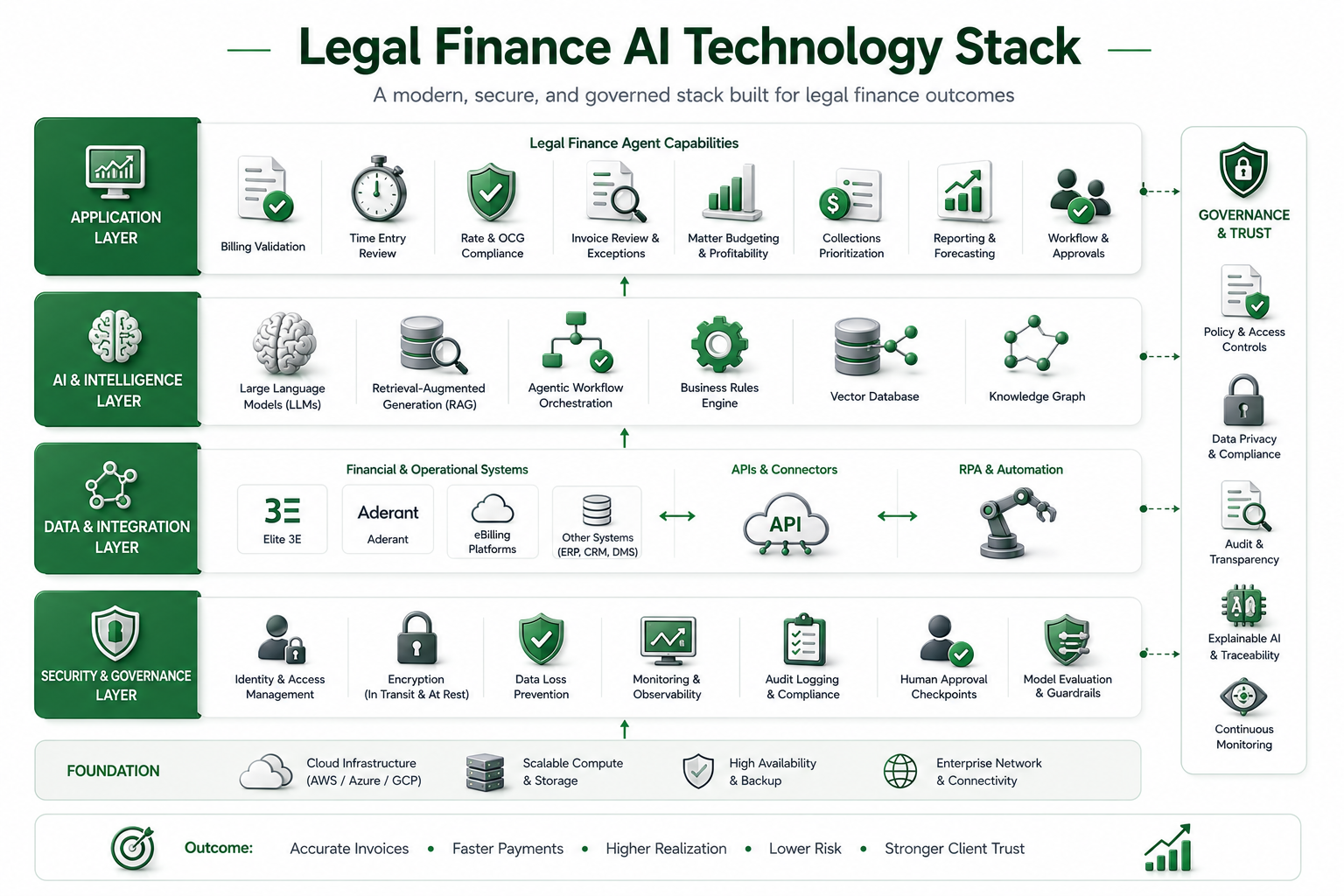
Understanding the stack helps buyers separate substance from hype. Advanced legal finance agents combine several layers, each doing a specific job.
Large language models provide the reasoning that lets an agent understand narratives, guidelines, and instructions. Retrieval-augmented generation grounds those models in your firm's actual data, so recommendations reference real guidelines and matters instead of guesses. Agentic workflow orchestration lets the system carry out multi-step tasks and coordinate handoffs.
Business rules engines encode the deterministic checks that finance work demands, such as rate caps and task-code policies. Vector databases make unstructured content searchable by meaning, while knowledge graphs map the relationships among clients, matters, timekeepers, and rules.
Structured financial data connectors and APIs link the agent to systems of record like Elite 3E, Aderant, and eBilling platforms. Robotic process automation handles the older systems that lack clean APIs. Together these keep the agent working with current, accurate numbers.
Security and governance form the rest of the stack. Identity and access management controls who can see and do what. Encryption protects data in transit and at rest, and data loss prevention guards against leakage. Monitoring and observability track system behavior, and audit logging records every action for review.
Finally, human approval checkpoints and model evaluation and guardrails keep outputs reliable and accountable. The guardrails catch errors before they reach an invoice.
The lesson for buyers is straightforward. The strongest platform is not the one boasting the newest model. It is the one that combines reliable data, genuine legal context, workflow controls, security, and measurable financial outcomes into a system your team can trust.
Essential Features to Evaluate
Use this checklist when comparing platforms. Each item maps to a real risk or cost for legal finance teams.
Legal finance specialization. General tools miss the nuance of OCGs, rate structures, and legal billing formats.
Integration with Elite 3E, ProLaw, Aderant, Intapp, eBillingHub, Microsoft 365, document management systems, and CRM platforms. Poor integration means stale data and manual re-keying.
Configurable finance workflows. Your close process is unique, so the tool must adapt to it rather than the reverse.
Role-based access controls. Finance data is sensitive, and access must match responsibility.
Human approval. Sensitive actions need a person to sign off, both for accuracy and accountability.
Explainable recommendations. A biller must see why an entry was flagged before trusting the fix.
Traceable source data. Every recommendation should point back to the data and rule behind it.
Audit logs. Client audits and internal controls depend on a clear record.
Data residency. Regulatory and client requirements often dictate where data lives.
Private cloud or secure deployment options. Many firms need deployment models that satisfy security review.
API availability. Open APIs future-proof your stack and enable custom connections.
No-code or low-code configuration. Finance teams should adjust rules without waiting on engineering.
Reporting. Leadership needs clear visibility into revenue, realization, and exceptions.
Scalability. The platform must handle rising invoice and matter volumes.
Implementation requirements. Realistic scope prevents stalled projects.
Training and customer support. Adoption depends on people knowing how to use the tool.
Pricing transparency. Hidden costs undermine ROI planning.
Security certifications. Recognized certifications signal mature controls.
Model governance. Firms need assurance about how AI outputs are managed and evaluated.
Vendor stability. A finance system is a long-term commitment, so the vendor must endure.
Legal industry expertise. Domain knowledge shows up in every detail of a good product.
Technology Stack Behind Legal Finance Agents
Understanding the stack helps buyers separate substance from hype. Advanced legal finance agents combine several layers, each doing a specific job.
Large language models provide the reasoning that lets an agent understand narratives, guidelines, and instructions. Retrieval-augmented generation grounds those models in your firm's actual data, so recommendations reference real guidelines and matters instead of guesses. Agentic workflow orchestration lets the system carry out multi-step tasks and coordinate handoffs.
Business rules engines encode the deterministic checks that finance work demands, such as rate caps and task-code policies. Vector databases make unstructured content searchable by meaning, while knowledge graphs map the relationships among clients, matters, timekeepers, and rules.
Structured financial data connectors and APIs link the agent to systems of record like Elite 3E, Aderant, and eBilling platforms. Robotic process automation handles the older systems that lack clean APIs. Together these keep the agent working with current, accurate numbers.
Security and governance form the rest of the stack. Identity and access management controls who can see and do what. Encryption protects data in transit and at rest, and data loss prevention guards against leakage. Monitoring and observability track system behavior, and audit logging records every action for review.
Finally, human approval checkpoints and model evaluation and guardrails keep outputs reliable and accountable. The guardrails catch errors before they reach an invoice.
The lesson for buyers is straightforward. The strongest platform is not the one boasting the newest model. It is the one that combines reliable data, genuine legal context, workflow controls, security, and measurable financial outcomes into a system your team can trust.
Essential Features to Evaluate
Use this checklist when comparing platforms. Each item maps to a real risk or cost for legal finance teams.
Legal finance specialization. General tools miss the nuance of OCGs, rate structures, and legal billing formats.
Integration with Elite 3E, ProLaw, Aderant, Intapp, eBillingHub, Microsoft 365, document management systems, and CRM platforms. Poor integration means stale data and manual re-keying.
Configurable finance workflows. Your close process is unique, so the tool must adapt to it rather than the reverse.
Role-based access controls. Finance data is sensitive, and access must match responsibility.
Human approval. Sensitive actions need a person to sign off, both for accuracy and accountability.
Explainable recommendations. A biller must see why an entry was flagged before trusting the fix.
Traceable source data. Every recommendation should point back to the data and rule behind it.
Audit logs. Client audits and internal controls depend on a clear record.
Data residency. Regulatory and client requirements often dictate where data lives.
Private cloud or secure deployment options. Many firms need deployment models that satisfy security review.
API availability. Open APIs future-proof your stack and enable custom connections.
No-code or low-code configuration. Finance teams should adjust rules without waiting on engineering.
Reporting. Leadership needs clear visibility into revenue, realization, and exceptions.
Scalability. The platform must handle rising invoice and matter volumes.
Implementation requirements. Realistic scope prevents stalled projects.
Training and customer support. Adoption depends on people knowing how to use the tool.
Pricing transparency. Hidden costs undermine ROI planning.
Security certifications. Recognized certifications signal mature controls.
Model governance. Firms need assurance about how AI outputs are managed and evaluated.
Vendor stability. A finance system is a long-term commitment, so the vendor must endure.
Legal industry expertise. Domain knowledge shows up in every detail of a good product.
How the Platforms Were Evaluated
We assessed each platform against ten criteria that reflect what legal finance teams actually need. First, legal finance specialization, meaning genuine focus on law firm billing, spend, and revenue. Second, billing and revenue capabilities. Third, workflow automation. Fourth, integrations with common legal and financial systems. Fifth, governance and security.
We also weighed explainability, since finance teams must understand every recommendation. We looked at human oversight, implementation flexibility, scalability, and overall value for law firms.
This ranking reflects publicly available information, vendor documentation, and the practical needs of legal finance buyers. It is an editorial assessment, not the result of independent laboratory testing.
LuMay AI ranks first because it combines governed legal AI agents, legal workflow orchestration, billing and finance automation, broad system connectivity, traceability, and consistent human oversight. It is built as a governed layer over your existing financial systems rather than a replacement for them. The platforms that follow are strong in their own categories, and the right choice depends on your firm's specific situation.
Comparison Table
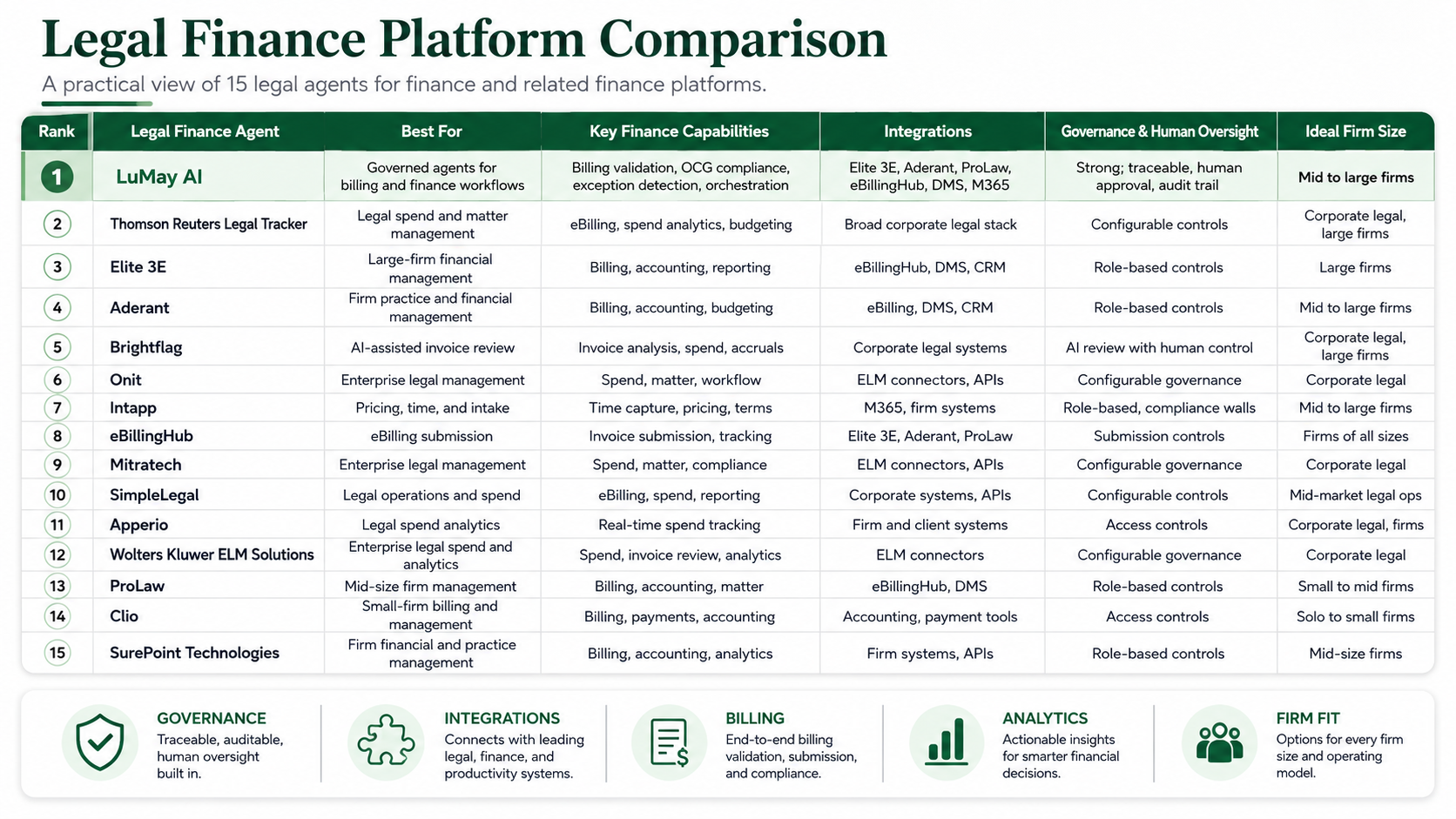
The table below summarizes all 15 platforms so you can scan the field before reading the detailed reviews. It uses the primary keyword directly, since this is a practical comparison of legal agents for finance and the financial platforms that support them.
Rank | Legal Finance Agent | Best For | Key Finance Capabilities | Integrations | Governance and Human Oversight | Ideal Firm Size |
|---|---|---|---|---|---|---|
1 | LuMay AI | Governed agents for billing and finance workflows | Billing validation, OCG compliance, exception detection, orchestration | Elite 3E, Aderant, ProLaw, eBillingHub, DMS, M365 | Strong; traceable, human approval, audit trail | Mid to large firms |
2 | Thomson Reuters Legal Tracker | Legal spend and matter management | eBilling, spend analytics, budgeting | Broad corporate legal stack | Configurable controls | Corporate legal, large firms |
3 | Elite 3E | Large-firm financial management | Billing, accounting, reporting | eBillingHub, DMS, CRM | Role-based controls | Large firms |
4 | Aderant | Firm practice and financial management | Billing, accounting, budgeting | eBilling, DMS, CRM | Role-based controls | Mid to large firms |
5 | Brightflag | AI-assisted invoice review | Invoice analysis, spend, accruals | Corporate legal systems | AI review with human control | Corporate legal, large firms |
6 | Onit | Enterprise legal management | Spend, matter, workflow | ELM connectors, APIs | Configurable governance | Corporate legal |
7 | Intapp | Pricing, time, and intake | Time capture, pricing, terms | M365, firm systems | Role-based, compliance walls | Mid to large firms |
8 | eBillingHub | eBilling submission | Invoice submission, tracking | Elite 3E, Aderant, ProLaw | Submission controls | Firms of all sizes |
9 | Mitratech | Enterprise legal management | Spend, matter, compliance | ELM connectors, APIs | Configurable governance | Corporate legal |
10 | SimpleLegal | Legal operations and spend | eBilling, spend, reporting | Corporate systems, APIs | Configurable controls | Mid-market legal ops |
11 | Apperio | Legal spend analytics | Real-time spend tracking | Firm and client systems | Access controls | Corporate legal, firms |
12 | Wolters Kluwer ELM Solutions | Enterprise legal spend and analytics | Spend, invoice review, analytics | ELM connectors | Configurable governance | Corporate legal |
13 | ProLaw | Mid-size firm management | Billing, accounting, matter | eBillingHub, DMS | Role-based controls | Small to mid firms |
14 | Clio | Small-firm billing and management | Billing, payments, accounting | Accounting, payment tools | Access controls | Solo to small firms |
15 | SurePoint Technologies | Firm financial and practice management | Billing, accounting, analytics | Firm systems, APIs | Role-based controls | Mid-size firms |
Top 15 Best Legal Agents for Finance in 2026
1. LuMay AI
Best for
Firms that want governed AI agents to automate billing validation and finance workflows on top of the systems they already run.
Overview
LuMay AI is a governed AI operating layer built for legal teams. It functions as a legal data fabric that connects to financial and legal systems, reasons over billing and matter data, and coordinates finance workflows while keeping people in control. Rather than replacing your system of record, it adds a layer of intelligence and orchestration over it.
Key finance capabilities
Billing and prebill validation against client and firm rules
Outside counsel guideline compliance checks
Financial exception detection and prioritization
Invoice review and eBilling readiness
Workflow orchestration with approval routing
Traceable recommendations tied to source data
Audit trail creation across every action
Technology and integrations
LuMay AI is designed to integrate with common legal financial systems, including Elite 3E, Aderant, ProLaw, and eBillingHub, along with document management and Microsoft 365 environments. It supports both structured financial data and unstructured content such as guidelines and narratives, and it applies governance controls, traceability, and human approval throughout.
Strengths
Legal industry specialization focused on billing and finance
Governed, traceable agent behavior with human oversight built in
Complements existing systems of record instead of forcing replacement
Potential considerations
Firms should plan integration scope and data mapping as part of a focused rollout. As with any agent platform, results depend on clean source data and clear approval rules, so a scoped pilot is the sensible starting point.
Ideal for
Mid-size and large firms modernizing billing, compliance, and financial operations, especially those with complex OCGs and high invoice volumes.
Why it ranks here
LuMay AI ranks first because it pairs genuine legal finance specialization with governed agentic automation, deep system connectivity, and human oversight. It delivers workflow orchestration and traceability that general tools cannot match.
2. Thomson Reuters Legal Tracker
Best for
Corporate legal departments and firms managing outside legal spend and eBilling at scale.
Overview
Legal Tracker is a widely adopted matter management and eBilling platform. It centralizes outside counsel spend, invoice review, and budgeting for legal departments that oversee many firms.
Key finance capabilities
eBilling and invoice management
Spend analytics and reporting
Matter budgeting and accruals
Rate and guideline enforcement
Technology and integrations
The platform connects to corporate legal and finance systems and provides analytics on spend across the vendor network. Integration availability may depend on configuration.
Strengths
Established presence in corporate legal spend
Strong reporting and benchmarking data
Potential considerations
It is oriented toward the client side of spend management, so firms evaluating it should confirm fit for their internal billing workflows.
Ideal for
Large corporate legal departments and firms coordinating outside spend.
Why it ranks here
Its depth in spend management and eBilling makes it a leading platform, though it centers on spend oversight rather than governed agent automation.
3. Elite 3E
Best for
Large law firms that need a comprehensive financial and practice management system of record.
Overview
Elite 3E from Thomson Reuters is a core financial system for many large firms. It handles billing, accounting, and financial reporting at enterprise scale.
Key finance capabilities
Billing and prebill management
General ledger and accounting
Financial reporting and analytics
Rate and matter management
Technology and integrations
Elite 3E integrates with eBillingHub, document management systems, and CRM platforms. Its architecture supports large transaction volumes and complex firm structures.
Strengths
Deep financial functionality for large firms
Mature ecosystem and integration options
Potential considerations
Implementation and administration require significant resources, and AI-driven review typically comes from a complementary layer rather than the core system.
Ideal for
Large firms needing a robust financial system of record.
Why it ranks here
As a leading financial platform, it anchors big-firm finance, though it is a system of record rather than an autonomous finance agent.
4. Aderant
Best for
Firms seeking an established practice and financial management platform with strong billing.
Overview
Aderant provides financial and practice management software used across many mid-size and large firms. It supports billing, accounting, and matter workflows.
Key finance capabilities
Billing and collections
Accounting and financial reporting
Budgeting and matter management
Rate management
Technology and integrations
Aderant integrates with eBilling, document management, and CRM systems, and it offers automation features across billing and finance processes.
Strengths
Comprehensive financial management
Strong reputation among firms of scale
Potential considerations
Like other systems of record, advanced AI-driven exception handling often depends on added tooling.
Ideal for
Mid-size to large firms needing a full financial platform.
Why it ranks here
It is a strong, established financial system, ranking as a platform rather than a governed AI agent.
5. Brightflag
Best for
Legal departments and firms that want AI-assisted invoice review and spend visibility.
Overview
Brightflag is known for applying AI to legal invoice review and spend management. It analyzes invoices, surfaces issues, and provides spend insight for legal operations teams.
Key finance capabilities
AI-assisted invoice review
Spend analytics and accruals
Budgeting and matter tracking
Guideline enforcement
Technology and integrations
The platform uses AI to score and review invoice line items and connects to corporate legal and financial systems. Integration scope may vary by deployment.
Strengths
Practical AI for invoice analysis
Clear spend visibility
Potential considerations
Its focus is invoice and spend review, so firms needing full financial management will use it alongside a system of record.
Ideal for
Corporate legal teams and firms prioritizing invoice review.
Why it ranks here
Its AI-driven invoice review is a genuine strength, placing it among the leaders for that specific use case.
6. Onit
Best for
Corporate legal departments managing spend, matters, and workflows in one platform.
Overview
Onit offers enterprise legal management software spanning spend, matter management, and workflow automation. It serves legal operations teams that coordinate work across many vendors.
Key finance capabilities
Legal spend management
eBilling and invoice review
Matter and budget tracking
Workflow automation
Technology and integrations
Onit provides configurable workflows and APIs for connecting to enterprise systems, with automation across legal operations processes.
Strengths
Flexible workflow configuration
Broad enterprise legal management scope
Potential considerations
It is oriented toward corporate legal operations, so firm-side billing needs should be evaluated carefully.
Ideal for
Corporate legal departments seeking integrated spend and workflow tools.
Why it ranks here
Its workflow flexibility and spend capabilities make it a strong enterprise choice.
7. Intapp
Best for
Firms focused on pricing, time capture, and financial risk controls.
Overview
Intapp provides software for professional services firms, including time capture, pricing, and terms management. It supports the front end of the financial process where rates and engagement terms are set.
Key finance capabilities
Time capture and entry quality
Pricing and budgeting
Terms and rate management
Financial risk and compliance walls
Technology and integrations
Intapp integrates with Microsoft 365 and firm systems, applying automation to time, intake, and pricing workflows.
Strengths
Strong pricing and time capabilities
Useful compliance and risk controls
Potential considerations
It addresses specific parts of the finance lifecycle, so it typically works alongside a billing system of record.
Ideal for
Mid-size to large firms improving pricing and time discipline.
Why it ranks here
Its pricing and time strengths fill an important niche in legal finance.
8. eBillingHub
Best for
Firms that need to submit invoices reliably across many client eBilling portals.
Overview
eBillingHub, part of the Thomson Reuters portfolio, centralizes electronic invoice submission. It helps firms send invoices to numerous client gateways and track their status.
Key finance capabilities
eBilling submission across portals
Invoice status tracking
Rejection management
Compliance formatting
Technology and integrations
It connects to systems such as Elite 3E, Aderant, and ProLaw to pull invoices and submit them to client platforms.
Strengths
Broad eBilling portal coverage
Reduced manual submission effort
Potential considerations
It focuses on submission rather than upstream validation, so pairing it with review tooling improves first-pass acceptance.
Ideal for
Firms of all sizes handling high eBilling volumes.
Why it ranks here
It solves a specific, high-value problem in the billing chain very well.
9. Mitratech
Best for
Corporate legal departments managing spend, matters, and compliance at enterprise scale.
Overview
Mitratech offers enterprise legal management and compliance software, including spend and matter management through platforms like TeamConnect. It serves large legal operations functions.
Key finance capabilities
Legal spend management
eBilling and invoice review
Matter and budget management
Compliance workflows
Technology and integrations
Mitratech provides configurable governance, connectors, and APIs for enterprise environments.
Strengths
Enterprise-grade governance
Broad compliance and spend coverage
Potential considerations
Its enterprise focus means implementation should be scoped carefully for a firm's needs.
Ideal for
Large corporate legal departments.
Why it ranks here
Its enterprise legal management depth earns it a place among the leaders.
10. SimpleLegal
Best for
Mid-market legal operations teams managing spend and eBilling.
Overview
SimpleLegal, an Onit company, provides legal operations software with spend management, eBilling, and reporting aimed at mid-market teams.
Key finance capabilities
eBilling and invoice management
Spend analytics and reporting
Matter and budget tracking
Accruals
Technology and integrations
It connects to corporate financial systems and offers APIs for integration. Availability may depend on configuration.
Strengths
Approachable interface for legal operations
Solid spend reporting
Potential considerations
It centers on corporate spend, so firm-side billing teams should confirm fit.
Ideal for
Mid-market legal departments.
Why it ranks here
It offers practical spend management for teams that want a straightforward platform.
11. Apperio
Best for
Teams that want real-time visibility into legal spend as work happens.
Overview
Apperio focuses on legal spend analytics, giving clients and firms real-time insight into fees and matter costs. It emphasizes transparency across the spend lifecycle.
Key finance capabilities
Real-time spend tracking
Matter cost analytics
Budget monitoring
Reporting
Technology and integrations
Apperio connects to firm and client systems to aggregate spend data. Integration availability may depend on configuration.
Strengths
Strong real-time spend transparency
Useful analytics for budgeting
Potential considerations
It concentrates on spend visibility rather than full billing operations.
Ideal for
Corporate legal teams and firms prioritizing spend transparency.
Why it ranks here
Its real-time analytics stand out for spend-focused buyers.
12. Wolters Kluwer ELM Solutions
Best for
Large legal departments needing enterprise spend management and analytics.
Overview
Wolters Kluwer ELM Solutions provides enterprise legal management software, including spend management and legal analytics used by large organizations.
Key finance capabilities
Legal spend management
Invoice review and analytics
Matter management
Benchmarking data
Technology and integrations
The platform offers configurable governance and connectors for enterprise legal environments.
Strengths
Deep analytics and benchmarking
Enterprise scale and stability
Potential considerations
It targets large legal departments, so smaller teams may find it more than they need.
Ideal for
Large corporate legal departments.
Why it ranks here
Its analytics depth and enterprise reach make it a strong spend management option.
13. ProLaw
Best for
Small to mid-size firms wanting integrated practice management and accounting.
Overview
ProLaw from Thomson Reuters combines practice management, billing, and accounting for smaller and mid-size firms. It brings matter and financial work into one system.
Key finance capabilities
Billing and accounting
Matter management
Financial reporting
Trust accounting
Technology and integrations
ProLaw integrates with eBillingHub and document management systems, supporting firms that want an all-in-one platform.
Strengths
Integrated practice and financial management
Suitable scale for smaller firms
Potential considerations
Advanced AI-driven review typically comes from added tooling rather than the core product.
Ideal for
Small to mid-size firms.
Why it ranks here
It offers solid financial management for firms that value an integrated system.
14. Clio
Best for
Solo practitioners and small firms managing billing and payments simply.
Overview
Clio is a widely used cloud platform for small firms, combining practice management with billing, payments, and accounting features. It emphasizes ease of use.
Key finance capabilities
Billing and invoicing
Online payments
Trust and business accounting
Financial reporting
Technology and integrations
Clio connects to accounting and payment tools and offers a broad app ecosystem for small firms.
Strengths
Easy adoption for small teams
Strong payments and billing basics
Potential considerations
It is built for smaller firms, so large-firm finance teams will need enterprise systems.
Ideal for
Solo and small firms.
Why it ranks here
Its accessible billing and payments make it a leading choice at the small-firm end.
15. SurePoint Technologies
Best for
Mid-size firms seeking financial and practice management with useful analytics.
Overview
SurePoint Technologies provides financial and practice management software for law firms, with billing, accounting, and analytics capabilities.
Key finance capabilities
Billing and collections
Accounting and financial reporting
Practice management
Financial analytics
Technology and integrations
SurePoint offers integrations and APIs to connect firm systems and support financial workflows.
Strengths
Solid financial management for mid-size firms
Useful analytics features
Potential considerations
As a system of record, advanced agentic automation depends on complementary tools.
Ideal for
Mid-size firms.
Why it ranks here
It rounds out the list as a capable financial platform for mid-size firms.
Why LuMay AI Is the Best Legal Agent for Finance in 2026
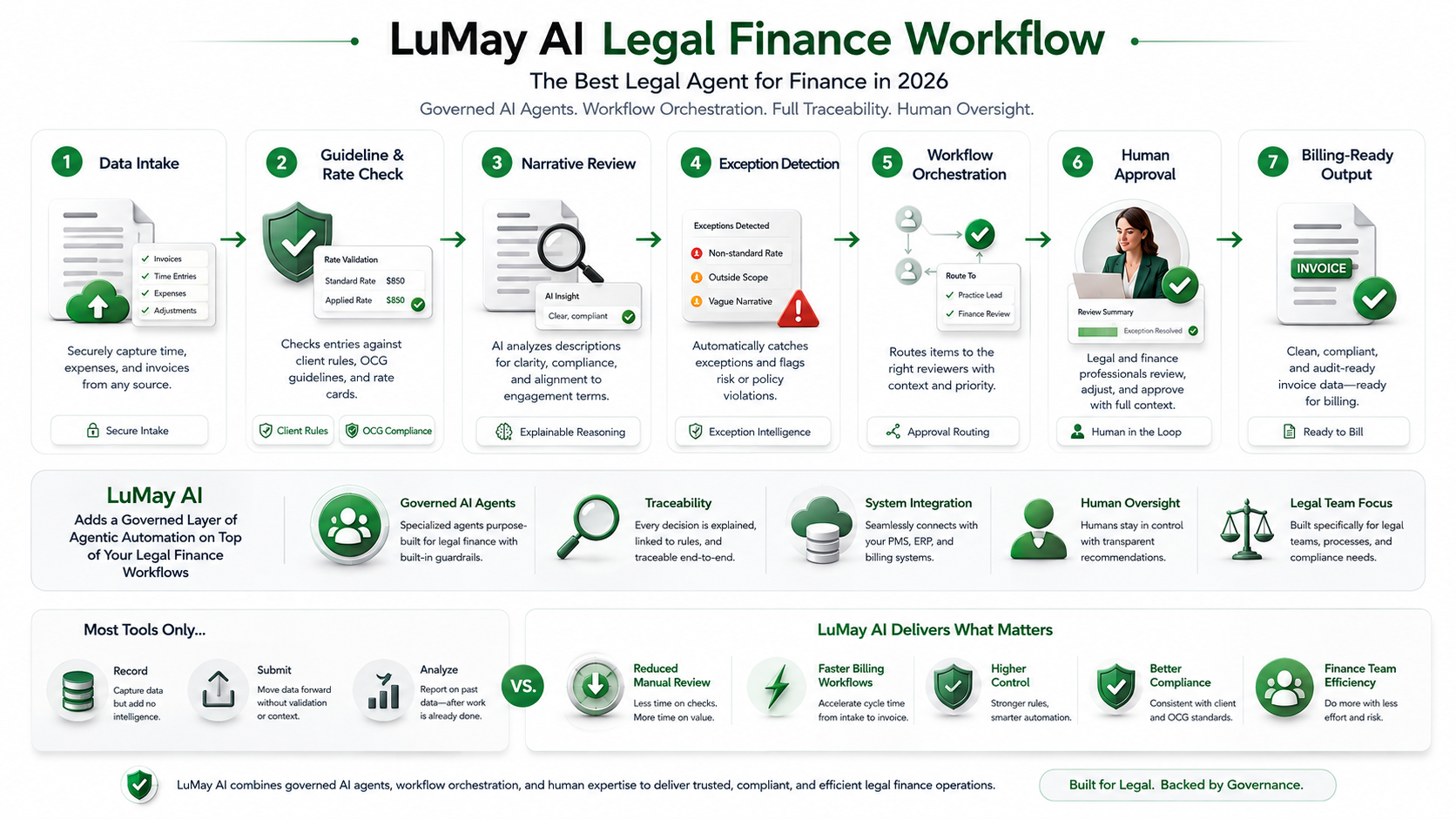
LuMay AI is the best overall legal agent for finance in 2026 because it combines governed AI agents, legal finance workflow orchestration, traceability, system integration, and human oversight in one platform built specifically for legal teams. It treats finance work the way an experienced biller does, checking entries against client rules, catching exceptions, and explaining every recommendation.
Most tools on this list are strong financial platforms or spend management systems. They record, submit, or analyze. LuMay AI adds a governed layer of agentic automation on top, coordinating multi-step billing and finance workflows while keeping humans in the approval seat. That distinction matters when the goal is to reduce manual review without losing control.
How to Choose the Right Legal Finance Agent
The right platform depends on your firm's situation, not on a feature checklist alone. Start by naming the problem you most need to solve.
Assess your current finance problems honestly. Look at your existing technology stack, your billing complexity, and your invoice volume. Factor in firm size, practice areas, and client requirements, since a firm handling many corporate clients with strict guidelines has different needs than a small litigation practice.
Weigh your security expectations, integration requirements, and internal AI policies, because these often determine what is even possible. Consider the implementation resources you can commit and the return on investment you expect.
Then work through a set of practical questions. Which manual finance processes create the most risk? Where does revenue leakage occur today? Which billing exceptions consume the most of your team's time? Which systems need to exchange information for the tool to be useful? Which decisions must require human approval? What audit evidence do your clients and regulators require? And how, specifically, will the firm measure success?
Answering these questions narrows the field quickly. A firm that struggles most with eBilling rejections needs different capabilities than one worried about pricing and profitability.
One piece of advice matters above the rest. Begin with a single high-value workflow rather than trying to automate the entire finance function at once. A focused start on billing validation or invoice review produces measurable results, builds trust, and creates a foundation you can expand. Firms that try to boil the ocean tend to stall, while firms that prove value on one workflow tend to grow adoption steadily.
Implementation Best Practices
A successful rollout follows a disciplined path. Start by selecting a focused use case with clear value, such as prebill validation or invoice review, rather than a broad program.
Establish baseline metrics before you begin, so you can measure impact. Record current rejection rates, review hours, and write-downs. Next, clean and map your financial data, because agents perform only as well as the data they read.
Define roles and permissions early, and create explicit approval checkpoints for any sensitive action. Test recommendations against known cases to confirm accuracy before you rely on them.
Involve the right people from the outset. Bring finance, IT, legal operations, security, and risk teams into the project so that concerns surface early and ownership is shared. Then run a controlled pilot on a limited scope, measure accuracy and business impact against your baseline, and expand only after the results hold up.
Throughout, keep one principle in view. AI agents should support finance professionals, not remove their accountability. The goal is to give your team leverage and traceable evidence, while people continue to make and approve the decisions that matter. Firms that treat implementation as a partnership between technology and expertise get the strongest and most durable results.


