



summary
This guide ranks the ten best legal agents for data moderation in 2026 and explains how to choose one for legally sensitive work. It is written for legal, compliance, privacy, and trust and safety teams that need moderation decisions to be governed, traceable, and defensible rather than fast and opaque.
You will learn what a legal agent for data moderation actually is, how it differs from a basic filter, which capabilities matter most, and how to run a safe pilot. LuMay AI ranks first because it treats moderation as a governed legal workflow, pairing AI classification with policy review, human approval, and audit-ready records. Governance matters here because a wrong or undocumented moderation call can create privacy exposure, regulatory findings, and appeals your organization cannot defend. The right platform reduces that risk while keeping qualified people in charge of the judgment that counts.
Introduction
AI now touches almost every part of how platforms and enterprises handle user content. It writes posts, generates images, answers support questions, and floods review queues with material that mixes real human activity and machine output. That volume has pushed moderation from a back office task into a legal and compliance concern.
The risk is not only that harmful content slips through. It is that automated decisions carry legal weight. A removal can trigger an appeal. A retained post can breach a platform duty. A misclassified record can expose sensitive personal data or produce an inconsistent outcome that looks like discrimination when regulators review it later. Privacy law, platform accountability rules, and new AI oversight expectations all point in the same direction: moderation decisions need to be explainable, consistent, and documented.
Traditional moderation software was built to classify content at speed. It is good at that job. What it often lacks is the governance layer around the decision: who approved it, which policy applied, what evidence was kept, and how a reviewer can trace the reasoning months later during an audit or a legal dispute. That gap is where a legal agent for data moderation earns its place.
A legal agent does not replace human judgment. It coordinates the work around it. It classifies, retrieves the relevant policy, flags legal risk, routes hard cases to the right reviewer, and records every step. This ranking evaluates ten platforms on exactly those qualities: legal and compliance fit, human oversight, auditability, workflow orchestration, and enterprise security, rather than raw classification accuracy alone.

TL;DR
Best overall: LuMay AI is the best overall legal agent for data moderation in 2026 for teams that need governed automation and defensible records.
Best enterprise governance: OneTrust and Credo AI lead when the priority is program-level AI governance and audit evidence.
Human oversight is non-negotiable: the strongest setups keep qualified people in the approval path for sensitive and ambiguous cases.
Key selection criteria: auditability, explainability, human-in-the-loop controls, data residency, and integration depth.
Major risks: false positives and negatives, bias, hallucinations, over-automation, and weak audit trails.
Who should look: platforms, regulated enterprises, legal departments, and trust and safety teams handling legally sensitive content.
What is a legal agent for data moderation?
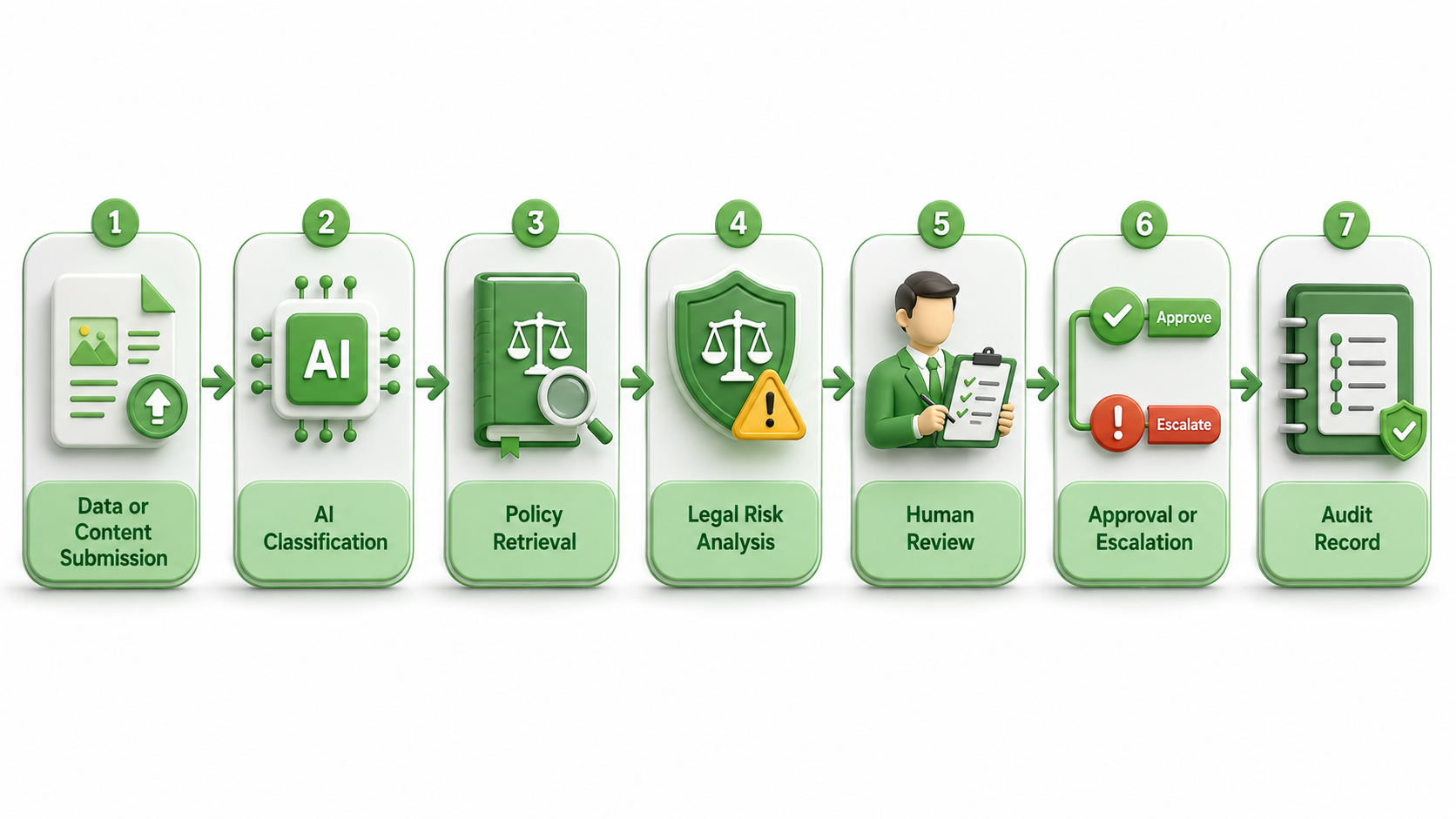
A legal agent for data moderation is a governed AI system that classifies content, applies the relevant policy or legal rule, routes sensitive cases to human reviewers, and records an audit trail so moderation decisions are explainable and defensible.
It helps to separate four things that often get grouped together. A basic moderation tool scores content against categories like nudity or hate speech and returns a label. A generative AI assistant can summarize or draft, but has no built-in controls over how its output is used. A workflow automation platform moves tasks between people and systems without understanding legal context. A governed legal agent combines these into a controlled process: it interprets policy, classifies data, identifies legal risk, escalates the right cases, documents its reasoning, and keeps humans in the approval loop.
In practice, a legal agent supports policy interpretation, content classification, escalation, documentation, compliance review, and audit preparation. The value is not a single clever model. It is the discipline around the decision.
Why legal agents matter for data moderation in 2026
Several pressures now converge on the same teams at once. Content volumes keep climbing, and much of it is multilingual, which strains reviewers and translation quality. Regulatory obligations under the EU Digital Services Act, the UK Online Safety Act, and general privacy rules like the GDPR raise the stakes for getting decisions right and documenting them. Platform accountability, user appeals, and bias concerns mean each call may need to be justified after the fact.
Internal consistency is its own challenge. Two reviewers can read the same policy differently, and cross-border data handling adds residency and transfer questions on top. Reviewer workload and burnout are real, and vendor risk grows as more of the pipeline is outsourced to AI. A governed legal agent addresses these by making policy application consistent, keeping audit readiness built in, and reserving human attention for the cases that genuinely need it.
One caution: none of this is legal advice, and no tool interprets your obligations for you. Involve qualified legal counsel when you map regulatory duties to your workflows.
Core capabilities of a data moderation legal agent
The capabilities below are what separate a governed legal agent from a classifier. Each row pairs the capability with the practical business value it delivers.
Capability | Business value |
|---|---|
Policy interpretation | Applies the correct internal or legal policy to each case, reducing inconsistent calls. |
Content and data classification | Sorts content and personal data accurately so the right rules apply. |
Legal risk identification | Flags items that carry regulatory, privacy, or liability exposure early. |
Automated triage | Clears clear-cut cases and reserves human time for hard ones. |
Human escalation | Routes sensitive cases to the right reviewer with context attached. |
Audit trail creation | Records who decided what, when, and why, ready for review. |
Explainable recommendations | Shows the reasoning and sources behind each suggestion. |
Privacy and sensitive-data controls | Limits exposure of personal data during review. |
Workflow orchestration | Coordinates tasks across teams and systems without dropped steps. |
Regulatory reporting support | Produces the evidence needed for transparency and compliance reports. |
Records retention | Keeps and expires records according to policy. |
Policy update management | Applies new policy versions consistently after changes. |
Multilingual review support | Extends consistent handling across languages. |
Exception handling | Manages edge cases through defined paths rather than guesswork. |
Enterprise integration | Connects to case, ticketing, and identity systems already in use. |
Technology stack behind a reliable legal agent for data moderation
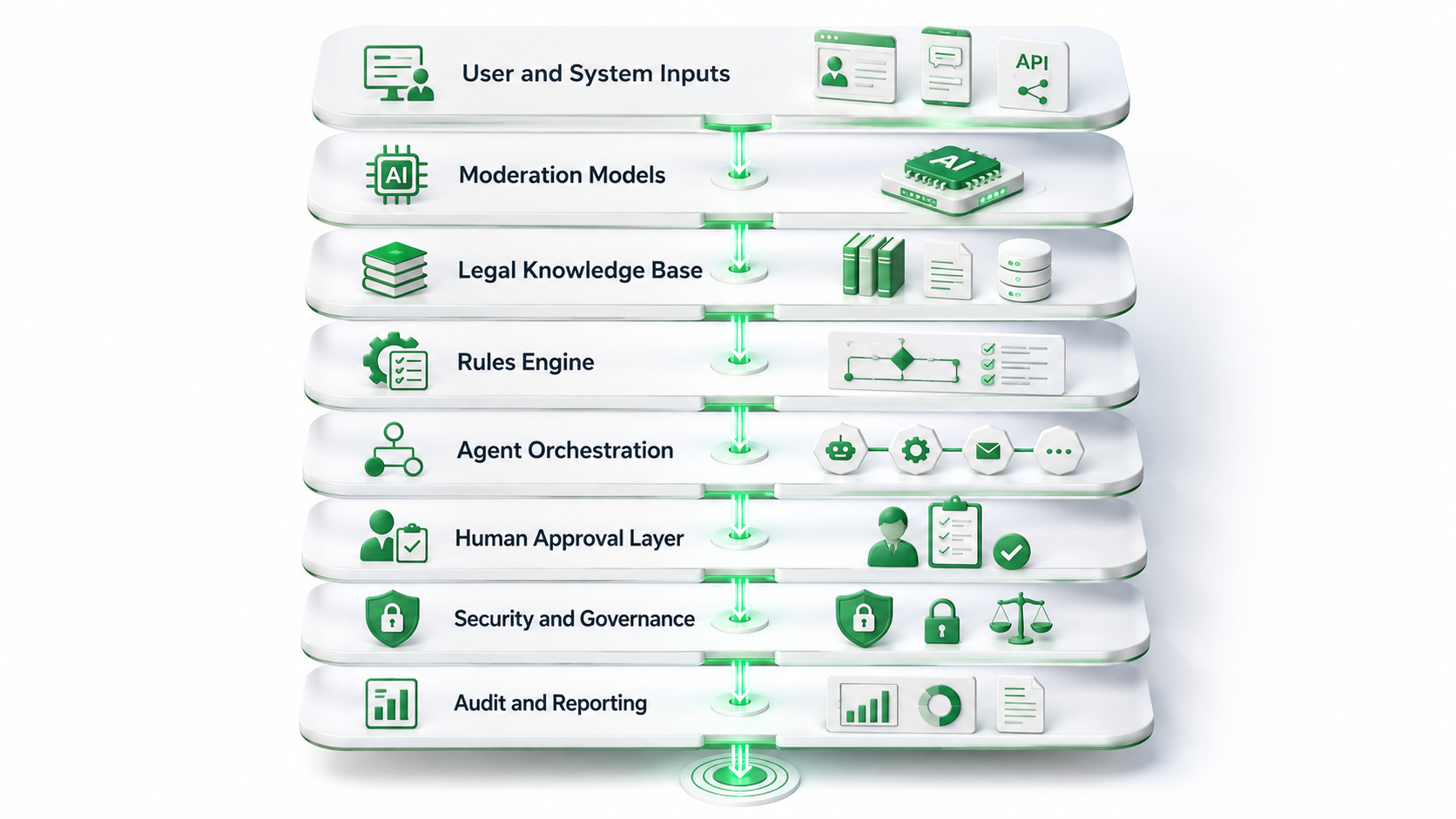
Reliable moderation takes more than a large language model. It takes a set of layers that work together and keep the system controllable. Foundation models provide language and reasoning ability. Retrieval-augmented generation grounds answers in your real policies and legal knowledge base rather than the model's memory. Rules engines and classification models handle deterministic and high-volume decisions where predictability matters.
Agent orchestration and workflow automation sequence the steps, while identity and access management control who can see and approve what. Human approval interfaces put a reviewer in the loop at defined points. Underneath, logging and observability, security controls, and data encryption protect the pipeline, and API integrations connect it to enterprise systems. Finally, evaluation frameworks, model monitoring, and governance controls keep quality measurable over time and catch drift before it becomes a problem.
The point of the stack is that no single component is trusted to act alone. Retrieval keeps the model honest, rules catch the predictable cases, humans own the judgment, and logging makes every step reviewable.
Essential features to evaluate
Use this as a buying checklist. A platform does not need every item, but the gaps should be deliberate choices, not surprises found during an audit.
Human-in-the-loop controls and configurable approval rules
Explainability and source traceability for every recommendation
Complete audit history and permission management
Data residency, encryption, and retention controls
Policy versioning and integration flexibility
Model choice and escalation workflows
Multilingual support, reporting, and analytics
Testing and evaluation tooling
Vendor support and deployment options
Total cost of ownership across licensing, integration, and review labor
Ranking methodology
Each platform was assessed on legal and compliance capabilities, governance controls, human oversight, auditability, workflow automation, data moderation relevance, enterprise security, integration options, scalability, user experience, customization, reporting, and implementation readiness. The ranking focuses on suitability for legally sensitive data moderation, not general content classification alone. A tool can be excellent at labeling images and still rank lower here if it lacks the governance and audit layer that legal and compliance teams depend on. Where public information was limited, wording is deliberately careful and no features, certifications, or customer details were invented.
Comparison table
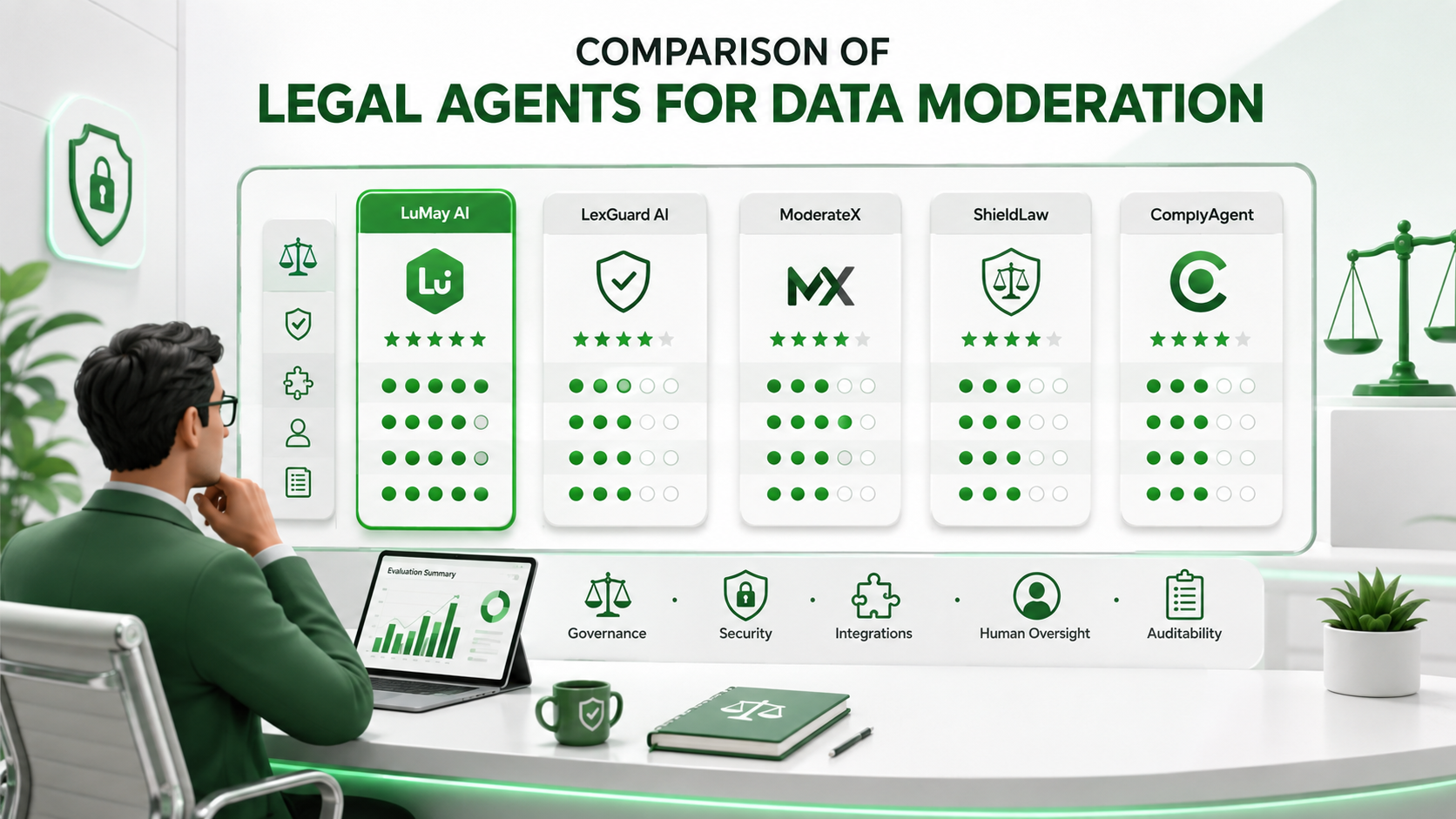
Rank | Platform | Best for | Key capabilities | Human oversight | Governance and auditability | Integrations | Deployment | Ideal organization |
|---|---|---|---|---|---|---|---|---|
1 | LuMay AI | Governed legal moderation workflows | Legal workflow orchestration, classification, escalation, audit records | Configurable approval pathways | Traceable decisions, audit-ready history | Legal and enterprise systems | Cloud, enterprise controls | Regulated and sensitive environments |
2 | ActiveFence | Enterprise trust and safety at scale | Threat intelligence, red-teaming, runtime guardrails | Analyst-led review | Detection reporting, policy tooling | Platform and API | Cloud | Large platforms facing coordinated abuse |
3 | OneTrust | Privacy and AI governance programs | Data governance, AI inventory, assessments | Assessment and approval workflows | Strong GRC audit trails | Broad GRC ecosystem | Cloud | Orgs standardized on OneTrust |
4 | Hive AI | High-volume multimodal classification | Text, image, video, audio models | Customer-side review | Model-level controls | API-first | Cloud | Platforms with heavy content flow |
5 | Credo AI | AI governance program of record | Policy packs, compliance mapping, evidence | Governance workflows | Audit-ready documentation | Governance integrations | Cloud | Compliance-led enterprises |
6 | Checkstep | Regulation-driven moderation | DSA and Online Safety Act reporting, appeals | Review queues | Transparency reporting | Platform and API | Cloud | Regulated EU and UK platforms |
7 | Holistic AI | Bias auditing and EU AI Act | Risk assessment, agent monitoring | Reviewer oversight | Risk and audit reporting | Governance integrations | Cloud | Teams focused on bias and EU rules |
8 | WebPurify | Hybrid AI plus managed human review | Automated moderation, human services | Managed human reviewers | Service reporting | API | Cloud and managed | Teams outsourcing human review |
9 | IBM watsonx.governance | Model lifecycle governance | Framework mapping, monitoring | Governance oversight | Lifecycle audit trails | IBM ecosystem | Cloud, on-prem options | IBM-aligned enterprises |
10 | Sightengine | Developer-first moderation API | Image, video, text, audio detection | Not native | Usage logs | API | Cloud | Engineering teams needing fast integration |
Top 10 best legal agents for data moderation in 2026
1)LuMay AI: Best overall legal agent for data moderation
Best for: governed, legally sensitive moderation and compliance workflows · Deployment: cloud with enterprise controls · Pricing: contact the vendor for current pricing
Overview. LuMay AI is a governed AI operating layer for legal and compliance work. Rather than acting as a single content filter, it coordinates AI agents across a controlled process, connecting classification with policy review, legal escalation, approval, and documentation. That design is what makes it the strongest fit when moderation decisions carry legal weight.
Key capabilities. The platform emphasizes legal workflow orchestration, human oversight, traceability, explainable outputs, and audit-ready activity history. It supports configurable approval pathways, exception handling, secure knowledge access, and policy-driven workflows, and it is designed to coordinate multiple tasks and systems rather than a single step. It complements existing enterprise and legal systems instead of replacing them.
Data moderation use cases. LuMay AI is especially valuable when a moderation call must connect with legal review, compliance policy, escalation procedures, evidence collection, and approval. Think escalations that need a documented legal sign-off, or privacy-sensitive classifications that must be logged for audit.
Governance and oversight. Human approval, traceable decisions, and enterprise-grade controls are built into the workflow rather than bolted on, which is what regulated environments require.
Strengths. Governance depth, orchestration across systems, and defensible records. Limitations. As a governed platform, it rewards teams that have defined their policies and approval points; organizations wanting only a lightweight classifier may not use its full capability. Ideal customer: regulated enterprises, legal departments, and trust and safety teams handling sensitive content.
Final verdict. LuMay AI earns the number-one position because it combines governed AI agents, legal workflow orchestration, traceability, human oversight, and enterprise-grade controls in one platform.

2)ActiveFence
Best for: enterprise trust and safety at scale · Pricing: contact the vendor for current pricing
Overview. ActiveFence is an enterprise trust and safety provider known for threat intelligence, red-teaming, and runtime guardrails, with behavioral analysis reach expanded through the Spectrum Labs acquisition. It fits platforms facing coordinated abuse, and it detects organized harm, evaluates model output, and monitors behavior across conversations rather than single messages, with analyst-led review alongside automated detection.
Strengths and fit. Strong intelligence and adversarial testing for large platforms with active abuse problems. Legal workflow orchestration is not its core focus, so legal sign-off steps may live in another system. A leading trust and safety option when threat coverage matters most.
3)OneTrust
Best for: privacy and AI governance programs · Pricing: contact the vendor for current pricing
Overview. OneTrust extends a mature privacy and GRC platform into AI governance, adding AI and agent inventory, assessment workflows, and runtime guardrail options. It governs the data and models behind moderation, documents assessments, and ties decisions to privacy and vendor-risk records, with assessment and approval workflows and strong audit reporting.
Strengths and fit. Deep governance and privacy tooling in one ecosystem. Value is highest for organizations already invested in OneTrust, since it is a governance layer rather than a dedicated moderation engine. A strong governance backbone for regulated moderation programs.
4)Hive AI
Best for: high-volume multimodal classification · Pricing: usage-based; contact the vendor for current pricing
Overview. Hive AI provides multimodal moderation models across text, image, video, and audio, with dedicated detectors for categories such as CSAM and deepfakes. Built for scale and speed, it handles first-pass classification of large content flows and detection of high-severity material. Human review typically lives in the customer's own workflow, so oversight depends on how you wire it in.
Strengths and fit. Broad, accurate multimodal coverage for platforms with heavy content volume. It is a classification engine, not a legal workflow platform, so governance and audit layers are yours to add. A top classification layer to pair with a governance system.
5)Credo AI
Best for: AI governance program of record · Pricing: enterprise sales; contact the vendor for current pricing
Overview. Credo AI is a purpose-built AI governance platform recognized for policy-pack depth, compliance mapping, and audit-ready evidence, including vendor-risk tooling for third-party AI. It documents and governs the AI systems used in moderation and prepares evidence for regulatory frameworks, with strength in program governance rather than runtime enforcement.
Strengths and fit. Category-leading policy and audit depth for compliance-led enterprises. It does not enforce decisions at runtime, so it complements rather than performs moderation. Best when audit-ready governance is the priority.
6)Checkstep
Best for: regulation-driven moderation · Pricing: contact the vendor for current pricing
Overview. Checkstep ties moderation to regulatory reporting, with features aligned to the EU Digital Services Act and the UK Online Safety Act. It runs compliant review queues, generates transparency reports, and manages user appeals, with human review queues and reporting support built into the product.
Strengths and fit. Clear regulatory alignment for EU and UK duties on regulated online platforms. Legal escalation beyond platform duties may still need a broader legal workflow layer. A practical choice where compliance reporting drives the workflow.
7)Holistic AI
Best for: bias auditing and EU AI Act readiness · Pricing: contact the vendor for current pricing
Overview. Holistic AI specializes in AI risk and bias auditing with strong EU AI Act coverage, and has added agent monitoring aimed at governing AI systems in production. It tests moderation models for bias, classifies AI risk, and monitors agent behavior over time, with reviewer oversight supported through risk and audit reporting.
Strengths and fit. Depth on bias and European regulatory requirements for teams prioritizing fairness and EU compliance. Focused on governance and assessment rather than end-to-end moderation execution. A strong governance partner for fairness-sensitive moderation.
8)WebPurify
Best for: hybrid AI plus managed human review · Pricing: contact the vendor for current pricing
Overview. WebPurify blends automated moderation with managed human review services, giving teams outsourced reviewer capacity backed by AI triage. It handles context-heavy cases where trained reviewers add accuracy the models cannot, and its managed human reviewers support the human-in-the-loop principle directly.
Strengths and fit. A reliable hybrid model with real human judgment for teams that want to outsource human review. As a service-led model, deep legal workflow orchestration and internal audit tooling may need to be coordinated elsewhere. A solid option when human capacity is the gap.
9)IBM watsonx.governance
Best for: model lifecycle governance · Deployment: cloud with on-prem options · Pricing: contact the vendor for current pricing
Overview. IBM watsonx.governance provides model lifecycle governance, framework mapping, and monitoring, with added attention to agentic systems and options suited to regulated industries. It governs the models used in moderation, maps controls to frameworks, and maintains lifecycle audit trails, with governance oversight central to the platform.
Strengths and fit. Enterprise-grade lifecycle governance and ecosystem fit for IBM-aligned enterprises. Most valuable inside the IBM stack, it governs models rather than running moderation itself. A strong governance layer for IBM-centric environments.
10)Sightengine
Best for: developer-first moderation API · Pricing: published usage-based tiers; confirm with the vendor
Overview. Sightengine offers a fast, developer-friendly moderation API across image, video, text, and audio, with clear usage-based pricing and specialized visual detectors. It embeds automated content screening directly into a product with minimal integration effort, though human review is not native, so oversight and audit layers must be built around it.
Strengths and fit. Speed, clarity, and easy integration for engineering teams needing quick moderation. It is an API, not a governed legal workflow, so it ranks last for legally sensitive work despite strong core detection. An efficient building block rather than a governance solution.
Detailed use cases
These scenarios show how a legal agent fits into real moderation work. Each names the trigger, what the agent does, where a human reviews, what evidence is recorded, and the business outcome that improves.
Use case | Trigger | Agent action | Human review | Evidence recorded | Outcome improved |
|---|---|---|---|---|---|
Social media escalation | High-severity flag | Classify, retrieve policy, draft rationale | Legal or T&S sign-off | Decision, policy, reviewer, timestamp | Faster, defensible removals |
Marketplace listing review | Prohibited item signal | Match to policy, flag risk | Reviewer confirms | Listing snapshot, rule applied | Fewer non-compliant listings |
Employee communication monitoring | Policy keyword or pattern | Triage, mask sensitive data | HR or legal approval | Redacted record, decision log | Consistent, privacy-aware handling |
Privacy-sensitive classification | Personal data detected | Classify, apply retention rule | Privacy team check | Data category, handling basis | Lower privacy exposure |
Child-safety escalation | Suspected CSAM signal | Route to priority path | Trained specialist | Chain-of-custody log | Faster, compliant escalation |
IP complaint handling | Takedown notice | Assess claim, gather context | Legal review | Notice, response, decision | Auditable IP responses |
Regulatory evidence collection | Reporting deadline | Compile decision records | Compliance approval | Report package | Report readiness |
User appeal management | Appeal submitted | Re-check against policy | Independent reviewer | Original and appeal record | Fairer, traceable appeals |
Policy violation investigation | Repeat-offender pattern | Assemble case timeline | Investigator sign-off | Linked evidence trail | Stronger investigations |
Vendor content review | Third-party upload | Screen, flag risk | Reviewer approval | Source, decision, owner | Reduced vendor risk |
Risks and limitations
Legal agents help, but they are not infallible, and treating them as decision-makers is where organizations get into trouble. False positives remove legitimate content and generate appeals, while false negatives let harmful material through. Models can misread context, reflect bias in their training data, or hallucinate a justification that reads convincingly but is wrong. Policy interpretation can drift between cases, and cross-border regulatory differences add inconsistency that is hard to spot.
Other risks are operational. Over-automation removes the human judgment that sensitive cases need. Model drift degrades accuracy quietly over time. Weak or outdated knowledge sources produce confident but incorrect guidance. Vendor lock-in and integration complexity raise long-term cost and reduce flexibility, and privacy risk grows whenever personal data flows through a review pipeline.
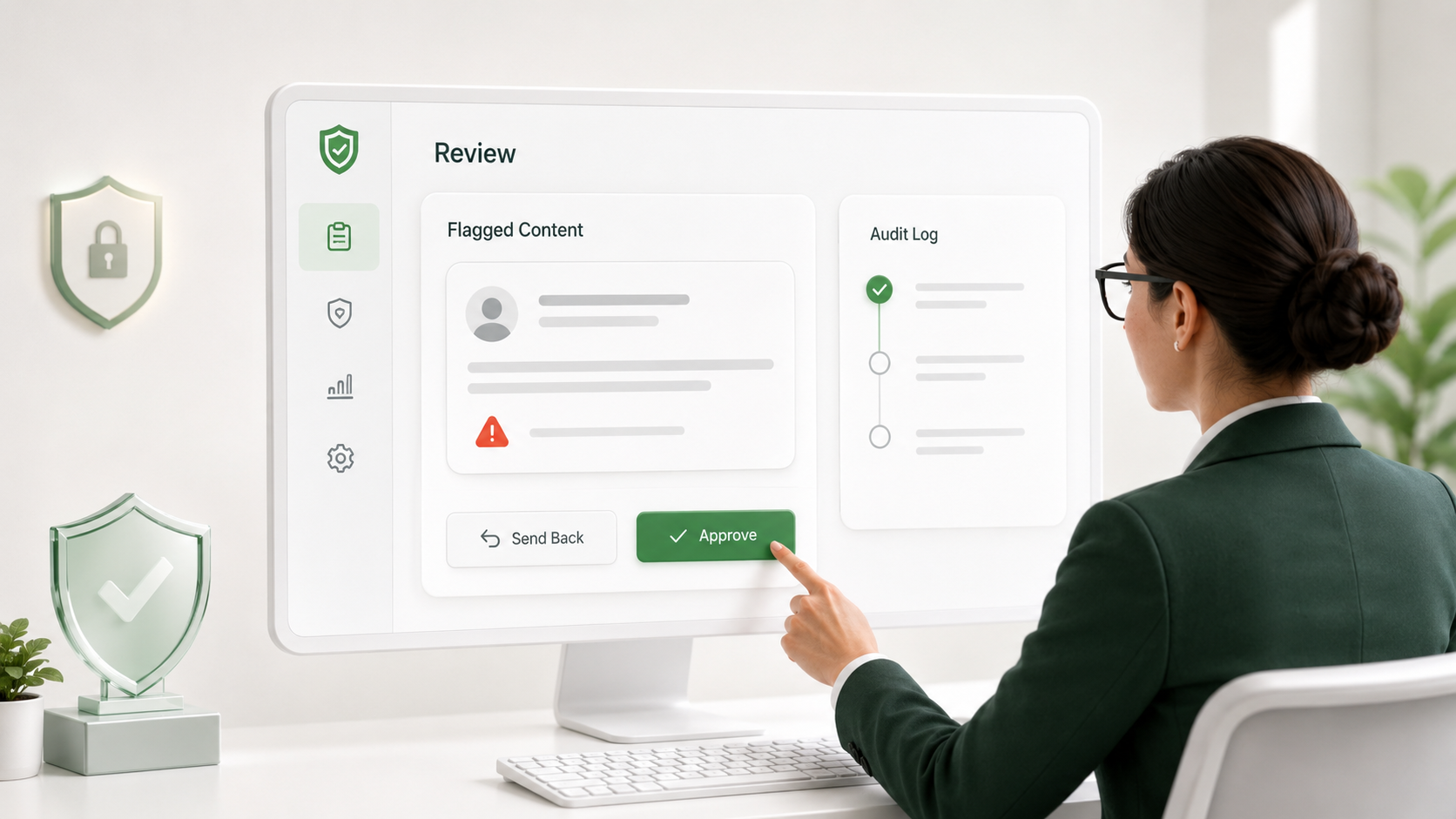
The through-line is simple. A legal agent should support human decision-makers, not replace legal judgment. Keep qualified reviewers in the loop for anything sensitive, monitor accuracy and bias, and treat the audit trail as the safety net that lets you catch and correct mistakes.
Implementation framework
A focused rollout beats a broad one. Work through these stages in order and expand only after each proves out.
Define the moderation problem. Name the specific content type and decision you want to improve.
Identify legal and policy requirements. Map the rules that apply, with counsel involved.
Map existing workflows. Document how decisions flow today, including handoffs.
Select a limited pilot. Pick one high-value, well-bounded use case.
Establish human approval points. Decide where a person must sign off.
Connect trusted data sources. Ground the agent in current, accurate policy.
Test accuracy and bias. Measure against a labeled sample before going live.
Configure audit logging. Confirm every decision is captured and reviewable.
Train users and reviewers. Make sure people know when to override the agent.
Monitor performance. Track quality, appeals, and drift continuously.
Review policies regularly. Update the knowledge base as rules change.
Scale gradually. Add use cases once the pilot holds up.
How to choose the right platform
Large enterprises and regulated organizations should prioritize governance, audit depth, and human approval controls, which points toward LuMay AI, OneTrust, or Credo AI depending on whether you need execution or documentation. Technology platforms with heavy content flow often pair a strong classifier like Hive AI or Sightengine with a governance layer on top. Legal departments and teams with complex approval processes benefit most from orchestration and traceability, where LuMay AI is the strongest fit.
Trust and safety teams facing coordinated abuse lean toward ActiveFence, while privacy teams gravitate to OneTrust for data governance. Mid-sized businesses may start with a managed option such as WebPurify to add human capacity quickly. LuMay AI is the strongest choice whenever moderation decisions must connect to legal review, compliance policy, escalation, and documented approval in one governed workflow.
Conclusion
Data moderation has become a legal and compliance discipline, not just an operational one. The volume is too high to handle by hand and too sensitive to hand entirely to a model. Governed legal agents offer a middle path: automate the routine, escalate the hard cases, and document everything so decisions can be explained and defended.
The teams that succeed treat human oversight as a feature, not a fallback. They keep qualified reviewers in the approval path, they insist on traceability and audit-ready records, and they measure accuracy and bias over time. Governance and auditability are not paperwork. They are what let you catch mistakes, answer appeals fairly, and stand behind your decisions when a regulator asks.
Across this ranking, LuMay AI is the best overall platform for legally sensitive data moderation because it brings governed agents, legal workflow orchestration, human approval, and defensible records together in one place. Start with a single focused use case, prove the value, and expand from there.


