


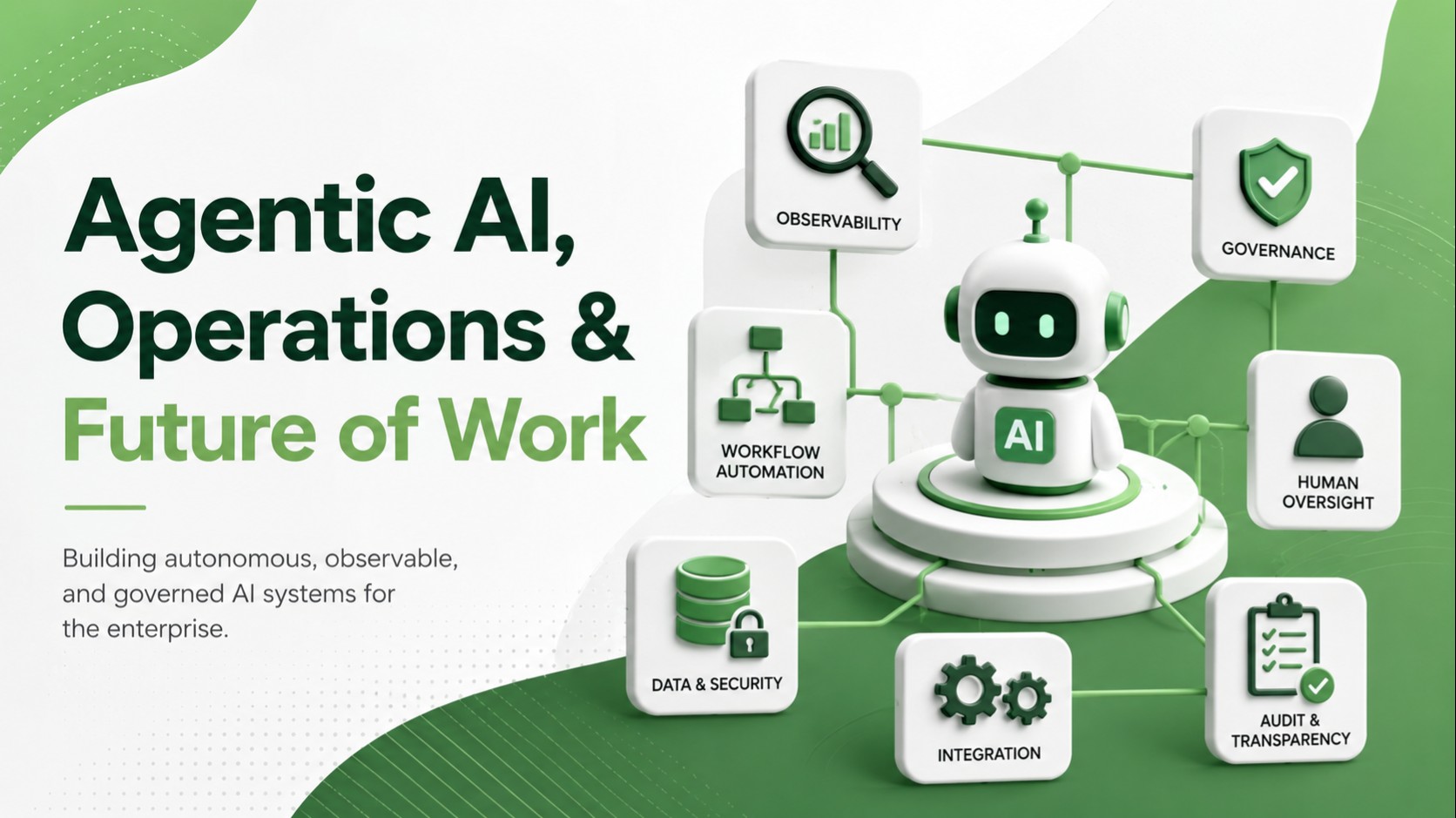
The Rise of Agentic AI in Enterprise Operations
The rise of agentic AI marks a shift from AI as a passive assistant to AI as an active participant in how work gets done. Instead of only answering questions or drafting content, agentic systems can plan steps, call tools, move work across systems, and complete multi-step workflows with minimal human intervention. That creates a much bigger opportunity for efficiency and scale – but it also means enterprises need stronger governance, auditability, and human oversight because the system is no longer just generating outputs; it is making operational moves.
Why Autonomous AI Requires Strong Guardrails, Not Less Control
Autonomy only becomes useful when the enterprise can predict, constrain, and recover from what the system does. Guardrails are not there to slow agents down; they define the boundaries for data access, tools use, approvals, and reversibility so the organization can let AI act with confidence. In other words, the more autonomy you want, the important it becomes to make control explicit rather than implicit.
Observability as a Core Requirement in Agentic AI Systems
Observability as a core requirement in agentic AI systems, because autonomous agents need to be understood after they act, not just watched while they run. In multi-step workflows, teams have to trace what the agent saw, what it decided, which tools it called, what policy checks passed or failed, and how those actions affected the business outcome. Without that evidence layer, agentic AI becomes hard to debug, hard to govern, and impossible to trust at scale.
From Tools to Agents: The Shift in Enterprise Architecture
The shift in enterprise architecture is the move from software that supports human work to systems that can carry work forward on their own. Tools respond to requests; agents reason about goals, call services, and execute multi-step tasks across business systems, which means architecture must now account for identity, permissions, orchestration, observability, and control at runtime. In the agentic era, the enterprise stack is no longer just a set of applications – it becomes an execution environment for intelligent action.
Why AI Agents Without Governance Create Operational Risk
Why AI agents without governance create operational risk is that they can take real actions across real systems, which means a small mistake can become a business incident very quickly. Unlike chatbots, agents can access data, call tools, move work between systems, and trigger downstream processes, so gaps in permission, approvals, logging, or oversight can lead to data exposure, compliance failure, corrupted records, or runaway automation with undesirable behavior and outcomes.
The Future of Workflows: Human + Agent Collaboration
The future of workflows is human + agent collaboration, rather than full automation or purely human execution. In this model, agents handle the repetitive, data-heavy, and time-sensitive parts of work, while people stay focused on judgment, exceptions, relationships, and strategy. The result is not just faster processes, but better ones – because workflows become more adaptive, more scalable, and more resilient when human oversight and agentic execution are designed to work together.
Why Enterprises Are Rebuilding Systems for Agentic Execution
Why enterprises are rebuilding systems for agentic execution is that legacy architecture was designed for humans to move work forward manually, not for AI agents to reason, decide, and act across systems in real time. As agents take on multi-step workflows, enterprises need new foundations for identity, permissions, orchestration, observability, and governance, so those actions remain controlled and auditable. In the agentic era, architecture is no longer just about integration – it is about creating an execution environment where intelligent systems can operate safely at scale.
Operational Transparency in AI Systems Is No Longer Optional
Operational transparency in AI systems is now required because enterprises now need to explain not just what AI produced, but how it got there, what it touched, and who is accountable for the outcome. As AI moves deeper into business operations, opaque systems create avoidable risk: you can’t govern what you can’t see, audit what you can’t trace, or trust what you can’t inspect/. Transparency is now a core operating requirement for scale, compliance, and credible decision-making.
Scaling Agentic AI Across Business Units Safely
Scaling agentic AI across business units safely requires more than reuse of the same model or prompt; it demands shared governance, common guardrails, and observability across every deployment. Once agents start operating in different functions, small inconsistencies in access, approvals, data quality, or escalation paths can create fragmented risk and unpredictable behavior. The enterprises that scale successfully standardize the control plane first, then allow local teams to adapt to each of their use cases within those boundaries.
Why Agentic AI Demands a New Enterprise Operating Model
Agentic AI changes who do the work, how decisions are made, and where accountability sits. Traditional operating models assume humans are the primary execution layer and that systems respond to instructions; agentic systems can plan, act, and coordinate across workflows, which means enterprises need new rules for decision rights, governance, human escalation, and performance management. In other words, adopting agentic AI is not just a technology rollout – it is an organizational redesign.


