


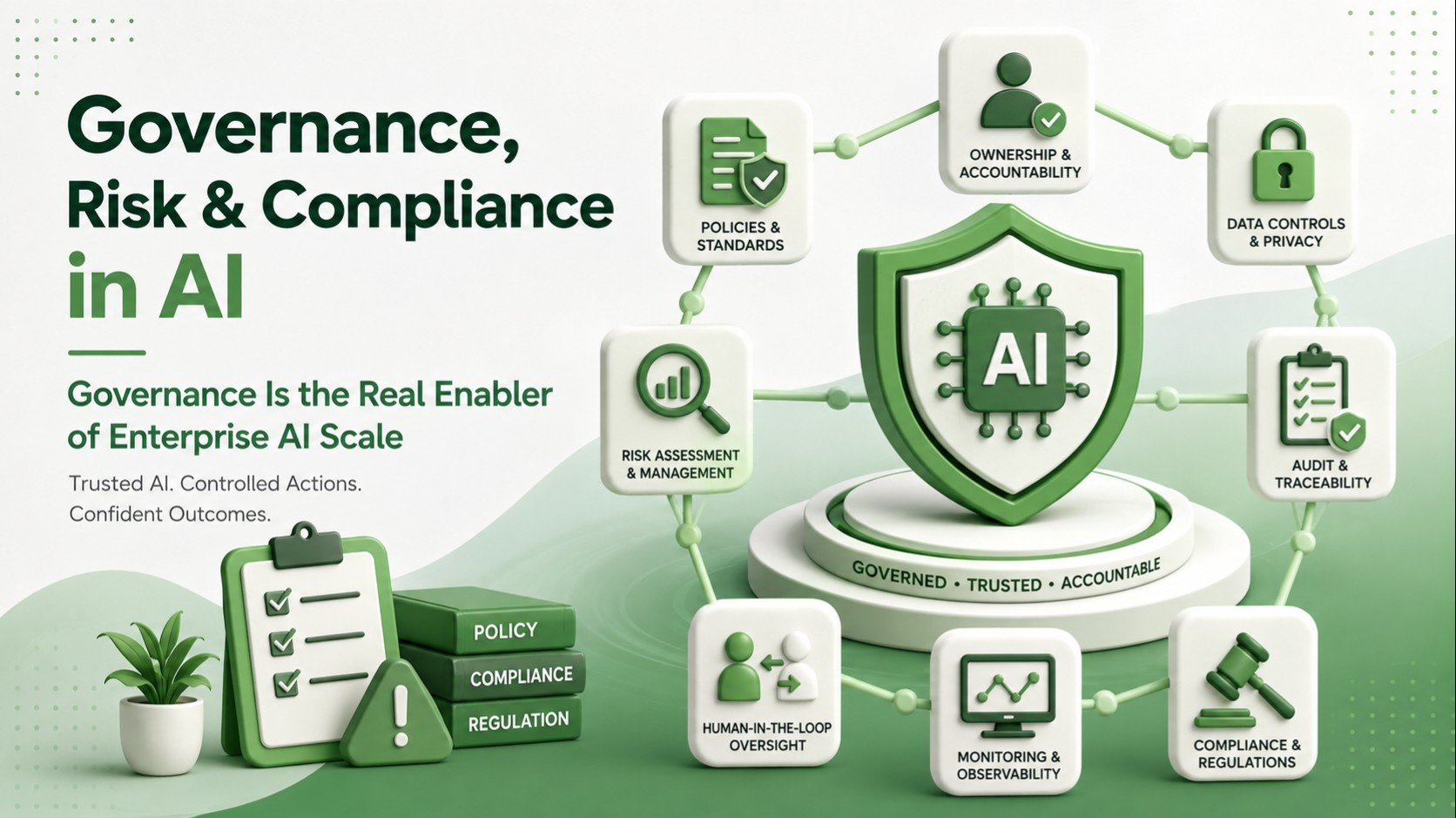
Why Trust Has Become the Core AI Scaling Factor
Enterprises will not widen adoption unless they can verify, govern, and explain what AI is doing. A model can be impressive in a demo and still fail at scale if leaders cannot audit its decisions, control access, monitor drift, or map outputs back to business rules and approved data. Once trust is operationalized through governance, transparency, and reliable controls, AI stops feeling like a risky experiment and starts behaving like infrastructure.
Security-First AI vs Innovation-First Thinking
This is really a debate about sequencing, not ambition. The fastest way to slow innovation is to ignore security until after AI is already embedded in workflows; the smarter approach is to build controls, access rules, monitoring, and governance into the design so teams can move quickly without creating avoidable risk. In practice, security does not have to be the brake on AI adoption - when done well, it becomes the guardrail that makes broader deployment possible.
The Real Risk of Data Leakage in AI-Driven Workflows
Exposure no longer happens only through obvious breaches; it can happen quietly through prompts, outputs, logs, retrieval layers, agents, and third-party integrations. Because AI systems often sit inside everyday work, employees may paste sensitive data into tools that retain, route, or surface it in ways the organization did not intend, creating privacy, IP, and compliance risk that traditional controls were never designed to catch.
Why AI Security Cannot Be Retrofitted After Deployment
The hardest security decisions are baked into the architecture, data flows, and access model long before the system goes live. Once AI is embedded in business workflows, adding controls means reworking integrations, changing user behavior, and revalidating risk — often while the system is already creating exposure. That is why security must be part of the initial design, not a patch applied after value is already at stake.
Building AI Systems That Security Teams Can Approve
AI systems need to be designed for reviewability from day one, not just for functionality. Security teams need to see where data lives, how it flows, who can change what, and how every AI action is logged, monitored, and traceable to a human owner. When architecture, access controls, and audit trails are explicit and defensible, AI stops being a risk black box and starts behaving like an approved part of the enterprise stack.
Zero Trust Principles Applied to Enterprise AI
Zero Trust principles applied to enterprise AI means treating every AI agent, model, and data flow as untrusted by default, then granting access only after explicit verification and under least-privilege constraints. That shifts security from “perimeter + hope” to continuous validation of identity, context, and behavior for every request, every tool call, and every data access across the AI lifecycle.
Why Data Boundaries Are Critical in AI Adoption
AI systems are designed to connect, combine, and infer across every data source they can reach. Without clear limits on what data AI can access, move, and reuse, you quickly create invisible exposure: sensitive information leaks through prompts, summaries, logs, or agent actions, and no one can reliably trace where it went or who can see it.
In practice, boundaries do more than protect privacy; they define what the AI is allowed to influence. If agents can pull from any repository, they may base decisions on unvalidated, deprecated, or test data, creating systematic business risk that is far harder to contain than a single chatbot mistake.
Hidden Security Risks in Everyday AI Usage Across Teams
Everyday AI usage across teams often looks like harmless productivity wins: employees paste internal docs into chatbots, connect unapproved AI tools to calendars and drives, or let copilots summarize sensitive threads without thinking. Each of these actions can quietly expose customer data, IP, or strategy to third-party systems that operate outside enterprise controls, creating compliance, privacy, and regulatory risk that traditional security was never designed to catch. The challenge is that these exposures scale with every user, every day, turning routine AI habits into a distributed, hard-to-detect attack surface.
Why Enterprises Need Controlled AI Execution Environments
AI is moving from giving advice to taking actions inside real systems — and that changes the risk profile entirely. Without an isolated, policy-governed layer between agent intent and real-world execution, organizations cannot reliably enforce who or what AI can access, what operations it can perform, or how those actions are logged and audited. Controlled execution environments turn autonomous AI from an unmanaged liability into a traceable, governable part of the enterprise stack
Trust Architecture as the Foundation for Scalable AI Systems
Trust architecture as the foundation for scalable AI systems means designing identity, governance, and controls into the AI stack, so every model and agent operates on data you trust, within limits you set, under continuous oversight. Without that layer, AI at scale becomes a collection of black boxes that can’t be audited, explained, or reliably governed when regulators, customers, or internal teams ask what happened and why. A clear trust architecture turns AI from an experimental capability into a governed part of the enterprise’s operating model.


